Poets, Flattery, and the Invention of Religious Cults

Coluccio Salutati, de laboribus Herculis 1.13-15

“It is clear then that Plato, and not Athena – the mother of morals and education – decided that poets were to be expelled. Though six other cities claimed for themselves the honor of Homer’s birthplace, Athens itself, the seventh city of Greece, renowned for so many philosophers, glorified by so many citizens, and decorated by so many generals, most strenuously defended its own claim to be the birthplace of one man, who was blind while he lived, because he was a poet. Therefore, let not senseless garrulity condemn poets; first let people learn what poetry is, or what the business of poets is. Then, if they are so inclined, they may reprehend it. For the beginnings of poetic are are believed to have sprung forth from the most eloquent men, who were without doubt the most religious of their time and country. When it came to checking the savagery of those people whom they had raised to the sky more from admiration of their merits and virtues rather than considering anything human, the poets thought it useful that these men be cultivated by religion, and exerted themselves through praising them to persuade the people of this. They offered the most sublime style and the most ornate character of speech to this project, and wishing to excite the popular multitude to admiration of the men whom they praised, they did not employ a plain mode of speech, but changed words for other words and things for other things in the sweetest way, and thus led the listening people away from their senses to such a degree that, forgetting entirely about mortality, they believed with certainty that even those mortals whom they had seen themselves were not dead, but lifted into the heavens for their virtuous merits.”
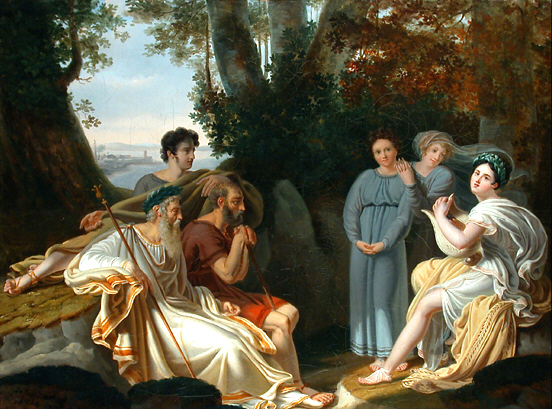
File:Lafond Sappho and Homer.jpg
Charles Lafond, Sappho Sings for Homer

Censuit itaque Plato, non morum et doctrine mater Athene, pellendos esse poetas. Nam cum alie sex civitates ortum sibi vendicarent Homeri, ipse Athene, septima Grecie civitas, tot clara philosophis, tot civibus inclita, totque ducibus exornata, unius ceci dum viveret hominis, quia poeta fuit, nativitatem post eius fata sibi contentiosissime defendebant. Non ergo damnet poetas insensata garrulitas, sed prius addiscant quid poesis quodve poetarum officium, deinde, si videbitur, reprehendant. Nam huius artis initium a viris eloquentissimis atque secundum sua tempora et nationem religiosissimis sine dubio creditur provenisse. Cum enim ad cohibendam feritatem populorum eos quos illi meritorum atque virtutum admiratione plus quam humanum aliquid cogitantes extulerunt in celum, putarent utile religione colendos idque decernentibus populis suaderi ipsorum laudibus insudabant. Cui quidem rei sublimem stilum et ornatissimum dicendi caractherem adhibuerunt et volentes popularem multitudinem in eorum quos laudabant admirationem inducere non plano orationis genere sed verba pro verbis et res pro rebus suavissime commutantes audientes populos a sensibus taliter traducebant quod etiam quos viderant fuisse mortales non mortuos sed translatos in celum pro virtutum meritis mortalitatis illorum obliti certissima opinatione tenerent.

“He Could Probably Stumble Through Homer”

Sir Leslie Stephen: Alexander Pope

“It is needless to say that he never became a scholar in the strict sense of the term. Voltaire declared that he could hardly read or speak a word of French; and his knowledge of Greek would have satisfied Bentley as little as his French satisfied Voltaire. Yet he must have been fairly conversant with the best known French literature of the time, and he could probably stumble through Homer with the help of a crib and a guess at the general meaning. He says himself that at this early period, he went through all the best critics; all the French, English and Latin poems of any name; ‘Homer and some of the greater Greek poets in the original,’ and Tasso and Ariosto in translations.”

How Gift-Giving is Like Getting Drunk: Fronto with Seasonal Advice

Cornelius Fronto, To Appian from Fronto 7

“The person who sends rather weighty gifts causes no less grief than the one who throws the ball too hard to his teammate or offers a big cup to his fellow drinker in toast. For the latter seems to toast not for pleasure but for getting drunk. Just as in wise drinking parties we see that the wine is mixed with a little pure alcohol and a lot of water, so too are gifts mixed best with a lot of thought and a little expenditure.

For who should we say gets the benefit from expensive gifts? Is it the poor? They are not capable of giving them. The rich? They don’t need to get them. In addition, it is not possible to constantly give expensive gifts—there will be a failure of resources if someone should often send out immense gifts. It is possible, however, to give small gifts endlessly and without regret—since someone owes only small thanks to the one who gave a small gift.”

  1. Ὁ δὲ τὰ βαρύτερα δῶρα πέμπων οὐχ ἧττον λυπεῖ τοῦ βαρεῖαν πέμποντος ἐπὶ τὸν συσφαιρίζοντα ἢ μεγάλην κύλην προπίνοντος τῷ συμπότῃ・ εἰς γὰρ μέθην οὐκ εἰς ἡδονὴν προπίνειν ἔοικεν. ὥσπερ δὲ τὸν οἶνον ἐν τοῖς σώφροσιν συμποσίοις ὁρῶμεν κιρνάμενον ἀκράτῳ μὲν πάνυ ὀλίγῳ, πλείστῳ δὲ τῷ ὕδατι, οὕτω δὴ καὶ τὰ δῶρα κιρνάναι προσῆκεν πολλῇ μὲν φιλοφροσύνῃ, ἐλαχίστῳ δὲ ἀναλώματι. τίσιν γὰp ἂν Φαίημεν ἁρμόττειν τὰ πολυτελῆ δῶρα; ἆρά γε τοῖς πένησιν; ἀλλὰ πέμπειν οὐ δύνανται・ ἢ τοῖς πλουσίοις; ἀλλά λαμβάνειν οὐ δέονται. τοῖς μὲν οὖν μεγάλοις δώροις τὸ συνεχὲς οὐ πρόσεστιν, ἢ ἐκπεσεῖν ἀναγκὴ τῶν ὑπαρχόντων, εἴ τις μεγάλα τε πέμποι καὶ πολλάκις. τοῖς δὲ μικροῖς δώροις τό τε συνεχὲς πρόσεστιν καί τὸ ἀμεταγνωστόν, εἰ <καὶ μικρὰ δεῖ τε>λέσαι μικρὰ πέμψαντι.†


Image result for Fronto medieval manuscript
Hermit at work on a manuscript, from the Estoire del Saint Graal, France

December Debates: Should We Accept Gifts from Bad People?

Seneca, De Beneficiis 1.14

“Indeed, I think that we should not look for an advantage from any person whose public esteem is low. Why? Shouldn’t what Claudius offered have been accepted? It should have been, but just as something given by chance which you know might immediately turn bad.

Why do we distinguish between these two instances just combined? A gift is not beneficial when its best part is missing—when it is given because of high esteem. A lot of money, if it is not given rightly or freely, is no more beneficial than a warehouse. There are many gifts which should be accepted but create no obligations.”

Ego vero nullius puto expetendum esse beneficium, cuius vile iudicium est. Quid ergo? Non erat accipiendum a Claudio, quod dabatur? Erat, sed sicut a fortuna, quam scires posse statim malam fieri. Quid ista inter se mixta dividimus? Non est beneficium, cui deest pars optima, datum esse iudicio: alioqui pecunia ingens, si non ratione nec recta voluntate donata est, non magis beneficium est quam thesaurus. Multa sunt autem, quae oportet accipere nec debere.


Image result for Medieval manuscripts gift giving
Bishop Engilmar Celebrating Mass, benedictional, Regensburg, about 1030-40

Imperialism Begins

Justin, Philippic Histories 1.1:

In the beginning of the world, the power of tribes and nations lay with kings, because it was not popular canvassing, but rather temperance observed among the nobles which led to this summit of majesty. The populace was restrained by no laws – the mere whims of princes served in their place. It was the custom to guard the borders of one’s empire rather than to extend them, and one’s kingdom ended within the limits of one’s own country. Ninus, the king of the Assyrians, was the first who, from his novel desire for power, changed this ancient and as it were ancestral custom. He was the first to bring war to his neighbors, and he totally subdued the borderlands, still unable to resist the incursions of other people, all the way to Libya.

There were, to be sure, other more ancient kings like Sesostris of Egypt and Tanaus of Scythia, one of whom progressed to Pontus, and the other to the limits of Egypt. But they were pursuing distant wars, not border conflicts; they were not seeking power for themselves, but glory for their people; and in their restrained victory, they abstained from the temptations of empire. Ninus confirmed the magnitude of the dominion he earned by continued possession. His neighbors having been subdued, when he was strengthened by the accession of new powers to march to other lands and found that each victory became the instrument of the subsequent win, he subjugated all of the peoples of the east. Finally, he had a war with Zoroaster, the king of the Bactrians, who is said to have first discovered the magic arts and to have most diligently observed the origins of the world and the motions of the stars. Once Zoroaster was killed, Ninus too died, leaving behind his still young son Ninyas and his wife Semiramis.

Principio rerum gentium nationumque imperium penes reges erat, quod ad fastigium huius maiestatis non ambitio popularis, sed spectata inter bonos moderatio provehebat. Populus nullis legibus tenebatur, arbitria principum pro legibus erant. Fines imperii tueri magis quam proferre mos erat; intra suam cuique patriam regna finiebantur. Primus omnium Ninus, rex Assyriorum, veterem et quasi avitum gentibus morem nova imperii cupiditate mutavit. Hic primus intulit bella finitimis et rudes adhuc ad resistendum populos terminos usque Libyae perdomuit. Fuere quidem temporibus antiquiores Vezosis [Sesostris] Aegyptius et Scythiae rex Tanaus, quorum alter in Pontum, alter usque Aegyptum excessit. Sed longinqua, non finitima bella gerebant nec imperium sibi, sed populis suis gloriam quaerebant continentique victoria imperio abstinebant. Ninus magnitudinem quaesitae dominationis continua possessione firmavit. Domitis igitur proximis, cum accessione virium fortior ad alios transiret et proxima quaeque victoria instrumentum sequentis esset, totius Orientis populos subegit. Postremum bellum illi fuit cum Zoroastre, rege Bactrianorum, qui primus dicitur artes magicas invenisse et mundi principia siderumque motus diligentissime spectasse. Hoc occiso et ipse decessit, relicto adhuc impubere filio Ninia et uxore Semiramide.

Brevity and Wit: Demetrius on Compression

See earlier posts for Demetrius on the words for punctuation

Demetrius, On Style 9

“This smallest part of a composition is called a phrase [komma]. This often defines a phrase: it is shorter than a clause” [kôlon], as in the previously quoted “Dionysus [is] in Korinth” or “know yourself” or “follow god”, those sayings of the wise men. Brevity is a characteristic of proverbs and maxims and it is cleverer to compress a lot of meaning into a small space, just as seeds have the power of whole trees. If someone works a proverb out at length, it develops into teaching or rhetoric instead of a proverb.”

(9) ἡ δὲ τοιαύτη βραχύτης κατὰ τὴν σύνθεσιν κόμμα ὀνομάζεται. ὁρίζονται δ᾿ αὐτὸ ὧδε, κόμμα ἐστὶν τὸ κώλου ἔλαττον, οἷον τὸ προειρημένον, τὸ [τε] “Διονύσιος ἐν Κορίνθῳ,” καὶ τὸ “γνῶθι σεαυτόν,” καὶ τὸ “ἕπου θεῷ,” τὰ τῶν σοφῶν. ἔστι γὰρ καὶ ἀποφθεγματικὸν ἡ βραχύτης καὶ γνωμολογικόν, καὶ σοφώτερον τὸ ἐν ὀλίγῳ πολλὴν διάνοιαν ἠθροῖσθαι, καθάπερ ἐν τοῖς σπέρμασιν δένδρων ὅλων δυνάμεις· εἰ δ᾿ ἐκτείνοιτό τις τὴν γνώμην ἐν μακροῖς, διδασκαλία γίνεταί τις καὶ ῥητορεία ἀντὶ γνώμης.

Image result for brevity is the soul of wit

Father Neleus Had How Many Sons?

Schol. A ad 11.692a

“There were twelve sons of blameless Neleus. According to the Separatists, Homer records that there were twelve children of Neleus in the Iliad but had three in the Odyssey where he provides the genealogy: “And I saw surpassingly beautiful Khloris” and soon after, “Nestor and Khromios, and proud Periklymenos”. It is likely that the children born before came to him from another woman and these three came from Khloris, for Priamos said, “I had fifty children. When the sons of the Achaeans came / 19 of them were from a single womb / the rest women bore to me in my home.”

δώδεκα γὰρ Νηλῆος <ἀμύμονος υἱέες ἦμεν>: πρὸς τοὺς Χωρίζοντας (fr. 5 K.), ὅτι ἐν μὲν ᾿Ιλιάδι δώδεκα Νηλῆος παῖδας λέγει, ἐν δὲ τῇ ᾿Οδυσσείᾳ τρεῖς γεγονέναι, ὡς γενεαλογεῖ· „καὶ Χλῶριν εἶδον περικαλλέα” (λ 281) καὶ ἐν τοῖς ἑξῆς „Νέστορά τε Χρομίον τε Περικλύμενόν τ’ ἀγέρωχον” (λ 286). ἐνδέχεται δὲ προγεγονότων αὐτῷ ἐξ ἑτέρας γυναικὸς παίδων ὕστερον ἐκ Χλώριδος τοὺς τρεῖς γεγονέναι· καὶ γὰρ ὁ Πρίαμός φησι· „πεντήκοντά μοι ἦσαν, ὅτ’ ἤλυθον υἷες ᾿Αχαιῶν· / ἐννεακαίδεκα μέν μοι ἰῆς ἐκ νηδύος ἦσαν, / τοὺς δ’ ἄλλους μοι ἔτικτον ἐνὶ μεγάροισιν <γυναῖ-κες>”

Image result for neleus and pelias
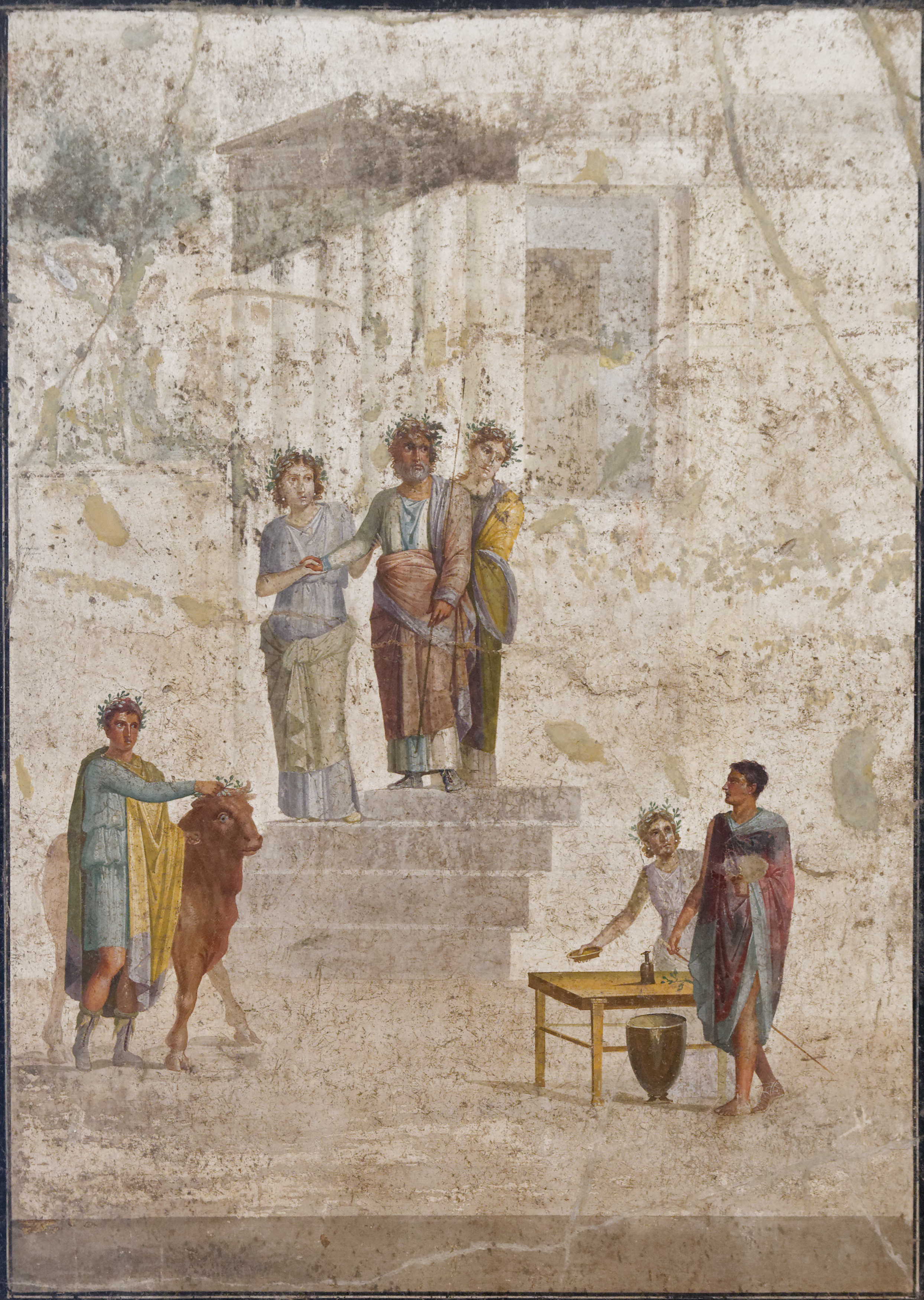
Neleus’ Brother Pelias on a Fresco from Pompeii

Weekend Plans with Alcaeus

Alcaeus, Fr. 38A (P. Oxy. 1233 fr. 1 ii 8–20 + 2166(b)1)

“Drink and get drunk with me, Melanippos.
Why would you say that once you cross the great eddying
River of Acheron you will see the pure light of the sun again?
Come on, don’t hope for great things.

For even the son of Aiolos, Sisyphos used to claim
He was better than death because he knew the most of men.
Even though he was so very wise, he crossed
The eddying river Acheron twice thanks to fate
And Kronos’ son granted that he would have toil
Beneath the dark earth. So don’t hope for these things.

As long as we are young, now is the time we must
Endure whatever of these things the god soon grants us to suffer.”

πῶνε [καὶ μέθυ᾿ ὦ] Μελάνιππ᾿ ἄμ᾿ ἔμοι· τί [φαῖς †
ὄταμε[. . . .]διννάεντ᾿ † Ἀχέροντα μέγ[αν πόρον
ζάβαι[ς ἀ]ελίω κόθαρον φάος [ἄψερον
ὄψεσθ᾿; ἀλλ᾿ ἄγι μὴ μεγάλων ἐπ[ιβάλλεο·
καὶ γὰρ Σίσυφος Αἰολίδαις βασίλευς [ἔφα
ἄνδρων πλεῖστα νοησάμενος [θανάτω κρέτην·
ἀλλὰ καὶ πολύιδρις ἔων ὐπὰ κᾶρι [δὶς
δ̣ιννάεντ᾿ Ἀχέροντ᾿ ἐπέραισε, μ[έμηδε δ᾿ ὦν
αὔτῳ μόχθον ἔχην Κρονίδαις βα [σίλευς κάτω
ελαίνας χθόνος· ἀλλ᾿ ἄγι μὴ τά[δ᾿ ἐπέλπεο·
θᾶς] τ᾿ ἀβάσομεν αἴ ποτα κἄλλοτα ν [ῦν χρέων
φέρ]ην ὄττινα τῶνδε πάθην τά[χα δῷ θέος.

Image result for medieval manuscript acheron
Dante Being rowed across Acheron, 5th c, Yates Thompson MS 36, f. 6r. B.L.

Some of us can’t say this any more…

Small Parts Make A Whole: Writing Advice from Demetrius

For more on Demetrius and our words for period, comma, and colon, see this post

Demetrius, On Style, 1-2

“Just as poetry is separated by meters—such as half-lines, hexameters, and the rest—so too will sections called clauses [kôla] separate and define prose composition. They allow rests to the speaker and what is spoken and they give the composition boundaries in many places, since it would be long and endless and would just exhaust anyone reading it otherwise.

These clauses are really meant to bring an end to a thought. Sometimes they convey a complete thought on their own, as when Hekataios says at the beginning of his History, “Hekataios speaks thus”. In this a case a whole thought coincides with a single clause and both end together. At another time, a clause doesn’t effect a complete thought, but merely part of one.

For, just as the hand is a whole thing but has individual parts of the whole, such as the fingers and the wrist—each of which has its own particular shape and recognizable parts—so too will the parts of a larger thought which is complete and whole be subsumed within it even though they too are recognizable and defined.”

(1) Ὥσπερ ἡ ποίησις διαιρεῖται τοῖς μέτροις, οἷον ἡμιμέτροις ἢ ἑξαμέτροις ἢ τοῖς ἄλλοις, οὕτω καὶ τὴν ἑρμηνείαν τὴν λογικὴν διαιρεῖ καὶ διακρίνει τὰ καλούμενα κῶλα, καθάπερ ἀναπαύοντα τὸν λέγοντά τε καὶ τὰ λεγόμενα αὐτά, καὶ ἐν πολλοῖς ὅροις ὁρίζοντα τὸν λόγον, ἐπεί τοι μακρὸς ἂν εἴη καὶ ἄπειρος καὶ ἀτεχνῶς πνίγων τὸν λέγοντα.

(2) βούλεται μέντοι διάνοιαν ἀπαρτίζειν τὰ κῶλα ταῦτα, ποτὲ μὲν ὅλην διάνοιαν, οἷον ὡς Ἑκαταῖός φησιν ἐν τῇ ἀρχῇ τῆς ἱστορίας, “Ἑκαταῖος Μιλήσιος ὧδε μυθεῖται”· συνείληπται γὰρ διάνοια τῷ κώλῳ ὅλῳ ὅλη, καὶ ἄμφω συγκαταλήγουσιν. ἐνίοτε μέντοι τὸ κῶλον ὅλην μὲν οὐ συμπεραιοῖ διάνοιαν, μέρος δὲ ὅλης ὅλον. ὡς γὰρ τῆς χειρὸς οὔσης ὅλου τινὸς μέρη αὐτῆς ὅλα ὅλης ἐστίν, οἷον δάκτυλοι καὶ πῆχυς (ἰδίαν γὰρ περιγραφὴν ἔχει τούτων τῶν μερῶν ἕκαστον, καὶ ἴδια μέρη), οὕτω καὶ διανοίας τινὸς ὅλης οὔσης μεγάλης ἐμπεριλαμβάνοιτ᾿ ἂν μέρη τινὰ αὐτῆς ὁλόκληρα ὄντα καὶ αὐτά·

Image result for greek bronze hand
From Christie’s Auction Catalogue

Making the Rich Do Right and Helping the Poor

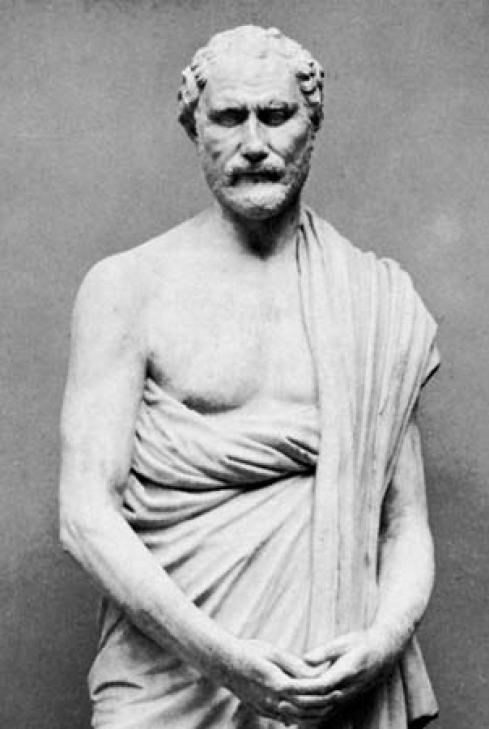
In this beautiful periodic sentence from Demosthenes,  he articulates the importance of leveling off income inequality.

De Corona, 103

“Right now, I want to take you back through the things I did when in power in order. And you, examine them again, anew, for what was best for the state. When I saw, Athenian men, that your navy was in disarray, and that some of the wealthy citizens were essentially untaxed because of the limited expenditures while other citizens of moderate or little wealth were losing what they had, and that the city was falling behind its opportunities because of these circumstances, I made a law through which I forced the wealthy to do what was right and I prevented the poor from suffering injustice—and this was most useful to the city: I ensured that her preparations happened at the necessary time.”

Βούλομαι τοίνυν ἐπανελθεῖν ἐφ’ ἃ τούτων ἑξῆς ἐπολιτευόμην· καὶ σκοπεῖτ’ ἐν τούτοις πάλιν αὖ, τί τὸ τῇ πόλει βέλτιστον ἦν. ὁρῶν γάρ, ὦ ἄνδρες ᾿Αθηναῖοι, τὸ ναυτικὸν ὑμῶν καταλυόμενον καὶ τοὺς μὲν πλουσίους ἀτελεῖς ἀπὸ μικρῶν ἀναλωμάτων γιγνομένους, τοὺς δὲ μέτρι’ ἢ μικρὰ κεκτημένους τῶν πολιτῶν τὰ ὄντ’ ἀπολλύοντας, ἔτι δ’ ὑστερίζουσαν ἐκ τούτων τὴν πόλιν τῶν καιρῶν, ἔθηκα νόμον καθ’ ὃν τοὺς μὲν τὰ δίκαια ποιεῖν ἠνάγκασα, τοὺς πλουσίους, τοὺς δὲ πένητας ἔπαυσ’ ἀδικουμένους, τῇ πόλει δ’ ὅπερ ἦν χρησιμώτατον, ἐν καιρῷ γίγνεσθαι τὰς παρασκευὰς ἐποίησα.

demosthenes