How We Spend Our Days–Do Nothing Rather Than Something Useless

Pliny, Letters 9 To Minucius Fundanus

“It is amazing how the schedule is or seems on individual days in the city when they all blend together. If you ask anyone “what did you do today?” He may say, “I went to a toga-ceremony, an engagement, or a marriage. I was the witness at a will-signing, or at court as a witness or supporter.” These things which you do seem necessary on the day that you do them but empty if you remember that you have done the same kind of things every day and they seem even sillier if you consider them when you are away.

Then the realization comes over you: “How many days have I wasted in trivial pursuits!” This occurs to me whenever I am reading or writing or taking some time to exercise, to keep my mind fit for my work, at my Laurentum. I hear nothing and I say nothing which later on it hurts me that I said or heard. No one troubles me with evil rumors. I find no one to blame but myself when I write with too little ease. I am troubled by no hope, no fear; I am disrupted by no gossip. I speak only with myself and my little books.

What a fine and sincere life! What sweet and honest leisure, finer than nearly any business at all. The sea, the beach, my own true and private museum—how much you discover for me, how much you have told me!

Take the first chance you can to leave that noise, the empty conversation, and so many useless tasks and dedicate yourself to studies or relaxing. For our friend Atilius put it most elegantly and intelligently when he said “it is better to do engage in leisure than to do nothing.”

Plinius Minicio Fundano Suo S.

1Mirum est quam singulis diebus in urbe ratio aut constet aut constare videatur, pluribus iunctisque

Nam si quem interroges “Hodie quid egisti?,” respondeat: “Officio togae virilis interfui, sponsalia aut nuptias frequentavi, ille me ad signandum testamentum, ille in advocationem, ille in 3 consilium rogavit.” Haec quo die feceris, necessaria, eadem, si cotidie fecisse te reputes, inania videntur, multo magis cum secesseris. Tunc enim subit recordatio: “Quot dies quam frigidis rebus absumpsi!” 4 Quod evenit mihi, postquam in Laurentino meo aut lego aliquid aut scribo aut etiam corpori vaco, cuius fulturis animus sustinetur. Nihil audio quod audisse, nihil dico quod dixisse paeniteat; nemo apud me quemquam sinistris sermonibus carpit, neminem ipse reprehendo, nisi tamen me cum parum commode scribo; nulla spe nullo timore sollicitor, nullis rumoribus inquietor: mecum tantum et cum libellis loquor. O rectam sinceramque vitam! O dulce otium honestumque ac paene omni negotio pulchrius! O mare, o litus, verum secretumque μουσεῖον, quam multa invenitis, quam multa dictatis! 7 Proinde tu quoque strepitum istum inanemque discursum et multum ineptos labores, ut primum fuerit occasio, relinque teque studiis vel otio trade. 8 Satius est enim, ut Atilius noster eruditissime simul et facetissime dixit, otiosum esse quam nihil agere. Vale.

Pindar Never Met 2020

Pindar,  Nemean Ode 4.1-8

“The best doctor for sufferings when they’re done
Is celebration—and the Muses’ talented daughters,
Songs to distract when they touch us,
Not even warm water can make limbs as soft
As the praise that takes the lyre as its partner.

An utterance lives longer than deeds,
Any word the tongue chances upon
With the Graces, drawn from a deep mind.”

ἄριστος εὐφροσύνα πόνων κεκριμένων
ἰατρός: αἱ δὲ σοφαὶ
Μοισᾶν θύγατρες ἀοιδαὶ θέλξαν νιν ἁπτόμεναι.
οὐδὲ θερμὸν ὕδωρ τόσον γε μαλθακὰ τέγγει
5γυῖα, τόσσον εὐλογία φόρμιγγι συνάορος.
ῥῆμα δ᾽ ἑργμάτων χρονιώτερον βιοτεύει,
ὅ τι κε σὺν Χαρίτων τύχᾳ
γλῶσσα φρενὸς ἐξέλοι βαθείας.

92-93

“Different generations have different people—
But everyone hopes to claim
That the things they faced were the most exceptional.”

ἄλλοισι δ’ ἅλικες ἄλλοι· τὰ δ’ αὐτὸς ἀντιτύχῃ,
ἔλπεταί τις ἕκαστος ἐξοχώτατα φάσθαι.

File:The Motion Picture - A Win-The-War Factor. Dorothy Gish in "The Greatest Thing in Life", a D. W. Griffith Artcraft pictu - NARA - 533725.tif
File:The Motion Picture – A Win-The-War Factor. Dorothy Gish in “The Greatest Thing in Life”, a D. W. Griffith Artcraft pictu – NARA – 533725.tif 1918 https://commons.wikimedia.org/wiki/File:The_Motion_Picture_-_A_Win-The-War_Factor._Dorothy_Gish_in_%22The_Greatest_Thing_in_Life%22,_a_D._W._Griffith_Artcraft_pictu_-_NARA_-_533725.tif

Nature vs. Nurture in Crops and Kids

Erasmus, Adagia 44:

Ἔτος φέρει, οὐχὶ ἄρουρα,

that is,

The year, not the field, brings forth the grain, a proverbial hemistich which is related in Theophrastus’ eighth book of On Plants:

Πρὸς αὔξησιν δὲ καὶ τροφὴν μέγιστα μὲν ἡ τοῦ ἀέρος κρᾶσις συμβάλλεται καὶ ὅλως ἡ τοῦ ἔτους κατάστασις. Εὐκαίρων γὰρ ὑδάτων καὶ εὐδιῶν καὶ χειμώνων γινομένων ἅπαντα εὔφορα καὶ πολύκαρπα, κἂν ἐν ἁλμώδεσι καὶ λεπτογείοις ᾖ. Διὸ καὶ παροιμιαζόμενοι λέγουσιν οὐκ ἄλλως, ὅτι ἔτος φέρει, οὐχὶ ἄρουρα. Μέγα δὲ καὶ αἱ χῶραι διαφέρουσιν

that is,

For growth and nourishment, much is affected by the temper of the sky and the condition of the year on the whole. For indeed if rains, calm periods, and winters occur at the right time, everything comes forth more happily and more abundantly, even in salty or less fertile fields. Thus, it is not unreasonable when they say proverbially that the year brings forth the crop, not the field. Yet it is of no small account what type of lands they are.

Here I thought it worth nothing that in the printed exemplars I have read οὐ καλῶς, that is, incorrectly, and this itself in my opinion is done οὐ καλῶς, partly because Theodorus of Gaza did not translate incorrectly in this passage, partly because it does not yet square with the real opinion of Theophrastus. For he concedes that it is true that the condition of the sky is of great importance (which is even attested by the proverb), and while not without cause is the entire account of the produce attributed to the weather, yet there is something decisive in the very nature of the soil. Therefore, I suspect that we should read οὐκ ἀλλῶς, that is, not by accident, in place of οὐ καλῶς. Yet I do indeed see that οὐ καλῶς can be defended. It is no wonder that Theophrastus disapproves of that common saying, which attributed everything of moment to the sky, though a great part depends upon the nature of the soil. Yet the previous reading mocks me, and I think that the learned will add their pen to my opinion.

He repeats the same adage in his third book On the Causes of Plants while relating the reason why wheat grows in both cold and hot regions. He hardly denies that the nature of the field contributes something to fertility, but says that the circumambient air has a much greater impact and the temper of the sky and the winds touches upon the matter, as well as what winds the field is exposed to. Plutarch notes in the seventh decade of his Symposiaca, second problem. Further, if I may extend the use of the proverb somewhat, it is not inappropriately accommodated to this thought, if someone says that education has a much greater impact upon virtue than birth does, and it clearly matters little from which ancestors you spring, but by far the most important thing is what methods were used to educate you and what habits you were instilled with. For we can see the sky as “leading up” [educating] what the earth brings forth. Euripides seems to allude to this adage in his Hecuba, whom he makes to speak thus:

Οὔκουν δεινόν, εἰ γῆ μὲν κακὴ

Τυχοῦσα καιροῦ θεόθεν εὔσταχυν φέρει,

Χρηστὴ δ᾽ ἁμαρτοῦσ᾽, ὧν χρεὼν αὐτὴν τυχεῖν,

Κακὸν δίδωσι καρπόν, ἀνθρώποις δ᾽ ἀεὶ

Ὁ μὲν πονηρὸς οὐδὲν ἄλλο πλὴν κακός,

Ὁ δ᾽ ἐσθλὸς ἐσθλός, οὐδὲ συμφορᾶς ὕπο

Φύσιν διέφθειρ᾽, ἀλλὰ χρηστός ἐστ᾽ ἀεί;

Ἆρ᾽ οἱ τεκόντες διαφέρουσιν ἢ τροφαί; |

Ἔχει γέ τοι τι καὶ τὸ θρεφθῆναι καλῶς

Δίδαξιν ἐσθλοῦ,

that is,

It is no miracle if, with the sky’s favor, bad earth bears good fruit. Good land which falls short of what was necessary will give forth bad fruit. But whoever of mortals is bad is unable to be anything but always bad, but the good always good. Does adverse Fortune not spoil the nature of man – does the good man always remain so? Do parents or the educators make the difference?  Indeed, being raised correctly has not a little of education in virtue.

Hecuba seems to attribute more to the mother than to education, and marvels on that account that the same thing does not happen in the character of mortals which occurs in the production of grain. Further, how much more education does than breeding is elegantly demonstrated by Lycurgus. Two dogs were brought before the multitude, of which one was born to a lowly mother but, on account of its education, pursued a beast with something like native ease, while the other dog, born to excellent parents, abandoned the hunt for the beast and stopped at the smell of bread and food because he had not been trained.

Ἔτος φέρει, οὐχὶ ἄρουρα,

id est

 Annus producit segetem, non aruum.

Hemistichion prouerbiale quod refertur a Theophrasto libro De plantis octauo:

Πρὸς αὔξησιν δὲ καὶ τροφὴν μέγιστα μὲν ἡ τοῦ ἀέρος κρᾶσις συμβάλλεται καὶ ὅλως ἡ τοῦ ἔτους κατάστασις. Εὐκαίρων γὰρ ὑδάτων καὶ εὐδιῶν καὶ χειμώνων γινομένων ἅπαντα εὔφορα καὶ πολύκαρπα, κἂν ἐν ἁλμώδεσι καὶ λεπτογείοις ᾖ. Διὸ καὶ παροιμιαζόμενοι λέγουσιν οὐκ ἄλλως, ὅτι ἔτος φέρει, οὐχὶ ἄρουρα. Μέγα δὲ καὶ αἱ χῶραι διαφέρουσιν,

id est

Ad incrementum autem alimentumque plurimum quidem coeli temperies et in totum anni conditio iuuat. Etenim si imbres, serenitates et hyemes accidant opportunae, cuncta felicius atque vberius proueniunt, etiam in salsuginosis ac parum pinguibus agris. Vnde non ab re est, quod prouerbio dicunt annum producere fructum, non aruum. Veruntamen non parui refert, quae sit regionum ratio.

Hic illud obiter admonendum duxi in impressis exemplaribus legi οὐ καλῶς, id est non recte, atque hoc ipsum, vt mea quidem est opinio, οὐ καλῶς, partim quod Theodorus Gaza verterit hoc loco non perperam, partim quod non perinde quadret ad Theophrasti sententiam. Nam is fatetur verum esse plurimum habere momenti coeli conditionem, id quod etiam prouerbio testatum sit, quo non sine causa tota prouentus ratio tribuitur aeri, tamen nonnihil etiam discriminis situm esse in ipso soli ingenio. Proinde legendum suspicor pro οὐ καλῶς, οὐκ ἀλλῶς, id est non temere. Quanquam equidem video et illud οὐ καλῶς vtcunque posse defendi. Nimirum vt Theophrastus improbet vulgare dictum, quod coelo momentum omne tribuit, cum et a soli ratione magna pars pendeat. Mihi tamen superior lectio magis arridet, atque huic meae sententiae doctos calculum suum addituros existimo.

Repetit idem adagium libro De causis plantarum tertio rationem reddens cur in frigidis pariter et calidis regionibus triticum proueniat, haud negans agri naturam nonnihil conferre ad fertilitatem, sed multo maximum momentum habere aerem circumfusum et cuiusmodi coeli ventorumque temperies contingat, tum ad quos flatus oppositus sit ager. Meminit et Plutarchus in Symposiacis decade septima, problemate secundo. Porro si libebit vsum prouerbii dilatare, non intempestiuiter accommodabitur in hanc sententiam, si quis dicat ad virtutem educationem longe plus adferre momenti quam genus, ac plane perparui referre, quibus maioribus sis natus, sed multo maxime quibus rationibus educatus quibusque moribus sis institutus. Nam coelum velut educat quod progignit terra. Ad hoc adagii videtur allusisse Euripides in Hecuba, quam ita loquentem facit:

 Οὔκουν δεινόν, εἰ γῆ μὲν κακὴ

Τυχοῦσα καιροῦ θεόθεν εὔσταχυν φέρει,

Χρηστὴ δ᾽ ἁμαρτοῦσ᾽, ὧν χρεὼν αὐτὴν τυχεῖν,

Κακὸν δίδωσι καρπόν, ἀνθρώποις• δ᾽ ἀεὶ

Ὁ μὲν πονηρὸς οὐδὲν ἄλλο πλὴν κακός,

Ὁ δ᾽ ἐσθλὸς ἐσθλός, οὐδὲ συμφορᾶς ὕπο

Φύσιν διέφθειρ᾽, ἀλλὰ χρηστός ἐστ᾽ ἀεί;

Ἆρ᾽ οἱ τεκόντες διαφέρουσιν ἢ τροφαί; |

Ἔχει γέ τοι τι καὶ τὸ θρεφθῆναι• καλῶς

Δίδαξιν ἐσθλοῦ,

id est

 Non nouum ergo, si mala

Fauente coelo terra fert segetem bonam,

Bona destituta, quibus opus fuerat, malum

Fructum aedit. At mortalium quisquis malus

Nil possit aliud esse quam semper malus,

Frugi vsque frugi. Sors nec ingenium viri

Aduersa vitiat, sed probus semper manet?

Vtrum id parentum an educantium magis?

Recte educari scilicet nonnullam habet

Doctrinam honesti.

Videtur Hecuba plusculum tribuere geniturae quam institutioni miraturque proinde non idem euenire in mortalium moribus, quod in prouentu segetum accidat. Porro quanto plus valeat institutio quam genus, Lycurgus eleganter ostendit prolatis apud multitudinem duobus canibus, quorum alter ingenerosa matre natus, propter institutionem gnauiter feram est insecutus, alter generosis ortus parentibus, quod institutus non esset, turpiter relicta fera ad odorem panis ac cibi restitit.

Looking For A Good Game for Your Holiday Get-Togethers? Try Plutarch’s Questions

Plutarch’s “Table-talk” stands alongside Athenaeus’ Deipnosophists and Petronius Satyricon as presenting a wide variety of fragments and subjects discussed within a somewhat fragile narrative frame. When compared to the other works, Plutarch’s seems to offer even less of an effort to unite the various topics as “Table-talk”. Over nine books, Plutarch presents 90 topics for discussion by a rotating case of characters (often including himself).

Below I have excerpted all of the questions without any of the answers. For a dinner party or get-together with classical or philosophical themes, or just any gathering you might fear will lack good cheer and exciting conversation, I suggest putting each question on a card and distributing them randomly for hilarity.

[PS: if you do this, take notes or record it and share it with the world]

Plutarch Table Talk, [Moralia]

1.1 [612] “Is it right to practice philosophy while drinking?
Εἰ δεῖ φιλοσοφεῖν παρὰ πότον

1.2 [615] “Should the host assign seats to his guests or should they arrange themselves?”
Πότερον αὐτὸν δεῖ κατακλίνειν τοὺς ἑστιωμένους τὸν ὑποδεχόμενον ἢ ἐπ᾿ αὐτοῖς ἐκείνοις ποιεῖσθαι;

1.3 [619] “Why the position called the ‘consul’s’ gained honor?”
Διὰ τί τῶν τόπων ὁ καλούμενος ὑπατικὸς ἔσχε τιμήν

1.4 [620] “What sort of person should be in charge of drinking?”
Ποῖόν τινα δεῖ τὸν συμποσίαρχον εἶναι;

1.5 [622] “Why do people say that “Love teaches the poet”?
Πῶς εἴρηται τὸ “ποιητὴν δ᾿ ἄρα Ἔρως διδάσκει”;

1.6 [623] “On Alexander the Great’s excessive drinking”
Περὶ τῆς Ἀλεξάνδρου πολυποσίας;

Continue reading “Looking For A Good Game for Your Holiday Get-Togethers? Try Plutarch’s Questions”

Hymning the Praises of Women and Men: A Lost Singer in the Odyssey

Homer Odyssey 3. 265-72

“Shining Klytemnestra was resisting the shameful deed
Previously, for she had use of some good advice for her mind.
See, a man was there beside her, a singer whom Agamemnon
Ordered much to safeguard his wife when he went to Troy.
But when the fate of the gods was bound to overcome him,
Then [he*] packed off the singer to some lonely island
And left him there as food and booty for the birds
And he, willingly, took her willing to his own home”

ἡ δ’ ἦ τοι τὸ πρὶν μὲν ἀναίνετο ἔργον ἀεικές,
δῖα Κλυταιμνήστρη· φρεσὶ γὰρ κέχρητ’ ἀγαθῇσι·
πὰρ δ’ ἄρ’ ἔην καὶ ἀοιδὸς ἀνήρ, ᾧ πόλλ’ ἐπέτελλεν
᾿Ατρεΐδης Τροίηνδε κιὼν εἴρυσθαι ἄκοιτιν.
ἀλλ’ ὅτε δή μιν μοῖρα θεῶν ἐπέδησε δαμῆναι,
δὴ τότε τὸν μὲν ἀοιδὸν ἄγων ἐς νῆσον ἐρήμην
κάλλιπεν οἰωνοῖσιν ἕλωρ καὶ κύρμα γενέσθαι,
τὴν δ’ ἐθέλων ἐθέλουσαν ἀνήγαγεν ὅνδε δόμονδε.

*note how carefully the Homeric text leaves the subject of the action in doubt until the final line.

Schol. EM ad Od. 3.267

“In olden days, singers used to hold the position of philosopher, everyone used to consider them wise and they entrusted their kind to them to be educated. When gathering in festivals and to rest for many days, they used to listen to them if any famous or noble deed had happened. So, the singer who was left with Klytemnestra was trying to hinder wicked thoughts from happening by narrating the virtues of men and women. And she was acting prudently as long as that singer was present. Some people say that the singer did not have genitals, wrongly. Some named him Khariades, others call him Demodokos, others Glaukos.”

τὸ ἀρχαῖον οἱ ἀοιδοὶ φιλοσόφου τάξιν ἐπέσχον καὶ πάντες αὐτοῖς προσεῖχον ὡς σοφοῖς, καὶ παιδευθῆναι τούτοις παρεδίδοσαν τοὺς ἀναγκαίους· ἔν τε ταῖς ἑορταῖς ἔν τε ταῖς ἀναπαύσεσιν ἐπὶ πολλὰς ἡμέρας συλλεγόμενοι τούτων ἤκουον εἴ που γέγονεν ἐπιφανὲς ἢ καλὸν ἔργον. καὶ ὁ καταλειφθεὶς οὖν παρὰ τῇ Κλυταιμνήστρᾳ ᾠδὸς πονηρὰς ἐπινοίας ἐγγίνεσθαι ἐκώλυε, διηγούμενος ἀνδρῶν καὶ γυναικῶν ἀρετάς. καὶ ἕως τούτου ἐσωφρόνει ἕως αὐτῇ παρῆν οὗτος. τινὲς ἀοιδὸν τὸν μὴ αἰδοῖα ἔχοντα, κακῶς. τοῦτόν τινες Χαριάδην, οἱ δὲ Δημόδοκον καλοῦσιν, οἱ δὲ Γλαῦκον.

Woodcut illustration of Clytemnestra and Aegisthus murdering Agamemnon and their subsequent deaths at the hand of Orestes
https://commons.wikimedia.org/wiki/File:Woodcut_illustration_of_Clytemnestra_and_Aegisthus_murdering_Agamemnon_and_their_subsequent_deaths_at_the_hand_of_Orestes_-_Penn_Provenance_Project.jpg

Schol MQV 3.267

“A singer was stationed with her too. For in ancient times, singers used to have the position of philosophers. Some people who know things badly report that he was a Eunuch”

συμπαρῆν γὰρ αὐτῇ καὶ ᾠδός. τὸ γὰρ ἀρχαῖον οἱ ᾠδοὶ φιλοσόφων τάξιν ἐπεῖχον. τινὲς δὲ κακῶς νοήσαντες τὸν εὐνοῦχον ἀπέδοσαν.

Schol. M. ad Od. 3.367

“There some people report he was a Eunuch from the alpha privative morios and aidoios for singer, that his genitals were removed.”

ἐνταῦθα δέ τινες ἀοιδὸν τὸν εὐνοῦον νοοῦσιν ἐκ τοῦ α στερητικοῦ μορίου καὶ τοῦ αἰδοίου, τὸν ἐστερη-μένον τῶν αἰδοίων.

Schol P. ad Od. 3.367

“Some say that the singers were tragedians. For the ancients treated these people with honor. And others say that the singer he mentions was a eunuch”

ἀοιδὸς] οἱ μὲν ἀοιδοὺς λέγουσι τοὺς τραγῳδούς. διὰ τιμῆς γὰρ οἱ παλαιοὶ τούτους ἦγον· οἱ δὲ …. φασὶν εἶναι εὐνοῦχον λέγοντα τὸν ἀοιδὸν εἶναι τῆς Κλυταιμνήστρας.

Schol. EHMQR Ad Od. 3.267

“Demetrius of Phalerum has as follows: “Menelaos, when he went with Odysseus to Delphi asked about the expedition which was about to happen against Troy. At that time, in fact, Kreon was running the nine-year contest of the Pythian games. The Spartan Demodokos won, a student of Automedon of Mycenae who was the first who composted the Battle of Amphritryon against the Teleboans and the Conflict of Kithairon and Helikon for whom the mountains in Boiotia are named. He was also a student of Perimedes the Argive who taught the Mycenean Automedes himself along with Likymnios the Bouprasian and Sinis along with Dôrieus, the Laconian Pharides and the Spartan Probolos.

At that time, Menelaos dedicated the expedition for Helen to Athena thanks to forethought. Agamemnon led Demodokos to Mycenae and ordered him to watch over Klytemnestra.

People used to honor singers excessively as teachers of the gods and other ancient acts of good men and they used to delight in the lyre beyond the other instruments. Klytemnestra clearly honored him—she didn’t have him murdered but instead ordered him to be exiled. Timolaus suggest that he was the brother of Phemios who accompanied Penelope to Ithaca to keep a watch over her. He sang for the suitors under compulsion.”

οὕτω Δημήτριος ὁ Φαληρεύς· Μενέλαος ἅμα τῷ ᾿Οδυσσεῖ ἐλθὼν εἰς Δελφοὺς τὸν θεὸν ἤρετο περὶ τῆς μελλούσης ἔσεσθαι εἰς ῎Ιλιον στρατείας. τότε δὴ καὶ τὸν ἐνναετηρικὸν τῶν Πυθίων ἀγῶνα ἀγωνοθετεῖ Κρέων, ἐνίκα δὲ Δημόδοκος Λάκων μαθητὴς Αὐτομήδους τοῦ Μυκηναίου, ὃς ἦν πρῶτος δι’ ἐπῶν γράψας τὴν ᾿Αμφιτρύωνος πρὸς Τηλεβόας μάχην καὶ τὴν ἔριν Κιθαιρῶνός τε καὶ ῾Ελικῶνος, ἀφ’ ὧν δὴ καὶ τὰ ἐν Βοιωτίᾳ ὄρη προσαγορεύεται· ἦν δὲ καὶ αὐτὸς μαθητὴς Περιμήδους ᾿Αργείου, ὃς ἐδίδαξεν αὐτόν τε τὸν Μυκηναῖον Αὐτομήδην, καὶ Λικύμνιον τὸν Βουπράσιον καὶ Σίνιν, καὶ τὸν Δωριέα, καὶ Φαρίδαν τὸν Λάκωνα, καὶ Πρόβολον τὸν Σπαρτιάτην. τότε δὴ Μενέλαος τῇ προνοίᾳ τῆς ῾Ελένης ἀνέθηκεν ὅρμον ᾿Αθηνᾷ. τὸν δὲ Δημόδοκον εἰς Μυκήνας λαβὼν ᾿Αγαμέμνων ἔταξε τὴν Κλυταιμνήστραν τηρεῖν. ἐτίμων δὲ λίαν τοὺς ᾠδοὺς ὡς διδασκάλους τῶν τε θείων καὶ παλαιῶν ἀνδραγαθημάτων, καὶ τῶν ἄλλων ὀργάνων πλέον τὴν λύραν ἠγάπων. δηλοῖ δὲ καὶ Κλυταιμνήστρα τὴν εἰς αὐτὸν τιμήν· οὐ γὰρ φονεύειν, ἀλλ’ ἀφορίζειν αὐτὸν ἐκέλευσε. Τιμόλαος δὲ ἀδελφὸν αὐτόν φησιν εἶναι Φημίου, ὃν ἀκολουθῆσαι τῇ Πηνελόπῃ εἰς ᾿Ιθάκην πρὸς παραφυλακὴν αὐτῆς· διὸ καὶ βίᾳ τοῖς μνηστῆρσιν ᾄδει.

Schol. EQ ad. Od. 3.367

“The music of rhapsodes applied so much to political matters that people report that the city of Sparta used it especially to encourage like-mindedness and preservation of the customs. They also say that once the Pythia, when a disturbance developed, told people to listen a Lesbian song and stop their rivalry.”

τοσοῦτον δὲ καὶ πρὸς τὰ πολιτικὰ διέτεινεν ἡ τῶν κιθαρῳδῶν μουσικὴ ὡς τῶν Σπαρτιατῶν τὴν πόλιν ὠφελεῖσθαι λέγουσιν ὑπὸ τούτων τῶν ἀνδρῶν τὰ μέγιστα καὶ πρὸς ὁμόνοιαν καὶ πρὸς τὴν τῶν νόμων φυλακήν. ὡς καὶ τὴν Πυθὼ, αὐτόθι φυομένης ταραχῆς, εἰπεῖν, τὸν Λέσβιον ᾠδὸν ἀκούειν καὶ παύσασθαι τῆς φιλονεικίας. ὃ καὶ γέγονεν. E.Q.

Even Gods Need Vacations

Cicero Academica (Lucullus) 121

“You deny that anything is possible without god. Look, here Strato from Lampascus interrupts to grant immunity to that god of yours, however big the task. And, since the gods’ priests get a vacation, it is so much fairer that the gods do too!

Anyway, Strato denies that he needs to use divine actions to create the universe: whatever exists—he teaches—comes from natural causes. He does not, however, follow the one who argues that [the world] was put together out of rough and smooth, hook-shaped or crooked atoms separated by void. He believes that these are dreams of Democritus not as he teaches but as he imagines things. Strato himself, as he outlines the components of the universe in order, insists that whatever is or develops emerges from or was made by natural means, through gravity and motion.

Thus he frees the god of great labor and me of fear. For, once they imagine that some deity is worrying about them, who wouldn’t shudder at divine power day and night and, when anything bad happens—for who avoids such things?—wouldn’t fear that it happened because of some negative judgment? Still, I don’t agree with Strato nor, to be honest, with you. Sometimes his idea seems more likely, at other times yours does.”


[121] Negas sine deo posse quicquam: ecce tibi e transverso Lampsacenus Strato, qui det isti deo inmunitatem — magni quidem muneris; sed cum sacerdotes deorum vacationem habeant, quanto est aequius habere ipsos deos —: negat  opera deorum se uti ad fabricandum mundum, quaecumque sint docet omnia effecta esse natura, nec ut ille qui asperis et levibus et hamatis uncinatisque corporibus concreta haec esse dicat interiecto inani: somnia censet haec esse Democriti non docentis sed optantis, ipse autem singulas mundi partes persequens quidquid aut sit aut fiat naturalibus fieri aut factum esse docet ponderibus et motibus. ne ille et deum opere magno liberat et me timore. quis enim potest, cum existimet curari se a deo, non et dies et noctes divinum numen horrere et si quid adversi acciderit, quod cui non accidit, extimescere ne id iure evenerit? nee Stratoni tamen adsentior nec vero tibi; modo hoc modo illud probabilius videtur.’

The Creation of Adam, Michelangelo, Sistine Chapel (Vatican City) https://commons.wikimedia.org/wiki/File:Creaci%C3%B3n_de_Ad%C3%A1n.jpg

Why We Love Drama

Augustine, Confessions 3.2:

“The shows at the theater seized me, full of images of my woes and the tinder for my fire. Why is it that humans wish to grieve there when they watch mournful and tragic things, which they would nevertheless not wish to suffer themselves? And yet, the spectator wishes to suffer from them and the suffering itself is the pleasure. What is this other than extraordinary insanity? For each person is moved by those things more as he is less healthy in regard to such feelings, and although it is called misfortune when he himself suffers them, it is called mercy when he feels sympathy with others. But what kind of mercy is there in fictional and theatrical things? The audience is not called forth to help, but is only invited to suffer, and he favors the actor more in proportion to how much more pain he himself feels. But if those human calamities, whether ancient or invented, are thus presented that the spectator does not grieve, then he will depart despising and criticizing them; but if he is suffering, he will remain fixed in his seat, and will cry as he rejoices.”

rapiebant me spectacula theatrica, plena imaginibus miseriarum mearum et fomitibus ignis mei. quid est quod ibi homo vult dolere cum spectat luctuosa et tragica, quae tamen pati ipse nollet? et tamen pati vult ex eis dolorem spectator et dolor ipse est voluptas eius. quid est nisi mirabilis insania? nam eo magis eis movetur quisque, quo minus a talibus affectibus sanus est, quamquam, cum ipse patitur, miseria, cum aliis compatitur, misericordia dici solet. sed qualis tandem misericordia in rebus fictis et scenicis? non enim ad subveniendum provocatur auditor sed tantum ad dolendum invitatur, et actori earum imaginum amplius favet cum amplius dolet. et si calamitates illae hominum, vel antiquae vel falsae, sic agantur ut qui spectat non doleat, abscedit inde fastidiens et reprehendens; si autem doleat, manet intentus et gaudens lacrimat.

The Dangers of Epitomes and Commonplace Books

Roger Ascham: The Scholemaster

“This is a way of studie, belonging, rather to matter, than to wordes: to memorie, than to vtterance: to those that be learned alreadie, and hath small place at all amonges yong scholers in Grammer scholes. It may proffet priuately some learned men, but it hath hurt generallie learning it selfe, very moch. For by it haue we lost whole Trogus, the best part of T. Liuius, the goodlie Dictionarie of Pompeius festus, a great deale of the Ciuill lawe, and other many notable bookes, for the which cause, I do the more mislike this exercise, both in old and yong.

Epitome, is good priuatelie for himselfe that doth worke it, but ill commonlie for all other that vse other mens labor therein: a silie poore kinde of studie, not vnlike to the doing of those poore folke, which neyther till, nor sowe, nor reape themselues, but gleane by stelth, vpon other mens growndes. Soch, haue emptie barnes, for deare yeares. Grammer scholes haue fewe Epitomes to hurt them, except Epitheta Textoris, and such beggarlie gatheringes, as Horman, whittington, and other like vulgares for making of latines: yea I do wishe, that all rules for yong scholers, were shorter than they be. For without doute, Grammatica it selfe, is sooner and surer learned by examples of good authors, than by the naked rewles of Grammarians. Epitome hurteth more, in the vniuersities and studie of Philosophie: but most of all, in diuinitie it selfe.

In deede bookes of common places be verie necessarie, to induce a man, into an orderlie generall knowledge, how to referre orderlie all that he readeth, ad certa rerum Capita, and not wander in studie. And to that end did P. Lombardus the master of sentences and Ph. Melancthon in our daies, write two notable bookes of common places.

But to dwell in Epitomes and bookes of common places, and not to binde himselfe dailie by orderlie studie, to reade with all diligence, principallie the holyest scripture and withall, the best Doctors, and so to learne to make trewe difference betwixt, the authoritie of the one, and the Counsell of the other, maketh so many seeming, and sonburnt ministers as we haue, whose learning is gotten in a sommer heat, and washed away, with a Christmas snow againe: who neuerthelesse, are lesse to be blamed, than those blind bussardes, who in late yeares, of wilfull maliciousnes, would neyther learne themselues, nor could teach others, any thing at all.”

“We weren’t learning anyway!”


How Joseph Met Mary In the [Apocryphal] Gospel of James

In the apocryphal Gospel of James [also sometimes called the “Infancy” Gospel” or the Protoevangelium of James], Mary’s mother Anna is barren and her father Ioachim retreats to the wilderness. When Anna is blessed with a child, she pledges her to the temple. So, Mary grows up in with the priests in the temple until she is on the cusp of adolescence.

Gospel of James, 8.2-9

7.2 “When [Mary] was twelve years old, the priests held a council where they were saying: “Look, Mary is twelve years old in the Temple of the Lord. What shall we do about her, since we don’t want her to defile the Temple of the Lord when women’s matters come to her.” And they said to the chief-priest: “you, you preside over the sacred place of the god—go there and pray about her and let us do whatever the Lord God reveals to you.

So the priest entered, once he took the twelve-belled cloak, the clothing of a priest, into the Most Holy of Holy Places and he prayed about her. And, look, an angel of the lord appeared, saying to him: “Zacharias, Zacharias, go out and hold an assembly of the people’s widowers and have every man carry a staff. To whomever the lord shows a sign, she will be his wife.” So, the heralds went throughout the land of Judea and the Lord’s trumpet sounded, and every one ran there.

Joseph dropped his sickle and hurried to the assembly too. And when they were all gathered, they approached the priest. The priest took all of their staves, went into the temple and prayed. Once he finished the prayer, he came out and gave each man his staff back. There was no sign upon any of them. But when Joseph received his staff last, look!, a dove came out if it and alighted upon Joseph’s head.

Then the priest said, “It is your fate to take the Lord’s virgin. Take her and keep her as your own.” Joseph responded, “I have two sons and I am an old man; she is a young girl. Should I become a joke among the sons of Israel?” Then the priest said to him, “Joseph, fear the Lord God and the things he did to Datham and Koreh and Abêrôm—how the earth opened in two and they were all drowned inside because of their refusals.You should fear too, now, Joseph, that these things will happen in your house too.” So, because he was afraid, Joseph took her into his own care. And he said to her, “Mary, look, I took you from the Temple of the Lord, My God, and now I will leave you in my home. I am leaving to build some of my buildings. And I will come back to you in turn. May the Lord keep you safe.”

[to be continued…]

2 γενομένης δὲ αὐτῆς δωδεκαετοῦς συμβούλιον ἐγένετο τῶν ἱερέων λεγόντων: ἰδοὺ Μαριὰμ γέγονε δωδεκαέτης ἐν τῷ ναῷ κυρίου: τί οὖν ποιήσωμεν αὐτήν, μήπως (ἐπέλθῃ αὐτῇ τὰ γυναικῶν καὶ) μιάνῃ τὸ ἁγίασμα κυρίου. καὶ εἶπον τῷ ἀρχιερεῖ: σὺ ἕστηκας ἐπὶ τὸ θυσιαστήριον θεοῦ: εἴσελθε καὶ πρόσευξαι περὶ αὐτῆς, καὶ ὅ ἄν φανερώσῃ σοι κύριος ὁ θεός, τοῦτο ποιήσωμεν. 3 καὶ εἰσῆλθεν ὁ ἱερεὺς λαβὼν τὸν δωδεκακόδωνα (ἱεροπρεπὲς ἱμάτιον) εἰς τὰ ἅγια τῶν ἁγίων καὶ ηὔξατο περὶ αὐτῆς. καὶ ἰδοὺ ἄγγελος κυρίου ἐπέστη αὐτῷ λέγων: Ζαχαρία, Ζαχαρία, ἔξελθε καὶ ἐκκλησίασον τοὺς χηρεύοντας τοῦ λαοῦ, καὶ ἐνεγκάτωσαν ἀνὰ ῥάβδον, καὶ εἰς ὅν ἐὰν δείξῃ κύριος ὁ θεὸς σημεῖον, τούτου ἔσται γυνή. καὶ ἐξῆλθον οἱ κήρυκες καθ’ ὅλης τῆς περιχώρου τῆς Ἰουδαίας, καὶ ἤχησεν ἡ σάλπιγξ κυρίου, καὶ ἔδραμον πάντες.

9.1 Ἰωσὴφ δὲ ῥίψας τὸ σκέπαρνον ἔδραμε καὶ αὐτὸς εἰς τὴν συναγωγήν, καὶ συναχθέντες ὁμοῦ ἀπῆλθαν πρὸς τὸν ἱερέα. ἔλαβε δὲ πάντων τὰς ῥάβδους ὁ ἱερεὺς καὶ εἰσῆλθεν εἰς τὸ ἱερὸν καὶ ηὔξατο. τελέσας δὲ τὴν εὐχὴν ἐξῆλθε καὶ ἐπέδωκεν ἑνὶ ἑκάστῳ τὴν ἑαυτοῦ ῥάβδον, καὶ σημεῖον οὐκ ἦν ἐν αὐτοῖς. τὴν δὲ ἐσχάτην ῥάβδον ἔλαβεν ὁ Ἰωσήφ, καὶ ἰδοὺ περιστερὰ ἐξῆλθεν ἐκ τῆς ῥάβδου καὶ ἐπετάσθη ἐπὶ τὴν κεφαλὴν Ἰωσήφ. καὶ εἶπεν αὐτῷ ὁ ἱερεύς: σὺ κεκλήρωσαι τὴν παρθένον κυρίου παραλαβεῖν. παράλαβε αὐτὴν εἰς τήρησιν σεαυτῷ. 2 ἀντεῖπε δὲ Ἰωσὴφ λέγων: υἱοὺς ἔχω καὶ πρεσβύτης εἰμί, αὕτη δὲ νεωτέρα. μήπως κατάγελως γένωμαι τοῖς υἱοῖς Ἰσραήλ; εἶπεν δὲ αὐτῷ ὁ ἱερεύς: Ἰωσήφ, φοβήθητι κύριον τὸν θεὸν καὶ ὅσα ἐποίησε Δαθὰμ καὶ Κορὲ καὶ Ἀβηρών, πῶς ἐδιχάσθη ἡ γῆ καὶ κατεποντίσθησαν ἅπαντες διὰ τὴν ἀντιλογίαν αὐτῶν. καὶ νῦν φοβήθητι, Ἰωσήφ, μήπως ἔσται ταῦτα ἐν τῷ οἴκῳ σου. 3 καὶ φοβηθεὶς Ἰωσὴφ παρέλαβεν αὐτὴν εἰς τήρησιν. καὶ εἶπεν αὐτῇ: Μαρία, ἰδοὺ παρέλαβόν σε ἐκ ναοῦ κυρίου τοῦ θεοῦ μου καὶ νῦν καταλιμπάνω σε ἐν τῷ οἴκῳ μου, ἀπέρχομαι γὰρ οἰκοδομῆσαι τὰς οἰκοδομάς μου, καὶ ἐν τάχει ἥξω πρὸς σέ. κύριος ὁ θεὸς διαφυλάξει σε.

Image result for mary and joseph marrying

Sorry to Scrooge This Up, But Aristotle Did Not Say This Thing about Snowflakes

The following quote has recently been attributed to Aristotle. As anyone who has read even a little bit by Aristotle can attest, this is about as far away from an Aristotelian sentiment as you can get.

Oh, Town and Country magazine, you fell for it. I get it. The quotation sounds kind of cool. It is inspiring in that insipid, soul-numbing way motivational posters start out as ‘neat’ and end up as part of a fevered nightmare.

As recently as 2012, this quotation was attributed anonymous (and this appears frequently). So, this one must have jumped attribution quite recently. Please, contact your local office of common sense and decency and let them know we cannot stand for this.

Here’s a real Aristotle quotation about snow:

Aristotle, Prior Analytics, 12b

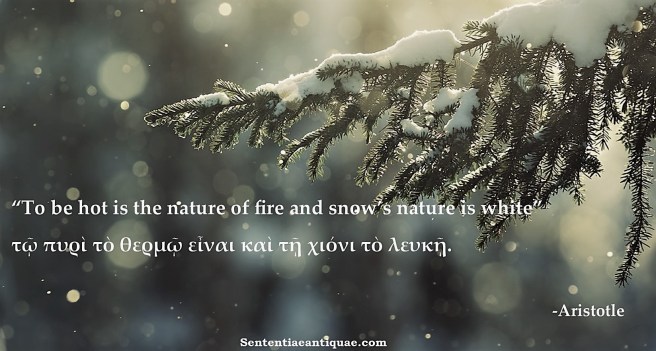
“To be hot is the nature of fire and snow’s nature is white”

τῷ πυρὶ τὸ θερμῷ εἶναι καὶ τῇ χιόνι τὸ λευκῇ.


And here is a Pinterest version for you:

Snow istotle

And because I was bored….

Snowy Mountain