Scars and Time: Trauma and Reading Homer

“…in the tenth year after our father died…”

…..δεκάτῳ ἔτει ὕστερον ἢ ὁ πατὴρ ἡμῶν ἀπέθανεν.

-Demosthenes

In recognition of a decade passing since my father’s death, here is a re-blog of a post I wrote about reading Homer, my father’s death, and the book that followed for Matthew Clark‘s excellent site, The Art of Reading Slowly.

The Greek noun trauma, meaning “wound”, does not appear in Homeric epic where we find more commonly helkos (ἕλκος) or ôteilê (ὠτειλή). Indeed, there is a surprising range of fatal and nonfatal wounding to be found in the Iliad or the Odyssey. Wounds are like almost everything else in Homer: places where stories can be advanced or where they begin. As Erich Auerbach notes in his famous Mimesis, Odysseus’ scar reveals a remarkable connection between memory, metonymy, and poetic art, making the story and the detail powerfully present

But Odysseus’ scar is also about the connection between the past and the present through the memory of pain. The word used to describe it-oulê--is also a possible source for the Roman variant on Odysseus’ name, Ulysses, perhaps meaning the “scarred man”. Odysseus’ scar is a marker of his story and his past, a sign of his identity for his nurse Eurykleia to recognize, and a connection between the boy who earned the “hateful” name Odysseus (folk-etymologized in Homer as “hateful”) and the man who returns home. This wound—this trauma—is part of what makes Odysseus who he is, for better or worse.

And even though the same words are rarely used to describe literal physical wounding and emotional pain in Homer, the idea that the experience of prior suffering stays with us is there. Penelope complains in book 1 of the Odyssey that the story of the failed homecoming of the Achaeans causes her pain and Odysseus repeatedly cries at hearing famous tales of himself arguing with Achilles or deploying the wooden horse. Yet we also hear that stories of past pain can bring some pleasure: Eumaios invites Odysseus (in disguise) to share with him the story of his troubles as they dine and drink. This pleasure comes in part from sharing tales that confirm who the speakers are and in reciting pains that are certainly over.

Pain without resolution, or stories without end? They cause suffering that lingers too. The Odyssey and the Iliad may not use the word ‘trauma’ to describe it, but both seem to have the concept embedded in their structure.

* * *

I have never been shy about my interest in what literature does in (and to) the world. I started my academic career trying to understand how the Iliad engaged with and enforced ideas of politics and rhetoric, how epic poetry explores the use of language to create and destroy communities. This was in no small part influenced by the fact that 9/11 happened in my first week of graduate school at NYU and that I was writing my dissertation prospectus during the many tragic missteps of the war on terror.

In fact, I always considered myself an ‘Iliad’ person, preferring to see that epic as more complex and interesting than the Odyssey. This affinity or alignment made it extra frustrating for me as I repeatedly failed to teach the Iliad well, despite the fact that I taught at the time at the largest veteran serving institution in the country (UTSA) and had students who had grown up and into adulthood around the rhetoric of war.

The Odyssey, however, always resonated with them. I would find myself going through passages and books of the Odyssey with students and reaching that breathless, brain buzzing point where they were saying things about the poem I had never heard and I was framing it in ways I never imagined. There was an energy to their responses that left me wondering about my own tastes.

In January 2011, my father died suddenly at 61 of pneumonia. I talked to him on the phone as he was admitted to the hospital on a Saturday afternoon, chastising him for not taking better care of himself and got a call 10 hours later to tell me he was gone. I don’t think I cried for 6 hours: we had to get on a plane from Texas to Maine; we had to secure release from duty for my wife (who was serving in the Army, stationed at Ft. Hood); we had to figure out what to pack for a funeral for an 8 month old. I broke down when the plane left the ground.

There is no way for me to divide the work I eventually did on the Odyssey from the emotional and ultimately physical shock of my father’s death. Back in the classroom, I would teach about the Lotus-Eaters making the choice to live a life of oblivion, and think of my father. I would make it to the final recognition scene, when Odysseus makes his father Laertes weep and then comforts him by taking him for a tour of their family’s orchards and choke up, finally understanding that the trees they tended together were a metonym for their relationship just as the gardens and lawns my father and I cut out of a pine forest were a record of our time together. And I saw for the first time the rupture of stories left incomplete, how the Ithacans were left without news of their sons and fathers for decades and how that destroyed their community.

I also learned something more deeply that I had suspected all along. A work like the Odyssey changes the more you read it, certainly; but it also is reshaped by your experiences in life. It is a different poem to a young man than it is to a young father. It transformed for me entirely over an 18 month period as my wife and I welcomed our daughter into the world, lost my father, and then 11 months later had a son.

* * *
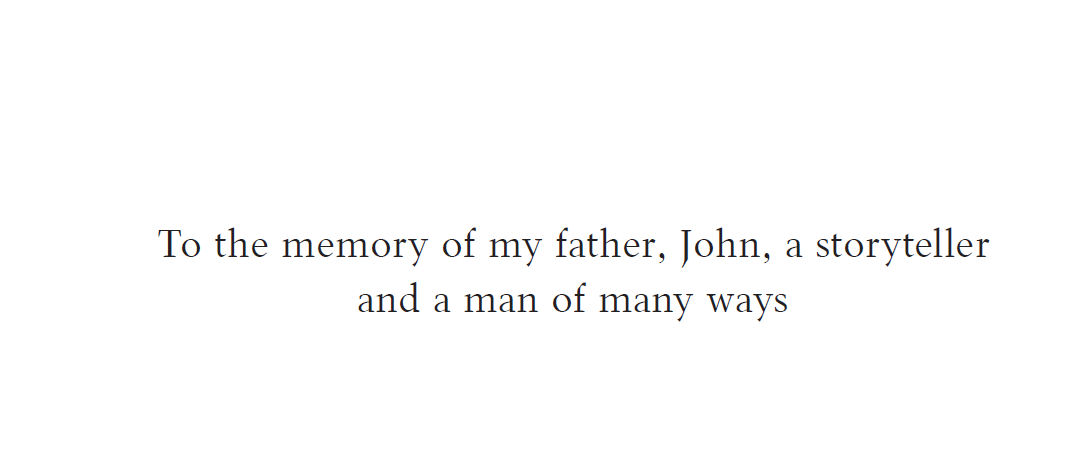
dedication page in the book


During the summer of 2012 or so, I walked into a class where I was teaching the Odyssey after reading a newspaper column that mentioned the idea of Learned Helplessness, the psychological phenomenon whereby people met with failure over time will both attempt tasks less frequently and also demonstrate declining success on those they try. Learned helplessness has been observed in animals and human beings and has been used in part to explain endemic poverty, depression, suicide, chronic illness, and premature death. It can also be triggered by unresolved trauma.

In that class, I told the students about the idea and then asked them to think about Odysseus on the edge of Ogygia, crying every day as someone suffering from the effects of learned helplessness and it was the first time I felt I really understood why he lingered there, without trying to act, mindlessly having sex with the goddess Kalypso every night. Suffering, failure, and repeated trauma can condition people not to try to improve their lives because they believe they will fail anyway.

In following summers and classes, I kept pressing on these ideas, reading through the epic looking for expressions of agency and determination and reflections of other ideas from modern psychology and cognitive science. At the same time, I started reading more from these modern subjects, getting increasingly sure that we underestimated the sophistication of what I came to think of Homeric “folk psychology” or epic’s “theory of mind”, the implicit assumptions about how human minds work in the world (and what happens when they don’t).

During this period I was also starting and expanding the this website, where many of these ideas found early expression. For me, writing and talking about classical literature every day just kind of became an overlapping, cyclical thing: I would teach about something, write about it in a blog post, and then eventually give a talk or publish something about it. That’s how I started publishing about Telemachus and learned helplessness and the structure of the epic, how narrative therapy helps explain the stories Odysseus tells in books 9-12 of the Odyssey, and how the end of the epic echoes different ideas about the human brain and storytelling from cognitive science.

Of course, I wasn’t the first person by any means to talk about Homer in this way. Jonathan Shay demonstrates convincingly in his Achilles in Vietnam and Odysseus in America that the Homeric epics reflect complex psychological experiences. But his approach does what much conventional scholarship on Homer does: it follows the natural emphasis of the text on elite men and ignores the reflections and lives of women and the enslaved. So, a good deal of the book I eventually published—The Many Minded Man—traces both the positive and negative impact narrative can have on human minds. I moved from thinking about how Odysseus uses narrative to regain agency, to how he imposes his will on others and how the epic itself depicts (and even creates) the mental conditions of oppression.

What I thought were the final stages of my work took me back to the people of Ithaca, to consider them not as villains and foils for Odysseus’ return but as a reflection of the majority of people left behind thanks to ‘heroic’ behavior. One of the things I like to emphasize to students is that the mythical term ‘hero’ does not overlap well with our modern usage. Where the modern term has a sense of sacrifice and nobility, the ancient one points to a person from a specific generation who has certain characteristics which include, above all, the capacity to suffer or to cause suffering (as articulated so clearly by Erwin Cook)

Part of what sets Homeric poetry apart is how it gives depth and care to most of its characters: the Odyssey individuates the suitors and allows their families and those of Odysseus’ lost companions to express their grief. In finishing my work on the Odyssey, I tried to see the whole of Ithaka as representing a people traumatized by their experiences, by the uncertainty of their political situation and their losses in war.

* * *

 “Your father is not here, for he died, used up by unfair fates”

nec genitor iuxta; Fatis namque haustus iniquis / occidit

Statius, Silvae 5.64-65

Living into and through 2020 made it hard for me to turn away from Greek epic and myth. Before the beginning of the shutdown here, I wrote about the politics of plagues in Greek myths and I spent my spring worried about the effects of isolation followed by a Fall wondering about the impact of not properly mourning the dead. The US election cycle had me returning to the end of the Odyssey to think about whether opposed sides can ever truly find peace. And since November at least I have been thinking about the long-term effects of paralysis. When finishing my work on the Odyssey, I picked up Robert Scaer’s The Body Bears the Burden to learn more about what happens to the human body and neurobiology from a long term lack of resolution in the fight or flight instinct. As Scaer explains, the prolonged “freeze” moment can cause us physical harm as well as psychological trauma, impeding our learning, altering the way we remember, and changing the way we react to danger. The longer we remain incapable of running away or doing something about our situation, the worse the effects can be.

So I’ve been thinking about Hektor in the Iliad as someone whose behavior might be better understood from this perspective and about how we might think about ourselves and our fellow human beings as peoples besieged by a plague, by anxiety about the future, by hateful racism and harmful politics, and by an inability to understand that the suffering we feel in our minds leaves its scars on our bodies too.

I have a tendency to reduce things at times to just-so stories, a moral to take from the Iliad, a paradigm to follow from the Odyssey. What I have learned at some cost is that living along with epic in my hands and my mind has helped me make sense of the world and my place in it and has helped me be a better ‘reader’ of Homer too.

Pompeo Batoni – Aeneas fleeing from Troy (from Wikimedia Commons)

What Use is a Good Reputation?

Sophocles, Oedipus at Colonus 141

“He is terrible to look at and terrible to hear”

δεινὸς μὲν ὁρᾶν, δεινὸς δὲ κλύειν

258-259

“What use is a good reputation? What good is
Fame flowing off to no end?”

τί δῆτα δόξης, ἢ τί κληδόνος καλῆς
μάτην ῥεούσης ὠφέλημα γίγνεται

852-855

“I know it and you will recognize it in time
That are are neither actly rightly now
Nor did you before, because in your love of your strength
You gave first place to your anger, the very thing that always ruins you.”

χρόνῳ γάρ, οἶδ᾿ ἐγώ, γνώσῃ τάδε,
ὁθούνεκ᾿ αὐτὸς αὐτὸν οὔτε νῦν καλὰ
δρᾷς οὔτε πρόσθεν εἰργάσω, βίᾳ φίλων
ὀργῇ χάριν δούς, ἥ σ᾿ ἀεὶ λυμαίνεται.

954-55

“Old age has nothing of rage except for dying
And no pain touches the dead.”

θυμοῦ γὰρ οὐδὲν γῆράς ἐστιν ἄλλο πλὴν
θανεῖν· θανόντων δ᾿ οὐδὲν ἄλγος ἅπτεται.

 1335-1339

“We are beggars and strangers, but you are a stranger.
You and I both live thanks to the good will of others
Since we have met the same fate.
A tyrant is in our home—it is terrible—
And he laughs as he mocks us in common.”

πτωχοὶ μὲν ἡμεῖς καὶ ξένοι, ξένος δὲ σύ·
ἄλλους δὲ θωπεύοντες οἰκοῦμεν σύ τε
κἀγώ, τὸν αὐτὸν δαίμον᾿ ἐξειληχότες.
ὁ δ᾿ ἐν δόμοις τύραννος, ὢ τάλας ἐγώ,
κοινῇ καθ᾿ ἡμῶν ἐγγελῶν ἁβρύνεται·

By Fulchran-Jean Harriet, “Oedipus at Colonus” 1798. Now in the Cleveland Museum of Art

counterpoint

How We Occupy Our Sorry Days…

Cicero, De Inventione 1.41

“For, in all things, familiarity is the mother of boredom”

nam omnibus in rebus similitudo mater est satietatis.

Sidonius, Letters 2.2.7 to Ecdicus

 “What more? Nothing will be discovered in these places which might be more sacred to examine. Still, only a few little verses will delay a reader a little bit—and these are only slightly inappropriate. Although they leave no desire to read them again, they can be read completely without boredom.”

quid plura? nihil illis paginis impressum reperietur quod non vidisse sit sanctius. pauci tamen versiculi lectorem adventicium remorabuntur minime improbo temperamento, quia eos nec relegisse desiderio est nec perlegisse fastidio.

Jerome, Letters 43.2

“Why do we, animals of the stomach, ever act this way? If a second hour reading falls on us, we yawn and distract our hunger by rubbing our face with our hands and then, as if after hard work, we distract ourselves with worldly duties again. I won’t even mention the meals by which our burdened minds are oppressed.

It is shameful to mention all the visits to say ‘hello’, how we go daily to someone else’s home or we wait for others to come to ours. When they come, we fall to conversation and our absent friends are attacked; others’ lives are detailed, and as we sink our teeth into others we are chewed on in turn. This is the kind of meal that entertains and then dismisses us. Then, when our friends have left, we add up our accounts. Now our anger dons the face of a lion and now silly concerns work out schemes for many years ahead.”

Quid nos, ventris animalia, tale umquam fecimus? Quos si secunda hora legentes invenerit, oscitamus, manu faciem defricantes continemus stomachum et quasi post multum laborem mundialibus rursum negotiis occupamur. Praetermitto prandia, quibus onerata mens premitur. Pudet dicere de frequentia salutandi, qua aut ipsi cotidie ad alios pergimus aut ad nos venientes ceteros expectamus. Deinceps itur in verba, sermo teritur, lacerantur absentes, vita aliena describitur et mordentes invicem consumimur ab invicem. Talis nos cibus et occupat et dimittit. Cum vero amici recesserint, ratiocinia subputamus. Nunc ira personam nobis leonis inponit, nunc cura superflua in annos multos duratura praecogitat

File:Saint Jerome Writing-Caravaggio (1605-6).jpg
Caravaggio, “St. Jerome Writing”

Harmony and Bad Ideas

Plotinus, Ennead 1.6 On beauty

“How can theories be well-measured in respect to one another? If they do in fact agree, there can be agreement and harmony even between bad ideas. The assertion that “prudence is silliness” is in agreement and harmony with the notion that “justice is a noble stupidity”, these ideas agree with one another.

Every kind of virtue is a beauty of the soul and this beauty is truer than those previously mentioned. But how is it well-measured? Not in terms of size or number. Since the soul has many parts, what is the recipe or mixture for minds and their theories? By what notion would the beauty of the mind stand alone?”

Θεωρήματα γὰρ σύμμετρα πρὸς ἄλληλα πῶς ἂν εἴη; Εἰ δ᾿ ὅτι σύμφωνά ἐστι, καὶ κακῶν ἔσται ὁμολογία τε καὶ συμφωνία. Τῷ γὰρ τὴν σωφροσύνην ἠλιθιότητα εἶναι τὸ τὴν δικαιοσύνην γενναίαν εἶναι εὐήθειαν σύμφωνον καὶ συνῳδὸν καὶ ὁμολογεῖ πρὸς ἄλληλα. Κάλλος μὲν οὖν ψυχῆς ἀρετὴ πᾶσα καὶ κάλλος ἀληθινώτερον ἢ τὰ πρόσθεν· ἀλλὰ πῶς σύμμετρα; Οὔτε γὰρ ὡς μεγέθη οὔτε ὡς ἀριθμὸς σύμμετρα· καὶ πλειόνων μερῶν τῆς ψυχῆς ὄντων, ἐν ποίῳ γὰρ λόγῳ ἡ σύνθεσις ἢ ἡ κρᾶσις τῶν μερῶν ἢ τῶν θεωρημάτων; Τὸ δὲ τοῦ νοῦ κάλλος μονουμένου τί ἂν εἴη;

Hell panel from The Garden of Earthly Delights. It is alleged that Bosch’s self-portrait is in the upper centre at right under the “table”.

Poisoned Arrows and an Etymology for Toxic

Aristotle, On Marvellous things heard, 86 [=837a]

“People claim that among the Celts there is a drug which they call the “arrow” [toxikon]. They report that it induces so quick a death that the Celts’ hunters, whenever they have shot a deer or some other animal, rush ahead to cut off its flesh before it is penetrated completely by the drug both for the sake of using the meat and so that the animal might not rot.

They also claim that the oak tree’s bark has been found to be an antidote for the poison. But others claim that there is a leaf which that call “raven’s leaf” because they have seen ravens, once they taste the poison mentioned before and start to feel the drug’s effect, rush to this leaf and stop their suffering by eating it.”

Φασὶ δὲ παρὰ τοῖς Κελτοῖς φάρμακον ὑπάρχειν τὸ καλούμενον ὑπ᾿ αὐτῶν τοξικόν· ὃ λέγουσιν οὕτω ταχεῖαν ποιεῖν τὴν φθορὰν ὥστε τῶν Κελτῶν τοὺς κυνηγοῦντας, ὅταν ἔλαφον ἢ ἄλλο τι ζῷον τοξεύσωσιν, ἐπιτρέχοντας ἐκ σπουδῆς ἐκτέμνειν τῆς σαρκὸς τὸ τετρωμένον πρὸ τοῦ τὸ φάρμακον διαδῦναι, ἅμα μὲν τῆς προσφορᾶς ἕνεκα, ἅμα δὲ ὅπως μὴ σαπῇ τὸ ζῷον. εὑρῆσθαι δὲ τούτῳ λέγουσιν ἀντιφάρμακον τὸν τῆς δρυὸς φλοιόν· οἱ δ᾿ ἕτερόν τι φύλλον, ὃ καλοῦσι κοράκιον διὰ τὸ κατανοηθῆναι ὑπ᾿ αὐτῶν κόρακα, γευσάμενον τοῦ φαρμάκου καὶ κακῶς διατιθέμενον, ἐπὶ τὸ φύλλον ὁρμήσαντα τοῦτο καὶ καταπιόντα παύσασθαι τῆς ἀλγηδόνος.

Toxic Dictionary
OED is missing this etymology

This comes from the Greek nominal root for bow:

toxos

We could also just do this:


“Oh,
The taste of your lips
I’m on a ride
You’re toxic I’m slippin’ under
With a taste of a poison paradise
I’m addicted to you
Don’t you know that you’re toxic?
And I love what you do
Don’t you know that you’re toxic?”

Hard to Beat That Greek Stuff

Robert Browning, Old Pictures in Florence (§11-13)

“If you knew their work you would deal your dole.”
May I take upon me to instruct you?
When Greek Art ran and reached the goal,
Thus much had the world to boast in fructu
The Truth of Man, as by God first spoken,
Which the actual generations garble,
Was re-uttered, and Soul (which Limbs betoken)
And Limbs (Soul informs) made new in marble.

So, you saw yourself as you wished you were,
As you might have been, as you cannot be;
Earth here, rebuked by Olympus there:
And grew content in your poor degree
With your little power, by those statues’ godhead,
And your little scope, by their eyes’ full sway,
And your little grace, by their grace embodied,
And your little date, by their forms that stay.

You would fain be kinglier, say, than I am?
Even so, you will not sit like Theseus.
You would prove a model? The Son of Priam
Has yet the advantage in arms’ and knees’ use.
You’re wroth—can you slay your snake like Apollo?
You’re grieved—still Niobe’s the grander!
You live—there’s the Racers’ frieze to follow:
You die—there’s the dying Alexander.

Dying Alexander in the Uffizi Gallery, Florence – Photo by Yair Haklai

Gambling and Work

Xenophon, Memorabilia 1.2.57

“Socrates, then, would agree that it is useful for a person to be a worker and both harmful and bad for someone to be lazy. Work, then, is a good thing; being lazy is an evil one. He said that work was when people  did something good, but he used to call people who gambled or did any other deceptive or questionable thing lazy. From these ideas, he rightly believed that “work isn’t to be criticized at all, laziness is.”

Σωκράτης δ᾿ ἐπεὶ διομολογήσαιτο τὸ μὲν ἐργάτην εἶναι ὠφέλιμόν τε ἀνθρώπῳ καὶ ἀγαθὸν εἶναι, τὸ δὲ ἀργὸν βλαβερόν τε καὶ κακόν, καὶ τὸ μὲν ἐργάζεσθαι ἀγαθόν, τὸ δ᾿ ἀργεῖν κακόν, τοὺς μὲν ἀγαθόν τι ποιοῦντας ἐργάζεσθαί τε ἔφη καὶ ἐργάτας εἶναι, τοὺς δὲ κυβεύοντας ἤ τι ἄλλο πονηρὸν καὶ ἐπιζήμιον ποιοῦντας ἀργοὺς ἀπεκάλει. ἐκ δὲ τούτων ὀρθῶς ἂν ἔχοι τὸἔργον δ᾿ οὐδὲν ὄνειδος, ἀεργίη δέ τ᾿ ὄνειδος


Herodotus 1.94

“During the reign of Manes’ son, a massive food shortage struck all of Lydia. The Lydians endured this living as they could, but after a while, when it did not stop, they sought cures, and different men devised different solutions. At that time they invented the ideas of dice, and knucklebones, and ball, and every other kind of game except for draughts. For the Lydians do not claim the invention of these games. They invented the games they did for the famine. They played their games on alternate days when they could not seek food and on others they stopped their games and ate. They lived this way for eighteen years.”

᾿Επὶ ῎Ατυος τοῦ Μάνεω βασιλέος σιτοδείην ἰσχυρὴν ἀνὰ τὴν Λυδίην πᾶσαν γενέσθαι· καὶ τοὺς Λυδοὺς τέως μὲν διάγειν λιπαρέοντας, μετὰ δέ, ὡς οὐ παύεσθαι, ἄκεα δίζησθαι, ἄλλον δὲ ἄλλο ἐπιμηχανᾶσθαι αὐτῶν. ᾿Εξευρεθῆναι δὴ ὦν τότε καὶ τῶν κύβων καὶ τῶν ἀστραγάλων καὶ τῆς σφαίρης καὶ τῶν ἀλλέων πασέων παιγνιέων τὰ εἴδεα, πλὴν πεσσῶν· τούτων γὰρ ὦν τὴν ἐξεύρεσιν οὐκ οἰκηιοῦνται Λυδοί. Ποιέειν δὲ ὧδε πρὸς τὸν λιμὸν ἐξευρόντας· · τὴν μὲν ἑτέρην τῶν ἡμερέων παίζειν πᾶσαν, ἵνα δὴ μὴ ζητέοιεν σιτία, τὴν δὲ ἑτέρην σιτέεσθαι παυομένους τῶν παιγνιέων. Τοιούτῳ τρόπῳ διάγειν ἐπ’ ἔτεα δυῶν δέοντα εἴκοσι.

Plutarch, De Tranquilitate Animi 467b

“Plato likened life to a dice-game in which we need both to throw what is advantageous and to use the dice well after we’ve thrown them. And when we are subject to chance, if we take good advice, this is our task: though we cannot control the toss, we can accept the outcome luck gives us properly and allot to each event a place in which what is good for us helps the most and what was unplanned aggrieves the least.”

Κυβείᾳ γὰρ ὁ Πλάτων (Resp. 604c) τὸν βίον ἀπείκασεν, ἐν ᾧ καὶ βάλλειν δεῖ τὰ πρόσφορα, καὶ βαλόντα χρῆσθαι καλῶς τοῖς πεσοῦσι. τούτων δὲ τὸ μὲν βάλλειν οὐκ ἐφ’ ἡμῖν, τὸ δὲ προσηκόντως δέχεσθαι τὰ γινόμενα παρὰ τῆς τύχης καὶ νέμειν ἑκάστῳ τόπον, ἐν ᾧ καὶ τὸ οἰκεῖον ὠφελήσει μάλιστα καὶ τὸ ἀβούλητον ἥκιστα λυπήσει τοὺς ἐπιτυγχάνοντας, ἡμέτερον ἔργον ἐστίν, ἂν εὖ φρονῶμεν.

And here is the passage Plutarch is drawing on from the tenth book of the Republic (Plato, Republic 604c-d)

“The best way to deliberate about what has happened is just as we might in the fall of dice: to order our affairs in reference to how the dice have fallen where reason dictates the best place would be, and not to stumble forward like children shocked at the outcome wasting time with crying. Instead, we should always prepare our mind towards addressing what has happened as quickly as possible and to redress what has fallen and what ails, erasing lament [lit. threnody] with treatment*.”

Τῷ βουλεύεσθαι, ἦν δ’ ἐγώ, περὶ τὸ γεγονὸς καὶ ὥσπερ ἐν πτώσει κύβων πρὸς τὰ πεπτωκότα τίθεσθαι τὰ αὑτοῦ πράγματα, ὅπῃ ὁ λόγος αἱρεῖ βέλτιστ’ ἂν ἔχειν, ἀλλὰ μὴ προσπταίσαντας καθάπερ παῖδας ἐχομένους τοῦ πληγέντος ἐν τῷ βοᾶν διατρίβειν, ἀλλ’ ἀεὶ ἐθίζειν τὴν ψυχὴν ὅτι τάχιστα γίγνεσθαι πρὸς τὸ ἰᾶσθαί τε καὶ ἐπανορθοῦν τὸ πεσόν τε καὶ νοσῆσαν, ἰατρικῇ θρηνῳδίαν ἀφανίζοντα.

Diogenes Laertius, Pythagoras 8.3

“Sôsikrates, in his Successions, says that when Pythagoras was asked by Leon, the tyrant of the Phliasians, who he was, he said, “a philosopher,” and that he said life was like the Great Games. Some people go there to compete, others go to make money, and the best people go to watch. For in life, some people have a slavish nature and they hunt for glory or profit, while philosophers search for the truth.”

Σωσικράτης δ᾿ ἐν Διαδοχαῖς φησιν αὐτὸν ἐρωτηθέντα ὑπὸ Λέοντος τοῦ Φλιασίων τυράννου τίς εἴη, φιλόσοφος, εἰπεῖν. καὶ τὸν βίον ἐοικέναι πανηγύρει· ὡς οὖν εἰς ταύτην οἱ μὲν ἀγωνιούμενοι, οἱ δὲ κατ᾿ ἐμπορίαν, οἱ δέ γε βέλτιστοι ἔρχονται θεαταί, οὕτως ἐν τῷ βίῳ οἱ μὲν ἀνδραποδώδεις, ἔφη, φύονται δόξης καὶ πλεονεξίας θηραταί, οἱ δὲ φιλόσοφοι τῆς ἀληθείας.


Pope’s Iliad: A Tickellish Subject

Samuel Johnson, Lives of the Poets: Tickell

The poetical incident of most importance in Tickell’s life was his publication of the first book of the “Iliad,” as translated by himself, an apparent opposition to Pope’s “Homer,” of which the first part made its entrance into the world at the same time.  Addison declared that the rival versions were both good, but that Tickell’s was the best that ever was made; and with Addison, the wits, his adherents and followers, were certain to concur.  Pope does not appear to have been much dismayed, “for,” says he, “I have the town—that is, the mob—on my side.”  But he remarks “that it is common for the smaller party to make up in diligence what they want in numbers.  He appeals to the people as his proper judges, and if they are not inclined to condemn him, he is in little care about the highflyers at Button’s.”

Pope did not long think Addison an impartial judge, for he considered him as the writer of Tickell’s version.  The reasons for his suspicion I will literally transcribe from Mr. Spence’s Collection:—

“There had been a coldness,” said Mr. Pope, “between Mr. Addison and me for some time, and we had not been in company together, for a good while, anywhere but at Button’s Coffee House, where I used to see him almost every day.  On his meeting me there, one day in particular, he took me aside and said he should be glad to dine with me at such a tavern, if I stayed till those people were gone (Budgell and Philips).  He went accordingly, and after dinner Mr. Addison said ‘that he had wanted for some time to talk with me: that his friend Tickell had formerly, whilst at Oxford, translated the first book of the Iliad; that he designed to print it, and had desired him to look it over; that he must therefore beg that I would not desire him to look over my first book, because, if he did, it would have the air of double-dealing.’  I assured him that I did not at all take it ill of Mr. Tickell that he was going to publish his translation; that he certainly had as much right to translate any author as myself; and that publishing both was entering on a fair stage.  I then added that I would not desire him to look over my first book of the Iliad, because he had looked over Mr. Tickell’s, but could wish to have the benefit of his observations on my second, which I had then finished, and which Mr. Tickell had not touched upon.  Accordingly I sent him the second book the next morning, and Mr. Addison a few days after returned it, with very high commendations.  Soon after it was generally known that Mr. Tickell was publishing the first book of the Iliad, I met Dr. Young in the street, and upon our falling into that subject, the doctor expressed a great deal of surprise at Tickell’s having had such a translation so long by him.  He said that it was inconceivable to him, and that there must be some mistake in the matter; that each used to communicate to the other whatever verses they wrote, even to the least things; that Tickell could not have been busied in so long a work there without his knowing something of the matter; and that he had never heard a single word of it till on this occasion.  This surprise of Dr. Young, together with what Steele has said against Tickell in relation to this affair, make it highly probable that there was some underhand dealing in that business; and indeed Tickell himself, who is a very fair worthy man, has since, in a manner, as good as owned it to me.  When it was introduced into a conversation between Mr. Tickell and Mr. Pope by a third person, Tickell did not deny it, which, considering his honour and zeal for his departed friend, was the same as owning it.”

Upon these suspicions, with which Dr. Warburton hints that other circumstances concurred, Pope always in his “Art of Sinking” quotes this book as the work of Addison.

To compare the two translations would be tedious; the palm is now given universally to Pope, but I think the first lines of Tickell’s were rather to be preferred; and Pope seems to have since borrowed something from them in the correction of his own.

Political Change as Seen from the Other Side

Theognis 667-682

If I had my possessions, Simonides,
It would not distress me, as it now does, to consort with the well-born.
But at the moment my possessions recognize me but pass me by.
I’m speechless with need.
Still, I understand better than many that right now we’re being carried along
With the white sails lowered, from the sea of Melos through the murky night,
And a crew unwilling to bail water as the sea pitches over both sides of the ship.
Someone is rescued with great difficulty, behaving as they are.
They’ve deposed the good pilot who skillfully kept watch.
They carry off cargo by force, discipline is destroyed,
And the division of things no longer happens equally, fairly.
Deckhands are in charge, the vulgar are above the well-born.
I’m afraid that perhaps a wave will in a way swallow the ship.
Let these things, concealed by me, be cryptically told to the well-born–
But even someone vulgar could understand, if he’s subtle.

εἰ μὲν χρήματ᾽ ἔχοιμι, Σιμωνίδη, οἷά περ ἤδη,
οὐκ ἂν ἀνιῴμην τοῖς ἀγαθοῖσι συνών.
νῦν δέ με γινώσκοντα παρέρχεται, εἰμὶ δ᾽ ἄφωνος
χρημοσύνῃ, πολλῶν γνοὺς ἂν ἄμεινον ἔτι,
οὕνεκα νῦν φερόμεσθα καθ᾽ ἱστία λευκὰ βαλόντες,
Μηλίου ἐκ πόντου νύκτα διὰ δνοφερήν,
ἀντλεῖν δ᾽ οὐκ ἐθέλουσιν, ὑπερβάλλει δὲ θάλασσα
ἀμφοτέρων τοίχων. ἦ μάλα τις χαλεπῶς
σῴζεται, οἷ᾽ ἔρδουσι· κυβερνήτην μὲν ἔπαυσαν
ἐσθλόν, ὅτις φυλακὴν εἶχεν ἐπισταμένως·
χρήματα δ᾽ ἁρπάζουσι βίη, κόσμος δ᾽ ἀπόλωλεν,
δασμὸς δ᾽ οὐκέτ᾽ ἴσος γίνεται ἐς τὸ μέσον·
φορτηγοὶ δ᾽ ἄρχουσι, κακοὶ δ᾽ ἀγαθῶν καθύπερθεν.
δειμαίνω μή πως ναῦν κατὰ κῦμα πίῃ.
ταῦτά μοι ᾐνίχθω κεκρυμμένα τοῖς ἀγαθοῖσιν.
γινώσκοι δ᾽ ἄν τις καὶ κακός ἂν σοφὸς ᾖ.

Larry Benn has a B.A. in English Literature from Harvard College, an M.Phil in English Literature from Oxford University, and a J.D. from Yale Law School. Making amends for a working life misspent in finance, he’s now a hobbyist in ancient languages and blogs at featsofgreek.blogspot.com.

Certainty, Hope, and Cures for Disease

Hippocrates of Cos, Nature of Man 13

“However many diseases develop quickly and whose causes are well-known turn out to be those whose progression can be foretold most certainly. The patient needs to provide their own cure by taking action against the cause of the disease. This is the way to remove what exposes the body to disease.”

Ὅσα τῶν νοσημάτων ἐξ ὀλίγου γίνεται, καὶ ὅσων αἱ προφάσιες εὔγνωστοι, ταῦτα δὲ ἀσφαλέστατά ἐστι προαγορεύεσθαι· τὴν δὲ ἴησιν χρὴ ποιεῖσθαι αὐτὸν ἐναντιούμενον τῇ προφάσει τῆς νούσου· οὕτω γὰρ ἂν λύοιτο τὸ τὴν νοῦσον παρασχὸν ἐν τῷ σώματι.


Cicero, De Senectute 69

“But the young person hopes to live for a long time, a very hope which the old person cannot hold. They hope unwisely for what is more foolish than to take uncertainty for certainty and falsehood for truth. They claim also that the old person has nothing to hope for. But the elderly are in a better place than the young because the young merely hope for what the elderly have obtained and the one wishes to live long, while the other has already done so.”

At sperat adulescens diu se victurum, quod sperare idem senex non potest. Insipienter sperat; quid enim stultius quam incerta pro certis habere, falsa pro veris? At senex ne quod speret quidem habet. At est eo meliore condicione quam adulescens, quoniam id quod ille sperat hic consecutus est: ille volt diu vivere, hic diu vixit.

Edinburgh. St. Cuthbert’s Churchyard. Grave of James Bailie.