Pitiless Force a Pitiful Possession

Simone Weil, The Iliad, or the Poem of Force (trans. Mary McCarthy):

Force is as pitiless to the man who possesses it, or thinks he does, as it is to its victims; the second it crushes, the first it intoxicates. The truth is, nobody really possesses it. The human race is not divided up, in the Iliad, into conquered persons, slaves, suppliants, on the one hand, and conquerors and chiefs on the other. In this poem there is not a single man who does not at one time or another have to bow his neck to force. The common soldier in the Iliad is free and has the right to bear arms; nevertheless he is subject to the indignity of orders and abuse:

But whenever he came upon a commoner shouting out,

he struck him with his scepter and spoke sharply:

“Good for nothing! Be still and listen to your betters.

You are weak and cowardly and unwarlike,

You count for nothing, neither in battle nor in council.”

Thersites pays dear for the perfectly reasonable comments he makes, comments not at all different, moreover, from those made by Achilles:

He hit him with his scepter on back and shoulders,

so that he doubled over, and a great tear welled up,

And a bloody welt appeared on his back

Under the golden scepter. Frightened, he sat down,

Wiping away his tears, bewildered and in pain.

Troubled though they were, the others laughed long at him.

Achilles himself, that proud hero, the undefeated, is shown us at the outset of the poem, weeping with humiliation and helpless grief – the woman he wanted for his bride has been taken from under his nose, and he has not dared to oppose it:

. . . But Achilles

Weeping, sat apart from his companions,

By the white-capped waves, staring over the boundless ocean.

What has happened is that Agamemnon has deliberately humiliated Achilles, to show that he himself is the master:

… So you will learn

That I am greater than you, and anyone else will hesitate

To treat me as an equal and set himself against me.

But a few days pass and now the supreme commander is weeping in his turn. He must humble himself, he must plead, and have, moreover, the added misery of doing it all in vain.

In the same way, there is not a single one of the combatants who is spared the shameful experience of fear. The heroes quake like everybody else. It only needs a challenge from Hector to throw the whole Greek force into consternation – except for Achilles and his men, and they did not happen to be present.

A Comic’s Lament: Tragedy is So Easy

From Athenaeus, Deipnosophists 6.222c-e

“Since, friend Timocrates, you are always asking about the things said among the learned dinnermates, because you think that I am making up crazy things, let me remind you of what Antiphanes says in his play Poetry, in this way:

Tragedy is the luckiest art form
of all. First, the stories
Are already known by the audience
Before anyone even speaks—the poet only needs
To remind: “Oedipus I say…”
And they know the rest: father Laios,
mother Iocasta, some daughters, some sons,
what he will suffer, and what he has. And, again,
If someone says “Alkmaeon”, he’s just as good
as mentioned all his kids and that
he went crazy and killed his mother, and that
Adrastus will get angry and return.
Then when they can’t say anything else
And they have fallen down in exhaustion
they raise up their crane like little finger
and they have a happy audience!
But it isn’t like that for us, we a have to make up
everything, new names and….
then the events that happened
previously, currently, and at the end,
As well as an introduction!
If some Chremes or Pheidon
Misses even one of these things
They boo and hiss him off the stage.
But you can get away with this with Peleus and Teucer.”

᾿Επειδὴ ἀπαιτεῖς συνεχῶς ἀπαντῶν, ἑταῖρε Τιμόκρατες, τὰ παρὰ τοῖς δειπνοσοφισταῖς λεγόμενα, καινά τινα νομίζων ἡμᾶς εὑρίσκειν, ὑπομνήσομέν σε τὰ παρὰ ᾿Αντιφάνει λεγόμενα ἐν Ποιήσει (II 90 K) τόνδε τὸν τρόπον·

μακάριόν ἐστιν ἡ τραγῳδία
ποίημα κατὰ πάντ’, εἴ γε πρῶτον οἱ λόγοι
ὑπὸ τῶν θεατῶν εἰσιν ἐγνωρισμένοι,
πρὶν καί τιν’ εἰπεῖν· ὥσθ’ ὑπομνῆσαι μόνον
δεῖ τὸν ποιητήν. Οἰδίπουν γὰρ φῶ ……
τὰ δ’ ἄλλα πάντ’ ἴσασιν· ὁ πατὴρ Λάιος,
μήτηρ ᾿Ιοκάστη, θυγατέρες, παῖδες τίνες,
τί πείσεθ’ οὗτος, τί πεποίηκεν. ἂν πάλιν
εἴπῃ τις ᾿Αλκμέωνα, καὶ τὰ παιδία
πάντ’ εὐθὺς εἴρηχ’, ὅτι μανεὶς ἀπέκτονε
τὴν μητέρ’, ἀγανακτῶν δ’ ῎Αδραστος εὐθέως
ἥξει πάλιν τ’ ἄπεισι …………..
ἔπειθ’ ὅταν μηθὲν δύνωντ’ εἰπεῖν ἔτι,
κομιδῇ δ’ ἀπειρήκωσιν ἐν τοῖς δράμασιν,
αἴρουσιν ὥσπερ δάκτυλον τὴν μηχανήν,
καὶ τοῖς θεωμένοισιν ἀποχρώντως ἔχει.
ἡμῖν δὲ ταῦτ’ οὐκ ἔστιν, ἀλλὰ πάντα δεῖ
εὑρεῖν, ὀνόματα καινά, …………
………… κἄπειτα τὰ διῳκημένα
πρότερον, τὰ νῦν παρόντα, τὴν καταστροφήν,
τὴν εἰσβολήν. ἂν ἕν τι τούτων παραλίπῃ
Χρέμης τις ἢ Φείδων τις, ἐκσυρίττεται·
Πηλεῖ δὲ ταῦτ’ ἔξεστι καὶ Τεύκρῳ ποιεῖν.

Strength Not Absolute

Simone Weil, The Iliad, or the Poem of Force (trans. Mary MacCarthy):

Perhaps all men, by the very act of being born, are destined to suffer violence; yet this is a truth to which circumstance shuts men’s eyes. The strong are, as a matter of fact, never absolutely strong, nor are the weak absolutely weak, but neither is aware of this. They have in common a refusal to believe that they both belong to the same species: the weak see no relation between themselves and the strong, and vice versa. The man who is the possessor of force seems to walk through a non-resistant element; in the human substance that surrounds him nothing has the power to interpose, between the impulse and the act, the tiny interval that is reflection. Where there is no room for reflection, there is none either for justice or prudence. Hence we see men in arms behaving harshly and madly. We see their sword bury itself in the breast of a disarmed enemy who is in the very act of pleading at their knees. We see them triumph over a dying man by describing to him the outrages his corpse will endure. We see Achilles cut the throats of twelve Trojan boys on the funeral pyre of Patroclus as naturally as we cut flowers for a grave.

These men, wielding power, have no suspicion of the fact that the consequences of their deeds will at length come home to them – they too will bow the neck in their turn. If you can make an old man fall silent, tremble, obey, with a single word of your own, why should it occur to you that the curses of this old man, who is after all a priest, will have their own importance in the gods’ eyes? Why should you refrain from taking Achilles’ girl away from him if you know that neither he nor she can do anything but obey you? Achilles rejoices over the sight of the Greeks fleeing in misery and confusion. What could possibly suggest to him that this rout, which will last exactly as long as he wants it to and end when his mood indicates it, that this very rout will be the cause of his friend’s death, and, for that matter, of his own? Thus it happens that those who have force on loan from fate count on it too much and are destroyed.

Drinking Etiquette For the Impeachment Blues

Anacreon Fr. 2

I don’t care for the man
who talks about strife,
and about fights that make you cry,
while he’s drinking his wine
right by the full mixing bowl.
instead, give me the man
who mixes the splendid gifts
of Aphrodite with those of the Muses
and reminisces about darling good times.

Phocylides Fr. 11

it’s only right that when men get together to drink and talk,
and the wine cups are going around,
you sit there peaceably and drink your wine,
and you make small talk, pleasantly.

Anacreon 2:

οὐ φιλέω, ὃς κρητῆρι παρὰ πλέωι οἰνοποτάζων
νείκεα καὶ πόλεμον δακρυόεντα λέγει,
‘aλλ’ ὅστις Μουσέων τε καὶ ἀγλαὰ δῶρ᾽ ᾽Αφροδίτης
συμμίσγων ἐρατῆς μνήσκεται εὐφροσύνης.

Phocylides Fr.11:

χρὴ δ᾽ ἐν συμποσίῳ κυλίκων περινισομενάων
ἡδέα κωτίλλοντα καθήμενον οἰνοποτάζειν.

Larry Benn has a B.A. in English Literature from Harvard College, an M.Phil in English Literature from Oxford University, and a J.D. from Yale Law School. Making amends for a working life misspent in finance, he’s now a hobbyist in ancient languages and blogs at featsofgreek.blogspot.com.

Love = Death

Jacopo Sannazzaro, Epigrams 2.56
(To His Own Soul)
“You burned, and the flame consumed your wretched marrow –
your desiccated bones dissolved into tenuous ash.
You wept, and your eyes poured forth a perennial dew;
Sebeto himself grew from your tears.
Why this unbridled desire for burning and crying?
O, my soul, you should learn to fear your funeral,
and not to go on seeking over and over for your destruction, your death.
Be happy that you have made it past the Sirens’ rocks.”
Image result for jacopo sannazzaro
Titian, Portrait of Jacopo Sannazzaro
Arsisti; et miseras consumsit flamma medullas;
Aridaque in cineres ossa abïere leves:
Flevisti; roremque oculi fudere perennem;
Sebethus lacrimis crevit et ipse tuis:
Ardendi, fledique igitur quae tanta cupido est?
O anime, exsequias disce timere tuas;
Neve iterum tua damna, iterum tua funera quaeras:
Sirenum scopulos praeteriisse juvet.

Love & Poetics & Immortality: Some Propertian Reflections

Propertius 3.1:

“Spirits of Callimachus, holy remains of Philitas –
please, let me enter into your grove.
I first, a priest from the pure fount,
set out to carry the Greek dances through Italic revelry.
Tell me, in what cave did you tighten up your poems,
or with what foot did you begin? What water did you drink?
Damn everyone who delays Apollo in war!
Let the verse go once it has been perfected with a slender eraser –
the verse by which Fame lifts me aloft from the earth,
and by which the Muse triumphs with crowned horses,
where little Cupids are coveyed with me in a chariot,
and a crowd of authors follows my wheels.
Why do you give the reins and vie with me in vain?
A wide road is not given for running to the Muses.
O Rome, many may add your praises to their Annals
and sing of Bactria as the future limit of our empire.
But this work, which you read in peace, was born down
from the Muses’ mountain on an untouched road by our page.
Daughters of Pegasus, give the soft crowns to your poet:
that hard crown will not do for my head.
But what the jealous crowd will take from me alive,
Honor will return to me with double interest after my death.
Age makes everything greater after its passing:
after the funeral, a name sounds grander on people’s mouths.
For, who would know about the citadels overturned by a wooden horse,
and how the rivers went head-to-head with Achilles –
the Idaean Simois and Scamander, son of Jupiter –
and how Hector stained Achilles’ wheels three times through the fields?
Their own ground would have hardly known Deiphobus and Helenus and Paris (however he may have appeared) in Polydamas’ arms.
You would now be the subject of small conversation, Ilion,
and you, Troy, captured twice by the will of the Oetaean god.
Yet that Homer, rememberer of your fall,
sensed his work increase with age,
and Rome will praise me in the age of her late grandsons;
I prophesy that that day will come after my bones have become ash;
it has been provided, with Apollo’s approval,
that a stone will not be the only marker of my bones upon a despised grave.”

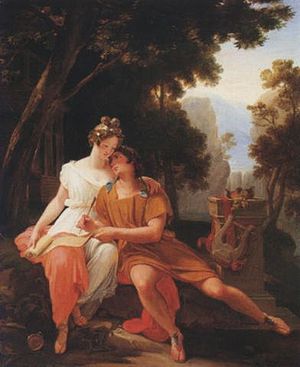
Related image
Auguste Jean Baptiste Vinchon, Propertius and Cynthia at Tivoli

Callimachi Manes et Coi sacra Philitae,
in vestrum, quaeso, me sinite ire nemus.
primus ego ingredior puro de fonte sacerdos
Itala per Graios orgia ferre choros.
dicite, quo pariter carmen tenuastis in antro
quove pede ingressi? quamve bibistis aquam?
ah valeat, Phoebum quicumque moratur in armis!
exactus tenui pumice versus eat,
quo me Fama levat terra sublimis, et a me
nata coronatis Musa triumphat equis,
et mecum in curru parvi vectantur Amores,
scriptorumque meas turba secuta rotas.
quid frustra immissis mecum certatis habenis?
non datur ad Musas currere lata via.
multi, Roma, tuas laudes annalibus addent,
qui finem imperii Bactra futura canent.
sed, quod pace legas, opus hoc de monte Sororum
detulit intacta pagina nostra via.
mollia, Pegasides, date vestro serta poetae:
non faciet capiti dura corona meo.
at mihi quod vivo detraxerit invida turba,
post obitum duplici faenore reddet Honos;
omnia post obitum fingit maiora vetustas:
maius ab exsequiis nomen in ora venit.
nam quis equo pulsas abiegno nosceret arces,
fluminaque Haemonio comminus isse viro,
Idaeum Simoenta Iovis cum prole Scamandro,
Hectora per campos ter maculasse rotas?
Deiphobumque Helenumque et Pulydamantis in armis
qualemcumque Parim vix sua nosset humus.
exiguo sermone fores nunc, Ilion, et tu
Troia bis Oetaei numine capta dei.
nec non ille tui casus memorator Homerus
posteritate suum crescere sensit opus;
meque inter seros laudabit Roma nepotes:
illum post cineres auguror ipse diem.
ne mea contempto lapis indicet ossa sepulcro
provisumst Lycio vota probante deo.

Love Ruins Everyone in Baiae

Giovanni Pontano, Baiae 1.3:

“Batilla went to the baths of Baiae,
and with her went that gentle companion, Cupid.
They bathe together and keep each other warm
while they lie together on the soft bed –
she plays games and starts some naughty combats,
and when Cupid is tired – just worn out –
Batilla laughs and grabs his bow.
Soon she covers her side with the painted quiver
and she tosses off the gentle arrows here and there.
Nothing, o, nothing you wretched little lovers,
nothing remains impenetrable to these arrows:
Alas, Baiae is ruinous for old and young alike!”

File:Joseph Mallord William Turner - The Bay of Baiae, with Apollo and the Sibyl - Google Art Project.jpg
Joseph Mallord William Turner – The Bay of Baiae

Baianas petiit Batilla thermas
Dumque illi tener it comes Cupido
Atque una lavat et fovetur una,
Dum molli simul in toro quiescit
Ac ludos facit improbasque rixas,
Sopito pueroque lassuloque
Arcum surripuit Batilla ridens,
Mox picta latus instruit pharetra
Et molles iacit huc et huc sagittas.
Nil, o nil reliquum miselli amantes,
Nil his impenetrabile est sagittis:
Heu, cladem iuvenum senumque, Baias!

What Is Love?

Leonardo Bruni, Letter to Giovanni Marrasio:

The madness of poets, then, stems from the Muses, while the madness of lovers comes from Venus. This arises, however, from the contemplation of true beauty, looking at the image of which we are taken away by the sharpest and most violent of our senses, struck dumb and as though placed outside of ourselves, seized away with all of our senses focused on it. Therefore, it is no less truly than elegantly said that the mind of a lover leads its life in the body of another.

This inflamed occupation and seizure of the soul is called love: a certain divine alienation, or a forgetting of oneself, or a transfusion of one’s being into that whose beauty you admire. If you call this madness and insanity, I will concede and confess it, as long as you understand that no poet is good (nor can a poet be good) unless they be seized by madness of this sort; nor do they see the future when they deliver prophecy, unless it be through this kind of madness, or is God worshiped perfectly and gloriously unless it be through this kind of alienation from one’s mind.

comedy roxbury GIF

Poetarum ergo furor a Musis est; amantium vero a Venere. Oritur autem hic ex verae pulchritudinis contemplatione, cuius effigiem visu intuentes acerrimo ac violentissimo sensuum nostrorum, stupentes ac velut extra nos positi, totis affectibus in illum corripimur, ut non minus vere quam eleganter dictum sit amantis animam in alieno corpore vitam ducere. Haec igitur vehemens occupatio animi atque correptio amor vocatur: divina quaedam alienatio ac veluti sui ipsius oblivio et in id quoius pulchritudinem admiramur transfusio. Quam si furorem ac vesaniam appellas, concedam etiam atque fatebor, dummodo intelligas neque poetam bonum esse ullum posse nisi huiusmodi furore correptum, neque futura praevidere vaticinantes, nisi per huiusmodi furorem, neque perfecte neque eximie deum coli, nisi per huiusmodi mentis alienationem.

Sophoclean Sex Sententia for Valentine’s Day

Plato, Republic 329:

I was once with Sophocles when someone asked him, ‘O Sophocles, how do things stand with you in the old love-making line? Can you still lie with a woman?’ Sophocles responded, ‘Ah man, you should sing a song of triumph for me – for indeed, I have most gladly fled from love as though I had gotten away from a cruel and raving master.’ It seemed to me at the time that he had spoken well on the subject, and I think so no less even today. Indeed, we are granted a certain peace and freedom from such concerns in old age. When our desires relent and finally cease to draw us out, then indeed does Sophocles’ saying come true, and we are entirely freed from many a raving master. But respecting these things, and our relationships with our friends, my dear Socrates, there is one cause to consider – not old age, but rather the person’s character. If they have their lives well-ordered and are easily contented, then old age is a moderate burden. But to a man of the opposite character, both old age and youth happen to be burdensome affairs.

None of this nonsense for Sophocles!

καὶ δὴ καὶ Σοφοκλεῖ ποτε τῷ ποιητῇ παρεγενόμην ἐρωτωμένῳ ὑπό τινος· “Πῶς,” ἔφη, “ὦ Σοφόκλεις, ἔχεις πρὸς τἀφροδίσια; ἔτι οἷός τε εἶ γυναικὶ συγγίγνεσθαι”; καὶ ὅς, “Εὐφήμει,” ἔφη, “ὦ ἄνθρωπε· ἁσμενέστατα μέντοι αὐτὸ ἀπέφυγον, ὥσπερ λυττῶντά τινα καὶ ἄγριον δεσπότην ἀποδράς.” εὖ οὖν μοι καὶ τότε ἔδοξεν ἐκεῖνος εἰπεῖν, καὶ νῦν οὐχ ἧττον. παντάπασι γὰρ τῶν γε τοιούτων ἐν τῷ γήρᾳ πολλὴ εἰρήνη γίγνεται καὶ ἐλευθερία· ἐπειδὰν αἱ ἐπιθυμίαι παύσωνται κατατείνουσαι καὶ χαλάσωσιν, παντάπασιν τὸ τοῦ Σοφοκλέους γίγνεται, δεσποτῶν πάνυ πολλῶν ἐστι καὶ μαινομένων ἀπηλλάχθαι. ἀλλὰ καὶ τούτων πέρι καὶ τῶν γε πρὸς τοὺς οἰκείους μία τις αἰτία ἐστίν, οὐ τὸ γῆρας, ὦ Σώκρατες, ἀλλ’ ὁ τρόπος τῶν ἀνθρώπων. ἂν μὲν γὰρ κόσμιοι καὶ εὔκολοι ὦσιν, καὶ τὸ γῆρας μετρίως ἐστὶν ἐπίπονον· εἰ δὲ μή, καὶ γῆρας, ὦ Σώκρατες, καὶ νεότης χαλεπὴ τῷ τοιούτῳ συμβαίνει.


Alexis, “I want to Know What Love Is”

Alexis (fr.386k from his Phaedrus; found at Athenaeus 13.13)

“As I was walking from the Peiraios beset
By troubles and despair, philosophy came over me.
And all the painters now seem to me to be ignorant
About love, and, to put it simply, so is everyone else
Who fashions images of him as a god.

For he is neither female nor male, and again,
He is not a god or mortal; nor is he foolish
Or wise, but he is drawn together from everywhere
And carries many shapes in one form.

For he has a man’s boldness with a woman’s restraint;
he has the senselessness of madness
But the reason of a thinker; he has a beast’s ferocity,
The toil of the unbreakable, and the avarice of a god.

Indeed, by Athena and the gods, I do not understand
What love is, but still it is the type of thing
I have said only without this name.”

πορευομένῳ δ᾽ ἐκ Πειραιῶς ὑπὸ τῶν κακῶν
καὶ τῆς ἀπορίας φιλοσοφεῖν ἐπῆλθέ μοι.
καί μοι δοκοῦσιν ἀγνοεῖν οἱ ζωγράφοι
τὸν Ἔρωτα, συντομώτατον δ᾽ εἰπεῖν, ὅσοι
τοῦ δαίμονος τούτου ποιοῦσιν εἰκόνας.
ἐστὶν γὰρ οὔτε θῆλυς οὔτ᾽ ἄρσην, πάλιν
οὔτε θεὸς οὔτ᾽ ἄνθρωπος, οὔτ᾽ ἀβέλτερος
οὔτ᾽ αὖθις ἔμφρων, ἀλλὰ συνενηνεγμένος
πανταχόθεν ἑνὶ τύπῳ <τε> πόλλ᾽ εἴδη φέρων.
ἡ τόλμα μὲν γὰρ ἀνδρός, ἡ <δὲ> δειλία
γυναικός, ἡ δ᾽ ἄνοια μανίας, ὁ δὲ λόγος
φρονοῦντος, ἡ σφοδρότης δὲ θηρός, ὁ δὲ πόνος
ἀδάμαντος, ἡ φιλοτιμία δὲ δαίμονος.
καὶ ταῦτ᾽ ἐγώ, μὰ τὴν Ἀθηνᾶν καὶ θεούς,
οὐκ οἶδ᾽ ὅ τι ἐστίν, ἀλλ᾽ ὅμως ἔχει γέ τι
τοιοῦτον, ἐγγύς τ᾽ εἰμὶ τοὐνόματος.

Cf. the philosopher Haddaway

And Foreigner’s desperate plea:


Pace the rejoinder from Turner 1984:

Related image
From here