“Let’s talk first concerning the disease which is called sacred and paralyzed people and the many anxieties which frighten people seriously enough that they lose their minds and believe that they see evil spirits by night or even at times by die or sometimes on all hours. Many have hanged themselves before because of this kind of vision, more often women than men.
For a woman’s nature is more depressed and sorrowful. And young women, when they are at the age of marriage and without a husband, suffer terribly at the time of their menstruation, which they did not suffer earlier in life. For blood collects later in their uterus so that it may flow out. When, then, the mouth of the exit does not create an opening, the blood pools up more because of food and the body’s growth. When the blood has nowhere to flow, it rises up toward the heart and the diaphragm. When these organs are filled, the heart is desensitized and from this transformation it becomes numb. Madness overtakes women because of this numbness.”
“And there is also a notion older than this which seemed right to Lykourgos for Sparta. Because he meant to provide warrior-athletes for Sparta, he said, “Let the girls exercise and permit them to run in public. Certainly this strengthening of their bodies was for the sake of good childbearing and that they would have better offspring.
For one who comes from this training to her husband’s home will not hesitate to carry water or to mill grain because she has prepared from her youth. And if she is joined together with a youth who has joined her in rigorous exercise, she will provide better offspring—for they will be tall, strong and rarely sick. Sparta became so preeminent in war once her marriages were prepared in this way.”
“Women know everything, even how Zeus married Hera.”
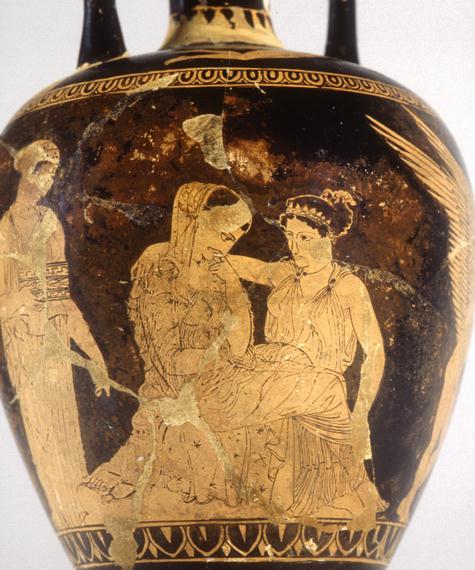
Homer has, “They traveled together to bed, avoiding their parents’ notice”. Aristokles in his work “On the Cults of Hermione”, provides something of an odd tale about the marriage of Zeus and Hera. For, as the story goes, Zeus was planning on having sex with Hera when he noticed that she was separated from the other gods. Because he did not want to be obvious and did not want to be seen by her, he changed his appearance into a cuckoo and was waiting on a mountain which was first called Thornax but is now just called Cuckoo.
Zeus made a terrible storm on that day and when Hera was going toward the mountain alone, she stopped at the very place where there is currently a temple to Hera Teleia. The cuckoo, flew down and sat on her lap when he saw her, shivering and freezing because of the weather. Hera saw the bird and pitied him and covered him with her cloak. Then Zeus suddenly transformed his appearance and grabbed a hold of Hera. Because she was refusing him due to their mother, he promised that he would marry her.
Among the Argives, who honor the goddess the most of all the Greeks, the cult image of Hera sits in the temple on a throne holding a scepter in one hand on which a cuckoo is seated.”
Pausanias (2.17.4) describes a statue in a temple to Hera outside of Corinth:
“The statue of Hera—extraordinarily huge—sits on a throne made of gold and ivory, a work of Polykleitos. She has a crown embossed with Graces and the Seasons and carries in one hand a pomegranate fruit and in the other a scepter. I must pass over the reason for the pomegranate, since the tale is protected by sacred rite. But people say that the cuckoo bird sitting on the scepter is Zeus: because he was in love with Hera when she was a maiden and turned himself into this bird which she hunted to have as a pet. I record this story as much as the others of the gods which I offer incredulously—but I record them still.”
Astuanassa: A handmaid of Helen, Menelaos’ wife. She first discovered positions for intercourse and wrote On Sexual Positions. Philainis and Elephantinê rivaled her in this later—they were women who danced out these sorts of wanton acts.
We have learned about this embroidered girdle, that Hera took it from Aphrodite and gave it to Helen. Her handmaid Astuanassa stole it but Aphrodite took it back from her again.
As is largely unsurprising from the perspective of Greek misogyny, excessive interest in sexual behavior is projected a female quality. Expertise beyond interest is made the province of female ‘professionals’ (slaves) who may act as scapegoats and marginal figures for the corruption of both men and women. There is a combination of such interest with an excessive emphasis on eating (and eating really well) in Athenaeus where the pleasures of the body are combined.
Athenaeus, Deipnosophists 8.335c
“Dear men, even though I have great admiration for Chrysippus as the leader of the Stoa, I praise him even more because he ranks Arkhestratos, well-known for his Science of Cooking along with Philainis who is credited with a licentious screed about sexual matters—even though the iambic poet of Samos, Aiskhriôn, claims that Polycrates the sophist started this slander of her when she was really quite chaste. The lines go like this:
“I, Philainis, circulated among men
Lie here thanks to great old age.
Don’t laugh, foolish sailor, as your trace the cape
Nor make me a target of mockery or insult
For, by Zeus and his sons in Hell
I was never a slut with men nor a public whore.
Polykrates, Athenian by birth,
A bit clever with words and with a nasty tongue,
Wrote what he wrote. I don’t know anything about it.”
But the most amazing Chrysippus combines in the fifth book of his On Goodness and Pleasure that both “the books of Philianis and the Gastronomiai of Arkhestratos and forces of erotic and sexual nature, and in the same way slave-girls who are expert at these kinds of movements and positions and who are engaged in their practice.” He adds that they learn this type of material completely and then thoroughly possess what has been written on these topics by Philainis and Arkhestratos and those who have written on similar topics. Similarly, in his seventh book, he says ‘As you cannot wholly learn the works of Philianis and Arkhestratos’ Gastronomia because they do have something to offer for living better.’ “
Here’s some mythical-grade misogyny, with a variation on the Potiphar’s wife motif, and some infanticide.
Apollodorus, Bibliotheca, 3.155
“Hektor married Andromache, Êetiôn’s daughter, and Alexandros [Paris] married Oinônê the daughter of Kebren the river. She learned the power of prophecy from Rhea and warned Alexander not to sail to Helen. Because she did not persuade him, she said that if he was wounded, he should come to her because she alone would be able to heal him.
But he did steal Helen from Sparta and, while Troy was attacked, he was struck by Herakles’ arrows from Philoktêtes. He went to Oinône in Ida. She, because she took delight in his suffering, said she would not heal him. Alexandros returned to Troy and was dying, but Oinônê changed her mind and was bringing medicine to heal him only to find him dead. She hanged herself.”
This story is the one basically told in Parthenius (Love Tales, 4.7). Another version of the tale is preserved in Photios but is attributed to the historian and mythographer Konon (BNJ 26 F1 = Photios, Bibliotheka 186). A few notes of caution: Konon is dated to the 1st century CE; Photios to the 9th Century CE
Konon BNJ 26 F1 = Photios, Bibliotheka 186
[This section] is about how a child Koruthos, who surpassed his father in beauty, was born from Alexander/Paris and Oinône, the woman he married before he kidnapped Helen. His mother sent him to Helen to make Alexandros jealous and devise some evil for Helen. When Koruthos got to ‘know’ Helen, Alexandros arrived in the bedroom, and saw Koruthos sitting near her, and, already enraged out of suspicion, he killed him.
Because of the outrage against herself and the killing of her child, she cursed Alexandros a lot and predicted—for she had the inspiration of prophecy and was skilled in preparing medicines—that he would be wounded by one of the Achaeans some day and because he could not find treatment, he would need her and come home.
Later on, Alexander was wounded in the battle against the Achaeans in front of Troy by Philoktetes and he was suffering terribly. He was brought in a wagon to Idea and sent a herald to ask for Oinône. She arrogantly reproached him, saying that he should go back to Helen. Then Alexander died along the road because of the wound.
A powerful change of mind over took her at the time of his death before she heard of it, and once she gathered some medicine, she rushed to overtake him. Once she learned from the herald that he was dead and that she had killed him, she killed the herald for his arrogance by smashing a stone on his head. She threw herself over Alexander’s corpse and, after repeatedly blaming their shared fate, she hanged herself with her belt.”
A couple of takeaways from this one. First, it seems that Oinône knew about Paris’ lust for Helen before he departed for Sparta and remained behind on Mt. Ida once he returned to Troy. Second, it is entirely unclear when the child returns to Troy to tempt Helen. This story is a variation on the same story told about Phoinix in book 9 (his mother had him seduce his father’s lover; his father exiled him). No one in this story looks great (except for Koruthos, he looks real great). Paris is, well, a jerk. Poor Oinône is depicted as a witch-prophetess who, despite all the abuse, still loves her terrible husband.
Like Apollodorus’ version above, Ovid’s Heroides (5) do not mention the son. The earliest extant reference to Oinône seems to be Hellanicus, but some speculation links her to Bacchylides fr. 20d (where three letters OIN[….] seem to refer to a wife of Paris. See Gantz Early Greek Myth, 1993 n. 67 on page 839
Diogenes said that the wealthy were like newly-born babies because they always needed swaddling clothes. The thing over which people had the greatest hassles and spent the most money, for which many cities were ruined and for the sake of which many of their peoples have been miserably wasted – to him, it was the least troublesome of all things, and certainly the cheapest. For he did not need to go anywhere for the sake venereal delights. Jokingly, he said that Aphrodite attended upon him straightaway in all placed, and that the poets slandered the goddess through their own licentiousness when they called her ‘golden’. Since a lot of people did not believe this, he jerked off in the open with everyone watching.
And he said that if all men did this, Troy would never have been taken, nor would Priam, king of the Phrygians and a descendant of Zeus, had been slain at that god’s altar. He added that the Achaeans were so stupid that they thought that even dead men still lusted for women, and killed Polyxena at the tomb of Achilles. He said that fish seemed a hell of a lot smarter than people: when they needed to blow a wad of sperm, they went out and rubbed themselves on something rough.
Indeed, he wondered that people wouldn’t pay a piece of silver to have their foot, or their hand, or any other part of their body rubbed, and even the very rich wouldn’t lose a drachma in this way. But that one part often cost whole talents of silver, and some people even wagered their lives for it. He joked that masturbation was the discovery of Pan. When he lusted after Echo but could not have her and wandered night and day through the mountains, Hermes took pity on his predicament and, since Pan was his son, taught him how to do it. When Pan had learned this, he was spared a lot of suffering, and shepherds learned how to do it from him.
Here’s some mythical-grade misogyny, with a variation on the Potiphar’s wife motif, and some infanticide.
Apollodorus, Bibliotheca, 3.155
“Hektor married Andromache, Êetiôn’s daughter, and Alexandros [Paris] married Oinônê the daughter of Kebren the river. She learned the power of prophecy from Rhea and warned Alexander not to sail to Helen. Because she did not persuade him, she said that if he was wounded, he should come to her because she alone would be able to heal him.
But he did steal Helen from Sparta and, while Troy was attacked, he was struck by Herakles’ arrows from Philoktêtes. He went to Oinône in Ida. She, because she took delight in his suffering, said she would not heal him. Alexandros returned to Troy and was dying, but Oinônê changed her mind and was bringing medicine to heal him only to find him dead. She hanged herself.”
This story is the one basically told in Parthenius (Love Tales, 4.7). Another version of the tale is preserved in Photios but is attributed to the historian and mythographer Konon (BNJ 26 F1 = Photios, Bibliotheka 186). A few notes of caution: Konon is dated to the 1st century CE; Photios to the 9th Century CE
Konon BNJ 26 F1 = Photios, Bibliotheka 186
[This section] is about how a child Koruthos, who surpassed his father in beauty, was born from Alexander/Paris and Oinône, the woman he married before he kidnapped Helen. His mother sent him to Helen to make Alexandros jealous and devise some evil for Helen. When Koruthos got to ‘know’ Helen, Alexandros arrived in the bedroom, and saw Koruthos sitting near her, and, already enraged out of suspicion, he killed him.
Because of the outrage against herself and the killing of her child, she cursed Alexandros a lot and predicted—for she had the inspiration of prophecy and was skilled in preparing medicines—that he would be wounded by one of the Achaeans some day and because he could not find treatment, he would need her and come home.
Later on, Alexander was wounded in the battle against the Achaeans in front of Troy by Philoktetes and he was suffering terribly. He was brought in a wagon to Idea and sent a herald to ask for Oinône. She arrogantly reproached him, saying that he should go back to Helen. Then Alexander died along the road because of the wound.
A powerful change of mind over took her at the time of his death before she heard of it, and once she gathered some medicine, she rushed to overtake him. Once she learned from the herald that he was dead and that she had killed him, she killed the herald for his arrogance by smashing a stone on his head. She threw herself over Alexander’s corpse and, after repeatedly blaming their shared fate, she hanged herself with her belt.”
A couple of takeaways from this one. First, it seems that Oinône knew about Paris’ lust for Helen before he departed for Sparta and remained behind on Mt. Ida once he returned to Troy. Second, it is entirely unclear when the child returns to Troy to tempt Helen. This story is a variation on the same story told about Phoinix in book 9 (his mother had him seduce his father’s lover; his father exiled him). No one in this story looks great (except for Koruthos, he looks real great). Paris is, well, a jerk. Poor Oinône is depicted as a witch-prophetess who, despite all the abuse, still loves her terrible husband.
Like Apollodorus’ version above, Ovid’s Heroides (5) do not mention the son. The earliest extant reference to Oinône seems to be Hellanicus, but some speculation links her to Bacchylides fr. 20d (where three letters OIN[….] seem to refer to a wife of Paris. See Gantz Early Greek Myth, 1993 n. 67 on page 839
The following epigrams are attributed to the poet Anyte of Tegea, one of a handful of Hellenistic women preserved in the Greek Anthology.
Gr. Anth. 7.490
“I mourn for the virgin Antibia, to whose father’s home
Many suitors came longing to marry,
Thanks to the fame of her beauty and wisdom.
But ruinous fate made all their hopes turn in the dust.”
“Dâmis built this grave for his battle-fierce but dead
Horse, after murderous Ares pierce his chest.
The blood spurted black from his thick-hided skin
And he dyed the earth with his painful life’s blood.”
“Your courage, Proarkhos, killed you in the fight and dying
You put the home of your father Pheidias into dark grief.
Yet this rock above you sings out a noble song:
That you died in a struggle for your dear homeland.”
Ever wondered why Helen left Menelaos or why her sister cheated on Agamemnon (other than the obvious)? Ancient poetry traced it back to a sin of their father
Schol. Ad Euripides’ Orestes 249
“Stesichorus says that when Tyndareus was sacrificing to the gods he overlooked Aphrodite. For this reason, the angry goddess made his daughters thrice and twice married deserters of husbands. The segment reads like this:
“Because when Tyndareus was sacrificing to all the gods
He neglected only the gentle-giving Kyprian
She was enraged and she made the daughters of Tyndareus
Twice and thrice married deserters of husbands.”
A fragment of Hesiod agrees with this (fr. 176):
“Smile-loving Aphrodite
Was enraged when she saw them: then she hung bad fame upon them.
After that, Timandra abandoned Ekhemos and left;
She went to Phyleus who was dear to the holy gods.
And so Klytemnestra abandoned shining Agamemnon
To lie alongside Aigisthos as she chose a lesser husband;
In the same way, Helen shamed the marriage-bed of fair Menelaos…”
This passage provides an explanation for why the daughters of Tyndareus—Helen and Klytemnestra—were unfaithful: it was Aphrodite’s game from the beginning because their father did not worship her correctly. A few interesting aspects here: first, Helen is “thrice-married” because after Paris dies, she marries Deiphobus (although some accounts associate her with Theseus too). Second, Hesiod’s fragmentary poems seems to be in the process of cataloging women who leave their husbands.
The first woman in the tale is Timandra, who, according to only this passage, was a third daughter of Tyndareus who left her husband Ekhemos, a king of Arcadia. They had a son together, named Leodocus before she eloped with Phyleus. In another fragment from Hesiod (fr. 23) we learn more about the family of Tyndareus and Leda:
“After climbing into the lush bed of Tyndareus
Well-tressed Leda, as fair as the rays of the moon,
Gave birth to Timandra, cow-eyed Klytemnestra,
And Phylonoe whose body was most like the immortal goddesses.
Her…the arrow bearing goddess
Made immortal and ageless for all days.”
Later on in the same fragment –after hearing about the marriage and children of Klytemnestra—we learn about Timandra:
“Ekhemos made Timandra his blooming wife,
The man who was the lord of all Tegea and Arcadia, wealthy in sheep,
A rich man who was dear to the gods.
She bore to him Laodakos, the horse-taming shepherd of the host,
After she was subdued by golden Aphrodite.”
This section of the Hesiodic Catalogue of Women seems to be mentioning only Leda’s children with Tyndareus and not those possibly fathered by Zeus (Helen, Kastor, Polydeukes). But we hear nothing of the future of Leda’s attractive daughter Phylonoe (also spelled Philonoe) other than that Artemis made her immortal. The ancient sources? Nothing at all to explain this.
Callimachus and Heraclitus of Halicarnassus, poets of the 3rd Century BC, were friends, as Callimachus’ tribute makes clear in the following poem:
Callimachus 2 (Gow-Page 34)
Someone spoke of your death, Heraclitus,
Moving me to tears.
I remembered how often we, talking,
Made the sun go down.
But now, my Halicarnassian friend,
Somewhere, and for almost too long to count,
You’ve been a pile of ashes.
Yet, your nightingales live on.
Hades, the god who steals everything,
Will not lay his hand on them.
Only one of Heraclitus’ “nightingales” survives, and it is the sepulchral poem below:
Heraclitus 7.465 (Greek Anthology)
Earth just recently dug up.
On the face of the tombstone
Half-green leafy garlands sway.
When the writing’s deciphered,
Traveler, we’ll know whose smooth bones
The stone claims to enclose:
“Stranger, I am Aretemias from Cnidus.
It was with Euphronus that I shared the marriage bed.
Rites of child birth were not denied me, and I bore twins:
One I left as a guide for his father in old age;
One I took with me—a reminder of my husband.”