More on the Pharmacology of Language

Gorgias, Defense of Helen 13-14

“The persuasion intrinsic to speech also shapes the mind as it pleases. We must first consider the narratives of astronomers who, by undermining one idea and developing another one, alter beliefs and make the incredible and invisible manifest to the eyes of belief. In turn, consider the necessary struggles in which one argument delights and persuades a great crowd when it has been written skillfully, even if it is spoken falsely. Finally, consider the rivalrous claims of philosophers which feature as well the speed of opinion that engenders volatility in the fidelity of a belief.”

 (13) ὅτι δ’ ἡ πειθὼ προσιοῦσα τῶι λόγωι καὶ τὴν ψυχὴν ἐτυπώσατο ὅπως ἐβούλετο, χρὴ μαθεῖν πρῶτον μὲν τοὺς τῶν μετεωρολόγων λόγους, οἵτινες δόξαν ἀντὶ δόξης τὴν μὲν ἀφελόμενοι τὴν δ’ ἐνεργασάμενοι τὰ ἄπιστα καὶ ἄδηλα φαίνεσθαι τοῖς τῆς δόξης ὄμμασιν ἐποίησαν· δεύτερον δὲ τοὺς ἀναγκαίους διὰ λόγων ἀγῶνας, ἐν οἷς εἷς λόγος πολὺν ὄχλον ἔτερψε καὶ ἔπεισε τέχνηι γραφείς, οὐκ ἀληθείαι λεχθείς· τρίτον <δὲ> φιλοσόφων λόγων ἁμίλλας, ἐν αἷς δείκνυται καὶ γνώμης τάχος ὡς εὐμετάβολον ποιοῦν τὴν τῆς δόξης πίστιν.

“The power of speech has the same logic regarding the disposition of the soul as that of the application of drugs to the natural function of bodies. For, just as certain drugs dispel certain afflictions from the body, and some end disease while others end life, so too are there stories that create grief and others that cause pleasure; some send us running, others make their audiences bold. Others still intoxicate and deceive the soul though some evil persuasion.”

 (14) τὸν αὐτὸν δὲ λόγον ἔχει ἥ τε τοῦ λόγου δύναμις πρὸς τὴν τῆς ψυχῆς τάξιν ἥ τε τῶν φαρμάκων τάξις πρὸς τὴν τῶν σωμάτων φύσιν. ὥσπερ γὰρ τῶν φαρμάκων ἄλλους ἄλλα χυμοὺς ἐκ τοῦ σώματος ἐξάγει, καὶ τὰ μὲν νόσου τὰ δὲ βίου παύει, οὕτω καὶ τῶν  λόγων οἱ μὲν ἐλύπησαν, οἱ δὲ ἔτερψαν, οἱ δὲ ἐφόβησαν, οἱ δὲ εἰς θάρσος κατέστησαν τοὺς ἀκούοντας, οἱ δὲ πειθοῖ τινι κακῆι τὴν ψυχὴν ἐφαρμάκευσαν καὶ ἐξεγοήτευσαν.


rhyme


Addictive Reading: Etymologies for Kirke and Pharmakon in the Suda

Some Words from the Suda

“Walled off”: This means “blocking”. As in the [unknown author’s line] “Because I have walled off my stomach, I am no longer susceptible to any drug.”

Ἀποτειχίζων: ἀποφράσσων. ἀποτειχίσας δὲ τὴν γαστέρα οὐδενὶ τῶν φαρμάκων ἔτι εἰμὶ ἁλώσιμος


Kirkê: This comes from “the woman who mixes [kirnôsa] the drugs. Or it is from kerkis [shuttle] from the verb kerkô. We call women who are especially subtle Kirkes.

Κίρκη: ἡ κιρνῶσα τὰ φάρμακα. ἢ παρὰ τὴν κερκίδα: κερκὶς δὲ παρὰ τὸ κρέκω. τὰς δὲ παιπαλώσεις γυναῖκας Κίρκας φαμέν.


“The oblivion of dogs”: [This is a proverb] for drugs that bring forgetfulness

Λήθην κυνῶν: λήθην ἐμποιούντων φαρμάκων.


Drug [Pharmakon]: this can mean persuasion, conversation: the etymology is said to be from bearing [pherein] the cure [akos]. Others claim that it comes from flowers.

Φάρμακον: παραμυθία, ὁμιλία, εἴρηται δὲ ἀπὸ τοῦ φέρειν τὴν ἄκεσιν: εἴρηται δὲ ἀπὸ τῶν ἀνθέων.


Circe and Odysseus, white-ground lekythos by the Athena Painter, ca. 490–480 BCE. From Eretria. National Archaeological Museum in Athens, 1133.

How Not to Remember the Dead

The Greek Anthology records fifty-one poems by the versatile Crinagoras of Mytilene (c. 1st century BC – 1st century AD). Here are 2 uncharitable epigrams of his regarding the tomb and decaying remains of one Eunicides:

7.380 (Greek Anthology)

Though the tomb’s been cut from a block of white marble,
And it’s been made fine with a mason’s straight rule,
It does not belong to a good man.
Do not appraise the dead, my friend, based on stone.
Stone is witless: this is how it covers
Even a corpse already turned black.
Here lies that limp rag, Eunicides,
Rotting away under the ashes.

7.401 (Greek Anthology)

The tomb atop his odious head
Crushes the bones of the reprobate
Who lies beneath the accursed dirt:
It crushes his jutting chest,
His foul-smelling row of teeth,
His legs bandaged like a slave’s,
And his hairless head as well.
Eunicides’ half-burnt remains, these,
And they’re still full of greenish pus.
Earth, you’ve made an unfortunate marriage;
Don’t now lie lightly, or even slightly,
On this misshapen man’s ashes.

7.380

εἰ καὶ τὸ σῆμα λυγδίνης ἀπὸ πλακὸς
καὶ ξεστὸν ὀρθῇ λαοτέκτονος στάθμῃ,
οὐκ ἀνδρὸς ἐσθλοῦ. μὴ λίθῳ τεκμαίρεο,
ὦ λῷστε, τὸν θανόντα. κωφὸν ἡ λίθος,
τῇ καὶ ζοφώδης ἀμφιέννυται νέκυς.
κεῖται δὲ τῇδε τὠλιγηπελὲς ῥάκος
Εὐνικίδαο, σήπεται δ᾽ ὑπὸ σποδῷ

7.401

τήνδ᾽ ὑπὸ δύσβωλον θλίβει χθόνα φωτὸς ἀλιτροῦ
ὀστέα μισητῆς τύμβος ὑπὲρ κεφαλῆς,
στέρνα τ᾽ ἐποκριόεντα, καὶ οὐκ εὔοδμον ὀδόντων
πρίονα, καὶ κώλων δούλιον οἰοπέδην,
ἄτριχα καὶ κόρσην, Εὐνικίδου ἡμιπύρωτα
λείψαν᾽, ἔτι χλωρῆς ἔμπλεα τηκεδόνος.
χθὼν ὦ δυσνύμφευτε, κακοσκήνευς ἐπὶ τέφρης
ἀνδρὸς μὴ κούφη κέκλισο, μηδ᾽ ὀλίγη.

This is an image by the surrealist photographer Hans Bellmer (1902-1975). It depicts the life-like (or rather, death-like) doll he built and set in poses before his camera.

Larry Benn has a B.A. in English Literature from Harvard College, an M.Phil in English Literature from Oxford University, and a J.D. from Yale Law School. Making amends for a working life misspent in finance, he’s now a hobbyist in ancient languages and blogs at featsofgreek.blogspot.com.

Tawdry Tuesday: Wanton Verse, Pure Heart. And Dicks for Sale (NSFW)

Hadrian, fr. II [A minor Latin Poet and a Major Roman Emperor]

“You were wanton in verse, but pure of thought”

Lascivus versu, mente pudicus eras.

 Martial, 12.97

“Even though your wife is a girl of a kind
A man would scarcely seek with inappropriate prayers
(rich, noble, erudite, chase, what a find!)
You bust your nut, Bassus, but on the hair
Of the the men you buy with your wife’s money.

And when to its mistress your dick is returned
Though it was for so many thousands bought
It is so limp that its full size cannot be earned
Even if by sweet whispers or soft strokings sought.

For once, have some shame or let’s go to court.
Bassus, you sold it—your dick ain’t yours.”

Uxor cum tibi sit puella qualem
votis vix petat improbis maritus,
dives, nobilis, erudita, casta,
rumpis, Basse, latus, sed in comatis,
uxoris tibi dote quos parasti.
et sic ad dominam reversa languet
multis mentula milibus redempta
ut nec vocibus excitata blandis
molli pollice nec rogata surgat.
sit tandem pudor aut eamus in ius.
non est haec tua, Basse: vendidisti.

Image result for Priapus weighing penis pompeii
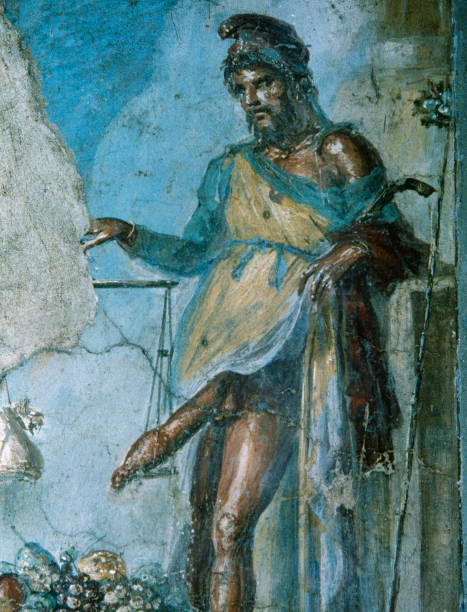
Wall-painting: Priapus weighing his phallus (Pompeii)

Palinurus Takes One for the Team

Cyril Connolly, The Unquiet Grave:

Harpies, Scylla, Charybdis, the Cyclops, Etna in eruption! Each one of the trials which the exiled pilot must have undergone could occasion an anxiety-neurosis or effort-syndrome in a man less well-balanced. One wonders how he reacted to Aeneas’ public account of them. Dido, we know, fell disastrously ‘in love” with Aeneas, and it is when he departs (Aeneas abandoning her after their cave-wedding), that Palinurus speaks again. The fleet has stolen out in the early morning and Dido has set alight her funeral pyre whose glow the sailors see, but Aeneas alone interprets rightly. At once a storm gets up.

But soon the Heav’ns with shadows were overspread;

A swelling Cloud hung hov’ring o’er their Head:

Livid it look’d (the threat’ning of a Storm),

Then Night and Horror Ocean’s Face deform.

The Pilot Palinunis ciy’d aloud,

‘What Gusts of Weather from that gath’ring Cloud

My Thoughts presage ; e’er yet the Tempest roars.

Stand to your Tackle, Mates, and stretch your Oars ;

Contract your swelling Sails, and luff to Wind’

The frighted Crew perform the Task assign’d.

Then, to his fearless Chief, ‘ Not Heav’n,’ said he,

‘ Tho’ Jove himself shou’d promise Italy

Can stem the Torrent of this raging Sea.

Mark how the shifting Winds from West arise,

And what collected Night involves the Skies

Nor can our shaken Vessels live at Sea,

Much less against the Tempest force their way;

’Tis fate diverts our Course ; and Fate we must obey.

Not far from hence, if I observ’d aright

The southing of the Stars and Polar Light,

Sicilia lies ; whose hospitable Shores

In safety we may reach with strugling oars.

The Course resolv’d, before the Western Wind

They scud amain; and make the Port assign’d

It seems clear that Palinurus who had led the fleet between Scylla and Charybdis, recognized that his storm could not be ridden out because he knew it followed on Aeneas’ betrayal of Dido. He also read the true meaning of the fire which they had seen and from that moment realized that was guilty of hubris and impiety; he was ‘not the Messiah’.

In Sicily Aeneas celebrates his arrival with elaborate games. In these — although they include various sailing contests — Palinurus himself does not join and lets the other pilots fight them out. One can imagine him brooding over the storm and his leader’s conduct while the noisy sport proceeds around him. Finally, to prevent the men leaving, the women set fire to the ships and four are destroyed. Here occurs an incident for which no scientific explanation is forthcoming, and which, if the narrator were Palinurus and not Viigil, we would be tempted to ascribe to a delusion of reference. Venus begs Neptune to guarantee that her beloved Aeneas and all his men will not be subjected to any more disasters and storms at sea by their enemy, Juno. Neptune agrees, but warns her that ‘In safety as thou prayest shall he reach the haven of Avernus. Only one shall there be whom, lost in the flood, thou shalt seek in vain; one life shall be given for many.’

“What is Written Here is Brief”: Some Roman Memorials for Memorial Day

Some Archaic Latin Inscriptions from the Loeb Classical Library (the LCL numbers are first, translations are mine). There are earlier poetic epitaphs on this site as well, even legendary ones

Epitaphs 14 [CIL 1861]

“Here lies the sweet clown and slave of Clulius
Protogenes, who created many moments of happiness for people with his joking”

Protogenes Cloul[i] | suavis heicei situst | mimus
plouruma que | fecit populo soueis | gaudia nuges.

15 [CIL 1202]

“This monument was erected for Marcus Caecilius
We give you thanks, Friend, since you stopped by this home.
May you have good fortune and be well. Sleep without worry.”

Hoc est factum monumentum | Maarco Caicilio. |
Hospes, gratum est quom apud | meas restitistei seedes. |
Bene rem geras et valeas, | dormias sine qura.

18 [CIL 1211]

“Friend, what is written here is brief—stop and read it all.
This is the unattractive tomb of an attractive woman.
Her parents named her Claudia
She loved her own husband with her whole heart.
She had two sons and leaves one of them
On the earth, but placed the other beneath it.
[She was] charming in conversation; but proper in behavior.
She safeguarded her house. She made wool. I have said it all. Go.”

Hospes, quod deico paullum est; asta ac pellege.
Heic est sepulcrum hau pulcrum pulcrai feminae.
Nomen parentes nominarunt Claudiam.
Suom mareitom corde deilexit souo.
Gnatos duos creavit, horunc alterum
in terra linquit, alium sub terra locat.
Sermone lepido, tum autem incessu commodo.
Domum servavit, lanam fecit. Dixi. Abei.

39 [CIL 1219]

“Here are the bones of Pompeia the first daughter
Fortune promises a lot to many but makes a guarantee for no one.
Live for all days and all hours. For nothing is yours wholly.
Salvius and Heros donated this.”

Primae | Pompeiae | ossua heic.|
Fortuna spondet | multis, praestat nemini;
vive in dies | et horas, nam proprium est nihil. |
Salvius et Heros dant.

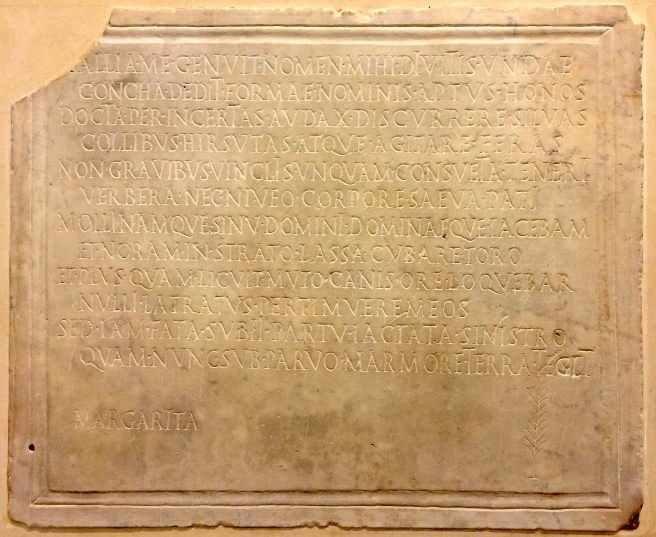
Image result for ancient roman epitaph

It Is Impossible to Speak Worthily of the Dead

Epitaphios: A speech performed annually in honor of those who have died in war. See this recent piece in The Conversation on Greek memorials or listen to a conversation with Arnie Arnesen.

The most famous that remains is Thucydides’ version of Perikles’ funeral oration (2.35-46).

Thucydides, 2.35

“Many of those who have spoken here already praised the one who made this speech law, that it is a noble thing to speak over the burials of those who died in war.  But honors paid in deeds for deeds performed by good men would seem to be sufficient to me—the acts which you see performed now by the public at this burial. The virtues of many should not be risked by entrusting them to the good or poor speaking of one man alone. “

‘Οἱ μὲν πολλοὶ τῶν ἐνθάδε ἤδη εἰρηκότων ἐπαινοῦσι τὸν προσθέντα τῷ νόμῳ τὸν λόγον τόνδε, ὡς καλὸν ἐπὶ τοῖς ἐκ τῶν πολέμων θαπτομένοις ἀγορεύεσθαι αὐτόν. ἐμοὶ δὲ ἀρκοῦν ἂν ἐδόκει εἶναι ἀνδρῶν ἀγαθῶν ἔργῳ γενομένων ἔργῳ καὶ δηλοῦσθαι τὰς τιμάς, οἷα καὶ νῦν περὶ τὸν τάφον τόνδε δημοσίᾳ παρασκευασθέντα ὁρᾶτε, καὶ μὴ ἐν ἑνὶ ἀνδρὶ πολλῶν ἀρετὰς κινδυνεύεσθαι εὖ τε καὶ χεῖρον εἰπόντι πιστευθῆναι.

For more….

Lysias, Epitaphios 1-3

“If I believed it were possible, men in attendance, to make clear in this speech the virtue of the men who lie here, I would complain to those who summoned me to speak after only a few days.

Εἰ μὲν ἡγούμην οἷόν τε εἶναι, ὦ ἄνδρες οἱ παρόντες ἐπὶ τῷδε τῷ τάφῳ, λόγῳ δηλῶσαι τὴν τῶν ἐνθάδε κειμένων [ἀνδρῶν] ἀρετήν, ἐμεμψάμην ἂν τοῖς ἐπαγγείλασιν ἐπ’ αὐτοῖς ἐξ ὀλίγων ἡμερῶν λέγειν·

For more…

Plato’s Menexenus (236dff), Socrates recites an epitaphios given by Aspasia:

“In deed, these men have what is required for them materially—now that they have obtained it, they proceed along the fated path: they have been carried out in common by the city and in private by their families.  But in speech it is necessary to pay out the remaining rite which custom assigns us.

῎Εργῳ μὲν ἡμῖν οἵδε ἔχουσιν τὰ προσήκοντα σφίσιν αὐτοῖς, ὧν τυχόντες πορεύονται τὴν εἱμαρμένην πορείαν, προπεμφθέντες κοινῇ μὲν ὑπὸ τῆς πόλεως, ἰδίᾳ δὲ ὑπὸ τῶν οἰκείων· λόγῳ δὲ δὴ τὸν λειπόμενον κόσμον ὅ τε νόμος προστάττει ἀποδοῦναι τοῖς ἀνδράσιν καὶ χρή.

For more…

Demosthenes, Epitaphios (speech 60)

“Since it seems right to the state to bury those lying in this grave publicly because they proved themselves noble in war and it has been assigned to me to deliver the customary speech on their behalf, I immediately began to examine how others have crafted the appropriate praise. But while I was considering and examining this, I realized that speaking worthily of the dead is one of those things that is impossible for men.”

᾿Επειδὴ τοὺς ἐν τῷδε τῷ τάφῳ κειμένους, ἄνδρας ἀγαθοὺς ἐν τῷ πολέμῳ γεγονότας, ἔδοξεν τῇ πόλει δημοσίᾳ θάπτειν καὶ προσέταξεν ἐμοὶ τὸν νομιζόμενον λόγον εἰπεῖν ἐπ’ αὐτοῖς, ἐσκόπουν μὲν εὐθὺς ὅπως τοῦ προσήκοντος ἐπαίνου τεύξονται, ἐξετάζων δὲ καὶ σκοπῶνἀξίως εἰπεῖν τῶν τετελευτηκότων ἕν τι τῶν ἀδυνάτων ηὕρισκον ὄν.

For more….

Image result for ancient greek epitaph
An epitaph

Year-End Advice for Teachers: How to Leave a Party

Suetonius, Lives of Illustrious Men (On Rhetoricians)

28 Marcus Epidius, famous for blackmailing people, started a school of elocution and among others he taught Marcus Antonius and Augustus. When these two were once mocking Tiverous Cannutius because he aligned himself with the powerful faction of the the ex-consul Isauricus, Cannutius responded that he would prefer to be a student of Isaurius instead of a slanderer like Epidius.

This Epidius maintained that he was descended from Gaius Epidius from Nucerina. People claim that he jumped into the headwaters of the Sarnus river and came out soon after with golden horns on his head. Immediately he vanished and was counted in the number of the gods.”

Epidius, calumnia notatus, ludum dicendi aperuit docuitque inter ceteros M. Antonium et Augustum; quibus quondam Ti. Cannutius, obicientibus sibi quod in re p. administranda potissimum consularis Isaurici sectam sequeretur, malle respondit Isaurici esse discipulum quam Epidi calumniatoris. Hic Epidius ortum se a C. Epidio Nucerino praedicabat, quem ferunt olim praecipitatum in fontem fluminis Sarni, paulo post cum cornibus aureis exstitisse, ac statim non comparuisse in numeroque deorum habitum.

File:Horned River-God on a Roman Sarcophagus at the Met (New York, NY) (5485650566).jpg
Horned River God on Roman Sarcophagus

Accius’ Trifling Scholarship

Aulus Gellius, Attic Nights 3.11:

Which and what stupid arguments Accius uses in his Didascalica, where he tries to show that Hesiod is more ancient than Homer.

There is no agreement about the dates of Homer and Hesiod. Some wrote that Homer was older than Hesiod (among these are Philochorus and Xenophanes), while others say that he was younger (including Lucius Accius the poet and Ephorus the historian). But Marcus Varro, in the first book of his Imagines, says that there is little agreement about which of the two was born first, but asserts that there is no doubt that they lived at around the same time, and that this fact is shown by an epigram written on a tripod which is said to have been placed on Mt. Helicon by Hesiod. Accius, in the first book of his Didascalica, uses some pretty weak arguments by which he thinks that it is shown that Hesiod was first in birth. He says, “Because Homer, in the beginning of the Iliad said that Achilles was the son of Peleus but did not say who Peleus was. Without a doubt, he would have said who Peleus was if he had not already seen that it was said by Hesiod already. Similarly, about the Cyclops, he would not have omitted to mention such a shocking fact as that he was one-eyed if it had not been made common knowledge by Hesiod in the songs of an earlier age.” About the fatherland of Homer there was a hell of a lot of argument. Some say that he was from Colophon, others from Smyrna, a few say from Athens, and a few even claim Egyptian birth for him. Aristotle says that he came from the island of Ios. Marcus Varro, in his first book of Imagines, placed this epigram next to the image of Homer: This white she-goat marks out the tomb of Homer, because with this the inhabitants of Ios make sacrificial offerings to the dead.

Quibus et quam frivolis argumentis Accius in didascalicis utatur, quibus docere nititur Hesiodum esse quam Homerum natu antiquiorem.

Super aetate Homeri atque Hesiodi non consentitur. Alii Homerum quam Hesiodum maiorem natu fuisse scripserunt, in quis Philochorus et Xenophanes, alii minorem, in quis L. Accius poeta et Ephorus historiae scriptor. M. autem Varro in primo de imaginibus, uter prior sit natus, parum constare dicit, sed non esse dubium, quin aliquo tempore eodem vixerint, idque ex epigrammate ostendi, quod in tripode scriptum est, qui in monte Helicone ab Hesiodo positus traditur. Accius autem in primo didascalico levibus admodum argumentis utitur, per quae ostendi putat Hesiodum natu priorem: “quod Homerus,” inquit “cum in principio carminis Achillem esse filium Pelei diceret, quis esset Peleus, non addidit; quam rem procul” inquit “dubio dixisset, nisi ab Hesiodo iam dictum videret. De Cyclope itidem,” inquit “vel maxime quod unoculus fuit, rem tam insignem non praeterisset, nisi aeque prioris Hesiodi carminibus involgatum esset.” De patria quoque Homeri multo maxime dissensum est. Alii Colophonium, alii Smyrnaeum, sunt qui Atheniensem, sunt etiam qui Aegyptium fuisse dicant, Aristoteles tradidit ex insula Io. M. Varro in libro de imaginibus primo Homeri imagini epigramma hoc apposuit: capella Homeri candida haec tumulum indicat, quod hac Ietae mortuo faciunt sacra.

Books–Loyal, Forgiving Friends

Cicero, Letters to Friends 175 to Varro

“Know that since I got back to the city, I have renewed my relationships with my old friends—by which I mean my books. It is not as if I avoided their presence because I was judging them, but because they filled me with shame. For I believe that since I submitted myself to events with the most turbulent and faithless companions, I had insufficiently obeyed my books’ commands.

But they have pardoned me. They welcome me back into that ancient communion and they tell me that you were wiser than I was because you persisted in this practice. But this is how I have achieved an understanding with them and why I think I am right to hope that should I see you again it will be easy for me to manage whatever is happening and whatever threatens in the future.”

scito enim me, postea quam in urbem venerim, redisse cum veteribus amicis, id est cum libris nostris, in gratiam. etsi non idcirco eorum usum dimiseram quod iis suscenserem sed quod eorum me suppudebat; videbar enim mihi, cum me in res turbulentissimas infidelissimis sociis demi<si>ssem, praeceptis illorum non satis paruisse. ignoscunt mihi, revocant in consuetudinem pristinam teque, quod in ea permanseris, sapientiorem quam me dicunt fuisse. quam ob rem, quoniam placatis iis utor, videor sperare debere, si te viderim, et ea quae premant et ea quae impendeant me facile laturum.

Image result for ancient roman books
Why, Salvete Amici!