Appeasing the Rage of Medea’s Children

CW: Infanticide

Pausanias, Corinthians, 6.6

“Going along the other road from the marketplace in the direction of Sikyon, one can see on the right side a temple and a bronze statue of Apollo and then a bit farther there’s a well called Glauke’s Well. People say Glauke threw herself into the well because she believed that the water would heal Medea’s drugs.

Above the well there is a place called the Odeion next to which is the tomb of Medea’s children. Their names were Mermeros and Pheres and they were allegedly stoned by the Korinthians because of the gifts they carried to Glauke. Because their death was violent and unjust, the Korinthians’ small babies were killed by them until sacrifices and honors were established for Fear at the advice of an oracle. This practice remained into the modern day and a rather frightening icon of the woman was made. But when Korinth was overthrown by the Romans and the Korinthians of old were eliminated.”

Ἑτέραν δὲ ἐκ τῆς ἀγορᾶς τὴν ἐπὶ Σικυῶνα ἐρχομένοις ἔστιν ἰδεῖν ἐν δεξιᾷ τῆς ὁδοῦ ναὸς καὶ ἄγαλμα χαλκοῦν Ἀπόλλωνος καὶ ὀλίγον ἀπωτέρω κρήνη καλουμένη Γλαύκης· ἐς γὰρ ταύτην ἔρριψεν αὑτήν, ὡς λέγουσι, τῶν Μηδείας ἔσεσθαι φαρμάκων τὸ ὕδωρ νομίζουσα ἴαμα. ὑπὲρ ταύτην πεποίηται τὴν κρήνην καὶ τὸ καλούμενον Ὠιδεῖον, παρὰ δὲ αὐτὸ μνῆμά ἐστι τοῖς Μηδείας παισίν· ὀνόματα μέν σφισι Μέρμερος καὶ Φέρης, καταλιθωθῆναι δὲ ὑπὸ Κορινθίων λέγονται τῶν δώρων ἕνεκα ὧν τῇ Γλαύκῃ κομίσαι 

φασὶν αὐτούς· ἅτε δὲ τοῦ θανάτου βιαίου καὶ οὐ σὺν τῷ δικαίῳ γενομένου, τὰ τέκνα Κορινθίων τὰ νήπια ὑπ᾿ αὐτῶν ἐφθείρετο, πρὶν ἢ χρήσαντος τοῦ θεοῦ θυσίαι τε αὐτοῖς ἐπέτειοι κατέστησαν καὶ Δεῖμα ἐπεστάθη. τοῦτο μὲν δὴ καὶ ἐς ἡμᾶς ἔτι λείπεται, γυναικὸς ἐς τὸ φοβερώτερον εἰκὼν πεποιημένη· Κορίνθου δὲ ἀναστάτου γενομένης ὑπὸ Ῥωμαίων καὶ Κορινθίων τῶν ἀρχαίων ἀπολομένων…

Médée (1868) par Henri Klagmann (1842-1871), musée des Beaux-Arts de Nancy.

Profiteers Tearing Apart the Republic

Ps. Sallust Against Cicero

“Where should I protest, whom should I implore, Senators, because the republic is being torn apart for any kind of audacious profiteer? Should I complain to the Roman people? They are so corrupted by bribes that they offer themselves and their fortunes for sale.

Should I appeal to you, Senators? You whose authority is a joke to any kind of criminal miscreant in this place where Marcus Tullius defends the laws, the courts and the state and acts like he is in charge here as if he were the only man left from a family of the most famous man, Scipio Africanus, and not some orphan found on the street, summoned here, and only just recently rooted in this city?”

Ubi querar, quos implorem, patres conscripti, diripi rem publicam atque audacissimo cuique esse praedae? apud populum Romanum? qui ita largitionibus corruptus est, ut se ipse ac fortunas suas venales habeat. an apud vos, patres conscripti? quorum auctoritas turpissimo cuique et sceleratissimo ludibrio est; ubi M. Tullius leges, iudicia, rem publicam defendit atque in hoc ordine ita moderatur quasi unus reliquus e familia viri clarissimi, Scipionis Africani, ac non reperticius, accitus, ac paulo ante insitus huic urbi civis.

Morgan Library, MS M.81, Folio 79r

Politics Getting You Down? Here’s a Pep-talk from Cicero

Cicero, Paradoxa Stoicorum: paradox 2: That having virtue is enough for being happy

“No one can be really happy if they rely wholly on themselves and value everything with themselves alone. But those whose reasoning and hope depend entirely on fortune cannot have anything certain—nothing possessed can be expected to last for more than a solitary day.

Threaten that kind of person, should you find one, with these threats of death and exile. In truth, whatever will happen in so thankless a state will happen whether I am protesting or resisting or not. What have I labored over or what have I done or what of my worries and thoughts passing throughout the night, If I have actually accomplished or pursued nothing to put me in a state that rashness of fate or injuries to my friends cannot weaken? Do you threaten death so that I will completely withdraw from humankind or exile so I may abandon the wicked? Death is terrible to those who lose everything along with life but not for those whose praise can never die. Exile is dreadful to those whose home is a mere boundary line but not to those who think that the whole world is one city.”

Nemo potest non beatissimus esse qui est totus aptus ex sese quique in se uno sua ponit omnia; cui spes omnis et ratio et cogitatio pendet ex fortuna, huic nihil potest esse certi, nihil quod exploratum habeat permansurum sibi unum diem. Eum tu hominem terreto, si quem eris nactus, istis mortis aut exilii minis; mihi vero quidquid acciderit in tam ingrata civitate ne recusanti quidem evenerit, non modo non repugnanti, Quid enim ego laboravi aut quid egi aut in quo evigilaverunt curae et cogitationes meae, si quidem nihil peperi tale nihil consecutus sum ut in eo statu essem quem neque fortunae temeritas neque inimicorum labefactaret iniuria? Mortemne mihi minitaris ut omnino ab hominibus, an exilium ut ab improbis demigrandum sit? Mors terribilis est eis quorum cum vita omnia exstinguuntur, non eis quorum laus emori non potest, exilium autem illis quibus quasi circumscriptus est habitandi locus, non eis qui omnem orbem terrarum unam urbem esse ducunt.

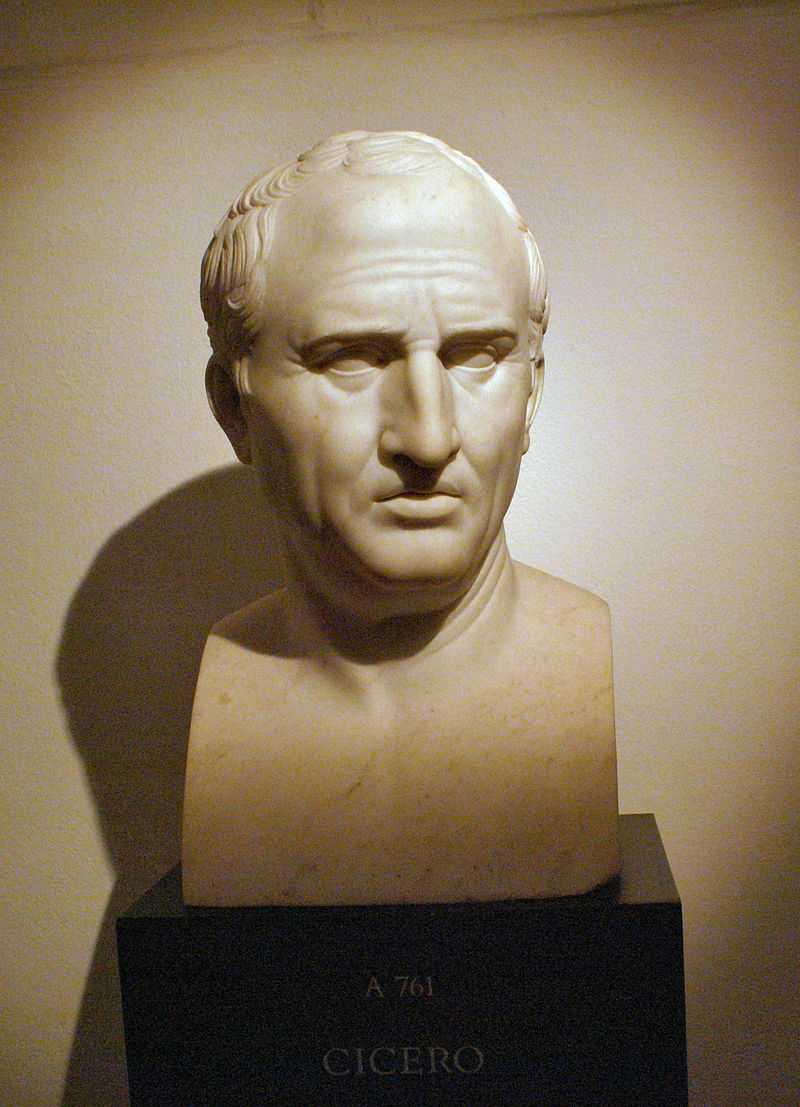
Cicero, copy by Bertel Thorvaldsen 1799-1800 of Roman bust

Are YOU Like Tiberius?

Suetonius, Life of Tiberius 70

“He pursued the liberal arts of both languages most seriously. He was a follower of Messala Corvinus when it came to Latin oratory, a man whom he had observed while an adolescent. But he used to confuse his style with such excessive affectation and officiousness that he was considered more effective as an extemporaneous speaker than a prepared one.

He also wrote a lyric poem which had the title “A Lament on the Death of Lucius Caesar.” When he composed Greek poems, he imitated Euphorion, Rhianus, and Parthenius, those poets whose writing he liked most of all, and he placed their portraits in the public libraries among the older, famous authors. For this reason, many of the learned men of the time were in a competition dedicating many books about these men to Tiberius.

Still, he took the greatest care in knowledge of the stories of myth, to the point of absurdity and silliness. For he even used to quiz the grammarians, a class of men whom, as I said, he was really preoccupied with, posing questions like: “Who was the mother of Hecuba?” “What name did Achilles have among the girls?” “What were the Sirens accustomed to singing?”

LXX. Artes liberales utriusque generis studiosissime coluit. In oratione Latina secutus est Corvinum Messalam, quem senem adulescens observarat. Sed adfectatione et morositate nimia obscurabat stilum, ut aliquanto ex tempore quam a cura praestantior haberetur. Composuit et carmen lyricum, cuius est titulus “Conquestio de morte L. Caesaris.” Fecit et Graeca poemata imitatus Euphorionem et Rhianum et Parthenium, quibus poetis admodum delectatus scripta omnium et imagines publicis bibliothecis inter veteres et praecipuos auctores dedicavit; et ob hoc plerique eruditorum certatim ad eum multa de his ediderunt.3Maxime tamen curavit notitiam historiae fabularis usque ad ineptias atque derisum; nam et grammaticos, quod genus hominum praecipue, ut diximus, appetebat, eius modi fere quaestionibus experiebatur: “Quae mater Hecubae, quod Achilli nomen inter virgines fuisset, quid Sirenes cantare sint solitae.”


 Kongelige Bibliotek, Gl. kgl. S. 3466 8º, Folio 37r

Infants, Trees, and Knowledge of the Good

Seneca, EM 125 7-9

“We say that being happy is what follows nature. And, moreover, what is according to nature is clear and obvious just as something that is complete is. That which is according to nature, what we touch at birth, I say is not the good but the beginning of the good. 

You attribute the highest good–pleasure–to infants so that at the moment of birth a baby starts where the perfected adult should end. You place the branch in the root’s position! If anyone should claim that that child, hidden in the maternal womb, with unclear gender, tender, incomplete, and unshaped, that this child is already in some true good, then they  would clearly seem to be lost in their ideas.

And yet how small is the difference between one who has just entered life and one who is still a hidden burden to their mother’s womb! They are equally knowing of the good and equally mature; An infant is no more conscious of the Good than a tree or any other speechless creature.”

Dicimus beata esse, quae secundum naturam sint, Quid autem secundum naturam sit, palam et protinus apparet, sicut quid sit integrum. Quod secundum naturam est, quod contigit protinus nato, non dico bonum, sed initium boni. Tu summum bonum, voluptatem, infantiae donas, ut inde incipiat nascens, quo consummatus homo pervenit. 

Cacumen radicis loco ponis. Si quis diceret illum in materno utero latentem, sexus quoque incerti,tenerum et inperfectum et informem iam in aliquo bono esse, aperte videretur errare. Atqui quantulum interest inter eum, qui cum1 maxime vitam accipit, et illum, qui maternorum viscerum latens onus est? Uterque, quantum ad intellectum boni ac mali, aeque maturus est, et non magis infans adhuc boni capax est quam arbor aut mutum aliquod animal.

Infant and Skull, Medieval, Louvre

Play, Work, and Death

In the three disparate pieces below, female gatherings occasion song-singing or song-making:  an ancient Greek children’s game; a Sappho fragment modeled on a work song; and a lyric poem by the Hellenistic writer Callimachus. 

The paradigmatic “women’s work” of weaving and sewing links them all. 

And so too does loss, which perhaps should be considered a paradigmatic female experience in the period. Here we see a young girl playing at being a woman whose son has died; then, a mother losing her daughter to Aphrodite (and by extension, to marriage); and finally, a circle of female friends losing one of their number to death. 

Young girls at play (Campbell 876)

The “Tor-i-Tortoise” is a young girls’ game, similar to [a boys’ game] the “Pot.” Here, a girl sits down and is called “tortoise” as the other girls go around her in a circle, asking: 

<group of girls> Tor-i-tortoise, why are you in the middle?
<girl in the middle> I was weaving wool and Milesian thread.
<group of girls>And your son, how did he die?
<girl in the middle> He jumped from his white horses into the sea!

ἡ δὲ χελιχελώνη, παρθένων ἐστὶν ἡ παιδιά, παρόμοιόν τι ἔχουσα τῇ χύτρᾳ· ἡ μὲν γὰρ κάθηται καὶ καλεῖται χελώνη, αἱ δὲ περιτρέχουσιν ἀνερωτῶσαι·

   χελιχελώνα, τί ποιεῖς ἐν τῷ μέσῳ;
ἡ δὲ ἀποκρίνεται
ἔρια μαρύομαι καὶ κρόκαν Μιλησίαν.
εἶτ᾿ ἐκεῖναι πάλιν ἐκβοῶσιν
ὁ δ᾿ ἔκγονός σου τί ποιῶν ἀπώλετο;
ἡ δέ φησι
λευκᾶν ἀφ᾿ ἵππων εἰς θάλασσαν ἅλατο

Mother and daughter at work (Sappho Fr.102)

Sweet mother, I can’t weave at the loom
Broken by longing for the slender boy.
Aphrodite’s to blame!

γλύκηα μᾶτερ, οὔτοι δύναμαι κρέκην τὸν ἴστον
πόθῳ δάμεισα παῖδος βραδίναν δι’ Ἀφροδίταν

A circle of friends (Callimachus 7.459)

Crethis—
A font of stories, that girl.
Known for good banter.
Samian girls often look for her,
Their sweetest sewing-mate
And chatty all the time.
Well, here she is—
Sleeping the Sleep that comes to all girls.

Κρηθίδα τὴν πολύμυθον ἐπισταμένην καλὰ παίζειν
δίζηνται Σαμίων πολλάκι θυγατέρες,
ἡδίστην συνέριθον ἀεὶ λάλον: ἣ δ᾽ ἀποβρίζει
ἐνθάδε τὸν πάσαις ὕπνον ὀφειλόμενον.

Terracotta oil flask. C.550-530 BC. Attributed to the Amasis Painter.
The vase depicts women at work, and most visible here is the central image of women at an upright loom.
Metropolitan Museum of Art.

Larry Benn has a B.A. in English Literature from Harvard College, an M.Phil in English Literature from Oxford University, and a J.D. from Yale Law School. Making amends for a working life misspent in finance, he’s now a hobbyist in ancient languages and blogs at featsofgreek.blogspot.com.

The Dangers of Anarchy and Loving Humanity

Pythagoras, fr. b (58D.4) 4.1.49 (Frag. 35 Wehrli)

“Generally, they believed that it was necessary to posit that there is no greater evil than anarchy, since a human being cannot naturally save themselves when no one is watching over them. This is what they used to say then about those who rule and those who are ruled.

They used to claim that those who rule must not only have knowledge but also a love of humanity and that those who are ruled must not only obey but they should love their rulers. And they also believed that people at every age should practice: children practice reading and writing and other kinds of knowledge; adolescents learn the customs and laws of the state; adults focus on the actions and politics of their communities.

They believed that the aged should spend their time exhorting people, framing rules and giving advice with all of the knowledge they have gained, not to act foolishly like babies, nor adolescents like children, nor adults like adolescents, nor should the elderly act like crazy people.”

καθόλου δὲ ᾤοντο δεῖν ὑπολαμβάνειν μηδὲν εἶναι μεῖζον κακὸν ἀναρχίας· οὐ γὰρ πεφυκέναι τὸν ἄνθρωπον διασῴζεσθαι μηδενὸς ἐπιστατοῦντος. περὶ δὲ ἀρχόντων καὶ ἀρχομένων οὕτως ἐφρόνουν, τοὺς μὲν γὰρ ἄρχοντας ἔφασκον οὐ μόνον ἐπιστήμονας ἀλλὰ καὶ φιλανθρώπους δεῖν εἶναι, καὶ τοὺς ἀρχομένους οὐ μόνον πειθηνίους ἀλλὰ καὶ φιλάρχοντας. ἐπιμελητέον δὲ πάσης ἡλικίας ἡγοῦντο, καὶ τοὺς μὲν παῖδας ἐν γράμμασι καὶ τοῖς ἄλλοις μαθήμασιν ἀσκεῖσθαι, τοὺς δὲ νεανίσκους τοῖς τῆς πόλεως ἔθεσί τε καὶ νόμοις γυμνάζεσθαι, τοὺς δὲ ἄνδρας ταῖς πράξεσί τε καὶ δημοσίαις λειτουργίαις προσέχειν. τοὺς δὲ πρεσβύτας ἐνθυμήσεσι καὶ κριτηρίοις καὶ συμβουλίαις δεῖν ἐναναστρέφεσθαι μετὰ πάσης ἐπιστήμης ὑπελάμβανον, ὅπως μήτε οἱ παῖδες νηπιάζοιεν, μήτε οἱ νεανίσκοι παιδαριεύοιντο, μήτε οἱ ἅνδρες νεανιεύοιντο, μήτε οἱ γέροντες παραφρονοῖεν.

Ashlar of Pythagoras in Ulm Minster by Jörg Syrlin the Elder

The Wakeful Mind and Happiness

Cicero, De Finibus 5. 87

“For this reason we must examine whether or not it is possible for the study of the philosophers to bring us [happiness].”

Quare hoc videndum est, possitne nobis hoc ratio philosophorum dare.


Aristotle, Eudemian Ethics, 2.1 (1219a25)

“Let the work of the mind be the performance of life—and what this means is using life and being awake (for sleep is some kind of a rest and cessation of life). As a result, since the work of the mind and its virtue are identical, then the work of virtue is an earnest life.

This, then, is the complete good, which is itself happiness. For it is clear from what we have argued—as we said that happiness was the best thing; the goals and the greatest of the goods are in the mind, but aspects of the mind are either a state of being or an action—it is clear that, since an action is better than a state and the best action is better than the best state, that the performance of virtue is the greatest good of the mind. Happiness, then, is the action of a good mind.”

Ἔτι ἔστω ψυχῆς ἔργον τὸ ζῆν ποιεῖν, τοῦτοχρῆσις καὶ ἐγρήγορσις (ὁ γὰρ ὕπνος ἀργία τις καὶ ἡσυχία)· ὥστ᾿ ἐπεὶ τὸ ἔργον ἀνάγκη ἓν καὶ ταὐτὸ εἶναι τῆς ψυχῆς καὶ τῆς ἀρετῆς, ἔργον ἂν εἴη τῆς ἀρετῆς ζωὴ σπουδαία.

τοῦτ᾿ ἄρ᾿ ἐστὶ τὸ τέλεον ἀγαθόν, ὅπερ ἦν ἡ εὐδαιμονία. δῆλον δὲ ἐκ τῶν ὑποκειμένων (ἦν μὲν γὰρ ἡ εὐδαιμονία τὸ ἄριστον, τὰ δὲ τέλη ἐν ψυχῇ καὶ τὰ ἄριστα τῶν ἀγαθῶν, τὰ ἐν αὐτῇ δὲ ἢ ἕξις ἢ ἐνέργεια), ἐπεὶ βέλτιον ἡ ἐνέργεια τῆς διαθέσεως καὶ τῆς βελτίστης ἕξεως ἡ βελτίστη ἐνέργεια ἡ δ᾿ ἀρετὴ βελτίστη ἕξις, τὴν τῆς ἀρετῆς ἐνέργειαν τῆς ψυχῆς ἄριστον εἶναι. ἦν δὲ καὶ ἡ εὐδαιμονία τὸ ἄριστον· ἔστιν ἄρα ἡ εὐδαιμονία ψυχῆς ἀγαθῆς ἐνέργεια.

ψυχή: can be translated into English as “spirit” or “soul” instead of “mind”. I avoided the former to sidestep the implication that Aristotle is making some kind of a mystical argument; I avoided the latter because it has such strong religious associations in English.

Seneca De Beneficiis 22

“A just reason for happiness is seeing that a friend is happy—even better, is to make a friend happy.”

iusta enim causa laetitiae est laetum amicum videre, iustior fecisse

Image result for medieval manuscript philosophy happiness
Ms 3045 fol.22v Boethius with the Wheel of Fortune, from ‘De Consolatione Philosophiae’, translated by Jean de Meung

Put the Living in Your Head and STFU About the Dead

Erasmus, Adagia 152

It is proper to remember the living. This is an old adage directed at those who talk excessively about the dead. It is commonly thought to be a bad omen to have the dead one the tip of one’s tongue and to bring them forth and cite them in speech. For this reason M. Varro in Book 3 of On the Latin Language thinks that letum (death) is derived ἀπὸ τῆς λήθης, that is from forgetting, as if to suggest that it is proper for one to move into oblivion once they have died. In funerals, it was once customary to hear from the announcet: “He has been given to death.” 

The adage is related by Cicero in his On the Ends of Good and Evil. There, when Piso and then Quintus Cicero have said that they are violently moved by the recollection of famous men from the contemplation of the places in which they had at some time been when they were alive, and when each of them decided by whose memory they were delighted the most, Pomponius Atticus added as if joking, ‘But I, whom you are accustomed to upbraiding as totally given over to Epicurus, am much more in the camp of Phaedrus, whom I esteem foremost, as you know, in the gardens of Epicurus, which we were just passing, but I remember the living in accordance with the advice of the ancient proverb: yet I could not forget Epicurus if I wanted to, since our closest friends have his image not just on tablets, but even on their cups and rings.’ So much for Cicero.

Similarly, Plautus in his Truculentus

You may know a person while they live; once they are dead, you should remain silent.

But now the rabble doesn’t even remember the good deeds of friends, since this saying of Thales is rightly celebrated, that it is proper to be mindful no less of absent friends than of present ones.

Vivorum meminisse oportet. Vetus adagium in eos, qui plurimum de vita defunctis loquuntur, id quod vulgo putant ominosum mortuos in ore habere eosque ut velut citatos in sermonem adducere. Unde et M. Varro libro De lingua Latina tertio putat lethum ἀπὸ τῆς λήθης, id est oblivione dictum, quasi in oblivionem abire conveniat, qui vita excesserit, atque in funeribus sic quondam a praecone dici solere: Ollus letho datus est. Refertur adagium a Cicerone libro quinto De finibus bonorum et malorum. Ubi cum Piso, deinde Q. Cicero dixissent se vehementer commoveri recordatione clarorum virorum ex contemplatione locorum in quibus aliquando vivi versati fuissent, et uterque recensuisset, quorum memoria potissimum delectaretur, tum Pomponius Atticus quasi iocans: At ego, inquit, quem vos ut deditum Epicuro insectari soletis, sum multum equidem cum Phaedro, quem unice diligo, ut scitis, in Epicuri hortis, quos modo praeteribamus, sed veteris proverbii admonitu vivorum memini; nec tamen Epicuri licet oblivisci, si cupiam, cuius imaginem non modo in tabulis nostri familiares, sed etiam in poculis et anulis habent. Hactenus Cicero. Plautus item in Truculento:

Dum vivit, hominem noveris; dum mortuus est, quiescas.

At nunc vulgus ne beneficium quidem amicorum meminit, cum Thaletis dictum iure celebretur oportere non minus absentium amicorum quam praesentium memores esse.

Biological Warfare in Ancient Greece

Suda, sigma 777

Solon: They [the Amphiktyones] selected this man to be their adviser for war against the Kirrhaians. When they were consulting the oracle about victory, the Pythia said: “you will not capture and raze the tower of this city before the wave of dark-eyed Amphitritê washes onto my precinct as it echoes over the wine-faced sea.”

Solon persuaded them to make Kirrhaia sacred to the god so that the sea would become a neighbor to Apollo’s precinct. And another strategy was devised by Solon against the Kirrhaians. For he turned a river’s water which used to flow in its channel into the city elsewhere.

The Kirrhaians withstood the besiegers by drinking water from wells and from rain. But [Solon] filled the river with hellebore roots and when he believed the water had enough of the drug, he returned it to its course. Then the Kirrhaians took a full portion of this water. And when they went AWOL because of diarrhea, the Amphiktyones who were stationed near the wall took it and then the city.”

Σόλων: τοῦτον εἵλοντο οἱ Κιρραίοις πολεμεῖν ᾑρημένοι σύμβουλον. χρωμένοις δὲ σφίσι περὶ νίκης ἀνεῖπεν ἡ Πυθώ: οὐ πρὶν τῆσδε πόληος ἐρείψετε πύργον ἑλόντες, πρίν κεν ἐμῷ τεμένει κυανώπιδος Ἀμφιτρίτης κῦμα ποτικλύζοι, κελαδοῦν ἐπὶ οἴνοπα πόντον. ἔπεισεν οὖν ὁ Σόλων καθιερῶσαι τῷ θεῷ τὴν Κίρραιαν, ἵνα δὴ τῷ τεμένει τοῦ Ἀπόλλωνος γένηται γείτων ἡ θάλαττα. εὑρέθη δὲ καὶ ἕτερον τῷ Σόλωνι σόφισμα ἐς τοὺς Κιρραίους: τοῦ γὰρ ποταμοῦ τὸ ὕδωρ ῥέον δι’ ὀχετοῦ ἐς τὴν πόλιν ἀπέστρεψεν ἀλλαχόσε. καὶ οἱ μὲν πρὸς τοὺς πολιορκοῦντας ἔτι ἀντεῖχον ἔκ τε φρεάτων καὶ τὸ ὕδωρ τὸ ἐκ θεοῦ πίνοντες. ὁ δὲ τοῦ ἑλλεβόρου τὰς ῥίζας ἐμβαλὼν ἐς τὸν ποταμόν, ἐπειδὴ ἱκανῶς τοῦ φαρμάκου τὸ ὕδωρ ᾔσθετο ἔχον, ἀντέστρεψεν αὖθις ἐς τὸν ὀχετόν, καὶ ἐνεφορήσαντο ἀνέδην οἱ Κιρραῖοι τοῦ ὕδατος. καὶ οἱ μὲν ὑπὸ τῆς διαρροίας ἐξέλιπον, οἱ δὲ ἐπὶ τοῦ τείχους τῆς φρουρᾶς Ἀμφικτύονες εἷλον τὴν φρουρὰν καὶ τὴν πόλιν.

Image result for medieval manuscript diarrhea
Roman d’Alexandre, Tournai 1338-1344.

From Apollonios Paradoxographus

“In his work On Plants, in the last part of the material, Theophrastos says that Eunomos, the Khian and purveyor of drugs, did not [cleanse himself/die] while drinking many draughts of hellebore. Once, even, when together with his fellow craftsmen he took over 22 drinks in one day as he sat in the agora and he did not return from his implements. Then he left to wash and eat, as he was accustomed, and did not vomit. He accomplished this after being in this custom for a long time, because he started from small amounts until he got to so many large ones. The powers of all drugs are less severe for those used to them and for some they are even useless.”

50 Θεόφραστος ἐν τῷ περὶ φυτῶν, ἐν τῇ ἐσχάτῃ τῆς πραγματείας· Εὔνομος, φησίν, ὁ Χῖος, ὁ φαρμακοπώλης, ἐλλεβόρου πίνων πλείονας πόσεις οὐκ ἐκαθαίρετο. καὶ ποτέ, ἔφη, ἐν μιᾷ ἡμέρᾳ συνθέμενος τοῖς ὁμοτέχνοις περὶ δύο καὶ εἴκοσι πόσεις ἔλαβεν ἐν τῇ ἀγορᾷ καθήμενος καὶ οὐκ ἐξανέστη ἀπὸ τῶν σκευῶν <μέχρι δείλης>. τότε δ’ ἀπῆλθεν λούσασθαι καὶ δειπνῆσαι, ὥσπερ εἰώθει, καὶ οὐκ ἐξήμεσεν.

 τοῦτο δὲ ἔπραξεν ἐν πολυχρονίῳ συνηθείᾳ γεγονώς, ἀρξάμενος ἀπὸ ὀλίγων ἕως τοσούτων πόσεων. πάντων δὲ τῶν φαρμάκων αἱ δυνάμεις ἀσθενέστεραι τοῖς συνειθισμένοις, ἐνίοις δὲ καὶ ἄπρακτοί εἰσιν.