Poets in the Posse, Entertainers in the Entourage

Pausanias, Description of Greece 1.2

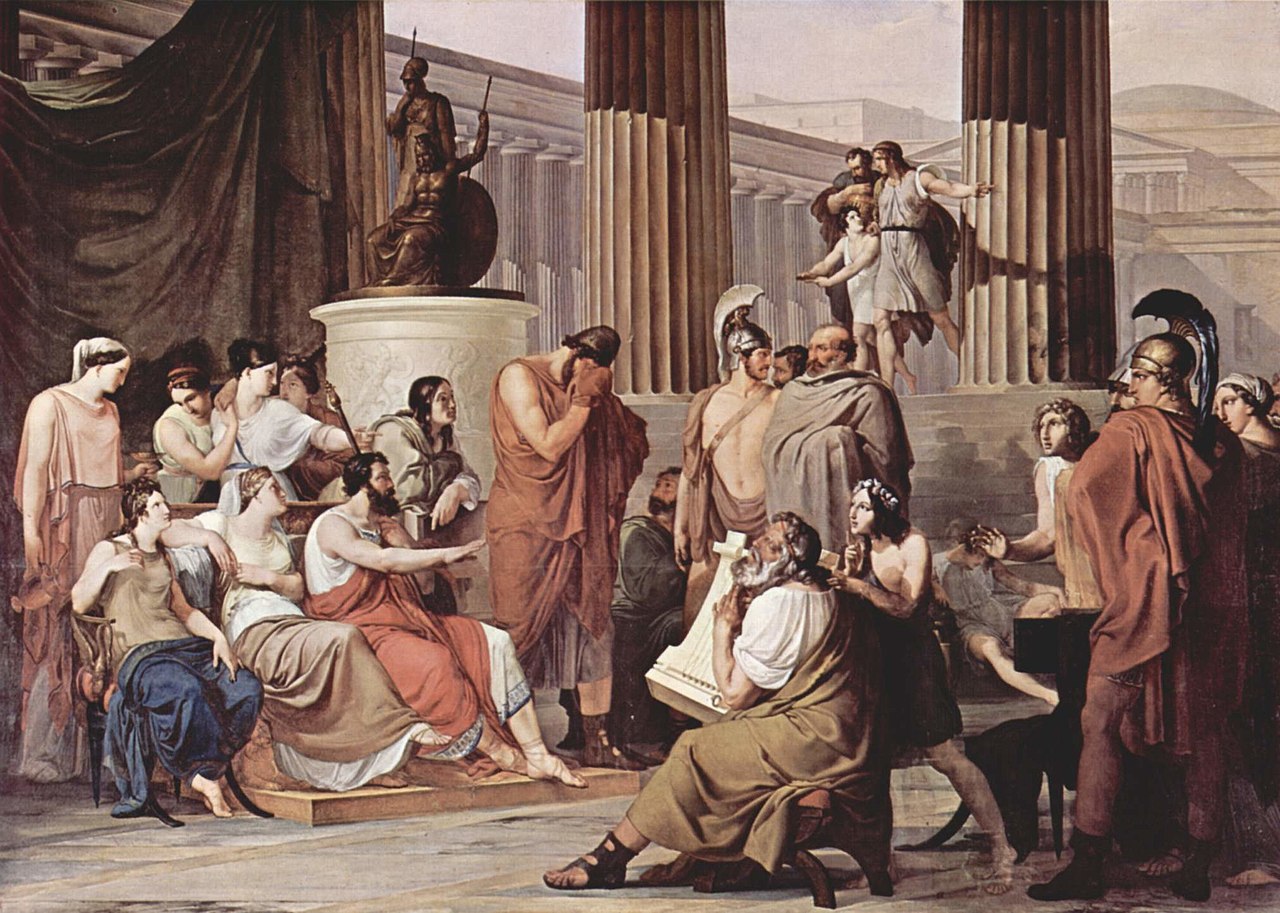
“At that time, poets spent their time among kings, and even earlier Anacreon found himself at the court of Polycrates of Samos, and  both Aeschylus and Simonides went to Syracuse to visit Hiero. Philoxenus spent time with Dionysius, who was later tyrant in Sicily, while both Antagoras of Rhodes and Aratus of Soli kept company with Antigonus when he ruled the Macedonians. Either Hesiod and Homer happened not to chance upon any kings, or they willingly despised them; Hesiod would have done so from his innate rusticity and aversion to traveling, while Homer spent a lot of time abroad and set the aid accruing to him from the wealth of the powerful at less than the good opinion from the people, since we find even among Homer that Demodocus spent time in the court of Alcinous, and Agamemnon left behind a poet with his wife. There is a grave not far from the gates, on which there is a depiction of a soldier standing next to a horse: I don’t know who it is, but Praxiteles carved both the horse and the soldier.”

Francesco Hayez, Odysseus at the Court of Alcinous

συνῆσαν δὲ ἄρα καὶ τότε τοῖς βασιλεῦσι ποιηταὶ καὶ πρότερον ἔτι καὶ Πολυκράτει Σάμου τυραννοῦντι Ἀνακρέων παρῆν καὶ ἐς Συρακούσας πρὸς Ἱέρωνα Αἰσχύλος καὶ Σιμωνίδης ἐστάλησαν: Διονυσίῳ δέ, ὃς ὕστερον ἐτυράννησεν ἐν Σικελίᾳ, Φιλόξενος παρῆν καὶ Ἀντιγόνῳ Μακεδόνων ἄρχοντι Ἀνταγόρας Ῥόδιος καὶ Σολεὺς Ἄρατος. Ἡσίοδος δὲ καὶ Ὅμηρος ἢ συγγενέσθαι βασιλεῦσιν ἠτύχησαν ἢ καὶ ἑκόντες ὠλιγώρησαν, ὁ μὲν ἀγροικίᾳ καὶ ὄκνῳ πλάνης, Ὅμηρος δὲ ἀποδημήσας ἐπὶ μακρότατον καὶ τὴν ὠφέλειαν τὴν ἐς χρήματα παρὰ τῶν δυνατῶν ὑστέραν θέμενος τῆς παρὰ τοῖς πολλοῖς δόξης, ἐπεὶ καὶ Ὁμήρῳ πεποιημένα ἐστὶν Ἀλκίνῳ παρεῖναι Δημόδοκον καὶ ὡς Ἀγαμέμνων καταλείποι τινὰ παρὰ τῇ γυναικὶ ποιητήν. —ἔστι δὲ τάφος οὐ πόρρω τῶν πυλῶν, ἐπίθημα ἔχων στρατιώτην ἵππῳ παρεστηκότα: ὅντινα μέν, οὐκ οἶδα, Πραξιτέλης δὲ καὶ τὸν ἵππον καὶ τὸν στρατιώτην ἐποίησεν.

Maybe it’s the Medizing, Maybe it’s the Wine

Aelian, Historical Miscellany 9.41

They say that Simonides of Ceos and Pausanias the Spartan were once at a dinner party together, and when Pausanias urged Simonides to say something wise, that man of Ceos laughed and said, ‘Remember that you are just human.’ Pausanias paid little heed to this thought then, and set it down as essentially worthless, perhaps because he was already blinded by his eagerness for Medizing, or perhaps it is just as likely that he was carried away by the wine. But when it happened that he was in the Bronze House of Athena, struggling with hunger and about to die in the most wretched way possible, he remembered what old Simonides had said and cried out three times, ‘O stranger from Ceos, your advice was a great thing to have, but in my folly I thought that it was nothing.’

“I wish I hadn’t been so drunk that night…”

῎Εν τινί φασι συνδείπνῳ παρῆν Σιμωνίδης ὁ Κεῖος καὶ Παυσανίας ὁ Λακεδαιμόνιος. προσέταξεν οὖν ὁ Παυσανίας τῷ Σιμωνίδῃ σοφόν τι εἰπεῖν, ὃ δὲ γελάσας ὁ Κεῖος ‘μέμνησο’ εἶπεν ‘ἄνθρωπος ὤν.’ τοῦτο παραχρῆμα μὲν ἐξεφαύλισε Παυσανίας καὶ παρ’ οὐδὲν ἔθετο, ὑποτυφόμενος ἤδη ἐς τὸν τοῦ μηδίζειν ἔρωτα, καὶ μεγαλοφρονῶν ἐπὶ τῇ πρὸς βασιλέα ξενίᾳ, ἴσως δὲ καὶ ὑπὸ τοῦ οἴνου παραφερόμενος. ἐπεὶ δὲ ἦν πρὸς τῇ Χαλκιοίκῳ, καὶ διεπάλαιε τῷ λιμῷ καὶ ἔμελλεν ἀποθνήσκειν ἀνθρώπων ἀλγεινότατα, ἀλλὰ τηνικαῦτα ἐμνήσθη τοῦ Σιμωνίδου καὶ ἐξεβόησεν ἐς τρὶς ‘ὦ ξένε Κεῖε, μέγα τι ἄρα χρῆμα ἦν ὁ λόγος σου, ἐγὼ δὲ ὑπ’ ἀνοίας οὐδὲν αὐτὸν ᾤμην εἶναι.’

Hunting, Leaping, and Drunk on Love

Anacreon, fr. 357

“Lord with whom Lust the subduer
And the dark-eyed nymphs
And royal Aphrodite play
As you roam the high mountain peaks.

I beg you:
come to me kindly
Hear my prayer made pleasing to you:

Be a good advisor to Kleoboulos,
Dionysus, that he accept
My desire.

ὦναξ, ὧι δαμάλης ῎Ερως
καὶ Νύμφαι κυανώπιδες
πορφυρῆ τ’ ᾿Αφροδίτη
συμπαίζουσιν, ἐπιστρέφεαι
δ’ ὑψηλὰς ὀρέων κορυφάς·

γουνοῦμαί σε, σὺ δ’ εὐμενὴς
ἔλθ’ ἡμίν, κεχαρισμένης
δ’ εὐχωλῆς ἐπακούειν·
Κλεοβούλωι δ’ ἀγαθὸς γένεο
σύμβουλος, τὸν ἐμόν γ’ ἔρω-
τ’, ὦ Δεόνυσε, δέχεσθαι.

fr. 358

“Again! Golden-haired Desire
Strikes me with a purple ball
Calling me out to play
With a fine-sandaled youth

But she is from well-settled
Lesbos and she carps at my hair,
Because it is white. So she stares at
Some other [hair] instead.”*

σφαίρηι δηὖτέ με πορφυρῆι
βάλλων χρυσοκόμης ῎Ερως
νήνι ποικιλοσαμβάλωι
συμπαίζειν προκαλεῖται·

ἡ δ’, ἐστὶν γὰρ ἀπ’ εὐκτίτου
Λέσβου, τὴν μὲν ἐμὴν κόμην,
λευκὴ γάρ, καταμέμφεται,
πρὸς δ’ ἄλλην τινὰ χάσκει.

*The Greek ἄλλην τινὰ may mean “some other girl” as the Loeb translation has it. But the structure of the sentence makes me think the girl is staring at different hair (not the narrator’s white hair).

fr. 359

“I long for Kleoboulos.
I am crazy for Kleoboulos.
I am staring at Kleoboulos.”

Κλεοβούλου μὲν ἔγωγ’ ἐρέω,
Κλεοβούλωι δ’ ἐπιμαίνομαι,
Κλεόβουλον δὲ διοσκέω.


fr. 360

“Boy with a maiden’s looks—
I am hunting you, but you don’t hear me
Because you do not know
That you are the charioteer of my soul”

ὦ παῖ παρθένιον βλέπων
δίζημαί σε, σὺ δ’ οὐ κλύεις,
οὐκ εἰδὼς ὅτι τῆς ἐμῆς
ψυχῆς ἡνιοχεύεις.


fr. 377

“Ah, I climbed up again and leapt
From the Leucadian Cliff into the grey wave,
Drunk with longing.”

ἀρθεὶς δηὖτ’ ἀπὸ Λευκάδος
πέτρης ἐς πολιὸν κῦμα κολυμβῶ μεθύων ἔρωτι.


fr. 378

“I am springing up to Olympos on light wings
Because of Desire—for [no one] wants to enjoy youth with me”

ἀναπέτομαι δὴ πρὸς ῎Ολυμπον πτερύγεσσι κούφηις
διὰ τὸν ῎Ερωτ’· οὐ γὰρ ἐμοὶ <> θέλει συνηβᾶν.


fr. 389

“Since you’re a friendly girl to strangers, allow me to drink because I’m thirsty”

φίλη γάρ εἰς ξείνοισιν· ἔασον δέ με διψέοντα πιεῖν.


Image result for ancient greek anacreon
Anacreon, Verso.


Likemindedness and Trees: An Excerpt from a Wedding Homily for Valentine’s Day

Late in 2021, I had the great honor of being asked to preside over the wedding of a former student and friend, Zach as he married his long time partner, Molly. In the midst of COVID19 still and all the chaos in the world, it was a moment of respite and celebration and a sign that life continues on. Here’s the better part of it to mark a commercial holiday with all the meaning that we make of it.

Welcome friends, family, and all of you who gather today to celebrate Molly and Zack. After nearly two years of uncertainty and fear, there are few things more life affirming and hopeful than this–two people confirming their love for each other and asking their community to stand with them to recognize that in a shifting and unsettled world, this is something to count on.

As a sage once said, how did we get here? When Zach first asked me before the Pandemic to officiate I said yes without hesitation–not because I have any authority or experience in doing so, but because I can think of an honor no greater than this, to stand here and help Molly and Zach speak into existence something they made for themselves, something to shape, define and comfort them for the rest of their lives. 

As is the custom with these things, I am in a position to offer some reflection and advice to the soon to be wed couple on what marriage means. Three short stories; three things to think about: politics, passion, and age.

I was Zach’s teacher in the Department of Brandeis University in the Department of Classical Studies. I used to joke to Zach that the nicest thing said about marriage in all of classical literature comes in Homer’s Odyssey when Odysseus, naked and bedraggled, gives a blessing to the young princess Nausikaa

“May the gods grant as much as you desire in your thoughts,
A husband and home, and may they give you fine likemindness,
For nothing is better and stronger than this
When two people who are likeminded in their thoughts share a home,
A man and a wife—this brings many pains for their enemies
And joys to their friends. And the gods listen to them especially”

σοὶ δὲ θεοὶ τόσα δοῖεν ὅσα φρεσὶ σῇσι μενοινᾷς,
ἄνδρα τε καὶ οἶκον, καὶ ὁμοφροσύνην ὀπάσειαν
ἐσθλήν: οὐ μὲν γὰρ τοῦ γε κρεῖσσον καὶ ἄρειον,
ἢ ὅθ᾽ ὁμοφρονέοντε νοήμασιν οἶκον ἔχητον
ἀνὴρ ἠδὲ γυνή: πόλλ᾽ ἄλγεα δυσμενέεσσι,
185χάρματα δ᾽ εὐμενέτῃσι, μάλιστα δέ τ᾽ ἔκλυον αὐτοί. 6. Od. 180-185

Doesn’t this sound great! The  lesson here, it’s a political one, the promise of the married couple working as a team to achieve their goals and punish all those who oppose them.  But there’s a limit too-a close reading shows that homophrosyne, likemindedness, means having shared aims and plans, but it really looks externally, to surviving the world outside the home.

If the Odyssey tells us about the politics of marriage, and dominating your neighbors, another famous story is about passion. Ovid’s Metamorphoses gives us the Babylonian Pyramus and Thisbe. Two young lovers, forbidden to be with each other, housed right next door. When they sneak out to meet, Thisbe runs from a lioness and leaves her veil behind only to have Pyramus arrive to see what he thinks is a predator with a bloody grin. The two end up taking their own lives in sorrow and inspiring tales like Romeo and Juliet. 

Pyramus and Thisbe, House of Dionysus

This story is in a way an warning allegory about passion and excess–it reflects the kind of love that burns bright and then fades. The frantic love of youth is a memory. It inflames, but is hard to sustain.

The one story from the ancient world that has always seemed to me to understand love the most is Baucis and Philemon, also told by Ovid. They were an aging couple in a wicked city and when the gods came to test them, they were the only ones who offered strangers hospitality. In thanks, Hermes and Zeus turned their home into a temple and when they died, they turned into two trees, rooted near each other, and over time they grew so intertwined that you couldn’t tell where one started and the other ended but you could still clearly see the wood and character of each tree.

Jan van den Hoecke, “Peasants Philemon and Baucis visited by Jupiter and Mercury.”

This too is an allegory for love: the way people grow together and change, shaping and shaped in turn, creating a life and story that is so intertwined that you cannot remember where one starts and the other ends. As I have learned in spending more than half my life with my partner, few gifts are more comforting and sustaining, to be part of something bigger while still yet becoming yourself. Passion inspires us to love; life requires us to team up and face the daily struggle, age and the passage of time brings this great, unexpected gift: becoming more than yourself by loving someone else.

May you bring joy to your friends and eliminate your enemies, may you feel the passion of youth for as long as it burns, and may you grow so close and strong together that no power on earth can move you apart.


I am presiding over another wedding this spring (!) and will have to come up with new stories to tell. 

“The One You Love”: The Best Love Poem Ever

Sappho, fr. 16

Some say a force of horsemen, some say infantry
and others say a fleet of ships is the loveliest
thing on the dark earth, but I say it is
the one you love

It is altogether simple to make this understood
since she whose beauty outmatched all,
Helen, left her husband
a most noble man

And went sailing to Troy
Without a thought for her child and dear parents
[Love] made her completely insane
And led her astray

This reminds me of absent Anaktoria

I would rather watch her lovely walk
and see the shining light of her face
than Lydian chariots followed by
infantrymen in arms

Οἰ μὲν ἰππήων στρότον, οἰ δὲ πέσδων,
οἰ δὲ νάων φαῖσ’ ἐπὶ γᾶν μέλαιναν
ἔμμεναι κάλλιστον, ἐγὼ δὲ κῆν’ ὄτ-
τω τις ἔραται

πά]γχυ δ’ εὔμαρες σύνετον πόησαι
πά]ντι τ[οῦ]τ’· ἀ γὰρ πολὺ περσκέθοισα
κά]λλος ἀνθρώπων Ἐλένα [τὸ]ν ἄνδρα
τὸν πανάριστον
/ [κρίννεν ἄρ]ιστον

καλλίποισ’ ἔβας ‘ς Τροίαν πλέοισα
/ ὂσ τὸ πὰν] σέβασ τροΐα[σ ὄ]λεσσ[ε,
κωὐδὲ παῖδος οὐδὲ φίλων τοκήων
πάμπαν ἐμνάσθη, ἀλλὰ παράγαγ’ αὔταν
οὐκ ἀέκοισαν
/ πῆλε φίλει]σαν

Κύπρις· εὔκαμπτον γὰρ ἔφυ βρότων κῆρ
] κούφως τ . . . οη . . . ν
κἄμε νῦν Ἀνακτορίας ὀνέμναι-
σ’ οὐ παρεοίσας

/ Ὠροσ. εὔκ]αμπτον γαρ [ἀεὶ τὸ θῆλυ]
αἴ κέ] τισ κούφωσ τ[ὸ πάρον ν]οήσῃ.
οὐ]δὲ νῦν, Ἀνακτορί[α, τ]ὺ μέμναι
δὴ] παρειοῖσασ,

τᾶς κε βολλοίμαν ἔρατόν τε βᾶμα
κἀμάρυχμα λάμπρον ἴδην προσώπω
ἢ τὰ Λύδων ἄρματα κἀν ὄπλοισι
πεσδομάχεντας.


petrarch1

Aelian, Fragment 187/190 (from Stobaeus 3.29.58)

“Solon the Athenian, the son of Eksêkestides, when his nephew sang some song of Sappho at a drinking party, took pleasure in it and asked the young man to teach it to him. When someone asked why he was eager to learn it, he responded: “So, once I learn it, I may die.”

Σόλων ὁ ᾿Αθηναῖος ᾿Εξηκεστίδου παρὰ πότον τοῦ ἀδελφιδοῦ αὐτοῦ μέλος τι Σαπφοῦς ᾄσαντος, ἥσθη τῷ μέλει καὶ προσέταξε τῷ μειρακίῳ διδάξει αὐτόν. ἐρωτήσαντος δέ τινος διὰ ποίαν αἰτίαν τοῦτο σπουδάσειεν, ὃ δὲ ἔφη ‘ἵνα μαθὼν αὐτὸ ἀποθάνω.’

F**k the SuperBowl – Aristotle vs. Socrates is the Match to Witness!

Petrarch, On His Own and Many Other People’s Ignorance (IV):

If I’m not mistaken, I have read all of Aristotle’s Ethics, and I even heard some of them in lectures. But before my ignorance was uncovered for all to see, I had seemed to understand a thing or two, and even appeared more learned than a few of these guys. But I did not, as was proper, find myself become a better person. I often complained to myself and others that in reality there was no fulfillment of that promise, which Aristotle himself had professed at the beginning of his Ethics, that we learn that whole branch of philosophy not for the sake of knowledge, but so that we can become good. To be sure, I see that old Aristotle defined, distinguished, and handled the subject of virtue well, and considered what was proper to virtue and what proper to vice. Since I learned all of that, I know a little bit more than I used to; but my mind is the same, my will is the same, and I am the same.

For it is one thing to know and another to love; one thing to understand and another to will. He teaches – I don’t deny it! – what virtue is. But the goads to virtue, the torches of words by which the mind if urged and inflamed to love of virtue and hatred of vice – reading Aristotle doesn’t have any of this, or has very little of it. If you want any of that stuff, you will find it in our authors, especially in Cicero and Seneca, and (though you might think it wild) even in Horace, who might have a rough pen, but is actually pretty delightful when you look at his thought.

What good will it do to know what virtue is if it isn’t loved once recognized? What good will the understanding of sin do if it isn’t shirked when recognized? I mean goddammit, if your will is depraved, the difficulty of virtue and the licentious ease of vice can impel a lazy and nodding soul into a worse state whenever it notes them. But one shouldn’t wonder if he is a bit sparing in exciting and straightening souls to virtue, since he once called Socrates, the father of ethical philosophy, a “morality merchant,” if I may use his words. And if we can trust Cicero, Aristotle even despised Socrates, though it seems that Socrates reciprocated the sentiment.**

** [This is a little hard to credit, given that Aristotle was born fifteen years after Socrates’ death. Cicero discusses enmity between Isocrates and Aristotle, so this is just a howler from half-digested reading.]

“And finally, when Aristotle is born, tell him that I hate him!”

Omnes morales, nisi fallor, Aristotilis libros legi, quosdam etiam audivi, et antequam hec tanta detegeretur ignorantia, intelligere aliquid visus eram, doctiorque his forsitan nonnunquam, sed non — qua decuit — melior factus ad me redii, et sepe mecum et quandoque cum aliis questus sum illud rebus non impleri, quod in primo Ethicorum philosophus idem ipse prefatus est, eam scilicet philosophie partem disci, non ut sciamus, sed ut boni fiamus. Video nempe virtutem ab illo egregie diffiniri et distingui tractarique acriter, et que cuique sunt propria, seu vitio, seu virtuti. Que cum didici, scio plusculum quam sciebam; idem tamen est animus qui fuerat, voluntasque eadem, idem ego.

Aliud est enim scire atque aliud amare, aliud intelligere atque aliud velle. Docet ille, non infitior, quid est virtus; at stimulos ac verborum faces, quibus ad amorem virtutis vitiique odium mens urgetur atque incenditur, lectio illa vel non habet, vel paucissimos habet. Quos qui querit, apud nostros, precipue Ciceronem atque Anneum, inveniet, et, quod quis mirabitur, apud Flaccum, poetam quidem stilo hispidum, sed sententiis periocundum.

Quid profuerit autem nosse quid est virtus, si cognita non ametur? Ad quid peccati notitia utilis, si cognitum non horretur? Imo hercle, si voluntas prava est, potest virtutum difficultas et vitiorum illecebrosa facilitas, ubi innotuerit, in peiorem partem pigrum nutantemque animum impellere. Neque est mirari si in excitandis atque erigendis ad virtutem animis sit parcior, qui parentem philosophie huius Socratem «circa moralia negotiantem», ut verbo eius utar, irriserit, et, si quid Ciceroni credimus, contempserit; quamvis eum ille non minus.

Venereal Disease? Try Venereal Death!

Ovid, Amores 2.11.21-36:

Let savage Amor break up my lazy hours of sleep, and let me not be the only burden upon my bed! Let my girlfriend wreck me with no one there to stop it. One may be enough, but if she isn’t, then two! I can handle it. My limbs are slender but not without their strength, and my body lacks mass but not sinews. Besides, the pleasure will add fuel for my strength. No girl has been fooled by my effort. Often I have consumed the time of the night lasciviously, only to wake up perfectly useful and strong in the morning.

Lucky is the one whom the mutual contests of Venus ruin! May that be the cause of my death! Let the soldier offer up his chest to the adverse slings and arrows and buy his eternal name with blood! Let the miser look for his fortune; let the sailor drink up with his treacherous mouth the waters which he wore out by ploughing. But let it fall to me to waste away in the motion of Venus, and when I die, let me go slack in the middle of the work. Then someone may say at my funeral, “At least your death was suited to your life!”

at mihi saevus amor somnos abrumpat inertes,
simque mei lecti non ego solus onus!
me mea disperdat nullo prohibente puella—
si satis una potest, si minus una, duae!
sufficiam—graciles, non sunt sine viribus artus;
pondere, non nervis corpora nostra carent;
et lateri dabit in vires alimenta voluptas.
decepta est opera nulla puella mea;
saepe ego lascive consumpsi tempora noctis,
utilis et forti corpore mane fui.
felix, quem Veneris certamina mutua perdunt!
di faciant, leti causa sit ista mei!
Induat adversis contraria pectora telis
miles et aeternum sanguine nomen emat.
quaerat avarus opes et, quae lassarit arando,
aequora periuro naufragus ore bibat.
at mihi contingat Veneris languescere motu,
cum moriar, medium solvar et inter opus;
atque aliquis nostro lacrimans in funere dicat:
‘conveniens vitae mors fuit ista tuae!’

Poetry Now!

D.H. Lawrence, Poetry of the Present:

It seems when we hear a skylark singing as if sound were running forward into the future, running so fast and utterly without consideration, straight on into futurity. And when we hear a nightingale, we hear the pause and the rich, piercing rhythm of recollection, the perfect past. The lark may sound sad, but with the lovely lapsing sadness that is almost a swoon of hope. The nightingale’s triumph is a pæan, but a death-pæan.

So it is with poetry. Poetry is, as a rule, either the voice of the far future, exquisite and ethereal, or it is the voice of the past, rich, magnificent. When the Greeks heard the Iliad and the Odyssey, they heard their own past calling in their hearts, as men far inland sometimes hear the sea and fall weak with powerful, wonderful regret, nostalgia; or else their own future rippled its time-beats through their blood, as they followed the painful, glamorous progress of the Ithacan. This was Homer to the Greeks: their Past, splendid with battles won and death achieved, and their Future, the magic wandering of Ulysses through the unknown.

With us it is the same. Our birds sing on the horizons. They sing out of the blue, beyond us, or out of the quenched night. They sing at dawn and sunset. Only the poor, shrill, tame canaries whistle while we talk. The wild birds begin before we are awake, or as we drop into dimness, out of waking. Our poets sit by the gateways, some by the east, some by the west. As we arrive and as we go out our hearts surge with response. But whilst we are in the midst of life, we do not hear them.

D. H. Lawrence, 1929

Life and the Great Game: Some Ancient Passages on Spectacles

Homer, Odyssey 8.147-8

“For as long as he lives, a man has no greater glory
than that which he wins with his own hands and feet”

οὐ μὲν γὰρ μεῖζον κλέος ἀνέρος, ὄφρα κεν ᾖσιν,
ἢ ὅ τι ποσσίν τε ῥέξῃ καὶ χερσὶν ἑῇσιν.

Diogenes Laertius, Life of Pythagoras 8.1

“Sosikrates in his Successions writes that when Pythagoras was asked by Leon the Tyrant of Plius what he was, he said “A philosopher”. And he was in the custom of comparing life to the Great Games because while some go there to compete, others go there to make money, even as some of the best go to watch. In the same way, in life, some grow up in servile positions, Pythagoras used to say, hunting for fame and profit while the philosopher hunts for the truth. That’s enough of that.”

Σωσικράτης δ᾿ ἐν Διαδοχαῖς φησιν αὐτὸν ἐρωτηθέντα ὑπὸ Λέοντος τοῦ Φλιασίων τυράννου τίς εἴη, φιλόσοφος, εἰπεῖν. καὶ τὸν βίον ἐοικέναι πανηγύρει· ὡς οὖν εἰς ταύτην οἱ μὲν ἀγωνιούμενοι, οἱ δὲ κατ᾿ ἐμπορίαν, οἱ δέ γε βέλτιστοι ἔρχονται θεαταί, οὕτως ἐν τῷ βίῳ οἱ μὲν ἀνδραποδώδεις, ἔφη, φύονται δόξης καὶ πλεονεξίας θηραταί, οἱ δὲ φιλόσοφοι τῆς ἀληθείας. καὶ τάδε μὲν ὧδε.

Tertullian, De Spectaculis

“This will be enough regarding the stained origin of games in idolatry”
Sed haec satis erunt ad originis de idololatria reatum.

102v
“How many ways have we shown that nothing which has to do with these games pleases god!”

Quot adhuc modis probavimus, nihil ex his quae spectaculis deputantur placitum deo esse!

Plutarch, Progress in Virtue 79F

Once when Aeschylus was watching a boxing match at the Isthmian games, one of the men was hit and the audience screamed out. He elbowed Ion of Chios and said, “Do you see what training is like? The man who was hit stays silent and the spectators yell!”

Αἰσχύλος μὲν γὰρ Ἰσθμοῖ θεώμενος ἀγῶνα πυκτῶν, ἐπεὶ πληγέντος τοῦ ἑτέρου τὸ θέατρον ἐξέκραγε, νύξας Ἴωνα τὸν Χῖον “ὁρᾷς,” ἔφη, “οἷον ἡ ἄσκησίς ἐστιν; ὁ πεπληγὼς σιωπᾷ, οἱ δὲ θεώμενοι βοῶσιν.”

Pindar, Nem. 4.6

“The story of deeds lives longer than deeds themselves”

ῥῆμα δ’ ἐργμάτων χρονιώτερον βιοτεύει

Cicero, De Senectute 58

“Let others have weapons, horses, spears, fencing-foils, ball games, swimming competitions, races, and leave to the old men dice and knucklebones for games. Or let that go too since old age can be happy without it.”

Sibi habeant igitur arma, sibi equos, sibi hastas, sibi clavam et pilam, sibi natationes1 atque cursus; nobis senibus ex lusionibus multis talos relinquant et tesseras; id ipsum ut2 lubebit, quoniam sine eis beata esse senectus potest.

Lucretius, De Rerum Natura 4.973-984

“And whenever people for many days in a row
Have given endless attention to games, we see that many
Have stopped actually absorbing these things with their senses
Even though there are paths still open in the mind
By which the representations of things may enter.
For many days in this way the same things are seen
Before their eyes and they stay awake so that they might seem
To see dancers moving their gentle limps
Or brush with their ears the liquid song of the lyre
And the talking chords, and to sense again that same concord
And the wild spectacular with its bright scene.”

Et quicumque dies multos ex ordine ludis
adsiduas dederunt operas, plerumque videmus,
cum iam destiterunt ea sensibus usurpare,
relicuas tamen esse vias in mente patentis,
qua possint eadem rerum simulacra venire.
per multos itaque illa dies eadem obversantur
ante oculos, etiam vigilantes ut videantur
cernere saltantis et mollia membra moventis,
et citharae liquidum carmen chordasque loquentis
auribus accipere, et consessum cernere eundem
scenaique simul varios splendere decores.

Horace, Epistles 1.19.48-9

“Sport tends to give rise to heated strife and anger, anger in turns brings savage feuds and war to the death”.

ludus enim genuit trepidum certamen et iram, ira truces inimicitias et funebre bellum.

Xenophanes, Fragment 2. 16-19

“Swiftness of feet—the thing honored most in all of man’s acts of strength in the contest—could never make a city governed well.”

οὐδὲ μὲν εἰ ταχυτῆτι ποδῶν, τόπερ ἐστὶ πρότιμον,
ῥώμης ὅσσ’ ἀνδρῶν ἔργ’ ἐν ἀγῶνι πέλει,
τούνεκεν ἂν δὴ μᾶλλον ἐν εὐνομίηι πόλις εἴη·

Image result for Ancient Greek athletic competitions

Aristotle’s Defense for Going to That Superbowl Party

Aristotle, Nicomachean Ethics IX

“…so, friends properly desire spending time with one another. And whatever it is that is truly living for each and what they think makes life worth living, they want to share that with their friends. This is why some people drink together, others play dice together, some exercise together, or hunt, or study philosophy.

Each group of people spend their time together doing what they delight in most in life—because they want to share their lives with their friends, they join them and share in their pursuits as much as possible.”

ὥστ᾿ εἰκότως τούτου  ἐφίενται. καὶ ὅ τι ποτ᾿ ἐστὶν ἑκάστοις τὸ εἶναι ἢ οὗ χάριν αἱροῦνται τὸ ζῆν, ἐν τούτῳ μετὰ τῶν φίλων βούλονται διάγειν· διάπερ οἱ μὲν συμπίνουσιν, οἱ δὲ συγκυβεύουσιν, ἄλλοι δὲ συγγυμνάζονται καὶ συγκυνηγοῦσιν ἢ συμφιλοσοφοῦσιν, ἕκαστοι ἐν τούτῳ συνημερεύοντες ὅ τί περ μάλιστα ἀγαπῶσι τῶν ἐν τῷ βίῳ· συζῆν γὰρ βουλόμενοι μετὰ τῶν φίλων, ταῦτα ποιοῦσι καὶ τούτων κοινωνοῦσιν ὡς οἷόν τε [συζῆν].

Image result for ancient greek party