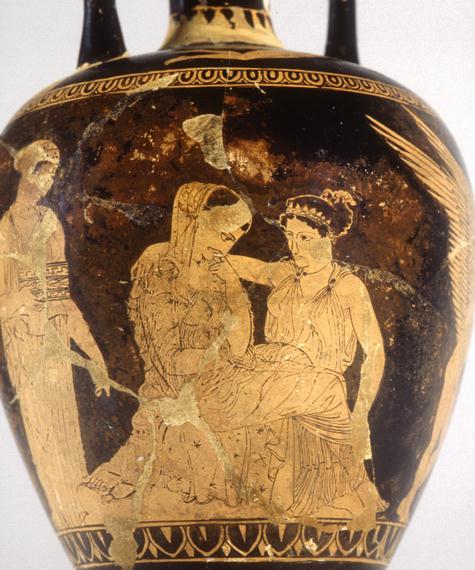
“At last, love is here—and the story I might have told to hide it
Would have caused me more shame than laying it bare.
Cytherea brought him right to me once I overwhelmed her
with my songs. Then she put him right in my lap.
She promised it and she did it. Let anyone tell the tale of my laughter
if they happen to have none of their own
I would never want to trust notes to anyone to sealed tablets,
Just in case someone else reads them before my love.
Ah, it is a pleasure to ‘sin’ and exhausting to hide my face
For rumor’s sake. Let me be known as a worthy woman with her worthy man.”
Tandem venit amor, qualem texisse pudori
quam nudasse alicui sit mihi fama magis.
exorata meis illum Cytherea Camenis
attulit in nostrum deposuitque sinum.
exsolvit promissa Venus: mea gaudia narret,
dicetur si quis non habuisse sua.
non ego signatis quicquam mandare tabellis,
ne legat id nemo quam meus ante, velim,
sed peccasse iuvat, vultus componere famae
taedet: cum digno digna fuisse ferar.
Martial, 10.35
“All girls who desire to please one man
Should read Sulpicia.
All husbands who desire to please one wife
Should read Sulpicia.
She doesn’t write the rage of the Colchian woman
Or repeat the dinners of dire Thyestes.
She doesn’t believe there ever was a Scylla, or Byblis
But she teaches chaste and honest love,
And games, both sweet and a little naughty.
Anyone who judges her poems well
Will say that there never was a cleverer girl,
There never was a girl more reverent!
I think that the jokes of Egeria
In Numa’s dark cave were something like this.
You would have been more humble and learned
With Sulpicia as a teacher or a peer, Sappho:
But if he had seen her by your side,
Harsh Phaon would have loved Sulpicia.
Uselessly: for she would not be wife of the Thunderer
Nor girlfriend to Bacchus or Apollo
Should she live after her Calenus was taken away.”
Omnes Sulpiciam legant puellae,
Uni quae cupiunt viro placere;
Omnes Sulpiciam legant mariti,
Uni qui cupiunt placere nuptae.
Non haec Colchidos adserit furorem 5
Diri prandia nec refert Thyestae;
Scyllam, Byblida nec fuisse credit:
Sed castos docet et probos amores,
Lusus, delicias facetiasque.
Cuius carmina qui bene aestimarit, 10
Nullam dixerit esse nequiorem,
Nullam dixerit esse sanctiorem.
Tales Egeriae iocos fuisse
Udo crediderim Numae sub antro.
Hac condiscipula vel hac magistra 15
Esses doctior et pudica, Sappho:
Sed tecum pariter simulque visam
Durus Sulpiciam Phaon amaret.
Frustra: namque ea nec Tonantis uxor
Nec Bacchi nec Apollinis puella 20
Erepto sibi viveret Caleno.
Today Reading Greek Tragedy Online returns to Sophocles’ Philoktetes at 3 PM EDT Online, and LIVE at Harvard University’s Hilles Cinema, sponsored by the Division of Arts and Sciences and Department of the Classics at Harvard University and the School of Arts and Sciences and Department of Classical Studies at Brandeis University. Tune in Live, return for a recording, or, if you can make it, stop by in person and say, “ἆ ἆ ἆ ἆ.”
Sophocles, Philoktetes 971-2
“You aren’t bad but by learning from wicked men you became used to pursuing wicked things”
RGTO is produced by a partnership of Out of Chaos Theatre, the Center for Hellenic Studies, and the Kosmos Society. This project started at the onset of COVID19 lockdowns in the US and UK and brings together actors and researches to stage scenes from the ancient stage and talk about how they impact us to this day. We have over 50 episodes posted already and will add a few more by the end of the year. In the first year of the Pandemic, we went through every extant Greek tragedy. As we have moved on, we have tried to broaden our scope, expanding the questions we ask of the past and reaching out to bring more people and perspectives into discussion.
Sophocles, Philoktetes 54-55
“You need to bewitch
Philoktetes’ mind with your words.”
τὴν Φιλοκτήτου σε δεῖ
ψυχὴν ὅπως λόγοισιν ἐκκλέψεις λέγων
This performance marks the first time many of us have met in person and the first time some of us have been together since before the start of the pandemic. As we have written about elsewhere, the process of putting on these readings has helped us to rethink Greek Tragedy. For me, it has forced a re-centering of performance and audience experience in creating a play’s meaning. Viewing and reflecting on tragic action together expands our emotional and cognitive grasp, helping us to see each other and ourselves through the characters on stage. In particular, the practice of listening to other peoples’ interpretations and using them as a sounding board for our own gives the moment of performance and its aftermath power that is often impoverished on a simple page.
Cast and Crew
Eunice Roberts
Damian Jermaine Thompson
René Thornton Jr.
Sara Valentine
Directed by Paul O’Mahony, translated by Ian Johnston.
With host Joel Christensen, and special guests, Naomi Weiss and David Elmer
Amazing People
Artistic Director: Paul O’Mahony (Out of Chaos Theatre) Host and Faculty Consultant: Joel Christensen (Brandeis University) Executive Producer: Allie Marbry (Center for Hellenic Studies) Producers: Keith DeStone (Center for Hellenic Studies), Hélène Emeriaud, Janet Ozsolak, and Sarah Scott (Kosmos Society) Director of Outreach: Amy Pistone (Gonzaga University) Poster Designer: Allie Marbry (Center for Hellenic Studies) Poster Illustration Artist: John Koelle
Sophocles, Philoctetes 86-95 (Neoptolemus to Odysseus)
“For my part, son of Laertes, I hate to carry out those plans which pain me to hear. I was not born to do anything from evil contrivance, nor was the one (as they say) who begot me. But I am always up to the task of taking a man by violence and not trickery. With his one foot, Philoctetes will not overwhelm us, who are so many, in a violent contest. Yet, since I was sent as your helpmate, I would rather not be called a traitor; but my lord, I would rather err while acting nobly than prevail while acting basely.”
We first visited Philoktetes on the island of Lemnos in 2020 with special guest Norman Sandridge. At the beginning of the pandemic it was impossible not to see Philoktetes’ isolation and dehumanization as a way to think about the impact of COVID19 on our lives.
Sophocles, Philoktetes 446-452
“He would survive, since nothing rotten ever dies,
but the gods take good care of these things
and they love turning the wicked back from hell
even as they are always damning the just and good.
How can we make sense of this, can we praise it
when look close at their work and realize the gods are evil?”
“We use ‘self-sufficient’ not to mean a person alone—someone living in isolation—but to include one’s parents, children, spouse, friends, and even fellow citizens, since a human being is a social creature by nature. Now, some limit needs to be observed in these ties—for it will go on endlessly if you extend it to someone’s ancestors and descendants. But that’s a problem for another time.
We posit that self-sufficiency is something which in itself makes life attractive and lacks nothing and for this reason we think it is happiness, since we imagine that happiness is the most preferable of all things when it is not counted with others. It is clear that it is desirable even with the least of the goods—the addition of goods increases the total, since the greater good is always desirable.”
No man is an Iland, intire of itselfe; every man
is a peece of the Continent, a part of the maine;
if a Clod bee washed away by the Sea, Europe
is the lesse, as well as if a Promontorie were, as
well as if a Manor of thy friends or of thine
owne were; any mans death diminishes me,
because I am involved in Mankinde;
And therefore never send to know for whom
the bell tolls; It tolls for thee.
“Beyond the theater is the shrine of Aphrodite. In front of the foundation is a stele on which Telesilla, a poet of lyric, is depicted. Her books are tossed near her feet while she looks at the helmet she holds in her hand as she is about to put it on her head. Telesilla was famous among women and especially honored for her poetry.
But a greater story about her comes from when the Argives were bested by Kleomenes the son of Alexandrides and the Lakedaimonians. Some Argives died during the battle itself and however many fled to the grove of Ares died there too—at first they left the grove under an armistice but they realized they were deceived and were burned with the rest in the grove. As a result, Kleomenes led the Spartans to an Argos bereft of men.
But Telesilla stationed on the wall of the city all the slaves who were unable to bear arms because of youth or old age and, after collecting however many weapons had been left in homes or in the shrines, she armed all the women at the strongest age and once she had armed herself they took up posts were the army was going to attack.
When the Spartans came near and the women were not awestruck by their battle-cry but waited and were fighting bravely, then the Spartans, because they reasoned that if they killed the women the victory would be ill-rumored even as their own defeat would come with great insult, yielded to the women.
The Pythian priestess had predicted this contest earlier in the prophecy relayed by Herodotus who may or may not have understood it (6.77):
But when the female conquers the male
And drives him away and wins glory for the Argives,
It will make many Argive women tear their cheeks.
These are the words of the oracle on the women’s accomplishment.”
Plutarch, On the Virtues of Women 245d-f6 reports a version of this tale; the Suda (s.v. Telesilla) likely takes its account from Pausanias.
“Telesilla, a poetess. On a stele her books are tossed around and she has placed a helmet on her head. And When the Lakedaimonians slaughtered the Argives who had fled to a shrine and were heading to the city to sack it, then Telesilla armed the women of the right age and set them against where they were marching. When the Lakedaimonians saw this, they turned back because they believed it shameful to fight against women whom it would be inglorious to conquer but a great reproached to be defeated by….” [the oracle is listed next”
“And there is also a notion older than this which seemed right to Lykourgos for Sparta. Because he meant to provide warrior-athletes for Sparta, he said, “Let the girls exercise and permit them to run in public. Certainly this strengthening of their bodies was for the sake of good childbearing and that they would have better offspring.
For one who comes from this training to her husband’s home will not hesitate to carry water or to mill grain because she has prepared from her youth. And if she is joined together with a youth who has joined her in rigorous exercise, she will provide better offspring—for they will be tall, strong and rarely sick. Sparta became so preeminent in war once her marriages were prepared in this way.”
“Let’s talk first concerning the disease which is called sacred and paralyzed people and the many anxieties which frighten people seriously enough that they lose their minds and believe that they see evil spirits by night or even at times by die or sometimes on all hours. Many have hanged themselves before because of this kind of vision, more often women than men.
For a woman’s nature is more depressed and sorrowful. And young women, when they are at the age of marriage and without a husband, suffer terribly at the time of their menstruation, which they did not suffer earlier in life. For blood collects later in their uterus so that it may flow out. When, then, the mouth of the exit does not create an opening, the blood pools up more because of food and the body’s growth. When the blood has nowhere to flow, it rises up toward the heart and the diaphragm. When these organs are filled, the heart is desensitized and from this transformation it becomes numb. Madness overtakes women because of this numbness.”
“Women know everything, even how Zeus married Hera.”
Homer has, “They traveled together to bed, avoiding their parents’ notice”. Aristokles in his work “On the Cults of Hermione”, provides something of an odd tale about the marriage of Zeus and Hera. For, as the story goes, Zeus was planning on having sex with Hera when he noticed that she was separated from the other gods. Because he did not want to be obvious and did not want to be seen by her, he changed his appearance into a cuckoo and was waiting on a mountain which was first called Thornax but is now just called Cuckoo.
Zeus made a terrible storm on that day and when Hera was going toward the mountain alone, she stopped at the very place where there is currently a temple to Hera Teleia. The cuckoo, flew down and sat on her lap when he saw her, shivering and freezing because of the weather. Hera saw the bird and pitied him and covered him with her cloak. Then Zeus suddenly transformed his appearance and grabbed a hold of Hera. Because she was refusing him due to their mother, he promised that he would marry her.
Among the Argives, who honor the goddess the most of all the Greeks, the cult image of Hera sits in the temple on a throne holding a scepter in one hand on which a cuckoo is seated.”
Pausanias (2.17.4) describes a statue in a temple to Hera outside of Corinth:
“The statue of Hera—extraordinarily huge—sits on a throne made of gold and ivory, a work of Polykleitos. She has a crown embossed with Graces and the Seasons and carries in one hand a pomegranate fruit and in the other a scepter. I must pass over the reason for the pomegranate, since the tale is protected by sacred rite. But people say that the cuckoo bird sitting on the scepter is Zeus: because he was in love with Hera when she was a maiden and turned himself into this bird which she hunted to have as a pet. I record this story as much as the others of the gods which I offer incredulously—but I record them still.”
Astuanassa: A handmaid of Helen, Menelaos’ wife. She first discovered positions for intercourse and wrote On Sexual Positions. Philainis and Elephantinê rivaled her in this later—they were women who danced out these sorts of wanton acts.
We have learned about this embroidered girdle, that Hera took it from Aphrodite and gave it to Helen. Her handmaid Astuanassa stole it but Aphrodite took it back from her again.
As is largely unsurprising from the perspective of Greek misogyny, excessive interest in sexual behavior is projected a female quality. Expertise beyond interest is made the province of female ‘professionals’ (slaves) who may act as scapegoats and marginal figures for the corruption of both men and women. There is a combination of such interest with an excessive emphasis on eating (and eating really well) in Athenaeus where the pleasures of the body are combined.
Athenaeus, Deipnosophists 8.335c
“Dear men, even though I have great admiration for Chrysippus as the leader of the Stoa, I praise him even more because he ranks Arkhestratos, well-known for his Science of Cooking along with Philainis who is credited with a licentious screed about sexual matters—even though the iambic poet of Samos, Aiskhriôn, claims that Polycrates the sophist started this slander of her when she was really quite chaste. The lines go like this:
“I, Philainis, circulated among men
Lie here thanks to great old age.
Don’t laugh, foolish sailor, as your trace the cape
Nor make me a target of mockery or insult
For, by Zeus and his sons in Hell
I was never a slut with men nor a public whore.
Polykrates, Athenian by birth,
A bit clever with words and with a nasty tongue,
Wrote what he wrote. I don’t know anything about it.”
But the most amazing Chrysippus combines in the fifth book of his On Goodness and Pleasure that both “the books of Philianis and the Gastronomiai of Arkhestratos and forces of erotic and sexual nature, and in the same way slave-girls who are expert at these kinds of movements and positions and who are engaged in their practice.” He adds that they learn this type of material completely and then thoroughly possess what has been written on these topics by Philainis and Arkhestratos and those who have written on similar topics. Similarly, in his seventh book, he says ‘As you cannot wholly learn the works of Philianis and Arkhestratos’ Gastronomia because they do have something to offer for living better.’ “
The following epigrams are attributed to the poet Anyte of Tegea, one of a handful of Hellenistic women preserved in the Greek Anthology.
Gr. Anth. 7.490
“I mourn for the virgin Antibia, to whose father’s home
Many suitors came longing to marry,
Thanks to the fame of her beauty and wisdom.
But ruinous fate made all their hopes turn in the dust.”
“Dâmis built this grave for his battle-fierce but dead
Horse, after murderous Ares pierce his chest.
The blood spurted black from his thick-hided skin
And he dyed the earth with his painful life’s blood.”
“Your courage, Proarkhos, killed you in the fight and dying
You put the home of your father Pheidias into dark grief.
Yet this rock above you sings out a noble song:
That you died in a struggle for your dear homeland.”
Ever wondered why Helen left Menelaos or why her sister cheated on Agamemnon (other than the obvious)? Ancient poetry traced it back to a sin of their father
Schol. Ad Euripides’ Orestes 249
“Stesichorus says that when Tyndareus was sacrificing to the gods he overlooked Aphrodite. For this reason, the angry goddess made his daughters thrice and twice married deserters of husbands. The segment reads like this:
“Because when Tyndareus was sacrificing to all the gods
He neglected only the gentle-giving Kyprian
She was enraged and she made the daughters of Tyndareus
Twice and thrice married deserters of husbands.”
A fragment of Hesiod agrees with this (fr. 176):
“Smile-loving Aphrodite
Was enraged when she saw them: then she hung bad fame upon them.
After that, Timandra abandoned Ekhemos and left;
She went to Phyleus who was dear to the holy gods.
And so Klytemnestra abandoned shining Agamemnon
To lie alongside Aigisthos as she chose a lesser husband;
In the same way, Helen shamed the marriage-bed of fair Menelaos…”
This passage provides an explanation for why the daughters of Tyndareus—Helen and Klytemnestra—were unfaithful: it was Aphrodite’s game from the beginning because their father did not worship her correctly. A few interesting aspects here: first, Helen is “thrice-married” because after Paris dies, she marries Deiphobus (although some accounts associate her with Theseus too). Second, Hesiod’s fragmentary poems seems to be in the process of cataloging women who leave their husbands.
The first woman in the tale is Timandra, who, according to only this passage, was a third daughter of Tyndareus who left her husband Ekhemos, a king of Arcadia. They had a son together, named Leodocus before she eloped with Phyleus. In another fragment from Hesiod (fr. 23) we learn more about the family of Tyndareus and Leda:
“After climbing into the lush bed of Tyndareus
Well-tressed Leda, as fair as the rays of the moon,
Gave birth to Timandra, cow-eyed Klytemnestra,
And Phylonoe whose body was most like the immortal goddesses.
Her…the arrow bearing goddess
Made immortal and ageless for all days.”
Later on in the same fragment –after hearing about the marriage and children of Klytemnestra—we learn about Timandra:
“Ekhemos made Timandra his blooming wife,
The man who was the lord of all Tegea and Arcadia, wealthy in sheep,
A rich man who was dear to the gods.
She bore to him Laodakos, the horse-taming shepherd of the host,
After she was subdued by golden Aphrodite.”
This section of the Hesiodic Catalogue of Women seems to be mentioning only Leda’s children with Tyndareus and not those possibly fathered by Zeus (Helen, Kastor, Polydeukes). But we hear nothing of the future of Leda’s attractive daughter Phylonoe (also spelled Philonoe) other than that Artemis made her immortal. The ancient sources? Nothing at all to explain this.
“Columns, and my Sirens, and you, sorrowful urn
Who holds Hades’ small portion of ash—
Say “hello” to those who walk by my grave,
Whether they happen to be citizens or from another town.
Tell them this too so they may know it:
this grave covered me when I was a bride,
My father used to call me Baukis and Tenos was my land
Tell them also that Erinna, my friend,
Etched this poem on my Tomb.”
“These outlines come from tender hands: noble Prometheus
There are people whose talent is near to yours!
Whoever drew this girl so truly
If he added a voice, she would be Agatharkhis entirely.”