Always Relevant: An Iliad of Troubles

Erasmus, Adagia 226:

Ἰλιὰς κακῶν, that is, an Iliad of troubles; used when speaking of the greatest and most numerous calamities, because in Homer’s Iliad there is no type of problem which isn’t covered. For this reason, the learned think that the premises of tragedies were taken from it, just as the plots of comedies were taken from the Odyssey. It is, however, a rather wordy work, hardly finished in twenty-four volumes. Thus, they call any speech which is a little more prolix than necessary ‘longer than the Iliad,’ as Aeschines, against Demosthenes wrote, ‘Ταῦτα δὲ εἰπὼν δίδωσιν ἀναγνῶναι ψήφισμα τῷ γραμματεῖ, μακρότερον μὲν τῆς Ἰλιάδος, κενώτερον δὲ τῶν λόγων οὓς εἴωθε λέγειν’ that is, ‘with these words he gave the decision to the scribe to be read, more long-winded than the Iliad, but more empty than the words with which he usually speaks.’

Eustathius inverts the saying thus: ‘Καὶ παροιμία μέντοι κακῶν Ἰλιάδα φησίν, αὕτη δὲ καλοῦ παντὸς Ἰλιάς,’ that is, ‘the proverb says an Iliad of troubles, but this is an Iliad of everything good.’ Synesius writes in a letter to his brother, Καὶ ὅλως κακῶν ἂν Ἰλιάς περιέστη τὴν πόλιν ἡμῶν, that is, ‘in sum, an Iliad of troubles has surrounded our city.’ Plutarch, in his Conjugal Precepts, writes, ‘Ὁ δὲ ἐκείνων Ἰλιάδα κακῶν Ἕλλησι καὶ βαρβάροις ἐποίησεν,’ that is, ‘but their marriage rites brought a whole Iliad of troubles upon the Greeks and the barbarians.’ For he is talking about the wedding of Paris and Helen, which was the cause of inestimable troubles. Cicero, too, uses this expression in his letters to Atticus: ‘such a great Iliad of troubles hangs over us.’
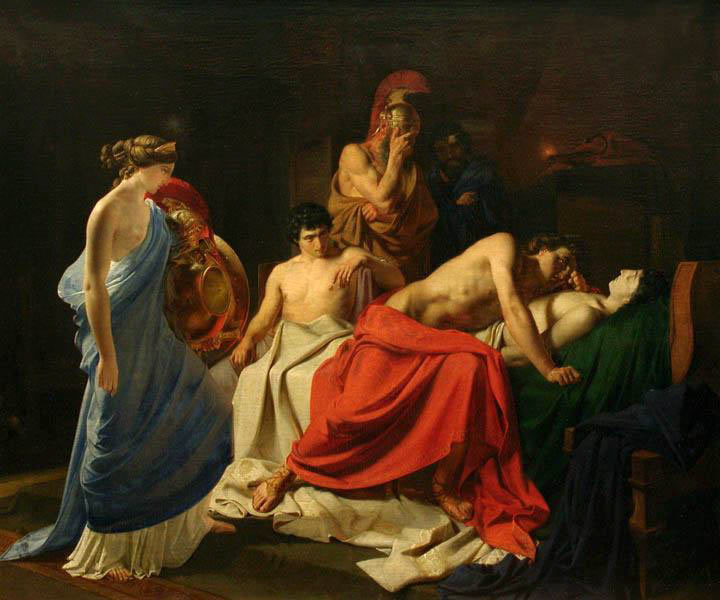
Achilles Lamenting the Death of Patroclus, by Nikolay Ge

Ἰλιὰς κακῶν, id est Ilias malorum. De calamitatibus maximis simul et plurimis. Propterea quod in Iliade Homerica nullum mali genus non recensetur. Vnde ex hac docti putant tragoediarum argumenta fuisse sumpta, sicut ex Odyssea comoediarum. Est autem opus verbosum, viginti quatuor voluminibus vix absolutum. Vnde et quamuis orationem plus satis prolixam Iliade longiorem vocant, vt Aeschines aduersus Demosthenem. Ταῦτα δὲ εἰπὼν δίδωσιν ἀναγνῶναι ψήφισμα τῷ γραμματεῖ, μακρότερον μὲν τῆς Ἰλιάδος, κενώτερον δὲ τῶν λόγων οὓς εἴωθε λέγειν, id est His dictis decretum scribae legendum tradit, prolixius quidem lliade, vanius autem verbis iis quae dicere consueuit.

Eustathius inuertit adagionem ad hunc modum: Καὶ παροιμία μέντοι κακῶν Ἰλιάδα φησίν, αὕτη δὲ καλοῦ παντὸς Ἰλιάς, id est Iliadem malorum prouerbium ait, at haec omnium bonorum llias. Synesius in epistola quadam ad fratrem: Καὶ ὅλως κακῶν ἂν Ἰλιάς περιέστη τὴν πόλιν ἡμῶν, id est In summa,  malorum Ilias circunstetit vrbem nostram. Plutarchus in Praeceptis coniugalibus: Ὁ δὲ ἐκείνων Ἰλιάδα κακῶν Ἕλλησι καὶ βαρβάροις ἐποίησεν, id est At illorum nuptiae Iliada malorum Graecis ac barbaris inuexerunt. Loquitur enim de coniugio Paridis et Helenae, quod inaestimabilium malorum fuit causa. Vtitur et M. Tullius in Epistolis ad Atticum: Tanta malorum impendet Ilias.

Lawlessness and The City

Solon, Fragment 4. 21-33.

Thanks to its enemies a prized city
Fast succumbs to wrongdoers’ cherished mobs.
This evil circulates in the land.
Many of the poor leave for foreign lands,
Bound and sold in shameful chains.

And so the people’s evil comes to each house
And the doors are disinclined to bar it.
It bounds the tall wall and always finds its man,
Even when he’s slipped into some recess
of an inner room.

My heart commands I teach Athenians this:
Lawlessness brings the city complete evil,
But respect for the law renders the whole
Orderly and sound, and it puts wrongdoers
In handcuffs, sometimes.

ἐκ γὰρ δυσμενέων ταχέως πολυήρατον ἄστυ
τρύχεται ἐν συνόδοις τοῖς ἀδικοῦσι φίλαις.
ταῦτα μὲν ἐν δήμῳ στρέφεται κακά: τῶν δὲ πενιχρῶν
ἱκνεῦνται πολλοὶ γαῖαν ἐς ἀλλοδαπὴν
πραθέντες δεσμοῖσί τ᾽ ἀεικελίοισι δεθέντες
…………………………………………
οὕτω δημόσιον κακὸν ἔρχεται οἴκαδ᾽ ἑκάστῳ,
αὔλειοι δ᾽ ἔτ᾽ ἔχειν οὐκ ἐθέλουσι θύραι,
ὑψηλὸν δ᾽ ὑπὲρ ἕρκος ὑπέρθορεν, εὗρε δὲ πάντως,
εἰ καί τις φεύγων ἐν μυχῷ ᾖ θαλάμου.
ταῦτα διδάξαι θυμὸς Ἀθηναίους με κελεύει,
ὡς κακὰ πλεῖστα πόλει δυσνομίη παρέχει,
εὐνομίη δ᾽ εὔκοσμα καὶ ἄρτια πάντ᾽ ἀποφαίνει,
καὶ θαμὰ τοῖς ἀδίκοις ἀμφιτίθησι πέδας.

Larry Benn has a B.A. in English Literature from Harvard College, an M.Phil in English Literature from Oxford University, and a J.D. from Yale Law School. Making amends for a working life misspent in finance, he’s now a hobbyist in ancient languages and blogs at featsofgreek.blogspot.com.

Eyes, Pre-existing Vision

Lucretius, De Rerum Natura 4.830-842

“Other accounts and those like it circulate,
all contingent on twisted logic,
When nothing develops in our body for us to use–
instead, each developing thing finds the purpose we make.

There was no seeing before the light of eyes arose;
There was nothing said before the tongue began
No, the tongue’s story far preceded speech
And the ears seeded before hearing that first sound.
All these human instruments developed before a function.
There’s no way they’d have evolved for use alone.”

cetera de genere hoc inter quaecumque pretantur,
omnia perversa praepostera sunt ratione,
nil ideo quoniam natumst in corpore ut uti
possemus, sed quod natumst id procreat usum.
nec fuit ante videre oculorum lumina nata,
nec dictis orare prius quam lingua creatast,
sed potius longe linguae praecessit origo
sermonem, multoque creatae sunt prius aures
quam sonus est auditus, et omnia denique membra
ante fuere, ut opinor, eorum quam foret usus;
haud igitur potuere utendi crescere causa.

Votivbild von 1871 (Motiv: Augen) „Es wurde mit Dank geholfen 1871“
Museum Europäischer Kulturen, Berlin

An Elephant’s Love for a Child


Athenaeus, Deipnosophistae, 13.85, 606F–607A [BNJ 81 F36]

“The same Phylarkhos also reports in his twentieth book how great a love an elephant once had for a child. He writes this: “There was a female elephant which was tended with that elephant, and they used to call her Nikaia. When the wife of the Indian who cared for her was dying, she handed her child who was 30 days old to her.

After she died, the animal’s love for the child was striking. It could not endure the child being separated from her; and whenever she did not see the child, she despaired. When the nurse fed the child milk, she put it in a cradle in the middle of the animal’s feet. If she failed to do this, the elephant would refuse to eat. After this, all day long the elephant would take reeds from the nearby grasses and chase away flies while the child was sleeping. Whenever the child cried, the elephant would move the cradle with her trunk and help him sleep. The male elephant often did the same thing.”

ὁ δὲ αὐτὸς ἱστορεῖ Φύλαρχος διὰ τῆς εἰκοστῆς ὅσην ἐλέφας τὸ ζῶιον φιλοστοργίαν ἔσχεν εἰς παιδίον. γράφει δὲ οὕτως· «τούτωι δὲ τῶι ἐλέφαντι συνετρέφετο θήλεια ἐλέφας, ἣν Νίκαιαν ἐκάλουν· ἧι τελευτῶσα ἡ τοῦ τρέφοντος ᾽Ινδοῦ γυνὴ παιδίον αὑτῆς τριακοσταῖον παρακατέθετο. ἀποθανούσης δὲ τῆς ἀνθρώπου δεινή τις φιλοστοργία γέγονε τοῦ θηρίου πρὸς τὸ παιδίον· οὐτε γὰρ ἀπ᾽ αὐτοῦ χωριζόμενον τὸ βρέφος ὑπέμενεν, τὸ δὲ εἰ μὴ βλέποι τὸ παιδίον ἤσχαλλεν. ὅτ᾽ οὖν ἡ τροφὸς ἐμπλήσειεν αὐτὸ τοῦ γάλακτος, ἀνὰ μέσον τῶν ποδῶν τοῦ θηρίου ἐτίθει αὐτὸ ἐν σκάφηι. εἰ δὲ μὴ τοῦτο πεποιήκοι, τροφὴν οὐκ ἐλάμβανεν ἡ ἐλέφας. καὶ μετὰ ταῦτα δι᾽ ὅλης τῆς ἡμέρας [τοὺς] καλάμους λαμβάνων ἐκ τῶν παρατιθεμένων χορτασμάτων καθεύδοντος τοῦ βρέφους τὰς μυίας ἀπεσόβει· ὅτε δὲ κλαίοι, τῆι προβοσκίδι τὴν σκάφην ἐκίνει καὶ κατεκοίμιζεν αὐτό. τὸ δ᾽ αὐτὸ ἐποίει καὶ ὁ ἄρρην ἐλέφας πολλάκις.»

Red elephant outline at the Jain temple of Sravanabelagola.

“When Will This Year Be Over”? Seneca on Speeding Life Along

Seneca, De Brevitate Vitae 7

“The man who has hoped for the fasces longs to put them down once he gets them and says constantly, “When will this year be over?” This man sponsors games which he once valued as a great opportunity for him, yet he says “When can I get away from them?” A lawyer is raised up by the whole forum and with full crowd beyond where he can be heard, but he complains “When will we have a break?” Everyone speeds their own life along and suffers for a desire for the future and boredom with the present.

But the person who portions out every moment to his own use, who schedules out every day like it is the last, neither hopes for nor fears tomorrows. For what kind of new pleasure is any hour alone capable of bringing? Everything is known and has been enjoyed fully. Fortune may by chance bring out something else, but life is already safe. Something can be added; nothing can be subtracted, and they will accept anything which is added like someone who is already satisfied and full will take some food they do not desire.

Therefore, it is not right to think that anyone has lived long because of grey hair or wrinkles. They have not lived a while, but they have existed for a time. Certainly, what if you thought that the person had traveled far whom a terrible storm grabbed in the harbor and dragged here and there in turns of winds raging from different directions  over the same space in a circle? They did not travel far, but were tossed around a lot.”

Adsecutus ille quos optaverat fasces cupit ponere et subinde dicit: “Quando hic annus praeteribit?” Facit ille ludos, quorum sortem sibi optingere magno aestimavit: “Quando,” inquit, “istos effugiam?” Diripitur ille toto foro patronus et magno concursu omnia ultra, quam audiri potest, complet: “Quando,” inquit, “res proferentur?” Praecipitat quisque vitam suam et futuri desiderio laborat, praesentium taedio.

At ille qui nullum non tempus in usus suos confert, qui omnem diem tamquam ultimum ordinat, nec optat crastinum nec timet. Quid enim est, quod iam ulla hora novae voluptatis possit adferre? Omnia nota, omnia ad satietatem percepta sunt. De cetero fors fortuna, ut volet, ordinet; vita iam in tuto est. Huic adici potest, detrahi nihil, et adici sic, quemadmodum saturo iam ac pleno aliquid cibi, quod nec desiderat et capit.

Non est itaque quod quemquam propter canos aut rugas putes diu vixisse; non ille diu vixit, sed diu fuit. Quid enim si illum multum putes navigasse, quem saeva tempestas a portu exceptum huc et illuc tulit ac vicibus ventorum ex diverso furentium per eadem spatia in orbem egit? Non ille multum navigavit, sed multum iactatus est.

Image result for medieval manuscript calendar
Johannes von Gmunden: Calendar, [Nuremberg], 1496

Opinions and Minor Detail

Lucretius, De Rerum Natura 4.811-817

“Yet, still, even in things that are painfully obvious, you can understand,
That if you aren’t really paying attention, then it is almost the same
As if the thing in front of you were removed and far off the whole time.

What’s the surprise, then, if the mind fails to see
Anything except what it actually focuses on?
In turn, then, we form serious opinions based on minor details,
And we lead ourselves into counterfeit delusions.”

et tamen in rebus quoque apertis noscere possis,
si non advertas animum, proinde esse quasi omni
tempore semotum fuerit longeque remotum.
cur igitur mirumst, animus si cetera perdit
praeterquam quibus est in rebus deditus ipse?
deinde adopinamur de signis maxima parvis
ac nos in fraudem induimus frustraminis ipsi.

James Pollock, ” Campfire Lyrics” 1990

The Secrets That You Keep

Plutarch, On Talkativeness, 505a-b

“Some of the other faults and disorders we suffer are dangerous, hateful, or absurd; but talkativeness is all of these things. For chatterboxes are mocked for explaining common affairs, hated for trumpeting bad news, and they risk their lives because they can’t keep secrets.

For this reason, when Anacharsis had a feast at Solon’s home and was stretched out to sleep, he covered his genitals with his left hand and placed his right hand over his mouth:  he thought that the tongue demanded the stronger protection! And this is correct. For, one couldn’t easily make a list of how many men have been laid low because of uncontrolled lust any more than the number of cities and governments which a revealed secret has destroyed.”

Τῶν δ᾿ ἄλλων παθῶν καὶ νοσημάτων τὰ μέν ἐστιν ἐπικίνδυνα τὰ δὲ μισητὰ τὰ δὲ καταγέλαστα, τῇ δ᾿ ἀδολεσχίᾳ πάντα συμβέβηκε· χλευάζονται μὲν γὰρ ἐν ταῖς κοιναῖς διηγήσεσι, μισοῦνται δὲ διὰ τὰς τῶν κακῶν προσαγγελίας, κινδυνεύουσι δὲ τῶν ἀπορρήτων μὴ κρατοῦντες. ὅθεν Ἀνάχαρσις ἑστιαθεὶς παρὰ Σόλωνι καὶ κοιμώμενος ὤφθη τὴν μὲν ἀριστερὰν χεῖρα τοῖς μορίοις τὴν δὲ δεξιὰν τῷ στόματι προσκειμένην ἔχων· ἐγκρατεστέρου γὰρ ᾤετο χαλινοῦ δεῖσθαι τὴν γλῶτταν, ὀρθῶς οἰόμενος. οὐ γὰρ ἄν τις ἐξαριθμήσαιτο ῥᾳδίως ἄνδρας τοσούτους ἀφροδισίων ἀκρασίᾳ πεπτωκότας, ὅσας πόλεις καὶ ἡγεμονίας λόγος ἐξενεχθεὶς ἀπόρρητος ἀναστάτους ἐποίησε.

The Romantics, “Talking in Your Sleep”

When you close your eyes and go to sleep
And it’s down to the sound of a heartbeat
I can hear the things that you’re dreaming about
When you open up your heart
And the truth comes out
You tell me that you want me
You tell me that you need me
You tell me that you love me
And I know that I’m right
‘Cause I hear it in the night
I hear the secrets that you keep
When you’re talking in your sleep

The Weeknd,  “Secrets”

Everybody here wants you
My love, my love
And I know that you want him too
My love, my love
I ask you what your heart desires
My love, my love
You tell me I’m the only one
My love, my love
It’s a lie, a lie
I catch you every time
In your lust, your lust
Every time you close your eyes
I hear the secrets that you keep
When you’re talking in your sleep
I hear the secrets that you keep, keep, keep
When you’re talk, talking, talking
I hear the secrets that you keep
When you’re talking in your sleep
I hear the secrets that you keep, keep, keep
When you’re talk, talking, talking
two men and a woman making love on a boat on the Nile, with a crocodile and a hippopotamus (looking like monstrous dog) – period / date: fourth style of pompeian wall painting, 50-79 AD – findspot: Pompeii – museum / inventory number: Napoli, Museo Archeologico Nazionale 27698

WTF Do I Know about other Things?

Some people love talking up Socrates but forget this most important lesson that knowledge in one specialized field does not qualify us as experts in others.

Plato, Apology 23e

“But, Athenians, the mistake has seemed to me identical for the poets and the good craftspeople: because they excel in one craft, each of them thinks they are incredibly wise about everything else that’s important as well. This categorical error obscures their actual wisdom.

This is why I asked myself for the oracle whether I should just accept myself as I am, since I am not wise in their kind of wisdom nor ignorant in their kind of ignorance and I don’t have both qualities like they do. So, I answered myself and the oracle: it is better for me to be as I am.”

ἀλλ’, ὦ ἄνδρες Ἀθηναῖοι, | ταὐτόν μοι ἔδοξαν ἔχειν ἁμάρτημα ὅπερ καὶ οἱ ποιηταὶ καὶ οἱ ἀγαθοὶ δημιουργοί—διὰ τὸ τὴν τέχνην καλῶς ἐξεργάζεσθαι ἕκαστος ἠξίου καὶ τἆλλα τὰ μέγιστα σοφώτατος εἶναι—καὶ αὐτῶν αὕτη ἡ πλημμέλεια ἐκείνην τὴν σοφίαν ἀποκρύπτειν· ὥστε με ἐμαυτὸν ἀνερωτᾶν ὑπὲρ τοῦ χρησμοῦ πότερα δεξαίμην ἂν οὕτως ὥσπερ ἔχω ἔχειν, μήτε τι σοφὸς ὢν τὴν ἐκείνων σοφίαν μήτε ἀμαθὴς τὴν ἀμαθίαν, ἢ ἀμφότερα ἃ ἐκεῖνοι ἔχουσιν ἔχειν. | ἀπεκρινάμην οὖν ἐμαυτῷ καὶ τῷ χρησμῷ ὅτι μοι λυσιτελοῖ ὥσπερ ἔχω ἔχειν.

Nicolas-André Monsiau, The Debate of Socrates and Aspasia, 1800

Humility and Pride: The Masks We Wear Day-to-Day

The art of humility display goes back centuries. The first recorded humility tweet was written thousands of years ago by a Greek woman named Helen: “Humbled that Achilles and Agamemnon would go to all that trouble!” The tradition continued in biblical times with Jesus of Nazareth: “Humbled to be the Messiah. Couldn’t have done it without Dad.” And one can find high-water moments of humility display throughout the centuries that followed, for example, from the great British general the Duke of Wellington: “Wow. A beef dish. Truly humbled.”

David Brooks, Truly Humbled to be the Author of this Article, Atlantic, July 2022


Cicero, Letters to Friends 20.16

“They imagined that I would be a humbled person after this, when the country was actually making me prouder than I had been at any point in my life when it declared it could not live without me, a single citizen!”

abiectiore animo me futurum, cum res publica maiorem etiam mihi animum quam umquam habuissem daret cum declarasset se non potuisse me uno civi carere


Seneca, Moral Epistles 120, 21-22

“Those people I describe are like this, that kind of man Horace talks about, someone who is never the same or even really like himself. That’s how far he walks in the opposite direction. Did I mention that many are like this? It is the same way with most people. Everyone changes their plans and prayers daily. Someone wants a spouse, then only a bit of fun on the side. Someone wants to rule, then they act more officious than an enslaved person. One day, someone flexes to the point of derision, only to withdraw and shrink into more humility than those who are truly without pretense. They throw money about and then hoard it!

This is how a silly mind exposes itself. It takes this form and then another and then never looks like itself. This is, for me, the worst way to be. I do understand, it is hard to take the shape of one person alone. No one can truly be singular except for the wise person, so the rest of us try on different masks in turn. We seem sober and serious one moment and then wasteful and silly the next. We often change our roles and play a part against where we started.

For this reason, try to play the same character to the end of life’s game that you started at the beginning. Try to make people praise you. If you can’t, at least let them recognize you. Otherwise, when it comes to someone you saw yesterday, they can ask, “who is this person?” That’s how much change you allow. Goodbye!”


Homines isti tales sunt, qualem hunc describit Horatius Flaccus, numquam eundem, ne similem quidem sibi; adeo in diversum aberrat. Multos dixi? Prope est, ut omnes sint. Nemo non cotidie et consilium mutat et votum. Modo uxorem vult habere, modo amicam, modo regnare vult, modo id agit, ne quis sit officiosior servus, modo dilatat se usque ad invidiam, modo subsidit et contrahitur infra humilitatem vere iacentium, nunc pecuniam spargit, nunc rapit. 

Sic maxime coarguitur animus inprudens; alius prodit atque alius et, quo turpius nihil iudico, impar sibi est. Magnam rem puta unum hominem agere. Praeter sapientem autem nemo unum agit, ceteri multiformes sumus. Modo frugi tibi videbimur et graves, modo prodigi et vani. Mutamus subinde personam et contrariam ei sumimus, quam exuimus. Hoc ergo a te exige, ut, qualem institueris praestare te, talem usque ad exitum serves. Effice ut possis laudari, si minus, ut adgnosci. De aliquo, quem here vidisti, merito dici potest: “hic qui est?” Tanta mutatio est. Vale.

Hieronymous Bosch, he Seven Deadly Sins and the Four Last Things – Pride, 1486

How to Unfriend with Lysias

Lysias, Accusation of Calumny 180

“These were the excuses you clearly made up about me and my relationship with Thrasymachos. And now that these excuses have escaped you, you stop at nothing to abuse me rather freely. I should have known then that it was my luck to endure these things, when you were shit-talking me to your associates. And then I have told you everything about Polykles, a man you are helping.

Why didn’t I guard my words more carefully? I was a bit simple-minded, I guess. I believed that since I was your friend I wouldn’t be maligned by you because you were slandering everyone else to me! I thought I had some kind of contract from you in your terrible insults about each other.

Well, I am happily quitting your friendship, since, by the gods, I can’t see how I’ll suffer by not associating with you when I won nothing by being your friend.”

τοιαύτας προφάσεις προφασιζόμενοι τότε μὲν ἐκ τῆς ἐμῆς καὶ Θρασυμάχου συνουσίας ἐστὲ φανεροί, νῦν δὲ ἐπειδὴ ἐκλελοίπασιν ὑμᾶς αἱ προφάσεις, ἐλευθεριώτερόν με κακῶσαι λείπετε ἤδη οὐδέν. χρῆν μὲν οὖν τότε με γιγνώσκειν ὀφειλόμενόν μοι ταῦτα παθεῖν, ὅτε καὶ πρὸς ἐμὲ περὶ ὑμῶν αὐτῶν ἐλέγετε κακῶς· ἔπειτα καὶ περὶ Πολυκλέους, ᾧ νυνὶ βοηθεῖτε, πάντ᾿ εἴρηκα πρὸς ὑμᾶς. κατὰ τί δὴ ταῦτα <οὐκ> ἐφυλαττόμην; εὔηθές τι ἔπαθον. ᾤμην γὰρ ἀπόθετος ὑμῖν εἶναι φίλος τοῦ μηδὲν ἀκοῦσαι κακὸν δι᾿ αὐτὸ τοῦτο, διότι πρὸς ἐμὲ τοὺς ἄλλους ἐλέγετε κακῶς, παρακαταθήκην ἔχων ὑμῶν παρ᾿ ἑκάστου λόγους πονηροὺς περὶ ἀλλήλων.

Ἐγὼ τοίνυν ἑκὼν ὑμῖν ἐξίσταμαι τῆς φιλίας, ἐπεί τοι μὰ τοὺς θεοὺς οὐκ οἶδ᾿ ὅ τι ζημιωθήσομαι μὴ ξυνὼν ὑμῖν·

Unfriend (2)