5 years ago we debuted the 2nd episode of Reading Greek Tragedy Online
A reading and discussion of Sophocles’ Philoctetes. Tim Delap, Evelyn Miller, Paul O’Mahony, and Jack Whitam perform select scenes, with Joel Christensen (Brandeis) and Norman Sandridge (Howard) moderating the discussion. Reading Greek Tragedy Online is presented by the Center for Hellenic Studies, the Kosmos Society, and Out of Chaos Theatre.
Tim Delap (http://www.spotlight.com/5313-5614-0380) – Tim has performed several times in leading roles at the National Theatre and in the West End. He recently played Rochester in the critically-acclaimed Jane Eyre.
Evelyn Miller (https://www.spotlight.com/6297-8974-1880) – just finished playing Bianca in The Taming of the Shrew at Shakespeare’s Globe. Other recent credits include leading roles at the National Theatre and RSC. Evvy is an associate director of Actors From The London Stage.
Paul O’Mahony (http://www.spotlight.com/2458-3492-2766) – artistic director of Out of Chaos with whom he created the award winning Unmythable. He recently toured the US in their production of Macbeth and is currently working on two productions inspired by ancient culture. He has twice been a visiting artist at the CHS.
Norman Sandridge is Associate Professor of Classics at Howard University and a co-founder of Kallion Leadership. His “Sophocles’ Philoctetes: Causes of and Remedies for Dehumanization in a Leadership Role” has appeared in the SAGE series of business case studies on “Becoming a Leader in the Ancient World.”
Jack Whitam (http://www.spotlight.com/9494-0165-4393) has numerous credits with the RSC and has recently played Macbeth for the Guildford Shakespeare Company.
Life is pretty strange at the moment. To be honest, we wouldn’t have been going out that much anyway, owing to our second daughter being born just 2 months ago and our lack of sleep not being conducive to extensive exploration of the outside world.
But I like to think (and maybe I’m just kidding myself) that we would at least have ventured out for more than just our weekly supermarket trip. We were all set for celebrating new life, but now it feels even more precious and, indeed, precarious. We’re aware how fortunate we are to be able to stay inside and limit our contact while friends all over the world face significant peril.
Unable to explore the outside world, we have no option but to explore further the inner one. Life can often be solitary for an actor. Of course there are bouts of unemployment but even when acting in a play we’ll spend a significant amount of time working things out by ourselves: we learn and interpret lines, discover actions, develop a character’s playlist (and whatever exercises may form our particular technique), all (at least in part) on our own.
But we always get to share the result of that work with our fellow creative teammates. We are accustomed to working extremely closely (physically and emotionally) with others – our fellow cast members, directors, choreographers, stage managers, technical team, accent coaches, etc. For now, this traditional network of people meeting to create has been placed on hold. So how can we respond?
I suggested to Lanah at the Center for Hellenic Studies that we could start running readings of tragedy once a week to create opportunities for actors and academics to meet online and discover something together. I’ve been passionate about tragedy and its enduring impact since my time as a student, and I’ve devoted a significant portion of my career to exploring the connections between the ancient and modern worlds.
I was really delighted to hear from the CHS that Joel Christensen had been in touch with a similar proposal – and so our first international collaboration has been created. Last week we read scenes from Helen. This week it’s Sophocles’ Philoctetes (a man who knows a lot about isolation). I’ll be providing actors and directors to offer readings and their creative responses – I hope we’ll start to find new ways to use the medium to our advantage as I bring more artists into this project. Check out the CHS homepage for the livestream.
I’m especially intrigued to discover how we’ll use a computer screen as our ’empty space’. I also hope it can provide a fascinating resource for students and even a supportive testing ground for new translations of tragedy. We’ll be meeting at 3pm ET (which works well for my 2 month old), every Wednesday until we tell you otherwise. I hope you’re all staying safe and well.
Paul
Editor’s Note: The Second Reading went pretty well, check it out here:
Actors included: Tim Delap, Evelyn Miller, and Jack Whitam with commentary by Norman Sandridge from Howard University.
“Cato, since Rome was then already getting full of statues, would not allow one of himself. He said, “I would rather have people ask why there isn’t a statue of me rather than why there is one.” Indeed, these kinds of things do create envy and many believe that they owe gratitude to people who have not received them but that those who have taken them have oppressed them, as when people ask for payment for something they have done.
So, just as a person who has sailed passed the Syrtis and overturned his ship right near the channel has done nothing great nor worthy of awe, so to the man who has served in the treasury and guarded the public coffers but has done a poor job in other offices finds himself wrecked on a cliff near the sea. No, the best person is one who doesn’t want any of these kinds of things, avoiding and refusing them when needed.”
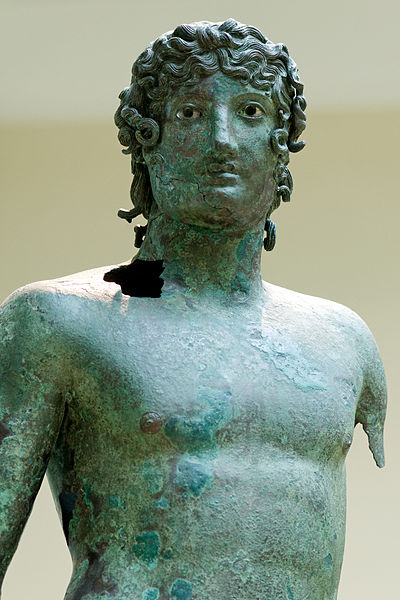
Bronze torso from an equestrian statue wearing a cuirass. MET
What to do with those toppled statues?
Diogenes Laertius, Lives of the Eminent Philosophers 5.5: Life of Demetrius (c. 350-280 BCE) 75 and 77
“Demetrios, the son of Phanostratos, from Phalerum. This guy was a student of Theophrastus. He was the lead of the city of Athens for ten years through his public speeches and was publicly awarded three hundred bronze statues for this, the vast majority of them had him on horse or chariot or with a pair of horse. He was supported so much that these statues were finished in not even 30 days.
“Although he was super famous among the Athenians, his light dimmed later on under the shadow of envy, which consumes everything. After he was indicted by some people on a charge carrying a penalty of death, he did not appear in court. When his opponents could not catch him in person, they took it out on his statues. Once they tore the statues down, they sold some, sank some in the sea, and broke others up for chamber pots. A single one is left on the Akropolis.”
Five years ago, a group of us got together and started reading Greek tragedies with actors and scholars and whoever else appeared. Over the next 3 years years, we aired 65 episodes, covering every tragedy, fragments, some comedies, original work, excerpts from epic, and eventually the Batrakhomuomakhia. We did a podcast about it and an interview a year or so later.
It was a transformative and uplifting experience that reshaped the way many of us thought about the relationship between performance and communities of support and interpretation. I am grateful for it and nostalgic in these darker days. We will be reposting the original notes for each session for the remainder of the year.
A week or so ago Paul O’Mahony pulled together a few people from the Center for Hellenic Studies (Lanah Koelle and Keith DeStone) with me and several members of the Kosmos Society (including Janet Ozsolak, Helene Emeriaud, Sarah Scott) with an idea: bringing together Hellenists and actors in isolation to do readings and discussions of Greek Tragedy during these strange times. We talked about how important it is to retain human contact and communication to stay sane, how the arts help us reflect on being human and how in these frightening times the humanities have no less a purchase on our imaginations and our needs than at any other.
We sketched out a basic plan to read a play a week and invite professional actors to read scenes together. And then we tried it out the next day. We recorded it rather than performing it live because we had no idea how well it would go. Here it is:
Designed by Paul O’Mahony with consultation from the Kosmos Society and Joel Christensen (me!)
Scenes include: Helen’s opening speech Helen and Teucer (l. 68-164) Menelaos speech (l.386-438) Menelaos and Old Woman (l.437-484) Menelaos and Helen meet (l.528-661) Menelaos and Helen plotting (l.1031-1093)
I hope you take some time to watch this and read along (we use this text). The conversation was unscripted and mostly unplanned–some of the comments about seeming and being and living at the edge of things or through mediated experiences struck me pretty hard.
We plan to do this on a weekly basis and are looking for experts in tragedy and actors who would like to participate. Please reach out! We hope to give people a chance to spend time thinking about Greek tragedy, engaging with one another, and meeting new people, learning new things.
For next week, we will be running the show live and opening it up to the public:
As of last week, this substack completed another tour of the Iliad, ending with the beginning of book 24. There’s more to be said, of course, but I will probably wait until September to start yet another tour of the Iliad from beginning to end. But don’t fear! The ‘stack must go on. I am going to try to continue posting weekly (at least), returning to highlighting scholarship on Homer in general, commenting on passages as they grab my interest, and returning to the Iliad as much as I can in a really mad and maddening world.
Why, might one fairly ask, continue reading the Iliad when the world seems to be spiraling out of control? I have two answers. First, Elton Barker and I just signed a contract to write an introduction to the Iliad for Routledge (due in June 2026). The chapters from the proposal are as follows:
Introduction: The Iliad through Time
Chapter 1: Zeus’ Plan–Gods, and Mortals, Agency and Fate
Chapter 2: Heroic Pain–Violence and Mortality
Chapter 3: Heroic Coalitions, Politics
Chapter 4: The Human City–Families, Women, Children, and Enslaved People
Chapter 5: Immortal Stories–narrative traditions and the message of the poem
Conclusion: Homeric Afterlives
As Elton and I start working on this, some of the posts will likely be “overflow” material or offshoots of investigations.
The second answer to why read Homer when the world is burning is this: it brings me peace. I have returned to the Iliad and the Odyssey throughout my life both as a touchstone for world events and as a type of therapy. I started grad school in NYC right before 9/11 and turned away from all my school work just to work on Homer. There’s no accident that my dissertation ended up being on Rhetoric and Politics in the Iliad–I was only dimly aware of responding to world events through my work. Similarly, following my father’s sudden death at 61, I immersed myself in the Odyssey. When the COVID-19 Pandemic hit, I teamed up with Lanah Koelle and Paul O’Mahony to start Reading Greek Tragedy Online, which culminated in a 24 hour, round the world reading of the Odyssey.
I used to think of these responses as escapist, at best providing some indirect ways of working through the challenge of ‘real’ life. But a conversation with one of the founders of the Sportula, Stefani Echeverria-Fenn, helped me understand that there is more going on than that. As Stefani wrote at the time, the slow reading of Greek or Latin can help rearrange reality, providing a therapeutic method of reasserting agency on the world. The slow reading of philology, of communing with the dead through their languages, can help produce what psychologists call a “flow state”.
There are important neurobiological aspects to such a state: when we are fully engaged on a task that takes us outside of ourselves, it can have positive effects on mental and physical health. It can slow down the heart-rate and calm a racing mind. There are studies that show similarities with the neurophysiology of prayer or other meditative practices. The deliberative practice of reading intensely creates space outside of time and the daily self. The space and the process can be therapeutic.
Years ago, when I was an undergraduate, I studied poetry with the translator and poet Olga Broumas. I distinctly remember a meeting when I told her I was an atheist and she calmly responded that I was not. How, I asked, could she say that? She told me I just hadn’t learned the words to talk about the universe in a way that made sense yet and that I was too spiritual to be an atheist. I can’t say that this much has changed in a quarter century, but I can say that when the world gets dark, I somehow find light in Homer. And that’s a pretty good start.
“Just like a prayer, / *Homer* can take me there”
New Book Alert!
Homer’s not just useful for mental health! Greek epic also provides a way to think about how humanity got where it is and what we need to do to survive. In addition to the resurgence of fascism, the stupidity of modern technology and its claims to intelligence, the horrors of ongoing conflicts, and rising income inequality, we may be facing an extinction level event from climate change over the next century. Not to be an alarmist–there is hope! But the hope diminishes with each passing year of inaction.
Ecocriticism is a cross–disciplinary theoretical approach to literature. While the term was first coined in the 1970s, the approach has seen slow adoption in past-focused disciplines like Classics. Ecocriticism can characterize a lot of work that looks at the interaction between human beings and the environment, and it can also apply to individual works like Richard Powers’ novel The Overstory that speaks directly to ecological concerns and humankind’s relationship with nature.
When it comes to classical studies and Homer, ecocritical approaches can have an important historicizing contribution. Just as post-colonial studies of Homer can help us understand the systems of values that have shaped Homeric reception and help us to understand epic’s fundamental relationship to enslavement, misogyny, political power, etc, and how these values have influenced later cultures and Homer’s appeal, so too can ecocritical studies help us understand how our modern relationship to the natural world draws on ancient beliefs.
The last decade has seen increasing interest in the depiction of the environment Homer. William Brockliss’ book on Homeric Imagery and the Natural Environment is a great resource for thinking through the presentation of the environment in Homer. Wayne Mark Rimmer has suggested that Homeric warriors function as an index of humanity’s ‘precarious place in a delicate natural world”. Julio Vega Payne does a great job in his dissertation of developing the way that Homer uses the natural world as a character to explore human-environmental dynamics. In her blog post “Bring Timber Into The City”: Reading The Iliad Against The Grain” Lindsay Davies concludes
“A human ecological reading of the Iliad requires us to recognize that in the world of the poem, humans, in their mobility of mind and body—remember swift-footed Achilles—are greater than trees and beasts. They transcend the earth through their imagination and ingenuity, if not in their bodies. Their eyes are cast upwards to the sky for meaning, not downwards to the earth. In this context, as Robert Pogue Harrison argues in his great study of the meaning of forests in culture, it becomes imperative to clear the trees, for “Where divinity has been identified with the sky, or with the eternal geometry of the stars, or with cosmic infinity, or with ‘heaven,’ the forests become monstrous, for they hide the prospect of god” (6, italics in original). This association of the sky with transcendence also explains the significance of Homer’s poor pigeon whose death causes warriors to wonder. For the bird struck down while striving to fly skyward potently symbolizes the quest for heroic glory, that which appeared to turn a man into a god yet simultaneously guaranteed that he would bite the dust.”
A little earlier, Jason Bell argued for a reading of the Odyssey that centered environmental ethics (see Elizabeth Schulz’s article on theOdyssey and ecocriticism too); and Sam Cooper’s article on “Speculative Fiction, Ecocriticism, and the Wanderings of Odysseus” shows how “Ecocritical readings of the Odyssey that wander purposefully between that epic and its receptions (let it be clear that the one I offer is by no means exhaustive) may help us to stay with its ecological troubles, and with those of later periods, and with our own.”
I think there is definitely more work to be done on the Odyssey’s relationship with the natural world, especially if we position the Odyssey in cosmic history as a text moving from a world of fantastic abundance (consider the endless feasting of the Iliad or the meals in the early part of the epic itself) to one of comparative scarcity (the suitors’ unchecked eating is a major concern). Given current interest in abundance and inequity, epic’s arc from the zero-sum game of Achaean honor in Iliad 1 to the premise that “wealth and peace should be enough” to avoid conflicts in book 24 of the Iliad is worth tracing. But I have been thinking about ecocriticism and Homer because I finally received a copy of Edith Hall’s most recent book Epic of the Earth: Reading Homer’s Iliad in the Fight for a Dying World.
I am going to say very little about this book right now, except that I think it should be one of the most important books written about Greek poetry of the year, if not the decade. I hosted Edith for a talk at Brandeis last year where she presented some of the research for this book and I immediately recognized its importance. It forces us to reconsider the natural world presented in Homer and to think as well about how the heroic world and its values contain the seeds of our own destructive relationship with the planet.
The book unfolds in part by looking at the poetics and the contents of the Iliad, following chapters about interpreting the poem, historical contexts, and ecocritical approaches. Hall traces the work of Loggers, Farmers, and Smiths, through chapters that blend history, archaeology, and philology to ask readers to confront the consumptive deforestation that Homeric epic presupposes as a necessity for heroic (if not Human) life. In the Epilogue, she notes that “central to the ideology of the Iliad is the idiom of infinitude, an assumption that the physical Earth, its contents, and the resources needed by humans, somehow limitless” (202). Homeric culture, as it were, is founded upon a need to continually expand to add new resources to fuel the machine of human war and politics. As Hall continues, “The Iliad shows that the seeds of environmental capacity were already sown by warfare at the dawn of human civilizations less than ten thousand years ago” (203). The military industrial complex is the largest driver of climate change today; and this has always been the case.
And, yet, Hall does not with total despair. She reads the Iliad as a record and a lament. It is “not only the poem of the Anthropocene; it has the potential to become the epic of the Earth–the poem for the Anthropocene” (205). By bearing witness, the Iliad advocates for all that has been lost to the blades of war; by learning from this witness, modern audiences have a chance to contemplate the nature of things in truth.
The world burning is not inevitable. It is a product of the way human beings choose to live. According to Hall, epic can help us choose to live a bit longer.
Aeneas Tacticus, Fragments LI: on the Sending of Messages”
“People who plan to work with traitors need to know how to send messages. Send them like this. Have a man be sent openly carrying some note about other matters. Have a different letter be secretly placed under the sole of the sandals of the person carrying the first message. Sew it between the layers and have it inscribed on tin to be safeguarded against mud and water.
Once the messenger has arrived to his destination and he has rested for the night, let the intended recipient remove the stitches from the sandals, take the message out, write a response secretly, and send the messenger back once he has written some public message to carry openly. In this way, not even the messenger will know what he carries.”
“But there are some souls who live with us on the earth and have come to possess unjust profit, which is clearly inhuman. They implore the guards, whether they are shepherds or guard-dogs, or the highest of all masters as they beg them, trying to persuade them with pleasing words and enchanting spells—as the stories of evil men go. They are able to profiteer among human beings without suffering anything!
But we say that the crime we call now “profiteering” is the same as a disease in the body’s flesh, or what we would call a plague in some seasons and years, or what, once the word is translated, is injustice itself in cities and states.”
“Remember that Socrates’ body was thought to be orderly and in control of wisdom for this reason too. When the Athenians were suffering a pandemic and some were dying and others were near death, Socrates was the only one who was not sick. What mind do we think shared space with such a body?”
“Do these practices merely make a refinement of the senses or establish power over the greatest and most amazing forces? You need to see what I mean from different things, not the least of which were done during that epidemic in Ephesus.
When the disease was in the shape of an old beggar, I saw it and once I saw it I tackled it. I did not stop the disease but instead I destroyed it. The one I prayed to is clear as day in the temple which I built in thanks. It was for Herakles the Defender, the one I chose as a helper—because he is wise and brave, he once cleansed Elis of a plague and wiped away the waves of filth which the earth released when Augeas was tyrant.”
“The Death of Socrates” by Jacques-Louis David. c. 1782 Pen and black ink, with brush and gray wash over black chalk, with light squaring in black chalk
The funeral games occupy the majority of Iliad 23, but the book begins with Achilles mourning the lost of Patroklos. At the end of the book, everyone else returns to sleep. Book 24 begins again with Achilles where he was at the beginning of 23: alone, at night, missing Patroklos:
Iliad 24.3-20
“…but Achilles Was weeping while he recalled his dear companion, not even sleep, That master of everything overtook him, but he turned here and there Longing for Patroklos’ manliness and his spirit, And all those things he endured with him and the pains they shared In the wars of men and testing the troubling seas.
He let loose a warm tear as he recalled all this– First he was lying on his side, then again on his back And other times on his stomach. Then he stood straight up And went grieving along the shore of the sea. Dawn Was not yet about to sneak her way over the salt and sands. But Achilles the yoked his horses to his chariot And bound Hektor to be dragged behind the car And pulled him three times around the grave of Menoitios’ dead son. He stopped again near his dwelling and let Hektor lie there On his face, stretched out in the dust. Apollo was holding All disgrace back from the man’s skin, because he pitied Him, even though he was dead.”
There are many things I find striking about this passage. Structurally, in the arc of the epic as a whole, it takes us back to book 1 where Apollo appears early as a guarantor of some kind of divine justice. In book 1, Apollo is summoned by Chryses to punish transgression against the reciprocal rite of supplication and ransom exchange. This open transgression is resolved when Achilles accepts Priam’s ransom of Hektor’s body. Within this meta-structural ring another theme is established as well: the right of all mortals to burial, supported in part by the truce in book 7 and Hera’s comments in book 16 that funeral rites are the geras thanontôn (“the honor-prize of the dead”).
Painting depicting the marriage of Peleus and Thetis by Gillis van Valckenborch, ca. 1570 – 1622
Apollo serves a complementary but different role at the end of the epic: he appears again as an upholder of divine justice. This time, instead of punishing a transgression, he advocates for Hektor’s burial in a council of the gods that may anticipate or echo his juridical appearance in the story of the Oresteia (where he argues on Orestes’ behalf against the Furies). At the beginning and end of the epic, moreover, Apollo establishes the closest thing archaic poetry has on offer for a universal bill of human rights: the honoring of a suppliant and the burial of the dead. Note for modern comparison how children and parents are central in both instances.
A second thing to note about this passage is that ancient scholars marked some of the lines as spurious. The complaints fall into two broad categories: these lines are two simple or unpoetic; or they are in some way morally questionable.
Schol. A. ad Il. 24. 6-9 ex.
‘These four lines are considered suspect because they are simple and Achilles’ grief is more emphatic than it is depicted here [in lines 4-5]. People also complain that manliness and menos aren’t different at all. The poet rarely says manliness when he means braveness. It is also somewhat twisted up, when he ends with “remembering these things” when they already had “thinking of his companion” above.
“Those who marked these lines as spurious are not somehow crack-brained, since they take these lines as naughty and suspect verses like this—because he longs for a bed-mate, not in the style worthy of demigods nor even of half women? For if this is wholly suspect, then Patroklos would be his lover because he [Achilles] is younger and very beautiful.
The [verses are considered suspect] for these reasons. Manliness is the nature of the man. But he also says “noble menos” and the verb tolupeuse is not well put.”
The second passage combines normative statements about poetics and ethics to explain why some ancient scholars athetized (literally “marked as out of place”) four of these lines. I have discussed elsewhere the relationship between Achilles and Patroklos and don’t need to belabor it further other than to say that the epic is at times unclear about their relationship, but this passage seems about as clear as it gets and resistance to its meaning is rooted in the normative values of audiences not epic itself.
Detail from Bartolomeo di Giovanni’s Wedding of Peleus and Thetis, ca 1490 depicting Peleus greeting Thetis.
When it comes to the suggestion that these lines are “simplistic” in some way and therefore questionable, I am similarly skeptical of the scholia. I suspect in part that this claim is made as in indirect way of rejecting the depiction of Achilles longing for Patroklos in erotic or overly physical terms. Even if we take the criticism seriously, however, I think it falls apart. When I read this passage now, I find it to be a vivid depiction of a human being in grief, incapable of sleeping, turning over and over until they give up and go out and try to act in some way. Achilles is both unmoored by grief (he has no direction) but he is also stuck in sorrow’s time-loop: he keeps returning to the same actions (crying and then mistreating Hektor’s corpse) because he cannot move on.
There’s a psychological realism here rooted in human embodiment that reminds me of one of the fragments attributed to Sappho.
Sappho fr. 31
That man seems like the gods To me—the one who sits facing You and nearby listens as you sweetly speak—
and he hears your lovely laugh—this then makes the heart in my breast stutter, when I glance even briefly, it is no longer possible for me to speak—
but my tongue sticks in silence and immediately a slender flame runs under my skin. I cannot see with my eyes, I hear A rush in my ears—
A cold sweat breaks over me, a tremble Takes hold of me. Then paler than grass, I think that I have died Just a little.”\
Sappho’s language evokes the physical indica of desire and anxiety. It is vivid and serves to bridge a connection between the embodied experience of the audience and the poet’s song: The poem’s depiction of the body creates a common ground between the poet’s story and the audience’s experience. In the same way, I think that Achilles’ restless night attempts to bridge that gap between epic narrative and human life. The Homeric narrator’s language is less figurative and more direct than Sappho’s, but I think this is in part a function of the genre of lament, typically more staid and somber than lyric reflections on love imperiled. Life’s greatest losses leave us exhausted and empty, yet still rooted in that moment of separation. The bereft are locked between what was and the absence of what will be. The busy actions of rituals that are aimed at bringing initial closure to loss—funerals, funeral games, wakes, sitting shiva etc.—create a social framework for experiencing grief, but they don’t erase grief itself or fill the emptiness left behind.
This is a powerful moment because we see the epic hero undressed, in a way, bereft of the trappings of leadership, the actions of war, and the ritual frameworks that have kept him in motion right up until this moment. Achilles tossing and turning at night brings to bear on the audience the force of his loss in a way that anyone who has grieved can understand: no matter what happens during the day, night leaves us along with our grief, turning this way and that, trying to think of anything else and failing.
“Hektor Dragged through Troy by Pierre Subleyras,
This in part explains Achilles’ return to Hektor’s corpse, a kind of regression to rage that is no longer there because rage filled him. When the scholion objects to the repetitions of words of remembering (μεμνημένος…τῶν μιμνησκόμενος), it is missing out on the structural framing that homes in on the act of memorialization, the work of narrative. Achilles’ grief issues from his memory’s interaction with his loss and the parenthetical structure echoes the inside/outside experience of narrative memory. Achilles is an audience to his own grief.
If this assertion seems tenuous, consider that this scene almost immediately reminds us that audiences are in fact observing Achilles’ lament. Apollo watches and pities Hektor (ἐλεαίρων). The gods act as indices for external audiences. Just as we are reminded of this as an audience, we are invited to consider the emotional experience, to weigh what it means to pity another, and to understand the impact that grief has on the human body.
“How I wish that you had invited me to that most sumptuous feast on the Ides of March! We would now have no little scraps if you had. But now you have with them such difficulty in preventing that divine benefit which you bestowed upon the Republic from exciting some complaint. But, though it is hardly right, I am on occasion angry with you, because it was by you – a noble man indeed – it was by you and by your good service that this pest [Marc Antony] was led away and still lives. Now you have left behind more trouble for me alone than for everyone else.”
Quam vellem ad illas pulcherrimas epulas me Idibus Martiis invitasses! reliquiarum nihil haberemus. at nunc cum iis tantum negoti est ut vestrum illud divinum <in> rem publicam beneficium non nullam habeat querelam. quod vero a te, viro optimo, seductus est tuoque beneficio adhuc vivit haec pestis, interdum, quod mihi vix fas est, tibi subirascor; mihi enim negoti plus reliquisti uni quam praeter me omnibus.
“Caesar left certain of his friends the impression that he did not want or desire to live longer because of his worsening health. This is why he ignored what the omens warned and what his friends revealed. Others believe that he dismissed the Spanish guards who accompanied him with swords because he was confident in the Senate’s recent decree and their sworn oath. Others report that he preferred to face the plots that threatened him at once rather than cower before them. There are those who assert that he used to say that his safety should be of more importance to the state than to himself: he had acquired an abundance of power and glory already, but the state, should anything happen to him, would have no rest and would suffer civil war in a worse condition than before.
The following is generally held to be the case, however: his manner of death was scarcely against his desire. For, when he read Xenophon’s account of how in the final days of illness Cyrus gave the plans for his own funeral, Caesar expressed disdain for so slow a death and wished that his own would be sudden and fast. And on the day before he died during dinner conversation at the home of Marcus Lepidus on the topic of the most agreeable end to life, Caesar said he preferred one that was sudden and unexpected.”
Suspicionem Caesar quibusdam suorum reliquit neque uoluisse se diutius uiuere neque curasse quod ualitudine minus prospera uteretur, ideoque et quae religiones monerent et quae renuntiarent amici neglexisse. sunt qui putent, confisum eum nouissimo illo senatus consulto ac iure iurando etiam custodias Hispanorum cum gladiis †adinspectantium se remouisse. [2] alii e diuerso opinantur insidias undique imminentis subire semel quam cauere … solitum ferunt: non tam sua quam rei publicae interesse, uti saluus esset: se iam pridem potentiae gloriaeque abunde adeptum; rem publicam, si quid sibi eueniret, neque quietam fore et aliquanto deteriore condicione ciuilia bella subituram.
illud plane inter omnes fere constitit, talem ei mortem paene ex sententia obtigisse. nam et quondam, cum apud Xenophontem legisset Cyrum ultima ualitudine mandasse quaedam de funere suo, aspernatus tam lentum mortis genus subitam sibi celeremque optauerat; et pridie quam occideretur, in sermone nato super cenam apud Marcum Lepidum, quisnam esset finis uitae commodissimus, repentinum inopinatumque praetulerat.
The Death of Caesar (1867). Oil on canvas, 85.5 × 145.5 cm (33.7 × 57.3 in). Walters Art Museum, Baltimore, Maryland