What Is Love?

Leonardo Bruni, Letter to Giovanni Marrasio:

The madness of poets, then, stems from the Muses, while the madness of lovers comes from Venus. This arises, however, from the contemplation of true beauty, looking at the image of which we are taken away by the sharpest and most violent of our senses, struck dumb and as though placed outside of ourselves, seized away with all of our senses focused on it. Therefore, it is no less truly than elegantly said that the mind of a lover leads its life in the body of another.

This inflamed occupation and seizure of the soul is called love: a certain divine alienation, or a forgetting of oneself, or a transfusion of one’s being into that whose beauty you admire. If you call this madness and insanity, I will concede and confess it, as long as you understand that no poet is good (nor can a poet be good) unless they be seized by madness of this sort; nor do they see the future when they deliver prophecy, unless it be through this kind of madness, or is God worshiped perfectly and gloriously unless it be through this kind of alienation from one’s mind.

comedy roxbury GIF

Poetarum ergo furor a Musis est; amantium vero a Venere. Oritur autem hic ex verae pulchritudinis contemplatione, cuius effigiem visu intuentes acerrimo ac violentissimo sensuum nostrorum, stupentes ac velut extra nos positi, totis affectibus in illum corripimur, ut non minus vere quam eleganter dictum sit amantis animam in alieno corpore vitam ducere. Haec igitur vehemens occupatio animi atque correptio amor vocatur: divina quaedam alienatio ac veluti sui ipsius oblivio et in id quoius pulchritudinem admiramur transfusio. Quam si furorem ac vesaniam appellas, concedam etiam atque fatebor, dummodo intelligas neque poetam bonum esse ullum posse nisi huiusmodi furore correptum, neque futura praevidere vaticinantes, nisi per huiusmodi furorem, neque perfecte neque eximie deum coli, nisi per huiusmodi mentis alienationem.

Let Me Ease Your Grief with Horsesh*t

Petrarch, Epistulae Familiares 24.3 (Part I):

To Severus Apenninicola, a consolation on exile.

Exile, even if it the word derives as I think from exilire or, as Servius has it, from the fact that one goes extra solum (beyond their ground), is yet in my opinion not exile unless it happens to someone against their will. Otherwise, even kings have often been exiles from their own kingdoms, especially when a lot weighed on extending and defending the boundaries of one’s kingdom and on propagating one’s glory. No one dares to call them exiles (unless their own reason has gone into exile), especially since they were never more truly (or more truly called) kings than at that time. Some violence or sadness must intervene in order for it to be true exile.

If you take that, you understand that whether you are an exile or a traveler lies with you. If you went away crying, sad, and dejected, you undoubtedly consider yourself an exile; but if you have lost nothing of your dignity and were not compelled to it, but instead with a happy heart, with the same orientation of both face and soul that you had when at home you obeyed when ordered to leave, then you are definitely traveling, and not in exile.

For in all of the other kinds of things we fear you will find that no one is miserable unless they have made themselves miserable. Thus, it is not a lack of things but a cupidity for them which makes a man poor. Thus, in death (which is a lot like exile), the asperity of the thing itself doesn’t hurt as much as fear and the perversity of opinion.† Remove those things, and you will see many people dying not just with equanimity, but even happily and with a certain degree of felicitation. Thus we understand that the evil of death is not necessary but willed, nor is it entirely placed in the thing itself, but in the bent understanding of mortals. Were it not so, there would never be such a disparity of mental reactions to the exact same danger.

I see the same argument holding good for exile as for everything else. That by which we are conquered lies not in the thing, but in ourselves. To be sure, once opinion has bent a little bit away from the truth, is soon tossed about by innumerable errors so that it returns to the truth only with the greatest difficulty and unless it receives much help, does not straighten itself out to look upon the majesty of its actual origin.

cf. Hamlet:

Who would fardels bear,
To grunt and sweat under a weary life,
But that the dread of something after death,
The undiscovere’d country, from whose bourn
No traveller returns, puzzles the will,
And makes us rather bear those ills we have
Than fly to others that we know not of?
Thus conscience does make cowards of us all,
And thus the native hue of resolution
Is sicklied o’er with the pale cast of thought,
And enterprises of great pitch and moment
With this regard their currents turn awry
And lose the name of action.
cf. Shakespeare, Julius Caesar:
Men at some time are masters of their fates:
The fault, dear Brutus, is not in our stars,
But in ourselves, that we are underlings.

Exilium, etsi ab exiliendo tractum rear vel, ut Servio placet, ab eo quod quis extra solum eat, non tamen exilium esse nisi invito accidat, annuerim. Alioquin, sepe a regnis suis reges exulant, eoque maxime tempore quod prorogandis tuendisque regni finibus et propagande glorie impenditur; quando nemo illos exules dicere audeat, nisi a quo ratio omnis exulaverit, quippe cum nunquam verius et sint et dicantur reges. Aliqua ergo vis dolorque aliquis interveniat oportet, ut exilium verum sit.

Id si recipis, iam cernis in tua manu situm, utrum exul an peregrinus sis: si lacrimans, si mestus, si deiectus exivisti, exulem te proculdubio noveris; si vero nichil proprie dignitatis oblitus neque coactus, sed libens et eodem habitu frontis atque animi quo domi fueras, iussus exire paruisti, peregrinaris profecto, non exulas.

Nam et in ceteris formidatarum rerum generibus invenies neminem esse miserum nisi qui se miserum fecit; sic pauperem non rerum paucitas sed cupiditas facit; sic in morte, que exilio simillima est, non tam rei ipsius asperitas, quam trepidatio et opinionis perversitas nocet, quibus amotis, multos aspicies non modo equanimiter, sed lete etiam ac feliciter morientes. Ex quo nimirum intelligitur non esse necessarium, sed spontaneum mortis malum, nec in re ipsa sed totum in obliqua mortalium existimatione repositum; quod nisi ita esset, nunquam in periculo pari tanta esset imparitas animorum.

Eandemque rationem exilii video quam ceterorum omnium; non in illo, sed in nobis esse quo vincimur: opinionem scilicet, que ubi paululum a veritate deflexerit, mox innumerabilibus iactatur erroribus ut ad verum difficillime redeat seque, nisi multum adiuta, non erigat ad intuendam proprie originis maiestatem.

Superstition and Hypocrites: Always a Problem?

Bartolomeo Platina, de Principe (1):

There are two things which you must especially attend to in this matter: first, that you not waste your time with superstition, and second, that you not be deceived by hypocrites. As Cicero says, not only the philosophers, but even our ancestors separated superstition from religion. For those who would spend all day praying and sacrificing so that their children might survive were called superstitious, and the name was later more broadly applied. However, those who diligently managed all things which pertained to the cult of the gods and as it were collected them together [relegerent] were called religious, just as we derive elegantes from eligendo, deligentes from deligendo, and intelligentes from intelligendo. In all of these words is the same power of selecting which we find in religiosus. Thus it happens that one of these is the name of a fault, and the other a word of praise.

Religion is, however, the cult of the true God, while superstition is that of the false, as in the case of those who cultivate the surviving memory of the dead as though they were gods. I am not sure, however, why Lactantius would have it that religion came from the word religando [to bind]. He says, “Christ was among the dead for two days. Constrained by this chain of piety we are bound to God, from which religion took its name.” Indeed, since there was a fear of the gods before Christ, by whose blood and piety had we been bound then? There was no bond – everything was tottering around, everything was all loosey-goosey then. Then came the one who would redeem us and whose piety and mercy we would go over, mindful of such great services.

Which of these explanations makes more sense is left to the judgment of others. But try to avoid the superstitions of old women and certain idlers lest, as I said before, you waste your time in certain little trifles and fear those things which a crowd of slack-jawed fools fashion and dream up for the sake of argument.

Sed duo hac in re maxime attendenda sunt: unum ne superstitione tempus teras, alterum ne ab hypocritis decipiare. Non enim philosophi solum, ut ait Cicero, verum etiam maiores nostri superstitionem a religione separaverunt. Nam qui totos dies precabantur et immolabant ut sibi sui liberi superstites essent, superstitiosi sunt appellati, quod nomen postea latius patuit. Qui autem omnia quae ad cultum deorum pertinerent diligenter retractarent et tanquam relegerent, sunt dicti religiosi, ut elegantes ex eligendo, tanquam a deligendo deligentes, ex intelligendo intelligentes: his enim verbis omnibus inest vis eligendi eadem quae in religioso. Unde alterum vitii nomen est, alterum laudis.

Est autem religio veri Dei cultus, superstitio falsi, ut qui superstitem memoriam defunctorum colunt tanquam deos. Cur autem a religando potius dictam velit religionem Lactantius, non satis intelligo. “Fuit biduo apud inferos Christus” inquit “hoc vinculo pietatis obstricti Deo religati sumus, unde religio nomen accepit”. Verum, cum ante Christum deorum quoque metus esset, cuius sanguine et pietate religati eramus? Nullum erat tum vinculum, immo titubabant et soluta erant omnia. Venit qui nos redimeret et cuius pietatem ac misericordiam relegeremus tantorum meritorum memores. Uter vero melius sentiat aliorum sit iudicium.

Aniles igitur superstitiones et otiosorum quorundam fuge ne, ut antea dixi, frustra tempus in nugis quibusdam teras et ea timeas quae oscitantes quidam aucupii gratia confingunt et somniant.

F**k the SuperBowl – Aristotle vs. Socrates is the Match to Witness!

Petrarch, On His Own and Many Other People’s Ignorance (IV):

If I’m not mistaken, I have read all of Aristotle’s Ethics, and I even heard some of them in lectures. But before my ignorance was uncovered for all to see, I had seemed to understand a thing or two, and even appeared more learned than a few of these guys. But I did not, as was proper, find myself become a better person. I often complained to myself and others that in reality there was no fulfillment of that promise, which Aristotle himself had professed at the beginning of his Ethics, that we learn that whole branch of philosophy not for the sake of knowledge, but so that we can become good. To be sure, I see that old Aristotle defined, distinguished, and handled the subject of virtue well, and considered what was proper to virtue and what proper to vice. Since I learned all of that, I know a little bit more than I used to; but my mind is the same, my will is the same, and I am the same.

For it is one thing to know and another to love; one thing to understand and another to will. He teaches – I don’t deny it! – what virtue is. But the goads to virtue, the torches of words by which the mind if urged and inflamed to love of virtue and hatred of vice – reading Aristotle doesn’t have any of this, or has very little of it. If you want any of that stuff, you will find it in our authors, especially in Cicero and Seneca, and (though you might think it wild) even in Horace, who might have a rough pen, but is actually pretty delightful when you look at his thought.

What good will it do to know what virtue is if it isn’t loved once recognized? What good will the understanding of sin do if it isn’t shirked when recognized? I mean goddammit, if your will is depraved, the difficulty of virtue and the licentious ease of vice can impel a lazy and nodding soul into a worse state whenever it notes them. But one shouldn’t wonder if he is a bit sparing in exciting and straightening souls to virtue, since he once called Socrates, the father of ethical philosophy, a “morality merchant,” if I may use his words. And if we can trust Cicero, Aristotle even despised Socrates, though it seems that Socrates reciprocated the sentiment.**

** [This is a little hard to credit, given that Aristotle was born fifteen years after Socrates’ death. Cicero discusses enmity between Isocrates and Aristotle, so this is just a howler from half-digested reading.]

“And finally, when Aristotle is born, tell him that I hate him!”

Omnes morales, nisi fallor, Aristotilis libros legi, quosdam etiam audivi, et antequam hec tanta detegeretur ignorantia, intelligere aliquid visus eram, doctiorque his forsitan nonnunquam, sed non — qua decuit — melior factus ad me redii, et sepe mecum et quandoque cum aliis questus sum illud rebus non impleri, quod in primo Ethicorum philosophus idem ipse prefatus est, eam scilicet philosophie partem disci, non ut sciamus, sed ut boni fiamus. Video nempe virtutem ab illo egregie diffiniri et distingui tractarique acriter, et que cuique sunt propria, seu vitio, seu virtuti. Que cum didici, scio plusculum quam sciebam; idem tamen est animus qui fuerat, voluntasque eadem, idem ego.

Aliud est enim scire atque aliud amare, aliud intelligere atque aliud velle. Docet ille, non infitior, quid est virtus; at stimulos ac verborum faces, quibus ad amorem virtutis vitiique odium mens urgetur atque incenditur, lectio illa vel non habet, vel paucissimos habet. Quos qui querit, apud nostros, precipue Ciceronem atque Anneum, inveniet, et, quod quis mirabitur, apud Flaccum, poetam quidem stilo hispidum, sed sententiis periocundum.

Quid profuerit autem nosse quid est virtus, si cognita non ametur? Ad quid peccati notitia utilis, si cognitum non horretur? Imo hercle, si voluntas prava est, potest virtutum difficultas et vitiorum illecebrosa facilitas, ubi innotuerit, in peiorem partem pigrum nutantemque animum impellere. Neque est mirari si in excitandis atque erigendis ad virtutem animis sit parcior, qui parentem philosophie huius Socratem «circa moralia negotiantem», ut verbo eius utar, irriserit, et, si quid Ciceroni credimus, contempserit; quamvis eum ille non minus.

Grammar is Bread, Ignorance is Gruel

Lorenzo Valla, Ars Grammatica 15-29

It is a bad teacher who does not exemplify their own rules, and there were several of these in centuries gone by, because they did not flip through the learned books of the ancients. So come on kids, sing with me in Latin, and consider this learning as something like bread, which is good by itself and also enhances other dishes. Every art is in need of Grammar, but it needs none of them, and those who don’t know Grammar are definitely just eating gruel. So come on kids, take this bread from my lips, which will make your bodies robust and minister strength to you. For you will read many things written in no books except in ours, although Bostar and Aspar dare to transfer them into their own pamphlets – I mean, what a disgrace! Laugh at them with me, as though they were little crows wearing the peacock’s tail or geese strutting around like swans.

Doctor enim malus est in quo sua non radiat lex,

quales iam seclis aliquot plerique fuere

quod libros veterum non evolvere disertos.

Quare agite, o pueri, mecum cantate latine,

assimilem pani doctrinam hanc esse putantes

que per se valet et reliquas corroborat escas;

indiga grammatice queque ars est, nullius illa,

quam qui non norunt vescuntur pulte profecto.

Hunc, pueri, nostra de voce capessite panem

qui corpus solidum reddat viresque ministret;

namque legetis adhuc in nullis scripta libellis

multa nisi in nostris quamvis ea Bostar et Aspar

in chartas transferre suas, o dedecus, audent!

quos mecum ridete, velut cornicula pavi

si gestet caudam vel se ferat anser olorem.

Medicinal Grammar

Lorenzo Valla, Ars Grammatica 1-12

You see how doctors giving wormwood to children anoint the cup’s rim with Cecropian honey, so that the bitterness covered by sweetness will offend less (for healthy things are often unpleasant to the taste); and you see how song relieves the sailor’s labor as he churns up the blue of the sea with his arms applied to the oars, and the bent ploughman consoles himself by singing. Thus it has pleased me to relate the precepts of Grammar in song, so that soft little ears can be massaged, and so that the heart may drink in the healthy perceptions below the honey; and for that reason I have at the same time added some little bit of resplendence, for there is no poem if the poem be not pleasing.

Lorenzo Valla - Wikipedia

Aspicis ut medici pueris absinthia dantes

Tingunt cecropio summum cratera liquore

Quominus offendat dulcedine tectus amaror

– nam sunt austero plerunque salubria gustu –

Utque lacertosis pelagi dum cerula verrunt

Remigibus levat ille canor quicunque laborem

Et se solatur cantando incurvus arator,

Sic mihi grammatice placuit precepta referre

Carmine, mollicule demulcerentur ut aures

Pectoraque haurirent sensus sub melle salubres

Nec nihil iccirco simul admiscere nitoris,

Nam nullum fuerit, fuerit nisi carmen amenum.

Read Collections of Miscellany!

Battista Guarino, de ordine docendi et studendi XXX: 

“When they first start to study on their own, they should make an effort to read those books which are composed of miscellaneous things, such as Gellius, the Saturnalia of Macrobius, the Natural History of Pliny, which is no less various than history itself; I would add to these Augustine’s City of God, which is a book crammed full of history, as well as matters on ancient ritual and religion. They should always hold to that practice of trying to make excerpts from everything which they read; they should also persuade themselves of the truth of Pliny’s maxim, that ‘no book is so bad that it is not good in some part.’”

Ubi primum per se studere incipient, operam dabunt ut eos videant qui variis ex rebus compositi sunt, quo in genere est Gellius, Macrobius Saturnalium, Plinii Naturalis Historia, quae non minus est varia quam ipsa natura; his addimus Augustinus De civitate Dei, qui liber historiis et tam ritu veterum quam religione refertus est. Sed omnino illud teneant, ut semper ex iis quae legunt conentur excerpere, sibique persuadeant, quod Plinius dictitare solebat, ‘nullum esse librum tam malum ut non in aliqua parte prosit.’

Poets, Flattery, and the Invention of Religious Cults

Coluccio Salutati, de laboribus Herculis 1.13-15

“It is clear then that Plato, and not Athena – the mother of morals and education – decided that poets were to be expelled. Though six other cities claimed for themselves the honor of Homer’s birthplace, Athens itself, the seventh city of Greece, renowned for so many philosophers, glorified by so many citizens, and decorated by so many generals, most strenuously defended its own claim to be the birthplace of one man, who was blind while he lived, because he was a poet. Therefore, let not senseless garrulity condemn poets; first let people learn what poetry is, or what the business of poets is. Then, if they are so inclined, they may reprehend it. For the beginnings of poetic are are believed to have sprung forth from the most eloquent men, who were without doubt the most religious of their time and country. When it came to checking the savagery of those people whom they had raised to the sky more from admiration of their merits and virtues rather than considering anything human, the poets thought it useful that these men be cultivated by religion, and exerted themselves through praising them to persuade the people of this. They offered the most sublime style and the most ornate character of speech to this project, and wishing to excite the popular multitude to admiration of the men whom they praised, they did not employ a plain mode of speech, but changed words for other words and things for other things in the sweetest way, and thus led the listening people away from their senses to such a degree that, forgetting entirely about mortality, they believed with certainty that even those mortals whom they had seen themselves were not dead, but lifted into the heavens for their virtuous merits.”

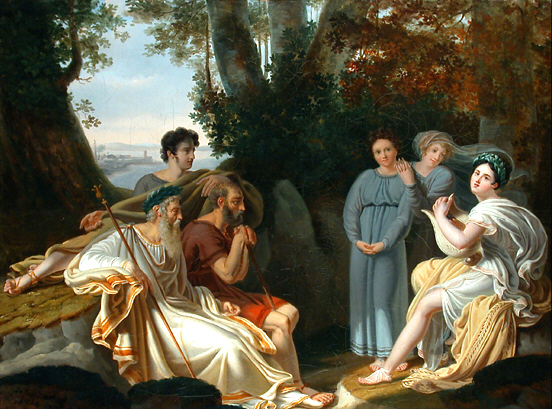
File:Lafond Sappho and Homer.jpg
Charles Lafond, Sappho Sings for Homer

Censuit itaque Plato, non morum et doctrine mater Athene, pellendos esse poetas. Nam cum alie sex civitates ortum sibi vendicarent Homeri, ipse Athene, septima Grecie civitas, tot clara philosophis, tot civibus inclita, totque ducibus exornata, unius ceci dum viveret hominis, quia poeta fuit, nativitatem post eius fata sibi contentiosissime defendebant. Non ergo damnet poetas insensata garrulitas, sed prius addiscant quid poesis quodve poetarum officium, deinde, si videbitur, reprehendant. Nam huius artis initium a viris eloquentissimis atque secundum sua tempora et nationem religiosissimis sine dubio creditur provenisse. Cum enim ad cohibendam feritatem populorum eos quos illi meritorum atque virtutum admiratione plus quam humanum aliquid cogitantes extulerunt in celum, putarent utile religione colendos idque decernentibus populis suaderi ipsorum laudibus insudabant. Cui quidem rei sublimem stilum et ornatissimum dicendi caractherem adhibuerunt et volentes popularem multitudinem in eorum quos laudabant admirationem inducere non plano orationis genere sed verba pro verbis et res pro rebus suavissime commutantes audientes populos a sensibus taliter traducebant quod etiam quos viderant fuisse mortales non mortuos sed translatos in celum pro virtutum meritis mortalitatis illorum obliti certissima opinatione tenerent.

Giovanni Judges Jokes

Giovanni Pontano, de Sermone 3.18:

Martial’s sayings are such that most of them have a lot of wit and no less of bile and bombast, and in their place they joke and delight, while now and then inciting a blush rather than a laugh. But there are others which aren’t just prurient or titillating, but even offer up petulance and jokes which are on the whole lacking in modesty. On so many occasions, he is so unacquainted with shame that he openly plays the clown, and seems not just to envy the sycophants, but even the parasites and the mimes.

Yet, he has embraced all these types so completely and is so much and so often among them that he wishes to seem to have taken the material for his play from other jokes of this sort. But since we seek a middle road in this matter and since extremity is to be avoided, we should look for other types of sayings and types of jokes which are entirely appropriate. And as in no small part the sayings of this Valerius are so little in keeping with our program, so too are many of Cicero’s to be rejected, especially since they are more appropriate to an orator trying to gain victory in a case than they are to that relaxation of the mind which we seek with honesty and dignity, and for which there is an innate appetite in all humans. And so, we ought not to skip over what and how Cicero thinks about these things.

Giovanni Pontano - Wikipedia

Eiusmodi sunt igitur Martialis dicta, ut pleraque multum habeant salis nec minus fellis atque ampullosi proque loco et iocentur et delectent, interdum ruborem inducant magis quam risum; alia vero quae non pruritum tantum exciant aut titillatum verum etiam petulantiam prae se ferant lususque parum omnino modestos. Persaepe autem verecundari ita nescit ut vel aperte scurretur, nec solum invidere sicophantis videatur ac parasitis verum etiam mimis. Adeo autem cuncta haec complexus est genera estque in iis ita frequens et multus ut aliis in eiusmodi iocis ludendi praeripuisse videri velit materiam. A nobis autem cum mediocritas parte in hac quaeratur defugianturque extrema, alia dictorum tum genera quaerenda sunt tum species quae facetorum sint omnino propria. Utque Valeri huius dicta, parte quidem non exigua, institutioni huic nostrae parum consentiunt, sic et Marci Ciceronis quaedem etiam explodenda, quippe quae oratori magis conveniant, ad victoriam causae comparandam, quam ad eam animorum relaxationem, quae a nobis cum honestate ac dignitate quaeritur, cuiusque insita est hominibus a natura appetitio. Itaque quid et quomodo Cicero de iis sentiat, a nobis praetereundum non est.

Don’t Read Trash! A Warning for the Internet Age

Leonardo Bruni de Studiis et Litteris 5

“But believe me, our own study overcomes and conquers everything, for it opens up and displays to us not only words and syllables, but also tropes, figures, and every fine ornament and beauty of speech. We are shaped and established by this study; through it, we then learn many things which can scarcely be taught by a teacher, such as melody, elegance, harmony, and charm. The head of this study will be first to see to it that we involve ourselves in the reading of only those books which were written by the best and most approved authors of the Latin language; but we must also be wary to avoid those which are written unskillfully and inelegantly, as they would be a certain calamity and blot upon our intellect. The reading of rude and unpolished writers attaches to the reader their faults and degrades his mind with a similar illness. It is like a pabulum for the soul, by which the mind is formed and nourished. For this very reason, those who are concerned for their stomach do not pour any food into it indiscriminately; so too, the reader who wishes to preserve the integrity of the mind will not permit himself to read everything indiscriminately.”

Caravaggio, “Saint Jerome Reading”

Sed omnia (mihi crede) superat ac vincit diligentia nostra. Haec enim non verba solum et syllabas, sed tropos et figuras et omnem ornatum pulchritudinemque orationis aperit nobis atque ostendit. Ab hac informamur ac velut instituimur, denique per hanc multa discimus, quae doceri a praceptore vix possunt: sonum, elegantiam, concinnitatem, venustatem. Caput vero huius diligentiae fuerit videre primum, ut in eorum tantum librorum, qui ab optimis probatissimisque latinae linguae auctoribus scripti sunt, lectione versemur, ab imperite vero ineleganterque scriptis ita caveamus, quasi a calamitate quadam et labe ingenii nostri. Inquinate enim inepteque scriptorum lectio vitia sua lectori affigit et mentem simili coinquinat tabe. Est enim veluti pabulum animi, quo mens imbuitur atque nutritur. Quam ob rem, qui stomachi curam habent, non quemvis cibum illi infundunt; ita, qui sinceritatem animi conservare volet, non quamvis illi lectionem permittet.