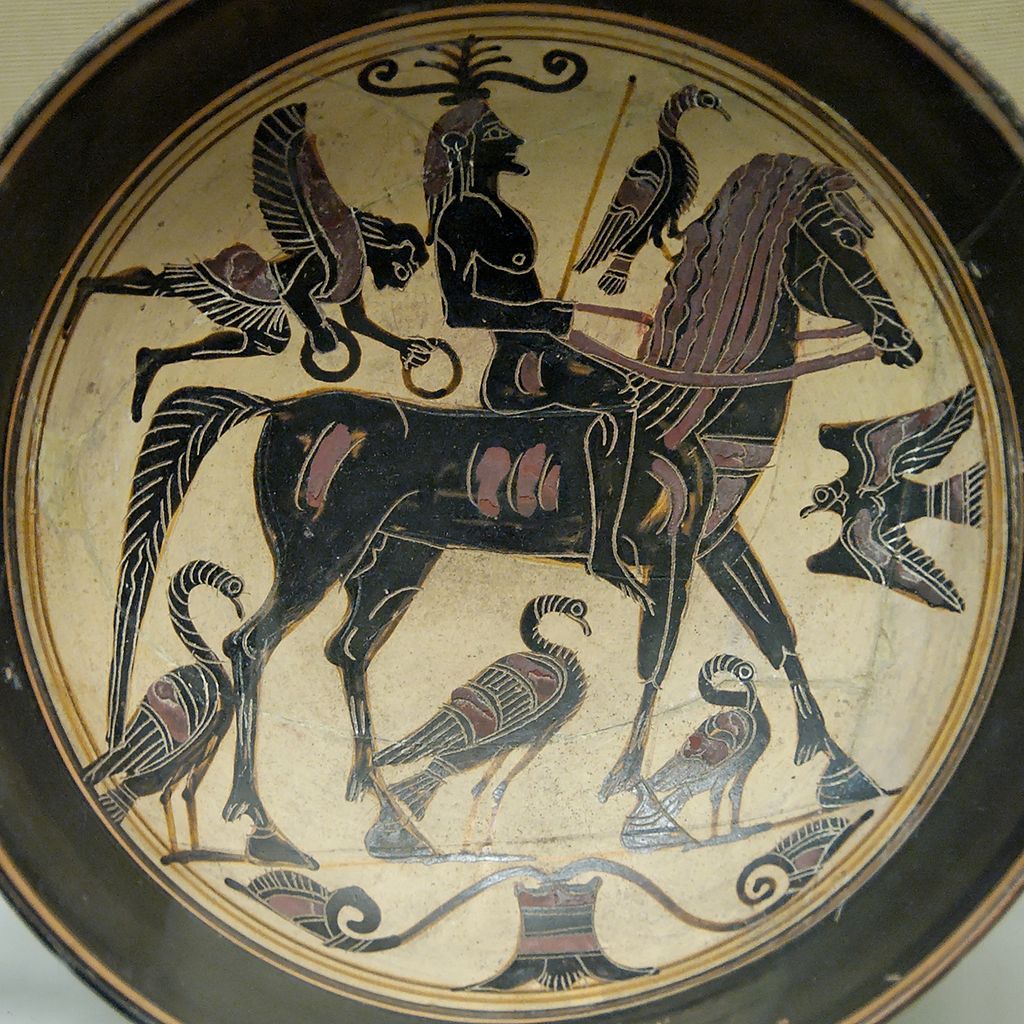
The Sacrifice of the Lokrian Maidens: Four Sources

Aelian, fr. 47 on the Locrian Women (cf. Apd. E. 6.20-22 below)

De virginibus Locrensibus ob stupratam Cassandram Troiam missis.

“Apollo told the Locrians that the horror would not stop for them unless they sent two maidens to Troy every year as recompense to Athena for Kasandra, “until you have fully propitiated the goddess.”

And the maidens who were sent would grow old in Troy unless replacements came.

[Meanwhile] the women were giving birth to cripples and monsters. Those who had suffered forgetfulness of the outrages done sent [representatives] to Delphi. Then the oracle did not receive them, because the god was angry with them. When they managed to learn the cause of the anger, the oracle prophesied. And it told them what was required concerning the virgins.

And they, since they could not deny the command, submitted the issue for judgment to Antigonus, concerning which Locrian city should send the payment. And the king decreed that the very thing which was entrusted to him for judgment would be decided by vote.”

ὁ ᾿Απόλλων φησὶ πρὸς Λοκροὺς μὴ ἂν αὐτοῖς τὸ δεινὸν λωφῆσαι, εἰ μὴ πέμποιεν ἀνὰ πᾶν ἔτος δύο παρθένους ἐς τὴν ῎Ιλιον τῇ ᾿Αθηνᾷ, Κασάνδρας ποινήν, ‘ἕως ἂν ἱλεώσητε τὴν θεόν.’
καὶ αἵ γε πεμφθεῖσαι κατεγήρασαν ἐν τῇ Τροίᾳ, τῶν διαδόχων μὴ ἀφικνουμένων.
αἱ δὲ γυναῖκες ἔτικτον ἔμπηρα καὶ τέρατα· οἳ δὲ τῶν τετολμημένων σφίσι λήθην καταχέαντες ἧκον ἐς Δελφούς.οὔκ ουν ἐδέχετο αὐτοὺς τὸ μαντεῖον, τοῦ θεοῦ μηνίοντος αὐτοῖς. καὶ λιπαρούντων μαθεῖν τὴν αἰτίαν τοῦ κότου, ὀψέ ποτε χρῆσαι.
καὶ τὸ ἐλλειφθὲν κατὰ τὰς παρθένους προφέρει αὐτοῖς.
οἳ δὲ (οὐδὲ γὰρ ἔσχον ἀνήνασθαι τὸ πρόσταγμα) ἐπ’ ᾿Αντιγόνῳ τίθενται τὴν κρίσιν ὑπὲρ τοῦ τίνα χρὴ Λοκρικὴν πόλιν πέμπειν δασμόν.
ὁ δὲ βασιλεὺς ᾿Αντίγονος, ἐφεθέν οἱ δικάσαι προσέταξε κλήρῳ διακριθῆναι.

Plutarch, De Sera Numinis Vindicta 557c-d

“And, truly, it has not been so long since the Lokrians stopped sending their virgins to Troy, “the girls who like the lowest slaves, with naked feet / sweep Athena’s temple around the altar / and come to great old age without a veil”—for the crime of Ajax!”

καὶ μὴν οὐ πολὺς χρόνος ἀφ’ οὗ Λοκροὶ πέμποντες εἰς Τροίαν πέπαυν-
ται τὰς παρθένους,

‘αἳ καὶ ἀναμπέχονοι γυμνοῖς ποσὶν ἠύτε δοῦλαι
ἠοῖαι σαίρεσκον ᾿Αθηναίης περὶ βωμόν,
νόσφι κρηδέμνοιο, καὶ εἰ βαθὺ γῆρας ἱκάνοι,’

διὰ τὴν Αἴαντος ἀκολασίαν.

Timaios, FrGrH 555 F146b (=Schol. to Lyk. 1141)

“After Ajax of Lokros was shipwrecked near Guraia and buried in Tremont, in the land of Delos, the Locrians who were saved, barely, returned home. A plague and famine gripped Lokris for tree years because of Ajax’s lawless act against Kasandra. The god prophesied that they needed to propitiate the goddess Athena in Troy each year by sending two virgins by lot and vote. The Trojans who went out to meet the women who were sent, if they caught them, they would kill them, and they would burn their bones with wild, unfruited wood from the Traronian mountain near Troy and then through the ash into the sea. And the Lokrians would have to send other women. If any of them fled, once they returned secretly into Athena’s temple, they would sweep and clean it and they would not approach the goddess or exit the shrine unless if was night. They were shaven, wearing a single tunic, and barefoot.

The first of the Lokrian maidens were Periboia and Kleopatra. First they sent virgins, then the Locrians sent year-old infants with their nurses. When one thousand years had past, after the Phocian War, they stopped that type of sacrifice. This is according to the Sicilian, Timaios. The Cyrenian Kallimakhos also mentions this story.”

TZETZ. LYKOPHR. Al. 1141: Αἴαντος τοῦ Λοκροῦ περὶ τὰς Γυραίας ναυαγήσαντος καὶ ταφέντος ἐν Τρέμοντι χώραι τῆς Δήλου, οἱ Λοκροὶ μόλις σωθέντες ἦλθον εἰς τὴν οἰκείαν. φθορὰ δὲ καὶ λοιμὸς μετὰ τρίτον ἔτος ἔσχε τὴν Λοκρίδα διὰ τὴν εἰς Κασάνδραν ἀθέμιτον πρᾶξιν τοῦ Αἴαντος. ἔχρησε δὲ ὁ θεὸς ἱλάσκεσθαι τὴν θεὰν ᾿Αθηνᾶν τὴν ἐν ᾿Ιλίωι ἐπ’ ἔτη α, β παρθένους πέμποντας κλήρωι καὶ λαχήσει. πεμπομένας δὲ αὐτὰς προυπαντῶντες οἱ Τρῶες εἰ κατέσχον, ἀνήιρουν, καὶ καίοντες ἀκάρποις καὶ ἀγρίοις ξύλοις τὰ ὀστᾶ αὐτῶν ἀπὸ Τράρωνος ὄρους τῆς Τροίας τὴν σποδὸν εἰς θάλασσαν ἔρριπτον· καὶ πάλιν οἱ Λοκροὶ ἑτέρας ἔστελλον. εἰ δέ τινες ἐκφύγοιεν, ἀνελθοῦσαι λάθρα εἰς τὸ τῆς ᾿Αθηνᾶς ἱερόν, ἔσαιρον αὐτὸ καὶ ἔραινον, τῆι δὲ θεῶι οὐ προσήρχοντο οὔτε τοῦ ἱεροῦ ἐξήρχοντο, εἰ μὴ νύκτωρ. ἦσαν δὲ κεκαρμέναι, μονοχίτωνες καὶ ἀνυπόδητοι. πρῶται δὲ τῶν Λοκρίδων παρθένων Περίβοια καὶ Κλεοπάτρα ἀφίκοντο. καὶ πρῶτον μὲν τὰς παρθένους, εἶτα τὰ βρέφη ἐνιαύσια μετὰ τῶν τροφῶν αὐτῶν ἔπεμπον οἱ Λοκροί· χιλίων δ’ ἐτῶν παρελθόντων, μετὰ τὸν Φωκικὸν πόλεμον, ἐπαύσαντο τῆς τοιαύτης θυσίας 〚ὥς φησι Τίμαιος ὁ Σικελός〛. μέμνηται δὲ τῆς ἱστορίας καὶ ὁ Κυρηναῖος Καλλίμαχος (F 13d Schn = F 35 Pf).

Apollodorus 6.20–22

“The Lokrians barely made it back to their own land; three years later, a plague struck Lokris and they obtained an oracle to propitiate Athena in Troy by sending two maidens there for one thousand years. Periboia and Kleopatra were the first selected by lot.

But when they went to Troy, they were pursued by the local inhabitants until they entered the shrine. They did not approach the goddess, but they swept and sprinkled water on the temple. They did not exit the temple; their hair was cut, they wore single-tunics and no shoes.

When they died, the Lokrians sent others and they entered the city at night so that they would not be murdered if seen outside the precinct. Later, the Lokrians started sending infants with nurses. When one thousand years had passed, they stopped sening suppliants after the Phocian War.”

Λοκροὶ δὲ μόλις τὴν ἑαυτῶν καταλαβόντες, ἐπεὶ μετὰ τρίτον ἔτος τὴν Λοκρίδα κατέσχε φθορά, δέχονται χρησμὸν ἐξιλάσασθαι τὴν ἐν Ἰλίῳ Ἀθηνᾶν καὶ δύο παρθένους πέμπειν ἱκέτιδας ἐπὶ ἔτη χίλια. καὶ λαγχάνουσι πρῶται Περίβοια καὶ Κλεοπάτρα.

αὗται δὲ εἰς Τροίαν ἀφικόμεναι, διωκόμεναι παρὰ τῶν ἐγχωρίων εἰς τὸ ἱερὸν κατέρχονται: καὶ τῇ μὲν θεᾷ οὐ προσήρχοντο, τὸ δὲ ἱερὸν ἔσαιρόν τε καὶ ἔρραινον: ἐκτὸς δὲ τοῦ νεὼ οὐκ ἐξῄεσαν, κεκαρμέναι δὲ ἦσαν καὶ μονοχίτωνες καὶ ἀνυπόδετοι.

τῶν δὲ πρώτων ἀποθανουσῶν ἄλλας ἔπεμπον: εἰσῄεσαν δὲ εἰς τὴν πόλιν νύκτωρ, ἵνα μὴ φανεῖσαι τοῦ τεμένους ἔξω φονευθῶσι: μετέπειτα δὲ βρέφη μετὰ τροφῶν ἔπεμπον. χιλίων δὲ ἐτῶν παρελθόντων μετὰ τὸν Φωκικὸν πόλεμον ἱκέτιδας ἐπαύσαντο πέμποντες.

There is actually an inscription from the historical period making arrangements for this sacrifice.

womans-cult

Blogging My Way to a Book

In 2014 or so I was a tenured professor, less than happy in my job, but without any plan for making a change. It is not easy to get a job as a professor in classics; it is harder to get job after you have tenure; and it is nearly impossible to do so without that holiest of holies, the single authored monograph.

I was tenured without a book because the department I was in didn’t expect one and I had published a lot otherwise (including a co-authored general audience book on Homer). The fact is that I really did not want to write one. Most successful academics are expected to turn their dissertation into a book. I hadn’t done that on purpose (I was sick of my dissertation and I wanted to do something different).

Perhaps more importantly, I also didn’t know how to write a book. It is not that I didn’t want to write about things. I just wanted to write about them in shorter segments. It may have been a lack of imagination as much as anything else, but I found many more reasons not to write a book than to write one: the fact that no one reads them, that lives are disrupted to write them, that we have an entire economy of knowledge dedicated to big books about small things, etc. etc.

That last phrase is not fair, completely. But, to crib from an ancient proverb, there’s a difference between a book that needs to be written and needing to write a book. After 2012, however, I started talking, thinking, and writing about the Odyssey in a way that clearly pointed to a lengthy treatment of a topic, if not wholly original, at least markedly different from work I had read before.

Some graduate programs do better jobs than others in training you how to do independent research. Many do a great job in preparing students to turn their dissertations into books. But few anticipate what to do next. This is not a huge problem, since the paths people take are so different depending on their institution, interests, etc. But the irony is that although I was a book review editor for a journal, had reviewed a dozen books, and had helped to write one, I really didn’t know what I was doing.

So, once I gave in to the desire to write a book, I started lamenting that I didn’t have enough time to do it. Fortunately, I have a spouse who is constitutionally incapable of not calling me on my bullshit. Over drinks in 2015, while I complained again that I just needed the time to write a book, she said, “look, you ran a stupid marathon last year. You spent hours every day running, training, and keeping track of every thing you did. I don’t know why you can do that and not write a book. You’re not a runner; you’re a Homerist.”

Now, to be honest, the conversation hurt my feelings a little bit because (1) running marathons didn’t come easy to me (I run like a rhinoceros, except uglier) and (2) she was absolutely right. I started to keep track of hours a week spent on the book project, making lists and schedules, and trying to break down the project into little bits.

It worked: I have books out in 2018, 2019, and 2020 (changing institutions and getting some summer funding for childcare also made a huge difference; the blog was crucial to those books too). But part of the story is also this website. I have written about the importance of the discipline of posting daily on the blog, but what I haven’t explained clearly enough is how each of the books I just mentioned relied on this regular writing practice for drafting, brainstorming, and progress.

So, for curiosity, inspiration, mockery, and whatever else may come, here’s an overview of the more than 30 blogposts that are part of my book on the Odyssey, out this week (The Many Minded Man: The Odyssey, Psychology and the Therapy of Epic). I am posting one each day on twitter with the hashtag #BloggingABook for about a month, but here’s a more organized collection.

Let’s start at the beginning. This post was one of the first that directly translated into content in the book, showing up as a table on page 16. It helped me to organize my thoughts about the structure of the poem without making an entire labor out of the structure of the poem.

Less often, I used posts to explore combining theoretical modern work with ancient concepts as in this early post about the work of Mark Turner, Aristotle, and narrative character was written at a Starbucks in San Antonio and is well integrated into the theoretical framework of the first chapter on Homeric psychology. Similarly, this post on correspondence and coherence in Odysseus’ lies.which became the framing for Chapter 5.

A good deal of the theoretical research of this book took me through post-structural theories like those in disability studies, which made me think differently about ideal bodies in Homer. I used some posts, like this one about Telemachus and monstrosity, to think through this. This ended up in a chapter NOT about Telemachus.  Several posts arose from my reading of disability studies texts alongside Homer, like this one about Thersities and beautiful minds, which in turn became parts of chapters and a forthcoming article.

I won’t even list all the posts on ancient medicine and mental health—I spent some time trying to learn more about these topics and most of the research ended up on the website (at least a dozen or more). This scholion on drugs made me think about ancient beliefs about addiction. As I explored ancient ideas of madness in philosophy and medicine, it was helpful to see how mythical figures at times appeared to help explain things like isolation and mental anguish (as in this passage from Aristotle). This contributed to Chapter 3’s examination of heroic isolation

Just a sample of posts and chapters

ChapterBlogpost
IntroductionSex, Trees, and the Structure of the Odyssey
Addiction and Self-restraint
1 Homeric Psychology Mark Turner, Aristotle, and narrative character
Complementarity
2 Treating TelemachusStudy of Scholia What’s Troubling Telemachus?
3 Escaping OgygiaHeroic Madness and Isolation
Sex and Anhedonia
4 Narrative Therapy[!]
5 Correspondence and CoherenceCorrespondence and coherence in Odysseus’ lies.
Eumaios, Storyteller
The Meaning of Odysseus’ Pseudonyms
6 Marginalized AgenciesA Little bit But not Too Long
Telemachus is not a Monster
The Millwoman’s Sorrowful Sign
Thersites and Beautiful Minds
How Much is a Slave’s Life Worth
His heart Barks
The Origin of Thersites
7 Penelope’s Subordinated AgencyPenelope and fidelity Naming Odysseus
Penelope Lays into a Suitor
8 Politics of IthacaThe Heroic Tale of Laertes
The Suitors Debate Killing Telemachus
The Trial of Odysseus
9 The Therapy of OblivionWhere Does the Odyssey End and Why?
Penelope’s Web Agamemnon on Feminine Fame
Conclusion, Escaping the Story’s BoundsPorphyry’s On Styx, Pseudo-Plutarch allegories from Metrodorus Allegories attributed to Porphyry by Stobaeus, Death and the End of the Odyssey

Part of what I love about research—when I get to do it freely—is the wandering path I take through things. Blogging gives me a sense of accomplishment (and that important reward feedback loop!) because it provides an end of sorts to a journey that lasts a day or just a few hours. Many posts are just me trying to make sense of scholia, especially longer ones like the large segments attributed to Porphyry in the Odyssey scholia. These were fodder for notes and content in the book.

Sometimes posts came from work in the scholia, like this one, where I tried to figure out the details of Telemachus’ journey for chapter 2. Indeed, many of my mythographical footnotes started or ended as posts on the site, like this one about Penelope and fidelity which contributes to one part of chapter 7. Some of the mythographical posts and studies didn’t make it to the book, but that’s ok because doing the work, as in this one on Nausikaa’s name, sharpened what I would say by helping me figure out what I didn’t need to.

Mythography doesn’t explain what audiences knew, but it can help show what they might have known which is why several posts talk about Thersites’ story outside of Homer like this one. A mere footnote in the book, but a useful one. On many occasions, I would think something might be important or interesting and find out only the latter is true, making it good for a post as in this scholion on Alkinoos’ marriage wish. It didn’t make it into the book, but Alkinoos did.  And I can’t even begin to figure out how to map my dozens of posts on Odysseus’ family and multiple sons onto the chapters of the book. But they were definitely formative.

Of course, some of the details I mined were important: this post on the end of the Odyssey was essential for footnotes in more than one publication. Often work on philological and literary problems, like what Penelope was weaving, produced posts that also involved scholarship and ended up in multiple chapters. In this case, a significant part of chapter 9. Sometimes philological investigations started as posts and then later added to larger arguments, as in this exploration of a speech introduction for Telemachus. This speech of Agamemnon became critical for both chapters 7 and 9 and appears in an article on Kassandra too.

Other posts respond to epic and other readings, shaping the tone of a section or chapter without necessarily being part of them as in this post on the hanging of the enslaved women.

Part of writing is figuring out which path to take. Some times this means writing stuff that gets moved around a lot. I had a series of posts on allegory and Homer which eventually contributed to half of the conclusion (originally a transitional segment between the two halfs of the book). Posts include translations of Porphyry’s On Styx, allegories from Pseudo-Plutarch, allegories from Metrodorus, and others attributed to Porphyry by Stobaeus

And, of course, there are posts on expected topics in the Odyssey. Naming Odysseus is no minor affair, so I have several posts looking at Homeric epithetis and their ancient reception of a man of may ways who is also quite shifty. Researching this book forced me to rethink the political situation on Ithaca from ancient perspectives, showing that Laertes likely unified a somewhat odd island ‘state’. This is an important part of chapter 8, which looks at Ithaca as a traumatized community

Rethinking the representation of agency in Homer really made me look differently at the representation of women’s agency in Homer. Some posts arose out of shock at reading passages anew as I had never read them before. The emotion and scene made it to the book. Part of the journey of writing this book was thinking about the suitors as full human beings rather than simple villains, especially in their political wranglings as in this post looking at their debate about killing Telemachus. This scene is critical in the book’s chapter 8.

In rereading representations of agency in the Odyssey it was necessary to think about heroes, non-heroes, children, enslaved people, and women and how these categories intersect. Some of the more explicit comments on these topics informed chapter 6 but are clearer in posts, like this one on the cost of an enslaved person’s life. This post contributes to chapter 6.  In the same vein, I also used a post to lay out the passages where Odysseus thinks about or responds to enslaved women’s sexuality. Working through these passages helped me understand the infantilization of enslaved people in the Odyssey.

Many posts were part of my writing process, which is to translate passages I want to write about. Laborious, but it gives me opportunities to post Penelope laying into a suitor like this one. This passage became part of thinking about where Penelope claims agency (and doesn’t). I cover the end of the Odyssey in two chapters, so thinking carefully through the trial of Odysseus was really important, I started this process by translating and discussing the scene in a post. The translations are improved in the book, but have the same core.

A second part of my writing process after translating is looking at scholia and commentaries, a step  often preserve in posts like this one on Eumaios as a storyteller. Again, this becomes part of footnotes and discussions, not central arguments in the book. Other posts like this one on the meanings of Odysseus’ pseudonyms ended up as footnotes and detail.

On many occasions I wanted to think more broadly about ancient literature and narrative. Early drafts from chapter 9 look like this post on how liars communicate but ended up being edited quite differently. Similarly, I would at times start to right grandly and in generalizations not fit at the point of the book I was writing. This one on complementarity can be seen in some footnotes from the introduction, but not very clearly.

Many posts start with questions about what lines mean from the perspective of Homer—so doing the whole clarify Homer through Homer thing—like this one on Odysseus’ lack of pleasure from sex in with Calypso. The work here influenced some ideas in the introduction and chapter 3.

Some posts also emerged as summaries of the thoughts in the book, like this one written at the beginning of the pandemic. It reflects on a project finished rather than attesting to work in progress. Others draw on the frameworks developed during research, like the post on Toxic Heroism and a School Massacre. Sometimes ideas started in the book but had no space there. This is true of my work on Kassandra, which went into a post before it became an article elsewhere and my personal reflections on the scene of Argos, the dog.

I did not know what the conclusion of this book would add until one day I saw a line from Cavafy online and then wrote a post about death and the end of the Odyssey. This post formed a third of the conclusion once expanded.

Where there are fewer blog posts, it is because I wrote directly to publication for some topics as in the work that forms some of chapter 4 (“The Clinical Odyssey: Odysseus’ Apologoi and Narrative Therapy.” Arethusa 51: 1–3) and a chapter in a collection that contributed to parts of chapters 2 and 3 (“Learned Helplessness, the Structure of the Telemachy and Odysseus’ Return.” in conference proceedings, Psychology and the Classics, Jeroen Lauwers, Jan Opsomer and Hedwig Schwall (eds.): 129–141). And many sections were also written for talks at professional conferences and invited lectures.

I don’t think there’s a clean and just-so way to end this post. There’s lots of advice out there about writing  a book in an hour or two a day and I am here to tell you it is possible. But it helps to have short term goals and ‘outputs’ to work towards. It also helps (probably more than anything) to have a stable job, good funding, and a partner who calls you on your bullshit.

Some sites say this is out tomorrow (in ebook and print); some say it is out November 22nd and December 25th.

A Lyric Take on the Death of Agamemnon

Pind. Pyth. 11.17-37

“The nurse Arsinoe took [Orestes]
from his father murdered
by the strong hands of Klytemnestra
by the grievous trick
when she sent the Dardanian girl, Kassandra,
with Agamemnon’s soul by means of grey bronze
to the dusty banks of Acheron,
the pitiless woman.

Was it Iphigenia, slaughtered
far away from her home near the Euripos
that moved her to heavy-handed rage?
Or was she overwhelmed by another bed,
made crazy by their nightly ‘sharing’?
This is the most hateful mistake
of young brides
and it is impossible to keep from other people’s tongues.
Citizens are vile-gossips.

Prosperity brings with it an equal-sized envy;
while the man who breathes close to the ground moves by unseen.
The hero son of Atreus himself died
when he came after a long time to famous Amyklai.
And he destroyed the prophetic girl too
after he despoiled the homes of the Trojans, burned for Helen.”

agdeath

Β′ τὸν δὴ φονευομένου πατρὸς ᾿Αρσινόα Κλυταιμήστρας
χειρῶν ὕπο κρατερᾶν
ἐκ δόλου τροφὸς ἄνελε δυσπενθέος,
ὁπότε Δαρδανίδα κόραν Πριάμου
Κασσάνδραν πολιῷ χαλκῷ σὺν ᾿Αγαμεμνονίᾳ
ψυχᾷ πόρευ’ ᾿Αχέροντος ἀκτὰν παρ’ εὔσκιον
νηλὴς γυνά. πότερόν νιν ἄρ’ ᾿Ιφιγένει’ ἐπ’ Εὐρίπῳ
σφαχθεῖσα τῆλε πάτρας
ἔκνισεν βαρυπάλαμον ὄρσαι χόλον;
ἢ ἑτέρῳ λέχεϊ δαμαζομέναν
ἔννυχοι πάραγον κοῖται; τὸ δὲ νέαις ἀλόχοις
ἔχθιστον ἀμπλάκιον καλύψαι τ’ ἀμάχανον
ἀλλοτρίαισι γλώσσαις·
κακολόγοι δὲ πολῖται.
ἴσχει τε γὰρ ὄλβος οὐ μείονα φθόνον·
ὁ δὲ χαμηλὰ πνέων ἄφαντον βρέμει.
θάνεν μὲν αὐτὸς ἥρως ᾿Ατρεΐδας
ἵκων χρόνῳ κλυταῖς ἐν ᾿Αμύκλαις,
Γ′ μάντιν τ’ ὄλεσσε κόραν, ἐπεὶ ἀμφ’ ῾Ελένᾳ πυρωθέντας
Τρώων ἔλυσε δόμους.

An Ancient Greek Horror Story to Make You Scream

CW: Violence against children; infanticide; violence against an intersex person. There are a range of intersex tales in ancient Greece, for ancient criticism of their superstitious and salacious nature, go here.

This might be the most disturbing thing I have read all summer. When I was reading the Greek for the final sentence below, I actually uttered “what the f*ck” aloud. Go here for the second part.

Phlegon of Tralles, On Marvels 2 (Part 1)

Hieron the Alexandrian or Ephesian tells of the following wonder which occurred in Aitolia.

There was a certain citizen, Polykritos, who was voted Aitolian arkhon by the people. His fellow citizens considered him worthy for three years because of the nobility of his forebears. During the time he was in that office, he married a Lokrian woman. After he shared a bed with her for three nights, he died on the fourth.

The woman remained in their home widowed. When she gave birth, she had a child who had two sets of genitals, both male and female, which was alarmingly different from nature. The parts up top were completely rough and masculine and those near the thighs were feminine and softer.

Awestruck by this, her relatives forced the child to the agora and held an assembly to take advice about this, calling together the omen readers and interpreters. Some were claiming that this meant there would be dissent between Aitolians and Lokrians, since the mother was Lokrian and the father was Aitolian. But others believed that it was necessary to take the child and mother to the frontier and have them burned.

While the people were deliberating, suddenly the dead Polykritos appeared in the assembly dressed in black near his child. Even though the citizens were thunderstruck by this apparition and many of them were rushing to flight, he asked the citizens to be brave and not to be rattled by the sight which appeared. Then a bit of the chaos and the uproar receded, and he said these things in a slight voice:

“My fellow citizens, although I am dead in my body, I live among you in goodwill and thanks. And now I am present imploring those people who have power of this land to your collective benefit. I advise you who are citizens not to be troubled or angry at the impossible miracle which has happened. And I ask all of you, vouching for the safety of each, is to give me the child who was born from me so that no violence may come from those who make some different kind of plans and that there may be no beginning of malicious and hard affairs because of a conflict on my part.

It would not be possible for me to overlook the burning of my child thanks to the shock of these interpreters who are advising you. I do have some pity, because you are at a loss when you see this kind of unexpected sight as to how you might respond to it correctly for current events. If you assent to me without fear, you will be relieved of the present anxieties and of the evils to come. But if you fall prey to another opinion, then I have fear for you that you will come into some incurable sufferings because you did not trust me.

Therefore, because of the goodwill I experienced while I was alive and the unexpectedness of the current situation, I am predicting the suffering to you. I think it is right that you do not delay any longer but that, once you deliberate correcly and obey the things I have said, you should hand over the child to me with a blessing. It is not fitting for me to waste any more time because of the men who rule this land.”

After he said these things, he kept quiet for a bit as he awaited what kind of decision there would be once they deliberated about it. Some were thinking it was right to give him the child and consider the sight sacred and the influence of a deity; but most of them denied this, claiming that it was necessary to deliberate in a calmer atmopshere when they were not at so great a loss, because the affair was a big deal.

When he saw that they were not moving in his favor but were actually impeding the decision there, he spoke these things in turn: “Fellow Citizens. If something more terrible happens to you because of a lack of decision, do not blame me, but this fate which directs you to something worse—it sets you in opposition to me and compels me to transgress against my child.”

When the mob ran together in strife over surrendering the monster, he reached for the child and and pushed off most of the people boldly before butchering and eating the child.

῾Ιστορεῖ δὲ καὶ ῾Ιέρων ὁ ᾿Αλεξανδρεὺς ἢ ᾿Εφέσιος καὶ ἐν Αἰτωλίᾳ φάσμα γενέσθαι. Πολύκριτος γάρ τις τῶν πολιτῶν ἐχειροτονήθη ὑπὸ τοῦ δήμου Αἰτωλάρχης, ἐπὶ τρία ἔτη τῶν πολιτῶν αὐτὸν ἀξιωσάντων διὰ τὴν ὑπάρχουσαν ἐκ προγόνων καλοκαγαθίαν. ὢν δὲ ἐν τῇ ἀρχῇ ταύτῃ ἄγεται γυναῖκα Λοκρίδα, καὶ συγκοιμηθεὶς τρισὶν νυξὶ τῇ τετάρτῃ τὸν βίον ἐξέλιπεν.

ἡ δὲ ἄνθρωπος ἔμενεν ἐν τῇ οἰκίᾳ χηρεύουσα, ἡνίκα δὲ ὁ τοκετὸς ἤπειγεν, τίκτει παιδίον αἰδοῖα ἔχον δύο, ἀνδρεῖόν τε καὶ γυναικεῖον, καὶ τὴν φύσιν θαυμαστῶς διηλλαγ-μένον· τὰ μὲν ἄνω τοῦ αἰδοίου ὅλως σκληρά τε καὶ ἀνδρώδη ἦν, τὰ δὲ περὶ τοὺς μηροὺς γυναικεῖα καὶ ἁπαλώτερα. ἐφ’ ᾧ καταπλαγέντες οἱ συγγενεῖς ἀπήνεγκαν εἰς τὴν ἀγορὰν τὸ παιδίον καὶ συναγαγόντες ἐκκλησίαν ἐβουλεύοντο περὶ αὐτοῦ, θύτας τε καὶ τερατοσκόπους συγκαλέσαντες. τῶν δὲ οἱ μὲν ἀπεφήναντο διάστασίν τινα τῶν Αἰτωλῶν καὶ Λοκρῶν ἔσεσθαι—κεχωρίσθαι γὰρ ἀπὸ μητρὸς οὔσης Λοκρί-δος καὶ πατρὸς Αἰτωλοῦ—οἱ δὲ δεῖν ᾤοντο τὸ παιδίον καὶ τὴν μητέρα ἀπενέγκοντας εἰς τὴν ὑπερορίαν κατακαῦσαι. ταῦτα δὲ αὐτῶν βουλευομένων ἐξαίφνης φαίνεται ὁ Πολύκριτος ὁ προτεθνηκὼς ἐν τῇ ἐκκλησίᾳ πλησίον τοῦ τέκνου ἔχων ἐσθῆτα μέλαιναν.

τῶν δὲ πολιτῶν καταπλαγέντων ἐπὶ τῇ φαντασίᾳ καὶ πολλῶν εἰς φυγὴν τραπομένων παρεκάλεσε τοὺς πολίτας θαρρεῖν καὶ μὴ ταράττεσθαι ἐπὶ τῷ γεγονότι φάσματι. ἐπεὶ δὲ ἔληξε τὸ πλέον τοῦ θορύβου καὶ τῆς ταραχῆς, ἐφθέγξατο λεπτῇ τῇ φωνῇ τάδε· «ἐγὼ, ἄνδρες πολῖται, τῷ μὲν σώματι τέθνηκα, τῇ δὲ εὐνοίᾳ καὶ τῇ χάριτι <τῇ> πρὸς ὑμᾶς ζῶ. καὶ νῦν πάρειμι <ὑμῖν> παραιτησάμενος τοὺς κυριεύοντας τῶν κατὰ γῆν ἐπὶ τῷ συμφέροντι τῷ ὑμετέρῳ. παρακαλῶ τοίνυν ὑμᾶς πολίτας ὄντας ἐμαυτοῦ μὴ ταράττεσθαι μηδὲ δυσχεραί-νειν ἐπὶ τῷ παραδόξῳ γεγονότι φάσματι. δέομαι δὲ ὑμῶν ἁπάντων, κατευχόμενος πρὸς τῆς ἐκάστου σωτηρίας, ἀποδοῦναί μοι τὸ παιδίον τὸ ἐξ ἐμοῦ γεγεννημένον, ὅπως μηδὲν βίαιον γένηται ἄλλο τι βουλευσαμένων ὑμῶν, μηδ’ ἀρχὴ πραγμάτων δυσχερῶν καὶ χαλεπῶν διὰ τὴν πρὸς ἐμὲ φιλονεικίαν ὑμῖν γένηται. οὐ γὰρ ἐνδέχεταί μοι περιιδεῖν κατακαυθὲν τὸ παιδίον ὑφ’ ὑμῶν διὰ τὴν τῶν ἐξαγγελλόντων ὑμῖν μάντεων ἀποπληξίαν. συγγνώμην μὲν οὖν ὑμῖν ἔχω, ὅτι τοιαύτην ὄψιν ἀπροσδόκητον ἑωρακότες ἀπορεῖτε πῶς ποτε τοῖς παροῦσι πράγμασιν ὀρθῶς χρήσεσθε. εἰ μὲν οὖν ἐμοὶ πεισθήσεσθε ἀδεῶς, τῶν παρόντων φόβων καὶ τῶν ἐπερχομένων κακῶν ἔσεσθε ἀπηλλαγμένοι. εἰ δὲ ἄλλως πως τῇ γνώμῃ προσπεσεῖσθε, φοβοῦμαι περὶ ὑμῶν μήποτε εἰς ἀνηκέστους συμφορὰς ἀπειθοῦντες ἡμῖν ἐμπέσητε. ἐγὼ μὲν οὖν διὰ τὴν ὑπάρχουσαν εὔνοιαν ὅτ’ ἔζων καὶ νῦν ἀπροσδοκήτως παρὼν προείρηκα τὸ συμφέρον ὑμῖν. ταῦτ’ οὖν ὑμᾶς ἀξιῶ μὴ πλείω με χρόνον παρέλκειν, ἀλλὰ βουλευσαμένους ὀρθῶς καὶ πεισθέντας τοῖς εἰρημένοις ὑπ’ ἐμοῦ δοῦναί μοι μετ’ εὐφημίας τὸ παιδίον. οὐ γὰρ ἐνδέχεταί μοι πλείονα μηκύνειν χρόνον διὰ τοὺς κατὰγῆν ὑπάρχοντας δεσπότας.»

ταῦτα δὲ εἰπὼν ἡσυχίαν ἔσχεν ἐπ’ ὀλίγον, καραδοκῶν ποίαν ποτὲ ἐξοίσουσιν αὐτῷ γνώμην περὶ τῶν ἀξιουμένων. τινὲς μὲν οὗν ᾤοντο δεῖν ἀποδοῦναι τὸ παιδίον καὶ ἀφοσιώσασθαι τό τε φάσμα καὶ τὸν ἐπιστάντα δαίμονα, οἱ δὲ πλεῖστοι ἀντέλεγον, μετὰ ἀνέσεως δεῖν βουλεύσασθαι φάσκοντες, ὡς ὄντος μεγάλου τοῦ πράγματος καὶ οὐ τῆς τυχούσης αὐτοῖς ἀπορίας. συνιδὼν δὲ αὐτοὺς οὐ προσέχοντας, ἀλλ’ ἐμποδίζοντας αὐτοῦ τὴν βούλησιν, ἐφθέγξατο αὖθις τάδε· «ἀλλ’ οὖν γε, ὦ ἄνδρες πολῖται, ἐὰν ὑμῖν συμβαίνῃ τι τῶν δυσχερεστέρων διὰ τὴν ἀβουλίαν, μὴ ἐμὲ αἰτιᾶσθε, ἀλλὰ τὴν τύχην τὴν οὕτως ἐπὶ τὸ χεῖρον ὑμᾶς ποδηγοῦσαν, ἥτις ἐναντιουμένη κἀμοὶ παρανομεῖν ἀναγκάζει με εἰς τὸ ἴδιον τέκνον.»

τοῦ δὲ ὄχλου συνδραμόντος καὶ ἔριν περὶ [τὴν ἄρσιν] τοῦ τέρατος ἔχοντος, ἐπιλαβόμενος τοῦ παιδίου καὶ τοὺς πλείστους αὐτῶν ἀνείρξας ἰταμώτερον διέσπασέ τε αὐτὸ καὶ ἤσθιε.

Rider BM B1.jpg

We’ve Been Doing This for 10 years: A Personal History of Sententiae Antiquae

“…It brings pleasure
Whenever someone discovers some new notion,
To share it with everyone…”
… ἡδονὴν ἔχει,
ὅταν τις εὕρῃ καινὸν ἐνθύμημά τι,
δηλοῦν ἅπασιν -Anaxandrides

What is this Fresh Garbage?

Today, October 22nd, this website has completed its tenth year. Such round numbers, if they don’t invite deeper reflection on life and its apparent meanings, can at least prompt us to ask what we are doing and what is this garbage we set on fire.

What does 10 years of Sententiae Antiquae mean? It means over 7000 posts in a decade from more than 20 different contributors (many of these have been repeated once). It means 400 page views for its first year, 8000 for the next year and over 500,000 thousand page-views just last year alone (to go with 37k+ followers on twitter. Check out the SA Tweetbook for more of that).

In the internet age these stats too often come to represent our worth (as commodities and moral agents!). I’d certainly be lying if we weren’t at times delighted with the popularity of this thing or that. But, as any good educator knows, quantity and quality are not coterminous. Indeed, there is a superabundance of shit on this website and some of the things that have gained the most views and likes are far from those for which we’d hope to be remembered.

So there’s the thing: what is this project for? What does it do in the world? After 10 years, I find myself regularly asking this, especially as time in front of a screen or on an app becomes all the more tiring in our panoptical pandemic omnipresence. For the sake of trying to figure this out and sharing some history of the site, I am going to go back to the beginning, to tell its story as best as I remember it.

“Beginnings are from Jove, oh Muses! Everything is full of Jove”
ab Jove principium, Musae; Jovis omnia plena  -Vergil

The Beginning

This site was born out of uncertainty, frustration, and sleeplessness. The first time I heard of twitter was, like most of the world, during the 2008 election cycle. When I ‘finally’ gave in and got my first smartphone in 2009, I was a twitter lurker, trying to suss it out. I had more experience with the world of blogs—I had never started one myself, but I had friends who tried them out in the early days of livejournal. I was also really suspicious of social networks, but like nearly everyone else in the existential aughts, I was pretty desperate for connections outside of the narrow world of work.

2010-2011 created a perfect storm that led to sententiaeantiquae’s beginnings. To start, my wife and I welcomed our first child into the world and I spent a lot of late hours bleary-eyed, staring at a smartphone, trying to will an infant to stay asleep while I occupied my fragmented mind. One night I read episode summaries of every season of Star Trek: The Next Generation; another, I spent 4 hours straight on rapgenius.com (the sleeplessness).

When I found myself on twitter, I naturally started to look at what was happening in Classics. Apart from the good work of the Rogue Classicist, I encountered countless accounts trafficking in unsourced and often false Plato and Aristotle quotes (there’s the frustration). I had been collecting quotations for years and had assembled a long list I used in my Greek classes. I was always frustrated when I found lines attributed to ancient authors without citations or the original language.

During the same period, my father died and we found out another child was on the way. In mid 2011, I was untenured, still furiously trying to finish some publications at night before the next child appeared, and I was starting to play around with twitter and wordpress for a music blog with my brother (we ran the blog for 4 years or so and then called it quits for various reasons).

I was also trying to find a way out of Texas. Even though the great recession was then 3 years behind us, the academic job market didn’t really recover and I hadn’t done myself any favors by publishing relatively little in my first few years after graduate school and not starting a book. More and more, jobs were asking for expertise or interest in the digital humanities. I knew then that social media does not equal DH, but I figured a quote account might be a start (and there’s the uncertainty).

On a weekend afternoon in October of 2011, I started texting my then-colleague Bill Short with a pretty simple idea: a website that would present daily Latin and Greek quotations with English transition and clear citations paired with a twitter account that would propagate ‘quality’ content. I think my pitch might have been wordier and less cogent, but that’s the gist.

I quickly set up the accounts and we soon had our first post (Homer, Iliad 22.304-5): May I not die without a fight and without glory but after doing something big for men to come to learn about” (μὴ μὰν ἀσπουδί γε καὶ ἀκλειῶς ἀπολοίμην, / ἀλλὰ μέγα ῥέξας τι καὶ ἐσσομένοισι πυθέσθαι).

“The result for the ambitious and bold young men is that they are always trying to work around and cover up their cultivated ignorance.”
 τοῖς δὲ φιλοτίμοις καὶ θρασέσιν ἀεὶ περιστέλλειν καὶ ἀποκρύπτειν συνοικοῦσαν τὴν ἀμαθίαν -Plutarch

The Early Years

For the first few months, Bill and I took turns, putting up Latin one day (Bill) and Greek the next. I still remember the first time notable things happened like getting retweeted and followed by the Society for Classical Studies or by Rogue Classicist. When Daniel Mendelsohn followed the account, we thought we had made it. By the following summer we had 500 followers and thought that was kind of special.

But the daily grind quickly became a daily grind: it was hard to keep up with the demand for new quotations (my long list gathered didn’t last a half year!). I started to search for new passages and made reading randomly a daily practice. Bill had other work to attend to (we both had small kids and tenure hurdles to worry about) and was less habit-oriented than I was. During the summer of 2012 we tried to vary our practice by inviting people to join us. We launched an Initiative called the (Un)Commonplace Book and sent out the following invitation:

There are many passages from ancient Greek and Roman literature whose beauty, complexity and influence are ill-fit to the epigrammatic style of Twitter but whose sound and sense stick with us and, in many cases, help to shape our perspective and to guide our lives.  The ancients would comb through texts for edification and take such purple passages to heart. Later European readers kept commonplace books to record similar endeavors and vouchsafe certain selections against the ravages of memory and time.

Here at Sententiae Antiquae we know that the sententia cannot always convey the full sentiment of a work and, further, when presented alone, does not always do full justice to the depth or impact of a passage. So, we are inviting readers, lovers of ancient wisdom, and thralls of the words of Greek and Roman literature to translate longer passages that have affected their lives in some meaningful way from deeper forms such as consolation and inspiration to no less significant responses like laughter or even scorn. To accompany these passages, we will also ask for short accompanying essays (under 500 words) to elucidate their place in your personal story.

We hope that these posts will help to illustrate the way that dead texts are reborn with each generation and how they evolve even as we change with and because them. In turn, those of us who internalize our love of Classical literature will be able to share it with the external world.

So, if you’re interested please email your submissions or interest to classics@XXX.edu. In a few months, we will select entries to post on a semi-weekly basis (alternating Latin and Greek)

From the SA Vault

We sent out a few dozen invitation to well-known scholars, both those we knew and those we didn’t. We didn’t receive any responses.

“Your books have turned your life upside down.
You have philosophized nonsense to heaven and earth.
They don’t give a shit about your words.’
ἀντέστροφέν σου τὸν βίον τὰ βιβλία·
πεφιλοσόφηκας γῇ τε κοὐρανῷ λαλῶν,
οἷς οὐθέν ἐστιν ἐπιμελὲς τῶν λόγων.’ -Theognetus

What’s This Nonsense for?

I don’t know if it was the open-endedness of the project or my incessant, intolerable enthusiasm for it that slowly drove Bill away; but he eventually stopped posting and, to be honest, we never really talked about it (in those years we used the same log-in, so it is not easy to discern one poster from another). For a while, Osman Umurhan helped out with some Latin and, eventually, Erik took over some of those responsibilities.

In the meantime, I doubled down on the whole thing even though I hadn’t the slightest idea why. As we moved from Austin to San Antonio and I spent more time shuttling kids around and less writing, I found myself reading twitter more and engaging with different people (my tenure file went through, prompting my chair at the time to congratulate me by saying “The only thing worse than getting tenure here is not getting tenure here”). 

The pseudonymity of this account accompanied by its implicit appeals to cultural authority of different stripes attracted a strange crew of experts, enthusiasts, tourists, and shit-posters: what we now call #classicstwitter. Even back when twitter was 30% sexbots, it was still a gentler place. #Classicstwitter was not a named thing, but the motley and changing assemblage of obsessives and weirdos who showed up in my timeline where the closest thing I’d had to a community around Classics since I was in graduate school.

Still, it was clear that I was spending a lot of time doing something that I couldn’t really describe to anyone and that I had even more trouble justifying. Anything we do on a regular basis has some kind of impetus: we get paid for going to work (even if we get meaning out of it). I guess for a while I thought of contributing to SA as a practice, something like exercise. I knew from my early years out of graduate school that my ‘skills’ in Latin and Greek were degrading from under-use or over-specific use (introductory Greek, every year ad infinitum).

I also realized something I hadn’t anticipated from graduate school: it is really easy to stop learning much new as a professor. We are incentivized to work on the same material over and over again to first establish and then maintain expertise. When I started branching out from my list of quotations, I realized that there were dozens—if not hundreds—of authors from the ancient world whose names I barely recognized and whose works I had never seen. What kind of expertise is this!?

So, I used SA as a kind of professional development/intellectual challenge program. You know how some men in their late 30s suddenly need to train for a triathlon? Well, I decided to spend 1-2 hours a day just reading stuff I hadn’t read before in Latin and Greek. Call it an early-career crisis, or whatever, but it was the first real intellectual exercise without a specific end-goal of publication I had done in a decade. If I didn’t enjoy it every day, I did more often than not. And I learned a lot.

(I never did the triathlon thing, cycling freaks me out. I did do the marathon thing to check off the mid-life crisis box)

“Friendships transform your character and there is no greater sign of a difference in character than in choosing different friends.”
ἠθοποιοῦσι γὰρ αἱ φιλίαι, καὶ μεῖζον οὐθέν ἐστιν ἠθῶν διαφορᾶς σημεῖον ἢ φίλων αἱρέσεις διαφερόντων. -Plutarch

Erik Changes it All!

There’s a longer story to be told about Erik and me becoming friends. It both does and does not include sententiae antiquae. I think we can put it this way: if Erik and I had not become friends, SA probably would not have lasted as long as it did and definitely would not have turned out to be what it is now.

The short of it is that one summer, perhaps in 2009 or so, I had a summer reading group for some Greek students and Erik asked to join in. (He had never been in any of my classes and was already graduated by that point.) Within the first few meetings we started debating something about the beginning of the Iliad and he sent me a screed of an email about it and I thought, well, this guy’s nuts.

But, as I learned over time, Erik was my kind of nuts, you know, the reading until your eyes hurt and obsessing over any kind of narrative nuts. He kept coming back each summer for different reading groups and we found common ground in ridiculous television shows we both loved (sure, we were into Breaking Bad and Game of Thrones like everyone else, but we also really got into the absurdity of Dexter). At some point in this process, I asked if Erik wanted to take over some of the posting to the blog that had been given up by other collaborators.

Erik’s first post was from Florus! In April of 2013 and he posted occasionally that summer and Fall (with winners like the Latin Anthology) without any regularity or plan. (Indeed, this has been a hallmark of our approach. Sometimes one of us will start a project or theme and the other one will join in, but we rarely plan anything.) He disappeared for several months, coming back to the blog in March of 2014.

So far, one might be surprised by my assertion that Sententiae Antiquae is what it is because of Erik, but I think that during this period he wasn’t any surer than I was about what the whole thing was for. He was also struggling to figure out what to do with his life, something he should tell you, not me. But in July of 2014, he started a madcap period where he really started to use posting as his own personal commonplace book, recording his readings and some of his favorite passages as he worked through Euripides’ Hippolytus and Ion.

Erik started to reach for scholia and less common texts like Macrobius and, although I had previously dabbled in obscure stuff here and there, I have to say many of his posts inspired a cheerful aemulatio. We would often respond to each other offline, excited or horrified by some fresh new delicacy or turd from the ancient world. Ausonius is a terrible poet—we had to have him on the website.

“Some one could rightly jeer at me for assuming a side-project greater than my actual work”
Εὐστόχως ἄν τις εἴποι ἐπιτωθάζων μοι, μεῖζόν σοι τοῦ ἔργου τὸ πάρεργον. -Zonaras

Longer Projects

Erik was also the first to think of the website as a place for longer term projects. Around the time that we started a non-summer reading project of working on the Homeric “Battle of Frogs and Mice,” Erik started translating and posting sections of the untranslated “History of Apollonius of Tyre”. He and I both benefited from this structure and vision. I don’t know if he ever finished it—but the basic principle of using blogposts as a way to ‘publish’ an ongoing project while also forcing accountability has been crucial in our work. I don’t know if Erik’s idea was innovative or not, but it shaped what happened next.

Yes, part of it was the friendly aemulatio, I mentioned earlier. At times, we competed to find the worst poems from antiquity (Rufinus wins this race currently) and to see whose posts could make a splash. At this time, our pageviews were still pretty limited, so a post that got 100 hits was huge and certain to earn bragging rights. The number 1 post from 2014, for instance, was a typical combination of scatology and mythology (Odysseus Dying From Feces!). It received 343 pageviews.

We started to post more thematic sequences: Late 2014 saw the beginning of our serial translation and commentary on the Homeric Batrakhomuomakhia along with a sequence of mythography posts, anticipating future projects like the history of Zonaras, translations of paradoxographers, or brief obsessions with animals sounds or the Non-Achilles-Non-Agamemnon-Iliadic Hero Bracket. In each of these cases, we tended to start an investigation and continue to the end (or near enough) because the logic of the public accountability demanded it!

Now, we likely took our readership (if it existed) and ourselves too seriously, but these projects were really somewhere between serious research and preparation for class. Sometimes they were fun, sometimes people could find them useful later, and often (for me at least) they helped me explore the kind of research I realized I didn’t want to do during the process.

At the same time, Erik found humor and wit in obscure places, pulling out amazing passages from much larger works, as in his early “A Spurious Etymology for Anger” or “Seal Sex, What do They Want?” Working with Erik, and watching him work, reminded me of something I so often forgot as a trudged my way to and through tenure: reading ancient texts can be hilariously—and naughtily—fun.

Responses to Erik’s posts and mine inspired by them made me remember something else too, important in the classroom, scholarship, and over time: people will engage with good material, but they need to notice it first. Every year the internet gets more cluttered with projects, information, and various spasming new media that it is hard to cut through the noise. For social media work or any kind of content, basic design and marketing principles do matter: pictures help, titles help too. We have been justly accused of going full-on clickbait from time to time.

From 2014 through 2016, Sententiae Antiquae was mostly something Erik and I did for fun, the way some people go to weekly trivia nights or play fantasy football. We’d post stuff, chortle at each other, text about it, and get together almost weekly to read, shoot the shit, and drink the occasional (group of) beer(s). And sometimes, these conversations would inspire some of our more needling posts, like which ancient authors were most despised.

One of Erik’s passions was always the history of scholarship and anecdotes about scholars. In 2015 he started posting about these and they proved to be extremely popular. The amazing thing is that these passages are like being part of an every day conversation with Erik, whether it’s talking about Richard Porson and the Devil or dwelling on peculiarities of Liddell and Scott. (Seriously don’t get Erik started about Bentley or Housman, unless you really, truly want to know about Bentley or Housman!)

If you scroll back through this period, you can see all the postings getting more varied and stranger. We pushed each other to be more creative and posts got longer, reflecting on travels or exploring scholarly questions like the meaning of the name Nausikaa. As 2015 moved on, I felt more comfortable writing about experiences in the classroom and on teaching in general.  (Erik joined in this too and opened up conversations about this later.)

We also started to repeat annual events, like our posts of how to say happy birthday in ancient Greek or our annual Halloween focused Werewolf Week or our increasingly numerous posts for Women’s History Month. Along the way, we learned that essential social media lesson: it is almost impossible to repeat something too much to break through the online noise.

“Occasionally I laugh, joke, and play, and if I wanted to claim all of the parts of my harmless leisure, I would say I am human.”
aliquando praeterea rideo iocor ludo, utque omnia innoxiae remissionis genera breviter amplectar, homo sum -Pliny

Part of Something Bigger

Part of what kept me keyed into twitter was a community of ‘friends’ who gathered over time. There were silly days of limericks about byzantine scholars; there were random attempts to come up with etymologies for kerberos and later ridiculous discussions which enriched my life, like whether Achilles or Odysseus was more likely to “shoot a man in Reno / just to watch him die”. (Don’t @ me. The answer is always Odysseus.)

But before all of this there was “Two-Ears One Mouth”. One weekend in September 2015, I joked that Paul Holdengraber’s 7 word autobiography ( “Mother always said: Two ears, one mouth.” ) sounded like something from a Presocratic philosopher. He loved this, we then enlisted a group of classicists online to put this into Greek, Latin, and in Greek and Latin verse. Of course, other scholars joined in to let us know that this was in fact originally from Greek and, well, by the end of it, I lost track of how many people joined in, the path this sent me down roads of paroemiology, and that one time Salman Rushdie retweeted me.

The point is, there was something delightful and playful about this. It was erudition but without specific purpose or bound. It was, in a way, like sitting around shooting the shit with Erik.

Of course, there was a Classics blogopshere long before there was SA. The rogueclassicist was doing his thing on wordpress since 2003 (and earlier in other forms) while Michael Hendry’s curculio.org or Michael Gilleland’s laudatortemporisacti.blogspot.com had been posting ancient passages, reflections, scholarship and miscellany since at least 2004 and 2005. While the rise of app-based internet and computers presaged the alleged “death of the blog”, in the years since we started, academic and classically-theme blogging has expanded incredibly.

Blogs are just part of what for many people (and organizations) is a multi-pronged and somewhat variegated social media presence. Established scholars like Edith Hall, Neville Morley, Sarah Bond, and Rebecca Futo Kennedy have blogs of their own to go along with traditional publications and other kinds of writing, while graduate students and independent scholars make their own space in the field with blogs like Mixed-up In Classics or genre-smashing brilliance like the occasional medium posts by Vanessa Stovall.

Before the raging, endless trumpster fire ignited in 2016, Classicists under a certain age were part of different online networks, some personal, some impersonal like the little lamented Famae Volent. When Eidolon first debuted in 2014, their posts made us see that we could do things differently, and that there were audiences for longer essays.

Eidolon’s success with essays made me realize how poorly we were differentiating our use of twitter and the blog. So, in 2015, I started to experiment a little bit with twitter. Prior to spring of that year, we used to tweet a few times a day. I started scheduling tweets every few hours ahead of time using tweetdeck. The twitter account went from gaining 1 or 2 new followers a day to 3, then 4, then, well, it kept going. In that summer as well, Erik started a facebook feed for the content, and the site’s traffic started rising.

Although I understood implicitly from the beginning that blogging and tweeting were different media, it wasn’t until 4 or 5 years in that we started to differentiate the content, adding more to the twitter feed and expanding the content on wordpress. We don’t really optimize facebook well—and, let’s be honest, who does? And we also just haven’t had the time to think about other platforms like reddit or instagram. If we were a real brand or a business, we’d probably have people do that. But we’re just two classics nerds all grown up.

“Let’s put aside these games and focus on serious things”
amoto quaeramus seria ludo -Horace

Making like Montaigne?

I mentioned Eidolon and “Two Ears One Mouth” in the last section because both were important in reshaping the classical studies media landscape (the former) and expanding how we used the space of the blog (the latter). Later, I would use the blog to post things for classics or talks, sometimes expanded into mini essays like “Paroimiai: proverbs from Ancient Greece to Star Trek” (June 2016).

The more time we spent online, the more we engaged with topics people were talking about. Erik really opened up the space here: before we started making more field-oriented comments, Erik started to experiment with shorter literary essays, like “Humanizing a Monster: The Saddest Scene in Classical Literature” and we both found space to talk about “real life”, as when Erik eulogized his former teacher and my former colleague James Gallagher, freeing me in a way to be more personal in latter essays on parenting and teaching badly, or death anxiety and classical literature.

Classics—as many people will remember—seemed to get drawn into a political quagmire step by step following the 2016 election. In retrospect, what really happened was an unveiling of what was already there and needed to be addressed, the field’s structural and historical racism. Classicism wasn’t misappropriated by white supremacists, but white supremacy is deeply ingrained within it and perhaps inescapable. Erik started to joust with these topics early on with “Antiquity for Everyone: How Classics is Misappropriated” and “Classics [Itself] is Not Classist”. I followed suit in time, moving on to talk about Pedantry in the field, my own experiences with Classism and feeling like an imposter and the exclusionary history of the field.

A real inflection point for me was when I made the decision to write about the classical studies job wiki and message board Famae Volent. The indulgent, long first post (“A Personal History”) was a combination of therapy and exorcism for me, as I admitted to myself why I had spent so many years lurking on that site and what it said to me about the field and our direction. This set off a series of revelations and surprises (I knew some of the founders; I had made some of the suggestions for the site!) and surprising turns: the site closing down permanently a few months later. In the second post, (“Who Killed Famae Volent”) I talked about some of our conversations and the negative, harmful turn the site had taken in recent years. And, as usual, I ended with too many words and an aporia. To continue the indulgence, here’s a quote:

“After so many words, if I were a better writer, I’d loop back to the beginning—I could marshal some kind of ‘just-so’ point to bring all this together and to inspire anyone compulsive enough to read to this sentence to act. But that’s not who I am and that’s not what this situation needs. We need to continue a difficult conversation about the state of our field, the choices we make that exacerbate it, and the health of all participants. We need to break taboos against speaking about class, race, and mental health. We need to care about each other”

Living partly online and writing about it made me feel ownership of and responsibility for the shared space. I found myself playing parts of translator, guardian, policeman, pleader, and now undertaker. I felt I could talk about the field now in I way I didn’t feel permitted before. Was this age? Was this experience? I still don’t know.

“I cannot abide, while I still live, not doing something which might help my friends and family.”
 me, ne dum vivo quidem, necessariis meis quod prosit facere. -Varro

Contributors

Part of the ‘dream of the blog’ at an early date, back when we sent out the invitation to get other people to write posts, was building a community around shared interests. We have had some fun over the years by bringing in other contributors. The first was the notorious SP Festus (AKA Prof. Robert Phillips) who gave us a series of posts on the dog days of summer, Roman law, and scribal marginal notes in his characteristic erudition and hectic charm (and 27 posts in total over the years).

We’ve had some great posts from new friends, like Mary McLouglin’s lyre-building story, Christopher Brunelle’s far underrated mock musical papyrus (hilarious!), the humorous posts of Amy Coker or Amy Lather, T.H.M Geller-Goad’s ridiculus magnetic Latin Poetry, Arie Amaya Akkermans’ challenging essays on art, culture, and history or Dani Bostick’s brilliant combination of fake Latin and barn-storming critiques of secondary Latin education and pedagogy. We have also been able to offer spaces to young scholars working on transgender topics and sexuality like Hilary Ilkay and Cassie Garison or people disgarded by the field like the inimitable Stefani Echerverria-Fenn. Most guests post only once or twice and I am always sad not to have them write again because I learn so much from what they give.

Part of me was ready long ago to cede more of this space to others. But what I have seen, and welcomed as well, is how many of these friends make their own spaces instead. Indeed, the recent announcement of the closing of Eidolon has made me worried that there will be too many individual spaces, and no center to unite them. But what is this other than the essential condition of the age of (dis)information?

(if you want to post something to this blog, contact us. we make it easy.)

“He used to say that it is strange that we sift out the chaff from the wheat and those useless for war, but we do not forbid scoundrels in politics.”
ἄτοπον ἔφη τοῦ μὲν σίτου τὰς αἴρας ἐκλέγειν καὶ ἐν τῷ πολέμῳ τοὺς ἀχρείους, ἐν δὲ πολιτείᾳ τοὺς πονηροὺς μὴ παραιτεῖσθαι. -Antisthenes

Why’s Your Blog So Political?

There’s an alternate timeline where this blog just carried on, perfecting the art of posting about ancient shit (literally), masturbation, and various stunt translations like “sharknado”. We always had a tendency to refer to politics obliquely and events through our blog posts. But, as the first half of 2016 unfolded, I found myself increasingly unable to resist being more explicit, even if it was just adding a video or comment, or pointedly talking about ancient views on citizenship and refugees.

When I had the opportunity to move from UTSA to Brandeis in 2016, I didn’t think much about what that meant for the blog. I did not realize until I got to Massachusetts how much I had hesitated in Texas because we were warned of the dangers of being political as employees of the state. It was a confluence of space and time that saw the blog focus more and more on the world outside. I had the space as a tenured professor at a private school and during the time, well, how could anyone be silent?

I got in a few twitter spats in 2016 and 2017, but after white supremacists marched in Charlotte and I spent a year just feeling deader inside every day, I lost my shit in 2017 (figuratively) when several people complained that our account had gotten too political and asked for a nice, simple, apolitical classics. Not only is no academic field truly apolitical, but the claim that something is apolitical is just an oppressive fiction to advance the supremacy of the ruling class. It is white supremacist to demand that Classical Studies not be political, it is that damn simple.

The fire of this rage, once stoked, kept burning, in part because Erik and I are both excitable, but also because our politics and views are so closely aligned. Without a word, Erik followed up on the soullessness of Political Correctness, inaugurating a glorious period of spitfire, brilliant polemic from the man which includes some of my favorites like: Classics for the Fascists, The Tyranny of Ancient Thought, MAGA Cap and Gown, or From Odysseus to Lindsey Graham. These posts and our conversations combined with our ongoing reading made us see our field differently: I could no longer divide the aesthetics projected by our field from our problematic ethics and history and Erik embarked on a long project on the facile, evil Classicism of the leaders of the American revolution.

As we have become more strident, we have, of course, received more criticism. We don’t block followers quickly, and we are generally pretty good at ignoring the ignorant and hateful. But we have received some threats in email and elsewhere and there’s always a line I am afraid someone might cross. I do fear our plunge into fascism and our president’s fanning of racist and sectarian violence. I think there’s a very real threat that if he is re-elected, his proponents will become bolder both legally and extra-legally. I don’t think it is completely paranoid to imagine a day when we might have to shutter the blog to protect ourselves and our families.

But we’re not quite there yet.

“No mortal has ever discovered a faithful sign of things to come from the gods: we are blind to the future.”
σύμβολον δ’ οὔ πώ τις ἐπιχθονίων / πιστὸν ἀμφὶ πράξιος ἐσσομένας εὗρεν θεόθεν, / τῶν δὲ μελλόντων τετύφλωνται φραδαί -Pindar

The Future

I can’t really think of where this project is going without fully acknowledging some of its advantages. We have somehow ended up with a platform that gives us more attention than we deserve. While I feel that we have mostly used it well, I stumble a bit in trying to figure out how ego-driven it is. Of course, the twitter feed is part persona, part self, but I will always struggle with the ethics of taking up too much space.

Part of this concern comes from really thinking hard about our field’s problems with racism and white supremacy. I have little confidence that a field that has been a primary enforcer of colonialization can be decolonized or truly focus on anti-racist action without erasing itself. While I think that someone who is an ideal subject and production of colonization (me) can be a positive force against it, it takes incredible care and time and will always be suspect in terms of motivation.

This has to do with the blog only insofar as I wonder if I can bring my values and actions into harmony. I know that as a white, male, tenured professor, I am complicit in an exclusionary system; I also realize that, although I can make some changes and advocate for others, I am at best a sorry incrementalist. So, I find myself wondering what cultural and structural forces the work we do online supports. I don’t always love the answers.

We have definitely received clear benefits from the site. Publishers ask about social media accounts on book proposals these days, and being able to claim an active profile with many followers helps convince them that you’ll be able to sell the book. There have been invitations, opportunities, etc. These have been gratifying at times, but at other times I’ve felt guilty, undeserving. Still, I’ve gotten to know so many people I genuinely like along the way that I hesitate to name any lest I forget to name one. And the fact of the matter is that the work of writing online has become inseparable from my writing and research in general. In November or December I hope to write a post laying out how much of my book on the Odyssey was written in or around this website.

The pandemic and its rolling lockdown, moreover, have made the social media work more urgent and even therapeutic. In the first few weeks of the lockdown I wrote about reading while the world is ending, isolation and humanity in science fiction and myth, and the therapy afforded by epic for trauma. Once our emergency remote classes ended, I even found time to finish a long-delayed post on reading Homer and tackling a too long read on my terrible history with pets.

Once the semester returned, however, and I had to commit fully to zoom life (I am teaching remotely and our children are learning remotely), the sheer number of hours online each day started to take its toll. Most of the posts on this site from September through November will be repeats (that’s ok, I think). But there’s something about this year that makes wool-gathering and navel-gazing inescapable. It is hard to think during a time of constant anxiety; it is hard to write through endless distraction.

What has ten years on this site meant to us, to me? Am I going to keep doing this for another ten years? I think the answer to the first question is simply, a lot. I have learned more than I learned in graduate school, accomplished more professionally while posting nearly every day than I did in the decade prior, and made more friendships I cherish than I can count. That seems like an unmitigated success.

Ah, but the future! Over the past year I have found myself wondering how much I can continue being a version of myself online before it becomes an obstacle. This is tied in part to what do I do next? I am in my third year as chair of my department and second as chair of the faculty senate. My file for promotion to full professor is working its way up the ladder right now. Much to my surprise, the work on this site was counted as an enthusiastic positive both in my tenure and promotion processes at Brandeis. But will the world want to hear the thoughts of a 50 year old full professor of Classical Studies? (That’s eight years from now…) Should I focus on writing different things?

Part of what has made this site what it is is our independence. We are un-funded, which means we have only the limits we put on ourselves. But this also means that the limits of the site are, well, ourselves.

There are a few other challenges coming down the road that will occupy my time and the further past the putative midpoint of my life I get, I wonder if this is the way I should spend my days. In all honesty, I don’t think I will stop: I am too compulsive and too much a creature of habit to give this up. But I think it would be great to share this space with others to a greater extent and see what they want to make of it

Whatever the next ten years brings—shit, whatever November brings—I could not end this history without expressing my deep gratitude for everyone who engaged with this site and made us feel welcome, valued, and needed over the past decade. This site has grown and changed in large part in response to what people have liked, commented on, and shared with others. In a way, all of you are as much authors as we have ever been. Thank you.

P. S. Please Vote.

Introducing the SA Tweetbook

This often ridiculous site and its associated twitter feed turn 10 years-old this Thursday (October, 21). In typically self-indulgent style, I will run a post on the history of the site then, but I wanted to start with a kind of gift/curse to the world: the SA Tweetbook.

What in all that is sacred is a Tweetbook? It is a collection of tweets! Is it a real book? No, just a somewhat edited, collection of some of @sentantiq’s most common tweets from 2011-2020. This document is a cleaned up version of my tweet rotation document (cleverly titled “tweetmaster”).

I have made the Tweetbook available as a public google drive document (both .doc and .pdf) and on academia.edu as a .pdf. I have provided the .doc version in case people want to create documentseven books–of their own. (And, let’s be honest, it’s me: there are likely mistakes and typos.)

It starts like this:

Homer, Iliad 22.304-5

“May I not die without a fight and without glory but after doing something big for people to come to hear about”

ὴ μὰν ἀσπουδί γε καὶ ἀκλειῶς ἀπολοίμην, ἀλλὰ μέγα ῥέξας τι καὶ ἐσσομένοισι πυθέσθαι.

It ends like this:

Sophocles, Antigone 737

“The state which belongs to one man is no state at all.”

πόλις γὰρ οὐκ ἔσθ᾽ ἥτις ἀνδρός ἐσθ᾽ ἑνός.

And there are 450 pages in between.

Most of the passages appear in some form or another on this website. The translations in this collection will not perfectly match those that have been shared over time. Our views about using non-binary and gender-neutral language have evolved over the past decade. Where, due to our rather conventional classical training, we were pedantically strict concerning the number and gender represented in Greek and Latin, we have seen the value in offering more inclusive translations. (And the internet has presented us with countless instances to illustrate the closemindedness of pedantry.) We have retained clear gender where the context or meaning seems to demand it in some way.

Ok, but what is a tweetbook? This document’s pages contain over 2000 passages drawn from over 2000 years of Greek and Latin. The quotations below are not exhaustive, broadly representative, or ordered in any systematic or pleasing fashion. Instead, the order is more or less chronological in terms of first appearance on the website or the twitter feed. Thanks to the editorial assistance of Julia Greig, the tweets have been presented with their citations in a more-or-less correct and consistent fashion. (If there are inconsistencies, their fault lies not with Julia, whose work was exemplary, but with my incessant meddling.)

But Why a tweetbook? Over the years, several people have asked for a document with our favorite lines. I have considered assembling a kind of coffee-table quote book at times, but my interest in doing this is on the other side of tepid. So, as a compromise I have used the occasion of our website’s tenth anniversary to share this strange fruit of our labors with the world. I don’t know what the next ten years may bring, but this is a version of a document I keep called “tweets master” from which I schedule daily tweets.

This ‘book’, then, gives you, dear reader, the power to become your own ancient tweetbot. Someday, there may be no twitter. Perhaps this document will be the source of a quote-feed in some future communal space. Perhaps it will just me something you search (through reading or ctrl+f) for words to match to your feeling or time. Perhaps you want to take these lines into new worlds, to boldly conquer instagram or some other social media we have not heard of. Or, maybe you just want to start up your own twitter feed. Whatever the case, I let this rather unpolished collection into the world and give it and you my best wishes. Re-use at will. But reuse for good, where possible.

May Our Lives Be Luckier Than These! Reading Euripides’ “Phoenician Women” Online

Euripides, Phoenician Women 1582-1583 (Full text on the Scaife Viewer)

“Today has begun many troubles for Oedipus’ house.
May our lives be luckier!”

πολλῶν κακῶν κατῆρξεν Οἰδίπου δόμοις
τόδ᾿ ἦμαρ· εἴη δ᾿ εὐτυχέστερος βίος.

Euripides, Phoenician Women 504

“Would you rather be a tyrant or save your country?”

πότερα τυραννεῖν ἢ πόλιν σῶσαι θέλεις,


Euripides, Phoenician Women 357-360

“Mother, I have come with good intentions among enemy men
Even though it is a bad plan. Still, everyone loves their country
By necessity. Anyone who claims otherwise is just playing with words—
Keeping their true thought deep inside.”

μῆτερ, φρονῶν εὖ κοὐ φρονῶν ἀφικόμην
ἐχθροὺς ἐς ἄνδρας· ἀλλ᾿ ἀναγκαίως ἔχει
πατρίδος ἐρᾶν ἅπαντας· ὃς δ᾿ ἄλλως λέγει,
λόγοισι χαίρει, τὸν δὲ νοῦν ἐκεῖσ᾿ ἔχει.

The Center for Hellenic Studies , the Kosmos Society and Out of Chaos Theatre has been presenting scenes from Greek tragedy on the ‘small screen’ since the beginning of the US lockdown in March. As our director Paul O’Mahony has put it, since we are “unable to explore the outside world, we have no option but to explore further the inner one.

Euripides, Phoenician Women 429-439

“What is it like to lose your country? Is it a great evil?”
τί τὸ στέρεσθαι πατρίδος; ἦ κακὸν μέγα;

Euripides, Phoenician Women 439-440

“People value money most of all:
It has the greatest power of everything humans possess.”

τὰ χρήματ᾿ ἀνθρώποισι τιμιώτατα
δύναμίν τε πλείστην τῶν ἐν ἀνθρώποις ἔχει.

Scenes (Cecelia Luschnig’s Translation)

216-637:  Polynices, Eteocles, Jocasta, Chorus
833-1018: Creon, Tiresias, Menoeceus, Chorus
1356-1477: Messenger
1584-1724: Creon, Oedipus, Antigone
 

Euripides, Phoenician Women 460-464

“I want to offer some bit of wisdom to you:
Whenever a friend is angry with a friend
And comes together to look them in the eyes,
One must examine on those things they are discussing
And make no reminder of troubles they had before.”

παραινέσαι δὲ σφῷν τι βούλομαι σοφόν·
ὅταν φίλος τις ἀνδρὶ θυμωθεὶς φίλῳ
ἐς ἓν συνελθὼν ὄμματ᾿ ὄμμασιν διδῷ,
ἐφ᾿ οἷσιν ἥκει, ταῦτα χρὴ μόνον σκοπεῖν,
κακῶν δὲ τῶν πρὶν μηδενὸς μνείαν ἔχειν.

Actors
 
Tamieka Chavis – Jocasta/Tiresias
Tabatha Gayle – Antigone/Eteocles
Richard Klautsch – Creon
Sara Valentine – Menoeceus/Messenger
Noree Victoria – Chorus
Argyris Xafis – Polynices/Oedipus
 

Special Guest: Anna Lamari

Euripides, Phoenician Women 469-472

“The story of truth is simple.
It does not require sophisticated interpretations.
Its very character is the occasion! But unjust speech
Is sick and needs clever medicines to work.”

ἁπλοῦς ὁ μῦθος τῆς ἀληθείας ἔφυ,
κοὐ ποικίλων δεῖ τἄνδιχ᾿ ἑρμηνευμάτων·
ἔχει γὰρ αὐτὰ καιρόν· ὁ δ᾿ ἄδικος λόγος
νοσῶν ἐν αὑτῷ φαρμάκων δεῖται σοφῶν.

Artistic Director: Paul O’Mahony (Out of Chaos Theatre)
Associate Director: Liz Fisher
Director of Outreach: Amy Pistone (Gonzaga University)
Dramaturg: Emma Pauly
Executive Producer: Lanah Koelle (Center for Hellenic Studies)
Producers: Keith DeStone (Center for Hellenic Studies), Hélène Emeriaud, Janet Ozsolak, and Sarah Scott (Kosmos Society)
Poster Artist: John Koelle
Poster Designer: Allie Marbry (Center for Hellenic Studies)

Upcoming Episodes

Performing Epic 1, Homer’s Iliad, October 7th

Euripides, Rhesus, October 14th

Aeschylus, Agamemnon, October 21

Euripides, Phoenician Women 889-890

“Since the wicked part is stronger than the good,
There is one other strategy for salvation.”

ἐπεὶ δὲ κρεῖσσον τὸ κακόν ἐστι τἀγαθοῦ,
μί᾿ ἔστιν ἄλλη μηχανὴ σωτηρίας.

For earlier performances see the project home page or the full playlist on YouTube.

Euripides, Phoenician Women 1013-1014/b>

“I am leaving. By giving the unshameful gift of my death
To the state, I will free this land of disease.”

στείχω δέ, θανάτου δῶρον οὐκ αἰσχρὸν πόλει
δώσων, νόσου δὲ τήνδ᾿ ἀπαλλάξω χθόνα.

Only Tears Remain: Reading Euripides’ “Suppliants Online

Euripides, Suppliant Women 98-99 (Full text on the Scaife Viewer)

“What’s happening, mother? It’s your job to tell me
And my job to listen. I think it’s something bad.”

τί ταῦτα, μῆτερ; σὸν τὸ μηνύειν ἐμοί,
ἡμῶν δ᾿ ἀκούειν· προσδοκῶ τι γὰρ νέον.

Euripides, Suppliant Women 214-218

“When god has given us this kind of support for life
Are we not truculent if it isn’t pleasing to us?
Arrogance seeks to be stronger than god—
Because we have boasts in our thoughts we think
We are wiser than divinities.”

ἆρ᾿ οὐ τρυφῶμεν, θεοῦ κατασκευὴν βίῳ
δόντος τοιαύτην, οἷσιν οὐκ ἀρκεῖ τάδε;
ἀλλ᾿ ἡ φρόνησις τοῦ θεοῦ μεῖζον σθένειν
ζητεῖ, τὸ γαῦρον δ᾿ ἐν φρεσὶν κεκτημένοι
δοκοῦμεν εἶναι δαιμόνων σοφώτεροι.

Euripides, Suppliant Women 238-245

“There are three groups of citizens: the wealthy
Are useless and are always longing for more.
Those who have nothing and struggling for a living
Are frightening because they honor envy too much
And aim their wicked barbs at the well-to-do,
Directed by the words of their cowardly leaders.
Those people in the middle third save cities
By preserving the order that each state creates.”

τρεῖς γὰρ πολιτῶν μερίδες· οἱ μὲν ὄλβιοι
ἀνωφελεῖς τε πλειόνων τ᾿ ἐρῶσ᾿ ἀεί·
οἱ δ᾿ οὐκ ἔχοντες καὶ σπανίζοντες βίου
δεινοί, νέμοντες τῷ φθόνῳ πλέον μέρος,
ἐς τούς <τ᾿> ἔχοντας κέντρ᾿ ἀφιᾶσιν κακά,
γλώσσαις πονηρῶν προστατῶν φηλούμενοι·
τριῶν δὲ μοιρῶν ἡ ᾿ν μέσῳ σῴζει πόλεις,
κόσμον φυλάσσουσ᾿ ὅντιν᾿ ἂν τάξῃ πόλις

The Center for Hellenic Studies , the Kosmos Society and Out of Chaos Theatre has been presenting scenes from Greek tragedy on the ‘small screen’ since the beginning of the US lockdown in March. As our director Paul O’Mahony has put it, since we are “unable to explore the outside world, we have no option but to explore further the inner one.

Euripides, Suppliant Women 429-439

“There is nothing more hateful to a state than a tyrant.
There, first, there are no common laws
Because one person rules, holding the law
In his control. This is not equality.
When laws are written both the weak
And the wealthy receive equal judgment.
It is possible then for the weak to accuse
The lucky whenever they are slandered
And the smaller person overcomes the great if his cause is just.
This is freedom: “Who has a good idea
And wants to offer counsel to the state?”

οὐδὲν τυράννου δυσμενέστερον πόλει,
ὅτου τὸ μὲν πρώτιστον οὐκ εἰσὶν νόμοι
κοινοί, κρατεῖ δ᾿ εἷς τὸν νόμον κεκτημένος
αὐτὸς παρ᾿ αὑτῷ· καὶ τόδ᾿ οὐκέτ᾿ ἔστ᾿ ἴσον.
γεγραμμένων δὲ τῶν νόμων ὅ τ᾿ ἀσθενὴς
ὁ πλούσιός τε τὴν δίκην ἴσην ἔχει,
[ἔστιν δ᾿ ἐνισπεῖν τοῖσιν ἀσθενεστέροις
τὸν εὐτυχοῦντα ταὔθ᾿, ὅταν κλύῃ κακῶς,]
νικᾷ δ᾿ ὁ μείων τὸν μέγαν δίκαι᾿ ἔχων.
τοὐλεύθερον δ᾿ ἐκεῖνο· Τίς θέλει πόλει
χρηστόν τι βούλευμ᾿ ἐς μέσον φέρειν ἔχων;

This week keeps us in the city of Thebes and contemplating unburied dead, but with a typical Euripidean twist. Instead of just the body of Polynices being at issue, Euripides’ play centers around the chorus of mothers of the Seven Against Thebes who supplicated Theseus in Athens to force Thebes to allow their bodies to be buried. Beyond the basic expansion of the funerary rites theme to the entire expedition, this play also introduces fascinating questions of Athenian empire and the ability of any one Greek city state to force another to maintain some basic level of civilization.

This play was allegedly performed in 423 BCE and reflects some earlier historical changes in ritual (there were tombs to the seven warriors erected on the borders of Attica in the historical period. But it would not be strange to wonder how this reflects the concerns of the Athenian and people during the Peloponnesian War.

Euripides, Suppliant Women 486-488

“All people certainly understand the better
Of two arguments, the good and the bad,
By how much peace is better than war for mortals.”

καίτοι δυοῖν γε πάντες ἄνθρωποι λόγοιν
τὸν κρείσσον᾿ ἴσμεν, καὶ τὰ χρηστὰ καὶ κακά,
ὅσῳ τε πολέμου κρεῖσσον εἰρήνη βροτοῖς·

Scenes (Cecelia Luschnig’s Translation)

Lines 1-41: Aethra
Lines 87-364: Theseus, Aethra, Adrastus, Chorus
Lines 399-584: Herald, Theseus
Lines 778-910: Chorus, Theseus, Adrastus
Lines 955-1071: Evadne, Iphis, Chorus
Lines 1165-1231: Athena, Adrastus, Theseus, Chorus
 

Euripides, Suppliant Women 724-725

“….He said he did not come to sack the city
But instead to ask for the dead.”

οὐ γὰρ ὡς πέρσων πόλιν
μολεῖν ἔφασκεν ἀλλ᾿ ἀπαιτήσων νεκρούς.

Performers

Aethra/Athena – Sara Valentine
Theseus – Evelyn Miller
Adrastus – David Rubin
Chorus – Hannah Barrie and Paul O’Mahony
Herald/Iphis – Carlos Bellato
Evadne – Noree Victoria
 

Special Guest: Angeliki Tzanetou

Euripides, Suppliant Women 775-777

“I mourn alone. Mortals have only one thing
That cannot be bought back once it is spent:
A mortal life. There are many ways to money.”

ἔρημα κλαίω· τοῦτο γὰρ μόνον βροτοῖς
οὐκ ἔστι τἀνάλωμ᾿ ἀναλωθὲν λαβεῖν,
ψυχὴν βροτείαν· χρημάτων δ᾿ εἰσὶν πόροι

Artistic Director: Paul O’Mahony (Out of Chaos Theatre)
Associate Director: Liz Fisher
Director of Outreach: Amy Pistone (Gonzaga University)
Dramaturg: Emma Pauly
Executive Producer: Lanah Koelle (Center for Hellenic Studies)
Producers: Keith DeStone (Center for Hellenic Studies), Hélène Emeriaud, Janet Ozsolak, and Sarah Scott (Kosmos Society)
Poster Artist: John Koelle
Poster Designer: Allie Marbry (Center for Hellenic Studies)

Upcoming Episodes

Euripides, Phoenician Women, September 30

Performing Epic 1, Homer’s Iliad, October 7th

Euripides, Rhesus, October 14th


Euripides, Suppliant Women 1006-1008

“The sweetest death
Is to die together with your loved ones
If some god will allow such things.”

ἥδιστος γάρ τοι θάνατος
συνθνῄσκειν θνῄσκουσι φίλοις,
εἰ δαίμων τάδε κραίνοι.

For earlier performances see the project home page or the full playlist on YouTube.

Euripides, Suppliant Women 971

“Only tears remain for me”

ὑπολελειμμένα μοι δάκρυα

Don’t Go to the Seventh Gate! Reading Aeschylus “Seven Against Thebes” Online

Aeschylus, Seven Against Thebes 968

“The mind goes mad with mourning.”

μαίνεται γόοισι φρήν.

Aeschylus, Seven Against Thebes 704

“Don’t take those paths to the Seventh Gate”

μη ᾿λθῃς ὁδοὺς σὺ τάσδ᾿ ἐφ᾿ Ἑβδόμαις πύλαις.

Aeschylus, Seven Against Thebes 92-95

“Which god or goddess will defend us?
Who will help us?
Should I fall before the paternal altars
Of our gods?

τίς ἄρα ῥύσεται, τίς ἄρ᾿ ἐπαρκέσει
θεῶν ἢ θεᾶν;
95πότερα δῆτ᾿ ἐγὼ <πάτρια> ποτιπέσω
βρέτη δαιμόνων;

The Center for Hellenic Studies , the Kosmos Society and Out of Chaos Theatre has been presenting scenes from Greek tragedy on the ‘small screen’ since the beginning of the US lockdown in March. As our director Paul O’Mahony has put it, since we are “unable to explore the outside world, we have no option but to explore further the inner one.

Aeschylus, Seven Against Thebes 208-210

“What’s this? Can a sailor find some clever safety
By escaping from the stern to the prow
When his ship is overcame by swelling seas?”

τί οὖν; ὁ ναύτης ἆρα μὴ ᾿ς πρῷραν φυγὼν
πρύμνηθεν ηὗρε μηχανὴν σωτηρίας
νεὼς καμούσης ποντίῳ πρὸς κύματι;

This week brings us back to Thebes, one of the central locations for Ancient Greek myth, and likely the second most famous tale of a besieged city from the ancient world. The tale of Seven Against Thebes is part of the Oedipus story, following on from his departure from the city and his cursing of his sons. We have records of a famous epic which told this tale, the lost Thebais, but Aeschylus’ version is our earliest full text dedicated to the struggle between Eteocles and Polyneices. Sophocles and Euripides will provide their own versions of this story, focusing in part on different aspects.

Aeschylus’ account takes us from the anticipation before the battle right up through the conflict over burying the brothers (more well-known from Sophocles’ Antigone). This play was produced in 467 BCE as part of a trilogy dedicated to the family of Oedipus, apparently with a play dedicated to each generation: LaiosOedipus, and the warring sons. The bulk of this play is the run up to the action, the description of where each of the famous seven fights, and the aftermath. 

Aeschylus, Seven Against Thebes 287-295

“I care about this, but my heart cannot sleep in fear.
Anxiety lives next door
To my heart, growing fear
About the enemies around my wall
Just as a dove shakes all over
Afraid of the snakes with evil plans
For the children sleeping in their beds.”

μέλει, φόβῳ δ᾿ οὐχ ὑπνώσσει κέαρ·
γείτονες δὲ καρδίας
μέριμναι ζωπυροῦσι τάρβος
τὸν ἀμφιτειχῆ λεών,
δράκοντας ὥς τις τέκνων
ὑπερδέδοικεν λεχαίων δυσευνάτορας
πάντρομος πελειάς.

Scenes (Ian Johnston’s Translation)

1-35: Eteocles 
78-287: Eteocles, Chorus 
375-791: Messenger, Eteocles, Chorus 
845-1010: Chorus, Antigone, Ismene 
 

Aeschylus, Seven Against Thebes 4

“If we should do well, it’s thanks to the gods.”

εἰ μὲν γὰρ εὖ πράξαιμεν, αἰτία θεοῦ·

Performers

Eteocles – Tim Delap
Chorus – Hannah Barrie and Paul O’Mahony
Messenger – Sara Valentine
Antigone – Tabatha Gayle
Ismene – Evelyn Miller

Special Guest: Naomi Weiss

Aeschylus, Seven Against Thebes 563-567

“The story hunts through my chest
Each strand of my hair stands straight up
As I leason to the boasts of these boastful
Unholy men. If the gods are gods,
I pray they destroy them in our land.”

ἱκνεῖται λόγος διὰ στηθέων,
τριχὸς δ᾿ ὀρθίας πλόκαμος ἵσταται
μεγάλα μεγαληγόρων κλυούσᾳ
ἀνοσίων ἀνδρῶν· εἰ θεοὶ θεοί,
τούσδ᾿ ὀλέσειαν ἐν γᾷ.

Artistic Director: Paul O’Mahony (Out of Chaos Theatre)
Associate Director: Liz Fisher
Director of Outreach: Amy Pistone (Gonzaga University)
Dramaturg: Emma Pauly
Executive Producer: Lanah Koelle (Center for Hellenic Studies)
Producers: Keith DeStone (Center for Hellenic Studies), Hélène Emeriaud, Janet Ozsolak, and Sarah Scott (Kosmos Society)
Poster Artist: John Koelle
Poster Designer: Allie Marbry (Center for Hellenic Studies)


Upcoming Episodes

Euripides, Suppliants September 23rd

Euripides, Phoenician Women, September 30

Performing Epic 1, Homer’s Iliad, October 7th

Euripides, Rhesus, October 14th


Aeschylus, Seven Against Thebes 1168-1171

“The adage holds that Obedience is the mother

Of Success and the wife of Salvation.”

Πειθαρχία γάρ ἐστι τῆς Εὐπραξίας

μήτηρ, γυνὴ Σωτῆρος· ὧδ᾿ ἔχει λόγος.

For earlier performances see the project home page or the full playlist on YouTube.

Aeschylus, Seven Against Thebes 783-787

“It is just as if the sea is driving on
Waves of troubles. One recedes but another rises
Three times as strong. And it crashes around
The city’s prow.
In between all we have
Is this thin breadth of a wall.”

κακῶν δ᾿ ὥσπερ θάλασσα κῦμ᾿ ἄγει
τὸ μὲν πίτνον, ἄλλο δ᾿ ἀείρει
τρίχαλον, ὃ καὶ περὶ πρύμ-
ναν πόλεως καχλάζει·
μεταξὺ δ᾿ ἄλκαρ ὅδ᾿ ὀλίγῳ
τείνει πύργος ἐν εὔρει.

“Should We Kill Our Mother?”: Reading Euripides’ “Electra” Online

Euripides, Electra 966

“What should we do? Should we kill our mother?”

τί δῆτα δρῶμεν; μητέρ᾿ ἦ φονεύσομεν;’

Euripides, Electra 904

“Our state is hard to please and loves complaints”

δυσάρεστος ἡμῶν καὶ φιλόψογος πόλις.

Euripides, Elektra 112-119

“Quicken the move of your foot with song
Walk on, walk on in tears.
Ah, my life.
I am a child of Agamemnon,
And Klytemnestra also bore me,
That horrible daughter of Tydnareus.
The citizens around call me
Unlucky Elektra.”

σύντειν᾿ ᾠδᾷ ποδὸς ὁρμάν· ὤ,
ἔμβα ἔμβα κατακλαίουσα.
ἰώ μοί μοι.
ἐγενόμαν Ἀγαμέμνονος
καί μ᾿ ἔτικτε Κλυταιμήστρα
στυγνὰ Τυνδάρεω κόρα,
κικλήσκουσι δέ μ᾿ ἀθλίαν
Ἠλέκτραν πολιῆται.

The Center for Hellenic Studies , the Kosmos Society and Out of Chaos Theatre has been presenting scenes from Greek tragedy on the ‘small screen’ since the beginning of the US lockdown in March. As our director Paul O’Mahony has put it, since we are “unable to explore the outside world, we have no option but to explore further the inner one.

Euripides, Elektra 265

“Stranger, women love their husbands not their children.”

γυναῖκες ἀνδρῶν, ὦ ξέν᾿, οὐ παίδων φίλαι

If this week’s story sounds familiar, well, it should. Euripides’ Electra revisits some of the same basic myths as his Orestes and the same story as Aeschylus’ Libation Bearers and Sophocles’ Electra. Of course, since this is Euripides, the tale is far from the same as either playwright or his own treatment. In this version, Electra really is front and center and she has a husband–who doesn’t touch her, don’t worry–and a kind of agency over the action she does not enjoy elsewhere.

This play, then, is famous for its engagement with Aeschylus and Homer (watch for a fabulous scar) while also offering potential parallels for Sophocles’ own version which may have been written later. This play likely proceeds Euripides’ Orestes with its murderous ends and responds in different ways to the Orestes who appears in foreign lands in Iphigenia at Tauris. But it is still Euripides: tune in for the lock of hair and footprints, stay for the Dioscuri taking it all home.

Euripides, Elektra 585-595

“You have come, You have come! O long-coming day,
You are shining bright and you have shown
A clear sign to the city, a torch which went
On an ancient flight from paternal halls
Wandering miserably abroad.
A god, some god, brings us victory,
Friend.
Raise up your hands! Raise up the tale!
Let loose prayers to the gods that with luck,
With luck your brother enters our city now.”

ἔμολες ἔμολες, ὤ, χρόνιος ἁμέρα,
κατέλαμψας, ἔδειξας ἐμφανῆ
πόλει πυρσόν, ὃς παλαιᾷ φυγᾷ
πατρίων ἀπὸ δωμάτων τάλας
ἀλαίνων ἔβα.
θεὸς αὖ θεὸς ἁμετέραν τις ἄγει
νίκαν, ὦ φίλα.
ἄνεχε χέρας, ἄνεχε λόγον, ἵει
λιτὰς ἐς θεούς, τύχᾳ σοι τύχᾳ
κασίγνητον ἐμβατεῦσαι πόλιν.

Scenes (Ian Johnston’s Translation)

1-82: Peasant, Electra
82-400: Orestes, Electra, Chorus, Pylades 
487-613: Old Man, Electra, Orestes, Chorus, Pylades 
774-843: Messenger 
961-1355: Orestes, Electra, Chorus, Clytaemnestra, Dioscuri (Castor and Polydeuces), Pylades  

Euripides, Elektra 430-431

“…whether rich or poor / Everyone is equal when their belly is full.”

πᾶς γὰρ ἐμπλησθεὶς ἀνὴρ / ὁ πλούσιός τε χὠ πένης ἴσον φέρει.

Performers

Peasant – Carlos Bellato
Electra – Evelyn Miller
Orestes – Tim Delap
Pylades/Messenger – Paul O’Mahony
Chorus – Bettina Joy de Guzman and Lanah Koelle
Old Man – David Rubin
Clytaemnestra – Eunice Roberts
Castor and Polydeuces – Carlos Bellato

Special Guest: Robert Groves

Euripides, Elektra 387-388

“Flesh lacking brains / is just decoration for the marketplace”

…αἱ δὲ σάρκες αἱ κεναὶ φρενῶν / ἀγάλματ᾿ ἀγορᾶς εἰσιν…

Artistic Director: Paul O’Mahony (Out of Chaos Theatre)
Associate Director: Liz Fisher
Director of Outreach: Amy Pistone (Gonzaga University)
Dramaturg: Emma Pauly
Executive Producer: Lanah Koelle (Center for Hellenic Studies)
Producers: Keith DeStone (Center for Hellenic Studies), Hélène Emeriaud, Janet Ozsolak, and Sarah Scott (Kosmos Society)
Poster Artist: John Koelle
Poster Designer: Allie Marbry (Center for Hellenic Studies)

Euripides, Electra 938-945

“What deceived you the most, what you misunderstood,
Is that someone can be strong because of money.
Money can only stay with us for a brief time.
Character is strength, not money.
Character always stands at our sides and bears our troubles.
Wealth shacks up with fools unjustly and then disappears
Leaving their houses once it bloomed for a little while.”

ὃ δ᾿ ἠπάτα σε πλεῖστον οὐκ ἐγνωκότα,
ηὔχεις τις εἶναι τοῖσι χρήμασι σθένων·
τὰ δ᾿ οὐδὲν εἰ μὴ βραχὺν ὁμιλῆσαι χρόνον.
ἡ γὰρ φύσις βέβαιος, οὐ τὰ χρήματα.
ἡ μὲν γὰρ αἰεὶ παραμένουσ᾿ αἴρει κακά·
ὁ δ᾿ ὄλβος ἀδίκως καὶ μετὰ σκαιῶν ξυνὼν
ἐξέπτατ᾿ οἴκων, σμικρὸν ἀνθήσας χρόνον.

Future Readings

Aeschylus, Seven Against Thebes September 16th

Euripides, Suppliants September 23rd

Euripides, Phoenician Women, September 30

Performing Epic 1, Homer’s Iliad

Euripides, Elektra 1168-1171

“I join in pity for this woman, undone by her children.
God certainly gives out justice at some point or another.
You suffered terribly things, but, wretched woman
You did unholy things to your husband.”

ᾤμωξα κἀγὼ πρὸς τέκνων χειρουμένης.
νέμει τοι δίκαν θεός, ὅταν τύχῃ·
σχέτλια μὲν ἔπαθες, ἀνόσια δ᾿ εἰργάσω,
τάλαιν᾿, εὐνέταν.

For earlier performances see the project home page or the full playlist on YouTube.

Euripides, Elektra 605

“Child, no one is your friend when you’re unlucky”

ὦ τέκνον, οὐδεὶς δυστυχοῦντί σοι φίλος.