Sacred queen of the gods
Sacred one who flies
Over the earth on golden wing—
Did you hear these things about Pentheus?
Did you hear
Of his unholy outrage against Bromios
Semele’s son, the first of the gods
Called upon in the finely-wreathed
Feasts? He holds sway here,
To entwine us in the dances
To make us laugh with the flute
To dissolve our worries
Whenever the grape’s shine
Arrives at the feast of the gods
And in the ivy-wound banquets of men
Where the winebowl lets down its sleep.
The fate for unbridled mouths
And lawless foolishness
Is misfortune.
The life of peace
And prudence
Is unshaken and cements together
Human homes. For even though
They live far off in the sky
The gods gaze at human affairs.
Wisdom is not wit;
Nor is thinking thoughts which belong not to mortals.
Life is brief. And because of this
Whoever seeks out great accomplishments
May not grasp the things at hand.
These are the ways of madmen
And wicked fools, I think.
I wish I could travel to Cyprus
The island of Aphrodite
Where the enchanters of mortal minds live,
The Erotes, at Paphos
Where the hundred mouths
Of the barbarian river
Water fertile earth despite no rain;
I wish to go where Pieria
Looms so fair, that seat of the Muses,
The sacred slope of Mount Olympos—
Take me there, Bromios, my Bromios,
Divine master of ecstasy.
There are the Graces, there is Longing, there it is right
For the Bacchants to hold their sacred rites.
The god, the son of Zeus,
He delights in the feast,
He loves wealth-granting peace
The child-rearing goddess.
He has granted equally to the rich
And those below to have
The grief-relieving pleasure of wine.
He hates the person who has no care for these affairs.
During the day and during lovely nights
To live a good life,
To protect wisdom and thoughts and heart
From men who go too far.
Whatever the rather simple-minded mob believes
This is welcome enough belief for me.
Confused about what a particle is? We probably make it harder in the classroom than it needs to be. Eric provides a simple definition on his about page:
A particle is a meaningless sound, which neither hinders nor causes a significant sound to be made out of many sounds … which cannot fittingly be put at the beginning of a sentence by itself, like μέν and δέ.
ARISTOTLE, POETICS, 1456B38–57A4 (GREEK TEXT FROM TARÁN AND GUTAS, 2012)
Eric will be rolling out a new post about a different particle every week. Eric starting designing this project over a year ago, building on his own fascination with particles and his frustration with easily accessible tools to understand them. Here’s what he says about his website:
“This website is aimed primarily at that student. Its goal is to aggregate the discussion of particles, which is often spread out and hard to track down, into one place, where the views of various scholars can be summarized in a succinct and understandable manner. Particles entries include extensive hyperlinking to the Glossary page, which includes definitions for common terms and explanations of theories which underlie the arguments being described.”
I have learned a lot in discussing the project (and particles!) with Eric. He resisted my urge to name the site “Particle Man”, showing maturity and wisdom beyond his years.
In additional to the specific posts, this site has gathered electronic resources on particles and includes a useful glossary. For each particle, Eric will focus on Homeric examples and usage in part, but these posts will range from basic definitions, through usage from a perspective of grammaticalization, and to different readings based on historical linguistics and contextualization.
“That [female] substance, even though it possesses all segments of the body in potential, actually exhibits none of them. For it contains those kinds of elements in potential by which the female is distinguished from the male. For just as it happens that at times deformed children come from deformed parents and at times they do not, so too in the same way sometimes female offspring come from females and sometimes they don’t, but males do instead. For the female is like a deformity of the male and menstrual discharge is like semen, but unclean.”
“These causes are also of the same. Some [offspring] are born similar to their parents while others are not. Some are similar to their father; others are like their mother, applying both to the body as a whole and to each part. Offspring are more like their parents than their ancestors and more like their ancestors than passersby.
Males are more similar to their father and females are more similar to their mother. But some are not like any of their relatives, but are still akin to human beings while others are like not at all like humans in their appearance, but rather like some monster. For whoever is not like his parents is in some way a monster because nature has in these cases wandered in some way from the essential character. The first beginning of this is when a female was born instead of a male.
But this is necessary by nature since a race of things divided by male and female must be preserved and since the male may at times not be in control because of age or youth or some other reason, it is necessary for species to have female offspring. Monstrosity is not necessary for any reason or specific ends, but it is necessary by probability of accident—since its origin must be considered as residing here.”
τέρας: can mean ‘monster’ (as translated here) or divine sign/omen. In cognates and parallel forms it is also associated with magic and the unnatural.
πηρόω (πεπηρωμένον) is a denominative verb from the noun πηρός, which means “infirm, invalid” (hence: “blind or lame”)
Thomson, Rosemarie Garland. 1997. Extraordinary Bodies: Figuring Physical Disability in American Culture and Literature. New York.
19: “Perhaps the founding association of femaleness with disability occurs in the fourth book of Generation of Animals, Aristotle’s discourse of the normal and the abnormal, in which he refines the Platonic concept of antinomies so that bodily variety translates into hierarchies of the typical and aberrant.”
20: “What this passage makes clearest, however, is that without the monstrous body to demarcate the borders of the generic, without the female body to distinguish the shape of the male, and without the pathological to give form to the normal, the taxonomies of bodily value that underlie political, social and economic arrangements would collapse.”
20: “This persistent intertwining of disability with femaleness in Western discourse provides a starting point for exploring the relationship of social identity to the body. As Aristotle’s pronouncement suggests, the social category of disability rests on the significance accorded bodily functioning and configuration.”
“Then fine-cheeked Melanthô reproached him shamefully.
Dolios fathered her and Penelope raised her. She treated her like her own child and used to give her delights* [athurmata] for her heart.
But she did not have grief in her thoughts for Penelope,
But she was having sex with and feeling affection for Eurumakhos.
She was reproaching Odysseus with abusive words.
“Wretched stranger, you are completely insane—
You don’t want to go sleep in the smith’s house
Or into a lodge but instead you say so much boldly
Here among the many men. And you are not at all afraid
In your heart. Really, wine has overtaken your thoughts or else
Your mind is always the kind to babble meaningless things.
Are you so confident because you defeated the beggar Iros?
May no other better than Iros quickly arise
Who might bash your head between his two strong hands
And drive you out of the house once he drenches you with so much blood.”
Then very-clever Odysseus answered as he glared at her:
“I will quickly tell Telemachus what you are saying, bitch,
After he comes here so that he can tear you apart by the limbs.”
[athurmata] Melanthô used to get ornaments and toys, and Penelope did not deprive her of delights, but instead was doing these things to please her—it is clear, this means material for children. For athurmata are the games of children.
“Athurma: a children’s toy. Josephus writes: “[the man who] was a toy of the king and was put on display for jokes and laughter while drinking.” And elsewhere: “it is not the place of men to waste time with children’s toys” In the Epigrams: “They stripped it clean and dedicated it near the road as a fine toy.” Instead of dedication: in Cratinus’ Odysseuses: “a new-fangled delight was made.”
“As a serpent awaits a man in front of its home on the mountain,
One who dined on ruinous plants [pharmaka], and a dread anger overtakes him
As it coils back and glares terribly before his home.
So Hektor in his unquenchable [asbestos] fury [menos] would not retreat,
After he leaned his shining shield on the wall’s edge.
He really glowered as he spoke to his own proud heart
As he stands before the walls of his city in book 22, Hektor is compared to a snake, coiled to strike an intruder. This moment of anticipation of violence is prolonged as Hektor turns away from the pleas of his family not to face Achilles. In a moment marked by the repeated speech introduction “ (ὀχθήσας δ᾽ ἄρα εἶπε πρὸς ὃν μεγαλήτορα θυμόν), Hektor ruminates, and worries despite what the opening simile anticipates. He resolves to face Achilles, but then immediately changes his mind: “When Hektor noticed Achilles, a tremor overtook him and he could not bear to wait for him / but he left the gates behind and left in flight” Ἕκτορα δ᾽, ὡς ἐνόησεν, ἕλε τρόμος: οὐδ᾽ ἄρ᾽ ἔτ᾽ ἔτλη / αὖθι μένειν, ὀπίσω δὲ πύλας λίπε, βῆ δὲ φοβηθείς).
What happens between the end of Hektor’s speech and his choice to run from Achilles?
*****
In the fall of 2019, I submitted my final manuscript for a book about the Homeric Odyssey and modern psychology. To say I had spent a lot of time with this book would be as much of an understatement as to make the overly banal claim that I learned a lot in the process. Both statements are true, but neither gets to the core of how much researching and writing this book changed the way I read ancient literature and think about just being a human being.
This project started with the observation in class one day in 2011 that Odysseus and Telemachus may be suffering from something we’d call learned helplessness and ended up with a reading of the whole epic as rumination on human agency, traumatized peoples, and the way stories have the power both to liberate and to chain us.
But, as with most long projects, my feeling at the submission was one of release and escape–every time I finish a paper or book, I wonder if I am done, if I have written all the words in me, and whether I have any other thoughts worth forming. I wanted to be done with the Odyssey and its trauma for a while, to think about something new, or, perhaps, to think about nothing at all.
And so much of what I read for the Odyssey book continued to course through my mind. Some people may bristle at the terminology, but it was clear to me that we were being collectively traumatized: by our fear about the safety of our lives and our loved ones’; by our inability to do anything about it; by the massive and arrogant failure of our government to protect or aid us; by fears about losing our homes and feeding our children; by the necessary and powerful reminder of racist rot at the core of our civilization provided by the #BlackLivesMatter protests; by the horrible uncertainty of the Trump administration’s attempt to steal the election; by rising threats of violence; and by a white supremacist coup. Each week and month of the pandemic was a frozen moment in an actual apocalypse, the unveiling of the terrible truths of who and what we are.
The question I started asking myself in April was whether or not knowing you’re being traumatized helps you process the trauma. The answers I found were contrary. So I started doing the very thing I swore I wasn’t going to do anymore, to think about Homer and human psychology. Somewhere along the way that took me back to Hektor, Troy’s prince and protector.
Hektor’s Trauma
Very few people who read or write about the Iliad can make great sense of Hektor. His traditional character is part of James Redfield’s widely cited The Tragedy of Hektor (1975) and his strange engagement with his advisor Poulydamas–with whom he argues on three separate occasions–is seen as a function of the limits of Trojan politics but rarely as evidence of the emotional response of an actual human being.
Indeed, throughout the Iliad, Hektor’s behavior can be hard to parse, and so much harder to defend. He is harsh to his brother, but within limits; his kindness to Helen and joy in his son seems ill-fit to his rejection of Andromache’s advice. In war, he seems relentless, speaking repeatedly of glory and the alternating chance of war, while pursuing an offensive onslaught that seems either wholly irrational or an artificial hastening of the war’s ultimate plot. Sure, we see the man-killing Hektor in all his unquenchable fury, but there are questions: he barely fights Ajax to a draw in book 7; he needs the help of another man and a god to slay Patroklos in book 16; he must be tricked to face Achilles when the final conflict awaits him.
I have always had a soft spot for Hektor–in his acceptance of his doomed state, I used to find a welcome nobility in contrast to Achilles’ selfishness. And, yet, the way he dismisses Poulydamas or ignores Andromache has always troubled me. His final flight from Achilles has always been something I failed to explain to students. Over the years I have called it denial, escapism, a wavering panic when the doom on the horizon finally appears. Who among us can say we won’t quail in our final moments, or shudder and engage in a brief fantasy that there’s more life yet to live?
During the pandemic, I started to think of Hektor as someone marked by prolonged uncertainty and torturous anticipation. In a way, we have lived in our own kind of siege over the past year: often unable to leave our homes, afraid of what days and weeks would bring, and plagued beyond all else by uncertainties that undermined many things we held to be true, even sacred. I started to think of Hektor and the Trojans as living this way not for one year, but for nine, hearing of the deaths or abductions of family members in other cities, seeing no way to break out. Before the beginning of the epic we know, Hektor spent nine years pacing the walls of his city, unable to fight off his enemies yet unable to flee. Until, of course, the Iliad’s action lets him break free.
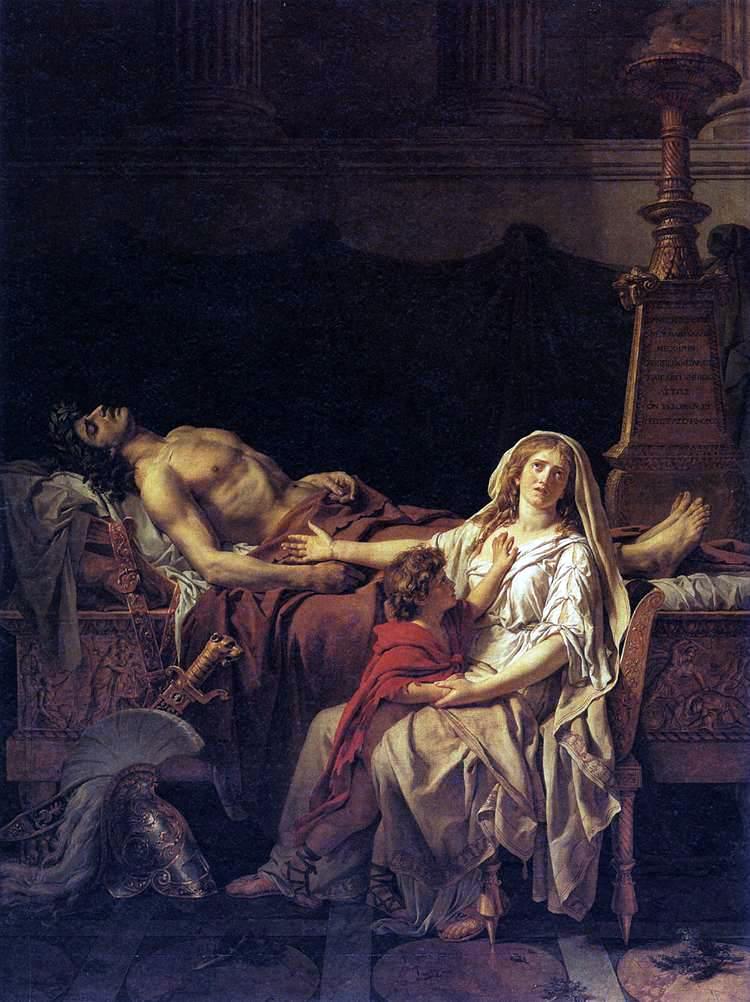
The Grief and Recriminations of Andromache over the Body of Hector Her Husband (1783) by Jacques-Louis David
Fight, Flight, or Freeze
In the third edition of his The Body Bears the Burden: Trauma, Dissociation, and Disease (2014), Robert Scaer looks at the cycle of arousal and rest that characterizes the function of our nervous system in response to crisis or danger. In simple terms, we can think of the fight or flight response which triggers different neurotransmitters to prepare for rapid response: in a resting state, our bodies are prepared for and more efficient at digesting and storing nutrients and also at processing and storing knowledge of facts and events (13). The fight/flight response puts us in a high-energy nervous state, raising blood-pressure and moving blood into our muscular system.
Such a shifting of biological resources is an essential survival tool. But when we experience prolonged arousal without release or resolution we can become locked in or frozen, establishing an unstable state that may look immobile but may actually be “rapid and exaggerated sympathetic/parasympathetic oscillation (15). To put it in other words: when we face a crisis situation we can neither fight nor flee, our “freeze” reaction is a parafunctional cycling through the same fight/flight and resting process over and over again. In this state, our minds can become “numb and dissociated” and our vascular and digestive systems suffer. So, if over the past year you’ve found yourself inexplicably tired, facing unanticipated digestive issues, out of breath with a racing heart while sitting still, you may have been showing the symptoms of your body encoding our trauma
As Scaer outlines (15-16), Animals often show remarkable responses to this freeze (a “discharge”) that can include convulsions and more in an instinctive attempt to restore “autonomic homeostasis” (16), that is, stability. Human beings, however, rarely show such ‘rests’ to discharge the trauma and reset the body. Such an inability to resolve the freeze moment, it seems, compounds the long term dangers of physical responses to trauma and the likelihood that memories of the events will incite similar physical responses, a return to a traumatized state. Scaer argues that many chronic diseases may be rooted in the reshaping of our brains by trauma and the inability of our conscious minds to distinguish between now and traumatizing events.
Hector’s last visit with his wife, Andromache, and infant son Astyanax, startled by his father’s helmet (Apulian red-figure vase, 370–360 BC)
Reading Hektor’s Trauma
I see so much of my sleepless nights, habitual doom scrolling, and somatic disarray in this description. And during these moments, I have wondered how this can change the way we approach Hektor both in a single moment and from the perspective of the whole narrative.
When we see Hektor before the walls of Troy, he is “coiled” like a snake (elissomenos) and he wouldn’t retreat because of his unquenchable heart. Note that I translate that participle clause ἄσβεστον ἔχων μένος causally. This is, of course, a significant choice, but I think a well-motivated one. This is the only time in Greek epic when menos—one’s energy, life force—is described as asbestos, “inextinguishable, unsatisfiable”. The adjective appears to mark extreme or powerful expressions of emotion as in describing the laughter of the gods at Hephaistos (1.599) or war cries of groups as they engage in battle (11.500, 11.530; 13.169; 13.450; 16.267). In the Odyssey, asbeston twice modifies kleos (4.584; 7.133). This word seems to describe extreme moments of pitch, or aggression with a sense of duration. But as Lorenzo Garcia argues in his Homeric Durability, asbestosmarks things that ultimately cannot endure: what the sound of a laugh or a war-cry share in common with Hektor’s menos is an unsustainable intensity. In addition, the adjective marks something that is public, shared, or heard by others. Here, the asbeston menos is something private, a massive, unsustainable thing somehow contained within a single person.
The simile compares Hektor to an animal coiled for attack; in describing his refusal to retreat, the narrative uniquely describes the energy driving him; the speech introduction that follows places him in a motif of deliberation over fighting or fleeing. Speeches introduced by the formula “He really glowered as he spoke to his own proud heart” (ὀχθήσας δ᾽ἄρα εἶπε πρὸς ὃν μεγαλήτορα θυμόν) are dramatic representations of deliberation—moments that happen in an instant but are unfolded in the time of performance to allow audiences to consider the inner workings of heroic minds. The simile of the serpent creates extra space and invites audiences to consider the space between the image of the coiled snake and Hektor’s actions: it is as much about how Hektor is the snake and how he is not.
For mortals, the moment of deliberation seems to be that very freeze before the selection of fight or flight: at 11.404-410, Odysseus, caught alone in battle worries about being overcome as the battle rages around him. At 17.90, Menelaos pauses in the defense of Patroklos’ body, afraid to face Hektor alone. At 18.5, Achilles is paralyzed by fear that something has happened to Patroklos and later at 20.143, Achilles finds himself perplexed at the sudden disappearance of Aeneas who has been rescued by the gods. At 21.552, Agenor the son of Antenor pauses mid-battle to decide to run or face Achilles.
The participle characterizing the speech, okhthêsas, moreover, expresses anger or resentment and may be an iterative of ekhthomai, that same root that gives us Greek words for hostility and enmity. Especially when combined with the asseverative particle ἄρα, this verb communicates an inward wrath at a choice with no good options. It is the coiling of anticipation, of loss, and of a loss of control. It is, I think, a formulaic marker for the process of navigating between fight and flight. In its pairing with the opening simile, it marks Hektor in that same moment, in an extended freeze. His resolution, however, contrasts with the other scenes: Hektor ends up acting contrary to his choice to stand.
Hektor’s menos, his anger, is a reflex of his loss of control and of his longing for something to be different. Andromache anticipates this when she speaks to him in book (6.407-409):
“Divine one, your menos will destroy you and you do not pity
Your infant child and my wretched fate, the one who will soon
Be your widow. For the Achaeans are on their way to kill you…”
Hektor’s drive to protect those he cares for most is the very thing that separates him from them, that unites them only in loss and longing. This calls to my mind the work of my friend, Emily Austin, who has written a book foregrounding the thematic importance of loss and longing (pothos) in the Iliad: it is the sudden absence that motivates Achilles’ menis. I think it is also the unconquerable fire that keeps Hektor from ever truly being still.
Thinking about the fight/flight/freeze complex as described by Scaer helps us confirm the poetic function of a Homeric formula: it also serves to invite audiences into a mind navigating a moment of crisis, of choice or judgment (hence Greek krisis) over running away or facing danger. In combination with a striking simile and a strange description of Hektor’s menos, this pattern also helps us see what can happen when the deliberation fails, when the freeze prolongs. Hektor’s menos is overloaded, it is too thoroughly interiorized, coiled inside him, breaking him from within.
Andromache looking down from the walls of Troy at Achilles dragging Hector’s corpse behind his chariot. Limestone, fragment of a sarcophagus, late 2nd century CE.
Hektor, Fighting and Fleeing
Almost 15 years ago, Elton Barker and I wrote an article about debates over fight or flight in the New Archilochus Poem and Homer. In it, we argued that both Homer and Archilochus were engaged in a tradition of poetic debate about the merits of fight or flight, transcending our narrow concepts of genre and operating ahierarchically, that is, prioritizing neither Homer nor Archilochus, but providing evidence of debate and reflection over time. I don’t think we’re wrong, still; but I do think that this debate is about more than drama and poets: it is about representing human emotion and cognition.
Broadly speaking, Scaer’s framework and my own experience makes me think that we need to rethink Hektor’s behavior throughout the epic and the depiction of Trojan responses to the war in general, allowing more richness to the emotive and cognitive content. There are thematic ties that tell a story of their own.
When Hektor speaks to Andromache in book 6, he anticipates the shame he worries about in book 22 and considers his wife’s suffering after his death. He expresses a characteristic fatalism when he dismisses Andromache to her weaving, saying, “I claim that there is no one who has escaped his fate, / whether a good person or a bad one, after they are born” (μοῖραν δ’ οὔ τινά φημι πεφυγμένον ἔμμεναι ἀνδρῶν, /οὐ κακὸν οὐδὲ μὲν ἐσθλόν, ἐπὴν τὰ πρῶτα γένηται, 6.488-489).
Perhaps it is too much to read into this passage to say that Hektor thinks flight is impossible (he does…), but it certainly helps explain his subsequent actions: keeping the Trojan army out on the field at night in book 8, breaking through the Greek fortifications despite a bad omen in book 12, and refusing to return to the defense of the city in book 18. When Polydamas calls for them to retreat, Hektor continues to insist Zeus is on their side and declares, “I will not flee him from the ill-sounding battle, but I will stand / against Achilles either to win great strength or to be taken myself. War is common ground and the one who kills is killed” (…οὔ μιν ἔγωγε / φεύξομαι ἐκ πολέμοιο δυσηχέος, ἀλλὰ μάλ’ ἄντην /στήσομαι, ἤ κε φέρῃσι μέγα κράτος, ἦ κε φεροίμην / ξυνὸς ᾿Ενυάλιος, καί τε κτανέοντα κατέκτα, 18.306-309).
When Hektor freezes in the choice to fight or flee in book 22, he knows there is no other option. In his speech, he often surprises modern audiences with a wish that he and Achilles could exchange pledges like young lovers and wishes neither would have to die even as he admits that shame would prevent him from retreat. As another friend Justin Arft has recently argued, Hektor “transitions from imagined mediation, to being unarmed, to being a woman, to intimate discourse, to he and Achilles in the place of lovers” (SCS 2021) and is flipping through cognitive schemas (patterns of behavior) trying to figure out what to do. It is as if Hektor has a handful of cards and is repeatedly flipping through them, looking for one that will change a fate he knows cannot be changed. He goes back through his own stories, perhaps stopping at his conversation with Andromache and thinking about what he loses, what he needs, and the absence of choices remaining to him. At the end, he returns to that deceptive idea, that fate alternates and he just might win the day (εἴδομεν ὁπποτέρῳ κεν Ὀλύμπιος εὖχος ὀρέξῃ, 130).
After not even a year yet in a society in trauma, I now see Hektor as someone whose response to the false hope of choice is to overcompensate, to come on too strong, and to engage in willful denial. He fights to extremes and then he flees excessively too. He is burdened by the weight of his past failures and the ultimate futility of his actions.
“Andromaque”, 1883 painting that can be seen in Rouen’s fine art museum in France.
The Trojans in Trauma
Of course, there’s not a single way to think about this moment. David Morris in his 2015 The Evil Hours notes that Freud theorized that war neuroses came from an internal conflict between self preservation and responsibility to honor and comrades (15). As Jonathan Shay adds in his Achilles in Vietnam, trauma undermines “the cohesion of consciousness” (1995,188). And this fragmentation has been born out by neurobiological studies since.
The additional thing to think about for Hektor and for us, is that the impact of trauma can be increased by duration. What if we think of the Trojan leader as coiled for nine years, as representing a people besieged, constantly poised between the need to fight and the desire for an impossible flight. The repeated suppression of the fight or flight choice, the prolonged freeze would be traumatizing neurobiologically. It would change the way Hektor’s mind and body worked.
I do want to be careful to say that I am not saying the Greeks would have seen it this way precisely, but rather that there is clearly a traditional marker through the collocation of simile, deliberative introduction, and the invitation to the audience to linger with Hektor for a moment (the freeze) that modern observers have seen as having both psychological and neurobiological components. Ancient audiences would have seen their own peers shaped and reshaped by similar traumas and their poems show evidence of understanding the long term impact experiences like isolation, betrayal, and helplessness can have on the working of human minds (think of Philoktetes, Ajax, Odysseus, and others like Klytemnestra and Medea in tragedy).
So, this is not a positivistic reading saying “this thing is definitely that” but more that our modern scientific discourse has outlined a space of behavior that traditional poetics found meaningful too and that the correlation between these observations may help us understand something about Hektor others have missed. But I think this is bigger than Hektor: it may be about the Trojans, a people besieged, as a whole.
In the traditional story of the Trojan War, the story of the horse seems all but ridiculous (ok, it is ridiculous). But what if we considered the Trojan willingness to accept a clear trap, to engage in such extreme denial, as a function of their collective trauma? We are no strangers to large parts of our population refusing to accept what others see as fact, in engaging in clearly self-destructive behavior because it adheres so much more closely to what they want to be true and reality causes them so much pain.
In Greek myth, trouble tends to run in families and cities, traveling from father to son and grandson until the whole line is used up. This too resounds with what we have learned over the past century. We know trauma can be passed down three generations. Large-scale studies of oppressed populations show greater evidence of trauma related behaviors (depression, suicide, drug use) in the grand-chhildren of those who suffered abuse and displacement than their peers. And these responses may be about more than the power of discourse and socialization. There’s growing evidence for the reshaping of DNA as a result of trauma. Our ancestors’ experiences may impact those parts of our DNA that inform our mental health and shape our responses to traumatic events in our lives.
(As a necessary aside, this makes it even harder to defend people who deny the justice of reparations on financial or ethical grounds. The legacy of past traumas are still shaping people today.)
Trauma impacts our physical health; it impedes learning and new memories; it alters how we respond to crisis; untreated, it deprives us of even instinctual advantages. The Iliad’s story of the Trojan War gives its audiences traumatized warriors and families on both sides. It shows people fraying then unraveling under the pressures of long term conflict. And it provides us with vignettes of men and women trying to make sense of the world as everything they know breaks down. When Hektor tries to face his death, but then runs, the traditional language and its images unfold a human mind at its most intense moment of crisis.
Over the past few years, I have often found myself arguing about what the humanities are, about what they are good for. A poem like the Iliad is not some timeless relic, a perfect object to be worshipped for the unmixed good it can bring. But it is a deeply complex inheritance, a poem that gives us the opportunity to move between what we know and see now and what others experienced thousands of years ago. By tracing out the story of Hektor’s mind and his body’s burden, we may find just a little help in learning how to carry our own.
“Euripides, since he’s a bit of a rascal,
Will probably try to help me get him free.
Sophocles will be well-behaved there since he was well-behaved here.”
There will be time aplenty in the new year to reflect on what Reading Greek Tragedy Online meant to those of us who were engaged with it every week. It suffices to say for the moment that it gave us structure, a sense of community, and a reason to drag ourselves out of bed a few times a week. it also gave us the opportunity to think and talking about performing Greek theater in a sustained way that none of us could have imagined a year ago today.
Back in April, when Paul and I were outlining the rest of the year with Lanah, we thought this play would be a nice way to end the series on something of an absurdist but reflective turn. Aristophanes’ Frogs stands as one of the earliest pieces of literary criticism in the Athenian tradition. Even if it is bawdy and hyperbolic, it provides critical comments and cultural frameworks for the three tragedians we moderns know best. As a comedy, it ranges from sophisticated engagement with literary motifs and styles right back down to fart jokes and the regrettable but by no means atypical repeated play with abusing an enslaved person.
But the Frogs also has a sense of coming near the end of things: it starts with the assertion that all the good poets are dead (in a year following the passing of both Euripides and Sophocles). Not only does it come at the end of an artistic era, but it was also composed and performed near the end of the Peloponnesian War and the high point of Athenian influence. Rarely does any play stand at the intersection of so many charged themes; it is even rarer that such a play is a comedy.
So, to end this, our most recent annus horribilis and this series which has meant so much to us, we turn to a new version of the Frogs. Who’s ready for some koaks koaks?
Aristophanes, Frogs 237-239
“I am developing blisters,
My rectum has been oozing for a while,
And soon it will jump out and say…
Artistic Director: Paul O’Mahony (Out of Chaos Theatre) Associate Director: Liz Fisher Director of Outreach: Amy Pistone (Gonzaga University) Dramaturg: Emma Pauly Executive Producer: Lanah Koelle (Center for Hellenic Studies) Producers: Keith DeStone (Center for Hellenic Studies), Hélène Emeriaud, Janet Ozsolak, and Sarah Scott (Kosmos Society) Poster Artist: John Koelle Poster Designer: Allie Marbry (Center for Hellenic Studies)
“This is the sign of a man
Who has some brains
And has traveled much:
To always move himself
To whichever side is doing well
And not to stand in one place, taking one stance,
Like a painted statue…”
“Come, let me look at this: did I see this in a dream?”
φέρ᾿ ἴδω, τοῦτ᾿ ἰδὼν ὄναρ λέγω;
Euripides, Cyclops 63-67
“There’s no Dionysus here, no choruses,
No Bacchic revels, no wand-bearing,
No explosion of drums
By the fresh-flowing springs,
Or young drops of wine.”
Silenos: Hello, stranger. Tell me who you are and your country
Odysseus: Odysseus from Ithaka, lord of the land of the Kephallenians
Silenos: I know that guy, a sharp conman, a descendent of Sisyphus.
Odysseus: I am that man. Don’t mock me.
This week, we arrive at the only surviving full Satyr play from Ancient Athens, Euripides’ Cyclops. During the tragic competition, poets would stage a trilogy followed by a satyr play, some kind of vaudevillian satire on tragedy itself. We don’t know as much about satyr plays as we’d like, but from this surviving example we can see some of the extreme bodily humor of comedy combined with tragedy’s mythical figures and themes.
Of course, comedy is about excess and in this reading of the story of Odysseus’ encounter with Polyphemos we are adding our own excess by adding in words and music from from “Cyclops, a Rock Opera” by J. Landon Marcus, Benjamin Sherman, and Chas LiBretto. The small screen may not hold all this energy, but that won’t stop us from trying.
Euripides, Cyclops 334-338
“I don’t sacrifice to anyone but myself, none of the gods,
And to the greatest divinity, my belly!
To drink and eat all day and have no pain
That is Zeus for wise people.”
Artistic Director: Paul O’Mahony (Out of Chaos Theatre) Associate Director: Liz Fisher Director of Outreach: Amy Pistone (Gonzaga University) Dramaturg: Emma Pauly Executive Producer: Lanah Koelle (Center for Hellenic Studies) Producers: Keith DeStone (Center for Hellenic Studies), Hélène Emeriaud, Janet Ozsolak, and Sarah Scott (Kosmos Society) Poster Artist: John Koelle Poster Designer: Allie Marbry (Center for Hellenic Studies)
“But after you kill the suitors in your home
Either with a trick or openly with sharp bronze,
Then go, taking with you a well-shaped oar,
until you come to people who know nothing of the sea,
men who do not eat food that has been mixed with salt.
These people also know nothing of purple-prowed ships,
Nor well-shaped oars which give the ships their wings.
I will speak to you an obvious sign and it will not escape you.
Whenever some other traveler meets you and asks
Why you have a winnowing fan on your fine shoulder,
At that very point drive the well-shaped oar in the ground
And once you sacrifice a bull a a boar which has loved sows,
Go home again and complete holy hekatombs
To the immortal gods, who live in the broad sky,
All of them in order. And then from the sea death will come
To you in a gentle way, and it will kill you
Already taken by a kind old age. Your people
Will be prosperous around you. I speak these things truly.”
Why does Odysseus leave home again and how does he die? According to the prophecy, he still has to make amends with Poseidon. From this perspective, his journey is a type of expiation. As with many details in the Odyssey, however, we have only Odysseus to trust: he is the one who narrates the prophecy! One slight difference between the two versions of the prophecy gives me pause.
Odysseus does not come straight out and tell the story to his wife. Instead, he merely outlines that there will be more troubles and uses language of toil and suffering which is familiar from the rest of the epic.
Odyssey 23.248–253
“Wife, we have not yet come to the end of our struggles
But toil without measure is still in front of us,
Great and hard toil, all the things which I have to complete.
For the spirit of Teiresias prophesied this to me
On that day when I went to the home of Hades
To inquire about my companions’ homecoming and my own.”
For someone who has suffered so much in this epic with not knowing the outcome of events, with the paralysis that comes from grief that is unresolved, Penelope is compelled to ask Odysseus to tell her (256-262) ending with a gnomic plea that “it is not at all worse to know right away” (πεύσομαι, αὐτίκα δ’ ἐστὶ δαήμεναι οὔ τι χέρειον). Odysseus winds up his story and prepares to recite the prophecy, but he begins differently.
Odyssey 23.265–279
“But I will tell you and I will not hide it.
My heart will not take pleasure in it. For I take no joy
Since he ordered me to go again through many cities of men
Holding a well-shaped oar in my hands…”
After building up the suffering and forestalling any clarification, he seems almost to protest too much that he will not enjoy what the future brings. His curse, he claims, is that he is ordered to go through many cities of men. The absence of this line in the original narration alone would be telling, but it is even more marked because it recalls the third line of the epic’s proem: πολλῶν δ’ ἀνθρώπων ἴδεν ἄστεα καὶ νόον ἔγνω (“he knew the cities and the mind of many people”. This traveling through many cities for which Odysseus is famous enough to be marked at the beginning of the poem does not really happen in our epic.
Note as well, that Odysseus’ tale of the future undoes much of what the Homeric Odyssey accomplishes. His future toils are his alone: there is no room for the lives of his son, elderly father, or wife. So, even though Odysseus is home and reunited with his family, this new revelation is enough to imply, perhaps, that when this story is over, Odysseus returns to himself, the one before the Odyssey brought him home again.
This is, I think, the inspiration behind Cavafy’s startling poem on the topic.
C. P. Cavafy, Second Odyssey [Walter Kaiser, trans.]
A great second Odyssey,
Greater even than the first perhaps,
But alas, without Homer, without hexameters.
Small was his ancestral home,
Small was his ancestral city,
And the whole of his Ithaca was small.
The affection of Telemachus, the loyalty
Of Penelope, his father’s aging years,
His old friends, the love
Of his devoted subjects,
The happy repose of his home,
Penetrated like rays of joy
The heart of the seafarer.
And like rays they faded.
The thirst
For the sea rose up with him.
He hated the air of the dry land.
At night, spectres of Hesperia
Came to trouble his sleep.
He was seized with nostalgia
For voyages, for the morning arrivals
At harbors you sail into,
With such happiness, for the first time.
The affection of Telemachus, the loyalty
Of Penelope, his father’s aging years,
His old friends, the love
Of his devoted subjects,
The peace and repose of his home
Bored him.
And so he left.
As the shores of Ithaca gradually
Faded away behind him
And he sailed swiftly westward
Toward Iberia and the Pillars of Hercules,
Far from every Achaean sea,
He felt he was alive once more,
Freed from the oppressive bonds
Of familiar, domestic things.
And his adventurous heart rejoiced
Coldly, devoid of love.
Another reception of Odysseus that echoes some of these themes is Tennyson’s “Ulysses”. The poem begins with frustration, the complaint that it is useless for a king to sit and rule men less than he with an aging wife, a crowd that cannot understand him (1–5). Tennyson’s Odysseus has retreated into an interior life, rejecting the dismal repetition of his life at home, and imaging him self as he once was. For this hero, a life at home is a life of wasted opportunities. The poem’s Ulysses confesses “I cannot rest from travel: I will drink / Life to the lees…” (6–7). This Ulysses understands his coming transformation: “…I am become a name” (11) and this name is made up of his travels, his suffering, and his joys (11–20). The narrator continues (20–30):
How dull it is to pause, to make an end,
To rust unburnish’d, not to shine in use!
As tho’ to breathe were life! Life piled on life
Were all too little, and of one to me
Little remains: but every hour is saved
From that eternal silence, something more,
A bringer of new things; and vile it were
For some three suns to store and hoard myself,
And this gray spirit yearning in desire
To follow knowledge like a sinking star,
Beyond the utmost bound of human thought.
Although in the next portion of the poem, Ulysses looks briefly back at the world he leaves to his son (31–42), this passage homes in on the Odyssey’s hero in a different light. Odysseus is looking forward to the boundary of death and although he concedes it is closer than ever before, he seems determined to inhabit it and atomize it, turning what remains of life to something like Zeno’s paradox, as if by filling every portion of it, he may always have another portion to fill. As will become clear from the prophecy itself, boundaries and limits are at the very core of his worry.
Tennyson’s Ulysses returns to the sea just as the Odyssey’s protagonist promises. He narrates a journey through the space of the sea that is also a straining against the bounds of time. This final battle, personal if epic still, culminates in Tennyson’s final, grasping boast: “To strive, to seek, to find, and not to yield.”
But to what is this Odysseus yielding? The story of the prophecy is ultimately that of an externally imposed compulsion. In its simplest form, this is death. In the more complex vision of the poem, this is fate, the very thing Zeus says men make worse through their own recklessness at the beginning of the epic.
Perhaps what is really chilling is that Odysseus is looking forward to the end of his story, to his own death. Few of us embrace the idea of our own ending. And when we know that the milestones of life and perhaps our greatest accomplishments are behind us, we often have little choice but to look toward the end on the horizon. This is a different type of helplessness from what Odysseus endures during his ‘exile’ with Kalypso–when he is stranded on Ogygia he has no where to go and all the time in the world. Once he gets home, he can go anywhere, but where has all that time gone?
In a way, Odysseus continues on the journey of his life rather than stopping and facing the reality around him. In other heroic tales–Bellerophon and Herakles especially, but Gilgamesh too–after a hero completes his great deeds, he metaphorically and literally challenges death only, ultimately, to fail. The fall of a hero is an allegory for what happens to us all when we are no longer young but not yet old: we either scan the horizon for our ending, or run to avoid even looking for it.
But I think there may be another allegory beyond this one. As Alex Purves (2006) and John Peradotto (along with Ann Bergren 1983) note, Odysseus’ emphasis the fact that they are not at “the limits of their suffering” (πάντων ἐπὶ πείρατ’ ἀέθλων) and on the “boundless toil” (ἀμέτρητος πόνος) strains against the limits of the narrative and the poem. But this epic is also about the boundaries of a life as it is lived. To look for the experiences of the life beyond the story we are living is to look for the promise that this story that our story will not end.
And, again, in that oar–as Alex Purves notes–we find a promise of transformation as the relationship between signifier and signified breaks down. The oar becomes a thing it isn’t when it is transported into different lands and, once planted, it is a “clear sign”, a sema of what has been accomplished. In the Iliad (7.81-91), a sema is the burial mound which will tell the story of what has transpired to future generations. It reduces an active, living thing, to a still, singular sign of the past. Here, of course, is the paradox of kleos perhaps articulated by Achilles’ rejection of the Iliadic ethos when he appears in the Odyssey: the story that continues on and does not change is not the self. The memory of the person is not the person remembered.
And in the Odyssey, it has already been established that an oar can function as the marker for a tomb–this is precisely what Elpenor requests when he meets Odysseus after dying (11.68-78). As a marker, a tombstone is final and, without readers, simple rather than complex. The single sign in the future Teiresias promises in the first version of the prophecy stands at odds with the multiplicity of meanings within the Odyssey and the multiple versions of the man whose tale it tells. So, while others have argued well that the prophecy anticipates a day and a place beyond the bounds of the heroic world, of epic meaning, and the range of epic transmission, I would add that this moment also reflects anxiety about the limits of the self.
(for a longer bibliography see at the end of the post)
Porphyry has an allegorical take Odysseus’ death and the tale of the sea.
Porphyry, On the Cave of the Nymphs 35
“And thus one may not escape from his toils, but when he has emerged from the sea altogether that his thoughts are so untouched of the sea and material matters, that he believes that an oar is a winnowing fan because of his total inexperience of the tools and affairs of the sea.”
Of course, in ancient myth, the “death from the sea” bit was not always considered an allegory. Homeric interpreters struggle over whether the phrase “from the sea” means a death that travels from the sea or one that happens away from the sea. Most versions settle on the first interpretation.
According to Aeschylus’ fragmentary Psychagogoi, Teiresias prophesied to Odysseus that his death would come from the sea in an avian fecal format:
“As a heron flies on high, he will strike you with shit from his stomach’s end.
And the thorns from that watery food will rot your old and balding skin.”
This may correspond to the Odyssey‘s cryptic note that “death will come from the sea”. For a great discussion, see Timothy Gantz. Early Greek Myth. 1993. 711-712.
A scholiast to the Odyssey glosses the “death will come to you from the sea” line as follows: “Some also say that Hephaistos at the bidding of Kirkê fashioned a spear from Telegonos from a sea sting-ray’s stinger, which Phorkys had killed while it was trying to eat fish in his harbor. The spear-base was adamantine and the handle was gold and that killed Odysseus.” (καί φασιν ὡς ἐντεύξει τῆς Κίρκης ῞Ηφαιστος κατεσκεύασε Τηλεγόνῳ δόρυ ἐκ τρυγόνος θαλασσίας, ἣν Φόρκυς ἀνεῖλεν ἐσθίουσαν τοὺς ἐν τῇ Φορκίδι λίμνῃ ἰχθῦς• οὗ τὴν μὲν ἐπιδορατίδα ἀδαμαντίνην, τὸν δὲ στύρακα χρυσοῦν εἶναι, τὸν ᾿Οδυσσέα ἀνεῖλεν,Schol. ad. Od. 11.134).
“Telegonos, after learning from Kirkê that he was the child of Odysseus, sailed out looking for him. After he arrived in Ithaka, he began to steal some of the Island’s cattle and he wounded Odysseus in the hand, who came out to help against him, with a spear that had a point made of a sting-ray’s spine. Then Odysseus died.”
This poisonous sting-ray weapon, as you might imagine, is exactly the type of thing Hellenistic authors might get excited about. The fragmentary historian Dictys tells a bit of a more complicated story: he has Odysseus send Telemachus away because dream-interpreters told him he would be killed by his son. According to Dictys, Telegonos struck him in the lung (τιτρώσκει τὸν ᾿Οδυσσέα κατὰ τοῦ πλευροῦ) “with a sting-ray’s point given to him by Kirkê” (ὅπερ ἔδωκε κέντρον θαλάσσιον τῆι Κίρκηι, FGH 1a49F fr. 10).
When Eustathius discusses Odysseus’ death from the sea (Comm. ad Od. 1.404) he first makes it clear that what is interesting is that Odysseus doesn’t die on the sea (ἀλλ’ ὁ θάνατός σοι οὐκ ἐν αὐτῇ ἔσται ἀλλ’ ἔξω αὐτῆς.) He then presents features both from the scholia (the special stin-ray spear) and Dictys while also explaining that Oppian tells us more about this in the Halieutica. Eustathius explains that the spear-point made from a sting-ray was considered especially sharp by some (αἰχμὴ δὲ τρυγόνος τὸ ἐπὶ τῷ ἀδάμαντι ὀξύτατον). A basic point to be drawn from his extensive discussion is that the sting-ray spear was a generally well-known motif.
It is so well-known, of course, that the Scholia to Lykophron must present an alternative. There, Telegonos does kill Odysseus but Kirkê resurrects him with her drugs, only after which was Telegonos married to Penelope and Telemakhos was married to Kassiphone, his half-sister. (ἄλλοι δέ φασιν ὅτι ἀναιρεθεὶς ὁ ᾿Οδυσσεὺς ὑπὸ Τηλεγόνου πάλιν ὑπὸ τῆς Κίρκης φαρμάκῳ ἀνέστη καὶ ἐγήματο *Κασσιφόνην* Τηλεμάχῳ, Πηνελόπη δ’ ἐν Μακάρων νήσοις ἐγήματο Τηλεγόνῳ, Schol ad. Lykophron 805). But that’s a story for another day.
[updated c. 2 hours later with an assist from Erik (see comments for his addition of the Tennyson poem)]
Some works consulted
Benardete, S. 1997. The Bow and the Lyre: A Platonic Reading of the Odyssey. Lanham.
Bergen, Ann, 1983. “Odyssean Temporality: Many (Re)Turns,” in C. A. Rubino and C. W. Shelmerdine, eds., Approaches to Homer. Austin. 38–73.
Buchan, M. 2004. The Limits of Heroism: Homer and the Ethics of Reading. Ann Arbor.
Foley, J. M. 1997. “Traditional Signs and Homeric Art,” in E. Bakker and A. Kahane, eds., Written Voices, Spoken Signs: Tradition, Performance,and the Epic Text. Cambridge, Mass. 56–82.
Nagy, G. 1990. Pindar’s Homer: the Lyric Possession of an Epic Past. Baltimore.
Olson, S. D. 1997. “Odysseus’ ‘Winnowing-Shovel’ (Hom. Od. 11.119–37) and the Island of the Cattle of the Sun,” ICS 22.7–9.
Purves, Alex. 2006. “Unmarked Space: Odysseus and the Inland Journey.” Arethusa 39: 1-20.
Purves, Alex. 2010. Space and Time in Ancient Greek Narrative. Cambridge.
Peradotto, J. 1985. “Prophecy Degree Zero: Tiresias and the End of the Odyssey,” in B. Gentili and G. Paioni, eds., Oralità: cultura, letteratura, discorso. Rome. 429–59.
_____. 1990. Man in the Middle Voice: Name and Narration in the Odyssey.Princeton.
In the Odyssey Telemachus goes from Ithaka to Sparta (via Pylos) and back. When he travels in both directions, he makes a stop for the night in a scene that I think most of us often forget:
Od. 15.185-188 (=3.486-490)
“All day long they shook the yoke around their necks.
The sun set and the wide ways were shadowed.
They arrived at Phêrai, the home of Diokles,
The son of Ortilokhos, the child whom Alpheios fathered.
There they spent the night and he gave them guest-gifts.”
Though he stops at this town twice, we get very little information about it from the epic itself. The scholia do provide some information:
Scholia HQ Ad Od. 15.186-193:
“Phêrai: the name of a town in Laconia. The journey from Sparta to Phêrai is one day; and it is nearly another day from Phêrai to Pylos… This is the same night that Odysseus sleeps at Eumaios’ place.”
Most interesting for me here is the almost throw-away line from the scholiast that this night spent in Phêrai is the same night during which Odysseus is entertained by Eumaios. Although some scholars entertain this seriously (e.g. Olson 1995, 91ff) a more standard take is presented by De Jong in her Narratological Commentary… (2001, 588):
If we count the days from Odysseus’ return to Ithaca (when Athena leaves him to go find Telemachus (13.439-440: ἡ μὲν ἔπειτα / ἐς Λακεδαίμονα δῖαν ἔβη μετὰ παῖδ’ ᾿Οδυσῆος.), we get a slightly different timeline for the second half of the Odyssey:
Day 1
14: Odysseus goes to Eumaios, they sleep (14.523)
15: Telemachus leaves Sparta, sleeps at Diokles’ house (Simultaneous action shown in parallel)
Day 2
15.301-494: Eumaios and Odysseus dine again and talk through most of the night
15: Telemachus bypasses Pylos for his ship,(15.296-300) (Simultaneous action shown in parallel)
Day 3
15.495-500: Telemachus arrives arrives in Ithaca and goes to Eumaios’ home (16); the suitors return from their ambush; Eumaios, Telemachus and Odysseus sleep (16)
Day 4
17: Telemachus and Odysseus go to their home separately; the suitors go home to sleep (18.427-428); Penelope sleeps (19.600-604); Odysseus sleeps (20.54-55)
Day 5
20.91: Dawn comes and the suitors return; 21: The Bow; 22: Mnesterophonia; 23.342-43: They sleep
Day 6
23.345-349 Dawn comes, Odysseus wakes and goes to see his father; the second Nekyuia; Testing of Laertes; Ithacan Assembly; Final showdown
Of course, thanks to a thing called “Zielinski’s Law” (see De Jong 2001, 590 for a bibliography and Cook 2009, 148 for a brief discussion) Homerists tend not to believe that Homeric narrative shows simultaneous actions…
Who is Diokles? Why do we care if the end of the Odyssey takes 6 or 7 days? Tune in next week….
In the following passage Kassandra prophesies Odysseus’ travails in returning home. Although she seems to refer to a few events not in our Odyssey (fast rocks, talking meat), what I find interesting is the possible poetic engagement with Kassandra’s presentation in the Odyssey where she is not mentioned as the cause of Athena’s anger or marked as a prophet.
Euripides, Trojan Women 424–447
“Really, a clever servant. Why do heralds have
the name they have, when one hatred is common to people:
the servants of tyrants and their regimes?
You say that my mother will arrive at
Odysseus’ home? Where then are Apollo’s words
which say—when I have translated them—
that she will die here? I will not insult her with the rest.
The wretched man, he doesn’t know what suffering awaits him—
how even these Phrygian horrors of mine will seem
golden to him. For ten years after sailing out added to ten
spent here he will finally arrive at his fatherland alone
< >
where the swiftest rocks [make] the passage narrow,
and dreadful Charybdis, near the man-eating, cliff-walking [Skyla],
The Kyklops, and the Ligurian, swine-witch
Kirkê, and shipwrecks over the salted-sea,
lusts for lotus, and the sacred cattle of Helios,
whose flesh will sing in human voice one day
a bitter song for Odysseus—I will cut this short:
he will go into Hades still alive and though feeling the water’s flow
he will come home and find countless evils at home.
But why do I enumerate the toils of Odysseus?
Take me right away, let me marry a bridegroom for Hades’ home.
You are evil and you will be evilly buried at night, not at day
Captain of the Danaid women, believing you are doing something good.”
Kassandra is most famous in ancient art and myth for the sexual violence she suffers at Oilean Ajax’s hands. But when there is an opportunity to refer to this, the Odyssey avoids it. Instead, it creates a new reason for Ajax to suffer: