“Our Culture”: Classics By Exclusion

“Indeed, what is believed overpowers the truth”

τό τοι νομισθὲν τῆς ἀληθείας κρατεῖ. Sophocles, fr 86

A few days ago, a lovely senior colleague of mine reached out with this article from The Daily Kos, expressing shock at how racists are using the ancient world and wondering what kinds of conversations Classicists are having about it. The article does a good job of pointing to the illuminating work of Curtis Dozier with the Pharos project, the public advocacy of Sarah Bond, and the work of Donna Zuckerberg in her writing and her work with others at Eidolon.

I didn’t take the time to tell my friend who has been teaching at Brandeis over 40 years about Rebecca Futo Kennedy’s work on race and antiquity in the Ancient World and on the problem of “western civilization”, the ragtag band behind Classics and Social Justice, the trail-blazing kindness of the Sportula or the work of Dan-el Padilla Peralta.  I can keep listing the people who do good work and try to make sense of the world, but in our own field there is doubt and derision.


The people I just listed and the many others who work alongside them face conflict on multiple sides. There is the fight of the field against this racist appropriation; but there is also a fight for the field that I think we are still trying to make sense of. We are constrained both by the disciplines we trained in and the way the history of these disciplines is entwined with structural and institutional racism.

Oh, boy. Do we need another post on this topic? And—this is certainly a fair question—do we need another post on this topic from me? I don’t work specifically on race in the modern world or antiquity. I don’t have any specialized academic training apart from a handful of undergraduate courses and professional training over the years. The fact is, it is really easy for me not to write this.

But, like many of us, I do teach students who see the world differently than I do; and I do train students in disciplines that are steeped in historical problems. Furthermore, I am in the position of trying to lead people who do this with me. I also somehow have helped create a space where some things might be heard. For each of these reasons, I think it is irresponsible not to engage with these issues and not to examine how deeply they go.

I got thinking about this again over the weekend after receiving this in response to a post on the misogyny of the story of the Lemnian Women:

“Are you actually saying that describing certain odors as foul is misogynistic? and You are a tenured professor? hahahahhahahhaha!

btw, How is your quickly collapsing civilization at the hands of a swelling muslim horde going? At least when it’s all razed to smouldering embers and muslim men are raping, impregnating or beheading your wives and daughters you can have the satisfaction of saying you weren’t racist or a misogynist.”

Now, this is a typical troll-technique in an attempt to elicit an aggressive response: first, belittle and mock the credentials of the addressee; second, cut to the chase and try to inspire fear by painting a picture of the cultural apocalypse to come. I am pretty good at not taking the bait of the first move, because, hey, sometimes it is surprising that I am a professor and tenured—not only because I will never shake off the old imposter syndrome, but also because I have known plenty of smarter and better people who for some reason did not make it at every level. For the second, well, all I said was the truth: a good part of my family is Muslim. It is pretty hard to fear a murderous, rapacious horde, when you’ve shared their tables, prayed alongside them, and love them.

“He commits a second crime, who is not ashamed of his first”

geminat peccatum, quem delicti non pudet  Publilius Syrus, Sent. G11

We periodically encounter push-back like this when we re-post the Hellenistic poet Palladas’ claim that Homer hated women or when someone complains that we should not talk about politics. But the exchange, which I have left up, reminded me yet again of a comment that has been “pending” on the site for over two years in response to a post on Harmodius and Aristogeiton.

“Your introduction sounds like you are in favour of the ongoing white genocide – bizarre from someone who would appear to admire white culture and civlization. Or perhaps you are a Jewish Supremacist? Personally I’m with Apion, Posidonius, Apollonius Molon, Manetho, Cicero, Juvenal, Horace etc – letting Jews control the discourse is never a good thing.”

(I am going to sidestep the anti-Semitism here except to say that the comment is clearly made by someone deeply indoctrinated in hate. This is repulsive but unsurprising. Indeed, I have been the target of anti-Semitic comments online on several occasions. I suspect this is because of where I teach. I block Nazis as soon as they announce themselves.)

This was not the last time I was accused of being in favor of white genocide (I have also been called a race traitor). The thing is, well, complicated. First, we can say that white genocide is an insane piece of nonsense sourced locally in South Africa and embraced by certifiable nutballs in Europe, Australia and the United States, as charted out in Harper’s.

(Don’t be confused, though. This poison is one among a number of fine American exports.)

I want to mock the very notion because whiteness itself is a myth. But just like “white genocide”, whiteness is a fiction which has real effects on the world. Whiteness is an oppositional category, an oppressive concept that has expanded to embrace most of Christianized Europe only out of necessity. It exists to obscure boundaries between some groups only for the purpose of oppressing others. When embraced as an identity, it is so empty of content that it consists entirely either of mere platitudes or of weaponized hate.

“We call those studies ‘liberal’ which are worthy of a free person”

Liberalia igitur studia vocamus, quae sunt homine libero digna, Vergerio de ing. Mor. 23

So, if one were to insist to me that there is a white race—and not a bunch of people with various degrees of comparatively paler skin who come from a variety of different linguistic and religious groups but largely speak dialects of English in the US, UK, and Australia—I would probably be in favor of ending the concept because it exists as a weapon of exclusion. This, in such deranged logic, makes me a race traitor. (Among other things, of course: my family is multiracial).

Now, it may seem like there is only a twisted path from the destructive and demeaning construction of whiteness and our problems with Classics, but let me get back to the point. It has become de rigeur for ‘intellectuals’ with certain affinities who rave about the rise of ‘identity politics’ and post-modernism to lament the collapse of Classical Education and the loss of some kind of shared culture. This concept of a ‘shared culture’ is as chimerical as whiteness. But it is no less damaging.

Indeed, when I wrote a thread in response to Roger Kimball’s paint-by-numbers indictment of the modern academy, our account was unfollowed by someone who felt we were insufficiently championing “our” culture.

https://twitter.com/CarmenC30263217/status/1135148289416990721

My friend, this cultured response is not innocent; it may be ignorant, but it remains an expression of an ethnonationalism that is merely a reflex of white supremacy. (It is also absurd: no one invents a culture. (1) I cannot see how it is ever logical to claim any credit for actions performed by others before you were born. (2) And if you claim the credits, you also owe the debts.) When one person frets over threats to “our” culture, another chants “you will not replace us” with a burning tiki torch.

“For it is not easy to take a false belief from them, not even if someone should refute it completely”

οὐ γάρ ἐστι ῥᾴδιον τούτων ἀφελέσθαι τὴν δόξαν, οὐδ’ ἂν πάνυ τις ἐξελέγχῃ, Dio Chrysostom Orat. 11


There are many kinds of exclusionary approaches. Some are clearly racist (ethnonationalists so proudly wave their black, white and red banners). Others are intellectually decorous, but amount to the same. When Erik exposed the counterfeit claims of modern conservative intellectualism, one respondent chortled (if one can describe a tweet that way) and offered up the example of T.S. Eliot.

When my colleague emailed me, rather than brag about all the smart and insightful people I know who are leading the fight against this racist nonsense, I sputtered, and meandered, talking about how much more there is to do in recognizing that exclusion and, yes, racism, have been central to the disciplines we call Classics not just for a few generations, but for most of the history of the discipline.

Here’s the thing. This is not just about misappropriation. This is about the nature and history of the field itself. Yes, we need to stand against the use of antiquity for hateful and destructive ends; but we also need to work to examine how our discipline has been shaped by these forces. As the kids say, racism is a feature not a bug of Classics as a field. And this gets straight to a conversation I have been having with myself and others since I posted about my myth class earlier in the year: How do you decolonize something that is has developed hand-in-glove with essential exclusionary, colonialist, and racist discourse?

(I am avoiding here the claim that that the material treated by Classical studies is necessarily racist. Much of it is ideological driven and used for racist ends, but I do think we need to be careful to separate material from use.)

“Humanity thinks only about temporary seeds, / Its pledge is nothing more than the shadow of smoke”

τὸ γὰρ βρότειον σπέρμ’ ἐφήμερα φρονεῖ, / καὶ πιστὸν οὐδὲν μᾶλλον ἢ καπνοῦ σκιά Aeschylus, fr. 399

Already, I know heads are spinning, but let me just sketch out without supporting evidence the areas of inquiry available to explore how exclusionism has shaped our field and how and when this went from ideology to bigotry and violence. For ease, I will break it into stages:

Pre-Archaic Greece to Hellenistic Period: The material preserved by most forces communicates Aristocratic values with a strong structural misogyny. Ableism is assumed. Much of the early material is, indeed, plurivocal, but the process of selection by later, elitist editors, exacerbates the nature of our evidence. Post-Persian wars the dichotomy of Greek and Barbarian develops. Almost no representation of women and lower classes. Mass enslavement.

Hellenistic period: Less stuff about barbarians! But even more of a skew toward elite culture and the literary remains of a few traditions from Greece proper. Poetry and oral culture did not perish, but it was not preserved to the same extent our already canonized tragedy, lyric, and epic were. Voices of women, lower classes, and non-Greek groups were largely excluded from the record keeping at this time. Flirtation with trans-linguistic cosmopolitanism. Mass Enslavement.

Roman Period: Willful occlusion of pre-Roman and non-Roman cultural groups; adoption of a Hellenistic veneer; Primarily recorded voices are those of male aristocrats. Some use Latin; some use Greek. People can become Roman by speaking Latin and Greek. Growth of empire means even greater occlusion of local and diverse perspectives. Mass enslavement.

Early Christian Period: Burgeoning of anti-Semitism. Perpetuation of much of the Hellenistic canon. Erasure of pagan cultures. Breaking of the Empire into Greek and Roman sides. Roman side preserved Latin Culture; Greek Side preserved Greek culture. Continued ableism. Misogyny. Enslavement.

Medieval Period: Even before crusaders sacked Byzantium, the largely Roman Catholic histories and focus from Rome (and wherever the Papacy moved) discredited, dehumanized, and dislocated the contributions of “easterners” (this, despite the fact that most people who have studied the time period would likely prefer to live in Byzantium to Rome). Christian readings and tending of the canon altered our tradition even more; most intellectual training in Western Europe during this period was theological in focus. As Stephanie Frampton has taught me, the term Classici emerges in the Medieval period to mark off scholars of a certain Class or Rank. This is, in part, about aesthetic judgment; but it is also a continuation of the process of selection and exclusion that began in the Hellenistic Period. Our field’s title, Classical Studies, is therefore implicitly—if not explicitly—exclusionary.

This period also saw the steady narrowing of whose perspective and contribution on Classical Studies is valued: non-Christians (e.g. Muslims, Jews, and even those farther afield) have had their scholarly histories expunged. This continued into the modern era in Europe where Protestants in the North (and England) undervalued and marginalized Catholics.

Rebirth of Philology: From Luther’s theses to the translation of the King James Bible and the religious conflicts prior to the Enlightenment, the seeds of Philology were sewn. Biblical and Classical philology—which first influenced each other in Hellenistic libraries like the one at Alexandria—were odd step-siblings united by basic assumptions about the search for authority and truth and the perfectability of the word of God by man. Anti-Semitism, explicit and not, excluded many voices from these conversations; a majority of the scholars who worked on texts and traditions were upper class; almost all were men; almost all were ‘white’ in the modern, unreflective sense. Mass enslavement in the US and British Empire. Classical ideas and philosophy are used to defend and advocate for colonialism, slavery, and genocide.

German Philhellenism: The rise of European nationalism saw many different types of identities emerge, but one of the more consequential was the German one. Among the intellectual class, there is a deep and confounding correspondence between German national pride and scholarly Philhellenism. Most Classicists acknowledge that our very concept of our field today owes much to 18th Century German Altertumswissenschaft, but few of us as readily acknowledge that one of the central concepts—the uniqueness of the Greeks and their language—was the method by which that very uniqueness could be claimed as a heritage for Germans. The impact of this is clear in German philosophy and in Nazi-adjacent authors like Martin Heidegger.

“Indeed, ignorance is a kind of weakness, but the detestation of knowledge is the sign of a depraved will.”

nescire siquidem infirmitatis est, scientiam vero detestari, pravae voluntatis Hugo St. Victor, Didascalion, Preface 1

There is more to be said about the rise of Classicism in the US and UK following German norms, but I will leave that for others. It is fairly safe to say that the majority of the voices within Classics complaining about the opening up of the field hew to ‘regimens’ and ‘standards’ developed prior to WWII.

The way we train our students, the languages we think are important, the books we think we should read, and the arguments we think are worth making are all shaped in some way by the intellectual and disciplinary prejudices we have acquired over a thousand years. Now, we can take a certain pride in claiming a heritage that is so old, but here again, the credit must be accounted with the debt.

There will be many objections to this periodization, but that is part of the point, it is an invitation to a discussion. But we still live with many of the consequences in our scholarship. For instance, in N. G Wilson’s From Byzantium to Italy—which represents what most Classicists seem to think happened during the Renaissance—the author spends a precious few pages talking about the work of Byzantine scholars. (Although, as has been pointed out to me, Wilson dedicates considerable space to Byzantine scholars in another book. The separation, which was likely not his choice, represents the way most people in Classics think about the transmission of ancient culture.)

The story that is typically told about the Renaissance is usually of how Italian scholars “rediscovered Greece”. This is a patent falsehood. Byzantine scholars from before the 6th century advanced the work of the Hellenistic period to a point not rivalled until after the Enlightenment (even if then). But northern European scholars denigrate and marginalize their contributions to this day (much as in the English speaking world we pretty much ignore the scholarship of modern Greeks.) Such designed ‘oversight’ emerges in every history of Classical Scholarship (Pfeiffer and Sandys are the worst for this). By continuing to tell this story, we reinforce an erroneous notion that centers Rome and Northern Europe as the inheritors of some virtuous past.

“For one who is falling cannot lift others; one who is ignorant cannot teach”

οὔτε γὰρ πίπτοντός ἐστιν ὀρθοῦν οὔτε διδάσκειν ἀγνοοῦντος, Plutarch, Moralia 780a

But, really, the entire notion of the “Greek Genius” or the “Greek Miracle” is built on a willful racist denial of the influence of Ancient Near Eastern peoples on Greece (and others) and rooted in an ignorance of the deep cultural and trading networks that connected the Ancient Mediterranean. Diogenes Laertius can claim that Greek philosophy came from Egypt; we ignore him as a naïve mythologos, while we reserve our most forceful mobilization for the Western de-centering work of Black Athena. Few people have the expertise to move from Hittites and Hurrians to Gilgamesh and Egyptians. Even when we can get them together, we still have evidence largely of upper classes. There is new work being done on the Bronze Age all over the Mediterranean, but our disciplinary and institutional boundaries have trouble funding and housing the scholars who do it.

And where we draw disciplinary boundaries is only part of the problem. Our field is still demonstrably hostile to women and people of color. Our professorships and placements in top PhD programs still go predominantly to people of the highest classes. Our journals still publish mostly work from white men.

Now, please do not misunderstand me, historians and archaeologists over the past century have used a range of tools to recuperate the voices and experiences of non-elites in Ancient Greece and Rome, but the impact of the evidence they generate is constrained by the conventions and assumptions of the fields they try to change.

The voices of fear and protest that worry over the loss of “our culture” are mostly unaware of what a fantastic confabulation “our culture” is. Instead of worrying about what we risk, we should celebrate what is to be gained from the admission of different voices. In brief, our understanding of the past has been transformed over the past few generations by women’s voices and by those less mutilated by heteronormative culture. Historians from different classes and backgrounds have looked for evidence of past peoples whose lives were never even imagined. Scholars of varied abilities and perspectives on gender and sexuality have helped us understand that the stories we received about the Ancient World were wrong. But there is more work to be done: consider how much of digital classics material is actual accessible? How many of our conferences and conference panels are hostile to women, non-binary scholars, and those of different abilities? 

“So, I did not want to write what the unlearned could not understand or what the learned would not care to.”

itaque ea nolui scribere quae nec indocti intellegere possent nec docti legere curaren, Cicero Academica 1.4

A few years back another internet troll told me I was not a real Classicist because a real classicist™ wants to emulate the Ancient Greeks and Romans. Others have called me out for dedicated my life to something I clearly hate. This is, as with most internet trollery, unrefined horseshit. What an impoverished definition of love one must have to think that you can only appreciate something you think is perfect? I have spent the past 20 years of my life reading, learning, and teaching Homer and Ancient Greek out of love and enchantment, but not with blind eye to the cruelty and the pain these things can represent and still effect in the world.

To study the past—to study the humanities—is to engage in inquiry about what it means to be human. To love the human race does not mean we need to deny its imperfections—to me it means that we learn the contours of our weakness as much as our strength so we may help with one and support the other. If I am not a Classicist because I do not emulate the Classical world, perhaps I can be a humanist because I aemulate it in the strictest Latin sense—I strive with it, I struggle to understand it, and I wear myself out trying to improve it.

This is what we need to do in our field. We need to root out and understand what has shaped us and improve upon it for the generations to come.


A Few Updates:

  1. In response to Dr. Ben Cartlidge’s very reasonable response on twitter, I softened the language about N. G. Wilson’s work on Byzantine scholarship. I unfairly used him as a straw man and may have misrepresented his work.
  2. I received a great email from Dr. Lara Fabian who noted that much of what I have written is conditioned by Anglo-American chauvinism and isolationism and, as she rightly points out, is evidence of a type of privilege of  English-language scholarship. She has some fascinating and enlightening things to say about the development of Classical Scholarship in Russia and I think I have persuaded her to write some blog posts.

If anyone has responses or work that can help correct/adjust/improve this conversation, please do let me know.

More evidence of my cultural blindspots and fascinating avenues for investigation:

https://twitter.com/byzantinologue/status/1136576163755823105

Epic Fabrication! Creating and Curating Fragmentary Traditions

About a month ago Hannah Čulík-Baird wrote a blog post about citation of authority and the quotation of fake or misrepresented quotations (among other themes). Now, perhaps it is in part guilt for this site’s own participation in the quotation-economy that drives my interest, but I have been at times obsessed over the past year with false attributions to Aristotle and with coming up with some kind of a scale for the general fakeness of a quotation. But, as I found out at a workshop at MIT organized by Stephanie Frampton, it is not just the ‘vulgar mob’ that is misappropriating the past—no, we professionals have been actively selecting, shaping, and fabricating it for a long time.

Some ways in which we do this are simple, and understated, as in the editing of a text where we apply inconsistent, unfair, or unclear criteria in choosing one form or variant over another. But some things we do are quite bolder. And this brings me to something I love (and Hannah does too): fragments.

I think that there is a misconception—which I once had—that fragments of lost poems and texts are exactly what they sound like—lines that exist on scraps of manuscript, stone, metal, and papyrus. While this is true for a few, the vast majority of the things we call fragments are actually embedded in other places and we have been excising them from the parent text and recreating them as something else since at least the Renaissance. (Florilegia, essentially quote books, and miscellany texts going back even further are another topic too).

Let’s look at two examples of fragmentary epic poets to make some sense of how we are actively engaged in the creation of the past, Creophylus and Peisander. Creophylus of Samos is dated to the Archaic period and is said by some to be Homer’s friend or even son-in-law. He is said to be the author of an epic “Capture of Oikhalia”. The best testimonia (“witnesses”) for this are a combination of imperial Greek (i.e. “second sophistic”) and later, although a passage from the Hellenistic period is embedded in Strabo (Strabo 14.1.18 including Call. Epigram 6 PF; Proclus Life of Homer 5; Hesychius Miletus, Life of Homer 6, Suda k 2376 [drawn from Hesychius]. Also: schol. ad Plato’s Republic, 600b; Photius, s.v. Creophylus).

There are three fragments attributed to Creophylos. They might all be bogus. The first fragment [ὦ γύναι, <αὐτὴ> ταῦτά γ᾿ ἐν ὀφθαλμοῖσιν ὅρηαι, fr. 1] is from the Epimerismi Homerici  dated to the early Byzantine period. This line can be justified as an entry in an hexameter poem. But there is nothing about it that makes it necessarily appropriate for a poem by Creophylus about the sack of Oikhalia by Herakles. It could be “To the woman complaining that there was nothing to eat, I said, / “Woman, you see these things in front of your eyes at least…” Or many, many other possibilities. None of which necessarily have to be about Herakles.

Kreo Fr 1
From West’s 2003 Loeb

The second “fragment” as it is listed in West 2003 is not fairly a fragment at all but two late testimonies to content. The first part is from Strabo 9.5.17 and the second is Pausanias 4.2.3. Both use a reference to Creophylus to or a poem attributed to him to discuss the location of the mythical Oikhalia.

It is, I think, somewhat distortive to even group these together. In Strabo, we get a reference to the “Author of the Capture of Oikhalia” (ὁ ποιήσας τὴν Οἰχαλίας ἅλωσιν) while in Pausanias Creophylus is credited with a Heraklea which told the story set in Oikhalia. Neither “fragment” presents any clear language from a poem. It is debatable, as well, that these references are to the same poem and poet rather than using a brief reference to the past as evidence for the authority of an assertion. The use of these ‘fragments’ says much more about the people whose opinions are being reported, the methods of the authors doing the reporting, and cultural ideas about authority and antiquity than they can possibly say about a legendary lost poem.

Kreo fr 2

The third fragment is also a summary of content and not a citation of actually lines. It comes from the Scholia to Sophocles’ Trachiniae and presents three different numbers of the sons of Eurytus. This detail has been selected for the purpose of showing the range of options and depth of research. It has been selected in service as well of elucidating another text from a different genre and it too says very little about any poem.

There is a circuity in what we say about figures like Creophylus as well. Compare Joachim Latacz’s entry on Creophylus in Brill’s New Pauly to the entry in the Suda:

Kreo Pauly 1

Here’s the Suda. From what I can see, our official “modern entry” adds the testimonia from above and some details from the Suda with little critical engagement with either.

“Kreophylos, the son of Astukles, a Chian or a Samian. An epic poet. Some say that he was homer’s son-in-law through his daughter. Others claim that he was only Homer’s friend and that after he welcomed Homer he received from him the poem “The Sack of Oikhalia”

Κρεώφυλος, ᾿Αστυκλέους, Χῖος ἢ Σάμιος, ἐποποιός. τινὲς δὲ αὐτὸν ἱστόρησαν ῾Ομήρου γαμβρὸν ἐπὶ θυγατρί. οἱ δὲ φίλον μόνον γεγονέναι αὐτὸν ῾Ομήρου λέγουσι καὶ ὑποδεξάμενον ῞Ομηρον λαβεῖν παρ’ αὐτοῦ τὸ ποίημα τὴν τῆς Οἰχαλίας ἅλωσιν.

Let’s do this again briefly with with Peisander. According to the Byzantine encyclopedia, the Suda (s.v. Peisandros), Peisander of Rhodes wrote about the “deeds of Herakles” in two books in the 7th Century BCE (and Herakles was also prominent in narrative lyric poetry like that of Stesichorus)— but his earliest testimony goes back to the Hellenistic period as well, in an epigram ascribed to Theocritus. But the rest of the testimonia are later: another collection of Strabo, Quintilian, Clement, and more. Almost all of his ‘so-called’ fragments consist of other authors claiming that Peisander gave some version of known tales about Herakles. Here’s a list:

  1. The Nemean Lion: Peisander, fr. 1 (Ps. Eratosthenes, Catast.12)
  2. Learnean Hydra: Peisander, fr. 2 (=Pausanias, 2.37.4); Panyasis, fr. 6
  3. Cerynian Hind: Peisander, fr. 3 (= Scholia to Pindar. Ol. 3.50b)
  4. Stymphalian Birds: Peisander, fr. 4 (=Pausanias 8.22.4)
  5. Sailed Across the Ocean in a Cup: Peisander fr. 5 (Athenaeus, 469c)
  6. Antaeus: Peisander, fr 6 (=Schol ad Pind, Pyth 9.185a) [giant wrestled on way to Hesperides]
  7. Conflict with Centaurs: Peisander, fr. 9 (=Hesychius nu 683)
  8. Sacking of Troy with Telamon: Peisander, fr. 10 (=Athenaus 783c)

Fragment 7 (preserved by the schol. To Aristophanes’ Clouds) has “Athena the grey-eyed goddess made a warm bath for him at Thermopylae along the shore of the sea.” (τῶι δ᾿ ἐν Θερμοπύληισι θεὰ γλαυκῶπις Ἀθήνη / ποίει θερμὰ λοετρὰ παρὰ ῥηγμῖνι θαλάσσης.) In typical late antique style, something about this is repeated at several other places (Cf. Zenob. vulg. 6.49; Diogenian. 5.7; Harpocr. Θ 11.) indicating a proverbial status for the lines or a common source. Other than the contextual information and the tradition that Athena helped Herakles (and other heroes) there is little here that makes a certain part of a poem about Herakles by Peisander.

Fragment 2 is a line with no context from Stobaeus: “There’s no reason to criticize saying even a lie to save a life.” (οὐ νέμεσις καὶ ψεῦδος ὑπὲρ ψυχῆς ἀγορεύειν.). This is another proverbial utterance with nothing particularly Heraklean about it as is fragment 9 (“there’s no thought in Centaurs” νοῦς οὐ παρὰ Κενταύροισι) cited by Hesychius.

So, again, as with Creophylus, Peisander’s ‘fragments’ are for the most part distorted quotations and receptions which are willfully presented as evidence of a lost poem when they are more fairly evidence for the way that ancient authors in the post-Hellenistic period constructed authority or explored variation and multiform myth in their own research and retelling. To be clear: I am not saying that these passages are not worthy of study or that they have nothing to tell us about the past. I am saying that the way we treat them is far from transparent and probably not that useful.

As discrete entries in collections of fragments and encyclopediae about the past, these details seem rather anodyne, but once you really think about them, the patterns they represent should give us some concern about the degree to which we fabricate and stitch together elements of the past to our liking. Once these ‘fragments’ enter scholarly texts—as they do in Davies 1988, Benarbé 1996, and West 2003—they become re-canonized as evidence for lost poems and mythical traditions. The last decade or so has seen an uptick in research and publishing on the fragments of the so-called epic cycle with insufficient acknowledgement for the contribution of this scholarly enterprise—all the way back to the Hellenistic period—in fabricating both the concept and its content.

Such thin evidence is then re-presented as concrete blocks upon which we build intricate arguments. And the level of knowledge, patience and time it takes to evaluate the veracity of these constructions is increasingly available only to a select few. And even those of us who have the time and training to understand that this house of cards is really a sculpture of broken toothpicks and tissue paper are too habituated to the claiming of these textual artifacts as fragments that we are unable or unwilling to call them something else.


For the standard version of the fragments and testimonies see


Benarbé, A. 1996. Poetorum Epicorum Graecorum. Leipzig.

Davies, M. 1988. Epicorum Graecorum Fragmenta. Göttingen

West, M.L. 2003. Epic Fragments. Loeb Classical Library.


For More:

Burgess J. S. 2001. The Tradition of the Trojan War in Homer and the Epic Cycle. Baltimore.

Davies, M. 1989. The Greek Epic Cycle. London. [a moderate reconstruction]

Fantuzzi, M. and Tsagalis, C. (eds). 2014. The Greek Epic Cycle and its Ancient Reception. Cambridge: 213–25. [collection of essays from somewhat different expectations]

West, M. L. 2013.The Epic Cycle. Oxford. [the most extreme of the reconstructions]


Memory, Our Guide to the Future

Plutarch, Obsolesence Of Oracles (Moralia 432)

“It is not necessary to feel wonder or disbelieve upon seeing this ability in the mind which is a parallel for prophecy, even if we see nothing else, which we call memory—how great an effort it proves to be to save and preserve the things that have happened before or, really, what is now. For nothing of what has happened exists or persist, but at the very moment everything comes to be it also perishes: deeds, words, emotions, each of them passing away on the stream of time.

But this power of the mind in some way I do not understand apprehends them and endows them with appearance and substance for those who are not here now. The prophecy which was given to the Thessalians was ordering them to consider “the hearing of a deaf man; the sight of the blind.”

And so memory is for us the hearing of affairs we are deaf to and the sight of matters to which we are blind. This is why, as I was saying, it should not be a surprise when it has control over things which no longer are and can anticipate those which have not yet happened. For these matters are much better fit to it and those are similar. Memory approaches and attaches to what will be and it breaks off from what has happened before and reached an end except for the sake of remembering it.”

οὐ δεῖ δὲ θαυμάζειν οὐδ᾿ ἀπιστεῖν ὁρῶντας, εἰ μηδὲν ἄλλο, τῆς ψυχῆς τὴν ἀντίστροφον τῇ μαντικῇ δύναμιν, ἣν μνήμην καλοῦμεν, ἡλίκον ἔργον ἀποδείκνυται τὸ σῴζειν τὰ παρῳχημένα καὶ φυλάττειν, μᾶλλον δὲ ὄντα· τῶν γὰρ γεγονότων οὐδὲν ἔστιν οὐδ᾿ ὑφέστηκεν, ἀλλ᾿ ἅμα γίγνεται πάντα καὶ φθείρεται, καὶ πράξεις καὶ λόγοι καὶ παθήματα, τοῦ χρόνου καθάπερ ῥεύματος ἕκαστα παραφέροντος· αὕτη δὲ τῆς ψυχῆς ἡ δύναμις οὐκ οἶδ᾿ ὅντινα τρόπον ἀντιλαμβανομένη τοῖς μὴ παροῦσι φαντασίαν καὶ οὐσίαν περιτίθησιν. ὁ μὲν γὰρ Θετταλοῖς περὶ Ἄρνης δοθεὶς χρησμὸς ἐκέλευε φράζειν: “κωφοῦ τ᾿ ἀκοὴν τυφλοῖό τε δέρξιν,”

ἡ δὲ μνήμη καὶ κωφῶν πραγμάτων ἀκοὴ καὶ τυφλῶν ὄψις ἡμῖν ἐστιν. ὅθεν, ὡς ἔφην, οὐκ ἔστι θαυμαστόν, εἰ κρατοῦσα τῶν μηκέτ᾿ ὄντων προλαμβάνει πολλὰ τῶν μηδέπω γεγονότων· ταῦτα γὰρ αὐτῇ μᾶλλον προσήκει καὶ τούτοις συμπαθής ἐστι· καὶ γὰρ ἐπιβάλλεται καὶ προστίθεται πρὸς τὰ μέλλοντα καὶ τῶν παρῳχημένων καὶ τέλος ἐχόντων ἀπήλλακται πλὴν τοῦ μνημονεύειν.

Charles Fernyhough, Pieces of Light (2001):

126: Memory’s “greater value”…”might have been its ability to foretell the future”

Mario Mikulincer. Human Learned Helplessness: A Coping Perspective. New York: Plenum Press, 1994.

102: “The hypothesis that the experience with recurrent lack of control generates an expectancy of no control in a new task is based on two assumptions; first, that people tend to anticipate future events congruent with present and/or past events; and second, that they tend to generalize expectancies to new tasks and situations”


Bern Le Hunte and Jan A. Golembiewski. “Stories Have the Power to Save Us: A Neurological Framework for the Imperative to Tell Stories.” Arts and Social Sciences Journal 5.2 (2014) 73-76.

75: “Storytelling, then, is essential to the way we construct our humanity. It’s also vital to our study of the future.”


Mark Turner, The Storytelling Mind 1996, 4-5:  “narrative imagining—story—is the fundamental instrument of thought. Rational capacities depend upon it. It is our chief means of looking into the future, of predicting, of planning, and of explaining. It is a literary capacity indispensable to human cognition generally. This is the first way in which the mind is essentially literary.”


Valenciennes, Bibl. mun., ms. 0007, f. 055 (the prophet Isaiah being sawn in half inside a cedar tree). Bible (second quarter of the 16th century?)
Valenciennes, Bibl. mun., ms. 0007, f. 055 (the prophet Isaiah being sawn in half inside a cedar tree).

Spring Cleaning Inspiration from the Romans!

Some more non-Elite Latin from Brandon Conley

Spring is here, and with it comes the dreaded (but necessary) spring cleaning. It’s often difficult to rid the house of an item we no longer need or want, but remember, if it doesn’t “inspire joy,” consider recycling or donating it for someone else’s use. Need ideas for types of items to purge? Here’s some Roman stuff to get you started.


Personal accessories and fashion items. These have a tendency to accumulate and create clutter in drawers, chests, and cabinets. Sometimes they can wreak havoc on a foot when walking through the house at night.

  1. Gold Bracelet. AE 1994, 1098.

Bracelet
(Image Wikimedia)

UTERE FELIX DOMINA IULIANE

“Use (this) happily, Lady Juliana.”

(‘Utere Felix’ was a very popular phrase on jewelry, to the extent that abbreviations such as ‘UT FE’ were common)


  1. Lapis Stone. AE 2009, 991.

FELICITAS PUBLICA

“Public Happiness”

(A common phrase on coinage, but less so on jewelry)


  1. Gold Ring. CIL 3.12677

FIDEM D(OMINO) N(OSTRO) CONSTANTI AUGUSTO N(OVO) A(NNO)

“Trust in our Lord Constans Augustus, this new year.”


  1. Gold Button. AE 2003, 1456.

button
(Image Pegasus Online, 2004)

AMORE AMANTI S[I A]MAS PIGNVS

“With love, to (my) love. If you love (me), (this is) a pledge.”


  1. Silvered Fibula. CIL 13.10027

Fibula
(Image Pegasus Online, 2004)

QVOD / VIS EG/O VOLO

“What you want, I want.”


Dining and drinking wares. We’ve all heard “you have too many mugs” or “how do you have so much Tupperware?” Or, in my case, “what do the two of you need with that much silverware?”

  1. Glass. CIL 15.7010.

(POL)YCARPE BIBE (VIVE) FELIX

“Polycarpus, live happily”


  1. Glass Dish. CIL 15.7029.

HILARE

SEMPER

GAVDEAS

“May you always be joyfully happy.”


  1. Spoon. AE 1982, 670.

VIR BONE VIVAS

“Live (well), my good man.”


  1. Cup. AE 1981, 572b.

BIBE / ET PRO/PINA

“Take a drink and pass (me) on.”

Election Plate
(Image EDH)

  1. Election Plate. AE 1979, 0064.

M(ARCUS) CATO QUEI PETIT TRIBUN(AT)U(M) PLEBEI

“Marcus Cato, who is running for Tribune of the Plebs.”

(Go ahead, throw out those Gore vs. Bush 2000 bumper stickers.)


Furniture. That table that blocks half of the hallway and is only used for car keys? Time to donate it.

  1. Inscription on a Table. AE 1941, 0053.

Table Inscription

Quisquis amat d[ictis absentum rodere vitam,

hanc mensam in[dignam noverit esse sibi.

“Whoever loves to slander the lives of people absent with gossip, let them know this table isn’t worthy of them.”


  1. Table, Votive. AE 2007, 1471.

ἡ τράπεζα Μηνός / Πρωτίωνος εὐχή // Q(uintus) Volumnius / Protio / cenaculum / L(unae?) v(otum) s(olvit)

“This table belongs to Men, an offering of Protio. Quintus Volumnius Protio fulfills his vow to Luna, this dining room.”


  1. Chair. CIL 6.0061

Chair

[…]a Primigenia B(onae) D(eae) d(onum) d(edit)

“… Primigenia gave this gift to Bona Dea.”


Lamps. The days are getting longer. How much light do you really need, anyway?

  1. CIL 15.6752

BONO QUI EME(T)

“For the good (of the person) who buys (me).”


  1. CIL 15.6900

[C]LAUDIO NON SUM TUA

“I (am) for Claudius. I am not yours.”


  1. CIL 15.6903

cil.png

SOTAE SUM. NOLI ME TANGER(E)

“I am Sota’s. Don’t touch me.”

lamp.png

  1. Ex Oriente Lux: Roman Lamps from Slovenia (2012)

PANE VINV RADIC, PAUPERIS CENA

“Bread, wine, radishes, the meal of the poor.”


  1. CIL 11.6699

Lamp 2

ANNVM NOVM FAVSTVM FELICEM MIHI

“A happy and prosperous new year for me!”


Miscellaneous. Stuff that can be dangerous, off-putting to guests, aesthetically unpleasant, or ‘just a little much.’

  1. Shield. CIL 11.02088

DE DONIS DEI ET DOMNI PETRI UTERE FELIX CUM GAUDIO

“From the gifts of god and Lord Peter. Use well and with joy.”

  1. Broken Lead Pipe. AE 1993, 0437.

lead pipe

L(ucius) Titius Neptunalis plu(m)b(arius) con suo filio fecit.

“Lucius Titius Neptunalis, the pipemaker, made this with his son.”


3. Dice Box. AE 1989, 0562

Dice Box
Wikimedia

PICTOS

VICTOS

HOSTIS

DELETA

LVDITE

SECVRI

VTERE


FELIX


“The Picts are defeated, the enemy destroyed. Play safely. Use happily.”

(If you have this, feel free to gift it to me.)

A Reminder: Medical and Philosophical Traditions Consider Women Not Fully Human

Aristotle, Generation of Animals Book 2, 737a

“That [female] substance, even though it possesses all segments of the body in potential, actually exhibits none of them. For it contains those kinds of elements in potential by which the female is distinguished from the male. For just as it happens that at times deformed children come from deformed parents and at times they do not, so too in the same way sometimes female offspring come from females and sometimes they don’t, but males do instead. For the female is like a deformity of the male and menstrual discharge is like semen, but unclean.”

καὶ γὰρ ἐκεῖνο περίττωμα, καὶ πάντα τὰ μόρια ἔχει δυνάμει, ἐνεργείᾳ δ᾿ οὐθέν. καὶ γὰρ τὰ τοιαῦτ᾿ ἔχει μόρια δυνάμει, ᾗ διαφέρει τὸ θῆλυ τοῦ ἄρρενος. ὥσπερ γὰρ καὶ ἐκ πεπηρωμένων ὁτὲ μὲν γίνεται πεπηρωμένα ὁτὲ δ᾿οὔ, οὕτω καὶ ἐκ θήλεος ὁτὲ μὲν θῆλυ ὁτὲ δ᾿ οὔ, ἀλλ᾿ ἄρρεν. τὸ γὰρ θῆλυ ὥσπερ ἄρρεν ἐστὶ πεπηρωμένον, καὶ τὰ καταμήνια σπέρμα, οὐ καθαρὸν δέ

Generation of Animals, Book 4, 767b

“These causes are also of the same. Some [offspring] are born similar to their parents while others are not. Some are similar to their father; others are like their mother, applying both to the body as a whole and to each part. Offspring are more like their parents than their ancestors and more like their ancestors than passersby.

Males are more similar to their father and females are more similar to their mother. But some are not like any of their relatives, but are still akin to human beings while others are like not at all like humans in their appearance, but rather like some monster. For whoever is not like his parents is in some way a monster because nature has in these cases wandered in some way from the essential character. The first beginning of this is when a female was born instead of a male.

But this is necessary by nature since a race of things divided by male and female must be preserved and since the male may at times not be in control because of age or youth or some other reason, it is necessary for species to have female offspring. Monstrosity is not necessary for any reason or specific ends, but it is necessary by probability of accident—since its origin must be considered as residing here.”

Αἱ δ᾿ αὐταὶ αἰτίαι καὶ τοῦ τὰ μὲν ἐοικότα γίνεσθαι τοῖς τεκνώσασι τὰ δὲ μὴ ἐοικότα, καὶ τὰ μὲν πατρὶ τὰ δὲ μητρί, κατά τε ὅλον τὸ σῶμα καὶ κατὰ μόριον ἕκαστον, καὶ μᾶλλον αὐτοῖς ἢ τοῖς προγόνοις, καὶ τούτοις ἢ τοῖς τυχοῦσι, καὶ τὰ μὲν ἄρρενα μᾶλλον τῷ πατρὶ τὰ δὲ θήλεα τῇ μητρί, τὰ δ᾿ οὐδενὶ τῶν συγγενῶν, ὅμως δ᾿ ἀνθρώπῳ γέ τινι, τὰ δ᾿ οὐδ᾿ ἀνθρώπῳ τὴν ἰδέαν ἀλλ᾿ ἤδη τέρατι. καὶ γὰρ ὁ μὴ ἐοικὼς τοῖς γονεῦσιν ἤδη τρόπον τινὰ τέρας ἐστίν· παρεκβέβηκε γὰρ ἡ φύσις ἐν τούτοις ἐκ τοῦ γένους τρόπον τινά. ἀρχὴ δὲ πρώτη τὸ θῆλυ γίνεσθαι καὶ μὴ ἄρρεν. ἀλλ᾿ αὕτη μὲν ἀναγκαία τῇ φύσει, δεῖ γὰρ σώζεσθαι τὸ γένος τῶν κεχωρισμένων κατὰ τὸ θῆλυ καὶ τὸ ἄρρεν· ἐνδεχομένου δὲ μὴ κρατεῖν ποτὲ τὸ ἄρρεν ἢ διὰ νεότητα ἢ γῆρας ἢ δι᾿ ἄλλην τινὰ αἰτίαν τοιαύτην, ἀνάγκη γίνεσθαι θηλυτοκίαν ἐν τοῖς ζῴοις. τὸ δὲ τέρας οὐκ ἀναγκαῖον πρὸς τὴν ἕνεκά του καὶ τὴν τοῦ τέλους αἰτίαν, ἀλλὰ κατὰ συμβεβηκὸς ἀναγκαῖον, ἐπεὶ τήν γ᾿ ἀρχὴν ἐντεῦθεν δεῖ λαμβάνειν.

τέρας: can mean ‘monster’ (as translated here) or divine sign/omen. In cognates and parallel forms it is also associated with magic and the unnatural.

πηρόω (πεπηρωμένον) is a denominative verb from the noun πηρός, which means “infirm, invalid” (hence: “blind or lame”)

Thomson, Rosemarie Garland. 1997. Extraordinary Bodies: Figuring Physical Disability in American Culture and Literature. New York.

19: “Perhaps the founding association of femaleness with disability occurs in the fourth book of Generation of Animals, Aristotle’s discourse of the normal and the abnormal, in which he refines the Platonic concept of antinomies so that bodily variety translates into hierarchies of the typical and aberrant.”

20: “What this passage makes clearest, however, is that without the monstrous body to demarcate the borders of the generic, without the female body to distinguish the shape of the male, and without the pathological to give form to the normal, the taxonomies of bodily value that underlie political, social and economic arrangements would collapse.”

20: “This persistent intertwining of disability with femaleness in Western discourse provides a starting point for exploring the relationship of social identity to the body. As Aristotle’s pronouncement suggests, the social category of disability rests on the significance accorded bodily functioning and configuration.”

Image result for ancient greek women
Ivory Sculpture from the MET


Men Quote When They Have Nothing to Say

This quotation is huge online. But, like most things that look big on the internet, its actual size leaves something to be desired. I started poking around (by which I mean googling) and found pretty quickly that this line has already been called into doubt. It seems to have entered the popular discourse through the usual route, a quote book from the 19th century (1891). The sentiment appears in different collections with some intensity a decade later in 1901, 1903, and 1904.

Proverbial wisdom that uses knowing when to speak as the distinction between wise people and fools is pretty common: check out quoteinvestigator’s overview of the ubiquitous “Better to remain silent and be thought a fool than to speak and to remove all doubt” attributed apocryphally to both Mark Twain and Abraham Lincoln.

Based on my own new rating system, this quotation is Peisistratos Fake: it draws on ancient ideas, but has no real antiquity to it.

Discerning when to be silent and when to speak is also a regular trope in ancient literature (which is alive and well in the Renaissance too, with entries on this from Piccolomini and Vergerio). Plutarch models Odysseus as the type of sage who shows his wisdom by selecting the right moments for speech (and Aulus Gellius says something similar and Macrobius too). It is also very common to use the figures of the fool and the wise person in antithesis

Gnomologia Vaticanum

58 “When Aristotle was asked what the most burdensome thing in life is he said “staying silent.”

῾Ο αὐτὸς ἐρωτηθείς, τί δυσκολώτατόν ἐστιν ἐν βίῳ, εἶπε· „τὸ σιωπᾶν”.

[Psst: the quotation I just provided falls somewhere between Rhetorica ad Fictum and Cylon-Helen]

Emerson Admirable
Ralph Waldo Emerson. H/T to Hannah Čulík-Baird for quoting this so I could quote it

Fake Aristotle Fakely Rails Against Fighting Inequality

Want to read about more fake Aristotle quotes? We have a post for that….

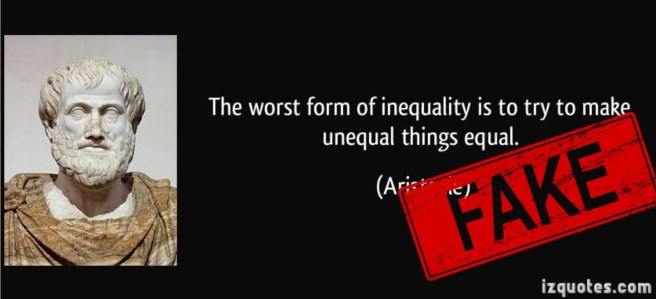
So, I came across the following in a random Aristotle hashtag search. it is, indubitably, a fake. This is Peisistratos and Racist Level Fake:

“The worst form of inequality is to try to make unequal things equal”

This has already been judged a “misattribution” by wikiquotes, but it has a life of its own as a meme that is used to justify inequality. What more a noble pursuit than the counterfeiting of ancient philosophical quotes in the service of upholding injustice!

This little horror shows up in the mid-seventies and has gained new life in the last decade or so. It seems that this is ‘inspired’ (to stretch the meaning of the word) by a segment from the Politics, which, by my reading, provides a very different sentiment from that purveyed by the meme:

Aristotle, Politics 3, 1280a 8-17

“First we must establish what people claim as the definitive boundaries of oligarchy and democracy and what principle of justice characterizes oligarchy and democracy in turn. For all people lay claim to some kind of justice, but they only pursue it up to a point and they do not define justice in its proper entirety.

For example, equality seems to be just and it is, but not to everyone, only to those who are equal to begin with. And so, inequality seems to be just, and, indeed, it is, but not for all people, only those who are not equal. But those people deprive [the concept of the meaning] in respect to those [whom it concerns] and render a bad judgment. The fault behind this is that the judgment is over something that concerns the people [making the judgment] themselves! Nearly all people are poor judges on matters that interest them.”

Ληπτέον δὲ πρῶτον τίνας ὅρους λέγουσι τῆς ὀλιγαρχίας καὶ δημοκρατίας, καὶ τί τὸ δίκαιον τό τε ὀλιγαρχικὸν καὶ δημοκρατικόν. πάντες γὰρ ἅπτονται δικαίου τινός, ἀλλὰ μέχρι τινὸς προέρχονται, καὶ λέγουσιν οὐ πᾶν τὸ κυρίως δίκαιον. οἷον δοκεῖ ἴσον τὸ δίκαιον εἶναι, καὶ ἔστιν, ἀλλ᾿ οὐ πᾶσιν ἀλλὰ τοῖς ἴσοις· καὶ τὸ ἄνισον δοκεῖ δίκαιον εἶναι, καὶ γάρ ἐστιν, ἀλλ᾿ οὐ πᾶσιν ἀλλὰ τοῖς ἀνίσοις· οἱ δὲ τοῦτ᾿ ἀφαιροῦσι, τὸ οἷς, καὶ κρίνουσι κακῶς. τὸ δ᾿ αἴτιον ὅτι περὶ αὑτῶν ἡ κρίσις, σχεδὸν δ᾿ οἱ πλεῖστοι φαῦλοι κριταὶ περὶ τῶν οἰκείων.

Just because this sentiment does not belong to Aristotle, does not mean that someone in the ancient world didn’t express (something like) it. H/T to Andrew Riggsby (@AntiqueThought) and John Ma (@Nakhthor) for pointing out these passages.

Cicero Republic 1.43

“But the people have too little participation in common justice and deliberation in monarchies; in aristocracies, the populace is incapable of having the smallest part of freedom since they lack access from any shared governance and power. When all the power is exercised by the people, even if it is done justly and moderately, the equality itself is not equal since it provides for no gradations in honor.”

Sed et in regnis nimis expertes sunt ceteri communis iuris et consilii, et in optimatium dominatu vix particeps libertatis potest esse multitudo, cum omni consilio communi ac potestate careat, et cum omnia per populum geruntur quamvis iustum atque moderatum, tamen ipsa aequabilitas est iniqua, cum habet nullos gradus dignitatis.


Pliny the Younger, Letters 9.5

 “You stand very far away from this mistake, I know well, but I cannot keep myself from seeming to warn you when praising the way you maintain differences of class and honor. If these things are mixed up and confused, nothing is more unequal than that kind of equality. Goodbye!”

A quo vitio tu longe recessisti, scio, sed temperare mihi non possum quominus laudem similis monenti, quod eum modum tenes ut discrimina ordinum dignitatumque custodias; quae si confusa turbata permixta sunt, nihil est ipsa aequalitate inaequalius. Vale.

Pliny the Younger, Letters 2.12.5

“But this is judged by the majority—their views are counted but they are not weighed. Nothing else can happen in public decision making in which there is nothing as unequal as this kind of equality. This persists because the right is everyone’s equally even though wisdom is unequally distributed.”

 Sed hoc pluribus visum est. Numerantur enim sententiae, non ponderantur; nec aliud in publico consilio potest fieri, in quo nihil est tam inaequale quam aequalitas ipsa. Nam cum sit impar prudentia, par omnium ius est.

Fake Aristotle

Women’s History Month, Week 3

For Week 1, go here; for Week 2, here.

Anecdotes

Amazing Ethnographies

Tacitus on Germanic Women and Child Bearing

Etymology of one word for Prostitute

Plutarch’s Story on Marriage and Death

Achilles’ Missing Sister


Women and Philosophy

The Pythagorean Women

Plato’s Sister and Women Among his Students

Plato’s Father, Rapist


Collections of Sayings

Spartan Women Said

Some more sayings of Spartan Women


Penelope in Myth

The Marriage of Penelope and Odysseus

Helen and Penelope were Cousins

Penelope’s Infidelity

Why We Disbelieve Women, According to Homer


Image result for ancient greek achilles

What’s Troubling Telemachus?

When Athena first goes to Ithaca to see Telemachus in the Odyssey, the narrator shifts focus and describes Odysseus’ son witnessing Mentes’ appearance (Athena in disguise, 1.113-120):

“God-like Telemachus saw her first by far.
For he was sitting among the suitors, tortured in his dear heart,
Dreaming about his noble father in his thoughts, if he should come home
From somewhere and scatter the suitors from his home,
And have his own place [honor] and rule over his possessions.
As he say imagining these things, he saw Athena,
And went straight to the entryway, rebuking himself
That a guest should stand in the doorway for so long…”

τὴν δὲ πολὺ πρῶτος ἴδε Τηλέμαχος θεοειδής·
ἧστο γὰρ ἐν μνηστῆρσι φίλον τετιημένος ἦτορ,
ὀσσόμενος πατέρ’ ἐσθλὸν ἐνὶ φρεσίν, εἴ ποθεν ἐλθὼν
μνηστήρων τῶν μὲν σκέδασιν κατὰ δώματα θείη,
τιμὴν δ’ αὐτὸς ἔχοι καὶ κτήμασιν οἷσιν ἀνάσσοι.
τὰ φρονέων μνηστῆρσι μεθήμενος εἴσιδ’ ᾿Αθήνην,
βῆ δ’ ἰθὺς προθύροιο, νεμεσσήθη δ’ ἐνὶ θυμῷ
ξεῖνον δηθὰ θύρῃσιν ἐφεστάμεν·

Telemachus is roused from a reverie by the appearance of a new stranger—and the characterization of his repose intrigues me. He does not appear to me to be a man of action except in the offering of hospitality. His emotional state is withdrawn: he inhabits his own thoughts, he is emotionally distressed, and he fantasizes about things being different from what they are. His first response is to rebuke himself for failing to live up to the very standard of hospitality that has been offered to the suitors, the abuse of which is a source of his frustration, and his daydream that his father will come home and put everything to rights.

telemachusgiovanni-battista-tiepolo-c-1740
By Giovanni Battisa Tiepolo, 18th Century

Although the phrase τετιημένος ἦτορ (“tortured/troubled in the heart”) does not have broad representation in the extant epic tradition, it does appear to have a rather marked one that indicates forced action or unwilling inaction. For instance, in the Iliad Ajax has to retreat from the Achaeans unwillingly (ὣς Αἴας τότ’ ἀπὸ Τρώων τετιημένος ἦτορ / ἤϊε πόλλ’ ἀέκων, 11.556-557). Odysseus describes himself the same way when mentioning the night he spent sleeping alone in the bushes on the shore of Skheria (7.287). The conceptual union between these two instances is that both Ajax and Odysseus are compelled to action by external forces. Later on in the Odyssey, the narrator describes Amphinomos suffering in the same way in book 18 when he feels fear at Odysseus-in-disguise’s prophecy (153-155)

“He went through the dear home, tortured in his heart,
And nodding his head. For he was imagining doom in his mind.
But there was no way to flee his fate….”

αὐτὰρ ὁ βῆ κατὰ δῶμα φίλον τετιημένος ἦτορ,
νευστάζων κεφαλῇ· δὴ γὰρ κακὸν ὄσσετο θυμῷ.
ἀλλ’ οὐδ’ ὧς φύγε κῆρα·…

Here, we have a thematic parallel for Telemachus’ first appearance. Amphinomos is full of dread over what he has just heard and cannot escape the future he is fearing. Note how both Amphinomos and Telemachus are characterized as occupied by their own thoughts, living an internal dream rather than engaging in the outside world.

There are other accounts that strengthen these associations in variations on the standard Homeric texts. When commenting upon Odysseus’ first appearance in book 5, the scholia record Aristonicus’ comment that the language is more fit (οἰκειότερον ἐν ᾿Ιλιάδι) for the Iliad at 2.721 where Philoktetes is described as “he lies there on the island suffering harsh pains” (ἀλλ’ ὃ μὲν ἐν νήσῳ κεῖτο κρατέρ’ ἄλγεα πάσχων, =Od. 5.13). He adds that it would be right for him instead to be “tortured in his heart” (νῦν δὲ ἔδει τετιημένος ἦτορ εἶναι, Schol. H ad Od. 5.13). Similarly Menelaos retreats from Patroklos’ body under force in book 17 of the Iliad, described as “troubled in his mind” (τετιηότι θυμῷ) and unwillingly—a phrase the scholia record appeared in the alternative τετιημένος ἦτορ in some manuscripts (Schol. Ad Il. 17.664b2). Another textual variant offers support: after Hera has been rebuffed by Zeus at the end of Iliad 1, most manuscripts depict Hephaestus as ministering to his mother, “white armed Hera” (λευκωλένῳ ῞Ηρῃ, 1.572) while the scholia report τετιημένῃ ἦτορ as a variant (Schol. bT ad Il. 1.572 Did. (?) λευκωλένῳ ῞Ηρῃ: ἄμεινον γράφειν „τετιημένῃ ἦτορ”). Hera’s ability to affect the action or even know Zeus’ plan has recently been limited—it makes sense that she would be characterized as being upset, unwilling, and trapped.

The description appears again once more with Telemachus and at a rather important juncture. After he has announced his departure at the assembly, Telemachus returns to his home in book two “tortured in his heart” (2.298) before he insults the suitors and declares that he is a grown man with a plan Od. 2.312–317):

“Isn’t it enough that you wasted my many fine possessions before, when I was still just a child [νήπιος], suitors? But now, when I am big, and I have learned by listening to the speech of other men, and the heart within me grows, I will discover some way that I may visit upon you wicked fates either when I go to Pylos or here in this country.”

ἦ οὐχ ἅλις, ὡς τὸ πάροιθεν ἐκείρετε πολλὰ καὶ ἐσθλὰ
κτήματ’ ἐμά, μνηστῆρες, ἐγὼ δ’ ἔτι νήπιος ἦα;
νῦν δ’ ὅτε δὴ μέγας εἰμί, καὶ ἄλλων μῦθον ἀκούων
πυνθάνομαι, καὶ δή μοι ἀέξεται ἔνδοθι θυμός,
πειρήσω, ὥς κ’ ὔμμι κακὰς ἐπὶ κῆρας ἰήλω,
ἠὲ Πύλονδ’ ἐλθὼν ἢ αὐτοῦ τῷδ’ ἐνὶ δήμῳ.

The application of the “tortured in the heart” phrase here troubled ancient readers—a scholion glosses its use as “not because he is sullen, but because he is thinking about how to leave” (φίλον τετιημένος ἦτορ] οὐκ ἐσκυθρωπακὼς, ἀλλὰ καὶ φροντίζων ὡς ἀποδημεῖν μέλλων, Schol ES ad Od. 2.298). The scholiastic adjustment here points both to the ‘typical’ interpretation of the line—that it indicates an isolated rumination—and the sense that something critical has changed here. As Telemachus moves into action and declares himself as an agent and a thinker, he also moves from his state of paralysis and rumination into a different part of his tale.

Give Your Money to The Sportula

Publilius Syrus, 78

“Generosity even devises an excuse for giving”

Benignus etiam causam dandi cogitat.

I am just going to get straight to it. This is a request for money. Not for me. Not for this site. There isn’t going to be a prolonged funding drive and there won’t be any cool canvas tote bags. But this is a plea for money.

I am asking you to support The Sportula. If you don’t know what The Sportula is, you probably have not been active on Classics Twitter for the past year or so, but it is, in my ever so humble opinion, one of the most original, important, and socially minded initiatives to develop in the disciplines of Classical Studies in a generation. It is a collective of graduate students who provide microgrants “ to economically marginalized undergraduates in Classics.” It is original because no one has done it before; it is important because it addresses an overlooked set of needs traditional fellowships and grants can rarely touch; and it is socially minded because it directly addresses issues of equity and inclusion that plague our field.

Big Heart

I don’t want to make this about me (although I will shortly). But Erik and I have never asked for money. We have run this site for the past eight years without support from anyone. We can do this because we are both lucky enough to have full-time, renewable, long-term employment in the fields of classics. If the founders of The Sportula are not inspiration enough for you, but you have ever been amused, educated, enraged, or otherwise distracted from the horrors of life by this website or its twitter feed, please give some money.

If you missed Amy Pistone’s virtual 5K, you can can donate through Go-Fund Me with a single payment; you can become a patron through Patreon and donate a small amount every month; or you can donate through the book auction book on by the phenomenal and dauntless Dr. Liv Yarrow. The twitter feed for our site has alone 23 thousand followers: if every one gave a single dollar a month, we could fund the next generation of Classics alone.

And let me be clear about this. I do not actually know the founders or directors of the Sportula. I have never even exchanged an email with them. But I believe so deeply in what they do and think that it is evidence not merely of great minds but also of great souls that I will gladly make some noise for them.

If we lived in a more perfect world, all students would have the financial means to attend school, buy books, get to class, pay rent. If we lived in a better world, the inability to do any of this would not be tied to historical, structural, and institutional racisms and prejudice. But we do not live in that world. That’s why we need revolutionary vision, a DIY aesthetic, and the courage to ask for help and give it whenever capable. This is why we need The Sportula.


Dicta Catonis 15

“Remember to tell the tale of another’s kindness many times
But whatever kind deed you do for others, keep quiet.”

Officium alterius multis narrare memento;
at quaecumque aliis benefeceris ipse, sileto.


Ok, here’s a story. As I have talked about before, I didn’t come from much money, but I could cut some corners and bend some rules here and there and I didn’t realize how much of that success depended on my race, gender, and sexual orientation until much later in life. The point is, despite this, funding and living in graduate school was hard. In 2001, I started at NYU on a stipend of 13,000.00 dollars a year with no health insurance. I hustled a bit: I worked in the Dean’s office; I was an editorial assistant for the Classical World; I took every tutoring job I could find; and then I taught every summer course they’d give me.

But even with long days which afforded just barely enough time to finish course work, my financial support was a shell game that required credit cards, student loans, and some willful denial. All this fell apart in my fourth year of graduate school when there was an electrical fire that burned out my apartment. I lost everything. No, I did not have renter’s insurance. No, I did not have savings. I had the clothes on my back, a cat who survived the fire (and needed $900.00 in medical treatment, thank you MBNA America), and an equally broke fiancee in dental school. Oh, and 18 thousand dollars in credit card debt. Those years of cutting corners had caught up.

My department bought me a new computer so I could continue my dissertation the very next day. When the red cross assistance turned out to be $200.00 dollars, some graduate student friends raised over 700 dollars at a party so my roommate and I could buy stuff for a renovated place. That was the community I had and it filled me with joy and well-being.

But I still had to face the fact that I was financially insolvent. My future wife and I were able to take out even more student loans (at 6.9% interest, a damn sight better than the 29% APR my credit card had ballooned to after I failed on my monthly payments). I was lucky enough to get a job in the last good year on the market in 2007—but even then we struggled for a few years (starting salary for a Homerist in 2007, 52K a year). I just paid off my final student loan this year at age 40.

When I think back on this ‘success story’, I don’t see a good plan or smart decisions, I see a series of close misses and dumb luck. We got health insurance as part of a graduate student union deal my second year: this meant I could have shoulder surgery. What if something had happened earlier or the insurance company had denied a pre-existing condition? What if there had been one fewer class for me to teach in the summer? What if I had gotten sick? What if I had been robbed while paying my rent for half a year in cash? (This happened to a classmate. And yes, I paid cash to my shady orthodontist land-lord in exchange for never facing a rent increase.) What if I had been arrested and had to pay legal fees (it was NYC, there were reasons)? What if I had not gotten a job right away or not had a supportive partner to help me bear the burden?

And all of these questions come after the question, what if I had been born looking like someone who isn’t me? As human beings, we have an insistent and necessary capability for denial—I mean, we walk around every day acting like we are not going to die and all. But this also means that we deny the essential precarity that attends each of our lives and take credit for the fact that bad shit does not happen every day. This is not a true view of the world. People slip on sidewalks and get concussions; people get cancer; people get treated like shit by other people; shit happens and too much of it is out of our control.

The Sportula is a force of good in the universe, designed and aimed at exerting just a little bit of corrective control. Microgrants may seem minor, but when you can’t make ends meet and need just a little help, they are the thing. This work is small in the every day, but aggregated over time it is transformative. The Sportula is that group of friends who threw a party for a kid whose apartment burned down. But they do it every day for people they don’t know.

Please, give some money to The Sportula. They make me believe in the basic goodness of humankind.


Seneca, De Beneficiis 4

“All generosity hurries—it is characteristic of one who does something willingly to do it quickly. If someone comes to help slowly or drags it out day by day, he does not do it sincerely. And he has thus lost the two most important things: time and a sign of his willing friendship. To be slowly willing is a sign of being unwilling.”

Omnis benignitas properat, et proprium est libenter facientis cito facere; qui tarde et diem de die extrahens profuit, non ex animo fecit. Ita duas res maximas perdidit, et tempus et argumentum amicae voluntatis; tarde velle nolentis est.

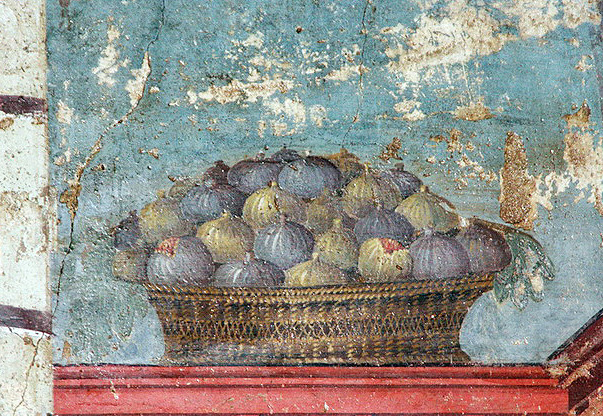
Figs in a basket, Fresco (Pompeii)