What’s a Slave’s Life Worth?

The Odyssey follows the slaughter of the suitors with the mutilation and murder of slaves: the torture of the goatherd Melanthios (Od. 22.474–477) and the hanging of twelve slave women (Od. 22.463–73). But it also considers the death of the older slave Eurykleia on multiple occasions. We first hear about her in book 1:

Homer, Odyssey 1.428-433

“And with him Eurykleia carried the burning torches.
She knew proper things, the daughter of Ops, the son of Peisênor
whom Laertes bought to be among his possessions
when she was just a girl and he paid a price worth 20 oxen.
And he used to honor her equal to his dear wife in his home
but he never had sex with her and he was avoiding his wife’s anger.”

τῷ δ’ ἄρ’ ἅμ’ αἰθομένας δαΐδας φέρε κεδνὰ ἰδυῖα
Εὐρύκλει’, ῏Ωπος θυγάτηρ Πεισηνορίδαο,
τήν ποτε Λαέρτης πρίατο κτεάτεσσιν ἑοῖσι,
πρωθήβην ἔτ’ ἐοῦσαν, ἐεικοσάβοια δ’ ἔδωκεν,
ἶσα δέ μιν κεδνῇ ἀλόχῳ τίεν ἐν μεγάροισιν,
εὐνῇ δ’ οὔ ποτ’ ἔμικτο, χόλον δ’ ἀλέεινε γυναικός·

So, it seems, Eurykleia’s life is ‘dear’—in the archaic English meaning of having a high price—since she was worth so many oxen and Laertes honored her equal to his wife without having sex with her. Despite so high a price—or perhaps because of it—her life is risked several times in the epic. The moment that has always stuck with me comes from the famous recognition of the scar scene. While this scene has garnered a lot of attention for the way the scar triggers a story and communicates Odysseus’ identity, there have been relatively few comments about the violence imminent in the scene.

Homer, Odyssey 19.466-490

“The old woman, as she took it in the flat part of her hands,
recognized the scar as she felt it, and she dropped the foot.
His shin fell onto the basin and the bronze clanged,
then it tilted to one side and water sloshed out onto the ground.
Joy and pain overtook her mind at once and
both of her eyes filled with tears as her strong voice got stuck inside.
She touched his beard and then addressed Odysseus.
“You really are Odysseus, dear child.
I did not recognize you before, before I examined my lord all over.”

And then she would have gotten Penelope’s attention too
with her eyes because she wanted to tell her
that her dear husband was here.
But she was not able to turn or to notice anything
because Athena had turned her mind elsewhere.
But Odysseus closed his hand on her throat with his right hand
and with his left hand he drew her close and said,

“Auntie, why do you want to ruin me?
You fed me yourself on your own breast.
Now after suffering many pains I have returned
in the twentieth year to my fatherland.
But since you have recognized me and a god put it in your mind
be silent lest anyone else in the home learn it.
For I will speak this out and it will be completed,
If the god subdues the haughty suitors under me
I will not leave you even though you were my nurse,
when I kill all the other slave women in my home.”

τὴν γρηῦς χείρεσσι καταπρηνέσσι λαβοῦσα
γνῶ ῥ’ ἐπιμασσαμένη, πόδα δὲ προέηκε φέρεσθαι·
ἐν δὲ λέβητι πέσε κνήμη, κανάχησε δὲ χαλκός,
ἂψ δ’ ἑτέρωσ’ ἐκλίθη· τὸ δ’ ἐπὶ χθονὸς ἐξέχυθ’ ὕδωρ.
τὴν δ’ ἅμα χάρμα καὶ ἄλγος ἕλε φρένα, τὼ δέ οἱ ὄσσε
δακρυόφιν πλῆσθεν, θαλερὴ δέ οἱ ἔσχετο φωνή.
ἁψαμένη δὲ γενείου ᾿Οδυσσῆα προσέειπεν·
“ἦ μάλ’ ᾿Οδυσσεύς ἐσσι, φίλον τέκος· οὐδέ σ’ ἐγώ γε
πρὶν ἔγνων, πρὶν πάντα ἄνακτ’ ἐμὸν ἀμφαφάασθαι.”
ἦ, καὶ Πηνελόπειαν ἐσέδρακεν ὀφθαλμοῖσι,
πεφραδέειν ἐθέλουσα φίλον πόσιν ἔνδον ἐόντα.
ἡ δ’ οὔτ’ ἀθρῆσαι δύνατ’ ἀντίη οὔτε νοῆσαι·
τῇ γὰρ ᾿Αθηναίη νόον ἔτραπεν. αὐτὰρ ᾿Οδυσσεὺς
χείρ’ ἐπιμασσάμενος φάρυγος λάβε δεξιτερῆφι,
τῇ δ’ ἑτέρῃ ἕθεν ἄσσον ἐρύσσατο φώνησέν τε·
“μαῖα, τίη μ’ ἐθέλεις ὀλέσαι; σὺ δέ μ’ ἔτρεφες αὐτὴ
τῷ σῷ ἐπὶ μαζῷ· νῦν δ’ ἄλγεα πολλὰ μογήσας
ἤλυθον εἰκοστῷ ἔτεϊ ἐς πατρίδα γαῖαν.
ἀλλ’ ἐπεὶ ἐφράσθης καί τοι θεὸς ἔμβαλε θυμῷ,
σίγα, μή τίς τ’ ἄλλος ἐνὶ μεγάροισι πύθηται.
ὧδε γὰρ ἐξερέω, καὶ μὴν τετελεσμένον ἔσται·
εἴ χ’ ὑπ’ ἐμοί γε θεὸς δαμάσῃ μνηστῆρας ἀγαυούς,
οὐδὲ τροφοῦ οὔσης σεῦ ἀφέξομαι, ὁππότ’ ἂν ἄλλας
δμῳὰς ἐν μεγάροισιν ἐμοῖς κτείνωμι γυναῖκας.”

This theme is internalized later when Eurykleia threatens her own life.When she tries to tell Penelope in book 23 that Odysseus is actually present, she offers to wager her life on the truth of the statement when Penelope doubts her.

Homer, Odyssey 23.75-79

“…I wanted to tell you myself
but he took me with his hands at my throat
and would not allow me to speak thanks to the cleverness of his mind.
So, follow me. But I will wager myself over this to you:
If I have deceived you, kill me with the most pitiful death”

….ἔθελον δὲ σοὶ αὐτῇ
εἰπέμεν· ἀλλά με κεῖνος ἑλὼν ἐπὶ μάστακα χερσὶν
οὐκ εἴα εἰπεῖν πολυκερδείῃσι νόοιο.
ἀλλ’ ἕπευ· αὐτὰρ ἐγὼν ἐμέθεν περιδώσομαι αὐτῆς,
αἴ κέν σ’ ἐξαπάφω, κτεῖναί μ’ οἰκτίστῳ ὀλέθρῳ.”

For me, Eurykleia’s willingness to wager her life is indication of an internalized oppression created by the experience of slavery. But the specific value of her initial price is interesting too. This probably complicates matters, but there is little in the Homeric poems set at a worth of 20 oxen. The price comes up again during the slaughter of the suitors. Eurymachus tries to offer Odysseus recompense and sets the price for each suitor at 20 oxen (in addition to payment for all the food and drink).

Homer, Odyssey 21.54–59

“But now, even though it is ordained by fate, spare your people.
And in exchange we will gather about the land as payment
As much as was drunk up and eaten in your halls,
And each man will bring a payment worth twenty oxen,
Which we will pay in bronze and gold, until your heart
Softens—before this, there is no blame for being angry.”

νῦν δ’ ὁ μὲν ἐν μοίρῃ πέφαται, σὺ δὲ φείδεο λαῶν
σῶν· ἀτὰρ ἄμμες ὄπισθεν ἀρεσσάμενοι κατὰ δῆμον,
ὅσσα τοι ἐκπέποται καὶ ἐδήδοται ἐν μεγάροισι,
τιμὴν ἀμφὶς ἄγοντες ἐεικοσάβοιον ἕκαστος,
χαλκόν τε χρυσόν τ’ ἀποδώσομεν, εἰς ὅ κε σὸν κῆρ
ἰανθῇ· πρὶν δ’ οὔ τι νεμεσσητὸν κεχολῶσθαι.”

Post-script: An average ox seems to cost around $3000.00 right now. So, in modern ox-dollars, Eurykleia was valued at $60,000. This seems a little off to me. According to Beef Magazine (which is a real thing) a good bull on average can run more like $7500, placing Eurykleia at $150,000. I do not print any of this to make light of the selling of human beings (because, when we leave the abstract, this is all really horrifying), but instead, rather, to give a really relative view of what her–and the suitors–economic value might be in today’s terms. The range is basically luxury car to cheap apartment. This is, alternatively, the price acceptable for a good slave, but not worth the life of an offending suitor. In both cases the economic equivalence for any human life is, to put it simply, dehumanizing.

Related image

Horrible Things Happen to Heraclitus on the Internet

https://twitter.com/swanofthedab/status/1097535557570195457

This quotation appears

page 237

It is marked as misattributed on wikiquote (where its original attestation seems to be Gabriel Suarez’s The Tactical Rifle, which assigns it to a certain Hericletus [sic]); Reddit has also marked it as a misquotation, although it assigns it to the apocryphal “Cynic Epistles” which were attributed to Heraclitus (this text is not available online as far as I can find; I have ordered it).

It is disturbing how popular this is as a meme: you can find it on quotefancy, pinterest, and way too many other places (it is of particular importance on sites that glorify firearms and snipers). Oh, it has also made the leap to popular history books, appearing in Paul B Bardunias’ and Fred Ray’s “Hoplites at War.”

To anyone who has read any of the extant fragments from Heraclitus, this is clearly not even remotely his style (here’s a cool site where you can find his fragments in Greek and translation). While it may be a bit too much to expect the internet to be familiar with Heraclitean obscurity, this passage sounds thoroughly and depressingly modern. It is not, of course, out of the character of Greek poetry to idolize a promakhos (the person who fights in front for his community), but phrasing and the “bring the others back” denouement is against the basic aesthetics of Greek martial poetry (see, for example, Callinus or Tyrtaeus). Of course, since all we have from Heraclitus is fragmentary, we are, as it were, in the dark.

Here’s one fragment that might work as inspiration:

Fr. 49 (103)

“One person is ten thousand to me, if he is the best.”

Εἷς ἐμοὶ μύριοι, ἐὰν ἄριστος ᾖ.

And here are a few more if we are looking for bellicose Pre-socratic quotations:

the best

Fr. 53 (44)

“War is father and king of everything. War proves some to be gods and others human beings; it makes some slaves and others free.”

Πόλεμος πάντων μὲν πατήρ ἐστι πάντων δὲ βασιλεύς, καὶ τοὺς μὲν θεοὺς ἔδειξε τοὺς δὲ ἀνθρώπους, τοὺς μὲν δούλους ἐποίησε τοὺς δὲ ἐλευθέρους.

Fr. 80 (72)

“One must know that war is common, that justice is strife, and that all things happen through strife by necessity”

εἰδέναι δὲ χρὴ τὸν πόλεμον ἐόντα ξυνόν, καὶ δίκην ἔριν, καὶ γινόμενα πάντα κατ’ ἔριν καὶ χρεών.

The text is problematic here, another version: Εἰδέναι χρὴ τὸν πόλεμον ἐόντα ξυνόν, καὶ δίκην ἔριν· καὶ γινόμενα πάντα κατ᾿ ἔριν καὶ †χρεώμενα†.

Fr. 48 (66)

“The bow’s name is life but its work is death.”

Τοῦ βιοῦ οὔνομα βίος, ἔργον δὲ θάνατος.

This version keeps the wordplay between biós (“bow”) and bíos (“life”). Another version obscures this punning:

βίος: τῶι οὖν τόξωι ὄνομα βίος, ἔργον δὲ θάνατος.


Quomodo Dicitur “State of the Union Address”?

The amazing Dani Bostick (@danibostick) live tweeted the State of the Union Address tonight in Latin. For those off twitter (or off TV), here are her tweets.

https://twitter.com/danibostick/status/1092967939093872640

https://twitter.com/danibostick/status/1092969038077030405

https://twitter.com/danibostick/status/1092969971125182464

https://twitter.com/danibostick/status/1092971101674557440

https://twitter.com/danibostick/status/1092971783354007552

https://twitter.com/danibostick/status/1092972357688410113

https://twitter.com/danibostick/status/1092973373267808258

https://twitter.com/danibostick/status/1092974682675048458


https://twitter.com/danibostick/status/1092975444041842688

https://twitter.com/danibostick/status/1092976446631485440


https://twitter.com/danibostick/status/1092977630306070528

Continue reading “Quomodo Dicitur “State of the Union Address”?” →

Non-Elite Latin for the Classroom

The following is a thoroughly masterful and fascinating introduction to using non-elite Latin in teaching by Brandon Conley.

Introduction

This is a brief introduction to non-elite Latin texts, intended for use in the classroom as a supplement to the more traditional Latin readings. For the majority of the following texts, knowledge of Latin equivalent to the first two to three semesters at the college level is advised, though several are suitable for first-year courses.

Firstly, what is non-elite Latin? Generally speaking, non-elite Latin comprises the texts produced outside of Rome’s powerful, exclusive literary circles, the arbiters of linguistic prestige—the ‘literati,’ so to speak. Other terms are often used to describe these texts, such as non-literary or non-standard. These definitions often, but not always, apply, and regularly more than one can be used to describe the same text. For example, we wouldn’t use ‘non-standard’ to describe an epitaph written for a freedwoman in Dacia that adheres to the linguistic standards of classical Latin (its adherence makes it, in fact, standard), but we could describe it as both non-elite and non-literary. The texts here can be standard or not (though most contain non-standard forms), as well as literary or not (though most aren’t). But they are all non-elite by virtue of the statuses, locations, and linguistic conventions of their authors.

nelatin

Reading non-elite texts, with few exceptions, presents a set of challenges different from those of classical Latin. Linguistic features are more prone to diachronic and geographic change than the comparatively change-resistant classical standards. Spellings can be phonetic, colloquial, learned conventions, or intentionally archaic for effect. Morphology and syntax often differ widely as well, as in the increased usage of the indicative or the expanded role of the accusative (at the expense of the ablative, regularly). Vocabulary can be geographically specific, and differences in semantic value between non-elite and classical Latin are not uncommon.

Some of these features are discussed below to aid in reading. Efforts were made to add punctuation, etc., for ease of reading and approachability to students. Spellings are often left in their non-standard forms, though to aid in reading, many words are edited using brackets or parentheses; for particularly problematic spellings, a classical form of the word is added in parentheses. Texts (and translations, where available) are taken from the sources linked, with modifications (unless otherwise noted).

Exercises in non-elite Latin are often exercises in editing, critical reading, and emendation, as many of the texts are damaged or difficult to interpret. Reading these texts presents a practical opportunity to discuss textual editing as a scholarly process.

Lastly, accessibility is paramount. Students, instructors, and independent scholars often lack access to the databases and publications in which many non-elite texts are presented. All of the texts presented below are freely available online. At the end of this document, however, the recommended reading list contains mostly sources that are not open access.

Feel free to add, remove, edit, scream at, or pour coffee on the text—though should you choose to pour the coffee, print it first.

Spelling

Motives for the spellings can be any number of things, from a widespread phonetic change to a local scribe’s misspelling. Often, unsurprisingly and necessarily, there is considerable debate on the causes of the spellings. Likewise, we must resist, often with great difficulty, tendencies to generalize non-standard spellings as broader linguistic features without the presence of more evidence.

These are some of the most common differences in spelling between non-elite and classical Latin.

Word-initial and Intervocalic Aspirate, h-, /h/ (habeo, hic, mihi, ): The initial and intervocalic aspirate /h/ had disappeared from most speech varieties by the imperial period, and from all eventually (with the exception of a select few prescriptive grammarians, perhaps). Hence, it is often omitted in non-elite texts, with resulting forms such as abes, mi, and ic.

Word-final -m, /m/ (dicam, amicum, etc.): -m was not pronounced (as /m/, at least) at the end of a word in spoken Latin, even before the time of Cicero; consider, for example, the impact this had in classical poetry in the process of elision. It is omitted from spelling with great frequency in non-elite texts, and can often cause confusion for first-time readers.

The v/b Shift, /w/ à /β/ (cf. the v in Spanish): this is a simplification of the process, but essentially the glide /w/ of classical pronunciation became increasingly pronounced as a bilabial fricative. This change is represented in non-standard spellings by the replacement of Latin v for b (e.g. dibi, classical divi, “gods”), as writers considered b to more closely represent the sound.

xs for x (dixsit,): there are potentially a few, if separate, factors that motivated this spelling. In short, an s was added after x due to the differing phonetic qualities of x as it was written (by itself, not representing /ks/). This is a common spelling feature, but generally not a problematic one for reading.

Assimilation and Weakening: a widespread trend in non-elite spellings is the simplification of consonant clusters, often through assimilation (i.e. one sound in the cluster ‘absorbs’ another sound) or weakening leading to loss. These can result in either a different letter being used to represent the altered sound (imveni, inveni) or the complete loss of a consonant (nuc, cf. nunc; meses, cf. menses). A notable loss, in cosul, is even reflected in standardized inscriptions in the abbr. cos. Loss is also quite common with consonants preceding the semivowel /j/, i (aiuto, cf. adiuto, “I help”).

Doubling of letters and reduction of doubled letters (faccio, facio; anis, cf. annis): multiple operations are at work, including the strengthening, weakening, and shortening of consonants, gemination and degemination, as well as the general tendency to eliminate letters that are not reflected in speech. Though not all spellings of these types can be ascribed to changes in pronunciation. For reading purposes, the doubling of letters (e.g. faccio) is usually not problematic. The absence of doubled letters can be problematic, though, as the non-standard forms frequently resemble other words with standard spellings (e.g. annis, dat/abl pl. ‘years,’ but anis, dat/abl pl. ‘rings’; or suum ‘own’, but sum ‘I am’).

Deletion: Vowels and consonants are regularly deleted in medial positions. Unstressed vowels are most commonly deleted (aspros, cf. asperos; copla, cf. copula), reducing the number of syllables in a word. This trend is not entirely unusual even in literary Latin.

Often duplicate vowels are reduced to one letter (serus, seruus; tus, cf. tuus).

Voiced and Devoiced Consonant Switching: switching in both directions is common, and the motives vary. The use of t for d and vice versa are perhaps the most common in the texts below (ed, set, at, ). Sometimes they are even used interchangeably in the same document. There is considerable doubt that these spellings reflected wider speech patterns.

Other Orthographic Consonant Substitutions: k is regularly used for c (karissimo), as is, to a lesser extent, q before u (mequm, quravit). These generally do not pose problems for readers.

e/i Representation: the writing of e for i and vice versa is one of the most commonly found spelling deviations from classical standards. Spellings of this type sometimes, though not always, reflect a widespread phonetic change in Latin speech well into the imperial period, whereby the vowels long e /e:/ and short i /i/ merged into a single vowel, /ẹ/. Both letters were used with little consistency to represent this phoneme. Another motive was the tendency for /e/ and /i/ to become a semivowel /j/ after a consonant (vinia as two syllables, rather than vinea). Occasionally, e was even used to represent ī /i:/. Some examples: sene, nese, dicet, ube, ibe, and signabet.

u/o Representation: another very common set of vowel substitutions, o is frequently used in place of u. The majority of instances occur in final syllables of the nominative and accusative singular; -us and -um become -os and -om, respectively. While another widespread vowel merger (similar to e/i) occurred very late in the imperial period, whereby ō /o:/ and u /u/ merged to a closed o /ọ/, the great majority of non-elite texts from the Roman Empire likely do not reflect this process. The use of o for u is far more likely to be an orthographic remnant (a ‘relic’, perhaps) of the old Latin spelling, which reflects the original o-stem. As mentioned above, there is also a strong stylistic tendency against writing the consecutive vowels uu, and o often replaces the second one. Examples: servos, mortuos, novom, salvom.

ei for i (tibei, ubei, etc.): the use of the vowels ei for classical i occurs regularly, and is an archaism of spelling, either for style or by learned inheritance, rather than an indication of pronunciation. It is a remnant of a popular spelling in old Latin which did reflect speech; the original diphthong /ei/ underwent a change to /i:/.

Monophthongization: ae /ae/ à e /ɛ/: other diphthongs disappear as well, but ae to e is present most frequently in the texts. Examples: que, quae; Cecilius, cf. Caecilius; and equum, cf. aequum. These can be problematic, as evidenced by the final example equum (potentially confused for the classical ‘horse’).

Morphology and Syntax

While there are numerous morphological and syntactic differences from classical Latin, they rarely impede reading to the extent of spelling differences. For example, a Latin student might recognize that the ‘incorrect’ verb tense is used in a conditional, but meaning can still be deduced. As such, only a few points will be mentioned here; see the recommended readings for further discussion.

Accusatives with Prepositions: there is plenty of evidence to support the convincing notion that the accusative became the default case for prepositional phrases. Most notably, cum, de, pro and in regularly take accusatives (even in instances in which the classical ‘ablative of place where’ would be expected). The situation is further complicated by the status of word-final -m, which made the ablative and accusative cases sound identical in speech in some instances, and the omission of which in writing can make a word appear ablative, though a writer originally had in mind an accusative. Advice for readers is to expect accusatives with prepositions which would otherwise be unexpected in classical Latin.

Analogy and Paradigm Leveling: analogy was a productive process in Latin, and in non-elite texts it occurs often in verbal and nominal morphology. Forth declension nouns in classical Latin sometimes use the more regular endings of the second declension in non-elite texts (an ongoing process that eventually saw the near-complete elimination of the fourth declension). Verbal constructions are leveled as well, for example in posso (“I can”) being given a common -o 1st singular ending in place of the standard possum.

Indicative or Infinitive: in instances where classical Latin would employ a subjunctive, such as in an indirect question, it is not uncommon in non-elite texts to see an indicative or an infinitival construction.

The conjunctions et and sed: a number of texts rely heavily on these conjunctions, including them where syntactically unnecessary or where other conjunctions would be more appropriate for clarity. One must not always take these literally or strictly when reading.

Vocabulary

Reading any different author or genre of Latin usually requires familiarization with new vocabulary, and non-elite texts are no exception. Cicero’s surviving works, for example, do not contain inventories of materials or equipment, and in the texts that do contain these, some words will be new to readers. In some instances, however, things are more complicated. Loanwords or local words with limited attestation are common, and their meanings are uncertain; the ostraka found at Bu Njem, for example, contain several Punic words. The texts below were chosen with these considerations in mind, though it will perhaps be necessary to look up some military terms, for example.

Keep reading for some phenomenal texts….

Continue reading “Non-Elite Latin for the Classroom” →

Against Pedantry

“..[D]on’t listen to the pedantic and specific precepts of grammarians; but heed your own ear…”

non finitiones illas praerancidas neque fetutinas grammaticas spectaveris, sed aurem tuam interroga

Aulus Gellius, Attic Nights 13.21

When I was applying to graduate school and asked what it was like, I remember my first Greek teacher telling me a story about his PhD qualifying exams. During the two-hour oral component, some eminent professor of distinguished achievement remained conspicuously silent. When he did speak up, he looked critically at the examinee (a Homerist) and asked a single question: “What is the name of Odysseus’ mother?” My teacher could not remember and it caused enough trauma that this was the story he used to characterize his experience in graduate school almost 30 years later.

When I was in a PhD program myself, this anecdote was the first thing that came to my mind as I looked over the returned draft of the first three chapters of my dissertation. Most dissertations leave behind them legacies of confusion, shame, and pain. Mine was not completely traumatizing, but that’s because, after struggling for six months to write over 100 pages of well-footnoted dreck, I had the audacity to throw everything away and start from scratch. During a feverish long-weekend in February 2006, I re-started from page 1 and ended up writing the first draft of a ‘chapter’ that, at over 100 pages, became the first three chapters of a messy, long, but ultimately ‘successful’ dissertation. (Spoiler: I passed).

When you submit chapters of your dissertation to advisors, the ensuing period of silence can be maddening. (And sometimes that long wait never ends.) When I did receive a marked-up version of my magnum opus, I scurried away from my advisor to start poring over his responses, hoping for some clue that I was on the right track, to divine some sign of my future. And inside: Corrected misspellings; Commas inserted and deleted; A Greek accent was repaired. The longest actual comment I could find was scrawled next to a footnote: the word “Phaeacia” was scratched out, next to it: “The Phaeacians live in Skheria.”

This was not the first warning I received in graduate school about the world into which I was seeking initiation. Any failure to translate adequately in seminars was met with sudden questions about obscure aorist stems. In casual conversation, I remember being corrected for calling someone “long-lifed”, when the right way of saying it is “long-lived”. But I am a blustery and confident sort. When I was asked in a seminar why I didn’t know the defective aorist of bainô, I responded, probably with a bit of acid, “because I am a student. I am here to learn.”

The first lesson I was taught in graduate school was either to shed the Socratic notion of owning up to my ignorance or be prepared for shame as a reward for my loyalty to Platonic dogma. The second lesson was really just the application of one I already knew: the best defense is a good offense. Know the nitty-gritty details; and, if you don’t, just put someone else on the spot first.

precise man

Continue reading “Against Pedantry” →

Annual Atopia: The Not-Top 10

Yesterday I posted a list of the top 10 posts on the site based on page-views. Sometimes we can guess which posts are going to generate some traffic; other times, we are surprised both by those that are popular and those. Here’s a list of some of my favorite posts that didn’t make the top 10.

1. Tessered Latin and Greek: A Lexical “Wrinkle in Time”

Mimi Kramer wrote a great story in the Daily Beast about Greek (and a little Latin) in Madeleine L’Engle’s A Wrinkle in Time. This blog has a little cameo…

2. The Difference of A Year: Some Links to Classicists Fighting the Good Fight Online

One of the things we don’t do enough on this blog that I want to try to do more of next year is promoting others’ work online (and off). In this post we highlighted some of the critical work Classicists are doing today. Several months later, the importance of their efforts has only increased.

3. Skatokhasm: Another Word You Know You Need

We posted a good deal of political material over the past year and got some minor abuse for it. It is hard to choose from the many absurd things we posted in response to the degeneration of our public discourse, but this riffing on shit-hole, σκατοχάσμα is one of my favorite.

4. Philology at Dinner: How I Began to Love Classics

Erik wrote a moving and important essay about what drew him to Classics. I have reread it many times. You should too.

5. Parenting While Teaching Greek Badly

I wrote a few essays this year that were deeply personal. This one is a little more uplifting than my bit on death. Also, while I certainly live the latter on a daily basis, I am all the more certain with each passing day that I will miss the parenting and teaching badly the most.

6. Tell Me Aristotle, Why Do We Have Butts?

Dr. Rebecca Raphael mentioned this passage on facebook and I had to post it. It is everything the world needs right now.

7. In Defense of Obscenity

Erik wrote this piece as part of defending the use of the colloquial and obscene from the ancient world on this blog and in the classroom. It emerged in part from an ongoing discussion about our discomfort with how popular the Tawdry Tuesday posts are. I don’t think we’re done figuring this one out, but I think we will keep returning to this post to think about it.

8. Humanizing a Monster II

This is the first album review to appear on the website! Erik writes movingly about the way Moonface engages with the story of the Minotaur (from his perspective) and humanizes both the monster and the audience by doing so. I have been listening to the album regularly since he posted this.

9. Newly Discovered Text: A Late Antique Dialogue on “The Etymology of ‘Mimosa’”

Benjamin Eldon Stevens posted a funny meme on twitter about the etymology of Mimosa. I butted in and added a different etymology. It turned into a blogpost.

10. The New Sappho Poem: a Student Commentary

This post is the product of work some of my Greek Lyric Class at Brandeis did. It is probably the best thing we did in class over the semester. (Note: teaching lyric is hard!)

Honorable Mentions:

“Your Father Does Not Dine With Us”: Orphanhood and Dehumanization
Science and Humanity
No, Internet, Kerberos is Probably Not “Spot”
Classroom Confession: I am a Terrible Teacher
What Does Helen Look Like?

Drinking Meme

“How Was the [Expensive Classics Event]?”: Income Inequality and the Classics

This is a companion to the earlier essay, “This is Not My Beautiful House: Classics, Class, and Identity”, which elicited a variety of personal responses from classicists and students about the myriad problems in the discipline. My contribution here, specifically, is to further articulate and contextualize my response to Amy Pistone’s asking “what can individuals maybe do to help?”


The title of this article is at the heart of my response to the question on what can be done to help to address the class-based challenges of studying the Classics. “How was the ________?”, whether the blank space is filled in with conference, study abroad term, workshop, or something else, is a question of access. Encoded in this question is the fact that one person had this access while another didn’t. It is an innocuous question, with an innocuous reply, that contextually is a perfect representation of Classics’ self-perpetuating economic inequalities. And these inequalities were regular features of my studies.

My formal involvement with Classics began when I was twenty-one years old, though in high school I had developed an interest in Greek and Roman history and was even able to take year of Latin before the program was cut. In my first years of college, I focused on social science courses in psychology, sociology, and political science, with an interest in labor relations. But after donating three years to these subjects, I didn’t feel the same love for learning them that I did when I was reading about the Peloponnesian Wars or Roman politics in my free time.

So, I switched to Classics, starting Latin coursework right away and Greek later (along with French in anticipation of graduate work). Now in my early thirties, I am still involved with the field as an adjunct instructor teaching Greek and Roman Civilization (while missing teaching Latin), and I also work outside of academia to pay the bills. At times I feel like I belong, but at other times I feel like a stranger in a strange land. This was the case from the beginning.

During both my undergraduate and graduate pursuits in Classics, I found myself uttering some variant of this “how was the ______?” quote almost every time I’d gone a week without seeing a classmate—or so it felt. On the same day that I was excited to use a coupon for $1 off the price of a pizza on my way home from an eight-hour shift at a liquor store, a classmate was, for example, touring the Alamo after the SCS Conference. Another classmate brought back some fantastic replica pottery and coins from an 8-week study abroad event in Greece a month or so earlier; I remember thinking at the time that the cost to bring the vases back on a plane was probably more than my disposable income for the month.

Asking about someone else’s experiences at a conference, study-abroad program, or workshop was at the same time painful and embarrassing. I received an (often thorough, vivid) account of a classmate’s engagement with the field in a way that I could only rarely—if ever—experience, and simultaneously I gave responses which made it abundantly clear that I couldn’t participate. Despite this, I was still genuinely interested in others’ more extensive involvement with Classics, through some combination of intellectual interest, living vicariously through my classmates, and being polite.

In upper-level undergrad and graduate courses, I just hoped the familiar classmates wouldn’t return with a question about my own travels. They almost always did, and I became better at changing the subject after a quick “no.”

These types of conversations—dialogues of coded income inequality—were not unusual to me even outside of academia, though. During my childhood in two small towns in the Midwest, my family toed the poverty line, between lower middle class and “lowest” (how’s that for an official socio-economic designation?). From elementary school onward, I listened to stories of Disneyworld during summer vacation and spring break trips to the beach. Later I would become a “first-generation” college student; I use quotation marks because my father attended college, but was not a part of my life past my infancy.

P. Mich 8.471 – Letters of Claudius Terentianus*

“My mother sold our linens for an as so I could go to Alexandria.”

mater m[e]a no[bi]s assem vendedi[t] lentiamina / [u]t veniam alexandrie

*My interests are in non-elite (“vulgar”) Latin; sorry, Cicero, Virgil, et al. Whenever possible I opt to use the words of people outside of Rome’s literary elite.


At any rate, by the time I arrived at a state university—after some time at a community college—I was quite accustomed to hearing about things I couldn’t do or have. Thankfully, my mother didn’t have to sell her linens so that I could leave town when the time came, unlike Claudius Terentianus’ mom. We have student loans for that now.

It wasn’t until graduate school and afterward that inequality in Classics, which had previously been confined in my cognitive space to my inability to contribute to travel-related conversations, became a more substantive obstacle. To be clear, it did not come from the faculty, classmates, or department at my state school, all of whom were wonderfully accommodating and committed to widening access to the historically isolated field.

Pompei_-_House_of_Julia_Felix_-_MAN

The inequalities became increasingly problematic during the first year of my M.A. program, as I began to focus more seriously on a career profile and CV that would get me beyond the first rounds of application purges. Diving into research on proper Classics CVs, newly hired faculty credentials, and all of the other things that repel students from graduate schools and higher education, it quickly hit me like a speeding chariot that I would not have even the opportunity for success in this discipline unless I could afford to sacrifice thousands of dollars (in addition to regular expenses), and extensive time away from a family that at many times needed me nearby.

Continue reading ““How Was the [Expensive Classics Event]?”: Income Inequality and the Classics” →

A Greek Horror Story to Make You Wish For the Summer

This might be the most disturbing thing I have read all summer. When I was reading the Greek for the final sentence below, I actually uttered “what the f*ck” aloud. Go here for the second part.

Phlegon of Tralles, On Marvels 2 (Part 1)

Hieron the Alexandrian or Ephesian tells of the following wonder which occurred in Aitolia.

There was a certain citizen, Polykritos, who was voted Aitolian arkhon by the people. His fellow citizens considered him worthy for three years because of the nobility of his forebears. During the time he was in that office, he married a Lokrian woman. After he shared a bed with her for three nights, he died on the fourth.

The woman remained in their home widowed. When she gave birth, she had a child who had two sets of genitals, both male and female, which was alarmingly different from nature. The parts up top were completely rough and masculine and those near the thighs were feminine and softer.

Awestruck by this, her relatives forced the child to the agora and held an assembly to take advice about this, calling together the omen readers and interpreters. Some were claiming that this meant there would be dissent between Aitolians and Lokrians, since the mother was Lokrian and the father was Aitolian. But others believed that it was necessary to take the child and mother to the frontier and have them burned.

While the people were deliberating, suddenly the dead Polykritos appeared in the assembly dressed in black near his child. Even though the citizens were thunderstruck by this apparition and many of them were rushing to flight, he asked the citizens to be brave and not to be rattled by the sight which appeared. Then a bit of the chaos and the uproar receded, and he said these things in a slight voice:

“My fellow citizens, although I am dead in my body, I live among you in goodwill and thanks. And now I am present imploring those people who have power of this land to your collective benefit. I advise you who are citizens not to be troubled or angry at the impossible miracle which has happened. And I ask all of you, vouching for the safety of each, is to give  me the child who was born from me so that no violence may come from those who make some different kind of plans and that there may be no beginning of malicious and hard affairs because of a conflict on my part.

It would not be possible for me to overlook the burning of my child thanks to the shock of these interpreters who are advising you. I do have some pity, because you are at a loss when you see this kind of unexpected sight as to how you might respond to it correctly for current events. If you assent to me without fear, you will be relieved of the present anxieties and of the evils to come. But if you fall prey to another opinion, then I have fear for you that you will come into some incurable sufferings because you did not trust me.

Therefore, because of the goodwill I experienced while I was alive and the unexpectedness of the current situation, I am predicting the suffering to you. I think it is right that you do not delay any longer but that, once you deliberate correcly and obey the things I have said, you should hand over the child to me with a blessing. It is not fitting for me to waste any more time because of the men who rule this land.”

After he said these things, he kept quiet for a bit as he awaited what kind of decision there would be once they deliberated about it. Some were thinking it was right to give him the child and consider the sight sacred and the influence of a deity; but most of them denied this, claiming that it was necessary to deliberate in a calmer atmopshere when they were not at so great a loss, because the affair was a big deal.

When he saw that they were not moving in his favor but were actually impeding the decision there, he spoke these things in turn: “Fellow Citizens. If something more terrible happens to you because of a lack of decision, do not blame me, but this fate which directs you to something worse—it sets you in opposition to me and compels me to transgress against my child.”

There was a great mist and a portent of strife as he reached for the child and and grabbed most of it up boldly before butchering and eating the child.

  ῾Ιστορεῖ δὲ καὶ ῾Ιέρων ὁ ᾿Αλεξανδρεὺς ἢ ᾿Εφέσιος καὶ ἐν Αἰτωλίᾳ φάσμα γενέσθαι.  Πολύκριτος γάρ τις τῶν πολιτῶν ἐχειροτονήθη ὑπὸ τοῦ δήμου Αἰτωλάρχης, ἐπὶ τρία ἔτη τῶν πολιτῶν αὐτὸν ἀξιωσάντων διὰ τὴν ὑπάρχουσαν ἐκ προγόνων καλοκαγαθίαν. ὢν δὲ ἐν τῇ ἀρχῇ ταύτῃ ἄγεται γυναῖκα Λοκρίδα, καὶ συγκοιμηθεὶς τρισὶν νυξὶ τῇ τετάρτῃ τὸν βίον ἐξέλιπεν.

 ἡ δὲ ἄνθρωπος ἔμενεν ἐν τῇ οἰκίᾳ χηρεύουσα, ἡνίκα δὲ ὁ τοκετὸς ἤπειγεν, τίκτει παιδίον αἰδοῖα ἔχον δύο, ἀνδρεῖόν τε καὶ γυναικεῖον, καὶ τὴν φύσιν θαυμαστῶς διηλλαγ-μένον· τὰ μὲν ἄνω τοῦ αἰδοίου ὅλως σκληρά τε καὶ ἀνδρώδη ἦν, τὰ δὲ περὶ τοὺς μηροὺς γυναικεῖα καὶ ἁπαλώτερα. ἐφ’ ᾧ καταπλαγέντες οἱ συγγενεῖς ἀπήνεγκαν εἰς τὴν ἀγορὰν τὸ παιδίον καὶ συναγαγόντες ἐκκλησίαν ἐβουλεύοντο περὶ αὐτοῦ, θύτας τε καὶ τερατοσκόπους συγκαλέσαντες. τῶν δὲ οἱ μὲν ἀπεφήναντο διάστασίν τινα τῶν Αἰτωλῶν καὶ Λοκρῶν ἔσεσθαι—κεχωρίσθαι γὰρ ἀπὸ μητρὸς οὔσης Λοκρί-δος καὶ πατρὸς Αἰτωλοῦ—οἱ δὲ δεῖν ᾤοντο τὸ παιδίον καὶ τὴν μητέρα ἀπενέγκοντας εἰς τὴν ὑπερορίαν κατακαῦσαι. ταῦτα δὲ αὐτῶν βουλευομένων ἐξαίφνης φαίνεται ὁ Πολύκριτος ὁ προτεθνηκὼς ἐν τῇ ἐκκλησίᾳ πλησίον τοῦ τέκνου ἔχων ἐσθῆτα μέλαιναν.

τῶν δὲ πολιτῶν καταπλαγέντων ἐπὶ τῇ  φαντασίᾳ καὶ πολλῶν εἰς φυγὴν τραπομένων παρεκάλεσε τοὺς πολίτας θαρρεῖν καὶ μὴ ταράττεσθαι ἐπὶ τῷ γεγονότι φάσματι. ἐπεὶ δὲ ἔληξε τὸ πλέον τοῦ θορύβου καὶ τῆς ταραχῆς, ἐφθέγξατο λεπτῇ τῇ φωνῇ τάδε· «ἐγὼ, ἄνδρες πολῖται, τῷ μὲν σώματι τέθνηκα, τῇ δὲ εὐνοίᾳ καὶ τῇ χάριτι <τῇ> πρὸς ὑμᾶς ζῶ. καὶ νῦν πάρειμι <ὑμῖν> παραιτησάμενος τοὺς κυριεύοντας τῶν κατὰ γῆν ἐπὶ τῷ συμφέροντι τῷ ὑμετέρῳ. παρακαλῶ τοίνυν ὑμᾶς πολίτας ὄντας ἐμαυτοῦ μὴ ταράττεσθαι μηδὲ δυσχεραί-νειν ἐπὶ τῷ παραδόξῳ γεγονότι φάσματι. δέομαι δὲ ὑμῶν ἁπάντων, κατευχόμενος πρὸς τῆς ἐκάστου σωτηρίας, ἀποδοῦναί μοι τὸ παιδίον τὸ ἐξ ἐμοῦ γεγεννημένον, ὅπως μηδὲν βίαιον γένηται ἄλλο τι βουλευσαμένων ὑμῶν, μηδ’ ἀρχὴ πραγμάτων δυσχερῶν καὶ χαλεπῶν διὰ τὴν πρὸς ἐμὲ φιλονεικίαν ὑμῖν γένηται. οὐ γὰρ ἐνδέχεταί μοι περιιδεῖν κατακαυθὲν τὸ παιδίον ὑφ’ ὑμῶν διὰ τὴν τῶν ἐξαγγελλόντων ὑμῖν μάντεων ἀποπληξίαν. συγγνώμην μὲν οὖν ὑμῖν ἔχω, ὅτι τοιαύτην ὄψιν ἀπροσδόκητον ἑωρακότες ἀπορεῖτε πῶς ποτε τοῖς παροῦσι πράγμασιν ὀρθῶς χρήσεσθε. εἰ μὲν οὖν ἐμοὶ πεισθήσεσθε ἀδεῶς, τῶν παρόντων φόβων καὶ τῶν ἐπερχομένων κακῶν ἔσεσθε ἀπηλλαγμένοι. εἰ δὲ ἄλλως πως τῇ γνώμῃ προσπεσεῖσθε, φοβοῦμαι περὶ ὑμῶν μήποτε εἰς ἀνηκέστους συμφορὰς ἀπειθοῦντες ἡμῖν ἐμπέσητε. ἐγὼ μὲν οὖν διὰ τὴν ὑπάρχουσαν εὔνοιαν ὅτ’ ἔζων καὶ νῦν ἀπροσδοκήτως παρὼν προείρηκα τὸ συμφέρον ὑμῖν. ταῦτ’ οὖν ὑμᾶς ἀξιῶ μὴ πλείω με χρόνον παρέλκειν, ἀλλὰ βουλευσαμένους ὀρθῶς καὶ πεισθέντας τοῖς εἰρημένοις ὑπ’ ἐμοῦ δοῦναί μοι μετ’ εὐφημίας τὸ παιδίον. οὐ γὰρ ἐνδέχεταί μοι πλείονα μηκύνειν χρόνον διὰ τοὺς κατὰγῆν ὑπάρχοντας δεσπότας.»

 ταῦτα δὲ εἰπὼν ἡσυχίαν  ἔσχεν ἐπ’ ὀλίγον, καραδοκῶν ποίαν ποτὲ ἐξοίσουσιν αὐτῷ γνώμην περὶ τῶν ἀξιουμένων. τινὲς μὲν οὗν ᾤοντο δεῖν ἀποδοῦναι τὸ παιδίον καὶ ἀφοσιώσασθαι τό τε φάσμα καὶ τὸν ἐπιστάντα δαίμονα, οἱ δὲ πλεῖστοι ἀντέλεγον, μετὰ ἀνέσεως δεῖν βουλεύσασθαι φάσκοντες, ὡς ὄντος μεγάλου τοῦ πράγματος καὶ οὐ τῆς τυχούσης αὐτοῖς ἀπορίας.  συνιδὼν δὲ αὐτοὺς οὐ προσέχοντας, ἀλλ’ ἐμποδίζοντας αὐτοῦ τὴν βούλησιν, ἐφθέγξατο αὖθις τάδε· «ἀλλ’ οὖν γε, ὦ ἄνδρες πολῖται, ἐὰν ὑμῖν συμβαίνῃ τι τῶν δυσχερεστέρων διὰ τὴν ἀβουλίαν, μὴ ἐμὲ αἰτιᾶσθε, ἀλλὰ τὴν τύχην τὴν οὕτως ἐπὶ τὸ χεῖρον ὑμᾶς ποδηγοῦσαν, ἥτις ἐναντιουμένη κἀμοὶ παρανομεῖν ἀναγκάζει με εἰς τὸ ἴδιον τέκνον.»

τοῦ δὲ ὄχλου συνδραμόντος καὶ ἔριν περὶ [τὴν ἄρσιν] τοῦ τέρατος ἔχοντος, ἐπιλαβόμενος τοῦ παιδίου καὶ τοὺς πλείστους αὐτῶν ἀνείρξας ἰταμώτερον διέσπασέ τε αὐτὸ καὶ ἤσθιε.

Hermaphrodite (Ulisse Aldrovandi, Monstrorum Historia)

A Reminder: Western Medical and Philosophical Traditions Consider Women Not Fully Human

Aristotle, Generation of Animals Book 2, 737a

“That [female] substance, even though it possesses all segments of the body in potential, actually exhibits none of them. For it contains those kinds of elements in potential by which the female is distinguished from the male. For just as it happens that at times deformed children come from deformed parents and at times they do not, so too in the same way sometimes female offspring come from females and sometimes they don’t, but males do instead. For the female is like a deformity of the male and menstrual discharge is like semen, but unclean.”

καὶ γὰρ ἐκεῖνο περίττωμα, καὶ πάντα τὰ μόρια ἔχει δυνάμει, ἐνεργείᾳ δ᾿ οὐθέν. καὶ γὰρ τὰ τοιαῦτ᾿ ἔχει μόρια δυνάμει, ᾗ διαφέρει τὸ θῆλυ τοῦ ἄρρενος. ὥσπερ γὰρ καὶ ἐκ πεπηρωμένων ὁτὲ μὲν γίνεται πεπηρωμένα ὁτὲ δ᾿οὔ, οὕτω καὶ ἐκ θήλεος ὁτὲ μὲν θῆλυ ὁτὲ δ᾿ οὔ, ἀλλ᾿ ἄρρεν. τὸ γὰρ θῆλυ ὥσπερ ἄρρεν ἐστὶ πεπηρωμένον, καὶ τὰ καταμήνια σπέρμα, οὐ καθαρὸν δέ

Generation of Animals, Book 4, 767b

“These causes are also of the same. Some [offspring] are born similar to their parents while others are not. Some are similar to their father; others are like their mother, applying both to the body as a whole and to each part. Offspring are more like their parents than their ancestors and more like their ancestors than passersby.

Males are more similar to their father and females are more similar to their mother. But some are not like any of their relatives, but are still akin to human beings while others are like not at all like humans in their appearance, but rather like some monster. For whoever is not like his parents is in some way a monster because nature has in these cases wandered in some way from the essential character. The first beginning of this is when a female was born instead of a male.

But this is necessary by nature since a race of things divided by male and female must be preserved and since the male may at times not be in control because of age or youth or some other reason, it is necessary for species to have female offspring. Monstrosity is not necessary for any reason or specific ends, but it is necessary by probability of accident—since its origin must be considered as residing here.”

Αἱ δ᾿ αὐταὶ αἰτίαι καὶ τοῦ τὰ μὲν ἐοικότα γίνεσθαι τοῖς τεκνώσασι τὰ δὲ μὴ ἐοικότα, καὶ τὰ μὲν πατρὶ τὰ δὲ μητρί, κατά τε ὅλον τὸ σῶμα καὶ κατὰ μόριον ἕκαστον, καὶ μᾶλλον αὐτοῖς ἢ τοῖς προγόνοις, καὶ τούτοις ἢ τοῖς τυχοῦσι, καὶ τὰ μὲν ἄρρενα μᾶλλον τῷ πατρὶ τὰ δὲ θήλεα τῇ μητρί, τὰ δ᾿ οὐδενὶ τῶν συγγενῶν, ὅμως δ᾿ ἀνθρώπῳ γέ τινι, τὰ δ᾿ οὐδ᾿ ἀνθρώπῳ τὴν ἰδέαν ἀλλ᾿ ἤδη τέρατι. καὶ γὰρ ὁ μὴ ἐοικὼς τοῖς γονεῦσιν ἤδη τρόπον τινὰ τέρας ἐστίν· παρεκβέβηκε γὰρ ἡ φύσις ἐν τούτοις ἐκ τοῦ γένους τρόπον τινά. ἀρχὴ δὲ πρώτη τὸ θῆλυ γίνεσθαι καὶ μὴ ἄρρεν. ἀλλ᾿ αὕτη μὲν ἀναγκαία τῇ φύσει, δεῖ γὰρ σώζεσθαι τὸ γένος τῶν κεχωρισμένων κατὰ τὸ θῆλυ καὶ τὸ ἄρρεν· ἐνδεχομένου δὲ μὴ κρατεῖν ποτὲ τὸ ἄρρεν ἢ διὰ νεότητα ἢ γῆρας ἢ δι᾿ ἄλλην τινὰ αἰτίαν τοιαύτην, ἀνάγκη γίνεσθαι θηλυτοκίαν ἐν τοῖς ζῴοις. τὸ δὲ τέρας οὐκ ἀναγκαῖον πρὸς τὴν ἕνεκά του καὶ τὴν τοῦ τέλους αἰτίαν, ἀλλὰ κατὰ συμβεβηκὸς ἀναγκαῖον, ἐπεὶ τήν γ᾿ ἀρχὴν ἐντεῦθεν δεῖ λαμβάνειν.

τέρας: can mean ‘monster’ (as translated here) or divine sign/omen. In cognates and parallel forms it is also associated with magic and the unnatural.

πηρόω (πεπηρωμένον) is a denominative verb from the noun πηρός, which means “infirm, invalid” (hence: “blind or lame”)

Thomson, Rosemarie Garland. 1997. Extraordinary Bodies: Figuring Physical Disability in American Culture and Literature. New York.

19: “Perhaps the founding association of femaleness with disability occurs in the fourth book of Generation of Animals, Aristotle’s discourse of the normal and the abnormal, in which he refines the Platonic concept of antinomies so that bodily variety translates into hierarchies of the typical and aberrant.”

20: “What this passage makes clearest, however, is that without the monstrous body to demarcate the borders of the generic, without the female body to distinguish the shape of the male, and without the pathological to give form to the normal, the taxonomies of bodily value that underlie political, social and economic arrangements would collapse.”

20: “This persistent intertwining of disability with femaleness in Western discourse provides a starting point for exploring the relationship of social identity to the body. As Aristotle’s pronouncement suggests, the social category of disability rests on the significance accorded bodily functioning and configuration.”

Image result for ancient greek women
Ivory Sculpture from the MET


A Friend in the Game: Odysseus’ Discus Throw

Odyssey 8.186-200

“So he spoke, and stripping off his cloak he grabbed a discus,
Larger and wider, not a little heavier than the ones
Which the Phaeacians where throwing among one another.
He turned around and whirled it from his strong hand
And the stone boomed. But the oar-wielding Phaeaians
Leapt to the ground, those men famous for their ships,
At the hurl of the stone. Then it flew past all of their markers,
Swiftly hurling it from his hand. Then Athena set the boundary
After taking on the form of a man, and she spoke a word and called out:

“Even a blind person, friend could find this marker
As he felt all around, since it is not at all mixed in with the others—
No, it is first by far. Be happy at this competition
None of the Phaeacians will come close or surpass it.”

So much-enduring Odysseus said and he laughed
Taking pleasure in the fact that he had a real friend in the game.”

ἦ ῥα, καὶ αὐτῷ φάρει ἀναΐξας λάβε δίσκον
μείζονα καὶ πάχετον, στιβαρώτερον οὐκ ὀλίγον περ
ἢ οἵῳ Φαίηκες ἐδίσκεον ἀλλήλοισι.
τόν ῥα περιστρέψας ἧκε στιβαρῆς ἀπὸ χειρός·
βόμβησεν δὲ λίθος· κατὰ δ’ ἔπτηξαν ποτὶ γαίῃ
Φαίηκες δολιχήρετμοι, ναυσικλυτοὶ ἄνδρες,
λᾶος ὑπὸ ῥιπῆς· ὁ δ’ ὑπέρπτατο σήματα πάντων,
ῥίμφα θέων ἀπὸ χειρός· ἔθηκε δὲ τέρματ’ ᾿Αθήνη
ἀνδρὶ δέμας εἰκυῖα, ἔπος τ’ ἔφατ’ ἔκ τ’ ὀνόμαζε·
“καί κ’ ἀλαός τοι, ξεῖνε, διακρίνειε τὸ σῆμα
ἀμφαφόων, ἐπεὶ οὔ τι μεμιγμένον ἐστὶν ὁμίλῳ,
ἀλλὰ πολὺ πρῶτον. σὺ δὲ θάρσει τόνδε γ’ ἄεθλον·
οὔ τις Φαιήκων τόν γ’ ἵξεται οὐδ’ ὑπερήσει.”
ὣς φάτο, γήθησεν δὲ πολύτλας δῖος ᾿Οδυσσεύς,
χαίρων οὕνεχ’ ἑταῖρον ἐνηέα λεῦσσ’ ἐν ἀγῶνι.

Schol. VT ad Od. 8.192 ex

“Signs, footprints. For many were hurling the discus previously. The signs are the impressions left by the discuses”

σήματα] σημεῖα. τινὲς δὲ, βήματα. V. πολλοὶ γὰρ προεδίσκευσαν. σήματα δὲ τὰ πηγνύμενα τοῖς δίσκοις. T.

Od. 8.201-235

“Now, match that, young men. Soon, I think I will throw another
As far as that or even farther still.
Of the rest of you whoever’s heart and spirit moves you
Come on, test yourself, since you raised my anger,
Either in boxing or wrestling or racing, I won’t refuse anything,
Of all the Phaeacians, except Laodamas himself.
For he is my host. Who would fight someone who loves you?
That man is a fool and a nobody
Who imposes the strife of contests on a guest-friend
In a foreign land. He merely undermines all his own plans.
But I will not refuse nor shy away from any of the rest.
For I am in no way incapable among the men who win prizes.
I know how to aim well the contoured bow.
I could strike a man first after aiming into a throng
Of ill-fated men, even if there were very many companions
Standing near me and shooting at people too.
Only Philoktetes surpassed me with the bow
In the land if the Trojans when we Achaeans were shooting.
I say that I am much better than the rest
However so many mortals now eat bread on the earth.
I would not wish to pit myself against the earlier men,
Neither Herakles nor Eurutos the son of Oikhalios,
Those who rivaled even the immortals in archery.
Thus even great Eurutos died early and old age
Never came to his home. For Apollo, angered, killed him
Because he challenged the god to an archery contest.
I throw a javelin as far as no other shoots an arrow.
In only the foots races I fear that one of the Phaeacians
May beat me. For I have been hobbled terribly
On the many waves where there was no lasting supply of food
In my ship and my dear limbs have grown weaker.”
So he spoke and they were all silent.”

“τοῦτον νῦν ἀφίκεσθε, νέοι· τάχα δ’ ὕστερον ἄλλον
ἥσειν ἢ τοσσοῦτον ὀΐομαι ἢ ἔτι μάσσον.
τῶν δ’ ἄλλων ὅτινα κραδίη θυμός τε κελεύει,
δεῦρ’ ἄγε πειρηθήτω, ἐπεί μ’ ἐχολώσατε λίην,
ἢ πὺξ ἠὲ πάλῃ ἢ καὶ ποσίν, οὔ τι μεγαίρω,
πάντων Φαιήκων πλήν γ’ αὐτοῦ Λαοδάμαντος.
ξεῖνος γάρ μοι ὅδ’ ἐστί· τίς ἂν φιλέοντι μάχοιτο;
ἄφρων δὴ κεῖνός γε καὶ οὐτιδανὸς πέλει ἀνήρ,
ὅς τις ξεινοδόκῳ ἔριδα προφέρηται ἀέθλων
δήμῳ ἐν ἀλλοδαπῷ· ἕο δ’ αὐτοῦ πάντα κολούει.
τῶν δ’ ἄλλων οὔ πέρ τιν’ ἀναίνομαι οὐδ’ ἀθερίζω,
ἀλλ’ ἐθέλω ἴδμεν καὶ πειρηθήμεναι ἄντην.
πάντα γὰρ οὐ κακός εἰμι, μετ’ ἀνδράσιν ὅσσοι ἄεθλοι·
εὖ μὲν τόξον οἶδα ἐΰξοον ἀμφαφάασθαι·
πρῶτός κ’ ἄνδρα βάλοιμι ὀϊστεύσας ἐν ὁμίλῳ
ἀνδρῶν δυσμενέων, εἰ καὶ μάλα πολλοὶ ἑταῖροι
ἄγχι παρασταῖεν καὶ τοξαζοίατο φωτῶν.
οἶος δή με Φιλοκτήτης ἀπεκαίνυτο τόξῳ
δήμῳ ἔνι Τρώων, ὅτε τοξαζοίμεθ’ ᾿Αχαιοί·
τῶν δ’ ἄλλων ἐμέ φημι πολὺ προφερέστερον εἶναι,
ὅσσοι νῦν βροτοί εἰσιν ἐπὶ χθονὶ σῖτον ἔδοντες.
ἀνδράσι δὲ προτέροισιν ἐριζέμεν οὐκ ἐθελήσω,
οὔθ’ ῾Ηρακλῆϊ οὔτ’ Εὐρύτῳ Οἰχαλιῆϊ,
οἵ ῥα καὶ ἀθανάτοισιν ἐρίζεσκον περὶ τόξων.
τῶ ῥα καὶ αἶψ’ ἔθανεν μέγας Εὔρυτος οὐδ’ ἐπὶ γῆρας
ἵκετ’ ἐνὶ μεγάροισι· χολωσάμενος γὰρ ᾿Απόλλων
ἔκτανεν, οὕνεκά μιν προκαλίζετο τοξάζεσθαι.
δουρὶ δ’ ἀκοντίζω ὅσον οὐκ ἄλλος τις ὀϊστῷ.
οἴοισιν δείδοικα ποσὶν μή τίς με παρέλθῃ
Φαιήκων· λίην γὰρ ἀεικελίως ἐδαμάσθην
κύμασιν ἐν πολλοῖσ’, ἐπεὶ οὐ κομιδὴ κατὰ νῆα
ἦεν ἐπηετανός· τῶ μοι φίλα γυῖα λέλυνται.”
ὣς ἔφαθ’, οἱ δ’ ἄρα πάντες ἀκὴν ἐγένοντο σιωπῇ·

Schol. T ad Od. 8.206 ex 2-4

“Now he uses speech more freely because he wishes not to seem simple and easily dismissed. For this alone is his passage to safety—seeming thoughtful in serious pursuits.”

νῦν δὲ παρρησίᾳ χρῆται ὁ βουλόμενος μὴ εὐτελὴς φανῆναί τις καὶ εὐκαταφρόνητος· τοῦτο γὰρ αὐτῷ μόνον ἐφόδιον πρὸς σωτηρίαν, τὸ δόξαι φρόνιμον εἶναι τοῖς σπουδαίοις ἐπιτηδεύμασιν. T.

Image result for Ancient Greek Odysseus discus
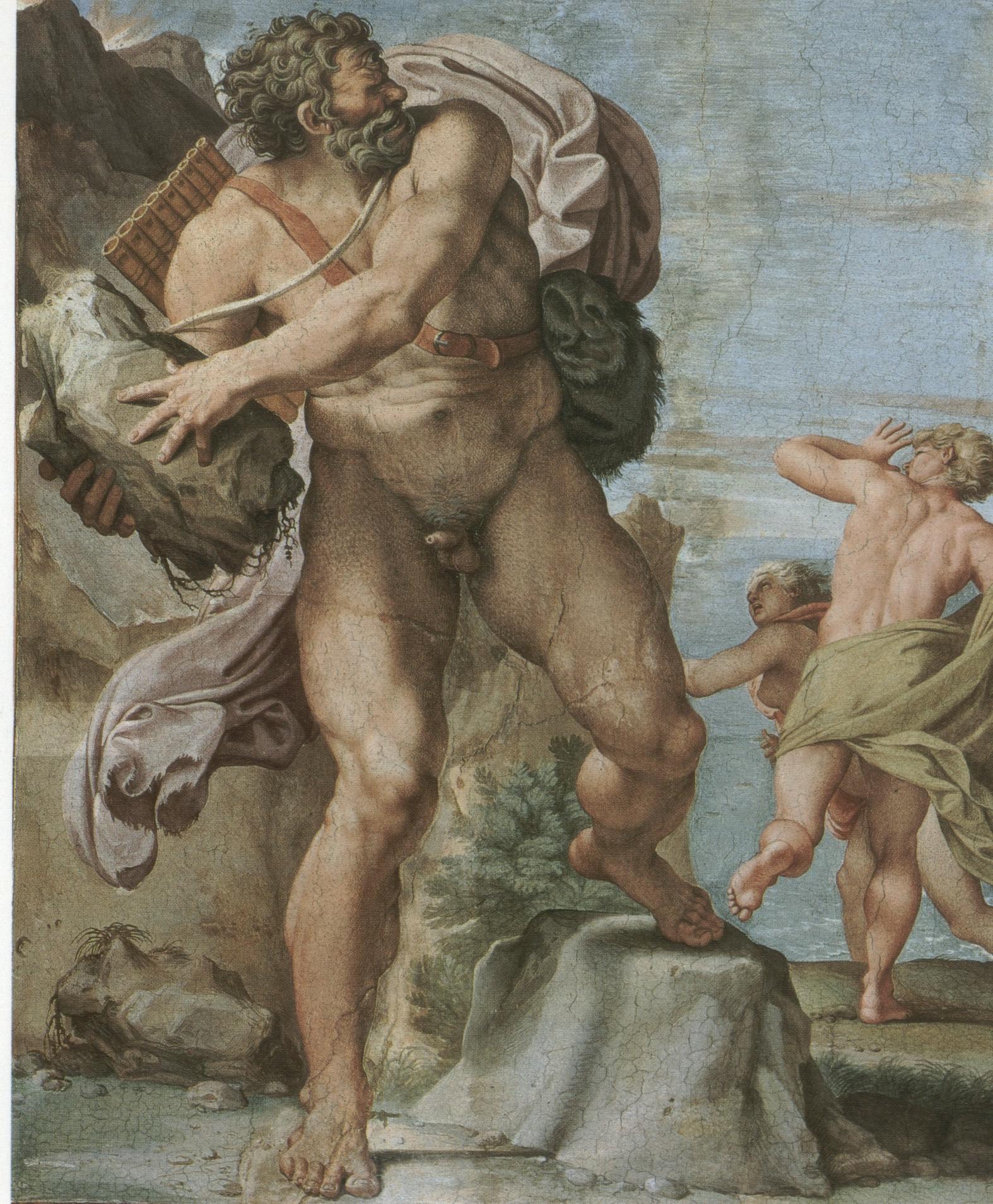
Pssst. Someone else throws things wicked far…(The Cyclops Polyphemus by Annibale Carracci)