Philology at Dinner: How I Began to Love Classics

“One should know a bit of philosophy – even at dinner!”

Oportet etiam inter cenandum philologiam nosse.

There are certain important moments or periods in one’s life – those discrimina rerum – in which one discovers a fondness for some pursuit in the world which appeals to their deepest sensibilities. When I was a young undergraduate, I fell into Classics after taking a Classical Literature in translation class. This was enough to push me down the august corridor of university learning to my Greek and Latin classes, but I don’t think that I had a conception yet of how much the study of antiquity would become a part of me. The Classics department (which has now been effaced and subsumed into a generalized ‘Humanities’ program) at my school was extremely small, and offered a course called Self-Paced Introductory Latin, which was in practice Self-Taught Introductory Latin. As I ground through declensions and conjugations, I remember hearing from my friend a story that one of the professors, Dr. Alessi, met once a night every week with a pair of retired ladies to read Latin while drinking wine and eating cheese. Perhaps because it sounded to my young ears like the pinnacle of refinement, or perhaps because it sounded so goddamn Classical, I remember feeling at that very instant the sincere wish that I were there at those meetings, those impenetrable mysteries of a cultured elite whose erudition I could aspire to but never achieve.

At the beginning of my second year in Latin, I had gone through all of Wheelock’s and even managed to read some of Seneca’s essays and a little bit of the Aeneid on my own. Because I had not really received much formal instruction at this point, I remember being shocked that the notes to the edition of Seneca were in Latin. In any event, I was qualified on this basis to sign up for a course which sent a tremor of simultaneous terror and excitement through my soul – Advanced Latin: Poetry. This was my first Latin course with Dr. Alessi, and I was one of only two students to take the course during my entire undergraduate career. (Though Johnny, who took the course with me in the fall of 2006, was only occasionally there for class during the semester, and never enrolled again.) That fall, we were set to read through selections from Ovid’s Metamorphoses, which is in many ways the perfect text to keep students motivated through the early period of advanced Latin reading, involving as it does innumerable consultations of the dictionary. (I will never forget the word squama, if only because I opened the dictionary so frequently to search for the adjective squamosus, only to find that I had forgotten it every time, no matter how much I thought that I knew this word.) Any time a textual or interpretive crux would arise, I would answer Dr. Alessi’s questions with the notes found in the commentary, eliciting his reply, “Ah, that’s very nice. It looks like our editor took Dr. Alessi’s Latin poetry class!”

About halfway through the semester, I was walking with Dr. Alessi to his office, when he said, “You know, I conduct a Latin reading group with a pair of retired women. We’re reading Cicero’s Pro Roscio and doing some prose composition. You could probably do it. If you’re interested.” I hardly needed to be asked twice, and found myself around the table in the most expensive house I had ever been in, on one of the ritziest parts of town, reading Latin with a retired doctor and a retired art teacher whose interest in Latin all began with their passion for calligraphy. I was only nineteen, and the warm acceptance which I received there only served further to inflame my ardor for what seemed to me the entry point for serious erudition and refinement. As a result, I got an extra dose of formal Latin instruction every week (these meetings off campus were actually something like three-hour seminars), and began to fall in love not just with the study itself, but with all of the external trappings of it – with the reception of Classics among people who were not even professional Classicists, but saw its value as an enduring part of the history and culture of the world.

The next semester, we read Ovid’s Ars Amatoria. In the following semester, we read Propertius, who was Dr. Alessi’s favorite. As a teacher myself, I realize now that one of the chief joys of the profession is the reward of transmitting your aesthetic tastes to a new generation. So, although many of my friends who know a thing or two about Classics are either wholly indifferent or openly hostile to Propertius, he is forever enshrined in my memory and my heart as my favorite of the Augustan elegists (yes, even above Ovid). Dr. Alessi told us that once you could read Propertius, you knew that you had really arrived in Latin. One day, I showed up to our weekly meeting having translated the wrong poem, and so had to render it at sight – so here, I felt, I had arrived.

In my final semester, we read Petronius’ Satyricon. Ostensibly, this should be one of the most popular of Latin works – it is funny, erudite, written in (mostly) clear Latin, and rendered in a style which we recognize as the form of our own modern novels. Yet, perhaps because so little of it survives, few people whom I know regularly cite it as among their favorite Latin works. Outside of Classics, few people (or at least, few who are not familiar with Fellini’s film) have ever heard of it. Yet it was The Satyricon which firmly fixed my love of Latin, and of Classics more generally, into the bedrock of my soul.

Trimalchio’s dinner is the largest surviving continuous segment of the novel, and while it appears at first glance like something of a simple satire upon the distasteful decadence and gauche absurdity of the freedman Trimalchio, it is at the same time a sort of loving tribute to Classical erudition. As the narrator, Encolpius, enters Trimalchio’s home, he observes some pictures:

“I began to ask the attendant in the atrium what pictures they had in the middle there, and he said, ‘The Iliad and the Odyssey, and the gladiatorial show of Laenas.”

Interrogare ergo atriensem coepi, quas in medio picturas haberent.” Iliada et Odyssian, inquit, ac Laenatis gladiatorium munus.”

There is of course a spoof on Trimalchio’s inclusion of a gladiatorial show next to images from those masterworks of literature, yet the passage nevertheless suggested to me how important the reception of these works was even in Petronius’ time. That is, it is one thing for us to think of these works as ‘classics’, yet they were classics even in the time of those whom we also regard as ‘classic.’ In a sense, this reinforced my sense that I was part of a long-continued tradition of reception and engagement with texts which had formed the backbone of a fascinating culture, whose reference points had been diffused through both space and time and maintained with relative consistency through countless generations. Trimalchio makes various blunders in his attempted display of erudition after he says that ‘one should engage in a bit of philology even at dinner,’ but it felt to me like the attempt to do so was immediately and directly appealing and worthwhile, even though Petronius mocked Trimalchio’s lack of success in it. Indeed, from the moment that Dr. Alessi first told me that Petronius’ function in Nero’s court was arbiter elegantiae, a kind of culture minister, I sensed myself transported with an enthusiasm for really making that culture a part of myself which I had not yet felt before. Until this point, Classics was an object of study and a possible career; after this, it became, for me, a life.

How different my life would now be had I not been invited to those reading dinners so many years ago! They are among my happiest memories of college life, and did so much to shape my own experience of the Classics and of my own conception of myself that I could scarcely imagine a life without them. The experience of reading The Satyricon in Latin, around a table, amply stocked with food and wine, in the company of lovely people who all got the joke and loved the culture, who happily invited me into their lives and into their home, was the pivotal point in my life which turned Classics into something far more than a set of museum busts, decaying ruins, and words not faithfully preserved in dusty tomes.

All of those days are gone now, and the feeling – the experience – could never be replicated. I am left with the joy which the memories give me, and the impact which those readings had on my life, but even my recollection of that time is hardly complete. It has become more fragmentary as I have now grown more than a decade distant from the experience, and in its fragmentation resembles the surviving text of The Satyricon itself – a series of disjointed episodes, existing only in my memory. Large chunks of that memory have perished forever, and what remains is but a loosely-organized set of recollected scraps which, though preserved for now, will one day be wholly lost to the sands of oblivion which have long since buried the rest of life’s text.”

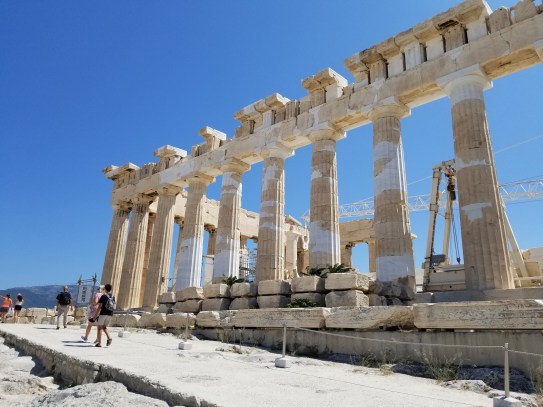
Image result for roman dinner fresco

Cicero Talks about Athens

Cicero, Brutus 26.7

“Greece is the witness to this because it was set aflame with a desire for eloquence and has surpassed in it and exceeded other places But Greece also has greater antiquity in all arts which it not only discovered but perfected because the power and abundance of speaking was developed by the Greeks. When I consider Greece, Atticus, your Athens occurs to me especially and shines out like a lighthouse. It is here that an orator first showed himself and here that oratory began to be entrusted to monuments and writings.”

vii. Testis est Graecia, quae cum eloquentiae studio sit incensa iamdiuque excellat in ea praestetque ceteris, tamen omnis artis vetustiores habet et multo ante non inventas solum sed etiam perfectas, quam haec est a Graecis elaborata dicendi vis atque copia. In quam cum intueor, maxime mihi occurrunt, Attice, et quasi lucent Athenae tuae, qua in urbe primum se orator extulit primumque etiam monumentis et litteris oratio est coepta mandari.


Cicero, Letters to Atticus, 5.10 27 (June 51)

“What else besides? Nothing really except for this. Athens has been a delight to me, when it comes to the city and its decoration and the love that its people show you, a certain kind of goodwill they have for us. But many things have been changed and philosophy is disordered this way and that. If there is anything left, it is Aristos’ and I am staying with him.

I left your, or rather ‘our’, friend Zeno to Quintus even though he is close enough that we are together the whole day. I wish that you will write me of your plans as soon as you can so I may know what you are doing and where you will be at which time and, especially, when you will be in Rome.

Quid est praeterea? nihil sane nisi illud: valde me Athenae delectarunt, urbe dumtaxat et urbis ornamento et hominum amore in te, in nos quadam benevolentia; sed mu<tata mu>lta.6 philosophia sursum deorsum. si quid est, est in Aristo, apud quem eram; nam Xenonem tuum vel nostrum potius Quinto concesseram, et tamen propter vicinitatem totos dies simul eramus. tu velim cum primum poteris tua consilia ad me scribas, ut sciam quid agas, ubi quoque tempore, maxime quando Romae futurus sis.


Cicero, Letters 6.1 20 Feb 50

“I wish you’d think about one thing also. I am hearing that Appius is building a gateway at Eleusis. Would we be fools if we made one at the Academia too? “I think so” you will answer. But, still, then—write this to me. I really do love Athens itself. I want there to be some memento in the city and I hate lying inscriptions on other’s statues. But do what pleases you. And let me know what day the Roman mysteries indicate and how the winter has been. Take care of yourself.”

Unum etiam velim cogites. audio Appium πρόπυλον Eleusine facere; num inepti fuerimus si nos quoque Aca<de>miae fecerimus? ‘puto’ inquies. ergo id ipsum scribes ad me. equidem valde ipsas Athenas amo; volo esse aliquod monumentum, odi falsas inscriptiones statuarum alienarum, sed ut tibi placebit, faciesque me in quem diem Romana incidant mysteria certiorem et quo modo hiemaris. cura ut valeas.

20180821_140514

Greek vs.Roman Speech

Plutarch, Life of Cato the Elder (12)

“He spent much of his time in Athens, and a certain speech of his is said to have been brought out, which he addressed to the city in Greek, being an eager fan of the virtue of the ancient Athenians, and having happily become an admirer of the city because of its beauty and greatness. This is not true; rather, he spoke through through an interpreter though he himself was able to address them in Greek, prefering to stick to his old ways and laughing at those who felt such wonder for Greek culture. He mocked Postumius Albinus for writing a history in Greek and asking for pardon on that account. Cato said that pardon should have been given to him if Albinus had persisted in the work under compulsion from the vote of the Amphictyonic Assembly. He said that the Athenians admired the speed and sharpness of his speech. Those things which he said with considerable brevity were rendered by the translator at length through many words. On the whole, he thought that the words of the Greeks came from their lips, but those of the Romans came from their hearts.”

Image result for cato the elder

πλεῖστον δὲ χρόνον ἐν ᾿Αθήναις διέτριψε, καὶ λέγεται μέν τις αὐτοῦ φέρεσθαι λόγος ὃν ῾Ελληνιστὶ πρὸς τὸν δῆμον εἶπεν, ὡς ζηλῶν τε τὴν ἀρετὴν τῶν παλαιῶν ᾿Αθηναίων, τῆς τε πόλεως διὰ τὸ κάλλος καὶ τὸ μέγεθος ἡδέως γεγονὼς θεατής· τοῦτο δ’ οὐκ ἀληθές ἐστιν, ἀλλὰ δι’ ἑρμηνέως ἐνέτυχε τοῖς ᾿Αθηναίοις, δυνηθεὶς ἂν αὐτὸς εἰπεῖν, ἐμμένων δὲ τοῖς πατρίοις καὶ καταγελῶν τῶν τὰ ῾Ελληνικὰ τεθαυμακότων. Ποστούμιον γοῦν ᾿Αλβῖνον ἱστορίαν ῾Ελληνιστὶ γράψαντα καὶ συγγνώμην αἰτούμενον ἐπέσκωψεν, εἰπὼν δοτέον εἶναι τὴν συγγνώμην, εἰ τῶν ᾿Αμφικτυόνων ψηφισαμένων ἀναγκασθεὶς ὑπέμεινε τὸ ἔργον. θαυμάσαι δέ φησι τοὺς ᾿Αθηναίους τὸ τάχος αὐτοῦ καὶ τὴν ὀξύτητα τῆς φράσεως· ἃ γὰρ αὐτὸς ἐξέφερε βραχέως, τὸν ἑρμηνέα μακρῶς καὶ διὰ πολλῶν ἀπαγγέλλειν· τὸ δ’ ὅλον οἴεσθαι τὰ ῥήματα τοῖς μὲν ῞Ελλησιν ἀπὸ χειλῶν, τοῖς δὲ ῾Ρωμαίοις ἀπὸ καρδίας φέρεσθαι.

Parenting While Teaching Greek Badly

This week Eidolon started a special series on “Parenting and Classics”. I thought about submitting a proposal when they put out a call for this subject, but I was too busy finishing a book and spending the waning days of summer with my children. When I read Donna Zuckerberg’s moving series of impressions of learning to be a parent and a writer in “This is How I have It All“, I remembered those earlier days of parenting with both fondness and frustration. And Jason Nethercut’s piece “Her Absence is Like the Sky”, reflecting on the loss of his mother, took me back to how I found comfort in reading and teaching the Odyssey after my father passed.

I am interested to see what others write in this series because my life has been defined over the past decade by being a parent and a Classicist. And, for me, there have been ways in which playing these two roles has made me better at both. I re-learned wonder and patience from parenting–so much so that students who had me before I became a father noted the difference in the way I paced classes and engaged with students.

I also think that what Eidolon is doing with this series is critical. As ‘scholars’ we often assume a falsely objective pose that denies we inhabit experiences and bodies which shape the way we see the world. Being a parent as a fact and a process shapes us critically as readers, writers and teachers. And classicists with children occupy a wide range of positions in the precarious academic economy.

Euripides, Supp. 1101-2

“Nothing is sweeter to an old father than a daughter”

πατρὶ δ᾽ οὐδὲν †ἥδιον† / γέροντι θυγατρός

I also hesitated to submit a proposal to Eidolon because I feel guilty about claiming much credit or authority for my story. I have been really lucky in my career and exceptionally fortunate to meet a life partner before graduate school who has been a constant and positive presence for over 20 years. Like most couples of our generation, my wife and I have a two-career household. One of us is a dentist and works year round, earning considerably more than the other. Dentistry is a physically demanding job; being a professor gets us good health insurance. On paper, this is a sweet deal.

In real life, however, we often face gendered questions about parenting from friends, family members, colleagues and our children’s teachers. Even though my wife is the one with the Ivy-league credentials and the social cache of being a ‘real’ doctor, expectations still weigh more heavily on her as a mother: she is expected to be the primary parent. But given the demands of our jobs and the eminently flexible schedule I have, this is not how it works.

Early on when our daughter was 2 months old or so, we had that conversation most couples do in the deep AM. It was definitely my wife’s turn to get up and tend to the infant. When I mentioned this, she said “if I am too tired when I go to work tomorrow and make a mistake, I can paralyze someone’s face. What’s the worst that you can do, teach Greek badly?”

One of the reasons I always found being a teacher attractive is that it is one of the few careers that lets us be parents. I always knew I wanted to have children and when I thought about other careers I couldn’t imagine that all of the sacrifice of time and human experience was worth the money they paid.

Euripides, Fr. 685 (Phaedra)

“Children are the anchors of a mother’s life”

ἀλλ’ εἰσὶ μητρὶ παῖδες ἄγκυραι βίου

As our children have grown older, parenting has been less about getting up in the middle of the night and more about actually thinking about how these little beings are developing. My own work as a classicist has been deeply affected by this process because it has led me to think more about cognitive development, education, and how the stories we tell shape us.

About a month ago my daughter (7, now 8) tried to jump from a dresser to a bed and missed. She lacerated her leg 5 inches long and down to the bone. The wound had trouble healing and it took almost four weeks and several visits with plastic surgeons to get it closed and all the stitches out

I told her the scar gives her character and told her the story of Odysseus and the boar, how the scar he won as a child became the marker of who he was and the beginning of his famous story.

I also told her that some people think that the Roman name Ulysses may be related to the Greek word for scar (oulê) and that who he is was tied to this mark on his body. Now she sees the scar as something that is uniquely hers as something that marks her out as special, as giving her her own story.

Arsenius 12.42a

“Whatever love you bear for your parents expect the same kind in old age from your children”

Οἵους ἂν ἐράνους ἐνέγκῃς τοῖς γονεῦσι, τούτους αὐτοὺς ἐν τῷ γήρᾳ παρὰ τῶν παίδων προσδέχου Πιττακοῦ.

It is hard to write about being a parent while being a classicist without also acknowledging the extent to which my ability to do so and my experience of doing so is marked by privilege. As a man, I get to be a parent without undergoing the primary physical and emotional labor of pregnancy and birth. I also avoid nearly all the secondary labor of recovery and social/emotional stigma of going back to work and not being an ideal mother. What has been clear to me for a long time has been backed up by research—men in the workplace earn social and economic capital from having children while women lose it. This is equally true in the University where men are expected to do less service and get more of a pass for attending to parenting.

The gendered structure of our society lingers with us individually and shapes our institutions. When I bring my children to a meeting or to a class, people smile and think what a good father I am. And I do often get questions about what my spouse is doing. Women in the same position, however, receive fewer smiles and rarely a question about why a partner is not available for childcare.

Euripides, Suppliant Women, 913-917

“For even an infant learns to speak
And listen to things he has no understanding of.
Whatever someone learns, he wants to save
For old age. So, teach your children well.”

..εἴπερ καὶ βρέφος διδάσκεται
λέγειν ἀκούειν θ᾿ ὧν μάθησιν οὐκ ἔχει.
ἃ δ᾿ ἂν μάθῃ τις, ταῦτα σῴζεσθαι φιλεῖ
ἐς γῆρας. οὕτω παῖδας εὖ παιδεύετε.

So, for me, talking about being a parent and a professor is over-determined. I ‘win’ if I talk about it; I win if I don’t. Yes, I am a primary caregiver; yes being a professor is mostly a full time job. But I am privileged again because I have never been outside the tenure track and was already in a secure position vis a vis tenure when we had our first child. I have had to be bad at my job at times to be an acceptable parent; I have often been a mediocre parent in order to be competent at my job. The two worlds I inhabit are always intersecting and overlapping. But this is the type of life I wanted.

In all the talk of the casualization of academic labor and the lives the majority of our PhDs are given to live, we do not acknowledge enough that there is a human cost in lives foreclosed. A generation of PhDs in precarious financial and social positions face difficult and sometimes impossible choices when it comes to starting and raising families.

Seneca, EM 3.3 (24)

“What you see happen to children happens to us, too, who are but slightly greater children.”

quod vides accidere pueris, hoc nobis quoque maiusculis pueris evenit.

I don’t really know where I meant to end up when I started writing this. I am really, really happy to be a parent and almost equally so to actually have a career as a classicist. I am often exhausted and I find myself sometimes anxious that I am not doing either thing equally well, but I know that my experiences in each have enriched my enjoyment of the other.

My lament is that we do not endeavor as a society and in the academy to ensure that everyone has the same opportunity to live both lives fully. There are hundreds of changes we as a society need to make, such as guaranteeing paid maternity leave (longer than 8 weeks by at least 42 more), providing universal health care, universal early childhood care for parents who choose to go to work, and universal pre-k nationwide. We cannot be a nation that cares about families while also legislating to punish (non-wealthy) people who choose to have them.

Many of these needs are outside our influence in the academy. But we can do more in our home institutions. We need more support for adjunct labor and graduate students who have families (or, let’s do away with adjunct labor in general and just pay college teachers living wages). We need childcare centers on all campuses for students, staff and faculty. We need to treat our staff with the same dignity we treat our faculty. We need to be models of the fully lived and enlightened lives we think the humanities can guide us to live.

Lucretius, De Rerum Natura 5.218-227

“Why does nature nourish and increase the races
of horrible beasts, enemies to humankind on land and sea?
Why do the seasons of the year bring diseases?
Why does an early death come suddenly?
So a child, just like a shipwrecked man tossed by savage waves,
lies naked and speechless on the ground needing everything required
to support life at the very moment when nature pours him
from his mother’s womb into the world of light,
he fills the room with a sorrowful wail, as if he knows
the measure of troubles that still remain for him to endure in life.”

praeterea genus horriferum natura ferarum
humanae genti infestum terraque marique
cur alit atque auget? cur anni tempora morbos
adportant? quare mors inmatura vagatur?
tum porro puer, ut saevis proiectus ab undis
navita, nudus humi iacet infans indigus omni
vitali auxilio, cum primum in luminis oras
nixibus ex alvo matris natura profudit,
vagituque locum lugubri complet, ut aequumst
cui tantum in vita restet transire malorum.

20180824_120552
Children make a new friend at Delphi Museum.

Marius Says: F**k Greek Literature!

Sallust, Bellum Iugurthinum (85)

[Marius speaking:]

“My words are not artfully chosen. I don’t give a shit about that. Virtue shows herself without any help. Only those who want to hide their shameful conduct with rhetoric have need of artifice. I also didn’t learn Greek literature: I had no desire to learn that, since it apparently never did anything to enhance the virtue of its teachers. Instead, I learned all about the things which do the best for the Republic: to assault the enemy, to move the defenses, to fear nothing except a bad reputation, to suffer summer blazes and winter frosts equally, to sleep on the ground, and to tolerate neediness and labor at the same time. I will exhort my soldiers with these precepts, but I will not coddle them with art, and I will make myself, not my glory, their work. This is useful, this is civic power. For, when you conduct the army safely through idle softness and drive it on with punishment, that is to be a master, not a general.”

Image result for marius roman general
John Vanderlyn, Marius Amid the Ruins of Carthage

Non sunt composita verba mea: parvi id facio. Ipsa se virtus satis ostendit; illis artificio opus est, ut turpia facta oratione tegant. Neque litteras Graecas didici: parum placebat eas discere, quippe quae ad virtutem doctoribus nihil profuerant. At illa multo optima rei publicae doctus sum: hostem ferire, praesidia agitare, nihil metuere nisi turpem famam, hiemem et aestatem iuxta pati, humi requiescere, eodem tempore inopiam et laborem tolerare. His ego praeceptis milites hortabor, neque illos arte colam, me opulenter, neque gloriam meam, laborem illorum faciam. Hoc est utile, hoc civile imperium. Namque cum tute per mollitiem agas, exercitum supplicio cogere, id est dominum, non imperatorem esse.

Caesarean Section: Thoughts on Reception and Teaching

Let me get into character – doing my best Ray Liotta – to tell you that as far back as I can remember, I always wanted to be a scholar. Though Henry Hill may have achieved his  mafioso dreams, I did not have the courage to pursue mine, and so in 2008 I had a lowly B.A. in Classics, a head full of preposterously impractical ideas, and an urgent need to secure gainful employment. You will not be surprised, then, to read that I found myself seated on the opposite side of the headmaster’s desk at a small private school, one of the chief resorts for unemployed Classics majors who would like to remain in some small way connected to the field. My interview with the headmaster went spectacularly well until she asked whether I was the sort of Latinist who read anything simply because it was written in Latin. Without hesitation, I responded that I avoided some large chunks of the surviving corpus, most especially Caesar, whom I would not even read in English.

Perhaps it is idle folly to wish for a different past, and perhaps I would have hated that job, which you may be sure was not offered to me. Indeed, my heroic Catonian stand against the Caesarean tyranny of the Latin prose canon could scarcely have earned me any points on the hiring ledger. Yet, for the longest time, I struggled with appreciating Caesar, whose writing literally put me to sleep on countless occasions.

A year or two later, a friend who did manage to secure a Latin teaching post told me that he was ‘savoring Caesar’s delicious prose.’ This was enough to make a man spew. But simultaneously, the judgment of generations of critics, culminating in the aesthetic pronouncements of a trusted friend, can at least be granted some consideration, and I began to wonder whether I was missing something. Of course, I did not follow up on this thought, and forgot about Caesar until I myself became a highschool teacher and was forced to teach him just as the students are forced to read him.

If we take Suetonius’ word for it, Cicero and other contemporaries admired Caesar’s prose style:

“Certainly, Cicero, in numbering the orators to Brutus, denied that he saw anyone to whom Caesar should yield, and he said that had an elegant, shining, and even magnificent and in some way noble mode of speaking. And he once wrote to Cornelius Nepos about Caesar: ‘What? What orator, among those who have done nothing but public speaking, would you place above Caesar? Who was sharper or more well-endowed in his phrases? Who was more ornate or more elegant in his words?”

Certe Cicero ad Brutum oratores enumerans negat se videre, cui debeat Caesar cedere, aitque eum elegantem, splendidam quoque atque etiam magnificam et generosam quodam modo rationem dicendi tenere; et ad Cornelium Nepotem de eodem ita scripsit: ‘quid? oratorem quem huic antepones eorum, qui nihil aliud egerunt? quis sententiis aut acutior aut crebrior? quis verbis aut ornatior aut elegantior?’

[Suetonius, Caesar 55]

Cicero seems to have supposed that Caesar would have been by far the greatest Latin writer had he not applied himself to other matters: capax scribendi nisi imperasset or something of the sort. Caesar seems to have been known for his wit as well, and Macrobius cites him for his popular stylistic advice:

“I would avoid an uncommon and unusual word as a sailor avoids the rocks.”

tamquam scopulum, sic fugiam infrequens atque insolens verbum

In this way, Caesar seems to resemble Samuel Johnson. Boswell’s Life of Johnson is replete with wit, pointed phrasing, and wonderful critical remarks which are much harder to find in Johnson’s own essays. When contrasted with his famous one liners and other assorted remarks, Johnson’s essays feel turgid and flat. Surely, some of this may be attributed to the shifting standards of prose fashion, but it is hard not to get the sense that the Johnsoniana are far better testaments to his genius than his considered prose. We have some scraps of Caesareana, but it is in some cases difficult to determine just how seriously to take this. A few of the best pieces are from Suetonius, as for example the quip about Sulla not knowing his ABC’s.

The high school teacher must take the man who butchered a nation and wrote a lucid prose account of it and make him appeal to teenagers. Naturally enough, they go in for the stories about his adultery and sensational murder, but all of this is external to the text itself. The opposite seems to be the case with Cicero. Students seem to love him until reading biographical details and Ciceroniana; they have much the same reaction as Petrarch, who was so saddened to discover from Cicero’s letters that he was just as petty as the rest of us. Similarly, they find that Caesar is just as boring as their teacher!

Yet, the cruel irony of all of this is that I myself have begun to enjoy reading Caesar, perhaps most of all because he is not the sort of author that I usually understand, sympathize with, or appreciate. As I begin my fourth year teaching AP Latin, I find that Caesar has at least substantially improved my knowledge of geography and ancient warfare. I recall having a similar experience when I first read the Odyssey in Greek and realized that I had no knowledge of nautical terminology. (I should note here that I have learned the English words, but have no idea what the English means. This is a state of ignorance with which I can feel reasonably content.)

My students know about my own history of Caesarean reception, if only because I would have them remember that we despise much of what we read when we are young, but this is simply a step in the development of a more refined judgment which, paradoxically, may embrace more as it advances. Never would I have re-crossed the Rubicon if not under compulsion. Few of my students keep up with their Latin immediately after graduation, and I would still hope that if they took Latin back up in middle age they would pick something a bit more lively than the world’s second most famous J.C. Yet, if they return at all, if they remember to keep revisiting those dusty and long-dismissed old codices, they may find that the cobwebs give way to a certain luster, and they may realize that the Elder Pliny was right when he said that no book was so bad that it didn’t have at least one good passage.

Image result for julius caesar
“We hated your book!”

Don’t Spend the Whole Day in Study

Quintilian, Institutio Oratoria 1.12:

“Therefore, since a teacher is unable and really ought not to take up the whole day, lest they turn away the learner’s mind with tedium, with what studies should we endow our free time? For, I would not have the student consumed in these arts: let them not dance or take up songs in musical modes, and let them not descend all the way to the most minute geometrical works. I do not make a comedian in pronunciation nor a dancer in movement. If I were to work through all of this, there was nevertheless plenty of time. The age suited to learning is long, and I am not speaking of slow intellects. Then why did excel in all of these things which I think should be learned by the future orator? He was not content with the studies which Athens was able to offer, and not content with the studies of the Pythagoreans, whom he had sailed to in Italy, he at last traveled even to the priests of Egypt, and learned their secret mysteries.”

Image result for quintilian

Ergo cum grammaticus totum diem occupare non possit, nec debeat ne discentis animum taedio avertat, quibus potius studiis haec temporum velut subsiciva donabimus? Nam nec ego consumi studentem in his artibus volo: nec moduletur aut musicis notis cantica excipiat, nec utique ad minutissima usque geometriae opera descendat; non comoedum in pronuntiando nec saltatorem in gestu facio. Quae si omnia exigerem, suppeditabat tamen tempus; longa est enim quae discit aetas, et ego non de tardis ingeniis loquor. Denique cur in his omnibus quae discenda oratori futuro puto eminuit Plato? Qui non contentus disciplinis quas praestare poterant Athenae, non Pythagoreorum, ad quos in Italiam navigaverat, Aegypti quoque sacerdotes adiit atque eorum arcana perdidicit.

The Athenians are Nice! (A Roman Writes From Athens)

Cicero, Letters to Atticus, 5.10 27 (June 51)

“What else besides? Nothing really except for this. Athens has been a delight to me, when it comes to the city and its decoration and the love that its people show you, a certain kind of goodwill they have for us. But many things have been changed and philosophy is disordered this way and that. If there is anything left, it is Aristos’ and I am staying with him.

I left your, or rather ‘our’, friend Zeno to Quintus even though he is close enough that we are together the whole day. I wish that you will write me of your plans as soon as you can so I may know what you are doing and where you will be at which time and, especially, when you will be in Rome.

Quid est praeterea? nihil sane nisi illud: valde me Athenae delectarunt, urbe dumtaxat et urbis ornamento et hominum amore in te, in nos quadam benevolentia; sed mu<tata mu>lta.6 philosophia sursum deorsum. si quid est, est in Aristo, apud quem eram; nam Xenonem tuum vel nostrum potius Quinto concesseram, et tamen propter vicinitatem totos dies simul eramus. tu velim cum primum poteris tua consilia ad me scribas, ut sciam quid agas, ubi quoque tempore, maxime quando Romae futurus sis.

Image result for Roman Athens
The Roman Agora

The Boots of Maximinus (Plus Some Disparaging Remarks on Tall People)

Erasmus, Adagia 1.1.21:

The boots of Maximinus is said commonly of those who are both coarse and rather tall. Julius Capitolinus relates this adage in his life of the emperor Maximinus, saying, ‘For since Maximinus was eight feet tall (nearly eight and a half), some people placed his shoes – that is, his military boots – in a grove which lies between Aquileia and Aritia (some read Arzia here, but others prefer Anagnia and Aritia), because it is agreed that it was in its track and measure greater than the foot of any human. From this fact the adage the boots of Maximinus is commonly drawn when talking about tall and bumbling people.’ So says Julius.

The proverb will therefore be more correctly employed if it be spoken with hatred or contempt, because that Maximinus (from whom the proverb is agreed to stem) was the most hateful both to the senate and the people of Rome, certainly because he was a native of Thrace, and of a lowly extraction, and finally because he was a man of barbarous and wild manners. Indeed, even now, it is common for people of outstanding height to hear poorly, as though they are careless and lazy.”

Image result for maximin emperor

Caliga Maximini (XXI)

Caliga Maximini vulgo dictitatum est in homines insulsos et immodicae proceritatis. Id adagii refert Julius Capitolinus in vita Maximini imperatoris Nam cum esset, inquiens, Maximinus pedum, ut diximus, octo et prope semis, calciamentum ejus, id est campagium regium, quidam in luco qui est inter Aquileiam et Aritiam, (Arziam legunt quidam, alii malunt inter Anagniam et Aritiam) posuerunt, quod constat pede majus fuisse hominis vestigio atque mensura. Unde etiam vulgo tractum est, cum de longis atque ineptis hominibus diceretur : Caliga Maximini. Hactenus Julius. Ergo proverbium rectius usurpabitur, si cum odio contemptuve dicatur, propterea quod is Maximinus (unde natum esse constat) invisissimus esset pariter et populo Romano et senatui, quippe Thrax natione, deinde sordido genere, postremo moribus barbaris ac feris. Quinetiam nunc homines insignitae proceritatis vulgo male audiunt, tanquam socordes atque inertes.

The Razor Against the Whetstone

Erasmus, Adagia, 1.1.20:

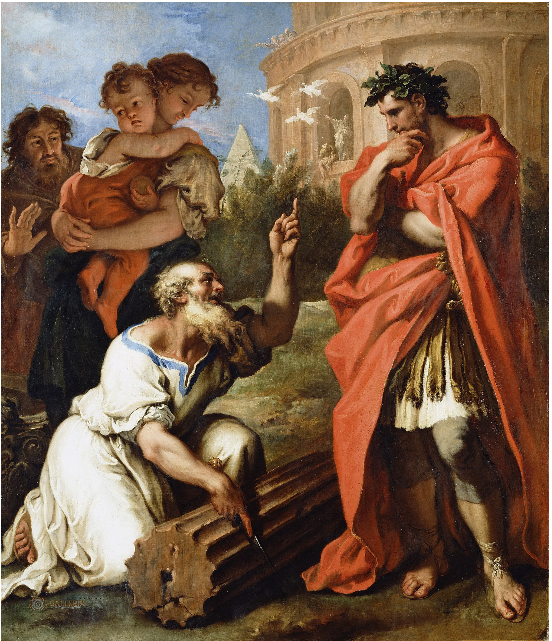
Ξυρὸς εἰς ἀκόνην, that is, the razor to the whetstone. This is usually said of those who have fallen by chance into those states of affairs which they did not desire. A razor is not able to fall more unfavorably than if it comes against the whetstone. The old saying of Horace is not dissimilar to this: ‘one seeking to slide his teeth against the coin ends up breaking them.’ This would be readily suited to one who, desirous of doing someone else harm finds someone by whom he is harmed in turn, and whom he cannot harm himself. Since indeed, a razor, if it run up against anything soft, cuts it apart; but if it runs against the whetstone, it is beaten back. Tarquinius considered this, when he said that he had in his mind that Actius Navius, the augur, would cut a whetstone with a razor, intending that the razor would have no power against the whetstone. Yet, the augur did what Tarquinius thought was impossible. Livy relates this in his first book.

Sebastiano Ricci, Tarquin the Elder consulting Attus Nevius the Augur

Novacula in cotem (XX)

Ξυρὸς εἰς ἀκόνην, id est Novacula in cotem. Dici solitum in hos, qui forte in eas res inciderunt, in quas minime volebant. Neque novacula potest incommodius cadere, quam si in cotem incurrat. Ab hoc non ita multum abhorret illud Horatianum : Et fragili quaerens illidere dentem / infringet solido. Recte accommodabitur et in eum, qui laedendi cupidus tandem hominem nactus est a quo vicissim laedatur, cum illi nocere non possit. Siquidem novacula, si in molle quippiam inciderit, dissecat ; si in cotem, retunditur. Huc respexit Tarquinus, qui dixit sibi in animo esse, ut Actius Navius augur novacula cotem discinderet, significans in cotem nihil posse novaculam, quanquam ab augure factum quod ille fieri posse non credebat. Refert Livius libro primo.