Stultifying Sentiments

Stultus, a, um -adj. “Foolish, simple, silly, fatuous”

Stultus, m. “a fool”

Publilius Syrus 451

“It is impossible for one who knows he is a fool not have some intelligence”

Non pote non sapere qui se stultum intellegit.

Dicta Catonis 18

“Be foolish when the time or the affair demands: sometimes to pretend foolishness is the greatest wisdom.”

Insipiens esto, cum tempus postulat aut res: stultitiam simulare loco, prudentia summa est.

Publilius Syrus 692

“Silence works as wisdom for a foolish person”

Taciturnitas stulto homini pro sapientia est.

Lucilius, 19.591

“Finally, nothing is enough for a fool even when he has everything”

Denique uti stulto nil sit satis, omnia cum sint

Publilius Syrus 144

“You make a criminal from a fool by forgiving too much”

Crebro ignoscendo facies de stulto improbum.

Seneca, EM 9.14 [Paraphrasing Chrysippus]

“A fool needs nothing since he knows how to use nothing but wants everything”

Contra stulto nulla re opus est, nulla enim re uti scit, sed omnibus eget

Publilius Syrus 118

“Contempt is harder on the wise than a beating is on a fool”

Contemni gravius est quam stulto percuti.

Macrobius, Saturnalia 1.10

“If someone who wants to buy a horse inspects not the horse itself but its saddle and bridle, he is a fool. Even more foolish is the one who thinks a person can be judged from his clothing or the chance that covers us like clothing.”

quemadmodum stultus est qui empturus equum non ipsum inspicit sed stratum eius ac frenos, sic stultissimus est qui hominem aut ex veste aut ex condicione quae nobis vestis modo circumdata est aestimandum putat.

Publilius Syrus 671

“Fortune makes whomever she wants to destroy into a fool”

Stultum facit Fortuna quem vult perdere

Seneca, EM 58

“Since the danger from living badly is greater than the danger of dying quickly, he is a fool who does not bet the price of a little time on a throw of great gain”

Et cum maius periculum sit male vivendi quam cito moriendi, stultus est, qui non exigua temporis mercede magnae rei aleam redimit.

Publilius Syrus 40

“The wise man rules his spirit, a fool serves his”

Animo imperabit sapiens, stultus serviet.

Ennius, Fr. 306

“It is a fool who, in desiring, desires desirously with a desirous mind.”

Stultus est qui cupida mente cupiens cupienter cupit


Image result for Medieval manuscript fool

Theological Controversy Against the Postal Service

Ammianus Marcellinus, Histories XXI:

“The bitterness of these times was increased by the insatiable rapacity of the suppliants who conferred upon Constantius more hatred than money. This seemed to many to be rather intolerable because he never heard a case nor had a care for the indemnity of the provinces when they were being vexed by the multiplied tributes and taxes.

Confounding the pure and simple Christian religion with the superstition of an old lady, Constantius excited many quarrels in scrutinizing this religion with more perplexity than settling it with authority, and he nursed these quarrels in a broader channel once they had developed through the idle wrangling of words. The result was that the various factions of theological opponents, rushing here and there on the public posts to their synods (as they call them) in an effort to bend every rite to their own judgment, nearly cut the sinews of the public transport.”

Augebat etiam amaritudinem temporum flagitatorum rapacitas inexpleta plus odiorum ei quam pecuniae conferentium. Hocque multis intolerantius videbatur, quod nec causam aliquando audivit nec provinciarum indemnitati prospexit, cum multiplicatis tributis et vectigalibus vexarentur. Eratque super his adimere facilis quae donabat.

Christianam religionem absolutam et simplicem anili superstitione confundens, in qua scrutanda perplexius quam conponenda gravius, excitavit discidia plurima, quae progressa fusius aluit concertatione verborum, ut catervis antistitum iumentis publicis ultro citroque discurrentibus per synodos, quas appellant, dum ritum omnem ad suum trahere conantur arbitrium, rei vehiculariae succideret nervos.

Plato’s Works: A Regular Spice Rack of Heresies

Tertullian, de Anima XXIII:

“In good faith, I grieve that Plato has become the spice merchant of all the heretics. You see in his Phaedo his souls going here and there. Just so, in the Timaeus, that the progeny of God, as they are about to give themselves to birth, receive an immortal soul and gird it round with a mortal body. Further, we read that this world is just the image of some other. In order to commend all of these things to our credulity, he has elaborated the argument that the soul in previous times had dealt with God and shared in the Ideas, from whence it then came here and re-learned those things which it previously knew by reviewing exempla. This idea was μαθήσεις ἀναμνήσεις, that is ‘memories as lessons.’ For he teaches that the souls coming here forget the circumstances in which they formerly existed, and then remember what they learned from these visible proofs. Since, then, those things which the heretics have adopted are bound up in this sort of argument from Plato, I will crush the argument of the heretics if I disprove the argument of Plato.”

https://images-na.ssl-images-amazon.com/images/I/A1GL5gZLB1L.jpg

Doleo bona fide Platonem omnium haereticorum condimentarium factum. Illius est enim et in Phaedone, quod animae hinc euntes sint illuc, et inde huc ; item in Timaeo, quod genimina dei delegata sibi mortalium genitura accepto initio animae immortali mortale ei circumgelauerint corpus; tum, quod mundus hic imago sit alterius alicuius. Quae omnia ut fidei commendet, et animam retro in superioribus cum deo egisse in commercio idearum et inde huc transuenire et hic quae retro norit de exemplaribus recensere, nouum elaborauit argumentum, μαθήσεις ἀναμνήσεις, id est discentias reminiscentias esse; uenientes enim inde huc animas obliuisci eorum in quibus prius fuerint, dehinc ex his uisibilibus edoctas recordari. Cum igitur huiusmodi argumento illa insinuentur a Platone quae haeretici mutuantur, satis haereticos repercutiam, si argumentum Platonis elidam

Who’s Your Favorite Historian, and Why Is It Tacitus?

Edward Gibbon, The Decline and Fall of the Roman Empire (XVI):

“Notwithstanding it is probable that Tacitus was born some years before the fire of Rome, he could derive only from reading and conversation the knowledge of an event which happened during his infancy. Before he gave himself to the public, he calmly waited till his genius had attained its full maturity, and he was more than forty years of age, when a grateful regard for the memory of the virtuous Agricola extorted from him the most early of those historical compositions which will delight and instruct the most distant posterity. After making a trial of his strength in the life of Agricola and the description of Germany, he conceived, and at length executed, a more arduous work; the history of Rome, in thirty books, from the fall of Nero to the accession of Nerva. The administration of Nerva introduced an age of justice and propriety, which Tacitus had destined for the occupation of his old age; but when he took a nearer view of his subject, judging, perhaps, that it was a more honorable or a less invidious office to record the vices of past tyrants, than to celebrate the virtues of a reigning monarch, he chose rather to relate, under the form of annals, the actions of the four immediate successors of Augustus.

To collect, to dispose, and to adorn a series of fourscore years, in an immortal work, every sentence of which is pregnant with the deepest observations and the most lively images, was an undertaking sufficient to exercise the genius of Tacitus himself during the greatest part of his life. In the last years of the reign of Trajan, whilst the victorious monarch extended the power of Rome beyond its ancient limits, the historian was describing, in the second and fourth books of his annals, the tyranny of Tiberius; and the emperor Hadrian must have succeeded to the throne, before Tacitus, in the regular prosecution of his work, could relate the fire of the capital, and the cruelty of Nero towards the unfortunate Christians. At the distance of sixty years, it was the duty of the annalist to adopt the narratives of contemporaries; but it was natural for the philosopher to indulge himself in the description of the origin, the progress, and the character of the new sect, not so much according to the knowledge or prejudices of the age of Nero, as according to those of the time of Hadrian. Tacitus very frequently trusts to the curiosity or reflection of his readers to supply those intermediate circumstances and ideas, which, in his extreme conciseness, he has thought proper to suppress.”

Historical Wallpapers: Great Fire of Rome (Magnum ...

A Marriage of Pity then Pride

Pliny, Letters 18.7-10

“This final testament is more praiseworthy because duty, trust, and shame have dictated it and because in it [Tullus] articulates his gratitude to all his relatives for their duty to him and especially to his wife. His most enduring wife has received the most charming homes, a great deal of money and probably deserved as much if not more from a husband she was criticized for even marrying.

For a woman of a famous family with pristine character—no longer young and long widowed with two children—seemed too indecorous in seeking marriage to a rich old man so deformed by sickness that he would even seemed disgusting even to a woman he had married when he was healthy and young. Since he was twisted and broken in every limb, he used to enjoy his great wealth with only his eyes and could move in bed without others. And this is foul and pitiable to add, his teeth had to be cleaned and washed for him. It was often heard from him—when he was complaining about the insults of his condition—that he licked the fingers of his own slaves each day.

Still, he was alive and he wanted to live with his wife’s help mostly, someone whose perseverance turned the ‘mistake’ of her criticized marriage into an object of renown.”

Quo laudabilius testamentum est, quod pietas fides pudor scripsit, in quo denique omnibus adfinitatibus pro cuiusque officio gratia relata est, relata et uxori. Accepit amoenissimas villas, accepit magnam pecuniam uxor optima et patientissima ac tanto melius de viro merita, quanto magis est reprehensa quod nupsit.

Nam mulier natalibus clara, moribus proba, aetate declivis, diu vidua mater olim, parum decore secuta matrimonium videbatur divitis senis ita perditi morbo, ut esse taedio posset uxori, quam iuvenis sanusque duxisset. Quippe omnibus membris extortus et fractus, tantas opes solis oculis obibat, ac ne in lectulo quidem nisi ab aliis movebatur; quin etiam (foedum miserandumque dictu) dentes lavandos fricandosque praebebat. Auditum frequenter ex ipso, cum quereretur de contumeliis debilitatis suae, digitos se servorum suorum cotidie lingere. Vivebat tamen et vivere volebat, sustentante maxime uxore, quae culpam incohati mat/rimonii in gloriam perseverantia verterat.

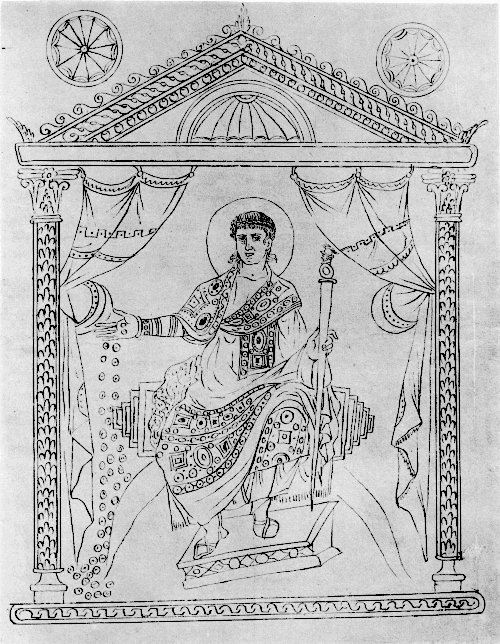
 Codices vindobonenses 2759-2764 in the Osterreichischen Nationalbibliothek, in Vienna, Austria

Paganism Is Out!

Edward Gibbon, The Decline and Fall of the Roman Empire (Chp. XV):

“When Christianity appeared in the world, even these faint and imperfect impressions had lost much of their original power. Human reason, which by its unassisted strength is incapable of perceiving the mysteries of faith, had already obtained an easy triumph over the folly of Paganism; and when Tertullian or Lactantius employ their labors in exposing its falsehood and extravagance, they are obliged to transcribe the eloquence of Cicero or the wit of Lucian. The contagion of these sceptical writings had been diffused far beyond the number of their readers. The fashion of incredulity was communicated from the philosopher to the man of pleasure or business, from the noble to the plebeian, and from the master to the menial slave who waited at his table, and who eagerly listened to the freedom of his conversation. On public occasions the philosophic part of mankind affected to treat with respect and decency the religious institutions of their country; but their secret contempt penetrated through the thin and awkward disguise; and even the people, when they discovered that their deities were rejected and derided by those whose rank or understanding they were accustomed to reverence, were filled with doubts and apprehensions concerning the truth of those doctrines, to which they had yielded the most implicit belief.

The decline of ancient prejudice exposed a very numerous portion of human kind to the danger of a painful and comfortless situation. A state of scepticism and suspense may amuse a few inquisitive minds. But the practice of superstition is so congenial to the multitude, that if they are forcibly awakened, they still regret the loss of their pleasing vision. Their love of the marvellous and supernatural, their curiosity with regard to future events, and their strong propensity to extend their hopes and fears beyond the limits of the visible world, were the principal causes which favored the establishment of Polytheism. So urgent on the vulgar is the necessity of believing, that the fall of any system of mythology will most probably be succeeded by the introduction of some other mode of superstition. Some deities of a more recent and fashionable cast might soon have occupied the deserted temples of Jupiter and Apollo, if, in the decisive moment, the wisdom of Providence had not interposed a genuine revelation, fitted to inspire the most rational esteem and conviction, whilst, at the same time, it was adorned with all that could attract the curiosity, the wonder, and the veneration of the people. In their actual disposition, as many were almost disengaged from their artificial prejudices, but equally susceptible and desirous of a devout attachment; an object much less deserving would have been sufficient to fill the vacant place in their hearts, and to gratify the uncertain eagerness of their passions. Those who are inclined to pursue this reflection, instead of viewing with astonishment the rapid progress of Christianity, will perhaps be surprised that its success was not still more rapid and still more universal. It has been observed, with truth as well as propriety, that the conquests of Rome prepared and facilitated those of Christianity.”

https://i.pinimg.com/736x/ec/ab/5b/ecab5b77faef42b1c9d946d62eed2652.jpg

F**k Shaving, and F**k the Theater Too!

Tertullian, de Spectaculis (23):

“Since human memory, even while the charm of pleasure still lingers, considers that those people should be condemned onto the crag of infamy with all of their honors taken away, how much more savagely would divine justice take notice of artificers of that sort? Will God be pleased by that charioteer, the man who stirs up so many souls, that minister of so much madness, crowned like a priest or painted like a pimp, whom the devil decked out to be taken by a chariot against Elijah? Will God be pleased by the man who alters his countenance with the razor, an infidel to his own face, who – not content to make it look like the face of Saturn and Isis and Bacchus – subjects it to the abuse of beating, as if he were making fun of the order of our Lord? To be sure, the devil teaches us to patiently offer our jaw to this abuse. Thus, too, he elevated the tragic actors upon their boots, because ‘no one is able to add a cubit to his height.’ He wishes to make Christ a liar. Indeed, I ask whether the creation of actors’ masks pleases God, who prohibits the making of any likeness – how much more the likeness of his own image? The author of truth does not love falsehood. Every fiction is like adultery to him.”

https://i.pinimg.com/originals/b4/3d/6a/b43d6ab2c4da663c27f89aec349ad65f.jpg
Consider shaving!

cum igitur humana recordatio etiam obstrepente gratia voluptatis damnandos eos censeat ademtis bonis dignitatum in quendam scopulum famositatis, quanto magis divina iustitia in eiusmodi artifices animadvertit? an deo placebit auriga ille tot animarum inquietator, tot furiarum minister, ut sacerdos coronatus vel coloratus ut leno, quem curru rapiendum diabolus adversus Elian exornavit? placebit et ille, qui voltus suos novacula mutat, infidelis erga faciem suam, quam non contentus Saturno et Isidi et Libero proximam facere insuper contumeliis alaparum sic obicit, tamquam de praecepto domini ludat? docet scilicet et diabolus verberandam maxillam patienter offerre. sic et tragoedos cothurnis extulit, quia “nemo potest adicere cubitum unum ad staturam suam”: mendacem facere vult Christum. iam vero ipsum opus personarum quaero an deo placeat, qui omnem similitudinem vetat fieri, quanto magis imaginis suae? non amat falsum auctor veritatis; adulterium est apud illum omne quod fingitur.

Domitian, Ovid, Lucan and Friends: Quintilian With Some World-Class Shade

Quintilian, Inst. Orat. 10.1

“Atacinus Varro acquired his name as a translator of other’s work—he certainly shouldn’t be dismissed, but in truth he has little to commend for improving an ability in speaking. Ennius, we should adore as we would groves sacred with age whose ancient trees have less beauty than they have religious awe. Others are closer to this time and are more useful for our subject. Ovid is certainly indulgent in his epic verse and too in love with his own genius, but still should be praised for some things. Cornelius Severus, moreover, even if he was a better metrician than a poet, still would have claimed second place for himself if he had finished his Sicilian War to the standard of his first book.

An early death kept Serranus from reaching his potential, yet his youthful works demonstrate special ability and a desire for correct form that is especially admirable in one so young. We recently lost a lot in Valerius Flaccus. Saleius  Bassus had a forceful poetic ability—it did not improve with age. Rabirius and Pedo are worth a read, if you have extra time. Lucan is forceful, intense, and famous for his quotability, but, if I may say what I really think, a model more for orators than poets.

I am listing these authors because care for the lands of the earth has distracted Germanicus Augustus [Domitian] from the pursuits he began—it seemed insufficient to the gods that he be the greatest of poets. But, still, what could appear more sublime, more learned, and more outstanding by every account than the works of this young man who put the empire aside? Who could sing of wars better than the one who wages them in this way? Whom would the deities of these arts heed more closely? To whom would Minerva more easily unveil her own arts? Future generations will explain these things more fully, for now this praise is constrained by the glare of his other virtues.”

Atacinus Varro in iis per quae nomen est adsecutus interpres operis alieni, non spernendus quidem, verum ad augendam facultatem dicendi parum locuples. Ennium sicut sacros vetustate lucos adoremus, in quibus grandia et antiqua robora iam non tantam habent speciem quantam religionem. Propiores alii atque ad hoc de quo loquimur magis utiles. Lascivus quidem in herois quoque Ovidius et nimium amator ingenii sui, laudandus tamen partibus. Cornelius autem Severus, etiam si sit versificator quam poeta melior, si tamen (ut est dictum) ad exemplar primi libri bellum Siculum perscripsisset, vindicaret sibi iure secundum locum. Serranum consummari mors inmatura non passa est, puerilia tamen eius opera et maximam indolem ostendunt et admirabilem praecipue in aetate illa recti generis voluntatem. Multum in Valerio Flacco nuper amisimus. Vehemens et poeticum ingenium Salei Bassi fuit, nec ipsum senectute maturuit. Rabirius ac Pedo non indigni cognitione, si vacet. Lucanus ardens et concitatus et sententiis clarissimus et, ut dicam quod sentio, magis oratoribus quam poetis imitandus. Hos nominamus quia Germanicum Augustum ab institutis studiis deflexit cura terrarum, parumque dis visum est esse eum maximum poetarum. Quid tamen his ipsis eius operibus in quae donato imperio iuvenis secesserat sublimius, doctius, omnibus denique numeris praestantius? Quis enim caneret bella melius quam qui sic gerit? Quem praesidentes studiis deae propius audirent? Cui magis suas artis aperiret familiare numen Minerva?  Dicent haec plenius futura saecula, nunc enim ceterarum fulgore virtutum laus ista praestringitur. Nos tamen sacra litterarum colentis feres, Caesar, si non tacitum hoc praeterimus et Vergiliano certe versu testamur


Image result for Ancient Roman Domitian

“I Liked Book Six Before It Was Mainstream”

Edward Gibbon, Memoirs of My Life:

“My next publication was an accidental sally of love and resentment; of my reverence for modest genius, and my aversion for insolent pedantry. The sixth book of the Aeneid is the most pleasing and perfect composition of Latin poetry. The descent of Aeneas and the Sibyl to the infernal regions, to the world of spirits, expands an awful and boundless prospect, from the nocturnal gloom of the Cumaean grot,

          Ibant obscuri sola sub nocte per umbram,

to the meridian brightness of the Elysian fields;

          Largior hic campos aether et lumine vestit

          Purpureo

from the dreams of simple Nature, to the dreams, alas! of Egyptian theology, and the philosophy of the Greeks. But the final dismission of the hero through the ivory gate, whence

          Falsa ad coelum mittunt insomnia manes,

seems to dissolve the whole enchantment, and leaves the reader in a state of cold and anxious scepticism. This most lame and impotent conclusion has been variously imputed to the taste or irreligion of Virgil; but, according to the more elaborate interpretation of Bishop Warburton, the descent to hell is not a false, but a mimic scene; which represents the initiation of Aeneas, in the character of a law-giver, to the Eleusinian mysteries. This hypothesis, a singular chapter in the Divine Legation of Moses, had been admitted by many as true; it was praised by all as ingenious; nor had it been exposed, in a space of thirty years, to a fair and critical discussion. The learning and the abilities of the author had raised him to a just eminence; but he reigned the dictator and tyrant of the world of literature. The real merit of Warburton was degraded by the pride and presumption with which he pronounced his infallible decrees; in his polemic writings he lashed his antagonists without mercy or moderation; and his servile flatterers, (see the base and malignant Essay on the Delicacy of Friendship,) exalting the master critic far above Aristotle and Longinus, assaulted every modest dissenter who refused to consult the oracle, and to adore the idol. In a land of liberty, such despotism must provoke a general opposition, and the zeal of opposition is seldom candid or impartial.

A late professor of Oxford, (Dr. Lowth,) in a pointed and polished epistle, (Aug. 31, 1765,) defended himself, and attacked the Bishop; and, whatsoever might be the merits of an insignificant controversy, his victory was clearly established by the silent confusion of Warburton and his slaves. I too, without any private offence, was ambitious of breaking a lance against the giant’s shield; and in the beginning of the year 1770, my Critical Observations on the Sixth Book of the Aeneid were sent, without my name, to the press. In this short Essay, my first English publication, I aimed my strokes against the person and the hypothesis of Bishop Warburton. I proved, at least to my own satisfaction, that the ancient lawgivers did not invent the mysteries, and that Aeneas was never invested with the office of lawgiver: that there is not any argument, any circumstance, which can melt a fable into allegory, or remove the scene from the Lake Avernus to the Temple of Ceres: that such a wild supposition is equally injurious to the poet and the man: that if Virgil was not initiated he could not, if he were, he would not, reveal the secrets of the initiation: that the anathema of Horace (vetabo qui Cereris sacrum vulgarit, &c.) at once attests his own ignorance and the innocence of his friend.

As the Bishop of Gloucester and his party maintained a discreet silence, my critical disquisition was soon lost among the pamphlets of the day; but the public coldness was overbalanced to my feelings by the weighty approbation of the last and best editor of Virgil, Professor Heyne of Gottingen, who acquiesces in my confutation, and styles the unknown author, doctus – – – et elegantissimus Britannus. But I cannot resist the temptation of transcribing the favourable judgment of Mr. Hayley, himself a poet and a scholar ‘An intricate hypothesis, twisted into a long and laboured chain of quotation and argument, the Dissertation on the Sixth Book of Virgil, remained some time unrefuted. – – – At length, a superior, but anonymous, critic arose, who, in one of the most judicious and spirited essays that our nation has produced, on a point of classical literature, completely overturned this ill-founded edifice, and exposed the arrogance and futility of its assuming architect.’ He even condescends to justify an acrimony of style, which had been gently blamed by the more unbiassed German; ‘Paullo acrius quam velis – – – perstrinxit.’ But I cannot forgive myself the contemptuous treatment of a span who, with all his faults, was entitled to my esteem; and I can less forgive, in a personal attack, the cowardly concealment of my name and character.”

https://www.commonwealmagazine.org/sites/default/files/styles/article_full/public/mcnamara.jpg?itok=CUY92ocA

Pliny the Elder on The Greatest Happiness

Pliny the Elder, Natural History 35.9-12

“It would be wrong to ignore the new invention in which, if not from gold then surely from bronze, images of those immortal spirits are set up in libraries, or even more those who did not exist are given shape and they produce glances which are not traditional, as has happened with Homer. As it goes though, I believe that there is no greater kind of happiness than if everyone should forever desire to know what kind of person someone was.

In Rome this was the innovation of Asinius Pollio who first established a library by declaring works of genius a public good. Whether they kinds of Alexandria or Pergamum began this earlier—those men who built their libraries in a great contest—I couldn’t decide easily. But that friend of Cicero, Atticus, is a witness that a certain passion for images burned in earlier days in the volume he published on the topic…

Non est praetereundum et novicium inventum, siquidem non ex auro argentove, at  certe ex aere in bibliothecis dicantur illis, quorum immortales animae in locis iisdem loquuntur, quin immo etiam quae non sunt finguntur, pariuntque desideria non traditos vultus, sicut in Homero evenit. utique maius, ut equidem arbitror, nullum est felicitatis specimen quam semper omnes scire cupere, qualis fuerit aliquis. Asini Pollionis hoc Romae inventum, qui primus bibliothecam dicando ingenia hominum rem publicam fecit. an priores coeperint Alexandreae et Pergami reges, qui bibliothecas magno certamine instituere, non facile dixerim. imaginum amorem flagrasse quondam testes sunt Atticus ille Ciceronis edito de iis volumine…

Image result for Roman imagines
Pssst…Do you want to know what we were like?