Apropos of Nothing, Achilles Calls the Commander-in-Chief a Dog[-face]

Homer, Iliad 1.158–168 [Achilles addressing Agamemnon]

“But, you great shamepot, we follow you so that you feel joy,
As we collect honor for Menelaos and you, dog-face,
From the Trojans—you don’t shudder at this, you don’t care.”

ἀλλὰ σοὶ ὦ μέγ’ ἀναιδὲς ἅμ’ ἑσπόμεθ’ ὄφρα σὺ χαίρῃς,
τιμὴν ἀρνύμενοι Μενελάῳ σοί τε κυνῶπα
πρὸς Τρώων· τῶν οὔ τι μετατρέπῃ οὐδ’ ἀλεγίζεις·

Iliad 1.224–228 [Achilles Addressing Agamemnon]

“Wine-sod! Dog-eyes! You have the heart of a deer!
You never suffer to arm yourself to enter battle with the army
Nor to set an ambush with the best of the Achaeans.
That seems like death itself to you!”

οἰνοβαρές, κυνὸς ὄμματ’ ἔχων, κραδίην δ’ ἐλάφοιο,
οὔτέ ποτ’ ἐς πόλεμον ἅμα λαῷ θωρηχθῆναι
οὔτε λόχον δ’ ἰέναι σὺν ἀριστήεσσιν ᾿Αχαιῶν
τέτληκας θυμῷ· τὸ δέ τοι κὴρ εἴδεται εἶναι.

Elsewhere in Homer, the insult is used primarily for women and it builds on basic Greek associations between women and dogs—dogs as animals of shame who are expected to be loyal.

Odyssey 4.154-146 [Helen speaking]

“…Telemachus, whom that man left when he was just born,
In his house, when the Achaeans went down to Troy
On account of dog-faced me, raising up their audacious war.”

Τηλεμάχῳ, τὸν ἔλειπε νέον γεγαῶτ’ ἐνὶ οἴκῳ
κεῖνος ἀνήρ, ὅτ’ ἐμεῖο κυνώπιδος εἵνεκ’ ᾿Αχαιοὶ
ἤλθεθ’ ὑπὸ Τροίην, πόλεμον θρασὺν ὁρμαίνοντες.”

Odyssey, 11.424-426

“…that dog-face
Went away and did not dare—even though I was on my way to Hades
To close my eyes with her hands or cover my mouth.”

… ἡ δὲ κυνῶπις
νοσφίσατ’ οὐδέ μοι ἔτλη, ἰόντι περ εἰς ᾿Αΐδαο,
χερσὶ κατ’ ὀφθαλμοὺς ἑλέειν σύν τε στόμ’ ἐρεῖσαι.

In Greek myth , the ‘dog’ nature of women comes as well from forces outside the home—a dog is a thieving creature.

Hesiod, Works and Days 67–68 [from the creation of Pandora]

“And Hermes, the slayer of Argos, that master guide,
Ordered that she possess a dog’s mind and a thief’s nature.”

ἐν δὲ θέμεν κύνεόν τε νόον καὶ ἐπίκλοπον ἦθος
῾Ερμείην ἤνωγε, διάκτορον ᾿Αργεϊφόντην.

But in the crown jewel of Greek mythology, Semonides’ “Diatribe against women”—which presents a lists of complaints about women categorized by different kinds of animals—emphasizes the inability of men to control female voices through the symbol of a dog. Note, as well, that violence is described as a regular reaction but is considered useless.

Semonides of Amorgos, fragment 7

“One women is from a dog, a sinful beast, a thorough mother—
She listens to everything and wants to know everything,
Lurking around everywhere and wandering
She barks even when she doesn’t see anyone.
She can’t stop this, not even if her husband threatens her
Nor if he is angry enough to bash her teeth
With a stone. You can’t change her by talking nicely either.
Even when she happens to be sitting among guests,
She keeps on an endless, impossible yapping.”

τὴν δ’ ἐκ κυνός, λιτοργόν, αὐτομήτορα,
ἣ πάντ’ ἀκοῦσαι, πάντα δ’ εἰδέναι θέλει,
πάντηι δὲ παπταίνουσα καὶ πλανωμένη
λέληκεν, ἢν καὶ μηδέν’ ἀνθρώπων ὁρᾶι.
παύσειε δ’ ἄν μιν οὔτ’ ἀπειλήσας ἀνήρ,
οὐδ’ εἰ χολωθεὶς ἐξαράξειεν λίθωι
ὀδόντας, οὐδ’ ἂν μειλίχως μυθεόμενος,
οὐδ’ εἰ παρὰ ξείνοισιν ἡμένη τύχηι,
ἀλλ’ ἐμπέδως ἄπρηκτον αὑονὴν ἔχει.

Franco, Cristina. 2014. Shameless: The Canine and the Feminine in Ancient Greece. Translated by Michael Fox. Berkeley and Los Angeles.

4: “In the ancient Greek imagination the figure of the dog seems, in fact, to be interwoven with the disparaging discourse on the nature of woman in afar from casual manner…Moreover, the dog appears as a paradigm for the base nature of women in two cornerstone texts of Greek misogyny” (referring to the creation of Pandora in Hesiod and Agamemnon’s comments on Clytemnestra in the Odyssey).

See also:

Graver, Margaret. 1995. “Dog-Helen and Homeric Insult.” Classical Antiquity 14: 41–61.

Pyxis with Bust of a Dog. 1931: bequeathed to Walters Art Museum by Henry Walters


Cato’s Radical Tax Plan

From Plutarch’s Life of Marcus Cato 18

“He also levied a tax of three on every thousand so that people, distressed by these charges, would note that families of equal wealth whose lives were modest and simple paid less to the public treasury and so repent from their behavior.

Both those who paid the taxes because of luxury and those who gave up their luxury because of the taxes were angry with him. For most people believe that hindering the display of their wealth deprives them of it and also that the display comes from their luxuries not their necessities.

This is what they say really surprised Ariston the philosopher, that those who possess superficial excess are thought to be luckier than those who are well-supplied with what is needed and useful.”

 καὶ προσετίμησε τρεῖς χαλκοῦς πρὸς τοῖς χιλίοις, ὅπως βαρυνόμενοι ταῖς ἐπιβολαῖς καὶ τοὺς εὐσταλεῖς καὶ λιτοὺς ὁρῶντες ἀπὸ τῶν ἴσων ἐλάττονα τελοῦντας εἰς τὸ δημόσιον ἀπαγορεύωσιν. ἦσαν οὖν αὐτῷ χαλεποὶ μὲν οἱ τὰς εἰσφορὰς διὰ τὴν τρυφὴν ὑπομένοντες, χαλεποὶ δ᾿ αὖ πάλιν οἱ τὴν τρυφὴν ἀποτιθέμενοι διὰ τὰς εἰσφοράς. πλούτου γὰρ ἀφαίρεσιν οἱ πολλοὶ νομίζουσι τὴν κώλυσιν αὐτοῦ τῆς ἐπιδείξεως, ἐπιδείκνυσθαι δὲ τοῖς περιττοῖς, οὐ τοῖς ἀναγκαίοις. ὃ δὴ καὶ μάλιστά φασι τὸν φιλόσοφον Ἀρίστωνα θαυμάζειν, ὅτι τοὺς τὰ περιττὰ κεκτημένους μᾶλλον ἡγοῦνται μακαρίους ἢ τοὺς τῶν ἀναγκαίων καὶ χρησίμων εὐποροῦντας.

Photographed By Robin Maggs – National Museum Wales
2013


A Solid Gold Colossus: Why Tyrants Spend Other Peoples’ Money

Suda,  Κυψελιδῶν ἀνάθημα

At Olympia. Plato claims in the Phaedrus that a metal Colossos was set up next to the dedication of the Kypselids at Olympia. But they claim that this from Kypselos himself and not the Kypselids. Agaklutos speaks about this in his On Olympia. “An ancient temple of Hera, dedicated by the Skillians. Those people are Eleians. Inside the temple is a gold colossus, a dedication from Kypselos of Korinth. For people say that Kypselos promised that if he should become tyrant of the Korinthians, then he would make everyone’s property sacred for ten years. Once he collected the taxes from this sacred assessment, he had the metal colossus created.”

Didymos, however, reports that Periander, his son, had the colossus made to restrain the luxury and audacity of the Korinthians. Theophrastus also reports in the second book of his Magic Moments, “while others spend funds on more masculine affairs, like raising an army and conquering enemies, as Dionysius the tyrant did. For he believed that it was necessary not only to waste others’ money but also his own in order to make sure that there would be no funds for plots against him. The pyramids of Egypt and the colossus of the Kypselids and all those kinds of things have similar or identical designs.

It is also reported that there was an an epigram on the colossus: “If I am not a colossus made of gold / then may the race of the Kypselids be wiped away.”

Apellas of Pontos, however, claims that he inscription was, “If I am not a solid-cold Colossus, may the race of Kypselids be completely destroyed”

ἐν ᾽Ολυμπίαι. Πλάτων ἐν Φαίδρωι (236 B)· παρὰ τὸ Κυψελιδῶν ἀνάθημα σφυρήλατος ἐν ᾽Ολυμπίαι ἐστάθη κολοσσός. ἀλλ᾽ οὐ τῶν Κυψελιδῶν, Κυψέλου δέ φασι τὸ ἀνάθημα, ὡς ᾽Αγάκλυτος ἐν τῶι Περὶ ᾽Ολυμπίας φησὶν οὕτως· «ναὸς τῆς ῞Ηρας παλαιός, ἀνάθημα Σκιλλουντίων· οὗτοι δέ εἰσιν ᾽Ηλείων. ἔνεστι δὲ ἐν αὐτῶι χρυσοῦς κολοσσός, ἀνάθημα Κυψέλου τοῦ Κορινθίου· φασὶ γὰρ τὸν Κύψελον εὐξάμενον, εἰ Κορινθίων τυραννεύσειε, τὰς οὐσίας πάντων εἰς δέκατον ἔτος ἀνιερώσειν, τὰς δεκάτας τῶν τιμημάτων εἰσπραξάμενον, κατασκευάσαι τὸν σφυρήλατον κολοσσόν».

Δίδυμος δὲ κατασκευάσαι τὸν κολοσσόν φησι Περίανδρον ὑπὲρ τοῦ τῆς τρυφῆς καὶ τοῦ θράσους ἐπισχεῖν τοὺς Κορινθίους· καὶ γὰρ Θεόφραστος ἐν τῶι Περὶ καιρῶν β̄ λέγει οὕτω· «ἕτεροι δὲ εἰς ἀνδρωδέστερα καταδαπανῶντες, οἷον στρατείας ἐξάγοντες καὶ πολέμους ἐπαναιρούμενοι, καθάπερ καὶ Διονύσιος ὁ τύραννος· ἐκεῖνος γὰρ οὐ μόνον ὤιετο δεῖν τὰ τῶν ἄλλων καταναλίσκειν ἀλλὰ καὶ τὰ αὑτοῦ πρὸς τὸ μὴ ὑπάρχειν ἐφόδια τοῖς ἐπιβουλεύουσιν· ἐοίκασι δὲ καὶ αἱ πυραμίδες ἐν Αἰγύπτωι καὶ ὁ τῶν Κυψελιδῶν κολοσσὸς καὶ πάντα τὰ τοιαῦτα τὴν αὐτὴν καὶ παραπλησίαν ἔχειν διάνοιαν».

φέρεται δέ τι καὶ ἐπίγραμμα τοῦ κολοσσοῦ· «εἰ μὴ ἐγὼ χρυσοῦς σφυρήλατός εἰμι κολοσσός, / ἐξώλης εἴη Κυψελιδῶν γενεά», ὅπερ ᾽Απελλᾶς ὁ Ποντικὸς οὕτω προφέρεται· «εἰ μὴ ἐγὼ ναξὸς παγχρύσεός εἰμι κολοσσός, / ἐξώλης εἴη Κυψελιδῶν γενεά».

Publication1

From Martial, 1.37

“Bassus, you unload your bowels into a golden bowl and feel no shame, but you drink from glass: so you’re paying more to shit.”

Ventris onus misero, nec te pudet, excipis auro,
Basse, bibis vitro: carius ergo cacas.

The Strong and the Weak: Reading Some Thucydides For No Particular Reason

“These well-known speeches have so many unclear and odd phrases that they barely make sense….”

Ipsae illae contiones ita multas habent obscuras abditasque sententias vix ut intellegantur– Cicero, Orator 9.31

“One could easily count the number of people who are able to understand all of Thucydides, and even these people need to rely on a commentary from time to time.”

εὐαρίθμητοι γάρ τινές εἰσιν οἷοι πάντα τὰ Θουκυδίδου συμβαλεῖν, καὶ οὐδ’ οὗτοι χωρὶς ἐξηγήσεως γραμματικῆς ἔνια –Dionysius of Halicarnassus, On Thucydides 51


Thucydides, 5.89

“Now, we ourselves will not provide a discreditable length of arguments with noble words that we rule justly because we threw off the Persians or that we are attacking now because we were done wrong by you; nor do we think that you should think you are able to persuade us by claiming either that you did not campaign with the Lakedaimonians when you are their allies or that you did us no harm. No, we each should say what we think is possible to accomplish in truth, because we know that what is just is judged in human reasoning from equal compulsion: those who are in power do what they can and those who are weak allow it.”

ἡμεῖς τοίνυν οὔτε αὐτοὶ μετ᾽ ὀνομάτων καλῶν, ὡς ἢ δικαίως τὸν Μῆδον καταλύσαντες ἄρχομεν ἢ ἀδικούμενοι νῦν ἐπεξερχόμεθα, λόγων μῆκος ἄπιστον παρέξομεν, οὔθ᾽ ὑμᾶς ἀξιοῦμεν ἢ ὅτι Λακεδαιμονίων ἄποικοι ὄντες οὐ ξυνεστρατεύσατε ἢ ὡς ἡμᾶς οὐδὲν ἠδικήκατε λέγοντας οἴεσθαι πείσειν, τὰ δυνατὰ δ᾽ ἐξ ὧν ἑκάτεροι ἀληθῶς φρονοῦμεν διαπράσσεσθαι, ἐπισταμένους πρὸς εἰδότας ὅτι δίκαια μὲν ἐν τῷ ἀνθρωπείῳ λόγῳ ἀπὸ τῆς ἴσης ἀνάγκης κρίνεται, δυνατὰ δὲ οἱ προύχοντες πράσσουσι καὶ οἱ ἀσθενεῖς ξυγχωροῦσιν.

Here are some translations of the last few phrases:

Rex Warner: “the strong do what they have the power to do and the weak accept what they have to accept”.

Benjamin Jowett: “the powerful exact what they can, and the weak grant what they must”.

Thomas Hobbes “They that have odds of power exact as much as they can, and the weak yield to such conditions as they can get”

The recent translation below, to my taste, does a much better job of not forcing a parallelism into the objects of the last two phrases

Johanna Hanink (How to Think about War, 2019: 169): “We need to accomplish what we can on the basis of what we really think, each side fully aware that justice is only a factor in human decisions when the parties are on equal footing. Those in positions of power do what their power permits, while the weak have no choice but to accept it.”

The last phrases cause some fits because there is no clear object for the verb ξυγχωροῦσιν. Warner, Jowett, and Hobbes seem to have taken δυνατὰ with both πράσσουσι and ξυγχωροῦσιν. While Greek (and Thucydides) is certainly capable of implying this, I think Hanink’s translation is much better for this.

When I try to teach Greek prose analysis to students, I do what I learned from Hardy Hansen (yes, the Hardy Hansen): Kola kai kommata! Break the sentences into levels of subordination and try to find the rhythm and parallels. This speech is actually kind of simple on a structural level (for Thucydides). What makes it bedeviling are some of the individual phrases. I have moved a few phrases to show how the sense works:

ἡμεῖς τοίνυν οὔτε αὐτοὶ μετ᾽ ὀνομάτων καλῶν [λόγων μῆκος ἄπιστον παρέξομεν]

ὡς ἢ δικαίως τὸν Μῆδον καταλύσαντες ἄρχομεν

ἀδικούμενοι νῦν ἐπεξερχόμεθα,

οὔθ᾽ ὑμᾶς ἀξιοῦμεν [λέγοντας οἴεσθαι πείσειν]

ἢ ὅτι Λακεδαιμονίων ἄποικοι ὄντες οὐ ξυνεστρατεύσατε

ἢ ὡς ἡμᾶς οὐδὲν ἠδικήκατε

τὰ δυνατὰ δ᾽ ἐξ ὧν ἑκάτεροι ἀληθῶς φρονοῦμεν διαπράσσεσθαι,

ἐπισταμένους πρὸς εἰδότας [=acc. Subj of infinitive διαπράσσεσθαι in indirect discourse]

ὅτι δίκαια μὲν ἐν τῷ ἀνθρωπείῳ λόγῳ ἀπὸ τῆς ἴσης ἀνάγκης κρίνεται,

δυνατὰ δὲ οἱ προύχοντες πράσσουσι καὶ οἱ ἀσθενεῖς ξυγχωροῦσιν.

I am really unsure if it is possible to convey the [forced?] antithesis between δίκαια μὲν and δυνατὰ δὲ in English! (Or what about the repetition τὰ δυνατὰ…δυνατὰ δὲ ?). But, you know, Thucydides is trying to give an idea of the kinds of things people were likely to say….

Thucydides, 1.22

“In respect to however many speeches individuals made, either when they were about to start the war or were already in it, it is hard for me to replicate with precision what was said—and this applies both to the things I heard myself and those from people reported them to me from elsewhere. So the speeches are presented as each speaker would seem to speak most appropriately about the material at hand, and when I am able to, as close as possible to the total sense of what was actually said.”

Καὶ ὅσα μὲν λόγῳ εἶπον ἕκαστοι ἢ μέλλοντες πολεμήσειν ἢ ἐν αὐτῷ ἤδη ὄντες, χαλεπὸν τὴν ἀκρίβειαν αὐτὴν τῶν λεχθέντων διαμνημονεῦσαι ἦν ἐμοί τε ὧν αὐτὸς ἤκουσα καὶ τοῖς ἄλλοθέν ποθεν ἐμοὶ ἀπαγγέλλουσιν· ὡς δ᾿ ἂν ἐδόκουν μοι ἕκαστοι περὶ τῶν αἰεὶ παρόντων τὰ δέοντα μάλιστ᾿ εἰπεῖν, ἐχομένῳ ὅτι ἐγγύτατα τῆς ξυμπάσης γνώμης τῶν ἀληθῶς λεχθέντων, οὕτως εἴρηται·

Are We The Baddies GIFs - Find & Share on GIPHY

Some other frightening moments:

92-93

Melians: How could it prove as useful to us to be slaves as it is for you to rule us?

Athenians: Because it would be beneficial for you to avoid suffering the most awful things and we would profit by not having to destroy you.

XCII. ΜΗΛ. Καὶ πῶς χρήσιμον ἂν ξυμβαίη ἡμῖν δουλεῦσαι, ὥσπερ καὶ ὑμῖν ἄρξαι;

XCIII. ΑΘ. Ὅτι ὑμῖν μὲν πρὸ τοῦ τὰ δεινότατα παθεῖν ὑπακοῦσαι ἂν γένοιτο, ἡμεῖς δὲ μὴ διαφθείραντες ὑμᾶς κερδαίνοιμεν ἄν.

107

Athenians: Don’t you believe that security is rooted in self-interest, while justice and nobility are pursued with some risk?’

Οὔκουν οἴεσθε τὸ ξυμφέρον μὲν μετὰ ἀσφαλείας εἶναι, τὸ δὲ δίκαιον καὶ καλὸν μετὰ κινδύνου δρᾶσθαι·

Only Bad Dudes Want Statues in the First Place

Restore removed statues to return truth and sanity to American history?

Plutarch, Precepts of Statecraft  820b (Full text on the Scaife viewer)

“Cato, since Rome was then already getting full of statues, would not allow one of himself. He said, “I would rather have people ask why there isn’t a statue of me rather than why there is one.” Indeed, these kinds of things do create envy and many believe that they owe gratitude to people who have not received them but that those who have taken them have oppressed them, as when people ask for payment for something they have done.

So, just as a person who has sailed passed the Syrtis and overturned his ship right near the channel has done nothing great nor worthy of awe, so to the man who has served in the treasury and guarded the public coffers but has done a poor job in other offices finds himself wrecked on a cliff near the sea. No, the best person is one who doesn’t want any of these kinds of things, avoiding and refusing them when needed.”

ὁ δὲ Κάτων, ἤδη τότε τῆς Ῥώμης καταπιμπλαμένης ἀνδριάντων, οὐκ ἐῶν αὑτοῦ γενέσθαι “μᾶλλον,”ἔφη, “βούλομαι πυνθάνεσθαί τινας, διὰ τί μου ἀνδριὰς οὐ κεῖται ἢ διὰ τί κεῖται.” καὶ γὰρ φθόνον ἔχει τὰ τοιαῦτα καὶ νομίζουσιν οἱ πολλοὶ τοῖς μὴ λαβοῦσιν αὐτοὶ χάριν ὀφείλειν, τοὺς δὲ λαβόντας αὑτοῖς καὶ βαρεῖς εἶναι, οἷον ἐπὶ μισθῷ τὰς χρείας ἀπαιτοῦντας. ὥσπερ οὖν ὁ παραπλεύσας τὴν Σύρτιν εἶτ᾿ ἀνατραπεὶς περὶ τὸν πορθμὸν οὐδὲν μέγα πεποίηκεν οὐδὲ σεμνόν, οὕτως ὁ τὸ ταμιεῖον φυλαξάμενος καὶ τὸ δημοσιώνιον ἁλοὺς δὲ περὶ τὴν προεδρίαν ἢ τὸ πρυτανεῖον, ὑψηλῷ μὲν προσέπταικεν ἀκρωτηρίῳ βαπτίζεται δ᾿ ὁμοίως. ἄριστος μὲν οὖν ὁ μηδενὸς δεόμενος τῶν τοιούτων ἀλλὰ φεύγων καὶ παραιτούμενος·

Bronze torso from an equestrian statue wearing a cuirass. MET

What to do with those toppled statues?

Diogenes Laertius, Lives of the Eminent Philosophers 5.5: Life of Demetrius (c. 350-280 BCE) 75 and 77

“Demetrios, the son of Phanostratos, from Phalerum. This guy was a student of Theophrastus. He was the lead of the city of Athens for ten years through his public speeches and was publicly awarded three hundred bronze statues for this, the vast majority of them had him on horse or chariot or with a pair of horse. He was supported so much that these statues were finished in not even 30 days.

[…]

Δημήτριος Φανοστράτου Φαληρεύς. οὗτος ἤκουσε μὲν Θεοφράστου· δημηγορῶν δὲ παρ᾿ Ἀθηναίοις τῆς πόλεως ἐξηγήσατο ἔτη δέκα, καὶ εἰκόνων ἠξιώθη χαλκῶν ἑξήκοντα πρὸς ταῖς τριακοσίαις, ὧν αἱ πλείους ἐφ᾿ ἵππων ἦσαν καὶ ἁρμάτων καὶ συνωρίδων, συντελεσθεῖσαι ἐν οὐδὲ τριακοσίαις ἡμέραις· τοσοῦτον ἐσπουδάσθη.

“Although he was super famous among the Athenians,  his light dimmed later on under the shadow of envy, which consumes everything. After he was indicted by some people on a charge carrying a penalty of death, he did not appear in court. When his opponents could not catch him in person, they took it out on his statues. Once they tore the statues down, they sold some, sank some in the sea, and broke others up for chamber pots. A single one is left on the Akropolis.”

Σφόδρα δὲ λαμπρὸς ὢν παρὰ τοῖς Ἀθηναίοις, ὅμως ἐπεσκοτήθη καὶ αὐτὸς ὑπὸ τοῦ τὰ πάντα 77διεσθίοντος φθόνου. ἐπιβουλευθεὶς γὰρ ὑπό τινων δίκην θανάτου οὐ παρὼν ὦφλεν. οὐ μὴν ἐκυρίευσαν τοῦ σώματος αὐτοῦ, ἀλλὰ τὸν ἰὸν ἀπήρυγον εἰς τὸν χαλκόν, κατασπάσαντες αὐτοῦ τὰς εἰκόνας καὶ τὰς μὲν ἀποδόμενοι, τὰς δὲ βυθίσαντες, τὰς δὲ κατακόψαντες εἰς ἀμίδας· λέγεται γὰρ καὶ τοῦτο. μία δὲ μόνη σώζεται ἐν ἀκροπόλει.

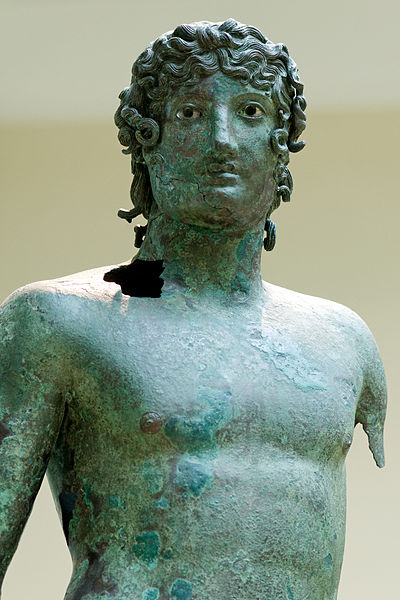
File:Bronze youth BM Br828 n3.jpg
A bronze statue of a young man. Roman Copy. Not Demetrius.

Demetrius may have been a pro-Macedonian puppet. Thanks to @skaios_ from twitter for suggesting this passage.

Back to RGTO: Reading Tragedy Together When Sheltering Alone

Five years ago, a group of us got together and started reading Greek tragedies with actors and scholars and whoever else appeared. Over the next 3 years years, we aired 65 episodes, covering every tragedy, fragments, some comedies, original work, excerpts from epic, and eventually the Batrakhomuomakhia. We did a podcast about it and an interview a year or so later.

It was a transformative and uplifting experience that reshaped the way many of us thought about the relationship between performance and communities of support and interpretation. I am grateful for it and nostalgic in these darker days. We will be reposting the original notes for each session for the remainder of the year.

Greek Tragedy Readings, Week 1: Euripides’ Helen (Supported by the Center for Hellenic Studies and the Kosmos Society and Out of Chaos Theatre).

A week or so ago Paul O’Mahony pulled together a few people from the Center for Hellenic Studies (Lanah Koelle and Keith DeStone) with me and several members of the Kosmos Society (including Janet Ozsolak, Helene Emeriaud, Sarah Scott) with an idea: bringing together Hellenists and actors in isolation to do readings and discussions of Greek Tragedy during these strange times. We talked about how important it is to retain human contact and communication to stay sane, how the arts help us reflect on being human and how in these frightening times the humanities have no less a purchase on our imaginations and our needs than at any other.

We sketched out a basic plan to read a play a week and invite professional actors to read scenes together. And then we tried it out the next day. We recorded it rather than performing it live because we had no idea how well it would go. Here it is:

Actors: Evelyn Miller, Richard Neal, Paul O’Mahony, and Eunice Roberts

Questions and comments by Joel Christensen

Designed by Paul O’Mahony with consultation from the Kosmos Society and Joel Christensen (me!)

Scenes include: Helen’s opening speech Helen and Teucer (l. 68-164) Menelaos speech (l.386-438) Menelaos and Old Woman (l.437-484) Menelaos and Helen meet (l.528-661) Menelaos and Helen plotting (l.1031-1093)

I hope you take some time to watch this and read along (we use this text). The conversation was unscripted and mostly unplanned–some of the comments about seeming and being and living at the edge of things or through mediated experiences struck me pretty hard.

We plan to do this on a weekly basis and are looking for experts in tragedy and actors who would like to participate. Please reach out! We hope to give people a chance to spend time thinking about Greek tragedy, engaging with one another, and meeting new people, learning new things.

For next week, we will be running the show live and opening it up to the public:

Wednesday at 3 PM EST we are reading Sophocles’ Philoktetes (using this text) and will be joined by Howard University’s Norman Sandridge. Watch here and the Center for Hellenic Studies website for news.

Tragedy readings

A Secret Messaging Alternative to Signal

Aeneas Tacticus, Fragments LI: on the Sending of Messages”

“People who plan to work with traitors need to know how to send messages. Send them like this. Have a man be sent openly carrying some note about other matters. Have a different letter be secretly placed under the sole of the sandals of the person carrying the first message. Sew it between the layers and have it inscribed on tin to be safeguarded against mud and water.

Once the messenger has arrived to his destination and he has rested for the night, let the intended recipient remove the stitches from the sandals, take the message out, write a response secretly, and send the messenger back once he has written some public message to carry openly. In this way, not even the messenger will know what he carries.”

Τοῖς κεχρημένοις προδόταις ἀναγκαῖον εἰδέναι πῶς ἐπιστολὰς δεῖ αὐτοὺς εἰσπέμπειν. ἀπόστελλε γοῦν οὕτως. πεμπέσθω ἀνὴρ ἐν τῷ φανερῷ φέρων1 ἐπιστολήν τινα περὶ ἄλλων πραγμάτων. τοῦ δὲ πορεύεσθαι μέλλοντος κρυφαίως αὐτοῦ εἰς τὸ τῶν ὑποδημάτων πέλμα ἐντεθήτω εἰς τὸ μεταξὺ βιβλίον καὶ καταραπτέσθω· πρὸς δὲ τοὺς πηλοὺς καὶ τὰ ὕδατα εἰς κασσίτερον ἐληλασμένον2 γραφέσθω πρὸς τὸ μὴ ἀφανίζεσθαι ὑπὸ τῶν ὑδάτων τὰ γράμματα. ἀφικομένου δὲ πρὸς ὃν δεῖ3 καὶ ἀναπαυομένου νυκτὸς ἀναλυέτω τὰς ῥαφὰς τῶν ὑποδημάτων καὶ ἐξελὼν ἀναγνούς τε καὶ4 ἄλλα γράψας λάθρᾳ ἀποστελλέτω τὸν ἄνδρα, ἀνταποστείλας καὶ δούς τι5 φέρειν φανερῶς· οὕτως γὰρ οὔτε ἄλλος οὔτε ὁ φέρων εἰδήσει.

Exhibit in the Bata Shoe Museum, Toronto, Ontario, Canada. https://commons.wikimedia.org/wiki/File:Greek_balsamaria_in_shape_of_lower_leg_with_open-toed_sandal,_6th_century_BC_-_Bata_Shoe_Museum_-_DSC00016.JPG

Another Plague: Profiteering

For more on how leaders make plagues worse, look around, or go here.

Philo, On the Virtues 92

“They were so messed up in the mind and so obsessed with making money, they treated every kind of profit as if they were dying”

εἰσὶ δ᾿ οἳ οὕτως ῥυπῶσι τὰς διανοίας προστετηκότες ἀργυρισμῷ καὶ δυσθανατῶντες περὶ πᾶσαν ἰδέαν κέρδους

Plato, Laws 906c

“But there are some souls who live with us on the earth and have come to possess unjust profit, which is clearly inhuman. They implore the guards, whether they are shepherds or guard-dogs, or the highest of all masters as they beg them, trying to persuade them with pleasing words and enchanting spells—as the stories of evil men go. They are able to profiteer among human beings without suffering anything!

But we say that the crime we call now “profiteering” is the same as a disease in the body’s flesh, or what we would call a plague in some seasons and years, or what, once the word is translated, is injustice itself in cities and states.”

ψυχαὶ δή τινες ἐπὶ γῆς οἰκοῦσαι καὶ ἄδικον λῆμμα κεκτημέναι, δῆλον ὅτι θηριώδεις πρὸς τὰς τῶν φυλάκων ψυχὰς ἄρα κυνῶν ἢ τὰς τῶν νομέων ἢ πρὸς τὰς τῶν παντάπασιν ἀκροτάτων δεσποτῶν προσπίπτουσαι πείθουσι θωπείαις λόγων, καὶ ἐν εὐκταίαις τισὶν ἐπῳδαῖς, ὡς αἱ φῆμαί φασιν αἱ τῶν κακῶν, ἐξεῖναι πλεονεκτοῦσι σφίσιν ἐν ἀνθρώποις πάσχειν μηδὲν χαλεπόν. φαμὲν δ᾿ εἶναί που τὸ νῦν ὀνομαζόμενον ἁμάρτημα τὴν πλεονεξίαν ἐν μὲν σαρκίνοις σώμασι νόσημα  καλούμενον, ἐν δὲ ὥραις ἐτῶν καὶ ἐνιαυτοῖς λοιμόν, ἐν δὲ πόλεσι καὶ πολιτείαις τοῦτο αὐτό, ῥήματι μετεσχηματισμένον, ἀδικίαν.

Theognis, 725-726

“No one goes to Hell with all his precious possessions”

… τὰ γὰρ περιώσια πάντα/ χρήματ’ ἔχων οὐδεὶς ἔρχεται εἰς ᾿Αίδεω

Miniature out of the Toggenburg Bible (Switzerland) of 1411. MS 78 E1.

Just Think Your Way Out of Sickness!

For more on plagues and leadership, see this post.

Aelian, Varia Historia 13.27

“Remember that Socrates’ body was thought to be orderly and in control of wisdom for this reason too. When the Athenians were suffering a pandemic and some were dying and others were near death, Socrates was the only one who was not sick. What mind do we think shared space with such a body?”

Ὅτι τὸ Σωκράτους σῶμα πεπίστευτο κόσμιον καὶ σωφροσύνης ἐγκρατὲς γεγονέναι καὶ ταύτῃ. ἐνόσουν Ἀθηναῖοι πανδημεί, καὶ οἱ μὲν ἀπέθνῃσκον, οἱ δὲ ἐπιθανατίως εἶχον, Σωκράτης δὲ μόνος οὐκ ἐνόσησε τὴν ἀρχήν. ὁ τοίνυν τοιούτῳ συνὼν σώματι τίνα ἡγούμεθα ἐσχηκέναι ψυχήν;

Apollonius of Tyana, 8.28

“Do these practices merely make a refinement of the senses or establish power over the greatest and most amazing forces? You need to see what I mean from different things, not the least of which were done during that epidemic in Ephesus.

When the disease was in the shape of an old beggar, I saw it and once I saw it I tackled it. I did not stop the disease but instead I destroyed it. The one I prayed to is clear as day in the temple which I built in thanks. It was for Herakles the Defender, the one I chose as a helper—because he is wise and brave, he once cleansed Elis of a plague and wiped away the waves of filth which the earth released when Augeas was tyrant.”

“Ἆρ᾿ οὖν τὸ οὕτως διαιτᾶσθαι λεπτότητα μόνον ἐργάζεται τῶν αἰσθήσεων ἢ ἰσχὺν ἐπὶ τὰ μέγιστά τε καὶ θαυμασιώτατα; θεωρεῖν δ᾿ ἔξεστιν ὃ λέγω καὶ ἀπ᾿ ἄλλων μέν, οὐχ ἥκιστα δὲ κἀκ τῶν ἐν Ἐφέσῳ περὶ τὴν νόσον ἐκείνην πραχθέντων· τὸ γὰρ τοῦ λοιμοῦ εἶδος, πτωχῷ δὲ γέροντι εἴκαστο, καὶ εἶδον καὶ ἰδὼν εἷλον, οὐ παύσας νόσον, ἀλλ᾿ ἐξελών, ὅτῳ δ᾿ εὐξάμενος, δηλοῖ τὸ ἱερόν, ὃ ἐν Ἐφέσῳ ὑπὲρ τούτου ἱδρυσάμην, Ἡρακλέους μὲν γὰρ Ἀποτροπαίου ἐστί, ξυνεργὸν δ᾿ αὐτὸν εἱλόμην, ἐπειδὴ σοφός τε καὶ ἀνδρεῖος ὢν ἐκάθηρέ ποτε λοιμοῦ τὴν Ἦλιν, τὰς ἀναθυμιάσεις ἀποκλύσας, ἃς παρεῖχεν ἡ γῆ κατ᾿ Αὐγέαν τυραννεύοντα.

“The Death of Socrates” by Jacques-Louis David. c. 1782
Pen and black ink, with brush and gray wash over black chalk, with light squaring in black chalk 

Sappho’s Equal? Some Epigrams Assigned to the Poet Nossis

Nossis is one of the best attested woman poets from the ancient world. Don’t feel bad if you haven’t heard of her.

Greek Anthology, 6.353

“Melinna herself is here. Look how her pure face
Seems to glance gently at me.
How faithfully she looks like her mother in every way.
Whenever children equal their parents it is beautiful.”

Αὐτομέλιννα τέτυκται· ἴδ᾿ ὡς ἀγανὸν τὸ πρόσωπον
ἁμὲ ποτοπτάζειν μειλιχίως δοκέει·
ὡς ἐτύμως θυγάτηρ τᾷ ματέρι πάντα ποτῴκει.
ἦ καλὸν ὅκκα πέλῃ τέκνα γονεῦσιν ἴσα.

7.718

“Stranger, if you sail to the city of beautiful dances, Mytilene,
The city which fed Sappho, the the Graces’ flower,
Tell them that the land of Lokris bore for the Muses
A woman her equal, by the name of Nossis. Go!”

Ὦ ξεῖν᾿, εἰ τύ γε πλεῖς ποτὶ καλλίχορον Μυτιλάναν,
τὰν Σαπφὼ χαρίτων ἄνθος ἐναυσαμέναν,
εἰπεῖν, ὡς Μούσαισι φίλαν τήνᾳ τε Λοκρὶς γᾶ
τίκτεν ἴσαν ὅτι θ᾿ οἱ τοὔνομα Νοσσίς· ἴθι.

6.275

“I expect that Aphrodite will be pleased to receive
As an offering from Samutha, the band that held her hair.
For it is well made and smells sweetly of nektar,
That very nektar she uses to anoint beautiful Adonis.”

Χαίροισάν τοι ἔοικε κομᾶν ἄπο τὰν Ἀφροδίταν
ἄνθεμα κεκρύφαλον τόνδε λαβεῖν Σαμύθας·
δαιδαλέος τε γάρ ἐστι, καὶ ἁδύ τι νέκταρος ὄσδει,
τοῦ, τῷ καὶ τήνα καλὸν Ἄδωνα χρίει.

9.332

“Let’s leave for the temple and go to see Aphrodite’s
Sculpture—how it is made so finely in gold.
Polyarkhis dedicated it after she earned great
wealth from the native glory of her body.”

Ἐλθοῖσαι ποτὶ ναὸν ἰδώμεθα τᾶς Ἀφροδίτας
τὸ βρέτας, ὡς χρυσῷ διαδαλόεν τελέθει.
εἵσατό μιν Πολυαρχίς, ἐπαυρομένα μάλα πολλὰν
κτῆσιν ἀπ᾿ οἰκείου σώματος ἀγλαΐας.

Marble bust of Nossis by Francesco Jerace