“The faculty of propagation through eternity was eventually transferred from water to Venus, so that everything would subsequently be born from the intercourse of male and female. Because of the story about the castration of Kronos, our countrymen to this day call him Saturn, on account of the Greek word sathen, which means ‘penis,’ as if to say Sathurn. Similarly, they think that Satyrs are actually called Sathyrs, because they are rather prone to libidinous pursuits. They think that the sickle is attributed to Saturn because time (Chronos) measures and subsequently crops and cuts all things. They say that Saturn used to devour his children and vomit them back up; by this, it is meant that he is identified with Time (Chronos), by whose agency all things come into being and, in their turn, are devoured and then reborn.”
Animalium vero aeternam propagationem ad Venerem generandi facultas ex humore translata est: ut per coitum maris feminaeque cuncta deinceps gignerentur. 9 Propter abscisorum pudendorum fabulam etiam nostri eum Saturnum vocitaverunt, παρὰ τὴν σάθην, quae membrum virile declarat, veluti Sathurnum: inde etiam Satyros veluti Sathunos, quod sint in libidinem proni, appellatos opinantur. Falcem ei quidam aestimant attributam, quod tempus omnia metat exsecet et incidat. 10 Hunc aiunt filios suos solitum devorare, eosdemque rursus evomere: per quod similiter significatur eum tempus esse a quo vicibus cuncta gignantur absumanturque et ex eo denuo renascantur.
Below are excerpts from several grammarians and scholars on the meaning of kraipale, a Greek word referring to the physical after-effects of drunkenness. In the thorough Socratic manner, we must first define our terms – later, I will add a post about how to manage this affliction! (No, the answer will not ‘abstinence’.)
Phrynicus, praeparatio sophistica 78.12-14:
Kraipale: The act of drinking from evening until morning and the consequent derangement of the senses; derived from ‘pallein,’ which means ‘to shake,’ the head.
Ptolemaeus Grammaticus, de differentia vocabulorum: 393.7-9
‘Kraipale’ (the headache from drunkenness) and ‘methe’ (drunkenness) differ: For, ‘methe’ is drunkenness which occurs on the same day. ‘Kraipale,’ however, is the drunkenness leftover from yesterday.
Kraipalo (verb): A second linking of the vowels with a circumflex. [?] The verb is formed from ‘kraipale,’ which signifies ‘methe’ (drunkenness). This comes from ‘kara’ (head) and ‘pallo’ (shake) by transposition and syncope.
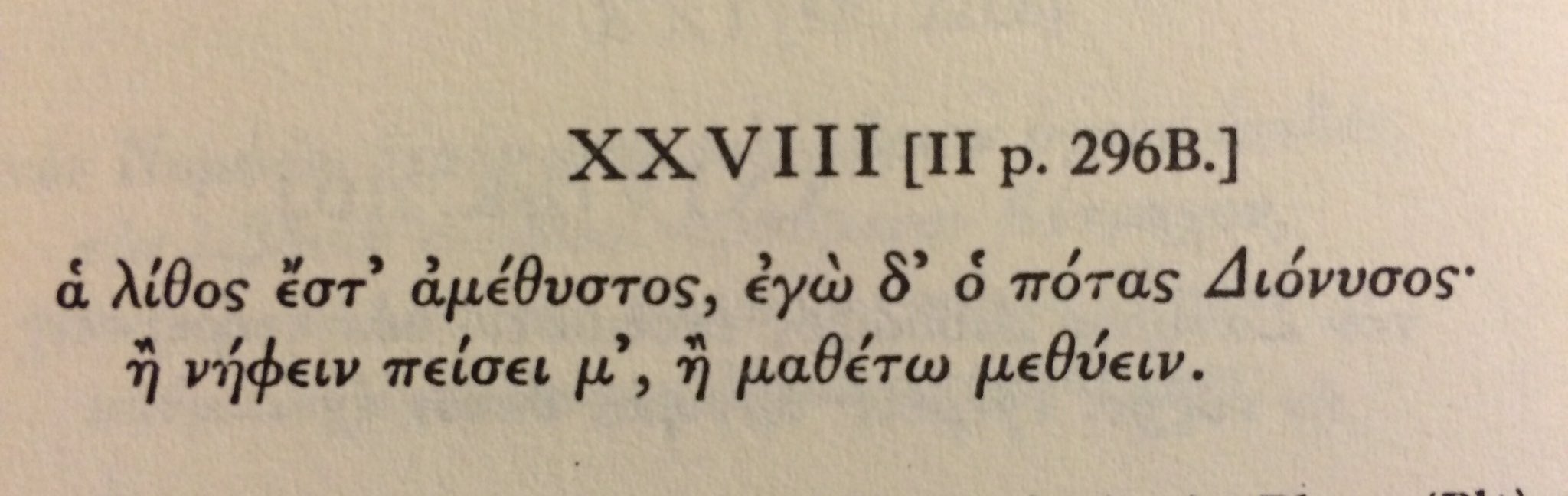
“Amethyst is the sober stone, but I am Dionysus the drinker; either it will persuade me not to drink, or it must learn to be drunk!”
I looked into this (just a little bit) after reading this epigram, and found that there was indeed something of a tradition of etymologizing the stone’s name a-methustos (not drunken) in relation to its reputation as a palliative for excessive indulgence:
Nonnos, Dionysiaca 12.380-81
Rhea gave Dionysus the wine-drinker alone the amethyst, that defender against compulsive madness.
“Some even think that herbal amethyst and the stone named after it are so called from their ability to aid against drunkenness, but they err; both are so named from their color.
I also found that this etymology was incorporated into the Wikipedia page for the stone, despite the fact that (of the sources that I looked through, at any rate) Plutarch seems to be most specific in his discussion, and flatly denies the etymology. Sed hae sunt nugae.
“In the forum one finds the Lacus Curtius (“Pool of Curtius”), which opinion holds was named for Curtius. But the story about why has three forms: Procilus does not report the same thing which Piso does and Cornelius doesn’t follow it either. Proclius reports that in this place the earth opened wide and this fact was referred by senatorial decree to the haruspices: they responded that the gods of the dead asked for completion of a vow that had been forgotten: a promise to send down the bravest citizen. At that time, a certain Curtius, a brave man, armed, climbed atop his horse, and, after he turned from the temple of Concord, threw himself into the hole with his horse. When that deed was done, the place close and entombed his body divinely: it created a monument to his family.
In his Annales, Piso writes that during the Sabine war that occurred between Romulus and Tatius, a most stout Sabine named Mettius Curtius, at the moment when Romuus brought his men on a charge from higher ground, escaped into a marshy spot which was then what the Forum was because the sewers were built and then retreated to his own men on the Capitoline. Well, Piso records this is how the place got its name.
Cornelius and Lutatius write instead that the place was struck by lightning and as a result was fenced in by a senatorial decree. This was done under the leadership of a Consul named Curtius who was a colleague of Marcus Genucius. For this reason, it was named Lacus Curtius.”
Cornelius et Lutatius scribunt eum locum esse fulguritum et ex S. C. septum esse: id quod factum esset a Curtio consule, cui M. Genucius fuit collega, Curtium appellatum.
In Foro Lacum Curtium a Curtio dictum constat, et de eo triceps historia: nam et Procilius non idem prodidit quod Piso, nec quod is Cornelius secutus. A Procilio relatum in eo loco dehisse terram et id ex S.C. ad haruspices relatum esse; responsum deum Manium postilionem postulare, id est civem fortissimum eo demitti. Tum quendam Curtium virum fortem armatum ascendisse in equum et a Concordia versum cum eo praecipitatum; eo facto locum coisse atque eius corpus divinitus humasse ac reliquisse genti suae monumentum.
Piso in Annalibus scribit Sabino bello, quod fuit Romulo et Tatio, virum fortissimum Mettium Curtium Sabinum, cum Romulus cum suis ex superiore parte impressionem fecisset, in locum palustrem, qui tum fuit in Foro antequam cloacae sunt factae, secessisse atque ad suos in Capitolium recepisse; ab eo lacum Curtium invenisse nomen.
My four-year old son talks in his sleep. And I don’t mean that he merely makes sounds–he holds entire conversations with himself. Sometimes there are arguments. As I discovered this morning, however, there is no Ancient Greek word for “sleeping-talkng” or “sleep walking”.
Based on the compound “walking on air” (ἀεροβατεῖν) I propose ὑπνολέγειν (“sleep-talking”) and ὑπνοβατεῖν (“sleep-talking”). But I must admit that my faith is a bit rattled. So, here are some sleep-compounds from ancient Greek.
ὑπνομαχέω: (hupnomakheô) “fight against sleep”
ὑπνοποιός: (hupnopoios) “sleep-making”
ὑπνάπατης: (hupnapatês) “cheating of sleep”
ὑπνοφόβης: (hupnophobês) “frightening in sleep”
ὑπνοφόρος: (hupnophoros) “sleep-bringing”
ὑπνοδεσμήτος: (hupnodesmêtos) “bound-by-sleep”
ὑπνοτραπἑζος: (hupnotrapezos) “table-sleeper” (an epithet for a parasite)
Gorgias on Sleep and His Brother (Aelian, Varia Historiia 2.30)
“When Gorgias of Leontini was at the end of his life and, extremely old, he was over taken by a certain weakness, he stretched out in his bed slipping off to sleep. When one of his attendants who was looking over him asked how he was doing, Gorgias replied “Sleep is now starting to hand me over to his brother.””
Gorgias of Leontini was an orator who lived nearly one hundred years. In Greek myth, Sleep (Hypnos) and Death (Thanatos) are brothers. Here’s the Euphronios Krater that shows the pair carrying off the mortally wounded Sarpedon.
“Amethyst is the sober stone, but I am Dionysus the drinker; either it will persuade me not to drink, or it must learn to be drunk!”
I looked into this (just a little bit) after reading this epigram, and found that there was indeed something of a tradition of etymologizing the stone’s name a-methustos (not drunken) in relation to its reputation as a palliative for excessive indulgence:
Nonnos, Dionysiaca 12.380-81
Rhea gave Dionysus the wine-drinker alone the amethyst, that defender against compulsive madness.
“Some even think that herbal amethyst and the stone named after it are so called from their ability to aid against drunkenness, but they err; both are so named from their color.
I also found that this etymology was incorporated into the Wikipedia page for the stone, despite the fact that (of the sources that I looked through, at any rate) Plutarch seems to be most specific in his discussion, and flatly denies the etymology. Sed hae sunt nugae.
“Kraipalê: The pounding that comes from drinking too much wine. We also have the participle “carousing” which is when someone acts poorly because of drinking, or just being drunk. It derives from the word “head” (kara) and “pound” (pallein). Or, it could also come from screwing up (sphallesthai) timely matters (kairiôn)
Kraipalôdês: “Prone to drunkenness”: The ancients knew well the weaknesses of the spirit, weather it was a person who was prone to excessive drinking or a love-seeker who has his brain in his genitals.”
Nikokharês
“Tomorrow we will boil acorns instead of cabbage
To treat our hangover.”
εἰσαύριον .. ἀντὶ ῥαφάνων ἑψήσομεν
βαλάνιον, ἵνα νῷν ἐξάγῃ τὴν κραιπάλην.
Alexis, fr. 390
“If only we got hangovers before we drank
Then no one would ever drink more
Than is good for them. But now, because
We do not expect to escape drinking’s penalty,
We too eagerly drink unmixed wines”
12 Concerning the miraculous tales which Pliny the Elder ascribes most unworthily to the philosopher Democritus; and also about the image of a flying dove
In the twenty-eighth book of his Natural Histories, Pliny the Elder reports that there was a book by the most noble Philosopher Democritus On the Power and Nature of the Chameleon and that he had read it himself. He ascribes to it many silly and ridiculous things, allegedly written by Democritus—a few of which I remember, unwillingly, since they are so repulsive. For instance, that Democritus claimed that a hawk, the fastest of all birds, if he flies over a chameleon by chance, is suddenly dragged to the ground by a chameleon crawling below it and that after it comes down by some force offers itself willingly on the ground to be taken and torn to pieces by other birds!
Another thing that is beyond all human belief: if the head and neck of a chameleon is burned with the wood which we call oak, rain and thunder occur suddenly; the same thing, allegedly, happens if that animal is burned on the top of a house. There is still another tale which, by Hercules, I doubted that I should include since it is so absurd. But I have decided clearly that it is necessary that we speak what we think about the false incitements that come from this type of wonder—the types of things by which many sharp minds—indeed, those which are most desirous of knowledge—are often possessed and which lead them especially to ruin. But I return to Pliny. He says to roast the chameleon’s left foot with iron heated in a fire along with a herb which bears the same name (“chameleon”), and to mix both into an ointment and to rub it into paste and place it in a wooden container. Whoever carries that, even if he is in the middle of a crowd, can be seen by no one.”
12De portentis fabularum, quae Plinius Secundus indignissime in Democritum philosophum confert; ibidem de simulacro volucri columbae.
1 Librum esse Democriti, nobilissimi philosophorum, de vi et natura chamaeleontis eumque se legisse Plinius Secundus in naturalis historiae vicesimo octavo refert multaque vana atque intoleranda auribus deinde quasi a Democrito scripta tradit, ex quibus pauca haec inviti meminimus, quia pertaesum est: 2 accipitrem avium rapidissimum a chamaeleonte humi reptante, si eum forte supervolet, detrahi et cadere vi quadam in terram ceterisque avibus laniandum sponte sua obicere sese et dedere. 3 Item aliud ultra humanam fidem: caput et collum chamaeleontis si uratur ligno, quod appellatur “robur”, imbres et tonitrus fieri derepente, idque ipsum usu venire, si iecur eiusdem animalis in summis tegulis uratur. 4 Item aliud, quod hercle an ponerem dubitavi, – ita est deridiculae vanitatis – nisi idcirco plane posui, quod oportuit nos dicere, quid de istiusmodi admirationum fallaci inlecebra sentiremus, qua plerumque capiuntur et ad perniciem elabuntur ingenia maxime sollertia eaque potissimum, quae discendi cupidiora sunt. 5 Sed redeo ad Plinium. Sinistrum pedem ait chamaeleontis ferro ex igni calefacto torreri cum herba, quae appellatur eodem nomine chamaeleontis, et utrumque macerari unguento conligique in modum pastilli atque in vas mitti ligneum et eum, qui id vas ferat, etiamsi is in medio palam versetur, a nullo videri posse.
“Euripides also speaks of [Erikhthonios’] birth in this way. Because he was filled with lust for her, Hephaistos wanted to have sex with Athena. But when she turned away—because she preferred her virginity—she hid herself in a certain part of Attica which they say is also named “the Hephaisteion” after him. He thought that he could overpower her but when he attacked he was struck by her spear and ejaculated—his semen fell on the earth. They say that a child was born from it, and that he was named Erikhthonius for that reason…”
The name Erikhthonios had folk etymologies in the ancient world based on the narratives surrounding him and the sound. One interpretation, “rich-earth” (eri-khthonios), points to his autochthonous character and his association with Athenian prosperity. Another (“strife-land”; eris-khthonios) draws possibly on the struggle between Poseidon-Erekhtheus and Athena. A third traces the root of the first half to “wool” (erion) perhaps reflecting Athena’s association with weaving and occurring as a reflex in the version of the tale where Athena uses wool to wipe off Hephaistos’ premature ejaculation (Apollodorus records that it was this semen-sponge that impregnated Gaia).
The Birth of Erikhthonios
Here’s what a Byzantine Etymological Dictionary has to say:
Etymologicum Magnum
“Erekhteus: He is called Epikhthonios because he was engendered [espasthai] in lust; Or from Hephaistos desire [orekseôs], or from “breaking” [ereikô], Erekhtheus’ power; from the fact that he brought apart the earth and was born from Hephaistos’ semen when Athena hid it in the earth, he is also called Erikhthonios.”
According to Homer (Il. 2.546-51) Erekhtheus, nearly identical to Erikhthonios in early narratives only to be disambiguated in royal genealogies by the classical period, was born from Gaia and raised by Athena. The name Erekhtheus may be derived from the verb erekhthô which means “to tear or smash” and may be associated with Poseidon the “earthshaker”.
Iliad 2.546-551:
“Then came the men who occupied the well-built city of Athens, the people of great-hearted Erekhtheus, whom Athena the daughter of Zeus raised after the fertile earth gave birth to him, the one Athena brought into her own wealthy temple. There the sons of Athens worship him every new year with bulls and lambs. Menestheus, the son of Peteos led them. No earth-born man ever was his equal at marshaling the cavalry and spear-holding men.”
There are some interesting echoes here from stories we learn later about Erikhthonios. Note (1) the closeness between Athena and Erekhtheus (implying no strife or suppressing it); (2) the early evidence for co-worship of the two; and (3) the possible—though not probable—echo of Erikhthonios in the adjective epikhthonios (“earth-born”).
Of some interest: According to Pausanias (1.28.10) it was Erekhtheus (the king) who first offered animal sacrifices at the Bouphonia (“Cow-slaughter” festival). In his commentary on the Iliad G. S. Kirk (1985, 206) suggests that the annual festival (περιτελλομένων ἐνιαυτῶν, here translated rather feebly as “every new year”) may be a form of the Panathenaia.
Sources:
OCD3
Walter Burkert. Greek Religion. Cambridge, 1985.
L. R. Farnell. The Cults of the Greek City States. 1895.
Timothy Gantz. Early Greek Myth. Baltimore, 1993.
Simon Price. Religions of the Ancient Greeks. Cambridge, 1999.
From the introduction to the Scholia to Lykophron’s Alexandra by John Tzetzes or his brother Isaac:
“Comedy is named either because of the time of the revel (kôma), since it was developed near sleep; because of the neighborhoods which are in the narrow streets (kômais); because of the villages (kômais) in the open countries; or because it developed in the vales (kômais) and places of Dionysus. But tragedy takes its name from the tragos or truga which is new wine: since in early times they anointed their heads with the raw wine. Or, they call it tragedy because they stand in a square (tetragônôs); or it turns from trakhodia into tragodia because they take their laments from harsh songs. Satyr-play is named from the satyrs who invented it or from the farmers and poor men.
“Tragedy: This is the dramatic performance of heroic lives and stories. It is called tragoidia because the prize that was given to the song was a goat [tragos têi oidê]. The song was thus the tragoidia. Or, those who won the competition took truga [“ripe grapes; or new wine”] as a prize. The ancients used to call new wine truga. Or, it is called this because the chorus had a four-sided shape [tetragônon]. Or because the choruses were composed of satyrs whom they used to call ‘goats’ [tragous] because they resembled them either because of their hairy bodies or because of their sexual zeal. For the animal was like that. Or tragedy is from the lees of wine [trugos]. This name has something in common with comedy, so the names of each type of poetry should be distinguished.
There was one prize for the latter, which is the truks [“new wine, lees”]. Later, tragedy had a common name [for the two?]. But the latter was named comedy since they used to perform them in the revels during the festivals for Dionysus and Demeter. This name came from “reveling” [kômazein] which is the song at the revel. This was developed at the time near sleep. Or it is the song of villagers [komêtai]. For larger rustic settlements are called kômai. Some farmers who were harmed by the citizens of Athens departed near the time of sleep. And those who lived near the roads used to refer to these wrongs which they suffered periphrastically. Thus, someone waits there and performs these deeds and others; as a result, there was a remedy to the injustice.