We’ve Been Doing This for 10 years: A Personal History of Sententiae Antiquae

“…It brings pleasure
Whenever someone discovers some new notion,
To share it with everyone…”
… ἡδονὴν ἔχει,
ὅταν τις εὕρῃ καινὸν ἐνθύμημά τι,
δηλοῦν ἅπασιν -Anaxandrides

What is this Fresh Garbage?

Today, October 22nd, this website has completed its tenth year. Such round numbers, if they don’t invite deeper reflection on life and its apparent meanings, can at least prompt us to ask what we are doing and what is this garbage we set on fire.

What does 10 years of Sententiae Antiquae mean? It means over 7000 posts in a decade from more than 20 different contributors (many of these have been repeated once). It means 400 page views for its first year, 8000 for the next year and over 500,000 thousand page-views just last year alone (to go with 37k+ followers on twitter. Check out the SA Tweetbook for more of that).

In the internet age these stats too often come to represent our worth (as commodities and moral agents!). I’d certainly be lying if we weren’t at times delighted with the popularity of this thing or that. But, as any good educator knows, quantity and quality are not coterminous. Indeed, there is a superabundance of shit on this website and some of the things that have gained the most views and likes are far from those for which we’d hope to be remembered.

So there’s the thing: what is this project for? What does it do in the world? After 10 years, I find myself regularly asking this, especially as time in front of a screen or on an app becomes all the more tiring in our panoptical pandemic omnipresence. For the sake of trying to figure this out and sharing some history of the site, I am going to go back to the beginning, to tell its story as best as I remember it.

“Beginnings are from Jove, oh Muses! Everything is full of Jove”
ab Jove principium, Musae; Jovis omnia plena  -Vergil

The Beginning

This site was born out of uncertainty, frustration, and sleeplessness. The first time I heard of twitter was, like most of the world, during the 2008 election cycle. When I ‘finally’ gave in and got my first smartphone in 2009, I was a twitter lurker, trying to suss it out. I had more experience with the world of blogs—I had never started one myself, but I had friends who tried them out in the early days of livejournal. I was also really suspicious of social networks, but like nearly everyone else in the existential aughts, I was pretty desperate for connections outside of the narrow world of work.

2010-2011 created a perfect storm that led to sententiaeantiquae’s beginnings. To start, my wife and I welcomed our first child into the world and I spent a lot of late hours bleary-eyed, staring at a smartphone, trying to will an infant to stay asleep while I occupied my fragmented mind. One night I read episode summaries of every season of Star Trek: The Next Generation; another, I spent 4 hours straight on rapgenius.com (the sleeplessness).

When I found myself on twitter, I naturally started to look at what was happening in Classics. Apart from the good work of the Rogue Classicist, I encountered countless accounts trafficking in unsourced and often false Plato and Aristotle quotes (there’s the frustration). I had been collecting quotations for years and had assembled a long list I used in my Greek classes. I was always frustrated when I found lines attributed to ancient authors without citations or the original language.

During the same period, my father died and we found out another child was on the way. In mid 2011, I was untenured, still furiously trying to finish some publications at night before the next child appeared, and I was starting to play around with twitter and wordpress for a music blog with my brother (we ran the blog for 4 years or so and then called it quits for various reasons).

I was also trying to find a way out of Texas. Even though the great recession was then 3 years behind us, the academic job market didn’t really recover and I hadn’t done myself any favors by publishing relatively little in my first few years after graduate school and not starting a book. More and more, jobs were asking for expertise or interest in the digital humanities. I knew then that social media does not equal DH, but I figured a quote account might be a start (and there’s the uncertainty).

On a weekend afternoon in October of 2011, I started texting my then-colleague Bill Short with a pretty simple idea: a website that would present daily Latin and Greek quotations with English transition and clear citations paired with a twitter account that would propagate ‘quality’ content. I think my pitch might have been wordier and less cogent, but that’s the gist.

I quickly set up the accounts and we soon had our first post (Homer, Iliad 22.304-5): May I not die without a fight and without glory but after doing something big for men to come to learn about” (μὴ μὰν ἀσπουδί γε καὶ ἀκλειῶς ἀπολοίμην, / ἀλλὰ μέγα ῥέξας τι καὶ ἐσσομένοισι πυθέσθαι).

“The result for the ambitious and bold young men is that they are always trying to work around and cover up their cultivated ignorance.”
 τοῖς δὲ φιλοτίμοις καὶ θρασέσιν ἀεὶ περιστέλλειν καὶ ἀποκρύπτειν συνοικοῦσαν τὴν ἀμαθίαν -Plutarch

The Early Years

For the first few months, Bill and I took turns, putting up Latin one day (Bill) and Greek the next. I still remember the first time notable things happened like getting retweeted and followed by the Society for Classical Studies or by Rogue Classicist. When Daniel Mendelsohn followed the account, we thought we had made it. By the following summer we had 500 followers and thought that was kind of special.

But the daily grind quickly became a daily grind: it was hard to keep up with the demand for new quotations (my long list gathered didn’t last a half year!). I started to search for new passages and made reading randomly a daily practice. Bill had other work to attend to (we both had small kids and tenure hurdles to worry about) and was less habit-oriented than I was. During the summer of 2012 we tried to vary our practice by inviting people to join us. We launched an Initiative called the (Un)Commonplace Book and sent out the following invitation:

There are many passages from ancient Greek and Roman literature whose beauty, complexity and influence are ill-fit to the epigrammatic style of Twitter but whose sound and sense stick with us and, in many cases, help to shape our perspective and to guide our lives.  The ancients would comb through texts for edification and take such purple passages to heart. Later European readers kept commonplace books to record similar endeavors and vouchsafe certain selections against the ravages of memory and time.

Here at Sententiae Antiquae we know that the sententia cannot always convey the full sentiment of a work and, further, when presented alone, does not always do full justice to the depth or impact of a passage. So, we are inviting readers, lovers of ancient wisdom, and thralls of the words of Greek and Roman literature to translate longer passages that have affected their lives in some meaningful way from deeper forms such as consolation and inspiration to no less significant responses like laughter or even scorn. To accompany these passages, we will also ask for short accompanying essays (under 500 words) to elucidate their place in your personal story.

We hope that these posts will help to illustrate the way that dead texts are reborn with each generation and how they evolve even as we change with and because them. In turn, those of us who internalize our love of Classical literature will be able to share it with the external world.

So, if you’re interested please email your submissions or interest to classics@XXX.edu. In a few months, we will select entries to post on a semi-weekly basis (alternating Latin and Greek)

From the SA Vault

We sent out a few dozen invitation to well-known scholars, both those we knew and those we didn’t. We didn’t receive any responses.

“Your books have turned your life upside down.
You have philosophized nonsense to heaven and earth.
They don’t give a shit about your words.’
ἀντέστροφέν σου τὸν βίον τὰ βιβλία·
πεφιλοσόφηκας γῇ τε κοὐρανῷ λαλῶν,
οἷς οὐθέν ἐστιν ἐπιμελὲς τῶν λόγων.’ -Theognetus

What’s This Nonsense for?

I don’t know if it was the open-endedness of the project or my incessant, intolerable enthusiasm for it that slowly drove Bill away; but he eventually stopped posting and, to be honest, we never really talked about it (in those years we used the same log-in, so it is not easy to discern one poster from another). For a while, Osman Umurhan helped out with some Latin and, eventually, Erik took over some of those responsibilities.

In the meantime, I doubled down on the whole thing even though I hadn’t the slightest idea why. As we moved from Austin to San Antonio and I spent more time shuttling kids around and less writing, I found myself reading twitter more and engaging with different people (my tenure file went through, prompting my chair at the time to congratulate me by saying “The only thing worse than getting tenure here is not getting tenure here”). 

The pseudonymity of this account accompanied by its implicit appeals to cultural authority of different stripes attracted a strange crew of experts, enthusiasts, tourists, and shit-posters: what we now call #classicstwitter. Even back when twitter was 30% sexbots, it was still a gentler place. #Classicstwitter was not a named thing, but the motley and changing assemblage of obsessives and weirdos who showed up in my timeline where the closest thing I’d had to a community around Classics since I was in graduate school.

Still, it was clear that I was spending a lot of time doing something that I couldn’t really describe to anyone and that I had even more trouble justifying. Anything we do on a regular basis has some kind of impetus: we get paid for going to work (even if we get meaning out of it). I guess for a while I thought of contributing to SA as a practice, something like exercise. I knew from my early years out of graduate school that my ‘skills’ in Latin and Greek were degrading from under-use or over-specific use (introductory Greek, every year ad infinitum).

I also realized something I hadn’t anticipated from graduate school: it is really easy to stop learning much new as a professor. We are incentivized to work on the same material over and over again to first establish and then maintain expertise. When I started branching out from my list of quotations, I realized that there were dozens—if not hundreds—of authors from the ancient world whose names I barely recognized and whose works I had never seen. What kind of expertise is this!?

So, I used SA as a kind of professional development/intellectual challenge program. You know how some men in their late 30s suddenly need to train for a triathlon? Well, I decided to spend 1-2 hours a day just reading stuff I hadn’t read before in Latin and Greek. Call it an early-career crisis, or whatever, but it was the first real intellectual exercise without a specific end-goal of publication I had done in a decade. If I didn’t enjoy it every day, I did more often than not. And I learned a lot.

(I never did the triathlon thing, cycling freaks me out. I did do the marathon thing to check off the mid-life crisis box)

“Friendships transform your character and there is no greater sign of a difference in character than in choosing different friends.”
ἠθοποιοῦσι γὰρ αἱ φιλίαι, καὶ μεῖζον οὐθέν ἐστιν ἠθῶν διαφορᾶς σημεῖον ἢ φίλων αἱρέσεις διαφερόντων. -Plutarch

Erik Changes it All!

There’s a longer story to be told about Erik and me becoming friends. It both does and does not include sententiae antiquae. I think we can put it this way: if Erik and I had not become friends, SA probably would not have lasted as long as it did and definitely would not have turned out to be what it is now.

The short of it is that one summer, perhaps in 2009 or so, I had a summer reading group for some Greek students and Erik asked to join in. (He had never been in any of my classes and was already graduated by that point.) Within the first few meetings we started debating something about the beginning of the Iliad and he sent me a screed of an email about it and I thought, well, this guy’s nuts.

But, as I learned over time, Erik was my kind of nuts, you know, the reading until your eyes hurt and obsessing over any kind of narrative nuts. He kept coming back each summer for different reading groups and we found common ground in ridiculous television shows we both loved (sure, we were into Breaking Bad and Game of Thrones like everyone else, but we also really got into the absurdity of Dexter). At some point in this process, I asked if Erik wanted to take over some of the posting to the blog that had been given up by other collaborators.

Erik’s first post was from Florus! In April of 2013 and he posted occasionally that summer and Fall (with winners like the Latin Anthology) without any regularity or plan. (Indeed, this has been a hallmark of our approach. Sometimes one of us will start a project or theme and the other one will join in, but we rarely plan anything.) He disappeared for several months, coming back to the blog in March of 2014.

So far, one might be surprised by my assertion that Sententiae Antiquae is what it is because of Erik, but I think that during this period he wasn’t any surer than I was about what the whole thing was for. He was also struggling to figure out what to do with his life, something he should tell you, not me. But in July of 2014, he started a madcap period where he really started to use posting as his own personal commonplace book, recording his readings and some of his favorite passages as he worked through Euripides’ Hippolytus and Ion.

Erik started to reach for scholia and less common texts like Macrobius and, although I had previously dabbled in obscure stuff here and there, I have to say many of his posts inspired a cheerful aemulatio. We would often respond to each other offline, excited or horrified by some fresh new delicacy or turd from the ancient world. Ausonius is a terrible poet—we had to have him on the website.

“Some one could rightly jeer at me for assuming a side-project greater than my actual work”
Εὐστόχως ἄν τις εἴποι ἐπιτωθάζων μοι, μεῖζόν σοι τοῦ ἔργου τὸ πάρεργον. -Zonaras

Longer Projects

Erik was also the first to think of the website as a place for longer term projects. Around the time that we started a non-summer reading project of working on the Homeric “Battle of Frogs and Mice,” Erik started translating and posting sections of the untranslated “History of Apollonius of Tyre”. He and I both benefited from this structure and vision. I don’t know if he ever finished it—but the basic principle of using blogposts as a way to ‘publish’ an ongoing project while also forcing accountability has been crucial in our work. I don’t know if Erik’s idea was innovative or not, but it shaped what happened next.

Yes, part of it was the friendly aemulatio, I mentioned earlier. At times, we competed to find the worst poems from antiquity (Rufinus wins this race currently) and to see whose posts could make a splash. At this time, our pageviews were still pretty limited, so a post that got 100 hits was huge and certain to earn bragging rights. The number 1 post from 2014, for instance, was a typical combination of scatology and mythology (Odysseus Dying From Feces!). It received 343 pageviews.

We started to post more thematic sequences: Late 2014 saw the beginning of our serial translation and commentary on the Homeric Batrakhomuomakhia along with a sequence of mythography posts, anticipating future projects like the history of Zonaras, translations of paradoxographers, or brief obsessions with animals sounds or the Non-Achilles-Non-Agamemnon-Iliadic Hero Bracket. In each of these cases, we tended to start an investigation and continue to the end (or near enough) because the logic of the public accountability demanded it!

Now, we likely took our readership (if it existed) and ourselves too seriously, but these projects were really somewhere between serious research and preparation for class. Sometimes they were fun, sometimes people could find them useful later, and often (for me at least) they helped me explore the kind of research I realized I didn’t want to do during the process.

At the same time, Erik found humor and wit in obscure places, pulling out amazing passages from much larger works, as in his early “A Spurious Etymology for Anger” or “Seal Sex, What do They Want?” Working with Erik, and watching him work, reminded me of something I so often forgot as a trudged my way to and through tenure: reading ancient texts can be hilariously—and naughtily—fun.

Responses to Erik’s posts and mine inspired by them made me remember something else too, important in the classroom, scholarship, and over time: people will engage with good material, but they need to notice it first. Every year the internet gets more cluttered with projects, information, and various spasming new media that it is hard to cut through the noise. For social media work or any kind of content, basic design and marketing principles do matter: pictures help, titles help too. We have been justly accused of going full-on clickbait from time to time.

From 2014 through 2016, Sententiae Antiquae was mostly something Erik and I did for fun, the way some people go to weekly trivia nights or play fantasy football. We’d post stuff, chortle at each other, text about it, and get together almost weekly to read, shoot the shit, and drink the occasional (group of) beer(s). And sometimes, these conversations would inspire some of our more needling posts, like which ancient authors were most despised.

One of Erik’s passions was always the history of scholarship and anecdotes about scholars. In 2015 he started posting about these and they proved to be extremely popular. The amazing thing is that these passages are like being part of an every day conversation with Erik, whether it’s talking about Richard Porson and the Devil or dwelling on peculiarities of Liddell and Scott. (Seriously don’t get Erik started about Bentley or Housman, unless you really, truly want to know about Bentley or Housman!)

If you scroll back through this period, you can see all the postings getting more varied and stranger. We pushed each other to be more creative and posts got longer, reflecting on travels or exploring scholarly questions like the meaning of the name Nausikaa. As 2015 moved on, I felt more comfortable writing about experiences in the classroom and on teaching in general.  (Erik joined in this too and opened up conversations about this later.)

We also started to repeat annual events, like our posts of how to say happy birthday in ancient Greek or our annual Halloween focused Werewolf Week or our increasingly numerous posts for Women’s History Month. Along the way, we learned that essential social media lesson: it is almost impossible to repeat something too much to break through the online noise.

“Occasionally I laugh, joke, and play, and if I wanted to claim all of the parts of my harmless leisure, I would say I am human.”
aliquando praeterea rideo iocor ludo, utque omnia innoxiae remissionis genera breviter amplectar, homo sum -Pliny

Part of Something Bigger

Part of what kept me keyed into twitter was a community of ‘friends’ who gathered over time. There were silly days of limericks about byzantine scholars; there were random attempts to come up with etymologies for kerberos and later ridiculous discussions which enriched my life, like whether Achilles or Odysseus was more likely to “shoot a man in Reno / just to watch him die”. (Don’t @ me. The answer is always Odysseus.)

But before all of this there was “Two-Ears One Mouth”. One weekend in September 2015, I joked that Paul Holdengraber’s 7 word autobiography ( “Mother always said: Two ears, one mouth.” ) sounded like something from a Presocratic philosopher. He loved this, we then enlisted a group of classicists online to put this into Greek, Latin, and in Greek and Latin verse. Of course, other scholars joined in to let us know that this was in fact originally from Greek and, well, by the end of it, I lost track of how many people joined in, the path this sent me down roads of paroemiology, and that one time Salman Rushdie retweeted me.

The point is, there was something delightful and playful about this. It was erudition but without specific purpose or bound. It was, in a way, like sitting around shooting the shit with Erik.

Of course, there was a Classics blogopshere long before there was SA. The rogueclassicist was doing his thing on wordpress since 2003 (and earlier in other forms) while Michael Hendry’s curculio.org or Michael Gilleland’s laudatortemporisacti.blogspot.com had been posting ancient passages, reflections, scholarship and miscellany since at least 2004 and 2005. While the rise of app-based internet and computers presaged the alleged “death of the blog”, in the years since we started, academic and classically-theme blogging has expanded incredibly.

Blogs are just part of what for many people (and organizations) is a multi-pronged and somewhat variegated social media presence. Established scholars like Edith Hall, Neville Morley, Sarah Bond, and Rebecca Futo Kennedy have blogs of their own to go along with traditional publications and other kinds of writing, while graduate students and independent scholars make their own space in the field with blogs like Mixed-up In Classics or genre-smashing brilliance like the occasional medium posts by Vanessa Stovall.

Before the raging, endless trumpster fire ignited in 2016, Classicists under a certain age were part of different online networks, some personal, some impersonal like the little lamented Famae Volent. When Eidolon first debuted in 2014, their posts made us see that we could do things differently, and that there were audiences for longer essays.

Eidolon’s success with essays made me realize how poorly we were differentiating our use of twitter and the blog. So, in 2015, I started to experiment a little bit with twitter. Prior to spring of that year, we used to tweet a few times a day. I started scheduling tweets every few hours ahead of time using tweetdeck. The twitter account went from gaining 1 or 2 new followers a day to 3, then 4, then, well, it kept going. In that summer as well, Erik started a facebook feed for the content, and the site’s traffic started rising.

Although I understood implicitly from the beginning that blogging and tweeting were different media, it wasn’t until 4 or 5 years in that we started to differentiate the content, adding more to the twitter feed and expanding the content on wordpress. We don’t really optimize facebook well—and, let’s be honest, who does? And we also just haven’t had the time to think about other platforms like reddit or instagram. If we were a real brand or a business, we’d probably have people do that. But we’re just two classics nerds all grown up.

“Let’s put aside these games and focus on serious things”
amoto quaeramus seria ludo -Horace

Making like Montaigne?

I mentioned Eidolon and “Two Ears One Mouth” in the last section because both were important in reshaping the classical studies media landscape (the former) and expanding how we used the space of the blog (the latter). Later, I would use the blog to post things for classics or talks, sometimes expanded into mini essays like “Paroimiai: proverbs from Ancient Greece to Star Trek” (June 2016).

The more time we spent online, the more we engaged with topics people were talking about. Erik really opened up the space here: before we started making more field-oriented comments, Erik started to experiment with shorter literary essays, like “Humanizing a Monster: The Saddest Scene in Classical Literature” and we both found space to talk about “real life”, as when Erik eulogized his former teacher and my former colleague James Gallagher, freeing me in a way to be more personal in latter essays on parenting and teaching badly, or death anxiety and classical literature.

Classics—as many people will remember—seemed to get drawn into a political quagmire step by step following the 2016 election. In retrospect, what really happened was an unveiling of what was already there and needed to be addressed, the field’s structural and historical racism. Classicism wasn’t misappropriated by white supremacists, but white supremacy is deeply ingrained within it and perhaps inescapable. Erik started to joust with these topics early on with “Antiquity for Everyone: How Classics is Misappropriated” and “Classics [Itself] is Not Classist”. I followed suit in time, moving on to talk about Pedantry in the field, my own experiences with Classism and feeling like an imposter and the exclusionary history of the field.

A real inflection point for me was when I made the decision to write about the classical studies job wiki and message board Famae Volent. The indulgent, long first post (“A Personal History”) was a combination of therapy and exorcism for me, as I admitted to myself why I had spent so many years lurking on that site and what it said to me about the field and our direction. This set off a series of revelations and surprises (I knew some of the founders; I had made some of the suggestions for the site!) and surprising turns: the site closing down permanently a few months later. In the second post, (“Who Killed Famae Volent”) I talked about some of our conversations and the negative, harmful turn the site had taken in recent years. And, as usual, I ended with too many words and an aporia. To continue the indulgence, here’s a quote:

“After so many words, if I were a better writer, I’d loop back to the beginning—I could marshal some kind of ‘just-so’ point to bring all this together and to inspire anyone compulsive enough to read to this sentence to act. But that’s not who I am and that’s not what this situation needs. We need to continue a difficult conversation about the state of our field, the choices we make that exacerbate it, and the health of all participants. We need to break taboos against speaking about class, race, and mental health. We need to care about each other”

Living partly online and writing about it made me feel ownership of and responsibility for the shared space. I found myself playing parts of translator, guardian, policeman, pleader, and now undertaker. I felt I could talk about the field now in I way I didn’t feel permitted before. Was this age? Was this experience? I still don’t know.

“I cannot abide, while I still live, not doing something which might help my friends and family.”
 me, ne dum vivo quidem, necessariis meis quod prosit facere. -Varro

Contributors

Part of the ‘dream of the blog’ at an early date, back when we sent out the invitation to get other people to write posts, was building a community around shared interests. We have had some fun over the years by bringing in other contributors. The first was the notorious SP Festus (AKA Prof. Robert Phillips) who gave us a series of posts on the dog days of summer, Roman law, and scribal marginal notes in his characteristic erudition and hectic charm (and 27 posts in total over the years).

We’ve had some great posts from new friends, like Mary McLouglin’s lyre-building story, Christopher Brunelle’s far underrated mock musical papyrus (hilarious!), the humorous posts of Amy Coker or Amy Lather, T.H.M Geller-Goad’s ridiculus magnetic Latin Poetry, Arie Amaya Akkermans’ challenging essays on art, culture, and history or Dani Bostick’s brilliant combination of fake Latin and barn-storming critiques of secondary Latin education and pedagogy. We have also been able to offer spaces to young scholars working on transgender topics and sexuality like Hilary Ilkay and Cassie Garison or people disgarded by the field like the inimitable Stefani Echerverria-Fenn. Most guests post only once or twice and I am always sad not to have them write again because I learn so much from what they give.

Part of me was ready long ago to cede more of this space to others. But what I have seen, and welcomed as well, is how many of these friends make their own spaces instead. Indeed, the recent announcement of the closing of Eidolon has made me worried that there will be too many individual spaces, and no center to unite them. But what is this other than the essential condition of the age of (dis)information?

(if you want to post something to this blog, contact us. we make it easy.)

“He used to say that it is strange that we sift out the chaff from the wheat and those useless for war, but we do not forbid scoundrels in politics.”
ἄτοπον ἔφη τοῦ μὲν σίτου τὰς αἴρας ἐκλέγειν καὶ ἐν τῷ πολέμῳ τοὺς ἀχρείους, ἐν δὲ πολιτείᾳ τοὺς πονηροὺς μὴ παραιτεῖσθαι. -Antisthenes

Why’s Your Blog So Political?

There’s an alternate timeline where this blog just carried on, perfecting the art of posting about ancient shit (literally), masturbation, and various stunt translations like “sharknado”. We always had a tendency to refer to politics obliquely and events through our blog posts. But, as the first half of 2016 unfolded, I found myself increasingly unable to resist being more explicit, even if it was just adding a video or comment, or pointedly talking about ancient views on citizenship and refugees.

When I had the opportunity to move from UTSA to Brandeis in 2016, I didn’t think much about what that meant for the blog. I did not realize until I got to Massachusetts how much I had hesitated in Texas because we were warned of the dangers of being political as employees of the state. It was a confluence of space and time that saw the blog focus more and more on the world outside. I had the space as a tenured professor at a private school and during the time, well, how could anyone be silent?

I got in a few twitter spats in 2016 and 2017, but after white supremacists marched in Charlotte and I spent a year just feeling deader inside every day, I lost my shit in 2017 (figuratively) when several people complained that our account had gotten too political and asked for a nice, simple, apolitical classics. Not only is no academic field truly apolitical, but the claim that something is apolitical is just an oppressive fiction to advance the supremacy of the ruling class. It is white supremacist to demand that Classical Studies not be political, it is that damn simple.

The fire of this rage, once stoked, kept burning, in part because Erik and I are both excitable, but also because our politics and views are so closely aligned. Without a word, Erik followed up on the soullessness of Political Correctness, inaugurating a glorious period of spitfire, brilliant polemic from the man which includes some of my favorites like: Classics for the Fascists, The Tyranny of Ancient Thought, MAGA Cap and Gown, or From Odysseus to Lindsey Graham. These posts and our conversations combined with our ongoing reading made us see our field differently: I could no longer divide the aesthetics projected by our field from our problematic ethics and history and Erik embarked on a long project on the facile, evil Classicism of the leaders of the American revolution.

As we have become more strident, we have, of course, received more criticism. We don’t block followers quickly, and we are generally pretty good at ignoring the ignorant and hateful. But we have received some threats in email and elsewhere and there’s always a line I am afraid someone might cross. I do fear our plunge into fascism and our president’s fanning of racist and sectarian violence. I think there’s a very real threat that if he is re-elected, his proponents will become bolder both legally and extra-legally. I don’t think it is completely paranoid to imagine a day when we might have to shutter the blog to protect ourselves and our families.

But we’re not quite there yet.

“No mortal has ever discovered a faithful sign of things to come from the gods: we are blind to the future.”
σύμβολον δ’ οὔ πώ τις ἐπιχθονίων / πιστὸν ἀμφὶ πράξιος ἐσσομένας εὗρεν θεόθεν, / τῶν δὲ μελλόντων τετύφλωνται φραδαί -Pindar

The Future

I can’t really think of where this project is going without fully acknowledging some of its advantages. We have somehow ended up with a platform that gives us more attention than we deserve. While I feel that we have mostly used it well, I stumble a bit in trying to figure out how ego-driven it is. Of course, the twitter feed is part persona, part self, but I will always struggle with the ethics of taking up too much space.

Part of this concern comes from really thinking hard about our field’s problems with racism and white supremacy. I have little confidence that a field that has been a primary enforcer of colonialization can be decolonized or truly focus on anti-racist action without erasing itself. While I think that someone who is an ideal subject and production of colonization (me) can be a positive force against it, it takes incredible care and time and will always be suspect in terms of motivation.

This has to do with the blog only insofar as I wonder if I can bring my values and actions into harmony. I know that as a white, male, tenured professor, I am complicit in an exclusionary system; I also realize that, although I can make some changes and advocate for others, I am at best a sorry incrementalist. So, I find myself wondering what cultural and structural forces the work we do online supports. I don’t always love the answers.

We have definitely received clear benefits from the site. Publishers ask about social media accounts on book proposals these days, and being able to claim an active profile with many followers helps convince them that you’ll be able to sell the book. There have been invitations, opportunities, etc. These have been gratifying at times, but at other times I’ve felt guilty, undeserving. Still, I’ve gotten to know so many people I genuinely like along the way that I hesitate to name any lest I forget to name one. And the fact of the matter is that the work of writing online has become inseparable from my writing and research in general. In November or December I hope to write a post laying out how much of my book on the Odyssey was written in or around this website.

The pandemic and its rolling lockdown, moreover, have made the social media work more urgent and even therapeutic. In the first few weeks of the lockdown I wrote about reading while the world is ending, isolation and humanity in science fiction and myth, and the therapy afforded by epic for trauma. Once our emergency remote classes ended, I even found time to finish a long-delayed post on reading Homer and tackling a too long read on my terrible history with pets.

Once the semester returned, however, and I had to commit fully to zoom life (I am teaching remotely and our children are learning remotely), the sheer number of hours online each day started to take its toll. Most of the posts on this site from September through November will be repeats (that’s ok, I think). But there’s something about this year that makes wool-gathering and navel-gazing inescapable. It is hard to think during a time of constant anxiety; it is hard to write through endless distraction.

What has ten years on this site meant to us, to me? Am I going to keep doing this for another ten years? I think the answer to the first question is simply, a lot. I have learned more than I learned in graduate school, accomplished more professionally while posting nearly every day than I did in the decade prior, and made more friendships I cherish than I can count. That seems like an unmitigated success.

Ah, but the future! Over the past year I have found myself wondering how much I can continue being a version of myself online before it becomes an obstacle. This is tied in part to what do I do next? I am in my third year as chair of my department and second as chair of the faculty senate. My file for promotion to full professor is working its way up the ladder right now. Much to my surprise, the work on this site was counted as an enthusiastic positive both in my tenure and promotion processes at Brandeis. But will the world want to hear the thoughts of a 50 year old full professor of Classical Studies? (That’s eight years from now…) Should I focus on writing different things?

Part of what has made this site what it is is our independence. We are un-funded, which means we have only the limits we put on ourselves. But this also means that the limits of the site are, well, ourselves.

There are a few other challenges coming down the road that will occupy my time and the further past the putative midpoint of my life I get, I wonder if this is the way I should spend my days. In all honesty, I don’t think I will stop: I am too compulsive and too much a creature of habit to give this up. But I think it would be great to share this space with others to a greater extent and see what they want to make of it

Whatever the next ten years brings—shit, whatever November brings—I could not end this history without expressing my deep gratitude for everyone who engaged with this site and made us feel welcome, valued, and needed over the past decade. This site has grown and changed in large part in response to what people have liked, commented on, and shared with others. In a way, all of you are as much authors as we have ever been. Thank you.

P. S. Please Vote.

Introducing the SA Tweetbook

This often ridiculous site and its associated twitter feed turn 10 years-old this Thursday (October, 21). In typically self-indulgent style, I will run a post on the history of the site then, but I wanted to start with a kind of gift/curse to the world: the SA Tweetbook.

What in all that is sacred is a Tweetbook? It is a collection of tweets! Is it a real book? No, just a somewhat edited, collection of some of @sentantiq’s most common tweets from 2011-2020. This document is a cleaned up version of my tweet rotation document (cleverly titled “tweetmaster”).

I have made the Tweetbook available as a public google drive document (both .doc and .pdf) and on academia.edu as a .pdf. I have provided the .doc version in case people want to create documentseven books–of their own. (And, let’s be honest, it’s me: there are likely mistakes and typos.)

It starts like this:

Homer, Iliad 22.304-5

“May I not die without a fight and without glory but after doing something big for people to come to hear about”

ὴ μὰν ἀσπουδί γε καὶ ἀκλειῶς ἀπολοίμην, ἀλλὰ μέγα ῥέξας τι καὶ ἐσσομένοισι πυθέσθαι.

It ends like this:

Sophocles, Antigone 737

“The state which belongs to one man is no state at all.”

πόλις γὰρ οὐκ ἔσθ᾽ ἥτις ἀνδρός ἐσθ᾽ ἑνός.

And there are 450 pages in between.

Most of the passages appear in some form or another on this website. The translations in this collection will not perfectly match those that have been shared over time. Our views about using non-binary and gender-neutral language have evolved over the past decade. Where, due to our rather conventional classical training, we were pedantically strict concerning the number and gender represented in Greek and Latin, we have seen the value in offering more inclusive translations. (And the internet has presented us with countless instances to illustrate the closemindedness of pedantry.) We have retained clear gender where the context or meaning seems to demand it in some way.

Ok, but what is a tweetbook? This document’s pages contain over 2000 passages drawn from over 2000 years of Greek and Latin. The quotations below are not exhaustive, broadly representative, or ordered in any systematic or pleasing fashion. Instead, the order is more or less chronological in terms of first appearance on the website or the twitter feed. Thanks to the editorial assistance of Julia Greig, the tweets have been presented with their citations in a more-or-less correct and consistent fashion. (If there are inconsistencies, their fault lies not with Julia, whose work was exemplary, but with my incessant meddling.)

But Why a tweetbook? Over the years, several people have asked for a document with our favorite lines. I have considered assembling a kind of coffee-table quote book at times, but my interest in doing this is on the other side of tepid. So, as a compromise I have used the occasion of our website’s tenth anniversary to share this strange fruit of our labors with the world. I don’t know what the next ten years may bring, but this is a version of a document I keep called “tweets master” from which I schedule daily tweets.

This ‘book’, then, gives you, dear reader, the power to become your own ancient tweetbot. Someday, there may be no twitter. Perhaps this document will be the source of a quote-feed in some future communal space. Perhaps it will just me something you search (through reading or ctrl+f) for words to match to your feeling or time. Perhaps you want to take these lines into new worlds, to boldly conquer instagram or some other social media we have not heard of. Or, maybe you just want to start up your own twitter feed. Whatever the case, I let this rather unpolished collection into the world and give it and you my best wishes. Re-use at will. But reuse for good, where possible.

Reader Madness

    Reading can become a dope habit. Book-sickness is a modern ailment.

Henry Ford

St. Augustine liked to write. Or at least so we assume, on the basis of a corpus of writing so extensive that you would have had to start reading it at the time of Augustine’s death to have any hope of finishing it by today. But as anyone who spends any time writing will tell you, it takes a lot of reading to produce one written work, and so we may assume that Augustine liked to read as well. At any rate, reading was central to his conversion to Christianity, and the entire history of the Latin-speaking portion of the Christian church owes much of its direction to one act of inspired reading. Here is the story, as Augustine tells it:

I was saying these things and weeping in the most bitter contrition of my heart. Then suddenly, I heard a voice from a nearby house of someone, perhaps a boy or girl, I don’t know, singing and repeating, ‘Pick it up and read. Pick it up and read.’ Immediately, my expression changed, and I began to think most intently whether children were accustomed to sing anything like that in the form of some game. It did not occur to me that I had ever heard anything like it, and so I suppressed the first motion of my tears and got up, understanding that I was divinely ordered to do none other than open my book and read the first chapter which I came upon.

I had heard of Antony that he was advised by reading from what he had come upon by chance in the New Testament, as if what he read was spoken to him: ‘Go, sell all that you have and give it to the poor, and you will have a treasure in heaven; and come, follow me.‘ Oh Lord, it was by such an oracle that he was immediately converted to you. And so, struck by what I heard, I returned to the place where Alypius was sitting, for it was there that I had placed the book of the apostle when I had gotten up. I grabbed it, opened it, and read in silence the first chapter on which my eyes fell: ‘Not in eating and drunkenness, not in fornication and shamefulness, not in strife and jealousy, but cloak yourself in the lord Jesus Christ and don’t concern yourself with the flesh in the midst of all your lust.‘

I did not want to read more, nor was it necessary. Indeed, immediately upon reaching the end of this sentence, as if with the light of security poured into my heart, all of the shadows of doubt fled away. [Confessions 8.12.29]

Augustine, Confessions 8.12.29

Almost 1,000 years later, Petrarch climbed with his brother to the top of Mt. Ventoux and cracked open his copy of Augustine’s Confessions. Like many writers before and after him, Petrarch was not one to miss the opportunity to exercise his authorial voice, and made the most of this moment. Some have doubted the theatrical details of Petrarch’s telling, but it makes for a scene to delight the heart of any literary enthusiast. Jakob Burkhardt seized upon this episode as particularly illustrative of the Renaissance spirit. He may have been mistaken in claiming that Petrarch was the first person in his time to climb a mountain recreationally, but both Burkhardt and Petrarch seemed to understand the climb and its attendant circumstances as marking an inflection point in intellectual history – in Petrarch’s case, he recognized the change wrought in him by the moment, and Burkhardt saw in the adventure the defining impetus of the early Renaissance.

Augustine and Petrarch’s remarkable reading experiences form a diptych dramatically united by Petrarch’s possession of a portable copy of Augustine’s Confessions on what might otherwise seem to be an adventure hardly conducive to serious reading. Yet in both cases, the course of intellectual history was bent not by dramatic new discoveries or inventions, nor by violent social or political upheaval. Each of these men changed the world with what began as simple acts of reading.

Just as Petrarch had a model for his own reading experience on Mt. Ventoux in the form of Augustine, so Augustine had before him the example of St. Ambrose, whom he had been acquainted with in Milan. While there are references to silent reading before Ambrose’s time, it was a sufficiently rare practice in antiquity to cause Augustine to remark upon it with wonder:

But when he [St. Ambrose] was reading, his eyes were lead along the pages and his heart was revealing their sense, but his voice and tongue maintained silence. Often, when we were in his presence (for he prohibited no one from coming in, nor was it his habit that an entrant should be announced to him), we would see him reading silently – never otherwise. After sitting in unbroken silence (who, indeed,would burden a man so intent on something?), we would leave him. We conjectured that when he had seized upon that small interval of time for rejuvenating his mind, taking a break from the tumult of other people’s affairs, he did not want to be summoned away to something else, so he took care lest some eavesdropper get caught up in it would hear something which the author of the book being read had expressed unclearly, thus making it necessary for Ambrose to explain and discuss various difficult questions. Then, by spending his free minutes on such a task, he would get through fewer books than he wished, even though the cause of preserving his voice, which was easily wrecked, had been a more just reason for reading silently. [Confessions 6.3]

Augustine, Confessions 6.3

Though Augustine was impressed by Ambrose’s silent reading, his own conversion in the garden involves him reading silentio (in silence), just as Ambrose had. If we are willing to grant the possibility that Augustine’s Confessions are composed with an ambitious dramatic framework in mind, then his wonder at Ambrose’s silent reading habits may be taken as a prelude meant to reinforce the seriousness of Augustine’s conversion. Ambrose reads silently because he is reading seriously. Thus, when Augustine picks up and reads in silence in the garden, we can be sure that he is now applying himself to the words of God with the same ardent zeal which Ambrose employed.

Ambrose is not only reading with focused intensity, he is also reading against the clock. Augustine suspects that Ambrose feared that he would not read as many books as he wished to read if he were interrupted by nagging questions. This frenetic urge to consume as much written material as possible is best exemplified by the reading habits of the elder Pliny:

Before daybreak, he would go to see the emperor Vespasian, who also liked to work at night, and then he would set about his assigned duty. Once he returned home, he gave the rest of his time up to study. Often, after eating (which, in the ancient way, was always light and sparing) he would lie in the summer sun if he had the leisure, and read a book which he annotated and excerpted from. He never read anything without at least making some notes: he was in the habit of saying that no book was so bad that it was not useful in at least some way. After the sun, he would wash in cold water, then eat and sleep a little bit; soon, as if it were a new day already, he would study again until dinnertime. While eating dinner, he would read and take notes in a cursory fashion. I remember that he was once reading out loud, and was asked by one of his friends to repeat what he had just recited; to this man, my uncle said, ‘Surely, you understood the meaning?’ When the friend said that he had, my uncle responded, ‘Why then did you ask me to repeat it? I have lost the time for reading ten more verses because of your interruption.’ Such was his parsimony of his time. In summer, he would leave the dinner table when it was still light out; in winter, within the first hour of night and as though he were compelled by some law.

He did all this amidst many labors, and the bustle of the city. In his retirement, the only time which he took away from his studies was in the bath-house (and when I say this, I mean the bath itself; when he was being oiled down or dried off, he would listen to or dictate something). When on the road, as though devoid of any other concerns, he had time for this alone: a secretary would be by his side with a book and some note-tablets, and this secretary would wear gloves in winter so that not even foul weather could snatch away any of his time for his studies. For this same reason, he was always carried in a chair when he was in Rome. I remember that one time, he asked me why I was walking. ‘You could have,’ he said, ‘avoided wasting these hours,’ for he thought that all time was wasted which was not spent on study.

Pliny, Letters 3.5

Ambrose and Pliny thus share the trait which marks out the true bibliomaniac: the conviction that the kinds of things which, for most people, make up ‘real life’ are in fact just distractions from life’s true purpose of infinite study. Augustine suspects that Ambrose may be afflicted by this kind of addiction to scholarly activity, but when he suggests that care of his voice would have been a “more just” reason for Ambrose’s silence, Augustine seems to hint at the whiff of impiety implied by Ambrose’s bibliomania. What would it matter how many books he had read through once he went to the heavenly kingdom?

But not all of the early church fathers could give up reading with the same renunciatory zeal which Augustine applied both to books and to sex. St. Jerome, like all of the educated men of his day, was educated on the pagan classics.

Suddenly, seized in spirit, I was dragged to the tribunal of the judge, where there was such light, such resplendence from the clarity of the bystanders, that as I was thrown upon the ground, I dared not look back up. When I was asked about my condition, I responded that I was a Christian. The one who was presiding said, ‘You lie! You are a Ciceronian, not a Christian! For where your treasure is, there too is your heart.’ I went silent, and in the midst of my beatings (for he had ordered me to be struck down), I was being tortured by the fire of conscience, thinking over that little verse, ‘Who shall confide in you in hell?’ I began to shout and say, ‘Have mercy on me, Lord, have mercy on me!’ My voice resounded among the beatings. Finally, those who were standing by turned to the knees of the judge and prayed that he grant some pardon to my youth and accommodate some bit of penitence to my error, with the intention of exacting torture from me if I ever afterward read books of pagan literature. I, constricted by such a bind would have been willing to swear to even greater things. I began to swear, and calling upon his name, said, ‘Lord, if I ever have worldly books, if I ever read them, I have denied you!’ [Jerome, Epistula ad Eustochium 30]

Jerome, Epistula ad Eustochium 30

Although there were people like Jerome who still loved the classics despite their pagan origin, Augustine had no truck with them at all. Once his Christian conversion had been completed, Augustine could feel only contempt for this kind of reading, which he saw as a dangerous diversion from the path of faith:

Even now I have not yet sufficiently explored why I then hated the Greek literature on which with which I was glutted as a little boy. Indeed, I loved Latin literature – not the stuff which our elementary teachers taught us, but the stuff that we learned from the philologists. To tell the truth, I considered those first readings, where one learns to read and write and count, almost as burdensome and punishing as all of Greek literature. But what caused this, except the sinfulness and vanity of life, which made me nothing but flesh, a passing wind which never returned. Surely those first readings were better, because they were more certain; by their aid it was happening – has happened – that I am able to read if I come across some writing and I myself am able to write if I please. They were better, I say, than those in which I was compelled to remember the wanderings of some Aeneas, while forgetting of my own wanderings, and to bewail Dido’s death because she committed suicide, while in the midst of these trifles I, wretched as could be, allowed myself to die away from you with dry eyes.

Augustine, Confessions 1.13

For what could be more wretched than a wretch not pitying himself as he cries about the death of Dido, which came about from loving Aeneas, all the while not crying over his own death, which happens from not loving you, God, the light of my heart and the bread of the internal mouth of my soul and the virtue marrying together my mind and the breast of my thoughts? I did not love you, and I was fornicating away from you, and as I fornicated everyone shouted, ‘Great job, great job!’ The friendship of this world is a kind of fornication away from you, and the phrase ‘Great job, great job!’ is spoken so that one might feel shame if he does not conform. I did not weep over all of these things. Instead, I wept over Dido, now dead after seeking her end with the sword, while I myself followed the lowest things which you created as I, no more than dirt, hastened to the dirt myself. Were I prevented from reading those things, I would have grieved, because I had no reading material to grieve over. With such madness did I think that literature more noble and fruitful than the things which taught me to read and write.

Augustine was pained by the amount of his life which he had applied to the Greek and Latin classics. Jerome seems to have felt something similar to Augustine’s sentiment about the problematic status of pagan reading in a true Christian’s intellectual life, but he had an addiction to it which was apparently stronger than Augustine’s addiction to the brothels. Both of these men had a difficult relationship to the reading which formed the standard curriculum of their time, but Jerome was willing to suffer to keep on reading. Their goal in reading may have differed, but one cannot deny that Ambrose, Augustine, and Jerome were all imbued with essentially the same spirit as Pliny the Elder.

In different ways but with similar intensity, each of these men approached reading as serious business, and applied themselves to it with a zeal that fostered biblio-neurosis. Pliny cannot give up a second of his time to non-lectorial pursuits; Ambrose regards personal interaction with other people as a distraction from serious thought; Augustine hates his early reading with the proselytizing zeal of the recent convert, and seems to be engaged in compensatory scribbling; Jerome felt that he loved the classics too much, and sought to punish himself for his indulgence. None of these men were engaged in leisurely reading, and none of them were doing anything like what we would recognize as reading for pleasure.

A few centuries after Petrarch’s religious reading experience on Mt. Ventoux, scholars of the early modern period took the obsession with reading to new heights. Isaac Casaubon did his best impression of Pliny:

Casaubon thought every moment lost in which he was not acquiring knowledge. He resented intrusion as a cruel injury. To take up his time was to rob him of his only property. Casaubon’s imagination was impressed in a painful degree with the truth of the dictum ‘ars longa, vita brevis.’

Pattison, Isaac Casaubon, pp.28-29

Anthony Grafton is fond of illustrating Casaubon’s intense devotion to study by noting that, after his death, it was discovered that Casaubon’s bladder was abnormally distended from retaining his lengthy reading sessions, which he was reluctant to break from even long enough to relieve his bladder.

*        *        *        *        *

Can people read themselves into madness? The most famous instance of this, in fiction, is of course Don Quixote. As the narrator, Cervantes even confesses to reading the scraps of paper which he finds in the streets. Ignatius J. Reilley, in John Kennedy Toole’s A Confederacy of Dunces, is a modern Don Quixote who has addled his brain with a combination of Boethius, cinema, and American television. Even Catherine Morland in Northanger Abbey owes much of her worldview to her obsession with the Gothic novel. Granted, these are fictional characters, but they represent a recognizable type.

That titan of American industry and anti-intellectualism, Henry Ford, thought that bibliomania was a harmful but largely novel phenomenon: “Reading can become a dope habit. Book-sickness is a modern ailment.” Perhaps if he had read a little more, he would have known that book-sickness was a very old ailment. Perhaps, too, he would have had sufficient vocabulary to improve upon the term ‘book-sickness’. Nevertheless, the problem which Ford observed afflicted real people as well as fictional characters, and there is no better example of the scholar who has read himself into madness than Robert Burton.

As a record of reading and madness, no book ancient or modern serves as an apt comparison to Robert Burton’s The Anatomy of Melancholy, a literary monster which not only defies summary, but is also nearly impossible to read in a traditional sense. There are two viable methods for approaching Burton’s work: one (and this is perhaps the sane and sensible method) involves simply flipping it open from time to time and perusing it for anything of interest. You may open to a random page; you may consult the index; you may find your way into this literary labyrinth any way you like, knowing that you may extract yourself any time at your leisure. The other method – sure to induce melancholy, if you were not already in its grip – is to make the heroic effort to plough through the book from cover to cover.

The Anatomy of Melancholy is a reader’s book, a writer’s book, a scholar’s book. Though I suspect that the material contained between its rather distantly-spaced covers is sufficiently broad that any reader would, perusing it long enough, find something which addressed their interests, it nevertheless remains true that the true bookworm – the helluo librorum – is the reader most likely to appreciate Burton’s approach. Burton is, through and through, a reader. There are moments at which his prose is worked up rather nicely (in particular in the lengthy prefatory section Democritus to the Reader), but substantial chunks of the book are little more than quotations or (what is still more frustrating now that many of Burton’s sources are not only out of print but perhaps even lost entirely) bare citations of works in rapid succession. These do not make for the most enlivening reading, especially if the book has begun to tax your mental stamina, but this should be no surprise, because Burton has condensed a whole lifetime of reading into it. If we feel ourselves going mad reading it, then Burton has managed to communicate more than just his learning – he has shared with us his actual experience.

Ultimately, it is hard to determine how to approach and read The Antomy of Melancholy. At times, the entire project seems like a ridiculous satire of itself, a monument to the absurdity not only of bookish learning, but of the whole of life. Burton wrote it to work through his own melancholy, and yet, after well over 1,000 pages of modern text, no real progress seems to have been made toward understanding or treating the disease, even in a strictly theoretical way. It is as though Burton, in the character of Democritus Junior, winks at us from the pages and says, “Behold, dear reader, how I have wasted my life. Read this book, and know that yours has been wasted too.”

In the book’s preface, bibliomaniacBurton laments his inability to keep up with the reading material of his time:

“What a company of poets hath this year brought out,” as Pliny complains to Sossius Sinesius. “This April every day some or other have recited.” What a catalogue of new books all this year, all this age (I say), have our Frankfort Marts, our domestic Marts brought out? Twice a year, Proferunt se nova ingenia et ostentant, we stretch our wits out, and set them to sale, magno conatu nihil agimus. So that which Gesner much desires, if a speedy reformation be not had, by some prince’s edicts and grave supervisors, to restrain this liberty, it will run on in infinitum. Quis tam avidus librorum helluo, who can read them? As already, we shall have a vast chaos and confusion of books, we are oppressed with them, our eyes ache with reading, our fingers with turning. For my part I am one of the number, nos numerus sumus, (we are mere ciphers): I do not deny it, I have only this of Macrobius to say for myself, Omne meum, nihil meum, ’tis all mine, and none mine.

Thus, within the first few pages of his work, we sense that Burton is about to crack, that his frenetic and discursive prose style is the sign of a man whose mind has been wracked by nervous strain. The language here does not reflect a reader casually enjoying his books: Burton is oppressed, his eyes and fingers ache. And yet, for all of his reading and writing, he has failed to keep up with the profusion of learning in his time. Burton has read himself into madness. He tried to write himself out of it, but that just involved more reading.

*        *        *        *        *

‘No, Sir; I do not believe he studied hard. I never knew a man who studied hard. I conclude, indeed, from the effects, that some men have studied hard, as Bentley and Clarke.’

Boswell, Life of Samuel Johnson

Samuel Johnson was one of Burton’s biggest fans, and according to Boswell, The Anatomy of Melancholy was the only book which induced Johnson to wake up early. Yet, as readers, these two men were entirely unlike each other. While reading was a fraught and difficult activity for Burton, who strained under the old impulse to consume the sum total of learning, Johnson was happy to treat books like the buffet and sample what appealed to him. He was not afflicted by the kind of plodding, scholarly emphasis on thoroughness in his reading which characterized scholars of the previous generation,like Bentley, or even ancient forbears like Pliny. Yet, the ravenous appetite was still there, and just like Pliny, Johnson felt no compunction about mixing the pleasures of the desk with the pleasures of the table:

At Mr. Dilly’s to-day were Mrs. Knowles, the ingenious Quaker lady, Miss Seward, the poetess of Lichfield, the Reverend Dr. Mayo, and the Rev. Mr. Beresford, Tutor to the Duke of Bedford. Before dinner Dr. Johnson seized upon Mr. Charles Sheridan’s Account of the late Revolution in Sweden, and seemed to read it ravenously, as if he devoured it, which was to all appearance his method of studying. ‘He knows how to read better than any one (said Mrs. Knowles;) he gets at the substance of a book directly; he tears out the heart of it.’ He kept it wrapt up in the tablecloth in his lap during the time of dinner, from an avidity to have one entertainment in readiness when he should have finished another; resembling (if I may use so coarse a simile) a dog who holds a bone in his paws in reserve, while he eats something else which has been thrown to him.

There is something fitful and neurotic about Johnson’s manner of reading which makes him relatable to readers in the digital age. Burton forces him up in the morning with an excited passion. He draws up systematic programs for his own reading, but he can’t make his way through them. Indeed, by his own admission, he almost never read books in their entirety.

Mr. Elphinston talked of a new book that was much admired, and asked Dr. Johnson if he had read it. JOHNSON. ‘I have looked into it.’ ‘What, (said Elphinston,) have you not read it through?’ Johnson, offended at being thus pressed, and so obliged to own his cursory mode of reading, answered tartly, ‘No, Sir, do YOU read books THROUGH?’

He also feels the need to justify the content of his reading:

“What he read during these two years he told me, was not works of mere amusement, ‘not voyages and travels, but all literature, Sir, all ancient writers, all manly: though but little Greek, only some of Anacreon and Hesiod; but in this irregular manner (added he) I had looked into a great many books, which were not commonly known at the Universities, where they seldom read any books but what are put into their hands by their tutors; so that when I came to Oxford, Dr. Adams, now master of Pembroke College, told me I was the best qualified for the University that he had ever known come there.’”

Thus, unlike Burton, Johnson did not read himself into a state of book-addled madness. Nevertheless, his attitude toward and relationship with books was hardly as simple or as casual as his apparent scholarly sprezzatura would suggest. He did not scourge himself like Jerome, distend his bladder like Casaubon, or crack his mind like Burton, but for all of his apparent ease in the literary world, he was at least forming plans of systematized and all-encompassing reading. (Perhaps Johnson’s book neurosis can be tied to his guilt in failing to help his father at his book stall?) Even in the case of a man who seems to roam the literary world with such ease, we get the sense that Johnson was reading not for sheer enjoyment, but to achieve and prove something.

*        *        *        *        *

Any surprise we may register at the nervous strain and compulsive, frenetic energy which many of these scholars applied to their reading may be due to the fact that reading is typically conceived of as an idle leisure activity. (The marketing of ‘beach reading’ does little to dispel this old notion.) No matter how intently I am reading a book on my balcony, passers-by feel no compunction about interrupting me either to ask what I am reading or to talk about something wholly unrelated. In his appearance on Talking in the Library with Clive James, Ian McEwan noted that, while people will not interrupt someone performing an obviously active task like playing tennis, there is no such reserve about interrupting someone in the middle of a book because reading is seen as a form of self-indulgent idleness.

In some ways, our age is more text-centric than any previous one, but the superabundance of text in our world means that each individual unit of it – an article, a book, even an advertisement – is comparatively less significant. When books were copied by hand and consequently rather expensive to produce, a much higher premium was placed upon eking out every last bit of value from every line. But in a world in which it would be impossible even to read all of the “canonical” literature available to us (even if we were to read like Casaubon), we feel comparatively little incentive to re-read or internalize any of what we consume. Thus, we experience a kind of poverty produced by abundance.

Despite alarmist scares about the death of literacy or the death of the book, I suspect that the overall percentage of the population engaged in serious reading has not declined much, if only because it was never very high to begin with. It is easy to get the impression that other historical periods were hyper-literate, if for no other reason than because, at a time when all records took the form of written text, only writing and the things interesting to writers would be transmitted to posterity. Even when a writer records or complains about sub-literacy, it feels like something literary after begin given the old authorial treatment. It is likely a historical accident that during the 19th century, mass literacy made a significant forward stride at the same time that working people gained disposable income and leisure time. The triple-decker novels of Dickens, Eliot, and Trollope would not have been commercial successes if Victorian England had access to radio or TV.

Reading is at times a curiously onanistic activity, and serious readers are often attracted to books about the act of reading itself. I do not actively seek these out, but I confess that I read every one of them that I stumble upon with rapt interest, as though histories of reading were themselves the most interesting reading material. In her reading memoir, Ex Libris, Anne Fadiman recalls that her obsession with reading once drove her to work through a car owner’s manual in the absence of any other reading material to hand. This reminded me of my own experience reading the backs of cereal boxes as a kid. There was nothing to them – they are of course just advertisements for the very cereal which you are already consuming. Yet it always seemed a terrible waste not to read something while tearing apart the roof of my mouth with Oreo-O’s or Cap’n Crunch.

*        *        *        *        *

I have never heard a child’s voice in a garden urging me to read, nor have I ever climbed Mt. Ventoux with a copy of Augustine. But one beautiful summer afternoon, I was outside St. Emmeram’s Abbey in Regensburg when my attention was seized by the following epigraph upon a wall:

Traveler, you have not yet read enough! Read further, or rather, write: blessed are the dead who die in the Lord, for the souls of the just stand in the hand of God, though their bodies lay in the bosom of the earth.

I have read through countless funerary inscriptions without thinking of them as more than idle rhetorical exercises, but this one immediately sent the shiver down my skin and the tears down my cheeks. No doubt, the formulation is more prosaic in intent than my initial reception would have it, but the words felt so deliberately pointed to all that I worry most about. You have not yet read enough. So much of my life has been devoted to bookishness and the projects of reading which Johnson so liked to formulate that I read in this statement a most potent memento mori: I have not read enough, and I have not lived enough.

Once, after a particularly heroic day of reading from dawn until dusk, Casaubon noted in his diary “Iam vixi”, “Now I have lived!” For those afflicted with bibliomania, the equation of reading and life is an easy one to make. Ecclesiastes tells us that “Of making many books there is no end, and much study wearies the body.” How many books I have somewhere inside of me, ready to be written! Yet, there is not only no end of making books – there is no beginning, either. How can I begin to write before I have surveyed all that has already been written? My avidity for books thus curses me with a kind of sterility.

The infinity of the written record itself is the most potent reminder of my own limited life. Greek and Roman poets typically hoped to achieve a kind of immortality through their works, and even Thucydides boldly called his writings a possession for all time. But Johnson notes that the library is the greatest testament to human vanity: so many monuments to entire lifetimes of reading, writing, and scholarly toil, and yet how often are they read? Did the authors read all that they had hoped to read, or write all that they had hoped to write? Even after Herculean lexical labor, when they had turned their minds into immense storehouses of erudition, even the most brilliant and well-read scholars died. Some few scraps remain from the treasury, if we care to read them; but the well furnished minds themselves have become just as barren and empty as if they had never read a book, or had never been born.

Even as I write, I wonder what wonderful worlds I will never visit as I lose time that could have otherwise been spent in reading. Tennyson’s Ulysses was right: “Life piled on life were all too little, and of one to me, little remains…” It’s no wonder that Burton suffered from melancholy – look at how much he read. Even if I achieved that breadth of reading, I would one day find myself at the end of my life, praying to draw one more breath, to read one more book, and I would know that the words carved in stone to commemorate the strengthless dead were meant for me: You have not yet read enough.

I read every day because I want to, but also because I feel that I have to. There lingers somewhere deep in the very constitution of my conscience a sense that the time which is not spent reading and learning is, in some way, wasted. To be sure, I do plenty of other things; but like Casaubon, too much time away from my books will make me anxious that a certain opportunity for learning has been irretrievably lost. I know that I am not the only one who feels this way. Perhaps it is time to discard Pliny as our heroic model, and take another look at life.

“Full of Ticks and Fleas”: The Odyssey and a Life of Pets

CW: Animal abuse

Odyssey 17.290-304

“So they were saying these kinds of things to one another.
And a dog who was lying there raised his head and ears.
It was Argos, enduring Odysseus’ dog the man himself
Had raised but never used before he went to sacred Ilion.
In earlier years young men used to lead him to hunt
Wild goats and hares and deer. But now
he was lying there, put aside in his master’s absence
on a pile of manure heaped up from mules and oxen
right in front of the door waiting for the slaves
to take it away to fertilize Odysseus’ great dominion.
There Argos the dog was lying full of ticks and fleas”

ὣς οἱ μὲν τοιαῦτα πρὸς ἀλλήλους ἀγόρευον·
ἂν δὲ κύων κεφαλήν τε καὶ οὔατα κείμενος ἔσχεν,
῎Αργος, ᾿Οδυσσῆος ταλασίφρονος, ὅν ῥά ποτ’ αὐτὸς
θρέψε μέν, οὐδ’ ἀπόνητο, πάρος δ’ εἰς ῎Ιλιον ἱρὴν
ᾤχετο. τὸν δὲ πάροιθεν ἀγίνεσκον νέοι ἄνδρες
αἶγας ἐπ’ ἀγροτέρας ἠδὲ πρόκας ἠδὲ λαγωούς·
δὴ τότε κεῖτ’ ἀπόθεστος ἀποιχομένοιο ἄνακτος
ἐν πολλῇ κόπρῳ, ἥ οἱ προπάροιθε θυράων
ἡμιόνων τε βοῶν τε ἅλις κέχυτ’, ὄφρ’ ἂν ἄγοιεν
δμῶες ᾿Οδυσσῆος τέμενος μέγα κοπρίσσοντες·
ἔνθα κύων κεῖτ’ ῎Αργος ἐνίπλειος κυνοραιστέων.

Attic Red Figure Chous, Penn Museum

I have always had mixed feelings about this very famous passage from the Odyssey. I side in part with Plutarch who notes that Odysseus seems to shed more tears (one) for his dog than he does his wife. And I also bristle at how much empathy people seem to be able to generate for the aged hunting dog when they can muster so little for the mutilated Melanthios or the hanged enslaved women at the epic’s end.

If I have to be honest with myself, this scene does not inspire contempt in me as much as a deep sorrow. We talk much of Argos’ loyalty, but his loyalty is a mere prop to aggrandize Odysseus and increase the value of his return home. I care far less about Odysseus’ tear than I do about the neglect: Argos, abandoned by Penelope, Telemachus, and Laertes. Argos, infested with fleas and sleeping on a mound of shit.

My wife wants us to get a puppy and name him Zeus. The second half of that sentence is calculating because she knows that I would enjoy nothing more than training a dog to follow commands in ancient Greek and shouting the vocative O Zeu in city parks. She also made this argument after watching me play with her sister’s dog, Apollo: down on the floor wrestling with an energetic English cream retriever of over 70 pounds, she said I looked happy.

Image
Apollo as a puppy

I have been saying no to pets for a decade. After our daughter and son were born our first cat together, Chineh had to be put to sleep. She had been on hormone supplements for a year and was suffering from congestive heart failure three weeks after our son was born. I took her to the vet knowing it would be the last time and did not know that the Dr. would ask me to stay and hold her while he administered the drugs. I told myself that would be the last time. And I had to say that, because it was not the first by far.

Anyone who follows the twitter feed for this account knows that my promise went unfulfilled. Last year, we capitulated and got a cat from a shelter. He’s a polydactyl tuxedo cat named Mowgli. He might be the sweetest cat I have ever known. But he was so sweet that he ruined our family. There was just not enough cat to go around.

One day, I came home from some summer meetings at work and the family was huddled around a computer. The three of them (with Mowgli in hand at 10 weeks) had been watching cat videos all day. My wife informed me that we had to drive to Maine. My first thought was that someone had died (I grew up in Maine). When I asked what was wrong, she told me, “Oh, nothing, we have to go put a deposit on a cat and choose which one we want.”

I do not talk a lot about my wife in essays because she is not a social media person and values her privacy. But anyone who knows her also knows her powers. We were in a car and looking at Maine Coon Cat kittens within three hours. Three weeks later, we returned.

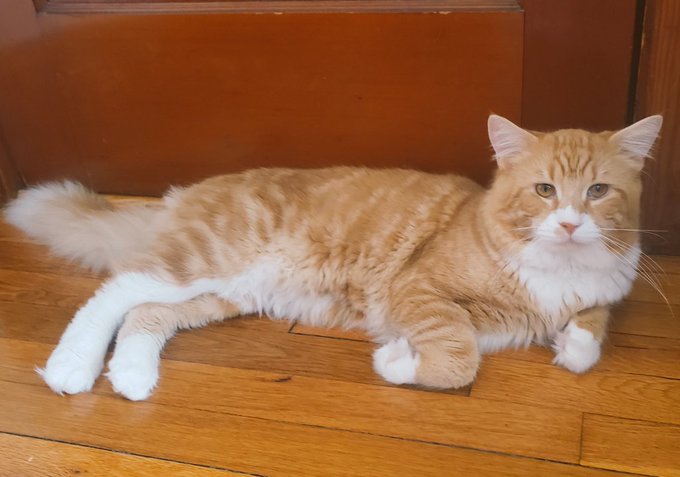
Again, anyone who follows this account on twitter knows Hermes, his attempts to escape our home, his eye infections, and his surgery. (Oh, the cat birthday parties too.) What people do not know is that when I can’t sleep at night and lay on the couch wondering what the fuck is happening to the world, Hermes comes over and starts grooming me. He licks my hair from root to end and then, if I do not start petting him, he bonks me in the cheek with his massive hairy paw.

If we get a dog, it’s Hermes’ fault. He’s, well, unleashed something that’s hard to explain.

Homer, Od. 17.301-305

“Then, indeed, [Argos] noticed that Odysseus was near
And he wagged his tail and relaxed both ears,
But he wasn’t able to go any closer to his master then.
Odysseus saw him to the side and wiped away a tear,
Keeping it secret from Eumaios….”

δὴ τότε γ’, ὡς ἐνόησεν ᾿Οδυσσέα ἐγγὺς ἐόντα,
οὐρῇ μέν ῥ’ ὅ γ’ ἔσηνε καὶ οὔατα κάββαλεν ἄμφω,
ἄσσον δ’ οὐκέτ’ ἔπειτα δυνήσατο οἷο ἄνακτος
ἐλθέμεν· αὐτὰρ ὁ νόσφιν ἰδὼν ἀπομόρξατο δάκρυ,
ῥεῖα λαθὼν Εὔμαιον….

When I talk about the Odyssey’s crucial recognition scenes, I always forget about this one. Odysseus needs his scar to be known to Eurykleia; he needs the story of the bed to finally prove himself to Penelope; and he has to tell the story of generations of trees to calm his father’s suspicions. Argos seems to need no sign, he just knows (ὡς ἐνόησεν). All that worry about some other Odysseus coming home dissipates with a wag of the tail.

I came from one of those families that always had a dog. I do not think it was possible for my parents to conceive of a family that did not have a dog. Before I was born, that had an Irish Setter named Duchess and a St. Bernard named Sam who used to follow the kids to the school bus and ride around town to the school (it was the 1970s, the world was different). When I was born, in a rare show of unity, my grandmothers made them give Sam away because they thought he was too dangerous. I used to see him at my godfather’s farm, tied up on a heavy chain, laying a distance from the house, flies swirling around him.

One of the things that is hard for me to explain to my spouse and impossible for me to talk about to my kids is that my life with pets is not a source of happy memories. My earliest memories of Duchess are of fear. And not fear of her, but fear for her. My parents, unlike Odysseus it seems, never trained their dogs well. Duchess used to run away and return after some time. It was such a regular occurrence that once my grandfather showed up in a pickup with someone else’s Irish Setter because he thought she was ours.

Duchess used to have accidents in the house because she was never walked and she was poorly trained. Every time, my father would scream, swear (“duchess, you fucking stupid bitch” is probably the earliest profanity I ever heard), and often hit or kicked her. More than once, he opened the door to the basement and threw her down the stairs. These are some of my earliest memories of my father and they do not add up to the man my wife met nearly 20 years later. And my siblings never saw him that way either.

When Duchess was a decade old, she gave birth to a single puppy. I must have been too young for kindergarten at the time, but I remember the utter confusion this inspired in our household but I do not quite remember my parents’ response. I was enchanted with this little squealing thing, this new life in our home. I named him Mud.

Three days later, I found Mud stiff and dead in the basement. My parents tried to explain to me that Duchess was too old to take care of a puppy and that Mud wasn’t meant to be born to begin with. We buried him in our back yard not too far off from where we grew squash and green beans.

We moved a few years later. Duchess was alive when we were getting ready to sell our home. Then, she was not when we moved. I have no memory of what happened to her. My father died almost ten years ago and I never asked him about it.

Homer, Od. 17.305-310

“…then Odysseus asked him
‘Eumaios, it is a great wonder that this dog lies in the manure.
His form is beautiful and I do not know clearly
Whether his speed was equal to his looks,
Or he was like those table dogs of certain men,
Those ones their masters raise for appearances.”

…ἄφαρ δ’ ἐρεείνετο μύθῳ·
“Εὔμαι’, ἦ μάλα θαῦμα κύων ὅδε κεῖτ’ ἐνὶ κόπρῳ.
καλὸς μὲν δέμας ἐστίν, ἀτὰρ τόδε γ’ οὐ σάφα οἶδα,
ἢ δὴ καὶ ταχὺς ἔσκε θέειν ἐπὶ εἴδεϊ τῷδε,
ἦ αὔτως οἷοί τε τραπεζῆες κύνες ἀνδρῶν
γίνοντ’, ἀγλαΐης δ’ ἕνεκεν κομέουσιν ἄνακτες.”

When Odysseus is asking about Argos, he wants to know if he grew up to be the dog he trained him to be. Odysseus applies an epic physiognomy here he also assumes for people: beauty should translate into good deeds; beauty without action makes you a useless suitor (or Phaeacian prince). But Odysseus also taps into an ancient distinction between working animals and, well, ‘pets’. Do we keep animals close to us just for show?

Image

Hermes is a “show” cat, for sure. He’s handsome, it’s true. Part of the reason I am so undone by Hermes is that he’s not like other cats I have been around. Where other cats are skittish, he is still. Where Mowgli and other cats I have had have rushed to the sound of cat food being opened, Hermes takes his time, eats a little and then walks away. He watches me do everything. My wife says I anthropomorphize his actual limited intelligence as contemplative. But who knows the thoughts of a quiet cat?

I did not grow up with cats. The first cat we ever had was an accident. We moved to 3 or 4 acres on the age of a large re-forested area in southern Maine (some of the land had been farmland in the late 19th century; some of it had been logged before the second World War; much had been burned in a famous fire mid-century). We had no neighbors by sight and few within a quarter mile.

One day, a small white and brown kitten was sitting, meowing at our door. Honest to goodness, I don’t know if there is anything cuter in the universe than a kitten. My mother was allergic to cats and forbade us to bring it in the house, but my sister and I took out a saucer of milk for the kitten creatively named, “Kitty”. When we returned from school, she was still there. At great urging from three children, my mother got some cat food and we fed her more.

The next day? Kitty was still there. We fed her and played with her outside, losing time the way only kids and new pets can. When we returned from school, she was still there. Later, after dinner, I went out to check on her and she was running strangely in the driveway. I caught her, and something was coming out of her rear end: a lot of something, most of her intestines. I called to my dad, who had recently returned home, and he looked at me, at the kitten and went inside.

He came out with a loaded .22, took the kitten, and walked into the woods. I have no idea how far he walked but there’s no way I wouldn’t have heard the report of the gun firing. I didn’t realize until later than Kitty had probably been hit by a car. It took me years to really think about which car that most likely was.

Homer, Od. 17.311-317

“Eumaios, my swineherd, you answered:
“Yes, this is the dog of a man who died far away.
If he were the way he was in looks and speed
When Odysseus left him to go to Troy,
You’d soon observe his great speed and valor.
Nothing ever escaped him in the deep forest
When he pursued. And he was clever at tracking too.

τὸν δ’ ἀπαμειβόμενος προσέφης, Εὔμαιε συβῶτα·
“καὶ λίην ἀνδρός γε κύων ὅδε τῆλε θανόντος
εἰ τοιόσδ’ εἴη ἠμὲν δέμας ἠδὲ καὶ ἔργα,
οἷόν μιν Τροίηνδε κιὼν κατέλειπεν ᾿Οδυσσεύς,
αἶψά κε θηήσαιο ἰδὼν ταχυτῆτα καὶ ἀλκήν.
οὐ μὲν γάρ τι φύγεσκε βαθείης βένθεσιν ὕλης
κνώδαλον, ὅττι δίοιτο· καὶ ἴχνεσι γὰρ περιῄδη.

Argos has heroic qualities, even specifically Iliadic ones. Speed and valor (ταχυτῆτα καὶ ἀλκήν)? You have an Achillean dog there, sir. But he’s also smart, like Odysseus: he is preeminent at tracking (ἴχνεσι γὰρ περιῄδη) and nothing ever escaped him in the deep darks of the wood. I don’t know if this is some foreshadowing of the murder of the suitors, but if a student claimed it on a paper, I’d give it a nice big check.

I stayed home the next day from school and generally made enough of a nuisance of myself that we got a kitten I named Nina the next week. Nina was the first pet who was almost solely mine. (My sister got a cat the next year named Jackie, mainly to taunt my father whose nickname was Jack.) I tried to establish the rule that she could not go outside, and this held for a while. When she was a month home, I was dropped off by a family friend early from school at the end of our dirt road. I came home to someone breaking into our home and stealing my father’s firearms.

The man in our driveway told me my mother was inside (which I knew to be a lie) and I silently stood at the end of the driveway. I probably scared the thief more than anything, and I certainly never felt myself in danger. He got in his car and drove off. I ran inside, through the door that had been kicked in, and called 911. The dispatcher was, in retrospect understandably, quite concerned about my safety. But I told her I had to put the phone down to find my cat. She was outside and in danger.

(I found her. She was fine, that day.)

My attachment to cats at that moment was linked to our trouble with dogs. After we moved, we had a new home so of course we needed a new dog. We picked up a shepherd-retriever mix from a shelter and named her Alfie after the ever present television Alien. Alfie was pure joy for three kids living on the edge of a forest with no friends around. My strongest memory of the time is just running around that house chased by that adorable puppy.

Puppies grow up to be dogs and when they are not fixed and are let to wander around outside, they get pregnant. Alfie gave birth to a litter of puppies a year later. Neither of my parents talked about her being pregnant and when she started giving birth to puppies, I was the only one down in the basement with her. She had six puppies. Over the next few months, we found homes for four of them.

No one who hasn’t spent time with a half dozen puppies understands how exhilarating and exhausting they are. We named each puppy and trounced around in the Maine snow with them until each one left. The two who remained, stayed for good. And it did not go well with Alfie. My parents built a pen outside and a large shed and the dogs were kept there, rain, snow or otherwise. They got loose once, attacked a neighbor’s dog, and nearly ripped his leg off. Alfie kept trying to run away from her puppies.

One day, I tried to corral the three dogs in the basement. Alfie would not go down the stairs with her offspring. She turned on me and attacked, leaving a four-inch gash in my leg. I don’t think I was mad at that dog for even a second because I never thought she was mad at me. My parents called the game warden. They told us Alfie was getting a “new home”. At age 11, I knew this was not how these stories ended.

I have no memory of what happened to the other two dogs. I do know they were still around two years later when a friend from junior high came to visit. Upon seeing the dogs, chained to trees a 100 feet from the house, dirty and ragged, he asked me how we could treat animals that way. I don’t know if I answered.

Homer, Od. 17.318-323

“But now he is overcome by evil and his master has died
Far away in another land. These shameless women don’t care for him.
The Enslaved women, whenever their rulers are gone,
Aren’t willing to do the right thing any longer.
Wide-browed Zeus strips a person of half their worth
Whenever slavery’s day overcomes them.”

νῦν δ’ ἔχεται κακότητι, ἄναξ δέ οἱ ἄλλοθι πάτρης
ὤλετο, τὸν δὲ γυναῖκες ἀκηδέες οὐ κομέουσι.
δμῶες δ’, εὖτ’ ἂν μηκέτ’ ἐπικρατέωσιν ἄνακτες,
οὐκέτ’ ἔπειτ’ ἐθέλουσιν ἐναίσιμα ἐργάζεσθαι·
ἥμισυ γάρ τ’ ἀρετῆς ἀποαίνυται εὐρύοπα Ζεὺς
ἀνέρος, εὖτ’ ἄν μιν κατὰ δούλιον ἦμαρ ἕλῃσιν.”

Argos serves here, I think, to represent some of the general entropy of the household in Odysseus’ action and as part of a process of vilifying the enslaved women before their deaths. I don’t understand why Eumaios says nothing of the rest of the family. (I mean, Telemachus parades around the island with two dogs.) Perhaps his place as the “good slave” makes it impossible for him to criticize family-Odysseus. But I’ve always thought a pet, because it depends on us, is a family’s shared responsibility.

I don’t usually get to the part of my story where Alfie is put to sleep. And I don’t know if I ever mention her puppies because even though I was not yet a teenager, I feel guilt for their lives and their ends. It is harder to tell the whole story because it is long and it seems embellished. And that’s before the next part.

Our second cat Nina eventually got to go outside. We lived on a large lot and we spent all our time outside in the summers. My mother was a school teacher and now I understand that she was suffering from depression and other issues. At the time, what I knew was that in summers, she slept a lot and spent the rest of the time in her bedroom, with the only air conditioner on, and the door closed. My siblings and I did what kids did then in the summer: we watched TV, we wandered in the woods, and we tried not to bring ticks in the house.

Nina turned out to be pregnant at the beginning of one summer vacation. I don’t know if my parents ever took her to a vet and we had gotten her from someone in the southern part of our town. She gave birth to seven kittens and they were just the cutest things I had ever seen.

The problem was that that summer saw the worst plague of fleas in decades. Our cats brought them home and the infestation was so bad when you stepped on the carpet, you could see dozens of fleas jump up and start to crawl up your leg. A day or two after they were born, the kittens were covered. I would pick one up and they would drip off them like water. And Nina stopped feeding them.

I told my mother. I told my father. Eventually, they called the vet and let me speak to them. I was told to use a comb and rubbing alcohol to try to get the fleas off the kittens. I did this with each one. Multiple times. The fleas came back. Then Nina stopped caring for the litter. One by one, the kittens stopped moving.

I don’t know what was going on between my parents. My father was gone for long days and overnight trips; my mother was distant as always. Neither of them came done to the basement to see the kittens. And I didn’t even think of asking how I would know if they were really dead. Even when I was burying them in our yard, I kept thinking I could hear them meow. We never discussed it.

We had the house fumigated, but the fleas came back. And you know what else? Nina came back, pregnant at the end of the summer. This is the part of the story I shake my head at even now. She gave birth again in a house covered in fleas. The kittens each died again one by one even after I combed them clean and tried to feed them with a washcloth dipped in milk. No one called the veterinarian the second time. Neither of my parents ever talked to me about that summer. That was three decades ago. I still feel nauseous when I think about it.

Homer, Od. 17.324-328

“So he spoke and went inside the inhabited home.
He went straight among the arrogant suitors in the hall.
But then the fate of dark death overtook Argos
Right after he saw Odysseus in his twentieth year.”

ὣς εἰπὼν εἰσῆλθε δόμους ἐναιετάοντας,
βῆ δ’ ἰθὺς μεγάροιο μετὰ μνηστῆρας ἀγαυούς.
῎Αργον δ’ αὖ κατὰ μοῖρ’ ἔλαβεν μέλανος θανάτοιο,
αὐτίκ’ ἰδόντ’ ᾿Οδυσῆα ἐεικοστῷ ἐνιαυτῷ.

Does Argos count as blessed in Solon’s words because he had a happy moment before he died? Does that one moment of relief at his master’s return make up for two decades of neglect? Will Odysseus go and get a puppy after the epic’s end?

There was another cat named Skye who lost an eye in a fight with a raccoon and like my sister’s cat Jackie just ended up wandering away one day as cats on the edge of a forest sometime do. Now I know that the cats probably fell prey to some predator or disease. But then, well, pets just kind of disappeared.

Once the last two of Alfie’s offspring were gone—wherever they went—my parents wanted another dog. This time, they went to a breeder with the plans of doing things right. We got a male chocolate lab and for reasons that are too convoluted to explain but include community theater, he was named Tevye.

We must have gotten Tevye in late spring or early summer, because by the fall he was a good-sized dog, but not yet full grown. My parents tried to keep this dog inside, closer to us, but they never put in the work to train him not to go to the bathroom in the house. He would go sometimes, my dad would explode and open the door and kick him outside. This went on until Tevye mostly whined at the door until someone let him out.

While we lived on a dirt road on one side of our property, the other side was bounded by a state road that ran north-south. There wasn’t a lot of traffic on the road and at night you could hear a car coming from a mile away. Our mailbox was a good walk from the front door to this main road. Tevye would go down there and look over the stone wall. My father would scream if he got too close.

One day, we were outside repairing the stone wall because some car had skidded off the road. As my father and I levered stones back into position, Tevye jumped over the wall and neared the road. My father started screaming and went after the dog, but I stepped in front of him and just said “no.” I pushed him back. I was in eighth grade and I was nearly the height I am now and the same weight. It was the only time in my life that I thought he would hit me and I wanted him too. But he didn’t.

On Thanksgiving, we were racing around the house trying to get everyone ready to go to my grandmother’s when there was a knock on the door. We rarely received door knocks, rarely enough in fact that my father was as likely to answer the door with a gun as he was to answer at all (he was deaf). At the door were two young men. They asked if we had a brown dog and said that one had jumped in front of their car.

They did not have a dog with them. My mother started screaming at them. My younger brother and sister started crying. I don’t know where my father went. But I was silent. I didn’t see any sense of losing it when we knew nothing. The world has more than one brown dog.

The walk from our home to the place where the dog was on the side of the road is three to five minutes, depending on your speed. Tevye was there, definitely dead, near the stone wall we had repaired. I had never handled a corpse that large before. My father hand grown up hunting, but when he took me out to learn to shoot at age six, I had no interest in the firearm or what you might do with it. Tevye was almost 50 pounds of deadweight and carrying him over that wall to a stand of pine trees felt like a lifetime.

No one else had exited the house yet. I walked the same distance back to the garage and got a shovel and then back to the stand of pine trees near the road. I started to dig near a large stone and had a large enough hole dug by the time my father came out to see what I was doing that there was no work left to be done. When I think of this now, I tremble, still confused: it was at least 20 minutes from when I left the house and started digging the hole before either of my parents came to see if their dog was really dead.

 I finished the job alone. I went to three funerals that year and one of them was a cousin who died at age 16 in a car accident. I remember that fourth funeral the most, standing alone over Tevye’s shallow grave.   

In similar tone to Odysseus’ dismissal of “table dogs”, Greek and Latin words for “pets” tend to emphasize their status as a luxury or adornment. In a fragment, Euripides calls a dog a “decoration [agalma] of Hekate” (Ἑκάτης ἄγαλμα φωσφόρου κύων ἔσῃ, fr. 968). Catullus’ Lesbia has a delicia; Martial’s Stella has a delicium (Ep. 1.7; cf. Seneca Apocolyntosis 13, subalbam canem in deliciis habere adsueverat). Exotic pets are signs of decadence: Theophrastus sees an obsequious person as likely to have a pet monkey (Characters 5); Plutarch records that comic poets slandered Perikles’ friend for his pet birds (Perikles 13.14). Diogenes Laertius tells of Heraclides and his pet snake (5.6, 89-90 These animals are different from foodstock and working animals: Alciphron calls his mistress’ Maltese puppy a “delight” (ἄθυρμα, Letters of Farmers 3.22) an here, as in Lucian (Assembly of the Gods, 5) and elsewhere the pet dog gets a diminutive: κυνίδιον.

In ancient literature, we see animals functioning as reflections for human characters. When Achilles’ horse Xanthus talks to him in the Iliad, he has the same color hair as his master and speaks to give a very Achillean message: you’re going to die. Alexander is paired in legend with Bucephalus, a horse who could be tamed only by the man who tamed the world. And Odysseus comes home to a loyal dog he forgot when he went to war. Bucephalus exists in narrative only to confirm Alexander’s greatness. Xanthus would speak for no other hero. Epic Argos exists only to increase Odysseus’ sense of loss and meaning.

Lip-cup from the British Museum

My family got a Newfoundland puppy after Tevye’s death. I kept a cautious distance from that dog and was off to college by the time she was four years old. I never had a conversation with my father about dogs and their deaths. I know he grew up with hunting dogs and my mother grew up with barn cats and farm animals and that both of them saw animals come and go in a way I never would. When my father died, he left behind a golden retriever and a wish that any donations in his name be made to the ASPCA. I bit my tongue at the irony.

When I turned 21 my future wife got me a kitten for my birthday. In truth, I think she really wanted a pet because she had never had one, but she also said that the way I talked about animals made her want to get one. I couldn’t tell her why getting a kitten caused me so much pain because I did not want to detract at all from the joy she experienced at getting one.

Chineh—which was a bastardized version of Tamil for “small”—was a feral cat who hated everyone except for my wife and me. When we went to the shelter, she put her paw outside the cage at us and meowed and it was over. My roommates and parents called her a devil cat. When I was in graduate school, my apartment burned out in an electric fire and somehow she survived. We put several thousand dollars on a credit card and spent a month cupping her rib cages to get her to cough up the smoke. I don’t know if that caused her health problems later, but it may have.

Chineh was 11 when our daughter was born. She was already having serious hormonal problems and was already less friendly than before. But I swear she changed around the baby. As our daughter grew and started to move, she would follow the cat around, pulling her tail, abusing her at every chance. And Chineh, who had scratched and bitten dozens of people before never hurt her at all.

When I left the clinic where Chineh was put to sleep, I gave them two different cat carriers and other accessories (they specialized in cats). They were hesitant because they thought I might get another cat someday. I told them I wouldn’t.

And here we are, a decade later, with two cats and hundreds of pictures on twitter to prove that I am, as my wife declares, obsessed with Hermes. Yes, he follows me to get a treat near dawn every morning. Yes, I brush him every night so his long hair won’t get matted. During the day, though, we stick to our own business.

I didn’t want to get more pets because I didn’t want to fail them. I resisted getting them because I don’t want to feel the grief of loss again. I didn’t want to get pets because I don’t want to see the pain in my children’s eyes when they die. But, as my wife says, that’s really no way to live at all.

I am going to resist getting a puppy named Zeus. Right now, my argument is that it will upset Hermes, because I can’t get these old stories out fast enough to make sense.

Good Words from Bad People

“Quoting the good words of a bad author will never shame me.”
Numquam me in voce bona mali pudebit auctoris
Seneca, De Tranquillitate Animi 8

Every so often—and perhaps too frequently in some fields—in turns out that a scholar or artist of some renown is a terrible person. Sometimes, they are garden-variety racists masquerading as free speech warriors; sometimes they just might be international criminals, selling ancient objects they don’t own, and trading on their fame and institutions to manipulate others; and, in the worst of times, they are sexual predators, causing irreparable harm while hiding in plain sight.

When these things happen, academic fields face the same challenges we have seen in recent years in film, SFF fiction, and nearly every industry where fame is a commodity that brings power and the cover to abuse with near impunity. We try to cut out the cancer before it does any more damage, but the presence is there for good, in the body. The debate on the existence and merits of ‘cancel culture’ dances around the hard questions of why some people think they’re entitled to fame and why we do in fact have the right to deprive bad actors of financial gain.

But these questions don’t really talk about what happens afterwards. In her 2016 Eidolon piece “Making a Monster”, Sarah Scullin writes about the strange horror of the Holt Parker fiasco, when an author of some influence on ancient sexuality turned out to be a child pornographer, and trying to figure out the balance between cries for a damnatio memoriae and our disciplinary standards of citing work where citation is due.

I have struggled with this question during what seems to be, thanks to our ever restrictive interconnections, the golden age of public assholery. Certain high profile cases of longterm problems suing undergraduates and famous Geniuses stealing papyri have forced me to face the monsters in my bibliography, and the compromises in my acknowledgements. Should I erase the names of people who have broken bad from my forthcoming work? Should I publicly disavow those who helped me in the past?

People and what we make of them

I guess I ask this because, like Scullin in her article, I am not sure of the answer. I incline in part towards not changing a thing, for two reasons. I feel in part that footnotes and acknowledgements to bad men are a kind of disclosure, a owning of the truth that our field is populated by flawed humans like any other. It also attests to the hierarchy of patronage that is central to the academic enterprise. It is a rare person who can make their way in this world without help from someone more experienced and powerful. And, well, power corrupts in all forms. And, well, getting to the top of the academic ladder does not require being a good human being.

So I guess part of the problem is that our performative obeisance exposes us to a chain of associative kleos which, given the tides of time, can go dus- or eu-. But I am also interested in how much of our behavior is based on a static and deeply problematic view of human beings. It is hard for most of us to accept the degree to which persons and personalities are contextual and that in a culture such as ours so much of what we see as signs of character are reactive and transactive negotiations.

A proverb erroneously attributed to Aristotle, “a friend to all is a friend to none”, would seem to indicate that constancy in treatment from one person to another is some kind of a value. In truth, Aristotle seems to come down on the side of not making all the friends in the Nicomachean Ethics 1170e-1171b) where he does say that “people who have many friends and shout familiarly to everyone appear to be friends of no one” (οἱ δὲ πολύφιλοι καὶ πᾶσιν οἰκείως ἐντυγχάνοντες οὐδενὶ δοκοῦσιν εἶναι φίλοι) because Aristotle argues that one significant goal of friendship is the pleasure of sharing each other’s perception of existing and being good.

Is there anyone who is good or bad to everyone they encounter? Indeed, another proverb from ancient Greek—that justice is doing good to your friends and evil to your enemies—would argue the opposite. Why is it so hard for us to comprehend that someone who was kind to us individually was cruel—if not abusive and worse—to someone else? Part of the problem with our response to the fall of great idols is that our shock and surprise runs counter to what we should already know about human beings. We are not stock characters; we are not constant beings; we are, at best, thin veils of temporary will over conflicting insecurities and desire.

Now, I know that pseudo-Lacanian description will gall many, but I would relent only to say that we conflate the reputations we grant to people for work we appreciate or use with the person themself. We make a metonymic error in seeing the kindness done for an individual as a sign of the sum total of a person’s identity. We make people into things they are not and then suffer the paralysis of horror when they turn out to be something different.


Things and what we make of them

For me, this runs up, to, and alongside current conversations about cancel culture. I have written before about my reaction to J. K Rowling being a transphobic trainwreck doing to Hogwart’s what not even Voldemort could achieve. My solution is naively simple: separate the art from the artist. We made Rowling into someone who matters because the world she created matters to us.

Any model of reading and reception that persists in centering the author over the audience is, in my ever so humble opinion, a dangerous distraction from reality rooted in a stubbornly individualistic worldview, steeped partly in monotheism and partly in capitalism (on which, more later). A painting had to be made by someone, of course, but it relies on a syntax of space, color, story, and meaning within and against which the painter operates and whose existence is only completed by the viewer who shares some frames of reference. (And this leaves out the contribution of the laborers who made the canvas and paint, the partner who made the painter’s lunch, the friend who sparked an idea, the custodian who cleans so the painter can paint and so on and so on.)

Literary and academic products draw more on conventions and the contributions of groups, especially audiences, than the individual who brings them to shape in the world. As I talked about probably too much, my favorite metaphor for this from ancient Greece comes from Plato’s Ion, where Socrates explains that a rhapsode (like Ion) is merely one of a series of metal rings that translates the magnetic charge from the “magnet” (which is the Muse or divine power) through a poet, through the rhapsode, to an audience. The one thing I would change about this metaphor is to acknowledge that it is iterative and reflexive. The divine Muse is the sum total of a cultural consciousness, that nearly indescribable shared mind of a language and people particularized in one form of art at one time or another.

Ah, yes, what heady language for academic work! One of the great ironies about the work we do in academia, however, is that despite how collaborative it is, how much it depends on the work of prior scholars, current editors, students, friends and teachers, we mostly credit and prize the individual genius of the scholar who somehow manages to write it down. I tend to thank a lot of people in acknowledgements because I am deeply conscious of my own limitations as a thinker and of how much I have been prompted to think, write, and say by others.

There are different ways to talk about how our minds work with each other. From simple things like cognitive offloading—e.g. couples over time specializing in remembering somethings and not others, relying on each other—to more complex models of group minds and distributed cognition (language etc.), it is clear that not only is no man an island, but each of us is less like a leaf on a tree than a cell in a complex organism. We don’t sense it this way because this is just too big a thought for our limited brains. The human species-wide Dunning-Kruger effect just may be that our individual consciousnesses are for the most part too simple to apprehend how complex we are collectively.

But what if someone is really, really bad? Do we need to socially distance ourselves from bad ideas too?

Where do Ideas come from?

Later, in the same passage of the Ion where he describes the metaphor of a magnet offers as proof the case of Tynnichus, a terrible poet who composed a song everyone loves (Plato, Ion 534d-535a)

“The greatest proof of my argument is Tynnichus of Chalcis who never composed any poem worth remembering except for the paean everyone sings, nearly the most beautiful of all songs, a thing he himself calls “some discovery by the Muses”.

In this example, especially, the god seems to me to demonstrate to us so that there is no doubt, that these poems are not human nor by humans but divine and by the gods and, moreover, that poets aer nother other than interpreters of the gods, inspired in the way that each one is inspired. And the god demonstrated this by having the worst poet compose the finest song.

μέγιστον δὲ τεκμήριον τῷ λόγῳ Τύννιχος ὁ Χαλκιδεύς, ὃς ἄλλο μὲν οὐδὲν πώποτε ἐποίησε ποίημα ὅτου τις ἂν ἀξιώσειεν μνησθῆναι, τὸν δὲ παίωνα ὃν πάντες ᾁδουσι, σχεδόν τι πάντων μελῶν κάλλιστον, ἀτεχνῶς, ὅπερ αὐτὸς λέγει,

‘εὕρημά τι Μοισᾶν.’ ἐν τούτῳ γὰρ δὴ μάλιστά μοι δοκεῖ ὁ θεὸς ἐνδείξασθαι ἡμῖν, ἵνα μὴ διστάζωμεν, ὅτι οὐκ ἀνθρώπινά ἐστιν τὰ καλὰ ταῦτα ποιήματα οὐδὲ ἀνθρώπων, ἀλλὰ θεῖα καὶ θεῶν, οἱ δὲ ποιηταὶ οὐδὲν ἀλλ᾽ ἢ ἑρμηνῆς εἰσιν τῶν θεῶν, κατεχόμενοι ἐξ ὅτου ἂν ἕκαστος κατέχηται. ταῦτα ἐνδεικνύμενος ὁ θεὸς ἐξεπίτηδες διὰ τοῦ φαυλοτάτου ποιητοῦ τὸ κάλλιστον μέλος ᾖσεν

Tynnichus was, in a way, an original one-hit wonder of ancient Greece. It can indeed make sense to wonder when someone creates a piece of art so impactful that its greatness is universally acknowledged why they fail to ever approach the same heights. We psychoanalyze the artist’s anxiety and fear of failure, that they are suddenly flame-throwing relievers who have lost the strike zone. But perhaps Socrates’ solution is simpler and more elegant. Tynnichus did not compose a great song again because he never composed it to begin with.

Where do great ideas come from? Our answer to this is almost always shaped by what we are already conditioned to look for. We gaze at the biographies of great men. We peer into their minds, looking for the difference that made them greater than others. But our gaze in many cases needs to look outward in time and space.

We give credit for inventions and innovations to individuals despite evidence to the contrary. There is good reason to lend credence to theories of multiple discovery or convergent evolution, showing that the intellectual background and shared conditions of a period can lead individuals like Newton and Leibniz to the same place (calculus!). Convergent evolution shows that similar solutions can develop for similar problems in similar circumstances without assigning genius to one place or another

And as my Brandeis colleague Aparna Baskaran explores in her work, complex systems that appear to have intelligence and intention (from cell movement to blocks of birds) can be explained by physics and mathematics as having neither. We impose agency and genius on the world because this is the way we see it.


Hit those Moneymakers?

“Simonides seems to have been the first to adapt money-making to songs and to compose his works for pay. This is what Pindar says deceptively in his second Isthmian: “For the Muse was not then greedy or out for hire.”
ὁ Σιμωνίδης δοκεῖ πρῶτος σμικρολογίαν εἰσενεγκεῖν εἰς τὰ ᾄσματα καὶ γράψαι ᾆσμα μισθοῦ. τοῦτο δὲ καὶ Πίνδαρος ἐν τοῖς Ἰσθμιονίκαις φησὶν αἰνιττόμενος·
. . . ἁ Μοῖσα γὰρ οὐ φιλοκερδής πω τότ᾿ ἦν οὐδ᾿ ἐργάτις . . . (2. 6).
Scholiast on Aristophanes’ Peace 695-700

A few weeks ago, a few lines of a song by Micah P. Hinson floated into my head and I went to spotify and started listening. I had not listened to Hinson in years and had nearly forgotten about him. So, I started reading about what had happened to him and discovered pretty quickly that I found him to be quite the objectionable chap. Indeed, so objectionable that I felt uncomfortable using a streaming service to send a fraction of a penny to his bank account. But can we truly buy our way into virtue or out of vice?

One indication of the problem in academia is the way we cite work in most systems: author, date, page. It flattens everything about the process of ideamaking and credits an individual. But the meaning made from that citation has the author of the footnote to thank as well as all the unnamed people who contributed to those ideas. Works have lives far beyond the minds of their authors—imagine if children walked around named Christensen 2010 and Christensen 2011! But citing by article name instead of author would be just a way not talking about the problem

The impetus behind boycotting and de-platforming bad actors is to my mind a good one. It is about depriving harmful people of both the ability to cause further harm and to profit from their harmful action. The melodramatic overreaction to “cancel culture” is in part an entrenched power class’s fragility at being held accountable and in part a panic over what was assumed to be an limitless field of earning. (Although, to be fair, the mobbing part of such cancellation introduces new problems.)

The danger comes in the way we translate our social value into economic worth and how our models of remuneration, citation, and authorship are thoroughly commodified. This is easy for me to see in the proverb “give credit where credit is due,” a saying, perhaps coined by Samuel Adams in 1777 . That word credit from the Latin loan or debt (creditum), according to the OED came through French and Italian conveying both the sense of belief trust and the sense of a loan to be made based on belief and trust.

This overlap between an estimation of moral value and a valuation in financial terms is truly ancient, likely predating Alkaios who famously sings “Man is money—no one poor is noble or honored.” χρήματ᾿ ἄνηρ, πένιχρος δ᾿ οὐδ᾿ εἲς πέλετ᾿ ἔσλος οὐδὲ τιμίος (fr. 360). The conceptual metaphor between reputation and potential financial worth is so ingrained in our culture that we rarely question the logic of rich people deserving their riches. (When we know that great wealth cannot actually be acquired without theft and exploitation.)

Our laws and practices in artistic copyright, intellectual property, publication, patents and more are wholly shaped by the definition of ideas as commodity. Even in the humanities, lines of credit on CVs translate into higher paying jobs, higher wages, better positions. In a school like mine, a book published early in a career might yield no royalties, but the raise I receive of 5% of my salary compounded over 30 years of a career can translate into significant wealth. Our lives (Greek, bioi) are shaped by the translation of our activity into livelihood. And this is one of the most pernicious elisions in our language: the worth of a life in nothing but the value of its work.

To what degree is citing or not citing someone we (or others) find reprehensible about deferred credit, about anxiety over the devaluation of our own esteem. In this, perhaps, is an acknowledgement of the collective nature of our ‘products’ in the risk that others bring us.

“Canceling” a terrible person targets cultural esteem and in many cases may harm them economically. (Although, I think that for someone like Rowling, her income growth will turn merely incremental from exponential.) Because I think poets are not wholly responsible for their poems, I can enjoy the verse of a bad person. But I don’t want to pay for it.

But if citation and mention translates into esteem, what does it mean to talk about the good works of bad people in public? What does it mean to cite the useful article of the shitbird academic? My first answer—to be honest about the field that makes us all complicit in propping up petty and nasty people—does not stand up well to the danger that an unmarked acknowledgment now may translate into future benefit for the person whose work I don’t despise.


Everything’s Coming Up Solon

“People have an ancient famous proverb:
That you should not judge any mortal lives
You can’t see them as good or bad before someone dies
Λόγος μὲν ἔστ᾿ ἀρχαῖος ἀνθρώπων φανεὶς
ὡς οὐκ ἂν αἰῶν᾿ ἐκμάθοις βροτῶν, πρὶν ἂν
θάνῃ τις, οὔτ᾿ εἰ χρηστὸς οὔτ᾿ εἴ τῳ κακός·
Sophocles, Trachinae 1-3

Some of us like to think that the arc of the universe bends towards justice, but instead, I think we’re really talking about a sphere giving in to entropy. Most things get worse, or at least get to be less of what they were, over time. The likelihood of someone you know upsetting or disappointing you overtime is non-negligible. That’s because none of us are consistently anything except for alive, until we’re not.

In the same essay where he declares himself immune to shame over quoting good words from bad authors, Seneca quotes from Publilius Syrus that “whatever can happen to someone else can also happen to you” (cuivis potest accidere quod cuiquam potest, De Tranq. 9). This line is part of an anti-hubris “check yourself before you wreck yourself” ethic, but it also reminds me of Herodotus’ Solon, who warned Croseus not to count a man as lucky before his days have ended

If you live a thoroughly wretched life but your last day is good, does that mean people to come can call you happy, Solon? And if you do mostly good, but have a really bad day, does that undo the good? And can we even manage to think about whether Solon’s notion is about pleasure at your own good and not actually doing good for other people? Clearly, this is not the place to answer this, but it seems likely that at the end of every person’s life we hear something like, “Indeed, Socrates, after all this talk, I guess we still don’t know what happiness is.”

One peril of admiring (or citing) anyone is that over a lifetime we’re all pretty much certain to disappoint. I like to think that Solon’s logic also contains the corollary that if life can turn out badly at the last moment, it can also turn out well. To believe in the possibility of education one must believe that people have the capacity to change. So, perhaps the bad words of a good author will improve and a bad author might turn out to be a better person some day.

But then we are back to the pageantry of withhdrawal and return, of wondering if someone has reformed truly or is merely back in disguise for more lines of credit. What are our limits on forgiveness? How much do we believe in personal growth? Separating the work from the life and the person from work may help liberate us all. And then we can get back to the hard work of living together and understanding ourselves.


Go here for a scholarly debrief on footnote practices.


File:Quentin Massys 030.jpg
Quentin Matsys Allegory of Folly

Founding Frauds of the Role-Playing Republic

“History, Stephen said, is a nightmare from which I am trying to awake.”
James Joyce, Ulysses

Every American schoolchild learns about the founding generation (or “the Founding Fathers”) from an early age. Much of what we learn is obviously mythical, as in the story of George Washington chopping down the cherry tree. Other early lessons involve some real history run through the filter of selectively patriotic distortion, which frames the Boston Massacre as the obvious first step in King George’s iron-heeled march toward a kind of colonial totalitarianism. There are also the sins of omission and denial, as in the long silence in American classrooms about the brutality of men like Jefferson who, for all of their Enlightenment rhetoric, were despotic tyrants over people whom they regarded as their property.

There are also misconceptions about the founding generation which partake of all three of these elements. One of these misconceptions is the idea that the founding generation represented a unique intellectual pinnacle in American life, and that the men who crafted our country’s political system were singularly imbued with a classical education. In many ways, this myth parallels the myth that the founders were all Christians, despite notable deistic (and even atheistic) tendencies among them, and despite their often spotty record of church attendance. In both cases, people want to project a set of values or qualities back upon idealized fictions bearing the names of men who lived through and participated in an inflection point in the nation’s history.

We will take a closer look at the classical attainments of the founding generation, and I hope that by the end of this essay it will be clear that the founders’ knowledge of the classics was not especially advanced in comparison to other people of their time; that in fact, many men of their generation displayed a hostility toward the study of ancient languages and literature which prefigures a broad trend of anti-intellectualism and hard-headed, efficiency-minded practicality in this country; that, while it is indeed true that the founders drew upon their classical learning to shape the political framework of this country, much of this rested upon selective and creative appropriation of classical history and thought; and finally, that many of America’s most dangerous and dysfunctional tendencies, in particular its inability to function collectively for civic good, can be attributed to the founders’ creative but fundamentally flawed reception of the classical past.


Founders vs. Scholars

It is often observed that the founders were steeped in classical learning, and that their reading of ancient history was the primary impetus for instituting a mixed form of government as described by Aristotle and Polybius. While there can be no doubt that the founders talked about classics all the time, it is not clear that many of them possessed much deep knowledge of antiquity. Indeed, many of them were familiar with all of the canonical works, but this was to be expected of anyone who had progressed through the classically-based educational system which prevailed at the time. Their knowledge was chiefly of the contents of ancient books, and reflects less serious engagement with the scholarly humanistic tradition than was characteristic of their counterparts across the Atlantic.

In order to better understand the extent of the founders’ classical knowledge, we may consider the example of their rough contemporaries. English classical scholarship in the generation immediately preceding that of the founders was dominated by Richard Bentley. While famous among Classical scholars, Bentley is largely forgotten to the broader intellectual world, except to those who recall him as the butt of the joke in Pope’s Dunciad and Swift’s Battle of the Books. Bentley, a graduate of St. John’s College, Oxford, spent much of the 1680s in the household of Edward Stillingfleet before rolling on to the scholarly scene in the 1690s with two works which display what Gibbon would call “a stock of erudition which would have puzzled a doctor.”

Bentley’s early scholarly fame was established by two immensely erudite treatises published toward the end of the 17th century, which received some impetus from the fashionable intellectual controversy known as The Battle of the Books (or The Quarrel Between Ancients and Moderns). The controversy itself has been forgotten by the public at large, perhaps because the debate has been so firmly settled on the side of modernity, but it was still capable of exciting tempers at the end of the 17th century, and served as the foundation for Bentley’s famous Dissertation Upon the Epistles of Phalaris. The epistles were literary forgeries (or playful literary exercises) written in the persona of Phalaris, the tyrant of Akragas, who cooked his enemies inside a brazen bull which he kept at his court. Many astute readers had long seen that the Epistles were not actually written by the tyrant himself, but that did not prevent Sir William Temple from blundering his way into citing them as proof for his claim that the achievements of antiquity far surpassed those of the modern world. Temple described the Epistles as having “more Race, more Spirit, more Force of Wit and Genius than any others I have ever seen, either antient or modern.” William Wotton, one of Bentley’s friends, penned a response to Temple arguing for the superiority of modern achievement, and published it along with the 78 page first edition of the Dissertation, composed by Bentley, which showed that the Epistles were neither original, nor as ancient as Temple had supposed. This led to a counterattack by Francis Atterbury, which in turn drove Bentley to publish a substantially enlarged, 540 page edition of the Dissertation. Unsurprisingly, the second edition of the Dissertation was far more diffuse and digressive than the first, and it does more than simply prove its point about the Epistles – it provides commentary upon and solutions to a wide range of textual and chronographic problems which are tangentially related to issues suggested by the Epistles themselves.

The example of Bentley is important because his work explored the deep arcana of classical reading. Many of his gentlemanly contemporaries faulted him for compiling indexes out of obscure (i.e. non-canonical) authors, and sifting through masses of Byzantine lexicography to illustrate and resolve textual difficulties in both major and minor works of classical literature. Bentley was a genius, and even when he applied himself to correcting some apparently small and well-defined textual problem, his method for solving the difficulty often led him to correct several other errors in other texts along the way, as though they were wholly accidental scholarly parerga.

Beyond England, Classical scholarship was alive and well on the continent, too, and one of history’s most renowned and important classical scholars, F.A. Wolf, was active during the same period as the founders. Consider the high level of classical education which Wolf achieved even as a very young man:

Towards the end of his school-days he became his own teacher. Starting once more with the declensions, he ‘read with new eyes the Latin and Greek Classics, some carefully, others more cursorily; learnt by heart several books of Homer, and large portions of the Tragedians and Cicero, and went through Scapula’s Lexicon and Faber’s Thesaurus’. During this time of strenuous study, ‘he would sit up the whole night in a room without a stove, his feet in a pan of cold water, and one of his eyes bound up to rest the other’. Happily this severe ordeal ended with his removal to the university of Gottingen.” [Sandys, A History of Classical Scholarship VOL. 3]

The founders may have been drilled in the classics as schoolboys, but it does not appear that any of them could match this kind of ardor for classical knowledge. Nor could they even hope to approximate the depth of the scholarship exemplified by those lights of the 18th century, Bentley and Wolf. They were perfectly happy to read from the classical canon, but even in that narrow context, their focus was primarily on the historical and political aspects of ancient writings. The founders made the mistake of treating antiquity not as an object for study and scholarship, but as a set of exempla for emulation and revivification.

One may object that the founders were men of action, not cloistered pedants, and so could not hope to rival the bibliomania and scholarly exactitude of real scholars. Gibbon was, for all of his scribbling, but a gentleman amateur, and yet the range of classical reading which he conducted in writing his Decline and Fall of the Roman Empire far outstrips that which can be gleaned from anything the founders wrote. Even as a young man, he was dipping into the more recondite parts of classical literature:

My first introduction to the historic scenes, which have since engaged so many years of my life, must be ascribed to an accident. In the summer of 1751, I accompanied my father on a visit to Mr. Hoare’s, in Wiltshire; but I was less delighted with the beauties of Stourhead, than with discovering in the library a common book, the Continuation of Echard’s Roman History, which is indeed executed with more skill and taste than the previous work. To me the reigns of the successors of Constantine were absolutely new; and I was immersed in the passage of the Goths over the Danube, when the summons of the dinner-bell reluctantly dragged me from my intellectual feast. This transient glance served rather to irritate than to appease my curiosity; and as soon as I returned to Bath I procured the second and third volumes of Howel’s History of the World, which exhibit the Byzantine period on a larger scale. Mahomet and his Saracens soon fixed my attention; and some instinct of criticism directed me to the genuine sources. Simon Ockley, an original in every sense, first opened my eyes; and I was led from one book to another, till I had ranged round the circle of Oriental history. Before I was sixteen, I had exhausted all that could be learned in English of the Arabs and Persians, the Tartars and Turks; and the same ardour urged me to guess at the French of D’Herbelot, and to construe the barbarous Latin of Pocock’s Abulfaragius. Such vague and multifarious reading could not teach me to think, to write, or to act; and the only principle that darted a ray of light into the indigested chaos, was an early and rational application to the order of time and place. The maps of Cellarius and Wells imprinted in my mind the picture of ancient geography: from Stranchius I imbibed the elements of chronology: the Tables of Helvicus and Anderson, the Annals of Usher and Prideaux, distinguished the connection of events, and engraved the multitude of names and dates in a clear and indelible series. But in the discussion of the first ages I overleaped the bounds of modesty and use. In my childish balance I presumed to weigh the systems of Scaliger and Petavius, of Marsham and Newton, which I could seldom study in the originals; and my sleep has been disturbed by the difficulty of reconciling the Septuagint with the Hebrew computation. I arrived at Oxford with a stock of erudition, that might have puzzled a doctor, and a degree of ignorance, of which a school-boy would have been ashamed. (Gibbon, Memoirs of My Life)

The mind aches just from reading the catalogue of this reading, but it is a testament to the kind of intellectual activity which was occurring in the English-speaking world contemporary with the founders, and tends to make their own experience with the classics look a bit provincial.

The tendency to exaggerate the attainments of the founders is a well-established part of mythologizing the American past. Even in other matters, it is hard not to see that they have been given more credit than is properly their due. To take one example, Jefferson is often praised as an English prose stylist, and yet his initial draft of the Declaration of Independence was improved by committee editing. Moreover, Jefferson only strikes us as a great prose stylist by comparison with other American writers of his time, but does he bear any real comparison with the other 17th century prose writers across the Atlantic, such as Addison, Hume, Johnson, Gibbon, or Burke? Benjamin Franklin is celebrated for his science, but does he really bear comparison with Isaac Newton or Joseph Priestly?


Antipathy to Classical Education

Naturally, not all of the founding generation held the same attitude toward the study of the classics, and some were positively opposed to retaining the old classical curriculum in the newly founded country. Benjamin Rush was one of the most virulent critics of the classics:

The study of the Latin and Greek languages is improper in the present state of society and government in United States. While Greek and Latin are the only avenues to science, education will always be confined to a few people. It is only by rendering knowledge universal, that a republican form of government can be preserved in our country. (Rush, Essays: Moral, Literary, and Political 10)

Elsewhere, Rush conceded that students may do something in the ancient languages, but argued that it should be strictly limited:

No more Latin should be learned in these schools than is necessary to translate that language into English, and no more Greek than is necessary to read the Greek Testament. (Rush, Letter to Ashbel Green, May 22 1807)

Rush is emblematic of the hard-headed practicality (some might even call it utilitarian provincialism) which to many people seems an integral part of the American spirit.

In a letter to Benjamin Rush in 1810, well after he had left politics behind, John Adams wrote to condemn Rush’s antipathy toward classical learning:

I deceived you a little by an Inference of my own from what The Edinborough Reviewers had written. I know not that they have mentioned you by Name or your Works by their Titles: but I read in them “If every Thing which has ever been written in America (if you except perhaps the Works of Franklin) were annihilated the Sum total of human Knowledge would in no degree be lessened.” I draw the Inference, for Dr Rush’s Works have been written and printed in America. I have felt as well as you The Odium Theologicum; the Odium Politicum, and The Odium Mercatorium. Happily I have escaped as far as I know The Odium Philologium, The Odium Medicum and The Odium Sanguiphobium. I have escaped these Hatreds because I never knew enough about any of them to excite any other Mans Jealousy or Envy.

But now I must tell you a great and grave Truth. I am one among your most Serious haters of the Philological Species. I do most cordially hate you for writing against Latin Greek and Hebrew. I never will forgive you untill you repent, retract and reform. No Never! It is impossible.”

Rush was not the only member of the founding generation to feel some doubts about the value of classical languages. In his Autobiography, Benjamin Franklin argues that  the traditional Latin curriculum is of doubtful utility:

I would therefore offer it to the consideration of those who superintend the education of our youth, whether, since many of those who begin with the Latin quit the same after spending some years without having made any great proficiency, and what they have learnt becomes almost useless, so that their time has been lost, it would not have been better to have begun with the French, proceeding to the Italian, etc.; for, tho’, after spending the same time, they should quit the study of languages and never arrive at the Latin, they would, however, have acquired another tongue or two, that, being in modern use, might be serviceable to them in common life.


Classics and Class: Luxury vs. Utility

Thomas Jefferson was, like John Adams, one of the keener enthusiasts for classical learning, but even he would limit it to the early years of education. In a letter to John Brazier (August 24th, 1819), Jefferson frames classical education as something ideally suited to form the writing style of the young, and delight old men in retirement:

I estimate the luxury of reading the Greek and Roman authors in all the beauties of their originals. And why should not this innocent and elegant luxury take its preeminent stand ahead of all those addressed merely to the senses? I think myself more indebted to my father for this than for all the other luxuries his cares and affections have placed within my reach; and more now than when younger, and more susceptible of delights from other sources.

[…]

But to whom are these things useful? Certainly not to all men. There are conditions of life to which they must be forever estranged, and there are epochs of life too, after which the endeavor to attain them would be a great misemployment of time. Their acquisition should be the occupation of our early years only, when the memory is susceptible of deep and lasting impressions, and reason and judgment not yet strong enough for abstract speculations.

Nearly two decades earlier, Jefferson had written to Joseph Priestly (January 27th, 1800) to praise the ‘luxury’ of classical reading:

To read the Latin and Greek authors in their original, is a sublime luxury; and I deem luxury in science to be at least as justifiable as in architecture, painting, gardening, or the other arts. I enjoy Homer in his own language infinitely beyond Pope’s translation of him, and both beyond the dull narrative of the same events by Dares Phrygius; and it is an innocent enjoyment. I thank on my knees, him who directed my early education, for having put into my possession this rich source of delight; and I would not exchange it for anything which I could then have acquired, and have not since acquired.

John Adams was not born into the same life of privilege was Jefferson was, and he recounts that his father made him dig in a ditch as a way of punishing him for failing to apply himself to his Latin lessons. Adams’ father understood that knowledge of the classics could lead to social advancement, and thought that the drudgery of the ditch would contrast favorably to the drudgery of declension. While Jefferson occasionally mentions the utility of classical education, as an aristocrat he clearly conceives of it as something like his birthright – a luxury available to a select few, and one which is chiefly a source of recreational delight. Adams had to suffer more for his education, and seems as a result to value its utility more. Consider their different attitudes toward reading classical political histories in retirement:

I have read Thucidides and Tacitus, So often, and at Such distant Periods of my Life, that elegant, profound and enchanting as is their Style, I am weary of them. When I read them I Seem to be only reading the History of my own Times and my own Life. I am heartily weary of both; i.e. of recollecting the History of both: for I am not weary of Living. Whatever a peevish Patriarch might Say, I have never yet Seen the day in which I could Say I have had no Pleasure; or that I have had more Pain than Pleasure. (John Adams, Letter to Thomas Jefferson, 3 February 1812)

The problem you had wished to propose to me was one which I could not have solved; for I knew nothing of the facts. I read no newspaper now but Ritchie’s, and in that chiefly the advertisements, for they contain the only truths to be relied on in a newspaper. I feel a much greater interest in knowing what has passed two or three thousand years ago, than in what is now passing. I read nothing, therefore, but of the heroes of Troy, of the wars of Lacedaemon and Athens, of Pompey and Caesar, and of Augustus too, the Bonaparte and parricide scoundrel of that day. I have had, and still have, such entire confidence in the late and present Presidents, that I willingly put both soul and body into their pockets. While such men as yourself and your worthy colleagues of the legislature, and such characters as compose the executive administration, are watching for us all, I slumber without fear, and review in my dreams the visions of antiquity. (Thomas Jefferson to Nathaniel Macon, January 12, 1819)

Jefferson and Adams were divided by geography and social class, and their views on their own classical learning reflect that. Nevertheless, it is also clear that their classical education provided a shared cultural reference point between them. Yet, despite their manifest enthusiasm for the classics, their justifications either strike the classist and elitist note (Jefferson) or emphasize the utility of learning (Adams), and this is characteristic of much of the debate among the founding generation. Compare this to the simple, democratic, and universalizing humanism of Samuel Johnson:

On Saturday, July 30, Dr. Johnson and I took a sculler at the Temple-stairs, and set out for Greenwich. I asked him if he really thought a knowledge of the Greek and Latin languages an essential requisite to a good education. JOHNSON. ‘Most certainly, Sir; for those who know them have a very great advantage over those who do not. Nay, Sir, it is wonderful what a difference learning makes upon people even in the common intercourse of life, which does not appear to be much connected with it.’ ‘And yet, (said I) people go through the world very well, and carry on the business of life to good advantage, without learning.’ JOHNSON. ‘Why, Sir, that may be true in cases where learning cannot possibly be of any use; for instance, this boy rows us as well without learning, as if he could sing the song of Orpheus to the Argonauts, who were the first sailors.’ He then called to the boy, ‘What would you give, my lad, to know about the Argonauts?’ ‘Sir, (said the boy,) I would give what I have.’ Johnson was much pleased with his answer, and we gave him a double fare. Dr. Johnson then turning to me, ‘Sir, (said he) a desire of knowledge is the natural feeling of mankind; and every human being, whose mind is not debauched, will be willing to give all that he has to get knowledge.’

Classical Errors:

The easy superficiality of the founders’ classical reading can be detected in some of the elementary errors which they committed to writing. In a letter to Christopher Gadsden in December 1766, Samuel Adams wrote, “The Stamp Act was like the sword that Nero wishd for, to have decollated the Roman people at a stroke…” Perhaps Samuel Adams thought that one tyrant was like every other, but he has misattributed this quotation to Nero, when in fact it is one of the more memorable sayings of Caligula, as recorded by Suetonius.

Samuel Adams’ more famous and ostensibly more erudite cousin, John Adams, was guilty of a similar lapse. Writing to Benjamin Rush in October 1810, Adams defended the study of the classics against Rush’s assault:

Hobbes calumniated the Classicks, because they filled young Mens heads with Ideas of Liberty, and excited them to rebellion against Leviathan.

Suppose We Should agree to Study the oriental Languages especially the Arabic, instead of Greek and Latin. This would not please the Ladies So well, but it would gratify Hobbes much better. According to many present appearances in the World many useful Lessons and deep Maxims might be learned from the Asiatic Writers. There are great Models of Heroes and Conquerors fit for the Imitation of the Emperors of Britain and France. For Example in the Life of Timur Bec, or Tamerlane the great We read vol. 1. p. 202. “It was Timurs Ambition of Universal Empire which caused him to undertake Such glorious Actions. He has been often heard to Say, that it was neither agreable nor decent, that the habitable World Should be governed by two Kings: according to the Words of the Poet, ‘as there is but one God, there ought to be but one King, all the Earth being very Small in Comparison of the Ambition of a great Prince” Where can you find in any Greek or Roman Writer a Sentiment so Sublime and edifying for George and Napoleon. There are Some faint Traces of it in the Conduct of Alexander and Cæsar but far less frank and noble, and these have been imprudently branded with Infamy by Greek and Roman orators and Historians. There is an Abundance more of Such profound Instruction in the Life of this Tamerlane as well as in that of Gengizcan, both of which I believe Napoleon has closely Studied. With Homer in one Pocket Cæsars Commentaries in the other Quintus Curtius under his Pillow, and the Lives of Mahomet Gengizcan, and Tamerlane in his Port Folio, and Polybius Folard, Montecucculi, Charlemagne, Charles twelfth Charles 5th cum multis aliis among his Baggage this Man has formed himself: but the Classics among them have damped his ardor and prevented his rising as yet to the lofty Heights of the Asiatic Emperors.

Where can you find in any Greek or Roman Writer a Sentiment so Sublime and edifying for George and Napoleon? One can find it in Homer, the author whom Adams cites as having a tempering influence on the tyrannical impulse in Napoleon. In the Iliad, when Agamemnon makes a trial of the Achaeans under his command, he finds that – contrary to his expectation – all are eager to abandon the field and head home after years of fruitless war. Odysseus rallies round and attempts to stop the men by doubling down on this cheerfully antidemocratic sentiment:

Let there be one ruler, one king…

…εἷς κοίρανος ἔστω, εἷς βασιλεύς… [Iliad 2.204-5]

My citation of these surprising lapses on the part of Samuel and John Adams is not mere pedantry. These are not deep scholarly arcana. Homer and Suetonius were very much a part of the classical curricular canon which any student would have been exposed to and expected to internalize. The episode in the Iliad in which Odysseus checks the flight of the troops is a famous scene, and yet Adams seems to have forgotten entirely that Odysseus advocates not just for monarchy, but for absolute monarchy. All of the Greek heroes are kings in their own right, but Agamemnon is to be the king of kings – much more of a Cyrus than a George Washington. It is convenient enough for Adams’ purpose to suggest that the classics are conducive to the spirit of liberty, but while the classical canon may feature plenty of approving uses of the word liberty and much scorn heaped on the evils of tyranny, there is almost nothing in the classics which is truly libertarian in spirit or subversive of unequal civic power structures. ‘Tyrant’ is often just a pleasing substitute for an enemy who has the power which you consider properly your own.

One cannot deny that many of the founders felt an enthusiasm for ancient models, but this was primarily because they served as internalized and self-justifying propaganda. Moreover, with the exception of Christianity, there was no other fixed cultural reference point for well-educated Europeans and their provincial satellites. Indeed, the classics made up something close to the sum total of educational curriculum at the time. Henry Steele Commager claimed that the founders knew more about the ancient world than they knew about America and contemporary Europe, but this should hardly be surprising. Rapid travel and communication were not yet possible, while America and contemporary Europe weren’t on the syllabus; the classics, however, were studied for years and good chunks of them were memorized by rote.

Thus, we ought not to read too much into the apparent classical enthusiasm of the founders when there was no real alternative for meaningful and universalized cultural reference. The classical knowledge possessed by the founders may have been greater than that possessed by most American politicians today, but the classical attainments of any person who had been to a grammar school in the 18th century would have been greater than the classical attainments of the average schoolchild in our own time. This is nothing more than an accident of curricular focus.


Classical Role-Playing

In his book, The Founders and the Classics, Carl Richard argues that the apparently novel idealism of the American Revolution was in fact a deeply reactionary project to re-stage the political and ideological struggles of antiquity:

The founders were thrilled by the belief that they were beginning anew the work of the ancient republicans, only this time with an unprecedented chance of success. Cato and Cicero had lost the first round of combat against the tyranny of Caesar and Augustus, but the founders, starting afresh in a virgin country with limitless resources, could pack the punch that would win the second and decisive round. (Richard, The Founders and the Classics 84)

There is something fundamentally deluded and dangerous about this urge to play at ancient heroism. Indeed, it may be that the urge to role-play and reenact classical history reflects an infantilizing tendency in the human imagination, not entirely different from the urge to make-believe about superheroes or monsters. At any rate, if Richard is right, then the founders become the Don Quixotes of American history, so hopped up on exciting tales from Livy and Plutarch that they go off in search of adventure in defense of classical republicanism.

Classical quotation produces the same result as most effective rhetoric does: it insensibly lulls the mind into a state of accepting passivity, and prepares it to assent to ideas which would not pass muster if they were not so elegantly phrase. In a letter to William Tudor in September 1774, John Adams approvingly quoted Horace’s phrase dulce et decorum est pro patria mori, “It is sweet and becoming to die for one’s country.” One can hear Horace’s audience exclaiming pulchre, bene, recte in their adulatory way, but is it really sweet to die for one’s country? Perhaps it is far sweeter to live in a time of relative peace and prosperity. Horace himself knows this, given that he beat an ignominious retreat at Philippi, and was happy to live a life of quiet ease on his farm. But how many young and promising people have been sent to their deaths in war under the banner of this quotation? Surely, no corpse lying on the battlefield senses anything sweet. But the quote does its job, and inflames the mind with a sense of spiritual grandeur and world-shaking righteousness which no one could feel if some more prosaic phrase were the pretext for their departure. When John F. Kennedy told us not to ask what our country could do for us, it is because the answer is, really, not much. But the elegant parallelism in his phrase inspires the listener to make a sacrifice of themselves for the sake of a patriotic abstraction, and it works because it sounds good.


This Catonian Republic

Following a brutal winter encamped at Valley Forge, George Washington decided to raise the spirits of his troops with a theatrical production. His choice of entertainment, Joseph Addison’s Cato: A Tragedy, may strike the contemporary reader as something less than an ideal choice. Though it enjoyed considerable popularity in the 18th century, Addison’s Cato is by now largely relegated to the inconspicuous curio cabinet of academic interest. The reasons for this are sufficiently plain to anyone who has read the text of the play: it consists largely of stilted and high-flown rhetorical exchanges which, while perfectly concordant with the Neoclassical taste of Addison’s day, strike a somewhat preening and pompous (not to mention boring) note today.

Set in Utica immediately after the Battle of Thapsus (46 BC), where the forces of Cato and his senatorial ally Scipio were defeated by the army of Julius Caesar, Cato and his surviving cronies are confronted with the choice of surrendering to their conqueror or attempting to sustain their fight against him. Among Cato’s counselors is the villainous Sempronius, who intends to betray Cato to Caesar in a ploy to take Cato’s daughter Marcia as a captive following her father’s defeat. Cato is supported by the Numidian king Juba, who also has his eyes on Marcia, but loves her for her virtue rather than her looks. Juba in turn has a treacherous counselor, the aged Syphax, who despises the Romans for their degenerate hypocrisy. Syphax hopes that Caesar, being less ideological and self-assuredly virtuous than Cato, will make a more favorable leader of the Roman state than Cato.

Addison’s Cato presents us with implausibly balanced moral antitheses in its dramatis personae. Juba and Marcia are both paragons of virtue, while Sempronius and Syphax are vice incarnate. (Indeed, the word virtue appears 46 times within the short span of the play.) Juba pronounces this encomium on the man he hopes to claim as his father-in-law:

Turn up thy eyes to Cato;

There may’st thou see to what a godlike height

The Roman virtues lift up mortal man.

While good, and just, and anxious for his friends,

He’s still severely bent against himself;

And when his fortune sets before him all

The pomps and pleasures that his soul can wish,

His rigid virtue will accept of none.

Witness, too, this exchange between Cato and Decius, as the latter attempts to convince Cato to accept terms from Caesar:

Cato. Nay, more, though Cato’s voice was ne’er employ’d

To clear the guilty, and to varnish crimes,

Myself will mount the rostrum in his favour,

And strive to gain his pardon from the people.

 Dec. A style like this becomes a conqueror.

 Cato. Decius, a style like this becomes a Roman.

 Dec. What is a Roman, that is Cæsar’s foe?

 Cato. Greater than Cæsar: he’s a friend to virtue.

If one can see past the heavy handed rhetorical construction of the play, it becomes more apparent why it gained such popularity: as a convenient sourcebook for self-congratulatory quotes and tags. America’s founding generation provides clear examples of this. Nathan Hale’s famous line, “I only regret that I have but one life to lose for my country”, is a reference to Cato’s speech (Act IV Scene 4), “What a pity it is that we can die but once to serve our country.” In their letters, both John Adams and George Washington both quoted Portius’ line, “’Tis not in mortals to command success, but we’ll do more, Sempronius—we’ll deserve it.” (Act I Scene 1)

Conveniently for the reader or audience member who would pilfer the play for justificatory tags, Addison does not deal with the messy social and political details of Rome’s late Republican period. From a dispassionate historical perspective, one can see that Cato’s talk of preserving Roman liberty was colossally self-aggrandizing: he identified the cause of liberty with himself, and Caesar, who never appears as anything but an off-stage threat throughout the play, is simply a metonym for the enslavement of the Roman people and the death of the Roman state. Yet it is not clear that life for the average Roman not involved in the military conflict would have differed much had either side prevailed. Would it have mattered to the people in the street whether Rome were governed by one rich man instead of a few rich men? The talk of despotism is all very frightening, but when men like Cato spoke of being deprived of liberty, they meant that they were going to be deprived of the ability to keep their own hands on the levers of governmental power. Moreover, we can see in retrospect that Cato’s suicide, while earning him a posthumous reputation as a martyr for the republic, nevertheless precluded the possibility of his leading the senate following Caesar’s assassination two years later.

But Addison’s aims are limited, and he does not touch upon any of this. Consequently, his play is an empty mold of rhetorical antithesis into which one might inject their own favorite cause. Elizabeth Inchbald explained the play’s popularity with both Whigs and Tories:

The most fortunate of all occurrences took place, from the skill with which Addison drew this illustrious Roman—he gave him so much virtue, that both Whigs and Tories declared him of their party; and instead of any one, on either side, opposing his sentences in the cause of freedom, all strove which should the most honour him.

Both auditors and readers, since that noted period, much as they may praise this tragedy, complain that it wants the very first requisite of a dramatic work—power to affect the passions. This criticism shows, to the full extent, how men were impassioned, at that time, by their political sentiments. They brought their passions with them to the playhouse, fired on the subject of the play; and all the poet had to do was to extend the flame.

It is for this same reason that the bigwigs of the American Revolution could earnestly frame themselves as a group of virtuous Catonians struggling against the malice and the manacles of that Caesarian villain, George III. Similarly, it is why the Koch Brothers’ propaganda operation can be called, without a hint of irony, The Cato Institute – for some reason, The Self-Righteous Reactionary Oligarch Institute simply doesn’t have the same ring.

What accounts for all of this Catonian posturing? Is this virtue signaling? That phrase is typically directed from the right to the left as a pejorative meant to discredit a person’s statements or actions for being obnoxiously righteous and largely ineffective in the real world. Yet what better example of virtue signaling can one find than the suicide of Cato, which did little for “republican liberty,” but turned Cato into a celebrity paragon of libertarian virtue?

The term ‘virtue signaling’ is particularly noxious and loaded, in part because its aim is to discredit the notion that causes associated with ‘wokeness’ (most of them centered upon advocacy for empathy and social justice, i.e. basic human decency) are little more than bespoke ideology tags which can enhance the social prestige of their users, as would fashionable accessories or perfectly filtered and curated Instagram accounts. According to this cynical worldview, people cannot feel genuine moral outrage about deep systemic injustice in the world and simultaneously find themselves unable to do anything substantial about it. But this misses the point entirely, given that many of the world’s most egregious and imminent problems could largely be obviated if a few hundred of its obscenely rich and powerful citizens could simply stop being evil. Gibbon was able to describe history as little more than the record of the crimes and follies of mankind because human affairs have almost always been horribly mismanaged by the powerful, if for no other reason than because one has to be at least a little evil to gain such power in the first place. Lord Acton’s old line about absolute power corrupting absolutely had it entirely backwards: only an absolutely corrupt person gets hold of absolute power.

Amidst all of the talk of ‘virtue signaling’, we never hear of its opposite: vice dissimulation. Among the Roman emperors, those like Augustus, who managed to keep their vices largely private, were often respected far more than those like Commodus, who made an open display of their criminality. The Koch brothers put money into “libertarian think tanks,” because such institutions serve as a palatable and attractive front for pre-emptive criminal apologetics. Other billionaires pretend to donate apparently large sums (which represent insignificant fractions of their wealth) to charities (which are really just shell operations which they managed) in order to make themselves appear to be relatively benign and decent people, and to distract us from the fact that their own abuse of capital and power has ruined life for countless people on this planet now and in the future. Yet, when an ordinary citizen with no effectual power but their own voice and some minimal capital to spend upon small indulgences takes to complaining about the state of the world, it is deemed intolerably self-righteous.

Of course, the reactionary right has embraced the Trump era with such enthusiasm because he has almost single-handedly eliminated the need for vice dissimulation. Criminality is now front-and-center as an agenda item, and all of the suppurating evil of the Republican soul can be given a fresh airing. When he falls, Donny T. will be hailed by his acolytes as a modern Cato saving us from the Caesarian tyranny of Obama’s deep state. Dirty, fundamentally oligarchic power politics will proceed in their same corrupt fashion, and the continued onslaught against ‘virtue signaling,’ led by villainy’s chief propagandists, will attempt to deprive us of the only remaining powers we have: our voice and our conscience.

But let’s return to the founders’ reception of this idea. The examples of classical republican liberty which the founders so admired are not harmless. Their enthusiasm for the Catonian ideal has fostered in America a dangerous attitude toward liberty and civil government. The popularity of Addison’s Cato in itself reflects the superficiality of their understanding of even the strictly historical and political parts of the classics. Addison’s Cato is really just a piece of puffery, an overblown rhetorical exercise, and a disingenuous rehabilitation of the real Cato’s reputation for meanness and intoxication. The real Cato was no hero waging a war for liberty, and it could be argued that social and economic conditions for the average Roman would have been worse if the stubborn and viciously reactionary Cato had prevailed. He was the one, along with his reactionary oligarchic faction in the senate, who was staunchly opposed to agrarian reform, resettlement of veterans, and other popular measures. Yet somehow, Cato has become the emblem of libertarian virtue, despite defending an obviously broken political system in which he and his friends exercised considerable power. Meanwhile, Caesar is represented as the villain in the minds of the revolutionary generation, despite the fact that he was the one who was working to subvert an entrenched system of power. This is not to say that Caesar was operating from noble motives, nor is it do deny that Caesar was hungry for power. All of these men were engaged in a contest of brutal power politics, and Cato lost. He ought not to be lionized as a hero for liberty simply for losing.

Indeed, Cato was not fighting for liberty – he would have had that under Caesar. Cato killed himself because he could not countenance the thought of a life without power. Lest anyone think that this is too grim and cynical a view of Cato, I would invite the reader to consider his portrayal in Sallust’s Bellum Catilinae, where he calls for the summary execution of the conspirators in direct contravention of established law and precedent, and against the comparatively liberal, sane, and humane objections of Caesar. Cato did not need to become dictator to reveal himself as the tyrant. His eagerness for extrajudicial murder should indeed make us hesitant to champion him as a hero just because he killed himself after reading a bit of Plato.

Role-Playing Republic:

However impressive their classical attainments may appear today, we must concede that the founders were not, by the standards of their time, great scholars of antiquity. They were enthusiasts, and enthusiasm has its perks, but it also has its dangers. Like many before and after them, the founding generation saw in the stories of ancient history a cheerful and salutary set of exempla well-adapted to their own world view. Study can be dull, but action is always action; yet that action gains an extra veneer of respectability when it it is framed as a continuation of an ancient struggle. We look back upon those heady days in the late 18th century and find, not a group of scholars drawn reluctantly from their desks, but a gang of provincial Don Quioxtes hopped up on some half-considered ideas from a few of their favorite books. The role-player superceded the reader, and our burly bearded brethren in their μολὼν λαβέ shirts are gratifying the same urge to stop studying antiquity and start reviving it. Maybe we would have a happier and more just society if they could just leave Lacedaemon in the library.

Writing_the_Declaration_of_Independence_1776_cph.3g09904

Statues and Canons

“You’re the carpenter’s square ” A proverb instead of a straight-rule [kanôn] and precise weight.”

Γνώμων εἶ: ἀντὶ τοῦ κανὼν καὶ ἀκριβὴς σταθμή.  Arsenius, 5.56f


What do we mean when we talk about a canon?

Over the past few years we have seen a return in public discourse to a question of “the canon”. To be honest, calling this a return is a bit dishonest because the issue has been central to discussions about public and university education, the rise and fall of the humanities, and the problematic (re)-construction of “western civilization” since the culture wars of the 1980s. Each iteration is a reactive reassertion in response to justified pressure to question the canon, to open it up, to break it down, and to make space for the majority of people some canons exclude.

One of the most frustrating things about this conversation is that reactions to disassembling or even questioning the canon are basically recycled spasms with different words. Today we hear panic about “cancel culture” and attacks on Aristotle or Homer. Such complaints present the canon as part history, part DNA, but almost always something which unites and forms us. Earlier conversations (e.g. the first period of Bloom) at least debated what belonged in this canon; the recent commentariat is mostly just enraged at the hubris of women and BIPOC students and scholars daring to ask serious questions instead of just imitating and emulating white scholars of old.

This post is already another tired rehearsal, but here’s where we can still do some work. Our discussions rarely ever follow some of the basic tenets of this so-called canon and start with definitions. What is a canon? How long have we had the canon.

In ancient Greek a kanôn is an instrument of measurement. It seems to have non-Greek origins.

Beekes canon

As fans of Robert Beekes will undoubtedly report, he often says that unclear roots are non-Greek in origin. The Mycenaean reflex demonstrates that the word—and perhaps the concept—was available in Greece long before the Classical period, so there’s an extent to which the ultimate etymological origins really don’t matter.

From the Archaic period on, we find the kanôn as a tool for measuring, a standard for building, and then, following the broader cultural discourse around the cognitive metaphor of crooked and straight, symbolic uses for right/just behavior and other kinds of rectitude. A clear and potentially ‘canonized version of this appears in Aristotle (Nicomachean Ethics, 1113a 29-1113b):

“The good person judges everything rightly, both how things seem and are in truth. For in each thing in particular there are noble and pleasing aspects and a good person differs most in being able to observe what is true for each thing, as if they are a kanôn and measure of these things. It seems that most people are deceived by pleasure. For even though it is not good, it seems to be so and they choose what is pleasing as good and they avoid what causes pain as an evil.”

ὁ σπουδαῖος γὰρ ἕκαστα κρίνει ὀρθῶς, καὶ ἐν ἑκάστοις τἀληθὲς αὐτῷ φαίνεται· καθ᾿ ἑκάστην γὰρ ἕξιν ἴδιά ἐστι καλὰ καὶ ἡδέα, καὶ διαφέρει πλεῖστον ἴσως ὁ σπουδαῖος τῷ τἀληθὲς ἐν ἑκάστοις ὁρᾶν, ὥσπερ κανὼν καὶ μέτρον αὐτῶν ὤν. τοῖς πολλοῖς δὲ ἡ ἀπάτη διὰ τὴν ἡδονὴν ἔοικε γίνεσθαι· οὐ γὰρ οὖσα ἀγαθὸν φαίνεται·αἱροῦνται οὖν τὸ ἡδὺ ὡς ἀγαθόν, τὴν δὲ λύπην ὡς κακὸν φεύγουσιν.

Here a philosophically informed person demonstrates the intelligence and wisdom—what some today might rephrase as taste or good sense—to judge a thing for its worth and to guide their behavior based on this. Of course, one might make the mistake of imagining that different folks might have different takes on what is pleasing and good. Aristotle addresses this elsewhere (On the Soul  411a):

“If the soul must be made out of the elements, it doesn’t need to be from all of them! It is enough for only one pair of opposites to judge itself and its counterpart. Thus we understand the straight and the crooked by the same method: the kanon is the test for them both—but neither the crooked nor the straight provides its own proof. Some might think that the soul is mixed up in everything, which is perhaps why Thales believed that everything was full of gods.”

εἴ τε δεῖ τὴν ψυχὴν ἐκ τῶν στοιχείων ποιεῖν, οὐθὲν δεῖ ἐξ ἁπάντων· ἱκανὸν γὰρ θάτερον μέρος τῆς ἐναντιώσεως ἑαυτό τε κρίνειν καὶ τὸ ἀντικείμενον. καὶ γὰρ τῷ εὐθεῖ καὶ αὐτὸ καὶ τὸ καμπύλον γινώσκομεν· κριτὴς γὰρ ἀμφοῖν ὁ κανών, τὸ δὲ καμπύλον οὔθ᾿ ἑαυτοῦ οὔτε τοῦ εὐθέος. καὶ ἐν τῷ ὅλῳ δέ τινες αὐτὴν μεμῖχθαί φασιν, ὅθεν ἴσως καὶ Θαλῆς ᾠήθη πάντα πλήρη θεῶν εἶναι. τοῦτο δ᾿ ἔχει τινὰς ἀπορίας

Here, he uses kanôn as a metaphor. As any amateur carpenter knows, just because something looks straight or level, does not mean that it is. This passage seems to imply that our soul or mind has the ability to judge things outside of it. But Aristotle makes how these kinds of judgments might work more interesting in a different passage (Nicomachean Ethics 1138a26-35):

“This is the nature of equity itself: it is a correction of the law where it is deficient because it is too general. This is the reason that not all things exist according to law: there are some cases in which it is impossible to establish a law so that we need some kind of vote. For the kanôn of the undefined can only be undefined itself. This is how it is with the lead kanôn used by builders in Lesbos. Just as that kanôn does not stay the same but is reshaped to the curve of a stone, so too a vote/ordinance is made to fit the affairs at hand.  This makes it clear what equitable is, that it is just, and that it is better than certain kinds of justice.”

καὶ ἔστιν αὕτη ἡ φύσις ἡ τοῦ ἐπιεικοῦς, ἐπανόρθωμα νόμου ᾗ ἐλλείπει διὰ τὸ καθόλου. τοῦτο γὰρ αἴτιον καὶ τοῦ μὴ πάντα κατὰ νόμον εἶναι, ὅτι περὶ ἐνίων ἀδύνατον θέσθαι νόμον, ὥστε ψηφίσματος δεῖ. τοῦ γὰρ ἀορίστου ἀόριστος καὶ ὁ κανών ἐστιν, ὥσπερ καὶ τῆς Λεσβίας οἰκοδομῆς ὁ μολίβδινος κανών· πρὸς γὰρ τὸ σχῆμα τοῦ λίθου μετακινεῖται καὶ οὐ μένει ὁ κανών, καὶ τὸ ψήφισμα πρὸς τὰ πράγματα. τί μὲν οὖν ἐστὶ τὸ ἐπιεικές, καὶ ὅτι δίκαιον, καὶ τινὸς βέλτιον δικαίου, δῆλον.

In a passage one could argue is potentially revolutionary, Aristotle notes the slippage between descriptive measures and prescriptive measures and that standards of judgment will need to be changed for different circumstances, especially in search of what is equitable.

During the Roman imperial period, Dio Chrystosom calls law “a straight-edge [kanôn] for affairs, against which we must each align our own manner. Otherwise, we will be crooked and wrong.” (Ἔστι δὲ ὁ νόμος τοῦ βίου μὲν ἡγεμών, τῶν πόλεων δὲ ἐπιστάτης κοινός, τῶν δὲ πραγμάτων κανὼν δίκαιος, πρὸς ὃν ἕκαστον ἀπευθύνειν δεῖ τὸν αὑτοῦ τρόπον· εἰ δὲ μή, σκολιὸς ἔσται καὶ πονηρός, Discourse 75: On Law). Longinus echoes a similar use when he quotes Demosthenes’ On the Crown as complaining that those who betrayed their countries to Philip and then Alexander transgressed “the boundaries and measures [kanones] of all that the Greeks used to hold as good” (, ἃ τοῖς πρότερον Ἕλλησιν ὅροι τῶν ἀγαθῶν ἦσαν καὶ κανόνες, ἀνατετροφότες, Longinus, On the Sublime 1 32, quoting De Corona 96).

The idea of the kanôn as a thing we measure ourselves against overlaps with the philosophical notion of a kanôn as presenting rudimentary basics necessary for a discipline: Epicurus is said to have composed a Kanôn where he “says that our perceptions, preconceptions and feelings provide the criteria for truth. So, Epicureans also make perceptions of imagined ideas function in the same way” (ἐν τοίνυν τῷ Κανόνι λέγων ἐστὶν ὁ Ἐπίκουρος κριτήρια τῆς ἀληθείας εἶναι τὰς αἰσθήσεις καὶ προλήψεις καὶ τὰ πάθη, οἱ δ᾿ Ἐπικούρειοι καὶ τὰς φανταστικὰς ἐπιβολὰς τῆς διανοίας, Diogenes Laertius, Life of Epicurus 30). Such definitions are questioned by Sextus Empiricus as the “Kanon of the verifiable truth” (κανόνος τῆς κατ᾿ ἀλήθειαν τῶν πραγμάτων ὑπάρξεως,) which underlies the positions of Dogmatists and the subtraction of would undermine their belief system (Against the Logicians 1 27).

In philosophy, canonical principles of a discipline can also be extended to principles of canonical behavior, satirized by Lucian (Hermotimus 76):

“If you ever met the kind of Stoic who is at the peak, that kind who neither feels pain nor is attracted by pleasure and never feels anger, but is stronger than envy, looks down on wealth and is completely happy, we need some straight-edge and square for a life of virtue from this sort of person. If this stoic is imperfect in even the smallest way, even though possessing more of everything else, well then they’re not yet happy.”

εἴ τινι ἐντετύχηκας τοιούτῳ Στωϊκῷ τῶν ἄκρων, οἵῳ μήτε λυπεῖσθαι μήθ᾿ ὑφ᾿ ἡδονῆς κατασπᾶσθαι μήτε ὀργίζεσθαι, φθόνου δὲ κρείττονι καὶ πλούτου καταφρονοῦντι καὶ συνόλως εὐδαίμονι. ὁποῖον χρὴ τὸν κανόνα εἶναι καὶ γνώμονα τοῦ κατὰ τὴν ἀρετὴν βίου—ὁ γὰρ καὶ κατὰ μικρότατον ἐνδέων ἀτελής, κἂν πάντα πλείω ἔχῃ—εἰ δὲ τοῦτο οὐχί, οὐδέπω εὐδαίμων.

The applications of canonical standards move easily from description to prescription and are not merely philosophical and ethical, but they also move into the aesthetic. Do just a little searching and you will find reference to the kanôn of Polyclitus, a description about the “proper” proportions of a human body described by Lucian (The Dance, 75)

“I am planning to show the body which is aligned with the kanon of Polycltius. Let it be neither too tall and long now short and dwarfish in shape, but a precisely correct proportion, not being fat, which makes the dance unbelievable, or too thin, which would be skeletal or corpse-like.”

τὸ δὲ σῶμα κατὰ τὸν Πολυκλείτου κανόνα ἤδη ἐπιδείξειν μοι δοκῶ· μήτε γὰρ ὑψηλὸς ἄγαν ἔστω καὶ πέρα τοῦ μετρίου ἐπιμήκης μήτε ταπεινὸς καὶ νανώδης τὴν φύσιν, ἀλλ᾿ ἔμμετρος ἀκριβῶς, οὔτε πολύσαρκος, ἀπίθανον γάρ, οὔτε λεπτὸς ἐς ὑπερβολήν· σκελετῶδες τοῦτο καὶ νεκρικόν.

A tool for measuring, metaphorically or literally, can function to describe the qualities of a thing but can also prescribe the boundaries of a thing itself. A measuring tape can be used to find the length of a thing but a measuring rod can also be used to indicate that something fails to adhere to some externally imposed model. In the example of Polyclitus’ kanôn the ‘ideal’ body is used to mark other bodies as deformed. In the Greek tradition of Aristotle we could say that the male body functions as a kanôn against which the female body is judged monstrous or sub-standard. In the same way, an aesthetic and intellectual canon demarcates space around it outside of which other forms, contents, and peoples are found lacking.

An additional problem comes from the dangers of exemplification: learning from representative models must be done with care. If they are haphazardly offered as “great” and admirable, audiences can be led astray. Plutarch notes this in his How to Study Poetry (25e):

“And so, the young should understand when we urge them to read poems not to have such high beliefs about them and their impressive names because they believe that they are wise and just men, the best kinds and models [kanones] of virtue and rightness.”

Οὕτως οὖν τούτων ἐχόντων ἐπάγωμεν τοῖς Eποιήμασι τὸν νέον μὴ τοιαύτας ἔχοντα δόξας περὶ τῶν καλῶν ἐκείνων καὶ μεγάλων ὀνομάτων, ὡς ἄρα σοφοὶ καὶ δίκαιοι οἱ ἄνδρες ἦσαν, ἄκροι τε βασιλεῖς καὶ κανόνες ἀρετῆς ἁπάσης καὶ ὀρθότητος

Oftentimes, the process of canonization tends to level with an upgrade: people who do big things (in fiction or real life) are never simply one thing or another.

Implicit then in the metaphorical use of the canon is the meaning we have in the modern world, but before we get to these meanings, it is worth considering some more recent history. Following the rise of Christianity, canon came to mean that which was authorized as legitimate by the Church (which Biblical books were divinely inspired; and these are some of the first definitions in the OED) and, eventually, laws and judgments issues by Ecclesiastical authorities. Our first use of the term canon to denote a group of authors seems to be by David Ruhnken in 1768 (Historia Critica Oratorum Graecorum see Montanari in Brill’s New Pauly, s.v. Canon and Easterling in the OCD3 and this blogpost).

Ruhnken uses the term to refer to the groups of lyric poets, orators, and tragedians who were handed down from antiquity. His use seems to have been prescriptive: if we follow his career in Sandys or Rudolph Pfeiffer, he seemed to have been dedicated to working with texts that were not in these groups. As Pat Easterling notes, however, the prescriptive meaning was long latent in scholarly circles: Photios uses it to denote the earlier model on which a later author based his work. As an authoritative, evenly divinely inspired model, the use of canon which emerges in the 19th century probably has more to do with Biblical studies than Aristotelian ethics.

How does any of this matter today? If you search google books or other sources there are very few uses of the term Canon to refer to a collection of ‘Western Great Books’ prior to the 1980s. So let’s be clear about what a canon is and what it does in this post-Biblical tradition: it provides a model with the hope of directing behavior, including ethics and aesthetics. This canon works by excluding one thing from another, by de-authorizing some traditions and burying them, and by rendering the selected object as sacred.

This, I suspect, is central to Harold Bloom’s use of the word canon in 1994’s The Western Canon: The Books and School of the Ages which functions almost entirely to exclude certain kinds of things from the halls of good taste (most often meaning any works not by European men). Regular mentions of the Western Canon at All prior to the culture wars of the 1980s/90s are further evidence of a very reactionary stance: in 1870, the Western Canon is used to refer to the imposition of the selection of New Testament Books on African Bishops. And it seems that century’s use of the phrase focused on the traditions of the Roman Catholic Church to the exclusion of others. (Although, to be honest, I would really prefer a church historian to confirm some of these assertions.)

If we can, we need to think about the other phrases people seem to use to mean something similar: in the early 20th century there was an effort to great curricula based on Great Books motivated by the overall concern that education had become too specialized and that students were missing out on the broader interdisciplinary tradition of the liberal arts and “western civilization”.

Both this movement and the subsequent culture wars of the humanities in the 1980s are reactions to higher education being opened up to new audiences: the middle classes of growing universities in the west before and after WW2 and the increasingly class, gender, and race diverse classrooms of the 1960s-1980s. Great books, Western Civilization, and The Western Canon are reactive creations, attempts to impose strict measures and rules on a world in flux.

The problem with the prescriptive canon is it obscures, I think, the aesthetic rule, responsibility of judgment, and any acknowledgment that both aesthetics and judgment are subject to experience and context.

The bigger problem is that our public discussions about canons do not acknowledge the religious and authoritative history of the term and that earlier debates about the canon—even the attempt to establish a singular one—are intentional attempts to create an authoritative culture that privileges a 19th century, Eurocentric, white supremacist, colonialist world view

A few weeks ago, I started asking myself how a canon is like a statue. Both are purportedly erected to honor something which has been lost. But both are much more about the present than they are about the past: they are raised to project a certain view of the world. And while some memorials of this kind are certainly aspirational, even these can be constrictive: those who don’t fit into that view are excluded. The implicit and explicit aesthetic and normative rules of a canon of literature of art has the same impact on expression, belief, and belonging.

A canon is unlike a statue because it cannot be brought down easily and parts of it are so thoroughly knit into our culture that it would be impossible. But we can talk about what it is, we can acknowledge the disproportionate impact canons can have, and we can broaden them understanding, following Aristotle, that to achieve equity, sometimes you need to change the measures you use.


Unknown Roman after Polykleitos Pentelic marble, Minneapolis Museum of Art

The Sense of a Beginning

As this lame opening sentence itself attests, beginnings are hard to do. Everyone likes to focus on the near impossibility of producing a satisfactory ending, both in life and in art. Breakups, divorces, and death are the most common conclusions to relationships. Usually an author can find some way to pad the blow, and as disappointing as literary conclusions can be, they are at any rate rarely as disappointing as conclusions in life. Literary beginnings must necessarily involve an even greater degree of artificiality than endings, if only because we are never conscious of beginnings in our lives. Nothing gets a preface or an introduction, and while you could pithily epigrammatize some lived experience, you can only do it retrospectively.

In antiquity, you could botch an ending just as badly as people do today, but the beginning had to be good for the simple reason that the earliest literature, that is to say poetry, was often remembered by reference to its first line. When that poetry was recited and heard, the audience needed a hook or a preview – something to prime the old pump. When transcribed onto scrolls, the impossibility of flipping casually through the contents for something appealing required that the first unfurling reveal some treasure.

We all know that the Iliad begins in dramatic fashion with the word wrath. As an opening word, it couldn’t be more heavily-weighted, and it’s clear that the anger precedes the singing of it. One would think that anyone possessed of any admiration for Homeric poetry would think that it admits of no improvement, but Aristoxenus records a flat variant to the famous proem:

Tell me now Muses having Olympian homes, how wrath and anger seized the offspring of Peleus and the shining son of Leto; for he was angry with the king…

῎Εσπετε νῦν μοι, Μοῦσαι ᾿Ολύμπια δώματ’ ἔχουσαι,
ὅππως δὴ μῆνίς τε χόλος θ’ ἕλε Πηλεΐωνα,
Λητοῦς τ’ ἀγλαὸν υἱόν· ὁ γὰρ βασιλῆι χολωθείς.

The only thing which can be said for this opening is the interest which stems from the parallelism between Achilles and Apollo, both of whom are taken by anger, both of whom work destruction on the Greeks, and both of whom feature in the post-Iliadic episode in which Apollo guides Paris’ arrow to slay Achilles. But by achieving this parallelism, the tragedy of specifically human experience is undermined as comparatively more power over the narrative’s direction is granted to the gods.

Homer was not the only epic artist to suffer some flattening in the hands of improving versifiers. For the choice of thematic opening words, you cannot beat Vergil:

Arma virumque cano Troiae qui primus ab oris…

Step aside Muses, Vergil is singing here! We will forgive the man – he was a paid pen, and it takes a remarkable man to own his hackwork instead of attributing it to other sources. Perhaps we shouldn’t put too fine a point on it, but Vergil’s shift from the imperative to the bold first person singular contains in itself the loss of religious feeling effected by seven centuries of philosophy. Ironically, the arma portion of the poem is mostly forgettable, and probably would be entirely forgotten if it hadn’t received top billing in the opening credits. At any rate, the Vergil syllabus from antiquity onward has been heavily weighted toward the virum end of things, and most readers seem most thrilled with a rehash of the greatest hits (the retrospective about the fall of Troy and Aeneas’ Odyssey in books 2&3), the romantic tragedy (Dido and Aeneas in book 4), or the curious admixture of occult arcana and SPQR propaganda theater in book 6.

But even all of the resounding majesty of good old arma virumque has not been granted unquestioned primacy of place. Here is the alternative opening to the Aeneid:

It is I, who once measured out my song on the slender reed, and setting out from the forests compelled the neighboring fields to yield to the farmer, however greedy, that work so pleasing to the people of the fields, but now I sing Mars’ horrible arms and a man…

Ille ego, qui quondam gracili modulatus avena 
carmen, et egressus silvis vicina coegi
ut quamvis avido parerent arva colono
gratum opus agricolis, at nunc horrentia Martis
arma virumque cano

If the phrase at nunc horrentia Martis were left in this fragmentary form without the other baggage weighing it down, it would suggest so much more, and make for a far more enticing opening. The mystery – what came before ‘at nunc’ – would have heightened our enjoyment of the passage. Yet the banality of what comes before should remind us that maybe some of our most enticing and suggestive fragments are better off in their fragmentary form. Indeed, maybe Kubla Kahn achieves in its incomplete form a kind of perfection which would have been impossible had Coleridge not been hurried off to Porlock.

Milton, though steeped in ancient learning, flouted the weightier classical models in one bold respect. Homer and Vergil both began their poems with potent thematic words: wrath, a man, arms. Milton takes a cue from Ovid and uses a preposition to begin Paradise Lost:

OF Mans First Disobedience, and the Fruit

Of that Forbidden Tree, whose mortal tast

Brought Death into the World, and all our woe,

With loss of Eden, till one greater Man

Restore us, and regain the blissful Seat,

Sing Heav’nly Muse, that on the secret top

Of Oreb, or of Sinai, didst inspire

That Shepherd, who first taught the chosen Seed,

In the Beginning how the Heav’ns and Earth

Rose out of Chaos: or if Sion Hill

Delight thee more, and Siloa’s brook that flow’d

Fast by the Oracle of God; I thence

Invoke thy aid to my adventrous Song,

That with no middle flight intends to soar

Above th’ Aonian Mount, while it pursues

Things unattempted yet in Prose or Rhime.

Milton yielded nothing to the ancients in his ability to begin a sentence with what is properly a subordinate element and then string them into quite a page-buster of a sentence. But nevertheless, the opening is memorable, and more interesting than the poem when taken as a whole. Some things are better in prospect, or in trailer form. Homer and Vergil had their endings down, but even in them we can detect a tendency for the epic middle to sag under its own weight. The buckling knees of the epic form finally gave way under Milton, who can still be read profitably for anyone in search of language. But as the long-spun proem may suggest, the language is all there is.

As in literature, so in life. The middle portion is an amorphous mass without always possessing an apparent structure, direction, or point – it is just there for us to experience. Literary beginnings are hard to manage because the beginning of life is hard to manage. We – that is, our conscious selves – are never around for the inception of life, so we are forced to begin our own narratives at some arbitrary and dimly-remembered point. What is my first memory? I don’t know. I can think of several early recollections, but it would be hopeless to impose any sequence or time stamp on them. They simply were experiences, re-experienced and likely transformed over time through the very process of recollection, just as any copy of anything gradually becomes a less faithful representation of its early exemplar.

When the poet brings us abruptly in medias res, he is faithfully representing the experience of life itself, which surely had a beginning, but is not experienced or remembered that way. The scholar’s urge to systematize, to ask where it all began and deduce the history from that point – all of that is impossible and played-out. Forget about the Bible and its “In the beginning…”s. Forget about the universal history of systematizers like Zonaras. Forget about Ovid’s primaque ab origine mundi (“from the first origin of the world…”). But don’t forget about the forgetting – about the fact that your memory is more lacuna than recollection. That middle might sag quite a bit, and the waters of Lethe might wash clean most of what lies between the cradle and the headstone, but you can still keep searching for the perfect word to open that narrative.

File:Barthel (Bartholomäus) Bruyn - Vanitas.JPG
Barhel Bruyn, Vanitas

Civilization and its Dissed Contents

                        O, what a fall was there, my countrymen!

Shakespeare, Julius Caesar

Whenever reactionary pundits see action in the streets, they dust off their abridged copies of Gibbon or Spengler and cue up the collapse of civilization narrative. To the privileged mind which can fight all of its battles in ink, the notion that anyone might, in defense of their rights, have to do anything not already currently being discussed by the commentariat is entirely perplexing. From bland neoliberals to Rand conservatives, consensus politics is the only politics, and despite their apparent ideological differences, their worldview is predicated upon the idea that the system always works in the end. But to everyone who doesn’t have their hands on the levers of power, or at least an entry permit to the control room, the political system (whatever system it happens to be) represents little more than the promise of failed promises.

From Occupy Wall Street to Black Lives Matter, any organized action to demand fundamental political change strikes fear into the heart of the reactionary, who is never in short supply of golden ages to hearken back to or of collapsed civilizations to warn of. The creation of street art is vandalism, and its erasure a triumph of law and order; the erection of a hateful statue is history, and its removal a testament to ignorance and decadence. Apparently it was only equestrian statues cast in bronze that held barbarism at bay; once they come down, you can assume that Odoacer has breached the walls. So, at least, goes the story.

This story takes for granted the idea that periods of violent political upheaval are inimical to true civilization, and ignores that great art and great literature, much of which has helped edge civilization down the promenade of progress, were not always created in times of bland and peaceful civic passivity. Of all the Italian cities which shone as beacons for ‘civilization’ in the Renaissance, none shone more brightly than Florence.

In the 15th century, that charming little town on the Arno possessed an importance to the history of European civilization well out of proportion to the scale of the city itself. But despite its cultural and intellectual dominance in the that century, Florence was riven with violent political factionalism and perpetually menaced by the threat of war with other Italian cities and, near the end of that century, by invasion from France. When politicians and pundits talk about how nasty politics is today, they pretend to have forgotten (or perhaps never knew) that even ostensibly republican politics of the past was a potentially deadly business.

For much of the 15th century, Florence was run by the Medici. Just as in any other free and fair political system, one man could not amass for himself the power to tyrannize over his fellow citizens, unless of course he first amassed a fortune with which to do it. Cosimo de’ Medici understood the golden rule – that he who has the gold makes the rules. And so, he used his wealth as Florence’s chief banker and financier for those who did hold political office, and contented himself to possess real power instead of its illusory trappings. Following Cosimo’s death, this state of affairs was largely upheld by his son Piero, but by the time the Medici bank was bequeathed to Cosimo’s grandson, Lorenzo de’ Medici, it was a little less amply stocked than it had been in Cosimo’s day, so Lorenzo thought it time for the Medici family to break into the business of openly running the state by holding political office.

Though Lorenzo was often spoken of in glowing terms by many of the Renaissance humanists to whom he sent a florin now and then, it seems that his compatriots entertained a less cheerful view of his heavy-handed tactics. In particular, the Pazzi family (the chief rivals to the Medici) resented the Medici supremacy as only someone in second place can. In 1478, the Pazzi attempted to kill Lorenzo and his brother Giuliano, but only Giuliano died. As invariably happens in such cases when a powerful man survives an assassination attempt, the conspiracy convinced him to consolidate his power. Enlisting the help of Naples, Lorenzo returned to the city and permanently banished all the members of the Pazzi family, who stayed banished until Lorenzo’s son, Piero, was himself banished from the city in 1494.

In the interest of brevity and tidiness, I have minimized the appearance of knives driven into bodies and bodies thrown into the Arno in the above narrative, but you can be sure that there was plenty of all of that. Florence in the 15th century was a violent place, where violent men did violent things to get hold of more power with which to do violence. People witnessed public executions in the streets; people witnessed extrajudicial murder in the alleys; people rioted, tore down monuments, stormed palaces, supported factions, opposed other factions, and made their feelings known in forceful ways as the mood struck them. But for all of this apparent chaos, there was in that very town, at that very time, an intellectual ferment which produced scholarship to strain the mind, political theory to chill the spine, and art so beautiful that only a heart of flint could maintain its pace when seeing it up close. Angelo Poliziano, one of the foremost Latinists of his day, is the man who wrote the primary contemporary account of the Pazzi conspiracy; he called Florence home. Marsilio Ficino was there. So was Leonardo da Vinci. Botticelli completed his Birth of Venus in 1480. Unrest may have prevailed in the streets, but the life of the mind was still pretty active inside.

The Florentine situation is not unparalleled. The height of Athenian cultural achievement occurred during the period largely marked out by the Persian Wars and the Peloponnesian War, which also saw a not insubstantial amount of internal factionalism. The Persians may have wrecked the city, but the Athenians just built it better the second time around. Perhaps if they had not spent so much time watching all those wonderful tragedies, they may have been more keen on preventing their own.

Similarly, Rome’s cultural zenith juts out from the 1st century BCE, at a time when the Romans had done such a thorough job spilling their neighbors’ blood that they had to take a turn spilling their own for a while. A few military and imperialist ventures punctuated the apparently endless series of civil wars, but for a better part of the century, it was Roman vs. Roman. It seems that the flow of blood materially improved the flow of ink, because no century contributed more to Latin literature than the one which began with the birth of Caesar and ended with the birth of Christ.

The literary machine was allowed to coast, and great stuff continued to be written until the reign of Nero, who thought that the best way to ensure his own literary reputation was to kill all the writers who might be worthy of one on their own. He killed a lot of writers, but as Seneca observed, no matter how many people the tyrant kills, his successor will always be one of the ones he didn’t kill. So there were plenty of later emperors, but great authors were in short supply. This time, the bloodshed made the inkwell run dry, and though some good writers now and then show up on the scene, Latin literature just wasn’t what it used to be. Roman civilization didn’t collapse when people rioted in the streets. In truth, it also didn’t collapse when Odoacer took the city in 476. It was, by then, just an old city with yet another new government, but all of the old civilization had fled when an endless succession of tyrants and military rulers made it clear that it was no longer safe to canvas for change when the inexorable logic of a broken system promised nothing more than to crush you under the newest set of purple shoes.

These are lessons to bear in mind when conservative commentators begin to decry the barbarians at the gates and ring the death knell for civilization simply because they see monuments to barbarism being taken down and people demanding the justice supposedly characteristic of that civilization. That stodgy old commentariat will try to scare people with dates like 476 and 1789, but will never ask themselves whose stubborn refusal to correct a broken system led to the events conjured up by those dates. Put simply, the equation of protest in the street and statues on their sides with the collapse of civilization is one developed by blockheads for dupes. They are wrong, and fail to consider that the agitation which they witness among their fellow citizens may not be the signs of incipient collapse or decadence, but may represent instead the first rumblings of a cultural ferment which will set us on the path to that ‘civilized’ society we so often hear of.

SUssi0010
Steffano Ussi, The Pazzi Conspiracy

Archipelagos of Time: On the Song of the Sirens

Screen Shot 2020-06-22 at 10.51.43 AM
Eirini Vourloumis, The Mermaid Madonna, (2015), Onassis Cultural Center, Athens

Homer, Odyssey, 12.184-191, (trans. Emily Wilson) (Full text on the Scaife Viewer)

‘Odysseus! Come here! You are well-known
from many stories! Glory of the Greeks!
Now stop your ship and listen to our voices.
All those who pass this way hear honeyed song,
poured from our mouths. The music brings them joy,
and they go on their way with greater knowledge,
since we know everything the Greeks and Trojans
suffered in Troy, by gods’ will; and we know
whatever happens anywhere on earth.’

‘δεῦρ᾽ ἄγ᾽ ἰών, πολύαιν᾽ Ὀδυσεῦ, μέγα κῦδος Ἀχαιῶν,
νῆα κατάστησον, ἵνα νωιτέρην ὄπ ἀκούσῃς.
οὐ γάρ πώ τις τῇδε παρήλασε νηὶ μελαίνῃ,
πρίν γ᾽ ἡμέων μελίγηρυν ἀπὸ στομάτων ὄπ᾽ ἀκοῦσαι,
ἀλλ᾽ ὅ γε τερψάμενος νεῖται καὶ πλείονα εἰδώς.
ἴδμεν γάρ τοι πάνθ᾽ ὅσ᾽ ἐνὶ Τροίῃ εὐρείῃ
Ἀργεῖοι Τρῶές τε θεῶν ἰότητι μόγησαν,
ἴδμεν δ᾽, ὅσσα γένηται ἐπὶ χθονὶ πουλυβοτείρῃ.

Traveling to and from islands is always, in a foundational narrative, a response to a search for origins, and finality, at the same time: “Islands are either from before or for after mankind […] Some islands drifted away from the continent, but the island is also that toward which one drifts; other islands originated in the ocean, but the island is also the origin, radical and absolute” (Deleuze, 2004). The second Homeric epic is a durational tale of the return of the hero to his home island of Ithaca, following the exploits of the Trojan War. While Odysseus was held for a year by the sorceress Circe on the mythical island Aeaea, she warned him about the song of the Sirens that he would encounter between Aeaea and the rock of Scylla: Whoever draws near their deadly song, he nevermore returns (Od. 12.36-54). He is advised to row past them, anointing the ears of his comrades with wax, and let them bind him to the mast of the vessel so that he may hear the voice of the two sirens and not come near them. But the survival tale of the hero leaves us wondering whether this isn’t one of the most cryptic passages in the epic.

In his first person account, Odysseus is unable to tell what it is exactly that he heard (Od. 12.180-194); it is a song without content, and the promise or threat of a song. The hero of the epic is fooling us into believing that he has heard a deadly song, and survived, rowing past the Sirens. The recital begins with the Iliadic expression πολύαιν᾽ Ὀδυσεῦ μέγα κῦδος Ἀχαιῶν (Il. 9.673; Il. 10.544, but esp. Il. 11.430 where he is faced with the possibility of death), “Odysseus, greatly praised, great glory of the Achaeans”, which appears nowhere else in the Odyssey. By re-introducing the militarism of the Iliad, the Sirens threaten Odysseus’ homecoming. This episode, however brief, has outlasted its importance in the diegesis of the Odyssey, and there’s an underlying contradiction that one cannot evade: “Since we know everything the Greeks and Trojans suffered in Troy, by gods’ will; and we know whatever happens anywhere on earth” is a flawed song and promise, for if they knew the future, they would have known that Odysseus sails on unmolested by their conditional offer.

The Sirens’ attempt to subvert time, expresses a desire to change the course of events not towards different historical events, but towards the one and single event: The endless repetition of the exploits of Troy. This temporal lacuna (a loss of vision) causes a rip in the texture of the Odysseic time-world, however minuscule and unsuccessful; according to the later account of Lycophron, the Sirens kill themselves after Odysseus escapes them (Lycophr. 1.712-716). This gap, a singularity, occurs as spatio-temporal remoteness: The Sirens know everything, except what is now present and visible. This remoteness is itself akin to an island – islands are unconnected. They represent a void in the continuity of the world, but also a last frontier that can be crossed, and yet a space without function: “Odysseus hears a voice without a story, and the audience a story without voice” (Schur, 2014). With these hypotactic metaphors in mind (void, island, breach, non-time), let’s travel to the northeastern Aegean island of Lesbos, where Odysseus made a brief stop en route from Troy to Ithaca (Od. 3.169).

Screen Shot 2020-06-22 at 11.24.49 AM
Eirini Vourloumis, The Mermaid Madonna, (2015), Onassis Cultural Center, Athens

“The islands of the blessed” (Μακἀρων νῆσοι) they were called – Lesbos, Chios, Samos, Cos, and Rhodes, because they were ruled by Macareus and his sons, or because of their enviable prosperity (Diod. 5.81-82), but Diodorus Siculus also tells us, in the 1st century BCE, that Lesbos had been inhabited in ancient times by many peoples, since it has been the scene of many migrations. After the Pelasgians perished in the flood of Deucalion, “It came to pass that Lesbos was also laid desolate by the deluge of the waters”. The rule of the Macarioi was just the first installment in an interminable history of conquest and resettlement of Lesbos, extending through the Mytilenian Debate (Thuc. 3.36-49), when the city-state of Mytilene attempted to revolt against Athenian hegemony, to the raising of the Greek flag in 1912, after the surrender of the Turks who ruled over it for over four hundred years. After the Asia Minor catastrophe in 1922, Greek refugees arrived in droves from Anatolia and settled in the northern part of the island, as Ottoman Muslims from Greece were exiled in the opposite direction.

Sea-locked in Lesbos, separated from Turkey only by a narrow strait, these former refugees once upon a time called “intruders, people with no identity, trash” (Papadiamantis, 2005), and at a considerable distance from the Athenian hegemony of today, were themselves the first ones to receive the new wave of refugees from the Middle East and Africa since 2015, enduring once again, the perils of Homer’s wine-dark sea (Od. 5.349). In this reenactment of a perpetual deluge through the island, without knowing yet the final destination (if there’s one), memories of unresolved trauma pile beneath new ones, and the role of an island as the focal point of a discentered void, becomes accentuated. “The desert island is the material of this something immemorial, something profound” (Deleuze, 2004). It’s not necessary for an island to be uninhabited to become deserted, or to contain inner deserts: There are manifold possibilities for being sea-locked; the raft on the water, the refugee camp of Moria in northern Lesbos, places of quarantine, and then the entire island. Archipelagos of time, zones of exclusion, confinement, para-legality.    

In Wu Tsang’s collaborative video-installation slash parafiction One Emerging From a Point of View” (2019, Fast Forward Festival 6, Onassis Cultural Center, Athens), the artist presents a polyphonic tale on the topic of migration that resembles more an epic than a linear narrative: Far from the logic of a documentary, a series of overlapping characters tell time (rather than specific events) in Lesbos not unlike the Homeric sirens – self-description becomes identical with a narrated event, time is a promise. What is promised is a story about history, but in the end we are faced with the condition of being outside of historical time, stuck, suspended, sealocked and unprotected by the spaces of mutual appearances. Realistic fragments from the present-day journey of a migrant, journalistic observations of life inside this political cosmogony (there’s no inside/outside on the island world), and the fictional narration of Yassmine Flowers, a transgender woman from Morocco, who escapes from a king to become a ‘deep sea techno witch’, interweave into a thick montage of present, fresh ruins.

In this hybrid fantasy world, events might be separated by impassable boundaries, where the border is not the limit of an experience, but its fundamental category. These different narrations collide in the photographic work of Eirini Vourloumis (one of Tsang’s collaborators), where she documents the physical traces of previous and current journeys from the viewpoint of an archaeology of borderwork: Working against a distinction between material and human (Hicks & Mallet, 2019).

panagia
Παναγία η Γοργὀνα

The iconic orange inflatable lifesavers are piled on the shoreline, a raft approaches the coast at night, and the debris of a makeshift settlement, all serve as a testimony of the new arrivals, but the testimony isn’t a memory – the deluge is still taking place, it has never stopped taking place (inside of the void, there’s no history, just one single continuous event). The Mermaid Madonna” is based on the eponymous novel of Stratis Myrivilis, published in 1955, set against the background of the Asia Minor catastrophe, but centered around two interrelated mythological characters: Our Lady of the Mermaid, (Παναγιά η Γοργόνα), a small church perched on a rock in the village of Skala Sykamnias, and the girl-nereid Esmeralda.

Centuries of oral traditions, transmissions and depictions in the Aegean, have blurred the distinction between various female mythological creatures, naiads, nereids, sirens, muses, tritonites, gorgonas, associated often with dual bodies/nature; they exist on the margins or at the borders of possible foundations. According to tradition the church took its name from what Myrivilis calls the strangest Virgin Mary in Greece and in the whole of Christianity, an apocryphal mural by an unknown folk painter that presented the Virgin Mary with a mermaid’s tail (now as an icon in the church). Esmeralda’s origin on the other hand is no less fantastical: A girl that doesn’t appear in the plot of the novel until several chapters later; she was born with emerald green eyes – like the sea, and golden curly hair – like the sun, so that the women in the village wondered whether she had been mothered by a nereid: “Who has given you such beautiful curls, my beloved? Your mother the nereid must be! Since you were born from the stars, go and ask the sun, whether it’s him or you who shines the world.” 

church
Skala Sykamnias, church of the Lady Mermaid

Soon rumors around the dark powers of sirens, mermaids, nereids and muses began to circulate; a mythography around all the tragedies in Esmeralda’s life. Throughout the novel, the divine origin in the sea of Esmeralda is speculated, but she remains in the end like the Homeric sirens, unaccounted (Homer, always rich in adjectives, doesn’t offer a genealogy or even a description of the Sirens): “She anchored by the shadow of the rocks, then undressed completely and plunged into the water. Her body shone for a moment, illuminated by the moon, like an enormous golden fish, and then disappeared. The gorgona virgin, the young nereid, the deep sea techno witch, the migrant and the gaze of the photojournalist, all cross each other in Lesbos, but never encounter one another. “One Emerging from a Point of View” expresses the lost imaginary of the future, in which the Homeric siren song must be cut short: Completeness of knowledge, threatens the present. In the end, a new creature arises from the violent seas of the here and now: “This mermaid is Greece – half land, half sea”

WU TSANG-EIRINI VOURLOUMI-3933
Wu Tsang, “One Emerging from a Point of View” (2019), Onassis Cultural Center, Athens

The perplexing articulation of Tsang’s cinematic epic in Athens around the shrinking of historical time, was then augmented by an experimental theater piece, Thomas Bellinck’s speculative documentary “The Wild Hunt” (2019, Fast Forward Festival 6, Onassis Cultural Center, Athens) which begins with a reference to a painting by Romantic Scandinavian painter Peter Nicolai Arbo, “The Wild Hunt of Odin” (1872), recalling the Wild Hunt of Scandinavian folklore, a terrifying procession flinging across the skies during midwinter to abduct all those unfortunate who have been unable to find a hiding place. In this long audio performance (extending through hours, during which you only see the audible words projected on a screen), another sinister polyphony pieces together a portrait of today’s human hunt taking place throughout the Mediterranean, through snippets of dialogues in different languages between migrants, journalists, smugglers. The missing images of toil (the impossibility for Odysseus of sharing or reenacting the ephemeral sound of a deadly song) wrestle away from us the possibility of being shocked, and therefore, desensitized. 

NOR Åsgårdsreien, ENG The wild Hunt of Odin
The Wild Hunt, Peter Nicolai Arbo, (1872)

And the reality of this human hunt (humans have prices, markets, bidders), makes us question whether the typology of the island hasn’t erected itself as an entirely new politics? Archipelagos of time are those zones of enframing, confinement, enclosure, that exist outside an audible human world (where one is heard and can speak): Camp Moria and Camp de la Lande (in the Calais area of France) at the outermost borders of Europe. Who are those unfortunate who have been unable to find a hiding place? Roaming around the earth, these undesirables, are not fighting out only a conflict between a militaristic narrative and a homecoming, but rather, they have been abandoned by the Odyssey in the land of the Lotus eaters: “So they went straightway and mingled with the Lotus-eaters, and the Lotus-eaters did not plan death for my comrades, but gave them of the lotus to taste. And whosoever of them ate of the honey-sweet fruit of the lotus, had no longer any wish to bring back word or to return, but there they were fain to abide among the Lotus-eaters, feeding on the lotus, and forgetful of their homeward way” (Od. 9.91-97).

FFF6-Thomas Bellinck_The Wild Hunt@Georges Salameh (3)
Thomas Bellinck, “The Wild Hunt” (2019), Onassis Cultural Center, Athens

It would be impossible today to discuss the structure of an emergency politics (the archipelago of time, the island, is the political condition of the exception, of the camp) without the Aristotelian sharp distinction between natural life and the polis (Aristot. Pol. 1.1252a.26-35), the demise of which is theorized by Agamben under the infamous concept of the state of exception: “When life and politics, originally divided, are linked together by means of the no man’s land of the state of exception that is inhabited by bare life -begin to become one, all life becomes sacred and all politics becomes the exception” (Agamben, 1998). Or, to put it more simply, the sovereign’s ability to commit crimes without suffering consequences: “Whoever entered the camp moved in a zone of indistinction between outside and inside, exception and rule, licit and illicit, in which the very concepts of subjective right and juridical protection no longer made any sense” (Agamben, 1998). On the island, those who have been gathered by Odin, exist in a different universe where they might not be killed, but they’re also not permitted to die.

This sacrality of life, Agamben informs us, is here fully decontextualized: “The principle of the sacredness of life has become so familiar to us that we seem to forget that classical Greece, to which we owe most of our ethico-political concepts, not only ignored this principle but did not even possess a term to express the complex semantic sphere that we indicate with the single term life” (Agamben, 1998). Out of this indistinction, where the traditional categories of friend and enemy that sustain classical political theory have been suspended, new forms of violence become possible in which what is traditionally called hostility, war, conflict, enmity, cruelty and hatred becomes here thus unidentifiable (Derrida, 2004). The camp, as the expression of the exception is a war without war: “To kill without bloodshed, with the help of new techniques, is perhaps already to accede to a world without war and without politics, to the inhumanity of a war without war” (Derrida, 2004). Agamben, in his fine construction, however, spins the tale as the natural outcome of Western metaphysics and this decline narrative must be abandoned at once.

FFF6-Thomas Bellinck_The Wild Hunt@Georges Salameh (4)
Thomas Bellinck, “The Wild Hunt” (2019), Onassis Cultural Center, Athens

Agamben’s willful oblivion of European imperialism brings us to a legal scholar to clarify the historical record. The state of exception didn’t rise out of Western metaphysics. It was in fact tried and tested by Europeans in their colonies, before it was shipped home and made to bear a constitutional face which is by no means exceptional, and thus destroys the traditional idea of colonialism as a period: “Colonialism is both place and process, a world-historical system that registers in different modes at different times” (Hussain, 2003). The island remains a liminal border of the colonial experience. Different colonial expeditions set sail not only towards inaccessible islands (Rufold Island in the Arctic) but also towards phantom islands: Islands that were previously recorded in maps and travelogues, but were found later not to exist. The exception of the camp is also a phantom island; it exists ghostly and outside cartography. The phantom island is also the story of the migrant stowaways on shipping vessels: a floating camp, bare life at sea, a site of radical difference (MacDonald, 2020).

What all these archipelagos of time share is actually the privation of time. Through dehumanizing borderwork (producing inside/outside border means to produce also illegality), impermanence becomes a form of transnational government and the bare life at sea (or on the desert, the island, the camp) articulates the interminability of colonial violence insofar as the permanence required to appear before others evaporates; the different languages of “The Wild Hunt” are inaudible gibberish without translation, just like the stuttering utterances of the deep sea techno witch, or in fact any inaudible story. Temporality is replaced with temporariness: The temporary becomes a space for politics, a time destroyed so quickly that it is perhaps shorter than the evénément (Hicks & Mallet, 2019).” Refugees are moved from place to place, their belongings destroyed, their institutionalization halted. But this privation of time isn’t simply by exclusion, it is also by reconfiguration: They’re condemned to exist in a time other than the timezone of modernity.

The everlasting present of this island functions as a geopolitics: “The temporal stasis that comes from the physical blockage arising from seeking asylum through irregular passage becomes the abhorrent condition of impermanence as abjection. Time is weaponized, as it was once before through Victorian savagery. But this now operates through the withdrawal of duration and the ongoing (post)colonial process of the imposition of different ages across different hemispheres” (Hicks & Mallet, 2019). As denizens of a global pandemic, we now know how difficult it is to sustain a world in which the fragility of human affairs isn’t mediated by our appearing together through sustained, mutual, acts of speech. The nature of human action is such, that as soon as the action ceases, so does the world. It was for example, in the Iliad, the factuality of public speech, of having a place where men can do battle with words, what guaranteed a truly political foundation (Barker & Christensen, 2013; Arendt, 1958). How do we inherit then Dan Hicks and Sarah Mallet’s notion of ‘giving time’ (back) as resistance to the threat of inaudible speech?

We must return here again to the Song of the Sirens and the opening Iliadic formula: πολύαιν᾽ Ὀδυσεῦ μέγα κῦδος Ἀχαιῶν (this time in the Wilson translation for clarity: ‘Odysseus! Come here! You are well-known from many stories! Glory of the Greeks!’). Invoking Odysseus as the πολύαινος (polyainos, full of wisdom and knowledge), the one of many deeds and praises from the Iliad, the tale of force (violence, bare life), becomes a challenge to the hero’s present ainoi, his speech acts: The goddess Athena celebrates him for being a cunning liar, “among mortal men, you’re far the best at tactics, spinning yarns, and I am famous among the gods for wisdom, cunning wiles, too” (Hom. Od. 13.324-39) His survival depends now solely on his capacity for storytelling and persuasion. Returning home for Odysseus, as the opening lines of the epic tell us (Hom. Od. 1.1-6), establishes a relation between his mind (noos) and his return (nostos), so that in returning home, he also saves his life and his mind, after “getting to know/see different ways.” Odysseus refuses to submit to the interminability of the song, the precarious eternity. 

The opening of the Odyssey already contains the answer to the Song of the Sirens: “Tell me about a complicated man. Muse, tell me  how he wandered and was lost when he had wrecked the holy town of Troy and where he went, and who he met, the pain he suffered in the storms at sea, and how he worked to save his life and bring his men back home.” (Hom. Od. 1.1-5) Odysseus is not only relating the life of the mind, his soul, to the life of the community, his return, but he is also a πολύτροπος (polytropos): One who could change in many different ways who he was, and who takes on many different forms, a man of many devices, a complicated man (in the Wilson translation). It speaks of the capacity to use stories as foundations, in order to emerge from a primeval void (Homer’s epics were also a break with previous master narratives).

Gregory Nagy’s interpretation of Odysseus’ homecoming highlights that this isn’t just any homecoming, but a return to light and life. In Joana Hadjithomas and Khalil Joreige’s video work Remember the Light (2016, Sharjah Art Foundation), men and women are submerged deeper and deeper underwater, and strange things happen to the spectrum of color – it narrows into disappearance: “Those men, this woman, seems then the echo of all those persons traveling through the sea without knowing their fate.” But something resurfaces then again towards the light, and the spectrum of light begins to magnify until the light is in full view. Lebanese Joana Hadjithomas, from a Greek family that sailed for Beirut after the Asia Minor catastrophe, still wonders how many more homecomings are possible: “What is forgotten, what remains and what can be imagined? And the truth may just be this: that in a time of monsters, in which ‘the old world is dying away, and the new world struggles to come forth’, the only thing that can bring us out of the darkness is the light of love, beauty, poetry” (Muller, 2006). 

06-RTL-People_160304_[h264 1080p] 1552 copy 3
Joana Hadjithomas & Khalil Joreige, Remember the Light, (2016)
“I’ve stared at beauty too much”, Cavafy tells us in one of his poems. The scene has changed from Athens to Beirut. In Hadjithomas and Joreige’s video, “I’ve Stared at Beauty So Much: Waiting for the Barbarians” (2013), in reference to Cavafy: “Because night has fallen and the barbarians haven’t come. / And some of our men just in from the border say / There are no barbarians any longer”, we see Beirut from the skies, overlapping realities, myths, we are confused, the view is blurred, and yet remains possible at the same time. As I wrote in 2014 about their lecture performance “An Additional Continent”: “For Hadjithomas and Joreige it is necessary not only to remember the past, but also to reinvent it as if it had never happened before. Hadjithomas insists that to re-stage is to re-start. They want to reframe the question of political foundations as a problem of culture (or of civilization). How to start something anew? How to be reinvented in uncertainty? How to live without foundations? And by foundation we meant the act of founding a body politic, a human community, a political stage.” Dialogue is the possibility of geography, the possibility of (again) time; but these conversations take a very long time, perhaps all the available time.

And then what does poetry have to do with the gift of time, in its practical implications? How is it possible to conflate the travels of Odysseus with the plight of unnamed migrants stranded and even lost at sea? Because the Odyssey functions as a master narrative, a self-contained universe, it allows us today to wonder at a time when we’re ourselves temporarily exiled from access to the immediacy of time (during a pandemic), whether this being lost at sea, as a political cosmology, isn’t growing between us as a new foundational narrative and a possible new world, even more violent than the old one.

Screen Shot 2020-06-22 at 1.11.29 PM
Joana Hadjithomas & Khalil Joreige, An Additional Continent, Ashkal Alwan, Beirut, (2014)

We should read this time the return to Ithaca against Cavafy, “To arrive there is your final destination. But do not rush the voyage in the least. Better it last for many years […]”, for we no longer want to delay time once it has been wrestled from our hands, and especially from their hands, into the evénément of the unexceptional exception of bare life at sea. But yet we will read it with Christos Ikonomou, from his collection of short stories “Good Will Come from the Sea” (2014): “In which land we are to live, I wonder, us and those who’ll come after us? In a country that will exist because it hates and is afraid? And I want to believe in something. I want to believe, okay? […] To know that something doesn’t exist and to believe in it – I think this is the only salvation left to us. Because if you believe in something that doesn’t exist, who knows, one day it could be born.” The procedure is simple; consciousness of limit, fragility, finitude, and only here, no other, distant worlds (Heller, 1993). The final word rests with Odysseus, in his address to the goddess Athena:

But even so, I want to go back home,
And every day I hope that the day will come.
If some god strikes me on the wine-dark sea,
I will endure it. By now I am used
To suffering – I have gone through so much,
At sea and in the war. Let this come too.

ἀλλὰ καὶ ὧς ἐθέλω καὶ ἐέλδομαι ἤματα πάντα
οἴκαδέ τ’ ἐλθέμεναι καὶ νόστιμον ἦμαρ ἰδέσθαι.
εἰ δ’ αὖ τις ῥαίῃσι θεῶν ἐνὶ οἴνοπι πόντῳ,
τλήσομαι ἐν στήθεσσιν ἔχων ταλαπενθέα θυμόν·
ἤδη γὰρ μάλα πολλὰ πάθον καὶ πολλὰ μόγησα
κύμασι καὶ πολέμῳ· μετὰ καὶ τόδε τοῖσι γενέσθω.

Homer, Odyssey, 5.219-224, (trans. Emily Wilson)

Screen Shot 2020-06-22 at 12.13.27 PM
Joana Hadjithomas & Khalil Joreige, “I’ve Stared at Beauty So Much: Waiting for the Barbarians”, (2013), commissioned by the Onassis Cultural Center, Visual Dialogues

Bibliography:

  • Giorgio Agamben, Homo Sacer: Sovereign Power and Bare Life, Meridian: Crossing Aesthetics, 1998
  • Arie Amaya-Akkermans, “Why Eternity is so Precarious?”, Hyperallergic, 2014
  • Hannah Arendt, The Human Condition, University of Chicago Press, 1958
  • Elton T.E. Barker & Joel Christensen, Homer: A Beginner’s Guide, Oneworld Publications, 2013
  • Michael Bull, Sirens: The Study of Sound, Bloomsbury, 2020
  • Gilles Deleuze, Desert Islands and Other Texts 1953-1974, Semiotext(e), 2004
  • Jacques Derrida, The Politics of Friendship, Verso, 2005
  • Lillian Eileen Doherty, “Sirens, Muses and Female Narrators in the Odyssey”, in The Distaff Side: Representing the Female in Homer’s Odyssey, ed. Beth Cohen, Oxford University Press, 1995 
  • Margalit Finkelberg (ed.), The Homer Encyclopedia, vol. 3, Wiley-Blackwell, 2011
  • Agnes Heller, A Philosophy of History in Fragments, Wiley-Blackwell, 1993
  • Dan Hicks & Sarah Mallet, Lande: The Calais Jungle and Beyond, Bristol University Press, 2019
  • Nasser Hussain, The Jurisprudence of Emergency: Colonialism and the Rule of the Law, University of Michigan Press, 2003
  • Megan C. MacDonald, “Bare Life at Sea (the Leper and the Plague)” in Biotheory: Life and Death under Capitalism, ed. Jeffrey R. Di Leo & Peter Hitchcock, Routledge, 2020
  • Nat Muller, “Beauty in a Time of Monsters” in Two Suns in a Sunset: Joana Hadjithomas and Khalil Joreige, Koenig Books, 2016 
  • Pedro Jesús Molina Muñoz, “La imagen de la Sirena en la obra de Stratis Myribilis, La Virgen Sirena”, in Identidades Femeninas en un Mundo Plural, ed. Maria Elena Jaime de Pablos, AUDEM, 2009
  • Gregory Nagy, The Ancient Greek Hero in 24 Hours, Harvard University Press, 2013, online.
  • Αλέξανδρος Παπαδιαμάντης, «Τραγούδια του Θεού», Άπαντα, κριτική έκδ. Ν. Δ. Τριανταφυλλόπουλος, Αθήνα, Δόμος, 2005
  • Pietro Pucci, “The Song of the Sirens”, Arethusa, Vol. 12, No. 2 (Fall 1979)
  • David Schur, “The Silence of Homer’s Sirens”, Arethusa, Vol. 47, No. 1 (Winter 2014) 
  • Emily L. Shields, “Lesbos in the Trojan War”, The Classical Journal, Vol. 13, No. 9 (June 1918)

Acknowledgments to the people who through their suggestions and conversations in the past year contributed to this essay: Arca Alpan, Katia Arfara, Gregory Buchakjian, Joel Christensen, Musab Daud, Maria Eliades, Sofia Georgiadou, Joana Hadjithomas, Dan Hicks. 

Arie Amaya-Akkermans is a writer and art critic based in Istanbul. He’s also tweeting about Classics, continental philosophy, contemporary art and Turkey/Greece.