J.E. Sandys, A History of Classical Scholarship Vol. II (Roger Ascham)
“Ascham’s definition of Plato’s εὐφυής, founded mainly on a passage of Plutarch’s Moralia, is, in a certain sense, the source of the Euphues of John Lyly (1579 f), but there is a vast difference between the plain and strong style of Ascham, and the elaborately antithetical and affectedly sententious manner of Lyly, who, so far from appealing to the same circle as the Scholemaster, has himself assured us that ‘Euphues had rather lye shut in a Ladyes casket, then open in a Schollers studie’ . In opposing the opinion of the bishop, who said, ‘we have no nede now of the Greeke tong, when all things be translated into Latin’, Ascham urges that ‘even the best translation is… but an evill imped wing to flie withall, or a heavie stompe leg of wood to go withall’.
While travelling abroad, he looked back on Cambridge as a place to be preferred to Louvain, and he failed to admire a Greek lecture on the Ethics at Cologne. He spent several years at Augsburg, where he frequently met Hieronymus Wolf. During nine days in Venice, he saw ‘more liberty to sin’ than he ever heard tell of in nine years in London; he knows many whom ‘all the Siren songs of Italy could never untwine from the mast of God’s word’; but he holds that, for young men, travelling in Italy is morally dangerous. Next to Greek and Latin he ‘likes and loves’ the Italian tongue, but he maintains that to read and to obey the precepts of Castiglione’s Cortegiano for one year would do a young man more good than three years spent in Italy.”
“As Aelian writ of Protagoras and Gorgias, we may say of them all, tantum a sapientibus abfuerunt, quantum a viris pueri, they were children in respect, infants, not eagles, but kites; novices, illiterate, Eunuchi sapientiae. And although they were the wisest, and most admired in their age, as he censured Alexander, I do them, there were 10,000 in his army as worthy captains (had they been in place of command) as valiant as himself; there were myriads of men wiser in those days, and yet all short of what they ought to be. Lactantius, in his book of wisdom, proves them to be dizzards, fools, asses, madmen, so full of absurd and ridiculous tenets, and brain-sick positions, that to his thinking never any old woman or sick person doted worse. Democritus took all from Leucippus, and left, saith he, the inheritance of his folly to Epicurus, insanienti dum sapientiae, &c. The like he holds of Plato, Aristippus, and the rest, making no difference betwixt them and beasts, saving that they could speak. Theodoret in his tract, De cur. grec. affect. manifestly evinces as much of Socrates, whom though that Oracle of Apollo confirmed to be the wisest man then living, and saved him from plague, whom 2000 years have admired, of whom some will as soon speak evil as of Christ, yet re vera, he was an illiterate idiot, as Aristophanes calls him, irrisor et ambitiosus, as his master Aristotle terms him, scurra Atticus, as Zeno, an enemy to all arts and sciences, as Athaeneus, to philosophers and travellers, an opiniative ass, a caviller, a kind of pedant; for his manners, as Theod. Cyrensis describes him, a sodomite, an atheist, (so convict by Anytus) iracundus et ebrius, dicax, &c. a pot-companion, by Plato’s own confession, a sturdy drinker; and that of all others he was most sottish, a very madman in his actions and opinions. Pythagoras was part philosopher, part magician, or part witch. If you desire to hear more of Apollonius, a great wise man, sometime paralleled by Julian the apostate to Christ, I refer you to that learned tract of Eusebius against Hierocles, and for them all to Lucian’s Piscator, Icaromenippus, Necyomantia: their actions, opinions in general were so prodigious, absurd, ridiculous, which they broached and maintained, their books and elaborate treatises were full of dotage, which Tully ad Atticum long since observed, delirant plerumque scriptores in libris suis, their lives being opposite to their words, they commended poverty to others, and were most covetous themselves, extolled love and peace, and yet persecuted one another with virulent hate and malice. They could give precepts for verse and prose, but not a man of them (as Seneca tells them home) could moderate his affections. Their music did show us flebiles modos, &c. how to rise and fall, but they could not so contain themselves as in adversity not to make a lamentable tone. They will measure ground by geometry, set down limits, divide and subdivide, but cannot yet prescribe quantum homini satis, or keep within compass of reason and discretion. They can square circles, but understand not the state of their own souls, describe right lines and crooked, &c. but know not what is right in this life, quid in vita rectum sit, ignorant; so that as he said, Nescio an Anticyram ratio illis destinet omnem, I think all the Anticyrae will not restore them to their wits, if these men now, that held Xenodotus’ heart, Crates’ liver, Epictetus’ lantern, were so sottish, and had no more brains than so many beetles, what shall we think of the commonalty? what of the rest?”
François-André Vincent – Alcibades Being Taught by Socrates
“Meanwhile I found an admirable method of learning my Latin translations. I was always very slow at using a dictionary: it was just like using a telephone directory. It is easy to open it more or less at the right letter, but then you have to turn backwards and forwards and peer up and down the columns and very often find yourself three or four pages the wrong side of the word you want. In short I found it most laborious, while to other boys it seemed no trouble.
But now I formed an alliance with a boy in the Sixth Form. He was very clever and could read Latin as easily as English. Caesar, Ovid, Virgil, Horace and even Martial’s epigrams were all the same to him. My daily task was perhaps ten or fifteen lines. This would ordinarily have taken me an hour or an hour and a half to decipher, and then it would probably have been wrong. But my friend could in five minutes construe it for me word by word, and once I had seen it exposed, I remembered it firmly. My Sixth-Form friendfor his part was almost as much troubled by the English essays he had to write for the Headmaster as I was by these Latin cross-word puzzles. We agreed together that he should tell me my Latin translations and that I should do his essays. The arrangement worked admirably. The Latin master seemed quite satisfied with my work, and I had more time to myself in the mornings. On the other hand once a week or so I had to compose the essays of my Sixth-Form friend. I used to walk up and down the room dictating just as I do now and he sat in the corner and wrote it down in long-hand. For several months no difficulty arose, but once we were nearly caught out. One of these essays was thought to have merit. It Was c sent up’ to the Headmaster who summoned my friend, commended him on his work and proceeded to discuss the topic with him in a lively spirit. I was interested in this point you make here. You might I think have gone even further. Tell me exactly what you had in your mind.’ Dr. Welldon in spite of very chilling responses continued in this way for some time to the deep consternation of my confederate. However the Headmaster, not wishing to turn an occasion of praise into one of cavilling, finally let him go with the remark. You seem to be better at written than at oral work.’ He came back to me like a man who has had a very narrow squeak, and I was most careful ever afterwards to keep to the beaten track in essay-writing.”
“I will here make some general observations about Latin which probably have their application to Greek as well. In a sensible language like English important words are connected and related to one another by other little words. The Romans in that stern antiquity considered such a method weak and unworthy. Nothing would satisfy them but that the structure of every word should be reacted on by its neighbours in accordance with elaborate rules to meet the different conditions in which it might be used. There is no doubt that this method both sounds and looks more impressive than our own. The sentence fits together like a piece of polished machinery. Every phrase can be tensely charged with meaning. It must have been very laborious, even if you were brought up to it; but no doubt it gave the Romans, and the Greeks too, a fine and easy way of establishing their posthumous fame. They were the first comers in the fields of thought and literature. When they arrived at fairly obvious reflections upon life and love, upon war, fate or manners, they coined them into the slogans or epigrams for which their language was so well adapted, and thus preserved the patent rights for all time. Hence their reputation. Nobody ever told me this at school. I have thought it all out in later life.”
Vergerio, de ingenuis moribus et liberalibus adulescentiae studiis, LIV:
“Everything will turn out well enough if our time is disposed of properly, if we on every day give fixed hours to the pursuit of literature, and he we are never dragged away by any business which prevents us from reading something every day. For, if Alexander was in the habit of reading much in his camp, and if Caesar wrote books as he was setting off with his army, and if Augustus after undertaking something so great in the Battle of Mutina nevertheless always read or wrote or declaimed every day in his tent, what could come upon us in our urban leisure which could call us far off from the study of literature? It is useful, however, for us to consider even the smallest loss of time as a great one; we should also keep an account of our time, just as we do of our life and health, so that nothing is uselessly lost, as when we commit our idle hours, (and those which others commit to leisure) to lighter studies or a bit of pleasant reading.”
Fient autem commode omnia si rite tempora dispensabuntur, si singulis diebus statutas horas litteris dabimus, neque ullo negotio abstrahemur quominus aliquid quotidie legamus. Nam si Alexander in castris lectitare plurimum solebat, si Caesar etiam cum exercitu proficiscens libros scribebat, et Augustus Mutinensi bello rem tantam adortus, semper tamen in castris legere aut scribere quotidieque declamitare consueverat, quid poterit urbano otio intervenire quod nos diu prorsus a litterarum studiis avocet? Utile autem est, ut vel cuiuslibet minimi temporis iacturam pro magna deputemus, et ita temporis, quemadmodum et vitae ac salutis, rationem habeamus, ut nihil inutiliter nobis depereat, veluti si inertes horas et quae apud ceteros otiosae sunt aut studiis levioribus dabimus aut lectione iucunda transigemus.
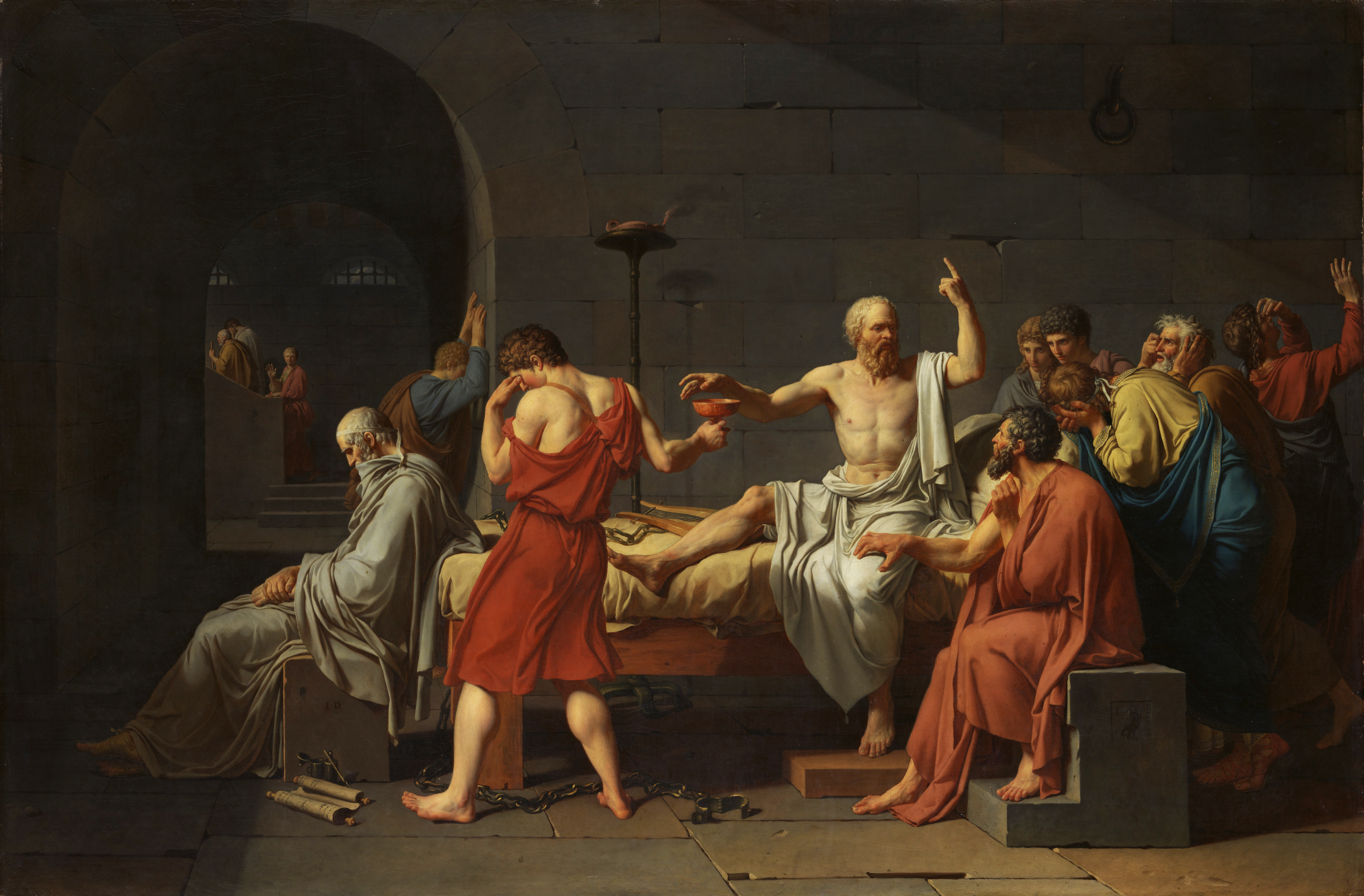
“Then someone had used the phrase ‘the Socratic method.’ What was that? It was apparently a way of giving your friend his head in an argument and progging him into a pit by cunning questions. Who was Socrates, anyhow? A very argumentative Greek who had a nagging wife and was finally compelled to commit suicide because he was a nuisance! Still, he was beyond doubt a considerable person. He counted for a lot in the minds of learned people. I wanted ‘the Socrates story.’ Why had his fame lasted through all the ages? What were the stresses which had led a government to put him to death merely because of the things he said? Dire stresses they must have been: the life of the Athenian Executive or the life of this talkative professor! Such antagonisms do not spring from petty issues. Evidently Socrates had called something into being long ago which was very explosive. Intellectual dynamite! A moral bomb! But there was nothing about in The Queen’s Regulations.”
‘Tis most true, tenet insanabile multos scribendi cacoethes, and there is no end of writing of books, as the wiseman found of old, in this scribbling age, especially wherein the number of books is without number, (as a worthy man saith,) presses be oppressed, and out of an itching humour that every man hath to show himself, desirous of fame and honour (scribimus indocti doctique——) he will write no matter what, and scrape together it boots not whence. Bewitched with this desire of fame,etiam mediis in morbis, to the disparagement of their health, and scarce able to hold a pen, they must say something, and get themselves a name, saith Scaliger, though it be to the downfall and ruin of many others. To be counted writers,scriptores ut salutentur, to be thought and held polymaths and polyhistors, apud imperitum vulgus ob ventosae nomen artis, to get a paper-kingdom: nulla spe quaestus sed ampla famae, in this precipitate, ambitious age,nunc ut est saeculum, inter immaturam eruditionem, ambitiosum et praeceps(’tis Scaliger’s censure); and they that are scarce auditors, vix auditores, must be masters and teachers, before they be capable and fit hearers. They will rush into all learning,togatam armatam, divine, human authors, rake over all indexes and pamphlets for notes, as our merchants do strange havens for traffic, write great tomes, Cum non sint re vera doctiores, sed loquaciores, whereas they are not thereby better scholars, but greater praters. They commonly pretend public good, but as Gesner observes, ’tis pride and vanity that eggs them on; no news or aught worthy of note, but the same in other terms. Ne feriarentur fortasse typographi vel ideo scribendum est aliquid ut se vixisse testentur. As apothecaries we make new mixtures everyday, pour out of one vessel into another; and as those old Romans robbed all the cities of the world, to set out their bad-sited Rome, we skim off the cream of other men’s wits, pick the choice flowers of their tilled gardens to set out our own sterile plots. Castrant alios ut libros suos per se graciles alieno adipe suffarciant(so Jovius inveighs.) They lard their lean books with the fat of others’ works. Ineruditi fures, &c. A fault that every writer finds, as I do now, and yet faulty themselves, Trium literarum homines, all thieves; they pilfer out of old writers to stuff up their new comments, scrape Ennius’ dunghills, and out of Democritus’ pit, as I have done. By which means it comes to pass, that not only libraries and shops are full of our putrid papers, but every close-stool and jakes,Scribunt carmina quae legunt cacantes; they serve to put under pies, to lap spice in, and keep roast meat from burning. With us in France, saith Scaliger, every man hath liberty to write, but few ability.Heretofore learning was graced by judicious scholars, but now noble sciences are vilified by base and illiterate scribblers,that either write for vainglory, need, to get money, or as Parasites to flatter and collogue with some great men, they put out burras, quisquiliasque ineptiasque. Amongst so many thousand authors you shall scarce find one, by reading of whom you shall be any whit better, but rather much worse,quibus inficitur potius, quam perficitur, by which he is rather infected than any way perfected.
“But even as a schoolboy I questioned the aptness of the Classics for the prime structure of our education. So they told me how Mr. Gladstone read Homer for fun, which I thought served him right , and that it would be a great pleasure to me in after life. When I seemed incredulous, they added that classics would be a help in writing or speaking English. They then pointed out the number of our modern words which are derived from the Latin or Greek. Apparently one could use these words much better, if one knew the exact source from which they had sprung. I was fain to admit a practical value. But now even this has been swept away. The foreigners and the Scotch have joined together to introduce a pronunciation of Latin which divorces it finally from the English tongue. They tell us to pronounce ‘audience’ ‘owdience’; and ‘civil ‘keyweel.’ They have distorted one of my most serviceable and impressive quotations into the ridiculous booby ‘Wainy, Weedy, Weeky.’ Punishment should be reserved for those who have spread this evil.”
In contrast to this, see Milton’s advice in his Tractate on Education:
“For the studies, first they should begin with the chief and necessary rules of some good grammar, either that now used, or any better: and while this is doing, their speech is to be fashioned to a distinct and clear pronunciation, as near as may be to theItalian,especially in the vowels. For weEnglishmenbeing far northerly, do not open our mouths in the cold air, wide enough to grace a southern tongue; but are observed by all other nations to speak exceeding close and inward: So that to smatter Latin with an English mouth, is as ill a hearing as Law-French.”
“So I resolved to read history, philosophy, economics, and things like that; and I wrote to my mother asking for such books as I had heard of on these topics. She responded with alacrity, and every month the mail brought me a substantial package of what I thought were standard works. In history I decided to begin with Gibbon. Someone had told me that my father had read Gibbon with delight; that he knew whole pages of it by heart, and that it had greatly affected his style of speech and writing. So without more ado I set out upon the eight volumes of Dean Milman’s edition of Gibbon’s Decline and Fall of the Roman Empre. I was immediately dominated both by the story and the style. All through the long glistening middle hours of the Indian day, from when we quitted stables till the evening shadows proclaimed the hour of Polo, I devoured Gibbon. I rode triumphantly through it from end to end and enjoyed it all. I scribbled all my opinions on the margins of the pages, and very soon found myself a vehement partisan of the author against the disparagements of his pompous-pious editor. I was not even estranged by his naughty footnotes. On the other hand the Dean’s apologies and disclaimers roused my ire.”
“Dr. Welldon took a friendly interest in me, and knowing that I was weak in the Classics, determined to help me himself. His daily routine was heavy; but he added three times a week a quarter of an hour before evening prayers in which to give me personal tuition. This was a great condescension for the Headmaster, who of course never taught anyone but the monitors and the highest scholars. I was proud of the honour: I shrank from the ordeal. If the reader has ever learned any Latin prose he will know that at quite an early stage one comes across the Ablative Absolute with its apparently somewhat despised alternative ‘Quum with the pluperfect subjunctive.’ I always preferred ‘Quum.’ True he was a little longer to write, thus lacking the much admired terseness and pith of the Latin language. On the other hand he avoided a number of pitfalls. I was often uncertain whether the Ablative Absolute should end in ‘e’ or ‘i’ or ‘o’ or ‘is’ or ‘ibus’? to the correct selection of which great importance was attached. Dr. Welldon seemed to be physically pained by a mistake being made in any of these letters. I remember that later on Mr. Asquith used to have just the same sort of look on his face when I sometimes adorned a Cabinet discussion by bringing out one of my few but faithful Latin quotations. It was more than annoyance, it was a pang. Moreover Headmasters have powers at their disposal with which Prime Ministers have never yet been invested. So these evening quarters of an hour with Dr. Welldon added considerably to the anxieties of my life. I was much relieved when after nearly a whole term of patient endeavour he desisted from his well-meant but unavailing efforts.”