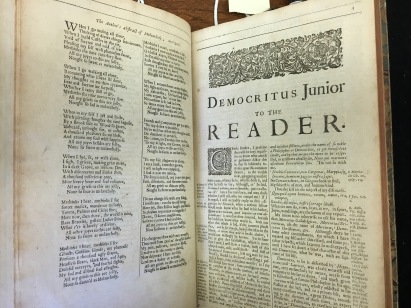
Poverty, the Muses’ Patrimony

Robert Burton, The Anatomy of Melancholy:

“Poverty is the muses’ patrimony, and as that poetical divinity teacheth us, when Jupiter’s daughters were each of them married to the gods, the muses alone were left solitary, Helicon forsaken of all suitors, and I believe it was, because they had no portion.

Calliope longum caelebs cur vixit in aevum?
Nempe nihil dotis, quod numeraret, erat.
Why did Calliope live so long a maid?
Because she had no dowry to be paid.

Ever since all their followers are poor, forsaken and left unto themselves. Insomuch, that as Petronius argues, you shall likely know them by their clothes. There came, saith he, by chance into my company, a fellow not very spruce to look on, that I could perceive by that note alone he was a scholar, whom commonly rich men hate: I asked him what he was, he answered, a poet: I demanded again why he was so ragged, he told me this kind of learning never made any man rich.

Qui Pelago credit, magno se faenore tollit,
Qui pugnas et rostra petit, praecingitur auro:
Vilis adulator picto jacet ebrius ostro,
Sola pruinosis horret facundia pannis.
A merchant’s gain is great, that goes to sea;
A soldier embossed all in gold;
A flatterer lies fox’d in brave array;
A scholar only ragged to behold.

All which our ordinary students, right well perceiving in the universities, how unprofitable these poetical, mathematical, and philosophical studies are, how little respected, how few patrons; apply themselves in all haste to those three commodious professions of law, physic, and divinity, sharing themselves between them, rejecting these arts in the mean time, history, philosophy, philology, or lightly passing them over, as pleasant toys fitting only table-talk, and to furnish them with discourse. They are not so behoveful: he that can tell his money hath arithmetic enough: he is a true geometrician, can measure out a good fortune to himself; a perfect astrologer, that can cast the rise and fall of others, and mark their errant motions to his own use. The best optics are, to reflect the beams of some great man’s favour and grace to shine upon him. He is a good engineer that alone can make an instrument to get preferment. This was the common tenet and practice of Poland, as Cromerus observed not long since, in the first book of his history; their universities were generally base, not a philosopher, a mathematician, an antiquary, &c., to be found of any note amongst them, because they had no set reward or stipend, but every man betook himself to divinity, hoc solum in votis habens, opimum sacerdotium, a good parsonage was their aim. This was the practice of some of our near neighbours, as Lipsius inveighs, they thrust their children to the study of law and divinity, before they be informed aright, or capable of such studies. Scilicet omnibus artibus antistat spes lucri, et formosior est cumulus auri, quam quicquid Graeci Latinique delirantes scripserunt. Ex hoc numero deinde veniunt ad gubernacula reipub. intersunt et praesunt consiliis regum, o pater, o patria? [Obviously the hope of profit stands before all arts, and the heap of gold is prettier than anything the Greeks and Latins wrote in their madness. From this number then they come to the government of the republic and find themselves amidst and even at the head of the councils of kings, o my father, o my fatherland?] so he complained, and so may others. For even so we find, to serve a great man, to get an office in some bishop’s court (to practise in some good town) or compass a benefice, is the mark we shoot at, as being so advantageous, the highway to preferment.”

Students Hate Caesar

John Knowles, A Separate Peace Chp. 11:

We went on to our room. I sat down at the translation of Caesar I was doing for him, since he had to pass Latin at last this year or fail to graduate. I thought I was doing a pretty good job of it.

“Is anything exciting happening now?”

“This part is pretty interesting,” I said, “if I understand it right. About a surprise attack.”

“Read me that.”

“Well let’s see. It begins, ‘When Caesar noticed that the enemy was remaining for several days at the camp fortified by a swamp and by the nature of the terrain, he sent a letter to Trebonius instructing him’—’instructing him’ isn’t actually in the text but it’s understood; you know about that.”

“Sure. Go on.”

“ ‘Instructing him to come as quickly as possible by long forced marches to him’—this ‘him’ refers to Caesar of course.”

Finny looked at me with glazed interest and said, “Of course.”

“‘Instructing him to come as quickly as possible by long forced marches to him with three legions; he himself—Caesar, that is—’sent cavalry to withstand any sudden attacks of the enemy. Now when the Gauls learned what was going on, they scattered a selected band of foot soldiers in ambushes; who, overtaking our horsemen after the leader Vertiscus had been killed, followed our disorderly men up to our camp.’”

“I have a feeling that’s what Mr. Horn is going to call a ‘muddy translation.’ What’s it mean?”

“Caesar isn’t doing so well.”

“But he won it in the end.”

“Sure. If you mean the whole campaign—” I broke off. “He won it, if you really think there was a Gallic War …” Caesar, from the first, had been the one historical figure Phineas refused absolutely to believe in. Lost two thousand years in the past, master of a dead language and a dead empire, the bane and bore of schoolboys, Caesar he believed to be more of a tyrant at Devon than he had ever been in Rome. Phineas felt a personal and sincere grudge against Caesar, and he was outraged most by his conviction that Caesar and Rome and Latin had never been alive at all … “If you really think there ever was a Caesar,” I said.

Finny got up from the cot, picking up his cane as an afterthought. He looked oddly at me, his face set to burst out laughing I thought. “Naturally I don’t believe books and I don’t believe teachers,” he came across a few paces, “but I do believe—it’s important after all for me to believe you.

Too cool for school.

Surgery Beneath the Scholar’s Dignity

Hastings Rashdall, The Universities of Europe in the Middle Ages I.4.6:

“It was the ordinary practice in the Italian Universities for a Medical Doctor to read the relative parts of this treatise while the Professor of Surgery performed the dissection and another Doctor pointed out to the students the various bones or muscles as they were named by the reader. By the Statutes of Florence food and wine and spices were to be provided to keep up the spirits of Professors and Students during this unwonted ordeal. The importance of Surgery in Italy as compared with its neglect in the Northern Universities is indicated by the different position occupied by its teachers. Not only was Surgery taught by Doctors of Medicine, but the latter were allowed to engage in surgical practice, an employment which was looked upon by the Doctors of Paris as a degrading manual craft, entirely beneath the dignity of a sage learned in all the wisdom of Aristotle and Galen.”

The True Value of Scholars

Robert Burton, The Anatomy of Melancholy:

“To say truth, ’tis the common fortune of most scholars, to be servile and poor, to complain pitifully, and lay open their wants to their respectless patrons, as Cardan doth, as Xilander and many others: and which is too common in those dedicatory epistles, for hope of gain, to lie, flatter, and with hyperbolical eulogiums and commendations, to magnify and extol an illiterate unworthy idiot, for his excellent virtues, whom they should rather, as Machiavel observes, vilify, and rail at downright for his most notorious villainies and vices. So they prostitute themselves as fiddlers, or mercenary tradesmen, to serve great men’s turns for a small reward. They are like Indians, they have store of gold, but know not the worth of it: for I am of Synesius’s opinion, King Hieron got more by Simonides’ acquaintance, than Simonides did by his; they have their best education, good institution, sole qualification from us, and when they have done well, their honour and immortality from us: we are the living tombs, registers, and as so many trumpeters of their fames: what was Achilles without Homer? Alexander without Arian and Curtius? who had known the Caesars, but for Suetonius and Dion?”

Practice Those Tongue-Twisters!

Quintilian, Institutio Oratoria 1.2:

“It would not be out of place at this age, so that the mouth may be firmed and speech may become more distinct, for the child to recite as quickly as possible certain names and verses of intentional difficulty roughly strung together from many discordant syllables (these are called ‘bridles’ in Greek). It is modest thing to say, but if it is omitted, many faults of the tongue unless they are removed in the early years, will endure into later life with an irremediable distortion.”

Non alienum fuerit exigere ab his aetatibus, quo sit absolutius os et expressior sermo, ut nomina quaedam versusque adfectatae difficultatis ex pluribus et asperrime coeuntibus inter se syllabis catenatos et veluti confragosos quam citatissime volvant (chalinoi Graece vocantur): res modica dictu, qua tamen omissa multa linguae vitia, nisi primis eximuntur annis, inemendabili in posterum pravitate durantur.

Looking for a Worthy Student of Aristotle

Roger Ascham, The Scholemaster:

“This diligence to gather examples, to giue light and vnderstandyng to good preceptes, is no new inuention, but speciallie vsed of the best Authors and oldest writers. For Aristotle him selfe, (as Diog. Laertius declareth) when he had written that goodlie booke of the Topickes, did gather out of stories and Orators, so many examples as filled xv. bookes, onelie to expresse the rules of his Topickes. These were the Commentaries, that Aristotle thought fit for hys Topickes: And therfore to speake as I thinke, I neuer saw yet any Commentarie vpon Aristotles Logicke, either in Greke or Latin, that euer I lyked, bicause they be rather spent in declaryng scholepoynt rules, than in gathering fit examples for vse and vtterance, either by pen or talke. For preceptes in all Authors, and namelie in Aristotle, without applying vnto them, the Imitation of examples, be hard, drie, and cold, and therfore barrayn, vnfruitfull and vnpleasant. But Aristotle, namelie in his Topicks and Elenches, should be, not onelie fruitfull, but also pleasant to, if examples out of Plato, and other good Authors, were diligentlie gathered, and aptlie applied vnto his most perfit preceptes there. And it is notable, that my frende Sturmius writeth herein, that there is no precept in Aristotles Topickes wherof plentie of examples be not manifest in Platos workes. And I heare say, that an excellent learned man, Tomitanus in Italie, hath expressed euerie fallacion in Aristotle, with diuerse examples out of Plato. Would to God, I might once see, some worthie student of Aristotle and Plato in Cambrige, that would ioyne in one booke the preceptes of the one, with the examples of the other. For such a labor, were one speciall peece of that worke of Imitation, which I do wishe were gathered together in one Volume.”

Forget Grammar – Look at the Latin

Roger Ascham, The Scholemaster

“And for spedy atteyning, I durst venture a good wager, if a scholer, in whom is aptnes, loue, diligence, & constancie, would but translate, after this sorte, one litle booke in Tullie, as de senectute, with two Epistles, the first ad Q. fra: the other ad lentulum, the last saue one, in the first booke, that scholer, I say, should cum to a better knowledge in the Latin tong, than the most part do, that spend foure or fiue yeares, in tossing all the rules of Grammer in common scholes. In deede this one booke with these two Epistles, is not sufficient to affourde all Latin wordes (which is not necessarie for a yong scholer to know) but it is able to furnishe him fully, for all pointes of Grammer, with the right placing ordering, & vse of wordes in all kinde of matter. And why not? for it is read, that Dion. Prussæus, that wise Philosopher, & excellent orator of all his tyme, did cum to the great learning & vtterance that was in him, by reading and folowing onelie two bookes, Phædon Platonis, and Demosthenes most notable oration peri parapresbeias. And a better, and nerer example herein, may be, our most noble Queene Elizabeth, who neuer toke yet, Greeke nor Latin Grammer in her hand, after the first declining of a nowne and a verbe, but onely by this double translating of Demosthenes and Isocrates dailie without missing euerie forenone, and likewise som part of Tullie euery afternone, for the space of a yeare or two, hath atteyned to soch a perfite vnderstanding in both the tonges, and to soch a readie vtterance of the latin, and that wyth soch a iudgement, as they be fewe in nomber in both the vniuersities, or els where in England, that be, in both tonges, comparable with her Maiestie. And to conclude in a short rowme, the commodities of double translation, surelie the mynde by dailie marking, first, the cause and matter: than, the wordes and phrases: next, the order and composition: after the reason and argumentes: than the formes and figures of both the tonges: lastelie, the measure and compas of euerie sentence, must nedes, by litle and litle drawe vnto it the like shape of eloquence, as the author doth vse, which is red.”

Some Reading Advice

Roger Ascham, The Scholemaster:

“Than take this order with him: Read dayly vnto him, some booke of Tullie, as the third booke of Epistles chosen out by Sturmius, de Amicitia, or that excellent Epistle conteinyng almost the whole first book ad Q. fra: some Comedie of Terence or Plautus: but in Plautus, skilfull choice must be vsed by the master, to traine his Scholler to a iudgement, in cutting out perfitelie ouer old and vnproper wordes: Cæs. Commentaries are to be read with all curiositie, in specially without all exception to be made, either by frende or foe, is seene, the vnspotted proprietie of the Latin tong, euen whan it was, as the Grecians say, in akme, that is, at the hiest pitch of all perfitenesse: or some Orations of T. Liuius, such as be both longest and plainest.

These bookes, I would haue him read now, a good deale at euery lecture: for he shall not now vse dalie translation, but onely construe againe, and parse, where ye suspect, is any nede: yet, let him not omitte in these bookes, his former exercise, in marking diligently, and writyng orderlie out his six pointes. And for translating, vse you your selfe, euery second or thyrd day, to chose out, some Epistle ad Atticum, some notable common place out of his Orations, or some other part of Tullie, by your discretion, which your scholer may not know where to finde: and translate it you your selfe, into plaine naturall English, and than giue it him to translate into Latin againe: allowyng him good space and tyme to do it, both with diligent heede, and good aduisement. Here his witte shalbe new set on worke: his iudgement, for right choice, trewlie tried: his memorie, for sure reteyning, better exercised, than by learning, any thing without the booke: & here, how much he hath proffited, shall plainly appeare. Whan he bringeth it translated vnto you, bring you forth the place of Tullie: lay them together: compare the one with the other: commend his good choice, & right placing of wordes: Shew his faultes iently, but blame them not ouer sharply: for, of such missings, ientlie admonished of, proceedeth glad & good heed taking: of good heed taking, springeth chiefly knowledge, which after, groweth to perfitnesse, if this order, be diligentlie vsed by the scholer & iently handled by the master: for here, shall all the hard pointes of Grammer, both easely and surelie be learned vp: which, scholers in common scholes, by making of Latines, be groping at, with care & feare, & yet in many yeares, they scarse can reach vnto them. I remember, whan I was yong, in the North, they went to the Grammer schole, litle children: they came from thence great lubbers: alwayes learning, and litle profiting: learning without booke, euery thing, vnderstandyng within the booke, litle or nothing: Their whole knowledge, by learning without the booke, was tied onely to their tong & lips, and neuer ascended vp to the braine & head, and therfore was sone spitte out of the mouth againe: They were, as men, alwayes goyng, but euer out of the way: and why? For their whole labor, or rather great toyle without order, was euen vaine idlenesse without proffit. In deed, they tooke great paynes about learning: but employed small labour in learning: Whan by this way prescribed in this booke, being streight, plaine, & easie, the scholer is alwayes laboring with pleasure, and euer going right on forward with proffit: always laboring I say, for, or he haue construed parced, twise translated ouer by good aduisement, marked out his six pointes by skilfull iudgement, he shall haue necessarie occasion, to read ouer euery lecture, a dosen tymes, at the least. Which, bicause he shall do alwayes in order, he shall do it alwayes with pleasure: And pleasure allureth loue: loue hath lust to labor: labor alwayes obteineth his purpose, as most trewly, both Aristotle in his Rhetoricke & Oedipus in Sophocles do teach, saying, pan gar ekponoumenon aliske. et. cet. & this oft reading, is the verie right folowing, of that good Counsell, which Plinie doth geue to his frende Fuscus, saying, Multum, non multa.”

Queen Elizabeth’s Greek

Roger Ascham, The Scholemaster:

“It is your shame, (I speake to you all, you yong Ientlemen of England) that one mayd should go beyond you all, in excellencie of learnyng, and knowledge of diuers tonges. Pointe forth six of the best giuen Ientlemen of this Court, and all they together, shew not so much good will, spend not so much tyme, bestow not so many houres, dayly orderly, & constantly, for the increase of learning & knowledge, as doth the Queenes Maiestie her selfe. Yea I beleue, that beside her perfit readines, in Latin, Italian, French, & Spanish, she readeth here now at Windsore more Greeke euery day, than some Prebendarie of this Chirch doth read Latin in a whole weeke. And that which is most praise worthie of all, within the walles of her priuie chamber, she hath obteyned that excellencie of learnyng, to vnderstand, speake, & write, both wittely with head, and faire with hand, as scarse one or two rare wittes in both the Vniuersities haue in many yeares reached vnto. Amongest all the benefites yt God hath blessed me with all, next the knowledge of Christes true Religion, I counte this the greatest, that it pleased God to call me, to be one poore minister in settyng forward these excellent giftes of learnyng in this most excellent Prince. Whose onely example, if the rest of our nobilitie would folow, than might England be, for learnyng and wisedome in nobilitie, a spectacle to all the world beside. But see the mishap of men: The best examples haue neuer such forse to moue to any goodnes, as the bad, vaine, light and fond, haue to all ilnes.”

Learning vs. Experience

Roger Ascham, The Scholemaster:

“Learning teacheth more in one yeare than experience in twentie: And learning teacheth safelie. when experience maketh mo miserable then wise. He hasardeth sore, that waxeth wise by experience. An vnhappie Master he is, that is made cunning by manie shippewrakes: A miserable merchant, that is neither riche or wise, but after som bankroutes. It is costlie wisdom, that is bought by experience. We know by experience it selfe, that it is a meruelous paine, to finde oute but a short waie, by long wandering. And surelie, he that wold proue wise by experience, he maie be wittie in deede, but euen like a swift runner, that runneth fast out of his waie, and vpon the night, he knoweth not whither. And verilie they be fewest of number, that be happie or wise by vnlearned experience. And looke well vpon the former life of those fewe, whether your example be old or yonge, who without learning haue gathered, by long experience, a litle wisdom, and som happines: and whan you do consider, what mischiefe they haue committed, what dangers they haue escaped (and yet xx. for one, do perishe in the aduenture) than thinke well with your selfe, whether ye wold, that your owne son, should cum to wisdom and happines, by the waie of soch experience or no.”

This is the way to do it.