And so I end the record of my literary performances,—which I think are more in amount than the works of any other living English author. If any English authors not living have written more—as may probably have been the case—I do not know who they are. I find that, taking the books which have appeared under our names, I have published much more than twice as much as Carlyle. I have also published considerably more than Voltaire, even including his letters. We are told that Varro, at the age of eighty, had written 480 volumes, and that he went on writing for eight years longer. I wish I knew what was the length of Varro’s volumes; I comfort myself by reflecting that the amount of manuscript described as a book in Varro’s time was not much. Varro, too, is dead, and Voltaire; whereas I am still living, and may add to the pile.
Francesco: It’s not coming to me right now, and I’m afraid to draw forth my ignorance into view. And so I would rather be silent about what I think is true.
Augustinus: This alone you have chosen wisely and modestly. For in every speech, especially in one important and doubtful, one should pay attention less to what is said than to what is not said, because the praise that comes from good speech cannot equal the chastisement that comes from bad speech. Therefore, keep in mind that fame is nothing but speech divulged by one person and then sprinkled about through the mouths of the multitude.
F.
Non occurrit id quidem ad presens et ignota in medium proferre metuo. Ideoque, quod esse verius opinor, siluisse maluerim.
A.
Prudenter hoc unum et modeste. Nam in omni sermone, gravi presertim et ambiguo, non tam quid dicatur, quam quid non dicatur attendendum est. Neque enim par ex bene dictis laus et ex male dictis reprehensio est. Scito igitur famam nichil esse aliud quam sermonem de aliquo vulgatum ac sparsum per ora multorum.
Battista Guarino, de Ordine Docendi et Studendi (5):
One must take care in every way not to beat students severely and harshly on account of their literary study. There is something servile in that, and a noble mind will wex so wondrous wroth that it hates literature because of the beatings, at a time when it has not even begun to taste the fruits of literary study. Furthermore, because they fear the beatings, they do not compose the declamations set to them with their own mind, but they bring forth things secretly composed by others. This is a capital crime, and most dangerous, because it deceives both parties: the teacher, who takes up false hope for the student; and the student, who does not understand that he lies about what they have done. It will therefore be more noble and more useful either to coax them with flattery or occasionally to introduce the fear of beatings in such a way that they fear that they are on the verge of being beaten straightaway. If the student lives without fear, that license will offer a wide-open window for negligence.
Omnino danda erit opera, ne pueri propter litterarum disciplinam graviter et acriter verberentur; habet enim ea res servile quiddam, et generosus saepenumero animus ita indignatur, ut plagarum causa iam tum litteras oderit cum necdum gustare coeperit. Adde quod metu verberum declamationes eis propositas non ingenio proprio componunt, sed ab aliis occulte compositas afferent; quod capitale et perniciosissimum est, nam utrumque vehementer fallit: et praeceptorem, qui spem falsam praesumit; et discipulum, qui id non intelligit quod a se factum mentitur. Honestius igitur et utilius erit, vel blanditiis agere, vel interdum solo verberum terrore, ita ut plagae statim subsecuturae videantur; nam si securus fuerit, maximam neglegentiae fenestram licentia illa praebebit:
Aeneas Silvius Piccolomini, On the Education of Boys (19):
I once heard that there was a Bohemian nobleman who made his children accustomed to drinking from the time they were in the crib by giving them big and frequent swigs of Malmsey or Rhenish wine. He used to say, ‘Once they have become men and have drunk so much, they will never lose their heads because of the influence of wine.’ Thus perhaps had Cyrus the younger been raised. Once, when he was urging the Lacedaemonians to join him, he said that his heart was far more stout than that of his brother, because he had drunk more wine than him and could hold it better to boot. But it seems like a foolish and empty precaution to be always drunk as a way of avoiding drunkenness. Those who are thus raised do not ruin their minds, but rather, ensure the continuation of a stupid mind and a perpetually clinging drunkenness. There is no memory there, no lively intellect, no desire of the good arts, no eagerness for glory or distinction.
Relatum est mihi ex Bohemis proceribus quondam fuisse, qui liberos ab infantia suos atque ab ipsis incunabulis solius Malvatici aut Rivoli magnis et crebris haustibus assuefaceret. Sic enim aiebat: ‘postquam viri fuerint multumque biberint, nullius vini potentia mentem amittent.’ Sic fortasse nutritus fuerat Cyrus iunior, qui cum Lacedaemonios, ut secum societatem inirent, hortaretur, cor sibi, dicebat, longe gravius esse quam fratri, nam et plus meri quam ille biberet et melius ferret. Stulta et inanis cautio, ne sis aliquando ebrius, semper erbium esse. Non perdunt, cum maxime bibunt, qui sic nutriti sunt, mentem, sed stultam mentem adhaerentemque semper ebrietatem continuant. Non ibi memoria est, non vivax ingenium, non bonarum cupido artium, non gloriae, non honestatis studium.
Don’t let the abundance of days and the contrived distinction of the age fool you. All of human life, however much it may be extended, is like a single day, and not even a whole one. You should frequently call back to mind Aristotle’s comparison, which I noticed pleases you a lot, and which you can scarcely read or hear without it making a real impression on your mind. You can find it put in more sparkling language (and certainly more apt to persuade) in Cicero’s Tusculan Disputations: ‘Aristotle says that certain little beasts which live for only one day are born near the Hypanis, which flows from part of Europe into the Black Sea. One of these who dies at sunrise dies as a youth; one who dies at noon has already achieved an advanced age; but one who departs at the setting of the sun dies old, especially if it is the solstice. Compare the entirety of our life with eternity, and we will be found to exist for just as short a time as that animal.’
This claim seems to me so true that it was diffused from the mouths of philosophers into common use. For have you not seen that even rude and ignorant people have drawn it into their daily parlance, as when they see a boy and say, ‘The sun rises for him,’ then see a man and say, ‘He’s reaching noon, and that guy is at his ninth hour,’ and when they see an old person, ‘That guy has come all the way to the evening and sunset of his life.’ I would then, my dear boy, having you revolve these things in your mind along with anything else of the sort which occurs to you (and I have no doubt that there is much of it). But these are the things which have obtruded themselves upon me at the moment. I beg you for one thing further. Contemplate with more diligence the graves of the ancients, but of those who lived with you, in the certainty that the very same seat and eternal reception hall will be prepared for you. All of us bend our course that way. This is the final home for everyone.
The Triumph of Death, fresco in Palermo
Nec te fallat dierum pluralitas et etatis operosa distinctio: tota hominum vita, quantumlibet extendatur, diei unius instar habet, eiusque vix integri. Crebro ante oculos revoca aristotelicam quandam similitudinem, quam animadverti tibi admodum placere, vixque unquam sine gravi mentis impulsu legi solere vel audiri; quam clariori eloquio et ad persuadendum aptiori in Tusculano quidem a Cicerone relatam invenies, aut his verbis aut profecto similibus, neque enim libri nunc illius copia est “Apud Hypanim” inquit “fluvium, qui ab Europe parte in Pontum influit, bestiolas quasdam nasci scribit Aristotiles, que unum diem vivant; harum que oriente sole moritur, iuvenis moritur; que vero sub meridie, iam etate provectior, at que sole occidente senex abit, eoque magis si solstitiali die. Confer universam etatem nostram cum eternitate, in eadem propemodum brevitate reperiemur ac ille”. Que quidem assertio meo iudicio tam vera est, ut ex ore philosophorum iampridem in vulgus diffusa sit. Nunquid enim rudes etiam et ignaros homines in quotidiani sermonis usum deduxisse vides, ut puerum aspicientes dicant: “Huic sol oritur”, virum autem: “Hic meridiem attigit; hic nonam”; senem vero decrepitum: “Ad vesperam atque ad solis occasum iste pervenit”. Hec igitur, fili carissime, tecum volve et, siqua huius generis occurrunt alia, que multa esse non dubito; sed hec erant que ex tempore se se obtulerunt. Unum preterea obsecro. Sepulcra veterum, sed eorum qui tecum vixere, diligentius, contemplare, certus eandem tibi sedem ac perennem aulam fore preparatam. Tendimus huc omnes. Hec est domus ultima cuntis.
Let us move on to the fact that grammar and music were once conjoined. Indeed, Archytas and Euenus thought that grammar was subject to music, and Sophron (a writer of mimes, one of whom Plato approved so much that he is thought to have had his books under his pillow when he was dying) has shown that each of these men was a professor of both music and grammar. Eupolis makes the same point: he says that Prodamus taught both music and literature, and that Maricas (that is, Hyperbolus) confessed that he knew nothing of music but the literary part of it.
Even Aristophanes in one of his books demonstrates that boys were formerly accustomed to be educated thus, and among Menander’s writings we have the old man in Hypobolimaeus, who in trying to explain to a father asking his son for the reason for all of the expense which he had laid out on his education, responded that he had paid out a load of money on dancing and geometry.
Hence came the habit of passing a lyre around after dinner at parties. When Themistocles confessed that he was unable to play the instrument, he was (to use the words of Cicero) considered a bit uneducated.
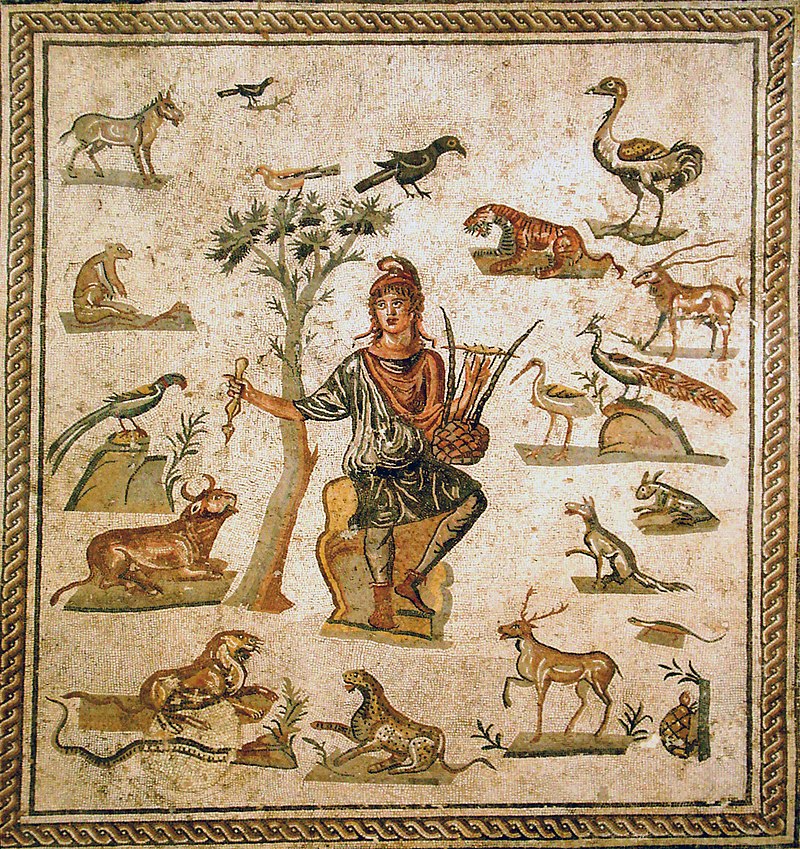
Professor Orpheus will now move on to grammar.
transeamus igitur id quoque, quod grammatice quondam ac musice iunctae fuerunt; siquidem Archytas atque Euenus etiam subiectam grammaticen musicae putaverunt, et eosdem utriusque rei praeceptores fuisse cum Sophron ostendit, mimorum quidem scriptor sed quem Plato adeo probavit, ut suppositos capiti libros eius, cum moreretur, habuisse credatur, tum Eupolis, apud quem Prodamus et musicen et litteras docet, et Maricas, qui est Hyperbolus, nihil se ex musice scire nisi litteras confitetur.
Aristophanes quoque non uno libro sic institui pueros antiquitus solitos esse demonstrat, et apud Menandrum in Hypobolimaeo senex, qui reposcenti filium patri velut rationem impendiorum, quae in educationem contulerit, exponens, psaltis se et geometris multa dicit dedisse.
unde etiam ille mos, ut in conviviis post cenam circumferretur lyra; cuius cum se imperitum Themistocles confessus esset ut verbis Ciceronis utar, est habitus indoctior.
Aeneas Silvius Piccolomini, de Educatione Liberorum IX:
“I would have them either educated (which is the best thing), or I would have them know that they are not educated. For, there is nothing worse than those who advance a little beyond the ABC’s and (to use Quintilian’s words), ‘put on a false cloak of learning.’
Ego illos aut eruditos esse voluerim, quod primum est, aut se non eruditos scire. Nihil enim peius est his, qui paululum aliquid ultra primas litteras progressi, ‘falsam sibi,’ ut Quintilianus verbis utamur, ‘scientiae persuasionem induerunt.’
Aeneas Silvius Piccolomini, On the Education of Boys (19):
Since the delight of taste holds back many people in both drink and in food, you should take care that you don’t become fond either of drinking too much or drinking wine which is too good. You should avoid every drink which can make you drunk. Let your drinking be moderate, of the sort which will not depress the mind, but will bear away your thirst. Nothing is more shameful than a boy who is keen on wine. ‘The use of wine,’ according to Valerius, ‘was unknown to Roman women at one time.’ What about the boys? Shall we suffer the minds of our boys to go fully Dionysian, or shall we destroy the rising mind with undiluted drink? Though it be entirely unpardonable in Teutonic custom to mix water with wine, I can in no way be persuaded that strong wine should ever be placed at a boy’s table unless it be corrected with the addition of water.
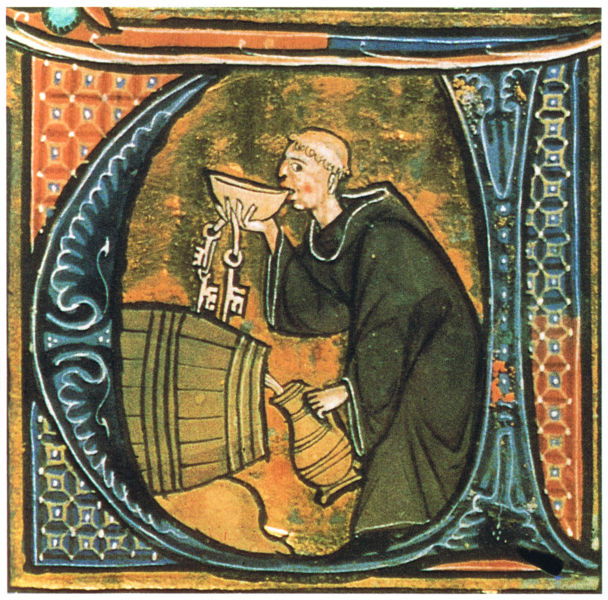
British Library manuscript Sloane 2435, f. 44v.
Verum, cum delectatio gustus plerosque non minus in potu quam in cibo detineat, cavendum est, tibi ne vel multi bibulus vel optimi bibulus fias. Omnem quae potest inebriare potionem vitabis. Sit moderata bibitio; non quae mentem gravet, sed quae sitim auferat. Multum succi in pueris est; lacte sunt et sanguine pleni raroque sitim sentiunt. Appetitore vini puero nihil turpius est. ‘Usus vini’ sicut Valerius ait, ‘Romanis olim feminis ignotus fuit.’ Quid pueris? Feremusne puerorum bacchari mentes aut vini surgentem ingenii iugulabimus mero? Quamvis Teutonico more nefas sit aquam misceri vino, mihi tamen nulla ratione persuasum fuerit fumosum vinum, nisi aqua castigatum, puerorum mensis apponi debere.
“In my opinion, ignorance of the poets is debilitating in literary affairs. The poets speak so much, so fittingly, and so wisely about life and manners, about the principles and causes of nature and generation; these can be found in the poets as the seeds of all learning. There is in them also a great authority based on their reputation for wisdom and their distinction; there is a notable splendor which stems from their elegance; there is an ingenuity so befitting free men that anyone who lacks it will seem like an uneducated yokel. What is lacking in Homer, that we should not consider him to be the wisest man in every kind of wisdom? Some people claim that his poetry is a complete education for life, equally divided between times of war and peace.”
Dante, Homer, Virgil, and Statius by Raffaello Sanzio
Mea quidem sententia mancus quodammodo in litteris est, qui poetas non didicit. Nam de vita moribusque percommode multa sapienterque ab illis dicta et naturae generationisque principia et causae et quasi doctrinarum omnium semina in illis reperiuntur; et inest auctoritas magna propter opinionem sapientiae ac vetustatem et splendor eximius propter elegantiam et ingenuitas quaedam liberis hominibus digna, ut, cui haec non adsit, paene subrusticus videatur. Quid Homero deest, quominus in omni sapientia sapientissimus existimari possit? Eius poesim totam esse doctrinam vivendi quidam ostendunt, in belli tempora pacisque divisam.
Around the fourth or fifth hour of the day, (you know, the time was not certain and clearly marked off) as the day urged me, I took myself into the colonnade or the covered portico, where I would think on the rest and dictate my thoughts. I get up into my carriage. There too I do the same thing as when walking or lying down; my application to my work continues, renewed even by this change. I take a little nap, then I walk, then I read aloud a Greek or Latin oration clearly and with attention less for the sake of my voice than for the sake of my stomach; of course, the voice still gains just as much from this exercise.
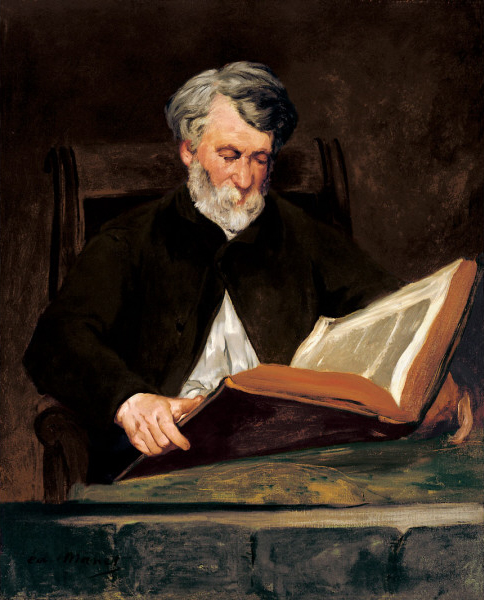
Edouard Manet, The Reader
Ubi hora quarta vel quinta – neque enim certum dimensumque tempus -, ut dies suasit, in xystum me vel cryptoporticum confero, reliqua meditor et dicto. Vehiculum ascendo. Ibi quoque idem quod ambulans aut iacens; durat intentio mutatione ipsa refecta. Paulum redormio, dein ambulo, mox orationem Graecam Latinamve clare et intente non tam vocis causa quam stomachi lego; pariter tamen et illa firmatur.