Bellum Incivile: Government Shutdown Over the Wall

Another text tentatively attributed to Caesar was discovered along with the fragments of the De Silvis and an appendix to De Bello Gallico. This is almost surely from the lost Bellum Incivile.

8.3 For reasons I already mentioned, Manicula resolved to keep people of color out of the homeland by means of executive orders and an expensive wall. Since he feared that people fleeing mortal danger and actual coyotes— amazing to say!– might cross the border and that heavy bags full of drugs might be thrown into the territory, he devised a new kind of wall, through which it possible to look, but not to enter, and decreed that sharpened stakes of steel be placed at regular, two-foot intervals into the ground. Disturbed by the new and rather unusual appearance of the wall, the citizens laughed and made fun of it, saying this plan for border security was childish and stupid and that the wall looked just like a medieval fortification. 

8.3 Manicula, his de causis quas commemoravi, coloratas gentes a patria decretis ac muro magni pretii prohibere constituit. Qui veritus ne gentes periculum effugientes et veri lupi, mirabile dictu, transirent saccique tumentes multis potionibus in fines conicerentur, formam muri novam, quo perspici posset, sed non intrari, excogitavit decrevitque ut trabes ferri praeacutae paribus intervallis, distantes inter se binos pedes, in solo collocarentur. Nova atque inusitatiore specie commoti cives inridebant atque increpitabant vocibus, consilium finium tuendorum puerile et stultum murumque simillimum forma munitionibus perveteribus esse.

8.4 Moved by great anger because of these words, Manicula replied that the wall should be referred to as a Beautiful Steel Slat Barrier; that the government must be shut down until the senators provide funding for his wall; and that in the meantime, according to his usual custom, he would put everyone who crossed the border into freezers and cages.

8.4 Magna adfectus ira his verbis Manicula ad ea respondit: murum Claustrum Trabium Ferrearum Pulchrum appellandum; rem publicam non administrandam, nisi senatores pecuniam publicam ex aerario ad murum struendum darent. Se interim consuetudine sua omnes, qui in fines transirent, in arcas gelatas ac caveas mitturum.

wolfbyz

Bellum Incivile: Ryan Zinke Profits From His Position

oxyrhynchus4

Another text tentatively attributed to Caesar was discovered along with the fragments of the De Silvis and an appendix to De Bello Gallico. This is almost surely the lost Bellum Incivile.

3.2 Even though he had no understanding of physical science, Ryan Zinke kept telling everyone he was a geologist and oversaw the health of the seas, rivers, mountains, and forests. As soon as he was appointed by Manicula, he began to scheme and turn over in his mind how he could make the most money during his term. Having abandoned science, he denied that terrible storms had arisen because of global warming and that lakes had been polluted because of man with the result that he was calling the whole nation to death and devastation, thinking the earth should be destroyed rather than conserved. Manicula approved of this travesty for a rather long time.

3.2 Cum ignarus physicorum esset, R. Zincus omnibus se geologum esse semper praedicebat salutique marium et rivorum et montium et silvorum praeerat. Simul atque a Manicula praefectus est, quaerere et in animo agitare coepit quomodo maximam quattuor annis pecuniam facere posset. Scientia relicta miserandas tempestates caelo ob aestum orbis coortas lacosque ob homines corruptos adeo negabat ut rem publicam universam ad exitum et vastitatem vocaret, existimans tellus delendum quam conservandum. Manicula hunc malum diutius fovebat.

Bellum Incivile: The Loyal Fixer

Another text tentatively attributed to Caesar was discovered along with the fragments of the De Silvis and an appendix to De Bello Gallico. This is almost surely the lost Bellum Incivile. The second passage was thought by some scholars to be part of a larger work called De Fraude, but recent evidence has all but proven it is related to Manicula’s exploits in Bellum Incivile

2.15 When he learned of these situations, M. Cohen, lest Manicula’s popularity be diminished among the people on account of this scandal and rumors change the opinion of voters (later it became known that Manicula’s moral failures would actually increase his appeal among many and that the Candidi* would believe all of his words) made big payments to the women. Since Cohen had constantly asserted he would never abandon Mancula’s cause and often used to say “A person who deserves my loyalty receives it,” Manicula trusted him greatly.

2.15 His rebus cognitis M. Coenus, ne gratia Maniculae propter flagitium minueretur rumorque opinionem suffragatorum commutaret (postea eius dedecus eam inter multos etiam aucturum Candidosque omnibus eius verbis credituros cognitum est), magnam pecuniam mulieris numeravit. Qui cum se numquam ab amicitia defecturum continuo confirmaret dignosque fide fidem accipere diceret, Manicula ei maxime confidebat.

*There is much debate over the Candidi. Some refer to this group simply as the “Whites,” while others prefer not to translate the term. There are fine scholars on both sides of this debate.

A connected text was found with extensive black markings which a team of paleographers and scientists determined were added intentionally shortly after the piece was written.  Based on similar phrases and the appearance of Maniculam, scholars believe the following should be included among the fragmenta incerta aut dubia of the Bellum Incivile.

?.?  Having accepted payments, M. Flynn was of great service to Turkey and (…) although he was national security advisor. Individual 1 ordered him to (….) and (…) secretly so that (….). At that same time Russians came to (….) complaining that punishments were exacted because of nonexistent offenses and that they had great hope that through his influence Manicula would put an end to the sanctions. (…) Flynn, having spoken with (…) about leniency, (…)

?.? Praemiis acceptis M. Flinnus cum consilia de patriae salute daret magno auxilio Galatianis fuit et (…). Prima Persona eum (…) et (…) clam ut (….) iussit. Eodem tempore Scythiani ad (…) veniebant questum poenas pro vanis iniuriis repetitas magnamque se habere spem auctoritate Maniculam finem suppliciis facturum. (…) Flinnus cum (….) de lenitate locutus, (…)

Image result for heavily damaged latin manuscripts

Bellum Incivile: The Candidi Assemble

Another text tentatively attributed to Caesar was discovered along with the fragments of the De Silvis and an appendix to De Bello Gallico. This is almost surely the lost Bellum Incivile.

C. Julius Caesar (?), Bellum Incivile. Edited by Dani Bostick

2.6 Having covered their heads with red caps, the Candidi, numbering 70,000, from places which were being impoverished by unjust laws and excessive spending of the state because they were regularly forgotten by everyone and were very far away from the resources and wealth of cities, assembled eager to see Manicula whom they believed was sent to them as a gift from the gods to be their leader. Among the Candidi a great fear had taken over which increased quickly because of Manicula’s various speeches.

2.6 Sanguinicis mitris capitibus opertis Candidi, ad hominum milia septuaginta, e locis, qui iniustis legibus atque sumptu civitatis exhuriebantur propterea quod ex omnium memoria diu deponebantur longissimeque ab opibus atque divitiis urbium absunt, studio videndi Maniculae, quem dono deum sibi missum ducem crediderunt, convenerunt. Apud Candidos incesserat animis magnus timor, qui variis Maniculae sermonibus celeriter augetur

2.9 Manicula addressed them and said that the Candidi had arrived at the end of their toils and indignities; that he would drain the low-lying areas around the forum by means of big sewers; and that Hillary, who concealed 30,000 letters, must be locked up and declared an enemy of the state so that he might increase his power. As Manicula was speaking the Candidi kept interrupting and shouting, “Lock her up!”

2.9  Manicula ad hunc modum locutus est: Candidos ad finem laborum ac contumeliarum perventos; se infima loca circa forum cloacis magnis siccaturum; Hillariam, quae triginta milia litterarum furtim celaret, in vinculis conieciendam hostemque rei publicae iudicandam ut suas opes augerentur. Dicentem Candidi interpellabant et conclamitabant: “In catenis!”


*mitreae are generally caps fashionable in the East, but here the term is most likely used as a reference to their place of manufacture, rather than the style. 

** There is much debate over the Candidi. Some refer to this group simply as the “Whites,” while others prefer not to translate the term. There are fine scholars on both sides of this debate.


fragment 2

Newly Discovered Text: Caesar on Education and News in Finland

The following text, surmised to be a lost appendix to the well known De Bello Gallico, presents some general facts about education and fake news in Northern Europe for an audience of the Republic far removed from such mundane concerns. The previous section on forestry can be found here.

C. Julius Caesar (?), De Silvis. Edited by Dani Bostick.

1.5 In Finland schools are very different from prisons and for this reason seem rather unusual to foreigners. It is permitted to walk and play outside rather often so that teachers, who are considered to be almost gods and receive the greatest honor among their people, can keep students in a happy state of mind. When students learn, their bodies are calm not because they fear punishment or are asleep but because they delight in knowledge. They enjoy excellent lunches consisting of small fish, sausages, cheese, and fruit so that bad nutrition does not diminish their strength and enthusiasm. And none of this originates in factories far away, but in neighboring gardens and fields. The state prepares for slaughter in schools in proportion to the danger of this possibility; since there is no danger of this type of situation, they have nothing to prepare for. This is the greatest glory to Finland.

1.5 In Finlandia scholae dissimillimae carceribus atque ob eam causam inusitatioresque barbaris sunt. licet in locis apertis saepius errare ludereque ut magistri, qui paene deorum habentur loco maximamque inter suos ferunt laudem, animi felicitate discipulos contineant. Cum hi docent, corpora eorum neque timore poenarum neque somnio, sed delectationibus scientiae immota sunt. gustant prandia optima, quae in pisculis et tomaculis et caseo et pomis consistunt, ne malus victus vires studiumque diminuat. nec quicquam in remota fabrica, sed in hortis et agris vicinis nascitur. Civitas pro magnitudine periculi caedem in scholis parat. Quoniam nullum periculum caedis est, nihil parandum est. Finlandiae maxima laus est.

1.6 The leader of Finland can read and understands everything easily even without pictures. When he hears gossip or a rumor, he does not communicate it publicly because it has been discovered that fearful and ignorant people are scared by rumors and sometimes believe false words. The leader avoids driving his citizens to greater madness and conveys the truth to the people. For in Finland they do not think it is appropriate to deceive or manipulate with deceitful lies. For this reason the leader of Finland is held in high regard not only at home home but also among all nations.

1.6 Dux Finlandiae legere potest omniaque etiam sine picturis faciliter intellegit. Cum rumorem aut famam accepit, publice non communicat, quod saepe homines temerarios atque imperitos falsis rumoribus terreri et falsis verbis interdum credere cognitum est. Itaque dux cives ad maiorem amentiam impellere vitans veritatem multitudini prodit. Nam in Finlandia nefas esse existimatur subdolis mendaciis fallere aut inducere. Qua de causa dux Finlandiae non solum domi sed etiam apud omnes nationes honore largiter habetur.

Caveat lector: this might be a piece of satire.

David with musicians and dancing children
David with musicians and dancing children, Illuminated psalter, Master of Isabella di Chiaromonte, Matteo Felice

Newly Discovered Text: Caesar on Forestry in Finland

The following text, surmised to be a lost appendix to the well known De Bello Gallico, presents some general facts about the practice of forestry in Northern Europe for an audience of the Republic far removed from such mundane concerns (until, of course, their country burns down around them…).

C. Julius Caesar (?), De Silvis. Edited by Dani Bostick.

1.3 The best part of Gaul is Finland which is inhabited by the most intelligent citizens of all because they most often rake leaves and keep four rakes under every tree. For this reason the Finnish people also surpass everybody in safety, because almost every day they clean their forest with these rakes either when leaves fall from trees or when there is dirt of another kind.

1.3 Optima pars Galliae est Finlandia quam cives intellegentissimi omnium colunt propterea quod saepissimeque folias conradunt atque quattuor pectines sub omni arbore ponunt. Qua de causa Finlandi quoque omnes sapientia praecedunt, quod fere cotidie pectinibus silvas purgant, cum aut foliae ex arboribus cadunt aut illuvies alterius generis est.

1.4 This technique is thought to have originated in Canada, where there are many forests, and brought to Finland, but now those who want to learn more about it do not go there for the sake of learning about it. You see, the entire nation of the Finnish people is extremely devoted to learning and on that account foreign teachers come to Finland so that they might learn to teach well, but they never ask how to keep forests clean on account of their stupidity.

1.4 Haec disciplina in Canada reperta atque in Finlandiam translata esse existimatur, sed nunc, qui diligentius eam rem cognoscere volunt, plerumque illo discendi causa non proficiscuntur. Nam natio est omnis Finlandorum admodum dedita eruditioni, atque ob eam causam barbari magistri veniunt ut bene docere discant, sed ob stultitiam quomodo silvae purgentur numquam rogant.

Dani Bostick teaches high school Latin and an occasional micro-section of ancient Greek in Virginia where she lives with her husband, children, and muppet-like dogs. She has published many collections of Latin mottoes online, has a strong presence as an activist for survivors of sexual violence on twitter, and is available to write, speak, or rabble-rouse.

Caveat lector: this might be a piece of satire.

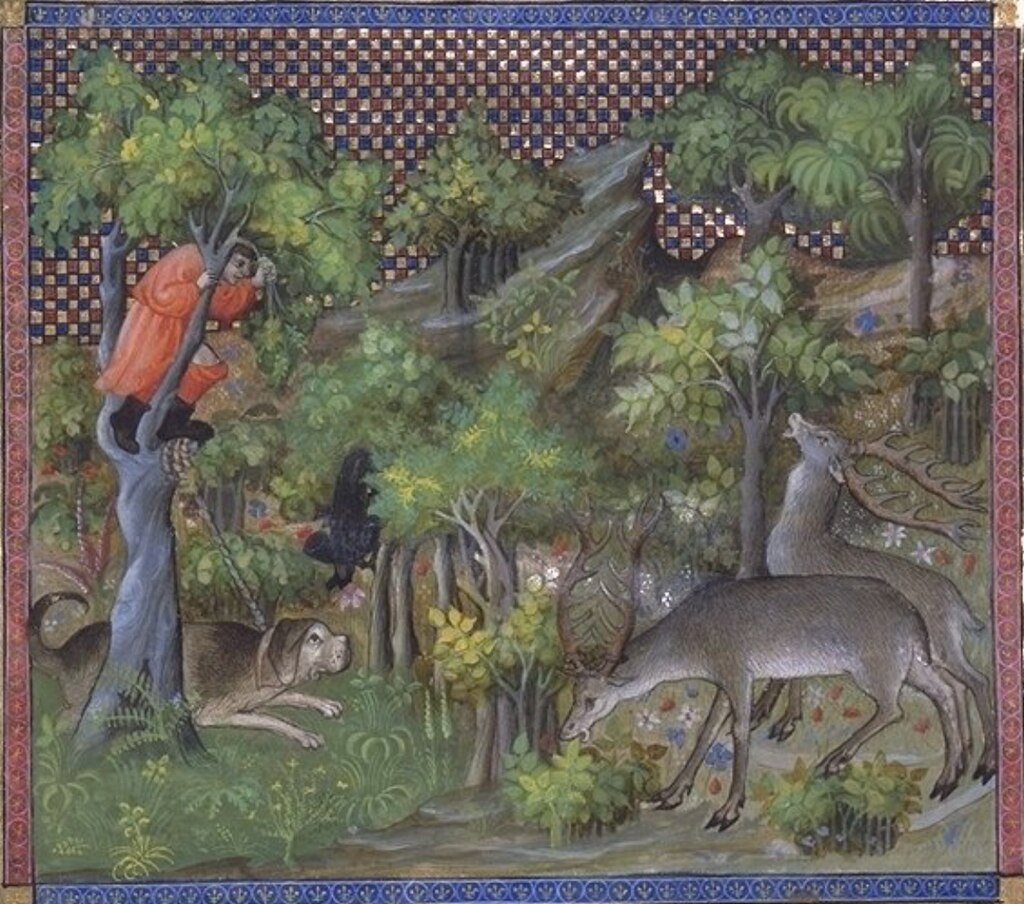
Finding the Hart from Livre de la Chasse by Gaston Phoebus, Count de Foix.