The Shame of Mock Slave Auctions in Secondary Classics

Dani Bostick teaches high school Latin and an occasional micro-section of ancient Greek in a Virginia public school. She has published several collections of Latin mottoes online and has a strong presence as an activist for survivors of sexual violence on Twitter.

The Junior Classical League purports to foster interest in the civilizations of ancient Greece and Rome and is one of the largest academic clubs in the world with 50,000 members and 1,200 chapters. For the last six decades, JCL has also supported mock slave auctions as a source of entertainment. Humor derived from dehumanization and degradation have no place in our society, especially given our country’s shameful history of enslavement and other forms of systemic racism.

My essay should end here. Ideally, the notion of mock slave auctions in an organization sponsored by the American Classical League should prompt outrage, activism, and sustained action. Too often, though, this kind of racism is tolerated and normalized by those both inside and outside of secondary classics. Latin teachers and other stakeholders, even those who purport to care about social justice, often protect the field over individuals marginalized and harmed by patterns of racism and hostility in secondary Latin. 

We can no longer afford to turn a blind eye to the state of secondary Classics. We are in dire need of reform.

The Junior Classical League is a space so insulated from the realities of racism that slave auctions have been a common source of entertainment and fun for decades. In 2016, a story about a mock slave auction went viral after black audience members were subjected to this racist spectacle at an Illinois Junior Classical League convention. In a demonstrably deceitful response, the National Junior Classical League and the American Classical League claimed they “regret to hear of the incident” and that “this incident in no way reflects the values we have as an organization.” 

The Junior Classical League did not “hear of the incident,” they have organized, promoted and sponsored similar events for the better part of a century. In the 1950s, a teacher wrote in Classical Outlook, “One boy bought a pretty girl just to have her following him around… The club has been asked to repeat the auction in assembly before the whole school.” 

1950s

Slave auctions continue in the Junior Classical League, often sanitized with the branding “Rent-a-Roman.” The 2011-2012 National Junior Classical League scrapbook contains a picture of a “slave” posing with her “master at the annual Rent-a-Roman.” In 2012, an event affiliated with the California Junior Classical League included this description: “You can offer yourself up for sale or bid on the merchandise to purchase a companion/ money-servant for the rest of the lunch hour.” In 2014, a write up in the newsletter of the Classical Association of the Midwest and South include a teacher touting activities that included a “master/slave program.” The 2017 California Junior Classical League constitution included a reference to slave auctions as a fundraising opportunity: “Should a slave auction be held at the state convention, the money acquired shall go to the state scholarship fund.” In 2018, the Pennsylvania Junior Classical League newsletter contained a report on a Saturnalia event where club leaders are “auctioned off to serve as ‘slaves’ for the night… these individuals will be ordered around by their new masters to fetch food, sing, dance, and entertain.”

Mock slave auctions are just one example of a much larger, pervasive problem in secondary Classics that includes trivializing slavery and turning oppression, and the oppressed, into a source of humor. In 2017, Erik Robinson documented problematic portrayals of slavery in secondary text books. The National Latin Exam, which over 140,000 students take, is notorious for their regressive treatment of slavery and other forms of oppression (e.g. sexual assault). There are too many examples to list here, but one recent question echoed the racist myth of the loyal slave. Loyalty is predicated on autonomy and feelings of allegiance, which mitigates the culpability of enslavers and misrepresents the realities of slavery. 
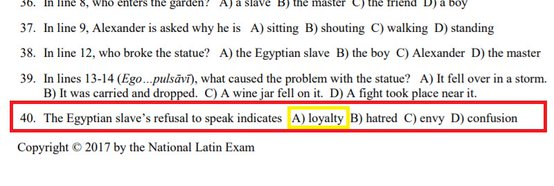
loyal slave

It is beyond the scope of this article to explain why slave auctions are racist and how this kind of humor, even in the context of ancient Rome, supports the messaging and strategies of white supremacy groups. Suffice it to say, these kinds of events are unethical and harmful. Recently, the New York attorney general’s office investigated a school for holding a slave auction, finding “that the teacher’s re-enactments in the two classes had a profoundly negative effect on all of the students present — especially the African American students — and the school community at large.” A student who witnessed the Illinois JCL slave auction told the Washington Post, “Since JCL is primarily white, they are so into their, like, white privilege, I guess, that they don’t know how they can affect minorities.”

The Junior Classical League has abused its monopoly and imposed a twisted value system on its members. JCL membership appeals to students looking to build their college resumes. And, many teachers are contractually required to sponsor a chapter. Our dues should not support this kind of culture. We should not cultivate students’ interest in this distortion of Classics.

The American Classical League has hired a diversity consultant, and in most of my correspondence with them, I am reminded of this fact. It is a positive step for the ACL to obtain the services of an outside expert, but a diversity consultant should be a small part of a larger strategy to eradicate racism from secondary Classics, not a standalone solution. As long as stakeholders in secondary Classics and our post-secondary colleagues protect the status quo through both action and inaction, this culture will persist and become even more toxic.

Concern for people affected by these systemic failures must trump the defense of the organization. ACL, JCL, NLE, and other affiliates exist to promote Classics. Nothing in the promotion of Classics should also include the promotion of racism and white supremacy, especially when hundreds of thousands of children are affected by the way the ACL has shaped the field. 

It is time for decisive action and commitment to change.

The co-chair of the National Latin Exam accused me in a late-night Twitter direct message of wanting a spectacle. I do not want a spectacle. (Perhaps that accusation was wishful thinking.) I want the culture of secondary Latin to stop supporting racism and narratives of white dominance.

This goal will take work, not just words. If you are interested in advocating against racism in Classics and want to know how to help, feel free to email me at dani.bostick@gmail.com 

Meanwhile, here are a few ways the American Classical League and its affiliates can begin to change the culture in secondary Classics. This list is far from exhaustive:

1)  Apologize for your role in perpetuating white supremacy and racism. Stop treating each instance of problematic content and practices as some sort of aberration. 

2)  Remove leaders and volunteers who have aggressively defended and perpetuated the status quo and who prioritize the interests and image of the organization over the well-being and safety of students.

3) Provide information to teachers about how to talk about white supremacy and dangerous appropriations of Classics. Our field has supported racist ideas and is used to legitimize hate and violence. We have a responsibility to equip students to recognize and counter these appropriations, even when they come from within our own field.

4) Remove all content immediately that is incompatible with the goal of “Classics for All” and release an accompanying statement that explains why the material was harmful. Do not legitimize offensive content and practices by engaging in a ‘both sides discussion’ and hiding behind procedure and tradition. Swift action and adherence to procedures are not mutually exclusive.

Colleagues in post-secondary Classics. Here are a few calls to action and points to consider: 

1) Find out if JCL held a mock slave auction on your campus. If so, apologize. Do not allow them on your campus. Fraternities have been suspended for holding slave auctions. It is even worse when they are held as entertainment in the context of an academic program for children. 

2) Formally condemn the practice of slave auctions and call on the Junior Classical League and, more broadly, the American Classical League, to own its uncomfortable past and repair the damage it has done through events like these and the culture they reflect. 

3) If you publish a newsletter or promote activities in secondary Latin, vet them before you provide a platform for abhorrent practices. There is no excuse for a “master/slave” activity to have been featured in a CAMWS publication (or any publication). 

4) Stay informed about what is going on in secondary Classics and hold organizations accountable for failures that affect both current students and the future of the field. 

The Tyranny of Ancient Thought

Few questions have as much staying power and contemporary relevance as those concerning the best form of governance, and few political assassinations have exercised as many minds as the slaying of Caesar. In 1400, Antonio of Aquila asked Coluccio Salutati whether he thought that Brutus and Cassius were traitors for slaying Caesar. The question possessed some immediate literary importance to both of these men, given that Florence’s poetic hero Dante had seen fit to punish Brutus and Cassius in the very inner circle of Hell. In the tradition of the times, Salutati composed a lengthy epistolary response to Antonio, beginning with an elaborately florid Florentine preface, followed by a carefully delineated set of topics: the definition of a tyrant, justifications for tyrannicide, whether Caesar was a tyrant, whether Caesar’s murder was justified, and (most important for the pedant) did Dante make the right choice in placing Brutus and Cassius in Hell? There is also an awkward appendix designed to answer the question whether Aeneas and Antenor were traitors to Troy, a question which Antonio had posed along with the apparently more salient one about Caesar’s murder.

Salutati’s tackles the definitional question in the initial section titled What Is a Tyrant and from What  is the Name Derived? by engaging in some amateur etymologizing. Salutati’s own etymologizing may not reflect the standard of scholarship achieved by men like Lorenzo Valla, but he does cite St. Gregory for what is effectively the proper definition of a tyrant:

“A tyrant is, properly speaking, one who reigns in a communal republic by something other than right.”

Proprie enim tyrannus dicitur qui in communi re publica non iure principatur.

Salutati cites Gregory again, this time displaying a Tacitean cynicism about human motives. In effect, Gregory believes that everyone is a tyrant in their own sphere, and will naturally seek to exercise as much power as they can:

“But we must recognize that every haughty person exercises tyranny in their own particular way. One person is the tyrant of a province, another of a city, another in his own house, and yet another – on account of his worthlessness – simply exercises tyranny in his mind. God is not concerned with how much evil someone can perpetrate, but only with how much they wish to perpetrate. When he is lacking causal power in the world, the tyrant is by himself, and his iniquity reigns supreme inside; because, even if he cannot afflict his neighbors outwardly, he yet harbors inwardly the desire to be able to afflict them.”

“Sed sciendum quia omnis superbus iuxta modum proprium tyrannidem exercet. Nam nonnumquam alius in provincia, alius in civitate, alius in domo propria, alius per latentem nequitiam hoc exercet apud se in cogitatione sua. Nec intuetur deus quantum quisque mali valeat facere, sed quantum velit. Et cum deest potestas foris, apud se tyrannus est, cui iniquitas dominatur intus; quia, et si exterius non affligat proximos, intrinsecus tamen habere potestatem appetit ut affligat.”

This line of thought, cited approvingly by Florentines during the Renaissance, was still popular centuries later and half a world away. Benjamin Rush, writing to John Adams, claimed that “Rulers become tyrants and butchers from instinct much oftener than from imitation.” Rome, Florence, and America are linked not only by their republican governments, but also by the cynical fear which served as the intellectual and emotional foundation of those republics. The generalized fear that any one person given sufficient latitude and power would subjugate the entire population to his will is often cited as the primary motivation for maintaining a republican (but not democratic) form of government.

Moving from his definition of tyranny to the question of tyrannicide, Salutati makes the general claim that because an individual would be justified in slaying another for violating his right to personal property, so too must it be lawful to slay one who invades the state, which is the property of all. Like Plato before him, Salutati engages himself in the pleasing error of confusing and conflating the individual and the state for the purpose of ethical reasoning.

Moral reasoning on classical principles would not be complete without the citation of ancient exempla, but Salutati makes a puzzling choice in his exemplum for justifying tyrannicide: the murder of Tiberius Gracchus. Through a curious inversion, Salutati reasons that Scipio Nasica was right to goad on the murder of Gracchus, a tribune of the people, because he was supposed by some sources to be aspiring to regal power. Salutati has let his own aristocratic bias overcome the apparently republican or demotic tone of an essay against tyranny, and has adopted the viewpoint of ancient aristocrats who likely saw Gracchus as a dangerous instrument of what they (or in modern times, someone like Mitch McConnell) would dismiss as “mob rule”.

But perhaps this is the problem with any republic – it is simply aristocracy under the guise of popular government. Perhaps that thin veneer of demotic sovereignty is just the political form of bread and circuses. When someone in America complains that the government is doing a poor job of representing the popular will, they are commonly treated to a curt civics lesson intended to remind them that this is a republic, not a democracy. Caesar was not killed for infringing the liberties of ‘the people’ more generally. Rather, in monopolizing power within the Roman state, Caesar offended the pride of other aristocrats who were denied access to the political power and prestige which they regarded as their rights. It is fashionable to dismiss the Augustan “restoration of the Republic” as a cynical PR sham, but (however much it may have later devolved into outright despotism) it is not clear that the reign of one man within a broadly constitutional framework differed substantially from the reign of a handful of traditional aristocratic families. Regardless of party, even America’s political elite are drawn almost exclusively from a class defined not by family lineage, but by access to one of a few prestigious universities (usually their law schools) which serve as bastions of privilege and entry points into the world of real and efficacious power within the political and corporate system. (This problem of elite “choke points” in the course of the rat race is similarly prevalent in academia.)

The third portion of Salutati’s essay, taken up with whether or not Caesar could be considered a tyrant, relies heavily on Cicero, whom Salutati affectionately refers to throughout as “our Cicero.” This is not wholly surprising, given that Cicero supplies the best contemporary documentary evidence for the period. Moreover, Cicero possessed for men like Salutati a kind of unparalleled authority, as is clear from the affectionate use of noster, “our” Cicero. Despite the fact that Cicero famously exulted over Caesar’s death, Salutati cites a number of Cicero’s letters and writings to prove, wholly on Cicero’s testimony, that Caesar was not a tyrant, but a popularly chosen (if supremely powerful) magistrate.

“Anyone who looks through Cicero’s writings diligently will find far greater praise than detraction of Caesar.”

Qui diligenter ipsius scripta perspexerit longe maiores Caesaris laudes invenerit quam detractiones.

Salutati rather naively or disingenuously takes the confirmation of Caesar’s political acts and appointments following his death as proof that even his enemies did not regard him as a tyrant. This may appear on the face of it to be mere idle fatuity on Salutati’s part, but he draws out a salient point: the conspirators objected to the man and the wounds which he inflicted upon their pride more than they objected to his political program.

“Why, man, he doth bestride the narrow world
Like a Colossus, and we petty men
Walk under his huge legs and peep about
To find ourselves dishonorable graves.” Shakespeare, Julius Caesar

In his dialogue with Cicero, Salutati argues that Caesar’s dictatorship was the logical and inevitable outcome of decades of simmering civil war. He then claims that Sulla’s dictatorship, though bloody, was nevertheless a stabilizing force for the Republic. At this point, it begins to seem that Salutati’s strongman theory of government depends in no small part on minute hair splitting about what exactly constitutes tyranny. Indeed, Sulla’s military seizure of the state, whether or not it was in crisis, is a perfect example of what the Greeks meant by tyranny.

Though Salutati and other Renaissance thinkers did much to throw off the shackles of scholasticism, some of the medieval schoolroom still stuck to his mind. He upbraids Cicero for forgetting his Aristotle. Salutati is only able to argue against an ancient authority by citing an even older and more august ancient authority. It is on this Aristotelian basis that Salutati makes his most appalling and dangerous claim: that nature herself fashioned some to rule and others to serve. As almost invariably happens, Greek political philosophy is being used to advocate for a reactionary aristocracy.

Salutati’s essay combines two of the most dangerous modes of classical reception and engagement: the practice of reasoning through uncritical dependence on historical exempla, and the citation of ancient philosophers as final intellectual authorities. Aristotle here represents the tyranny of auctoritas. The Enlightenment may have bequeathed to modernity its own set of intellectual horrors and stumbling blocks, but at least it helped to free the mind from this stifling tyranny of authority. As supporters of the classics, we should fear the prospect of lapsing back into this mode of reception. Indeed, the period in which classical learning suffered the most was not the 20th century decline classics courses in high schools and universities. Rather, it was the period of medieval scholasticism during which classical learning became ossified and inert – an instrument for justifying institutionalized power, a cudgel to be wielded against those without access to it.

Classical learning exhibits the most vitality when it is actively engaged – soaked in and fully digested, yes, but also thoroughly interrogated and wrangled with. Salutati attempts this kind of interrogation in his argument written directly against Cicero, but he fails in that he is only able to cite authority against authority. (If medieval and early Renaissance thought were a card game like Magic: The Gathering or Pokemon, the Plato and Aristotle cards would be so wildly overpowered as to render the game wholly unbalanced.)

Some readers of On the Tyrant have been surprised, perplexed, or disappointed with Salutati’s reasoning, perhaps especially with his ardent support for political strongmen. This is apparently at variance with his more general belief in republican government, but his thoughts on tyranny may seem less surprising when we consider more carefully the ways in which tyranny and republican government are not wholly dissimilar. If we understand a tyrant to be one who governs without securing popular consent, might this definition not clearly apply to a president who attained office without winning the popular vote? Is that not a form of constitutionally institutionalized tyranny? Any political or social thought which is not informed by but rather based upon ancient thinkers is bound to be reactionary and aristocratic, because this is what survives: endless talk of “liberty” but a generalized paranoia about both monarchic rule on one hand and democratic power on the other. The ancient partiality for “balance” and “moderation” – that peculiar fetish for the golden mean, the aurea mediocritas which certainly has a tendency to foster mediocrity – suggested strongly to ancient thinkers and their successors that aristocratic republics were the sensible middle ground between the monarch and the mob. Salutati concludes that Dante was right to place Brutus and Cassius in the deepest pit of hell – but now we’re the ones who are suffering.

Image result for brutus and cassius in hell

Tawdry Tuesday: Words You Didn’t Know You Need

Selections from the Comica Adespota

72 Aelian Historical Miscellany 13.15

“The comic poets say that there was a guy named Polydorus who was really thick in the head and had nearly impenetrable skin. There was also another person named Koikylion who used to try to count the waves of the sea because of madness. There is a tale that Sannurion was like this, a man who was looking for a ladder in a flask. They also say that those guys Koroibos and Melitides were stupid too”

φασὶ παχύτατον γενέσθαι τὴν διάνοιαν οἱ τῆς κωμῳδίας ποιηταὶ τὸ δέρμα ἔχοντα ἀδιακόντιστον Πολύδωρόν τινα, καὶ ἄλλον Κοικυλίωνα ὄνομα, ὅσπερ τὰ κύματα ἠρίθμει ὑπὸ τῆς ἄγαν μανίας. λόγος δέ τις καὶ Σαννυρίωνα τοιοῦτον γενέσθαι, ὃς ἐν τῇ ληκύθῳ τὴν κλίμακα ἐζήτει. καὶ Κόροιβον δὲ καὶ Μελιτίδην καὶ ἐκείνους ἀνοήτους φασίν.

The Loeb translates the phrase “ladder in a flask” as “tempest in a teapot”. I feel less than compelled by the translation in this context.

173 Etym. Gen. lambda 34

“Long-balls”: this means having big testicles. Aristokrates was mocked thus.”

λαπιδόρχας· ὁ μεγάλους ὄρχεις ἔχων. Ἀριστοκράτης δὲ οὕτω διεβάλλετο.

221 Eustathius ad Od. 1910.10

“Harsher than this is to be called a centaur in jest, one in comedy who pricks the ass [kent-orros]”

πικρότερον δὲ τούτου εἰς σκῶμμα τὸ εἰρῆσθαι κένταυρον, ὃς κεντεῖ ὄρρον τὸν παρὰ τῷ κωμικῷ.

511 Photius p. 192.12

“Laconian-ass-bandit: For Kleinias who had Laconian style anal-sex. They say that having sex with boys is to “act like a Laconian.” According to Aristotle, Theseus had sex with Helen this way.”

Κυσολάκων· ὁ Κλεινίας ὁ τῷ κυσῷ λακωνίζων· τὸ δὲ τοῖς παιδικοῖς χρῆσθαι λακωνίζειν λέγουσιν· Ἑλένῃ γὰρ Θησεὺς οὕτως ἐχρήσατο, ὡς Ἀριστοτέλης.

File:Plastic aryballos BM GR1888.6-1.660.jpg
Squatting man aryballos

A Ghost Story from Petronius for Werewolf Week

Earlier  we saw how Plato makes being a tyrant equivalent to a type of lycanthropy. The Romans were also into that kind of thing. One of our oldest werewolf tales comes from Petronius’ Satyricon (61-62):

“Trimalchio turned to Niceros and said: “You used to be more pleasant company—I don’t know why you are now so quiet and subdued. If you want to make me happy, please tell us what happened to you.

Niceros, excited at his friend’s request, replied: “May all profit escape me, if I cannot deflate your joy—when I see how you are. Nevertheless, may happiness be ours, even if I am afraid that these scholars will laugh at me. Let them look on: I will tell the story nonetheless, what difference is it to me? It is better to tell a joke than be one.”

werewolf

Once he had uttered these words, he began the following tale:

‘When I was a slave, we were living in a narrow street where the home of Gavus is now. There is was where the gods decided I would fall in love with the wife of Terence the Innkeeper. You do remember Melissa from Tarentum—that most beautiful little package? By god, I loved her less for her body and sexcapades than I did for her fine morals. She didn’t deny me anything I sought. She made a penny, I got half! I put everything I had into her lap, and I was never cheated.

Her husband passed away at the inn one day. As you can imagine, I risked Skylla and Charybdis so I could get to her: for, as they say, Friends are present in times of need.

By chance, my master was visiting Capua in pursuit of some business. I took my chance and compelled a guest to accompany me to the fifth milestone. He was a soldier and as strong as Orcus. We blundered off around the time of the cock’s crow while the moon was shining as bright as midday. We went among the graves and my friend went among the stones to defecate. I sat singing and counting gravemarkers. And then, as I looked for my companion, he appeared and placed all his clothes near the road.

My breath nearly jumped out my nose—I was standing like a corpse. But he pissed around his clothes and suddenly became a wolf! Don’t you dare imagine I am joking, that I am lying. I make up nothing for such an inheritance as this! But, back to what I started to say, after he turned into a wolf, he began to howl and fled into the forest. At first, I didn’t remember where I was: then I went to gather up his clothes, but they had transformed into stones! What could I do but die from fear?

I drew my sword and struck all the shadows before me until I made it to my girlfriend’s home. I entered as pale as a ghost with sweat rushing down to my groin, my eyes nearly dead. I could hardly regain myself. My Melissa was at first surprised because I had gone out so late. And then she said “I wish you had come earlier, you could have helped us: a wolf entered the house and loosed more blood from the ship than a butcher! He escaped, but he didn’t laugh: an older slave tore his throat with a spear.”

Once I heard these words, I could not sleep any longer. At first light I fled the home of Gaius like an angry landlord. But once I came to the place where his clothing had turned into stone, I found nothing but blood. Honestly, I went home and my soldier was lying like a bull on his bed as a doctor was tending to his neck. I knew that he was a shapeshifter* then, and I wouldn’t have been able to share a meal with him even if you threatened to kill me. Let these men believe what they want about this, but if I am lying, let the gods hate me.”

*”shapeshifter”: Latin, versipellis (lit. “pelt-changer”) is used several times for form-changing in Latin literature. Often, this example and that of Pliny EN 8.80 (cf. LSJ s.v.) are translated as “werewolf”. I chose the more general sense.

[LXI] … Trimalchio ad Nicerotem respexit et: “Solebas, inquit, suavius esse in convictu; nescio quid nunc taces nec muttis. Oro te, sic felicem me videas, narra illud quod tibi usu venit.” Niceros delectatus affabilitate amici: “Omne me, inquit, lucrum transeat, nisi iam dudum gaudimonio dissilio, quod te talem video. Itaque hilaria mera sint, etsi timeo istos scolasticos ne me rideant. Viderint: narrabo tamen, quid enim mihi aufert, qui ridet? satius est rideri quam derideri.”

Haec ubi dicta dedit talem fabulam exorsus est:

“Cum adhuc servirem, habitabamus in vico angusto; nunc Gavillae domus est. Ibi, quomodo dii volunt, amare coepi uxorem Terentii coponis: noveratis Melissam Tarentinam, pulcherrimum bacciballum. Sed ego non mehercules corporaliter aut propter res venerias curavi, sed magis quod benemoria fuit. Si quid ab illa petii, nunquam mihi negatum; fecit assem, semissem habui; in illius sinum demandavi, nec unquam fefellitus sum. Huius contubernalis ad villam supremum diem obiit. Itaque per scutum per ocream egi aginavi, quemadmodum ad illam pervenirem: nam, ut aiunt, in angustiis amici apparent.

[LXII] “Forte dominus Capuae exierat ad scruta scita expedienda. Nactus ego occasionem persuadeo hospitem nostrum, ut mecum ad quintum miliarium veniat. Erat autem miles, fortis tanquam Orcus. Apoculamus nos circa gallicinia; luna lucebat tanquam meridie. Venimus inter monimenta: homo meus coepit ad stelas facere; sedeo ego cantabundus et stelas numero. Deinde ut respexi ad comitem, ille exuit se et omnia vestimenta secundum viam posuit. Mihi anima in naso esse; stabam tanquam mortuus. At ille circumminxit vestimenta sua, et subito lupus factus est. Nolite me iocari putare; ut mentiar, nullius patrimonium tanti facio. Sed, quod coeperam dicere, postquam lupus factus est, ululare coepit et in silvas fugit. Ego primitus nesciebam ubi essem; deinde accessi, ut vestimenta eius tollerem: illa autem lapidea facta sunt. Qui mori timore nisi ego? Gladium tamen strinxi et umbras cecidi, donec ad villam amicae meae pervenirem. In larvam intravi, paene animam ebullivi, sudor mihi per bifurcum volabat, oculi mortui; vix unquam refectus sum. Melissa mea mirari coepit, quod tam sero ambularem, et: ‘Si ante, inquit, venisses, saltem nobis adiutasses; lupus enim villam intravit et omnia pecora tanquam lanius sanguinem illis misit. Nec tamen derisit, etiamsi fugit; senius enim noster lancea collum eius traiecit’. Haec ut audivi, operire oculos amplius non potui, sed luce clara Gai nostri domum fugi tanquam copo compilatus; et postquam veni in illum locum, in quo lapidea vestimenta erant facta, nihil inveni nisi sanguinem. Vt vero domum veni, iacebat miles meus in lecto tanquam bovis, et collum illius medicus curabat. Intellexi illum versipellem esse, nec postea cum illo panem gustare potui, non si me occidisses. Viderint quid de hoc alii exopinissent; ego si mentior, genios vestros iratos habeam.”