Sad Ovid’s Sad Poem is Really Sad

Ovid, Tristia 3, 1-20

“I come to this city fearfully, sent as an exile’s book.
Reader, my friend, give a calming hand to the weary
and don’t worry that I might shame you in some way.
No line in this manuscript teaches about love.

My master’s fate is such that the miserable man
should not hide it in any jokes
That work which amused him once in his green age
He now condemns—alas, too late—and hates.
Look what I carry: you will find nothing but sorrow here,
a song which matches its own days.

If the lame song breaks off in alternating lines,
then it comes from the meter’s form or the journey’s length.
If I am not bright with cedar nor smooth from pumice,
it is because I turned red at looking better than my master.
If the letters are shapeless, if they are marred by erasure,
it is because the poet wounded the work with his own tears.
If any words seem by chance not to be Latin,
it is because he wrote them in a barbarous land.

Tell me, readers—if it is not too much—where should I go,
What home should I, a foreign book, seek in this city?

Missus in hanc uenio timide liber exulis urbem
da placidam fesso, lector amice, manum;
neue reformida, ne sim tibi forte pudori:
nullus in hac charta uersus amare docet.
Haec domini fortuna mei est, ut debeat illam
infelix nullis dissimulare iocis.
Id quoque, quod uiridi quondam male lusit in aeuo,
heu nimium sero damnat et odit opus.
Inspice quid portem: nihil hic nisi triste uidebis,
carmine temporibus conueniente suis.
Clauda quod alterno subsidunt carmina uersu,
uel pedis hoc ratio, uel uia longa facit;
quod neque sum cedro flauus nec pumice leuis,
erubui domino cultior esse meo;
littera suffusas quod habet maculosa lituras,
laesit opus lacrimis ipse poeta suum
Siqua uidebuntur casu non dicta Latine,
in qua scribebat, barbara terra fuit.
Dicite, lectores, si non graue, qua sit eundum,
quasque petam sedes hospes in urbe liber.

Image result for Medieval manuscript sad poet
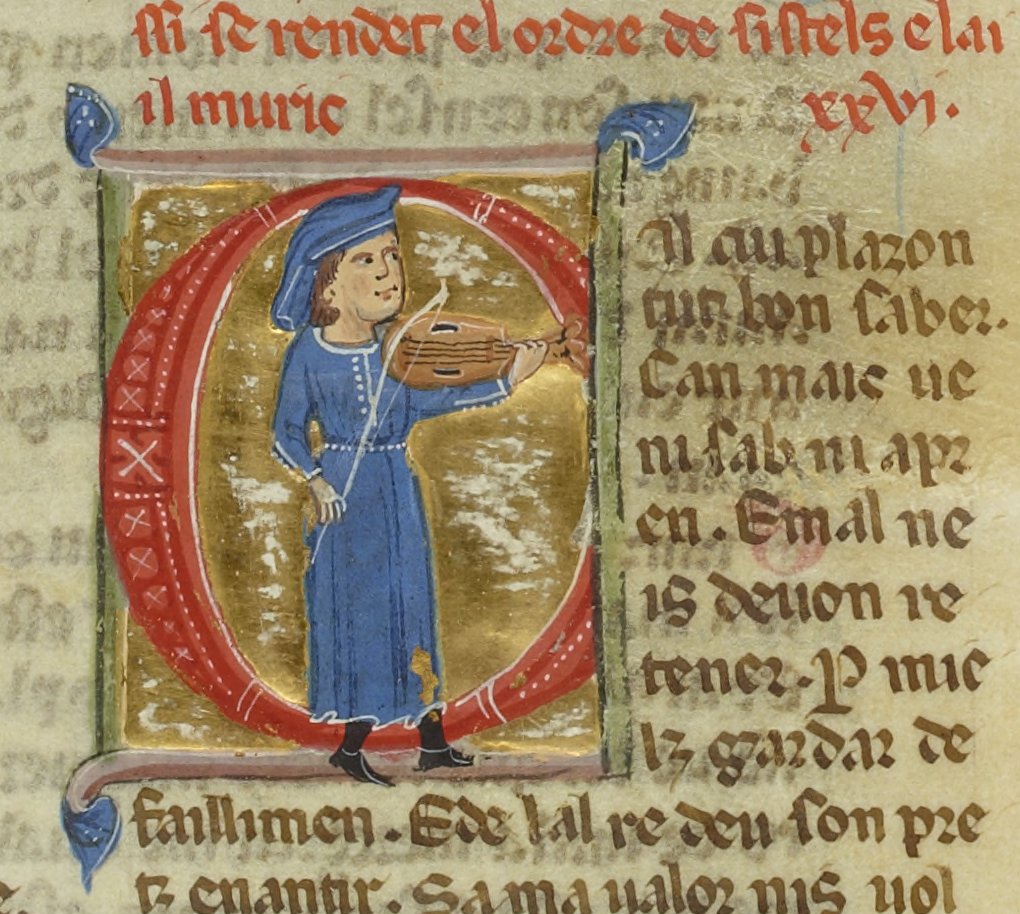
A troubador


Classroom Confession: I am a Terrible Teacher

My students hate Latin. It’s a dead language, it has nothing to do with their lives, it takes too long to look up unfamiliar words in the dictionary, all of the sentences are in the wrong order. As far as they can tell, Caesar bored the Gauls into submission, Vergil was right to ask that the Aeneid be burned upon his death, and Cicero has received the nickname the Roman Aeolus on account of the fact that he possesses such an ample store of wind. They like Catullus at any rate, and react to his poems with that peculiarly condensed form of internet speak which effortlessly conveys entire paragraphs of thought in one adjective, ‘relatable’. (Or sometimes, though now less frequently, ‘saaame.’ Yes, the vowel must be lengthened.)

Why are these students in Latin then? For the most part, they aren’t. Approximately 2,700 students attend my school, of which about 100 are enrolled in one of the Latin courses in any given year. Of those, I have never had more than 20 enrolled in my Latin III & IV courses (that is, 20 students between those two courses combined) because students in Texas are only required to take two years of any given language. Of the students who go through all four years, typically only one or two are there for Latin; the rest simply like me as a teacher. (Lest this seem prepossessing, I note that this is what the students have told me explicitly.)

I often tell them that I would prefer that they love Latin while hating me as an odious tyrant, whose grim oppression they endured in the pursuit of their favorite subject. Though I may be charged with insincerity on this score, I nevertheless cannot help but feel like a failure as an educator when I realize that I have not transmitted my enthusiasm to my young charges. I have heard Reginald Foster remark on numerous occasions that this is the central failure of modern Latin pedagogy: a failure to instill a sense of Latin’s beauty, power, and interest. Typically he adds that a music class would be unsuccessful if the students walked away disliking Mozart. Rhetorically, this is appealing, yet I think that it unfairly compares something (music) which has a certain universal and almost primal appeal to something else (Latin), learning which requires a previously-developed interest to undertake, and – once undertaken – a substantial amount of labor to appreciate in any meaningful way.

Latin per se is a hard sell in high school, because few students have any real idea about the potential treasures which await them. Indeed, I did not even take Latin until my third year of college, and only then because I was so captivated by a Classical literature in translation class which I had taken the year before, and I doubt that I would have applied myself so diligently to mastering declensions and conjugations if I were not already so eagerly desirous of reading ancient texts in the original.

I have been listening recently with rapt attention to Scott Lepisto’s delightful Itinera podcast, which satisfies my own deep craving for vicarious professorial experience as someone who always thinks wistfully about what could have been if I had gone to graduate school. Yet, both on the podcast and in my personal interactions with professional Classicists, I have been surprised to learn just how many professionals in the field either hated Latin in highschool, or found it extremely challenging. I first encountered this latter sentiment among one of my fellow Latin teachers in town. Never before had it occurred to me that anyone in Classics found Latin difficult. This may itself reflect an inherited form of elitist prejudice which I subconsciously inherited in my early days as a Classics student. We are told that the languages are what make the field rigorous and clearly superior to the other humanities as physics is superior to the other sciences. Quite often, as Amy Pistone noted in her post, ‘You can’t spell Classicist without Classist’, the phrase ‘linguistic rigour’ is used as a criterion for base exclusion. Indeed, professors and graduate school application advice pages often imply that a certain linguistic wizardry is required to even consider proceeding to advanced study within the field.

Indolence, however, is my chief besetting vice, and in this case managed to form a potent cocktail in conjunction with personal vanity. I recall that I spent a fair amount of time doing the basic gruntwork of paradigm memorization, but I was attracted to Latin in part because I found it supremely easy. This in turn allowed for the requisite amount of idle time-wasting so essential to the authentic American college experience. Whether my interest was bolstered by my apparent facility with the language or whether I acquired it so readily because of my blossoming enthusiasm for it is impossible for me to determine. My retrospectacles have become so darkly tinted with the accretions of later time and experience that I have lost all sense for the difficult spots in Latin.

That is why I am a terrible teacher. I can present reams of information in an exciting and compelling way, but I struggle with anticipating students’ difficulties, and indeed, cannot understand it when they are stuck. Boswell noted of Samuel Johnson that he was not “well qualified for being a teacher of elements, and a conductor in learning by regular gradations”. This has given rise to my most toxic and obnoxious pronouncement in class: “Oh it’s not that bad, Latin practically learns itself.” By now, I regret saying this to my students because I realize that it is likely to produce further frustration among the ones who are struggling, but at the same time, it has become something of a running joke/catch-phrase among the kids. One student even wrote on the top of her test, Lingua Latina a se discitur!, which was enough to earn a laugh and some extra points.

Mythology, history, and Roman culture all still captivate the students. But not Latin itself. They catch a sense of my unbridled enthusiasm for Classics. But they do not catch that enthusiasm themselves. I often return home depressed that, because of my pedagogical limitations, my own highly-charged and passionate teaching does little more for the students than the sit-at-your-desk-and-watch-football pedagogy so rigorously and assiduously applied by the coaches on campus. Only one of my students has gone on to study Classics in college, and even the best have laughed when I suggested that they may want to hold on to their Latin dictionaries after high school so that they can keep reading.

Perhaps my perspective is fundamentally flawed. Almost all Classicists took Latin in school somewhere, but that in no way implies that all people who took Latin in school wanted to become Classicists. I try to remember that there is a disparity in experience between my role in the classroom, where I am doing what seems to me the most important thing in the world, and the students’ role, which is simply to make it through one of seven courses for the day in the pursuit of grades and credit certifying them for the next stage in their lives.

I have begun to get away from thinking that every student in my class needs to learn Latin. Some of them simply do not put in the time to make anything meaninful out of any of the texts. I could of course simply give them a failing grade, but this would compound the problem of having wasted my own time by wasting their time too. Recently, for those students whose averages are regularly well below 70, I have assigned essays on Roman history/culture, Classical myth, and even Classical reception. One student is inordinately fascinated with dictatorships, so he is now writing an essay on the use of Roman history and symbols under Mussolini’s fascist rule. Another student is reading Plautus in translation and writing a comparative appraisal of Roman comic tropes with those of contemporary Hollywood comedies. I wish that they were doing actual Latin, but at this point (second semester of the second year), it seems clear that they can/will not. Perhaps a better teacher could make it happen through sheer force of will, and perhaps this compromise is more reflective of my limitations than theirs.

It may be that one of these students will be interviewed on Itinera twenty years from now, and they will concede that though they didn’t care much for Latin itself in highschool, they gave it a second shot in college and became experts on Martianus Capella or something similarly recondite. Perhaps they will at least, in later life, look back upon the time in my classroom as well spent and pick up a translation of Tacitus to better understand our own time. My impact on the field and on the world may always be entirely negligible, but I am at least happy that for a few hundred hours of these students’ lives, I get to share with them what I love.

Image result for fox teaching medieval manuscript

Homer: Poet, Parent, Parodist?

If you want to read more about Homer and the “Battle of Frogs and Mice”, you can check out the page on the blog. And you can also check out our book…

Greek Anthology, Exhortative Epigrams 90

“Because he wanted to exercise his mind,
Homer made up the tale of frogs and mice,
Which he then gave to children to imitate.”

῞Ομηρος αὐτοῦ γυμνάσαι γνῶσιν θέλων,
τῶν βατράχων ἔπλασε καὶ μυῶν μῦθον
ἔνθεν παρορμῶν πρὸς μίμησιν τοὺς νέους.

The problematic biographies, the various Lives of Homer, include some similar information.

Vita Herodotea 332-4

“The man from Khios had children around the same age. They were entrusted to Homer for education. He composed these poems: the Kekropes, Batrakohmuomakia, Psaromakhia, Heptapaktikê, and Epikikhlides and as many other poems as were playful.”

ἦσαν γὰρ τῷ Χίῳ παῖδες ἐν ἡλικίῃ. τούτους οὖν αὐτῷ παρατίθησι παιδεύειν. ὁ δὲ ἔπρησσε ταῦτα· καὶ τοὺς Κέρκωπας καὶ Βατραχομυομαχίαν καὶ Ψαρομαχίην καὶ ῾Επταπακτικὴν καὶ ᾿Επικιχλίδας καὶ τἄλλα πάντα ὅσα παίγνιά ἐστιν.

Vita Plutarchea 1.98-100

“He wrote two poems, the Iliad and the Odyssey and, as some say, though not truthfully, he added the Batrakhomuomakhia and Margites for practice and education.”

ἔγραψε δὲ ποιήματα δύο, ᾿Ιλιάδα καὶ ᾿Οδύσσειαν, ὡς δέ τινες, οὐκ ἀληθῶς λέγοντες, γυμνασίας καὶ παιδείας ἕνεκα Βατραχομυομαχίαν προσθεὶς καὶ Μαργίτην.

Vita Quinta, 22-24

“Some also say that two school poems were attributed to him, the Batrakhomuomakhia and the Margites.”

τινὲς δ’ αὐτοῦ φασιν εἶναι καὶ τὰ φερόμενα δύο γράμματα, τήν τε Βατραχομυομαχίαν καὶ τὸν Μαργίτην.

The Margites is another epic parody we have only in fragmentary form.  Aristotle attributes it to Homer in his Poetics (1448b28-1449a3):

“We aren’t able to say anything about [parody] before Homer—but it is likely there were many—but we must start from Homer who leaves us the Margites and other works of this sort. It is fitting that among these works he also developed the iambic meter—for this is the very reason that iambos is called this today, since men are always mocking each other in that meter. Some of the ancient poets wrote heroic poetry, others wrote iambic.  Just as Homer was the exceptional poet in serious matters—for he didn’t only do it well in other ways but he also made his representations dramatic—in the same way he was the first to display the character of comedy in dramatizing something funny, not reproachful. And his Margites completes an analogy for us: just as the Iliad and the Odyssey are to tragedy, so to the Margites is to comedy.”

τῶν μὲν οὖν πρὸ ῾Ομήρου οὐδενὸς ἔχομεν εἰπεῖν τοιοῦτον ποίημα, εἰκὸς δὲ εἶναι πολλούς, ἀπὸ δὲ ῾Ομήρου ἀρξαμένοις ἔστιν, οἷον ἐκείνου ὁ Μαργίτης καὶ τὰ τοιαῦτα. ἐν οἷς κατὰ τὸ ἁρμόττον καὶ τὸ ἰαμβεῖον ἦλθε μέτρον—διὸ καὶ ἰαμβεῖον καλεῖται νῦν, ὅτι ἐν τῷ μέτρῳ τούτῳ ἰάμβιζον ἀλλήλους. καὶ ἐγένοντο τῶν παλαιῶν οἱ μὲν ἡρωικῶν οἱ δὲ ἰάμβων ποιηταί. ὥσπερ δὲ καὶ τὰ σπουδαῖα μάλιστα ποιητὴς ῞Ομηρος ἦν (μόνος γὰρ οὐχ ὅτι εὖ ἀλλὰ καὶ μιμήσεις δραμαικὰς ἐποίησεν), οὕτως καὶ τὸ τῆς κωμῳδίας σχῆμα πρῶτος ὑπέδειξεν, οὐ ψόγον ἀλλὰ τὸ γελοῖον δραματοποιήσας· ὁ γὰρ Μαργίτης ἀνάλογον ἔχει, ὥσπερ ᾿Ιλιὰς καὶ ἡ ᾿Οδύσσεια πρὸς τὰς τραγῳδίας, οὕτω καὶ οὗτος πρὸς τὰς κωμῳδίας.

The Batrakhomuomakhia, however, is not clearly ascribed to Homer until the first century CE.

BM

The Learned Lumber of Greek and Roman Reading

Thomas Jefferson, Letter to Robert Skipwith, (Aug. 3rd 1771)

“I sat down with a design of executing your request to form a catalogue of books amounting to about 30. lib. sterl. but could by no means satisfy myself with any partial choice I could make. Thinking therefore it might be as agreeable to you, I have framed such a general collection as I think you would wish, and might in time find convenient, to procure. Out of this you will chuse for yourself to the amount you mentioned for the present year, and may hereafter as shall be convenient proceed in completing the whole. A view of the second column in this catalogue would I suppose extort a smile from the face of gravity. Peace to it’s wisdom! Let me not awaken it. A little attention however to the nature of the human mind evinces that the entertainments of fiction are useful as well as pleasant. That they are pleasant when well written, every person feels who reads. But wherein is it’s utility, asks the reverend sage, big with the notion that nothing can be useful but the learned lumber of Greek and Roman reading with which his head is stored? I answer, every thing is useful which contributes to fix us in the principles and practice of virtue. When any signal act of charity or of gratitude, for instance, is presented either to our sight or imagination, we are deeply impressed with it’s beauty and feel a strong desire in ourselves of doing charitable and grateful acts also. On the contrary when we see or read of any atrocious deed, we are disgusted with it’s deformity and conceive an abhorrence of vice. Now every emotion of this kind is an exercise of our virtuous dispositions; and dispositions of the mind, like limbs of the body, acquire strength by exercise. But exercise produces habit; and in the instance of which we speak, the exercise being of the moral feelings, produces a habit of thinking and acting virtuously.”

Image result for thomas jefferson

Opposites Attract: Plato, Hesiod, and Paula

Plato, Lysis, 215c-d

“I once heard someone saying—and I just now remembered it—that like is most hostile to like and the good is hostile to the good. Indeed, I believe that he furnished Hesiod as a witness, since he says that “a potter rivals a potter, a singer a singer, and a beggar a beggar” and he says that this is the same by necessity with everything else, especially when something is very similar, they are filled with envy, competitiveness, and enmity. But things that are unlike one another are filled with love.”

῎Ηδη ποτέ του ἤκουσα λέγοντος, καὶ ἄρτι ἀναμιμνῄσκομαι, ὅτι τὸ μὲν ὅμοιον τῷ ὁμοίῳ καὶ οἱ ἀγαθοὶ τοῖς ἀγαθοῖς πολεμιώτατοι εἶεν· καὶ δὴ καὶ τὸν ῾Ησίοδον ἐπήγετο μάρτυρα, λέγων ὡς ἄρα—

καὶ κεραμεὺς κεραμεῖ κοτέει καὶ ἀοιδὸς ἀοιδῷ
καὶ πτωχὸς πτωχῷ,

καὶ τἆλλα δὴ πάντα οὕτως ἔφη ἀναγκαῖον εἶναι μάλιστα τὰ ὁμοιότατα ἄλληλα φθόνου τε καὶ φιλονικίας καὶ ἔχθρας ἐμπίμπλασθαι, τὰ δ’ ἀνομοιότατα φιλίας·

I am not quite sure that Hesiod would agree to this interpretation:

Hes. Fr. 264

“Good men flock to the tables of good men on their own.”
αὐτόματοι δ’ ἀγαθοὶ ἀγαθῶν ἐπὶ δαῖτας ἵενται.

And, because of my age, I cannot even think “opposites attract” without hearing this:

Neither Property Nor Speech

Epictetus, Encheiridion 44

“These statements are illogical: “I am richer than you and therefore better than you. I am more articulate than you and therefore better than you.” But these conclusions are more fitting: “I am wealthier than you, therefore my possessions are greater than yours. I am more articulate than you, therefore my speech is better than yours.” You are neither your property nor your speech.”

c. 44. Οὗτοι οἱ λόγοι ἀσύνακτοι· “ἐγώ σου πλουσιώτερός εἰμι, ἐγώ σου ἄρα κρείσσων”· “ἐγώ σου λογιώτερος, ἐγώ σου ἄρα κρείσσων” ἐκεῖνοι δὲ μᾶλλον συνακτικοί· “ἐγώ σου πλουσιώτερός εἰμι, ἡ ἐμὴ ἄρα κτῆσις τῆς σῆς κρείσσων”· “ἐγώ σου λογιώτερος, ἡ ἐμὴ ἄρα λέξις τῆς σῆς κρείσσων.” σὺ δὲ γε οὔτε κτῆσις εἶ οὔτε λέξις.


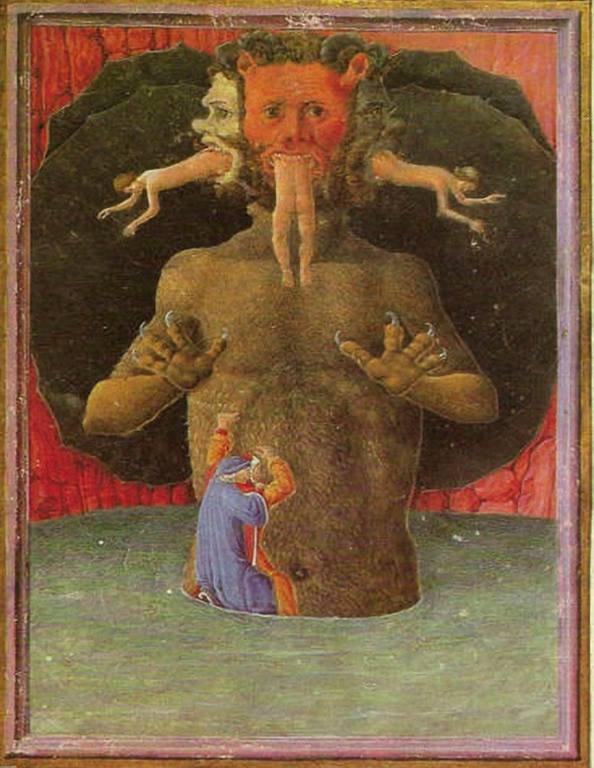
Botticelli’s Lucifer

Stemming the Torrent of Vice

Abigail Adams, Letter to John Thaxter (May 21st, 1778):

“If we look to that period in History we shall find that neither the Eloquence of Cicero, the stern virtue of Cato nor the poignard of Brutus and Cassius, could stem the Torrent of vice or save a people who were sunk into every excess of debauchery, grown wicked and Effimanate, having intirely lost that purity of Morals and that Love of Liberty which had acquired them, immortal fame and Glory.—Has not Britain arrived to the same period, and will not her Cicero’s and Cato’s plead in vain?”

Image result for suicide of cato the younger

Suspicious Speech and the Pleasure Principle

Quintilian Inst Orat. 5.14

“In addition, the harsher something is by nature, the more it must be peppered with pleasures. A speech’s content is less suspicious thanks to disguise; and the audience’s pleasure aids much the speech’s credibility. Unless, of course, we believe that Cicero put it badly in his suggestion that “laws keep quiet among arms’ or “sometimes a sword is handed to us by the laws themselves.” In these cases, the devices must be consideration as an ornament, not an impediment.”

quoque quid est natura magis asperum, hoc pluribus condiendum est voluptatibus, et minus suspecta argumentatio dissimulatione, et multum ad fidem adiuvat audientis voluptas: nisi forte existimamus Ciceronem haec ipsa male in argumentatione dixisse, ‘silere leges inter arma’, et ‘gladium nobis interim ab ipsis porrigi legibus’. In his tamen habendus is est modus ut sint ornamento, non impedimento.

Image result for medieval manuscript pleasure
Roman de la Rose. Bruges c. 1490-150

1/10 Will Die Today!

In my typically discursive and unplanned way, I talked to my students today about the Roman practice of decimation. I gave them a typically general run-down on it, but tomorrow I will have some actual sources for them:

Dionysius of Halicarnassus, Roman Antiquities IX.50:

“Afterward, the centurions whose men had fled, and the standard-bearers who had lost their standards either had their heads cut off at the neck, or were beaten to death with clubs. Of the rest of the army, one man of every ten was selected by lot and killed in front of the others. This is for the Romans the typical punishment given to those who broke their ranks or abandoned their standards.”

καὶ μετὰ τοῦθ᾽ οἱ λοχαγοί τε, ὧν οἱ λόχοι ἔφυγον, καὶ οἱ πρόμαχοι τῶν σημείων, ὅσοι τὰ σημεῖα ἀπολωλέκεσαν, οἱ μὲν πελέκει τοὺς αὐχένας ἀπεκόπησαν, οἱ δὲ ξύλοις παιόμενοι διεφθάρησαν: ἐκ δὲ τοῦ ἄλλου πλήθους ἀπὸ δεκάδος ἑκάστης εἷς ἀνὴρ ὁ λαχὼν κλήρῳ πρὸ τῶν ἄλλων ἀπέθνησκεν. αὕτη Ῥωμαίοις πάτριός ἐστι κατὰ τῶν λιπόντων τὰς τάξεις ἢ προεμένων τὰς σημαίας ἡ κόλασις

Livy, ab Urbe Condita 2.59

“Finally the consul (Appius Claudius), once the men had been collected from the disorderly retreat, and after he had followed his own soldiers and called them back in vain, placed his camp in the now peaceful field. He called a meeting and rightly railed on against the army which he called the betrayer of military discipline and the deserter of the standards. He kept asking individual soldiers where their standards and weapons were. He marshalled the offending standard bearers, centurions, and the double-paid soldiers who had abandoned their lines; he had them beaten with switches and he then killed them with an axe. Of the rest of the army, each tenth man was selected by lot to be executed.”

Tandem conlectis ex dissipato cursu militibus consul, cum revocando nequiquam suos persecutus esset, in pacato agro castra posuit; advocataque contione invectus haud falso in proditorem exercitum militaris disciplinae, desertorem signorum, ubi signa, ubi arma essent singulos rogitans, inermes milites, signo amisso signiferos, ad hoc centuriones duplicariosque qui reliquerant ordines, virgis caesos securi percussit: cetera multitudo sorte decimus quisque ad supplicium lecti.

Plutarch, Crassus 10:

“Many men fell in the battle, but many were saved by abandoning their weapons and fleeing. Crassus received Mummius himself harshly. He armed his soldiers again, making them swear to maintain their arms. He then took five hundred of the first and most cowardly, and dividing them into fifty groups of ten he killed one out of each group selected by lot, thus renewing an ancient military punishment which had been unused for many years.”

καὶ πολλοὶ μὲν ἔπεσον, πολλοὶ δὲ ἄνευ τῶν ὅπλων φεύγοντες ἐσώθησαν. ὁ δὲ Κράσσος αὐτόν τε τὸν Μόμμιον ἐδέξατο τραχέως, καὶ τοὺς στρατιώτας ὁπλίζων αὖθις ἐγγυητὰς ᾔτει τῶν ὅπλων, ὅτι φυλάξουσι, πεντακοσίους δὲ τοὺς πρώτους, καὶ μάλιστα τοὺς τρέσαντας, εἰς πεντήκοντα διανείμας δεκάδας ἀφ᾽ ἑκάστης ἀπέκτεινεν ἕνα τὸν κλήρῳ λαχόντα, πάτριόν τι τοῦτο διὰ πολλῶν χρόνων κόλασμα τοῖς στρατιώταις ἐπαγαγών.

Image result for decimatio

Play The Role You’re Assigned: Epictetus Anticipates Shakespeare?

Epictetus, Encheiridion, 17

“Remember that you are an actor in a drama, whatever kind the playwright desires. If he wishes it to be short, it is short. If he wants it to be long, it is long.

If he wants you to act as a beggar, act even that part seriously. And the same if you are a cripple, a ruler, or a fool. This is your role: to play well the part you were given. It is another’s duty to choose.”

Μέμνησο, ὅτι ὑποκριτὴς εἶ δράματος, οἵου ἂν θέλῃ ὁ διδάσκαλος· ἂν βραχύ, βραχέος· ἂν μακρόν, μακροῦ· ἂν πτωχὸν ὑποκρίνασθαί σε θέλῃ, ἵνα καὶ τοῦτον εὐφυῶς ὑποκρίνῃ· ἂν χωλόν, ἂν ἄρχοντα, ἂν ἰδιώτην. σὸν γὰρ τοῦτ᾿ ἔστι, τὸ δοθὲν ὑποκρίνασθαι πρόσωπον καλῶς· ἐκλέξασθαι δ᾿ αὐτὸ ἄλλου.

On Facebook M. L Lech let me know that this sentiment appeared in the work of an earlier cynic philosopher

Teles the Philosopher, On Self-Sufficiency (Hense, 5)

“Just as a good actor will carry off well whatever role the poet assigns him, so too a good person should manage well whatever chance allots. For chance, as Biôn says, just like poetry, assigns the role of the first speaker and the second speaker, now a king and then a vagabond. Don’t long to be the second speaker when you have the role of the first. Otherwise, you will create disharmony.”

Δεῖ ὥσπερ τὸν ἀγαθὸν ὑποκριτὴν ὅ τι ἂν ὁ ποιητὴς περιθῇ πρόσωπον τοῦτο ἀγωνίζεσθαι καλῶς, οὕτω καὶ τὸν ἀγαθὸν ἄνδρα ὅ τι ἂν περιθῇ ἡ τύχη. καὶ γὰρ αὕτη, φησὶν ὁ Βίων, ὥσπερ ποιήτρια, ὁτὲ μὲν πρωτολόγου, ὁτὲ δὲ δευτερολόγου περιτίθησι πρόσωπον, καὶ ὁτὲ μὲν βασιλέως, ὁτὲ δὲ ἀλήτου. μὴ οὖν βούλου δευτερολόγος ὢν τὸ πρωτολόγου πρόσωπον· εἰ δὲ μή,  ἀνάρμοστόν τι ποιήσεις.

 W. Shakespeare, As You Like It, Act II, Scene 7 (spoken by Jaques)
                                        All the world’s a stage,
And all the men and women merely players;
They have their exits and their entrances;
And one man in his time plays many parts…
Image result for ancient greek vase actors