“Posidonios of Apamea records the story of [Athenion] which I am going to lay out even though it is rather long, so that we may examine carefully all men who claim to be philosophers, and not merely trust in their shabby robes and unkempt beards. For, as Agathon says (fr. 12):
If I tell the truth, I won’t make you happy.
But if I am to make you happy, I will say nothing true.
Since the truth, they say, is dear to us, I will tell the whole story about this man.”
“Granting that these things should be learned, it is often asked whether they can all be handed over and understood at one time. Some deny it, because the mind is confused at worn out by so many disciplines tending in different directions, for which neither the mind nor the body nor even the day itself is sufficient. Indeed, even if a more robust age could tolerate this, it is hardly right to burden the years of childhood. But these people do not perceive how strong the nature of the human intellect is. It is so agile and swift and looks in every direction, as I have said, so that it is not even capable of doing just one thing, but rather exerts its strength on many things not just on the same day but even in the same instant.
Is it not the case that cithara players attend to memory, the sound of the voice, and many other turns, while at the same time they run over the strings with their right hands, they draw, hold, and release others with their left, while not even the foot is at rest as it preserves the certain order of time. Does this not all happen at the same time?
So? When we are seized by the sudden necessity of doing something, do we not say somethings while thinking ahead about others, at a time when the discovery of the facts, the selection of the words, the composition, gestures, pronunciation, countenance, and motions are all required at once? If people can perform such diverse things in one individual effort, why should we not divide our hours among several cares, especially considering that variety itself tends to restore us, while nothing could be more difficult than to persevere in one task? Therefore, the pen rests during reading and the tedium of reading is alleviated by changes of subject. However many things we may undertake, we are in a certain way always fresh on the scene for whatever we are beginning. Who is there who would not find themselves made full if they had to endure one instructor of any subject for the entire day? The student will be restored by change just as happens in the matter of food, a diversity of which tends to restore the stomach and in many cases nourishes it with less risk of disgust.
Perhaps my detractors should tell me what other mode of learning there might be. Should we sit at the feet of the literature professor only, and then move to the geometer, only to forget in the meantime what we have learned? Should we then shift to music while all of our earlier studies slip away? When we begin to study Latin literature, should we not look back at Greek? And, in short, should we do nothing except for the newest thing? Why do we not persuade the farmers to do the same, and tell them not to simultaneously cultivate grapes and olives and fruits, and not to tend their meadows and flocks and gardens and beehives and birds at the same time? Why do we often give some attention every day to legal matters, to the desires of our friends, to our domestic affairs, to the care of our body, and even to pleasure? Any one of these things, without intermission, would wear us out: so much easier is it to do many things than to do one thing for long.”
Quaeri solet an, etiamsi discenda sint haec, eodem tempore tamen tradi omnia et percipi possint. Negant enim quidam, quia confundatur animus ac fatigetur tot disciplinis in diversum tendentibus, ad quas nec mens nec corpus nec dies ipse sufficiat, et, si maxime patiatur hoc aetas robustior, pueriles annos onerari non oportere. II. Sed non satis perspiciunt quantum natura humani ingenii valeat, quae ita est agilis ac velox, sic in omnem partem, ut ita dixerim, spectat, ut ne possit quidem aliquid agere tantum unum, in plura vero non eodem die modo sed eodem temporis momento vim suam intendat. III. An vero citharoedi non simul et memoriae et sono vocis et plurimis flexibus serviunt, cum interim alios nervos dextra percurrunt, alios laeva trahunt continent praebent, ne pes quidem otiosus certam legem temporum servat – et haec pariter omnia? IV. Quid? nos agendi subita necessitate deprensi nonne alia dicimus alia providemus, cum pariter inventio rerum, electio verborum, compositio gestus pronuntiatio vultus motus desiderentur? Quae si velut sub uno conatu tam diversa parent simul, cur non pluribus curis horas partiamurcum praesertim reficiat animos ac reparet varietas ipsa, contraque sit aliquanto difficilius in labore uno perseverare? Ideo et stilus lectione requiescit et ipsius lectionis taedium vicibus levatur; V. quamlibet multa egerimus, quodam tamen modo recentes sumus ad id quod incipimus. Quis non optundi possit si per totum diem cuiuscumque artis unum magistrum ferat? Mutatione recreabitur sicut in cibis, quorum diversitate reficitur stomachus et pluribus minore fastidio alitur. VI. Aut dicant isti mihi quae sit alia ratio discendi. Grammatico soli deserviamus, deinde geometrae tantum, omittamus interim quod didicimus? mox transeamus ad musicum, excidant priora? Et cum Latinis studebimus litteris, non respiciamus ad Graecas? Et, ut semel finiam, nihil faciamus nisi novissimum? VII. cur non idem suademus agricolis, ne arva simul et vineta et oleas et arbustum colant? ne pratis et pecoribus et hortis et alvearibus avibusque accommodent curam? cur ipsi aliquid forensibus negotiis, aliquid desideriis amicorum, aliquid rationibus domesticis, aliquid curae corporis, nonnihil voluptatibus cotidie damus? Quarum nos una res quaelibet nihil intermittentis fatigaret: adeo facilius est multa facere quam diu.
We’ve quoted a lot on this site from the Varia Historia of Claudius Aelianus. Here’s the mixed praise delivered in his honor.
Philostratus, Lives of the Sophists 31
“Aelian was a Roman, but he used Attic just as well as the Athenians in the middle of the region. This man seems to me to be worthy of praise, first because he toiled to achieve a pure version of Greek even though he lived in a city that spoke a different language; and, second, because, although he was called sophist by those who flatter in this way, he did not believe them and he neither kept the same opinion of himself nor was inflated by the title—even though it is impressive—but once he examined himself well as unsuited for public speeches, he set himself to writing and earned wide respect from this. Simplicity is the overwhelming nature of the style, at times nearing the attractions of Nikostratos, at others he favors Dio and his tone.
Once Philostratos of Lemnos* met him when he had a book in hand and was reading it aloud with anger and a striking voice—he asked Aelian what he was pursuing and he answered “I have written a condemnation of Gynnis*, for that’s what I call the tyrant who has just been killed, since he shamed the Roman Empire with every type of disgusting behavior.” And Philostratus answered, “I would be more impressed if you had condemned him when he was alive!” For it takes a brave man to stand up to a living tyrant, while anyone can attack him when he’s dead.
Aelian used to say that he had never traveled abroad anywhere outside of the Italian peninsula, and that he had never stepped on a ship or got to know the sea—for this reason he was praised in Rome on the grounds that he valued their lifestyle. He was a student of Pausanias but he respected Herodes the most varied of sophists. He lived until he was sixty years old and without children, for he avoided child-rearing by never marrying. Whether this is a blessing or a curse it is not the right time to consider.”
19. The account of the Sibylline Books and King Tarquin the Proud
This story is preserved in the ancient accounts concerning the Sibylline books. An old woman, unknown, approached king Tarquin the Proud with new books which she was claiming were divine oracles (and she wished to see them). Tarquin asked the price. The woman asked for an enormous, excessive amount. The King, as if he believed she was senile, laughed. Then she placed a brazier already lit before him, burned three of the nine books and asked whether the King wished to buy the remaining six for the same amount. But Tarquin laughed even more and said that he’d lost all doubt that the woman was insane. The woman then burned up three more books immediately and calmly asked him the same thing again, to buy the three remaining books for that price. Tarquin then became more serious and attentive, believing that this insistence and confidence ought not to be ignored: he bought the remaining books for no less than the price which had been sought for all of them!
But it is agreed that after the woman departed from Tarquin, she was never seen again. The Three books, which were placed in a shrine, are called “The Sibylline Books”. The Fifteen [priests] turn to them for oracles whenever the gods must be consulted for the public good.”
XIX. Historia super libris Sibyllinis ac de Tarquinio Superbo rege.
1 In antiquis annalibus memoria super libris Sibyllinis haec prodita est: 2 Anus hospita atque incognita ad Tarquinium Superbum regem adiit novem libros ferens, quos esse dicebat divina oracula; eos velle venundare. 3 Tarquinius pretium percontatus est. Mulier nimium atque inmensum poposcit; 4 rex, quasi anus aetate desiperet, derisit. 5 Tum illa foculum coram cum igni apponit, tris libros ex novem deurit et, ecquid reliquos sex eodem pretio emere vellet, regem interrogavit. 6 Sed enim Tarquinius id multo risit magis dixitque anum iam procul dubio delirare. 7 Mulier ibidem statim tris alios libros exussit atque id ipsum denuo placide rogat, ut tris reliquos eodem illo pretio emat. 8 Tarquinius ore iam serio atque attentiore animo fit, eam constantiam confidentiamque non insuper habendam intellegit, libros tris reliquos mercatur nihilo minore pretio, quam quod erat petitum pro omnibus. 9 Sed eam mulierem tunc a Tarquinio digressam postea nusquam loci visam constitit. 10 Libri tres in sacrarium conditi “Sibyllini” appellati; 11 ad eos quasi ad oraculum quindecimviri adeunt, cum di immortales publice consulendi sunt.
The Sibylline books had 15 priestly interpreters by the time of Cicero. Why? Maybe because they were in Greek!
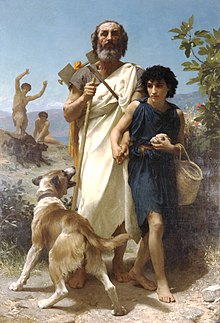
“Concerning the dates for Homer’s life, the following is reported. Heraclides argues that he is older than Hesiod; Pyrander and Hypsicrates of Amisos claim he was the same age. Krates of Mallos says that he was full-grown sixty years after the end of the Trojan War; but Eratosthenes says it was a hundred years after the Ionian migration; Apollodorus makes it eighty years.
From birth Homer was called Melesigenes or Melesagoras. Later he was called Homer in the Lesbian dialect because of the harm that came to his eyes–the Lesbians call the blind Homeroi. Another account is that the name came because he entrusted to the king as a hostage (Homeros can mean a guarantee).
They say that he was blinded in the following way. When he came to the tomb of Achilles he prayed that he might see the hero as he was when he went into battle arrayed with his second set of arms. When Achilles appeared to him, Homer was blinded by the weapons’ gleam. Because Thetis and the Muses took pity on him, they endowed him with the poetic art.
Others say that he suffered this thanks to to the rage of Helen who was angry at him because he claimed that she abandoned her first husband to follow Alexander. For this reason, the ghost of Helen appeared to him at night and advised him to burn his poems to make himself safe. He could not make himself do this.
People say that he died on the island of Ios when he found himself undone because he could not solve the riddle of the fishing boys. The riddle was: “We left whatever we caught and carry whatever we didn’t”. On his tomb the following epigram is inscribed:
“Here the earth covers the sacred head
of divine Homer, the artist of heroic men”
In case any readers are overwhelmed by the riddle and may suffer faint-hearted Homer’s fate, other Homeric Lives provide an interpretation of the riddle. In the Pseudo-Plutarchean Vita (71) we get the following explanation:
“They were obscuring in riddle the fact they actually had discarded whichever of the lice they had caught and killed; but they would still be carrying the lice they did not catch in their clothing. Because he was not able to interpret this, Homer died because of despair.”
The Vita Herodotea contains a similar explanation but contests the cause of Homer’s death:
“When those who were present were not able to interpret what had been said, the boys explained that they were able to catch nothing while fishing but that they were attacked while sitting on land. And they left behind however many of the lice they caught but were carrying home all those they couldn’t. Homer, when he heard these things, spoke these verses:
You are born from the blood of the kinds of fathers
Who are neither wealthy nor tend numerous flocks.
Then it happened that Homer died because of a sickness on Ios, not because he couldn’t interpret what the children said, as some believe, but because of weakness.”
“Mnestheus of Athens also insists that the Pythia commanded the Athenians to honor Dionysus as a doctor. So Alcaeus the Mitylenaean poet says:
Wet your lungs with wine, for the dog-star is rising. The season is rough: everything thirsts in this heat.
And elsewhere he says: “Let’s drink, for the dog star is rising.” Eupolis says that Callias is compelled to drink by Pythagoras so that “he may cleanse his lung before the dog star’s rise.” And it is not only the lung that gets dry, but the heart runs the same risk. That’s why Antiphanes says:
Tell me, why do we live? I say that it is to drink. See how many trees alongside rushing streams Drink constantly throughout the day and night And how big and beautiful they grow. Those that abstain Wilt from the root up.
“Human strength is meager
Our plains incomplete
Toil follows toil in our short lives.
Death looms inescapable for all—
Men who are good and bad draw
of that an equal portion.”
“Since you are human, never claim what tomorrow might bring.
Nor, if you see a fortunate man, how long it will last.
For not even the time of a tender-winged fly
Is not as fast.”
Joannes Malalas, Chronographia, 5.21 6-7 (=Diktys BNJ 49 F 10)
“Some time passed and Odysseus began to see dreams which told of his death. After he woke, he summoned everyone who had experience in interpreting dreams—among whom was Kleitophon of Ithaka and Polyphemos of Argos. He told the dream to them and said what he thought:
“I was not lying on my own bed but instead there was a beautiful and frightening divine creature which could not keep the shape of a grown man. I saw it happily. But I was also disoriented by it. That bed from which it took life was no longer obvious to me from my familiarity with it or by knowledge. Therefore, once I recognized this, I wanted to throw my arms around it eagerly. But it spoke using a human voice and said there was a connection and binding of relationship between us and that it was my fate to be destroyed by him. As I was thinking about this a sudden stab came at me from the sea, targeted at me by his order. I became paralyzed by my great panic and I died shortly. These are the things I saw and you need to fear nothing when you offer me an interpretation. I know well that the vision is not a good one.
Then those who were there were examining the interpretation and they said that Telemachus should not be there. When he left, they said that Odysseus would be struck by his own child and die. He immediately rushed toward Telemachus because he wanted to kill him. But when he saw his son crying and begging him and he returned to a paternal mindset, he decided to have his son sent away and he ordered him to guard himself. Then he himself returned to the farthest part of Kephalenia, believing he would protect himself from fear of death.”
By chance, I came across this passage five minutes before my Latin III/IV AP class today, and on a whim turned it into a fun exercise in sight reading which my students seemed to enjoy, in particular because I took them down the old byways of Roman imperial history to explain it. I had planned to read more Caesar with them, but they seemed glad to catch a break from that snoozefest!
Historia Augusta, Hadrian:
“Hadrian was so eager for widespread fame that he gave books about his own life, which he wrote himself, to his freedmen who had literary inclinations, and he ordered them to publish them under their own names. Indeed, even the books of Phlegon are said to be written by Hadrian. He wrote some extremely obscure parodic books in imitation of Antimachus. He responded to Florus’ poem, which went
‘I don’t want to be Caesar
strolling through Britain
lurking in…
and suffering the Scythian frosts.’
by writing back
‘I don’t want to be Florus
walking through the taverns,
lurking in the brothels,
and suffering fat mosquitoes.’
He was, further, extremely fond of the ancient mode of speech. He preferred Cato to Cicero, Ennius to Vergil, Caelius to Sallust, and formed his judgments about Plato and Homer with the same affectation.”
Famae celebris Hadrianus tam cupidus fuit ut libros vitae suae scriptos a se libertis suis litteratis dederit, iubens ut eos suis nominibus publicarent. nam et Phlegontis libri Hadriani esse dicuntur. Catachannas libros obscurissimos Antimachum imitando scripsit. Floro poetae scribenti ad se:
Ego nolo Caesar esse,
ambulare per Britannos,
latitare per . . .
Scythicas pati pruinas,
rescripsit:
Ego nolo Florus esse,
ambulare per tabernas,
latitare per popinas
culices pati rotundos.
amavit praeterea genus vetustum dicendi. controversias declamavit. Ciceroni Catonem, Vergilio Ennium, Sallustio Caelium praetulit eademque iactatione de Homero ac Platone iudicavit.
I am reposting this list for International Women’s day. I would also like to ask for help from anyone who would like to aid in creating individual posts for each of the names in this list and any that have been left out.
Most of the evidence for these authors has been collected only in Wikipedia. We can probably do better by adding more information from ancient sources and modern ‘scholarly’ texts. Many of the testimonia and fragments concerning these authors have also not been collected. Please email me (joel@brandeis.edu) if you would like to post a guest entry or two.
I received a link to the following in an email from my undergraduate poetry teacher the amazing poet and translator Olga Broumas. The post is on tumblr on a page by DiasporaChic, bit the original author who has already won my admiration is Terpsikeraunos.
** denotes names I have added
Women in ancient Greece and Rome with surviving works or fragments
Aesara of Lucania: “Only a fragment survives of Aesara of Lucania’s Book on Human Nature, but it provides a key to understanding the philosophies of Phintys, Perictione, and Theano II as well. Aesara presents a familiar and intuitive natural law theory. She says that through the activity of introspection into our own nature – specifically the nature of a human soul – we can discover not only the natural philosophic foundation for all of human law, but we can also discern the technical structure of morality, positive law, and, it may be inferred, the laws of moral psychology and of physical medicine. Aesara’s natural law theory concerns laws governing three applications of moral law: individual or private morality, laws governing the moral basis of the institution of the family, and, laws governing the moral foundations of social institutions. By analyzing the nature of the soul, Aesara says, we will understand the nature of law and of justice at the individual, familial, and social levels.” – A History of Women Philosophers: Volume I: Ancient Women Philosophers, 600 B.C.-500 A.D., by M.E. Waith
Melissa: “Melissa (3rd century BC)[1][2] was a Pythagorean philosopher…Nothing is known about her life. She is known only from a letter written to another woman named Cleareta (or Clearete). The letter is written in a Doric Greek dialect dated to around the 3rd century BC.[2] The letter discusses the need for a wife to be modest and virtuous, and stresses that she should obey her husband.[2] The content has led to the suggestion that it was written pseudonymously by a man.[2] On the other hand, the author of the letter does not suggest that a woman is naturally inferior or weak, or that she needs a man’s rule to be virtuous.[1]” –Wikipedia
Perictione (I and II): “Two works attributed to Perictione have survived in fragments: On the Harmony of Women and On Wisdom. Differences in language suggest that they were written by two different people. Allen and Waithe identify them as Perictione I and Perictione II. Plato’s mother was named Perictione, and Waithe argues that she should be identified as the earlier Perictione, suggesting that similarities between Plato’s Republic and On the Harmony of Women may not be the result of Perictione reading Plato, but the opposite–the son learning philosophy from his mother. On the Harmony of Women, however, is written in Ionic prose with occasional Doric forms. This mixed dialect dates the work to the late fourth or third centuries BC. The reference in On the Harmony of Women to women ruling suggests the Hellenistic monarchies of the third century BC or later. On Wisdom is written in Doric and is partly identical with a work by Archytas of the same name. This work should be dated later, to the third or second centuries BC. Both the dates of the works and their dialects mean Perictione as the mother of Plato could not have written them. We then have two Pythagorean texts, attributed to otherwise unknown women named Perictione who should be dated perhaps one hundred years apart.” –Women Writers of Ancient Greece and Rome: An Anthology, by I.M. Plant
Phintys: “Phintys (or Phyntis, Greek: Φίντυς; 4th or 3rd century BC) was a Pythagorean philosopher. Nothing is known about her life, nor where she came from. She wrote a work on the correct behaviour of women, two extracts of which are preserved by Stobaeus.” –Wikipedia
Ptolemais of Cyrene: “Ptolemais is known to us through reference to her work by Porphyry in his Commentary on the Harmonics of Ptolemy. He tells us that she came from Cyrene and gives the title of her work, The Pythagorean Principles of Music, which he quotes. She is the only known female musical theorist from antiquity. Her dates cannot be known for sure. She clearly preceded Porphyry, who was born about AD 232; Didymus, who is also quoted by Porphyry, knew Ptolemais’ work and may even have been Porphyry’s source for it. This Didymus is probably the one who lived in the time of Nero, giving us a date for Ptolemais of the first century AD or earlier…One of the problems in dealing with this text is that it is in quotation. Porphyry does not clearly distinguish between the text he quotes from Ptolemais and his own discussion of the issues raised…A second issue is the problem of the accuracy of the quotation. Porphyry says in the introduction to fragment 4 that he has altered a few things in the quotation for the sake of brevity. We should not assume that this is the only quotation to have suffered from editing. On the other hand, where he quotes the same passage twice (fragment 3 is repeated almost verbatim in fragment 4) his consistency is encouraging. Ptolemais’ extant work is a catechism, written as a series of questions and answers. She discusses different schools of thought on harmonic theory, distinguishing between the degree to which they gave importance to theory and perception. Her text prefers the approach of Aristoxenus to that of the Pythagoreans, thus she should not be thought a Pythagorean, despite the title of her work.” –Women Writers of Ancient Greece and Rome: An Anthology, by I.M. Plant