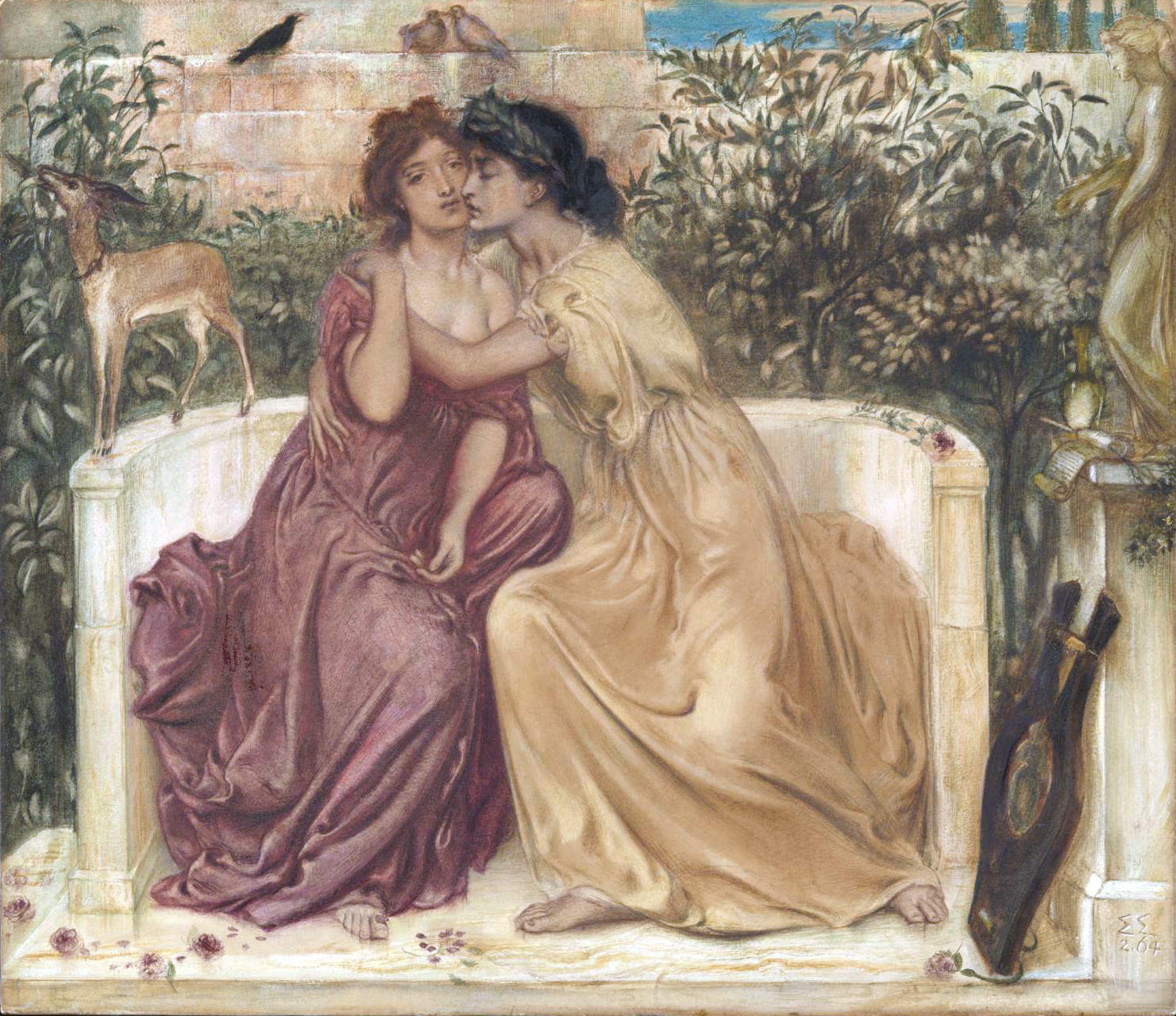
“Klea, I do not have the same opinion as Thucydides concerning the virtue of women. For he claims that the best woman is the one who has the slimmest reputation among those outside her home, critical or positive—since he believes that the name of a good woman ought to be locked up and kept indoors just like her body. Gorgias, in fact, is more appealing to me, since he insists that the fame rather than the form of a woman should be known to many. Indeed, the Roman practice seems best: granting praise to women in public after their death just as for men.
So, when Leontis, one of the best women died, you and I had a rather long conversation which did not lack philosophical solace; and now, just as you have asked, I have written down for you the rest of the things one can say supporting the assertion that the virtue of a man and woman are the same thing. This [composition] is historical and is not arranged for pleasurable hearing. But if some pleasure is possible in a persuasive piece thanks to the nature of its example, then the argument itself does not avoid some charm—that aid to explanation—nor is it reluctant to “mix the Graces in with the Muses, a most noble pairing”, in the words of Euripides, basing its credibility on the love of beauty which is a special province of the soul.”
Animae sanctae colendae d(is) m(anibus) s(acrum). Furia Spes L(ucio) Sempronio Firmo coniugi carissimo mihi. Ut cognovi puer puella obligati amori pariter. Cum quo vixi tempori minimo et quo tempore vivere debuimus a manu mala diseparati sumus. Ita peto vos manes sanctissimae commendat[um] habeatis meum ca[ru]m et vellitis huic indulgentissimi esse horis nocturnis ut eum videam et etiam me fato suadere vellit ut et ego possim dulcius et celerius aput eum pervenire.
“To a sacred and worshipped spirit: a sacred thing to the spirits of the dead. Furia Spes (made this) for her dearest husband, Lucius Sempronius Firmus. When we met as boy and girl, we were joined in love equally. I lived with him for a short while, and in a time when we should have lived together, we were separated by an evil hand.
So I ask you, most sacred spirits, to protect my dear husband entrusted to you, and that you be willing to be most accommodating to him in the nightly hours, so I may have a vision of him, and so he might wish that I persuade fate to allow me to come to him more sweetly and quickly.”
Clausa iacet lapidi coniunx pia cara Sabina. Artibus edocta superabat sola maritum vox ei grata fuit pulsabat pollice c(h)ordas. Set (sed) cito rapta silpi (silet)…
“My beautiful, faithful wife, Sabina, lies enclosed in stone. Skilled in the arts, she alone surpassed her husband. Her voice was pleasing (as) she plucked the strings with her thumb. But suddenly taken, now she is silent.”
Dis Manibus Flaviae Sophene [Ge]nealis Caesaris Aug(usti) [se]rvos verna dispens(ator) [ad] frumentum carae coniugi et amanti bene merenti fecit [vix(it)] an(nis) XXXII m(ensibus) VII
“To the spirits of the dead. For Flavia Sophe. Genialis, home-born slave of Caesar Augustus, keeper of the grain supply, made this for his loving, dear, well-deserving wife. She lived 32 years, 7 months.”
Iulia Cecilia vicxit annis XLV cui Terensus marit(us) fek(it) dom(um) et(e)r(nalem) f(eci)t
“Julia Caecilia lived 45 years, for whom her husband Terensus made this. He made her an eternal home.”
CIL 13.01983 (EDCS-10500938)
D(is) M(anibus) et memoriae aetern(ae) Blandiniae Martiolae puellae innocentissimae quae vixit ann(os) XVIII m(enses) VIIII d(ies) V. Pompeius Catussa cives Sequanus tector coniugi incomparabili et sibi benignissim(a)e quae mecum vixit an(nos) V m(enses) VI d(ies) XVIII sine ul(l)a criminis sorde. Viv(u)s sibi et coniugi ponendum curavit et sub ascia dedicavit. Tu qui legis vade in Apol(l)inis lavari quod ego cum coniuge feci. Vellem si ad(h)uc possem
“To the spirits of the dead and the eternal memory of Blandinia Martiola, a most innocent girl who lived 18 years, 9 months, 5 days. Pompeius Catussa, a Sequani citizen and plasterer, (made this) for his incomparable and most kind wife, who lived with me 5 years, 6 months, 18 days without any transgressions. While alive, he saw to the building and dedicated this, while under construction, to himself and his wife. You who read this, go and bathe in the bath of Apollo, which I did with my wife. I wish I were still able to do it.”
Hospes quod deico paullum est. Asta ac pellege. Heic est sepulcrum hau(d) pulcrum pulcrai feminae. Nomen parentes nominarunt Claudiam. Suom mareitum corde deilexit souo. Gnatos duos creavit horunc (horum-ce) alterum in terra linquit alium sub terra locat. Sermone lepido tum autem incessu commodo domum servavit lanam fecit dixi abei
“Stranger, what I say is short. Stand and read over it. This is the hardly beautiful tomb of a beautiful woman. Her parents called her Claudia. She loved her husband with all her heart. She had two sons, one of whom she leaves on earth, the other she placed under it. With pleasant conversing but respectable gait she cared for her home and made wool. I have spoken. Move along.”
CIL 06.20307
Iulio Timotheo qui vixit p(lus) m(inus) annis XXVIII vitae innocentissim(a)e decepto a latronibus cum alumnis n(umero) VII. Otacilia Narcisa co(n)iugi dulcissimo
“For Julius Timotheus, who lived around 28 years of a most innocent life, cheated by bandits along with his 7 fostered children. Otacilia Narcisa (made this) for her sweetest husband.”
“When a Spartan woman was speaking to her son who had been crippled in battle and was depressed because of that she said “don’t be sad, child—for each step recalls your private virtue”
“A Spartan woman said of her son who was thankful that he was the only one to survive a battle-line “why aren’t you ashamed that you’re the only one alive?”
“It is also necessary for a woman to take to heart that she will find no kind of purifying remedy for this mistake [adultery], something that would allow her to approach the temples and altars of the gods as a chaste and god-loved woman. This is because in this crime especially the divine spirit is most unforgiving. The most beautiful achievement of a free woman and the foremost glory is to provide as testimony to her prudence toward her husband her children, if they do in fact bear the imprint of similarity to the father who sowed them. That seems to me to be enough regarding marriage.
The following seems to be right to me when it comes to the management of the body. A woman should wear white, but be dressed simply and without decoration. This style of dressing is achieved without transparent or decorated robes or robes which are made from silk; instead a woman should wear modest and white clothing. She preferably also avoids luxury and ostentation and will not cause vile jealousy in other women. She should also not put on gold or emeralds at all—this behavior would make her seem wealthy and haughty to common women.
It is necessary that the well-governed city which is ordered completely with a view to its whole should be one of common experiences and likemindedness. And it should keep out the craftspeople who create these sorts of baubles from its territory. A prudent woman should not embellish her appearance with foreign decoration and makeup but should use the native beauty of the body—she should decorate her body by washing it in water rather than bringing it shame. For this brings honor to herself and the man she lives with.
Women need to make processions from their homes to make sacrifices to the leading-god of the city for themselves, their husbands, and their households. They must make their expedition to the theater or to the market for household goods, however, not when the evening star is rising nor when it is dark but whenever it is still light, accompanied by a single servant or, at most, two as is proper.
In addition, a prudent woman must also perform sacrificial rites for the gods as is permitted to her, but must abstain from the occult rites and rituals of the Great Mother at home. For the common law prohibits women from performing these rituals, since, in addition to other things, these practices make them drunk and insane. The woman of the home needs to be temperate and uncontaminated by everything, even when she is governing the home.”
In our now annual tradition, we are re-posting this list with more names and updated links. Most of the evidence for these authors has been collected only in Wikipedia. I have added new translations and new names over the past few years (especially among the philosophers). Always happy to have new names and links suggested.
I originally received a link to the core list in an email from my undergraduate poetry teacher, the amazing poet and translator Olga Broumas. The post is on tumblr on a page by DiasporaChic, bit the original author is Terpsikeraunos.
Women in ancient Greece and Rome with surviving works or fragments
PHILOSOPHY
Here is a list of Women philosophers with testimonia and fragments (with French translations and commentary).
Aesara of Lucania: “Only a fragment survives of Aesara of Lucania’s Book on Human Nature, but it provides a key to understanding the philosophies of Phintys, Perictione, and Theano II as well. Aesara presents a familiar and intuitive natural law theory. She says that through the activity of introspection into our own nature – specifically the nature of a human soul – we can discover not only the natural philosophic foundation for all of human law, but we can also discern the technical structure of morality, positive law, and, it may be inferred, the laws of moral psychology and of physical medicine. Aesara’s natural law theory concerns laws governing three applications of moral law: individual or private morality, laws governing the moral basis of the institution of the family, and, laws governing the moral foundations of social institutions. By analyzing the nature of the soul, Aesara says, we will understand the nature of law and of justice at the individual, familial, and social levels.” – A History of Women Philosophers: Volume I: Ancient Women Philosophers, 600 B.C.-500 A.D., by M.E. Waith
Melissa: “Melissa (3rd century BC)[1][2] was a Pythagorean philosopher…Nothing is known about her life. She is known only from a letter written to another woman named Cleareta (or Clearete). The letter is written in a Doric Greek dialect dated to around the 3rd century BC.[2] The letter discusses the need for a wife to be modest and virtuous, and stresses that she should obey her husband.[2] The content has led to the suggestion that it was written pseudonymously by a man.[2] On the other hand, the author of the letter does not suggest that a woman is naturally inferior or weak, or that she needs a man’s rule to be virtuous.[1]” –Wikipedia
Perictione (I and II): “Two works attributed to Perictione have survived in fragments: On the Harmony of Women and On Wisdom. Differences in language suggest that they were written by two different people. Allen and Waithe identify them as Perictione I and Perictione II. Plato’s mother was named Perictione, and Waithe argues that she should be identified as the earlier Perictione, suggesting that similarities between Plato’s Republic and On the Harmony of Women may not be the result of Perictione reading Plato, but the opposite–the son learning philosophy from his mother. On the Harmony of Women, however, is written in Ionic prose with occasional Doric forms. This mixed dialect dates the work to the late fourth or third centuries BC. The reference in On the Harmony of Women to women ruling suggests the Hellenistic monarchies of the third century BC or later. On Wisdom is written in Doric and is partly identical with a work by Archytas of the same name. This work should be dated later, to the third or second centuries BC. Both the dates of the works and their dialects mean Perictione as the mother of Plato could not have written them. We then have two Pythagorean texts, attributed to otherwise unknown women named Perictione who should be dated perhaps one hundred years apart.” –Women Writers of Ancient Greece and Rome: An Anthology, by I.M. Plant
*N.B. This account leaves out the the basic narrative from Diogenes Laertius, that Plato’s father Ariston raped his mother Perictione.
Phintys: “Phintys (or Phyntis, Greek: Φίντυς; 4th or 3rd century BC) was a Pythagorean philosopher. Nothing is known about her life, nor where she came from. She wrote a work on the correct behavior of women, two extracts of which are preserved by Stobaeus.” –Wikipedia
*Note, Stobaeus (4.32.61a) calls her the daughter of Kallikrates the Pythagorean (Φιντύος τᾶς Καλλικράτεος θυγατρὸς Πυθαγορείας). Here are some of her fragments on the prudence befitting women: part 1 and part 2.
Ptolemais of Cyrene: “Ptolemais is known to us through reference to her work by Porphyry in his Commentary on the Harmonics of Ptolemy. He tells us that she came from Cyrene and gives the title of her work, The Pythagorean Principles of Music, which he quotes. She is the only known female musical theorist from antiquity. Her dates cannot be known for sure. She clearly preceded Porphyry, who was born about AD 232; Didymus, who is also quoted by Porphyry, knew Ptolemais’ work and may even have been Porphyry’s source for it. This Didymus is probably the one who lived in the time of Nero, giving us a date for Ptolemais of the first century AD or earlier…One of the problems in dealing with this text is that it is in quotation. Porphyry does not clearly distinguish between the text he quotes from Ptolemais and his own discussion of the issues raised…A second issue is the problem of the accuracy of the quotation. Porphyry says in the introduction to fragment 4 that he has altered a few things in the quotation for the sake of brevity. We should not assume that this is the only quotation to have suffered from editing. On the other hand, where he quotes the same passage twice (fragment 3 is repeated almost verbatim in fragment 4) his consistency is encouraging. Ptolemais’ extant work is a catechism, written as a series of questions and answers. She discusses different schools of thought on harmonic theory, distinguishing between the degree to which they gave importance to theory and perception. Her text prefers the approach of Aristoxenus to that of the Pythagoreans, thus she should not be thought a Pythagorean, despite the title of her work.” –Women Writers of Ancient Greece and Rome: An Anthology, by I.M. Plant
We have posted before about Odysseus’ sister Ktimene. She is mentioned by the swineherd Eumaios but never by Odysseus. The scholia connect her to one of Odysseus’ companions. The evidence for this seems to be the fact that Ktimene was sent to Same for marriage (where Eurylochus is from) and a kinship term used for him by Odysseus. Also of interest, according to the scholion, Odysseus may have had more sisters.
Homer, Odyssey 15.364-41
Strong Ktimenê, the youngest of the children she bore.
I was raised with her, and she honored me little less.
But when we both made it to much-praised youth,
They gave her to Samê and received much in return
But she gave me a cloak, tunic and clothing
Dressing me finely and give me sandals for my feet
And sent me to the field. But she loved me more in her heart.
“She bore the youngest of the children”: [this means] of the female children. For his father only had Odysseus [for a son]. There were more sisters of Odysseus.”
“So he spoke, and I was turning over in my thoughts
As I began to draw the sharp-edged sword next to my thick thigh,
Whether I should cut off his head and drive him to the ground
Even though he really was my relative. But our companions
Were restraining me with gentle words from all sides.”
“Pêos: A relative by marriage. In-law. Also, “in-lawness” [Pêosunê], relation-by-marriage. There is also Pêôn [genitive plural], for “of relatives-by-marriage. Homer has: “relatives and friends” [Il. 3.163]
“…There is a difference between in-law and friend. People who have no connection to you by birth are friends. In-laws are related to you through marriage.”
“Reverent Hera, who often comes down
From the sky to gaze upon your fragrant Lakinian home.
Take the linen robe which Theophilos, the daughter of Kleokha
Wove for you with the help of her noble daughter Nossis.”
“These weapons the Brettian men hurled down from their unlucky shoulders
As they were overcome by the hands of the fast-battling Lokrians.
They are dedicated here singing the Lokrians glory in the temple of the gods.
They don’t long at all for the hands of the cowards they abandoned.”
“Pass by me, give an honest laugh, and speak over me
A loving word. I am Rhintho from Syracuse,
A minor nightingale of the Muses. But from my tragic
Nonsense poems, I made my own ivy crown.”
“There is nothing sweeter than love: all other blessings
Take second place. I even spit honey from my mouth.
This is what Nossis says. Whomever Kypris has not kissed,
Does not understand her flowers, what kinds of things roses are.”
“This frame has the picture of Thaumareta. The painter
Caught the form and the age of the soft-glancing woman well.
Your house dog, the little puppy, would paw at you if she saw this,
Believing that she was looking down at the lady of her home.”
“Then, when they had procured shelter, clothing and fire
And woman joined man in one [home]
They were known, they saw their own children born
And the race of man first began to grow weak.
For fire cared for them so that quaking bodies
Could no longer endure the cold under the roof of the sky;
Venus whittled down their strength and children
Easily broke their parents’ proud character with their charms.”
As usual, the start of all evil…
Inde casas postquam ac pellis ignemque pararunt
et mulier coniuncta viro concessit in unum
* * *
cognita sunt, prolemque ex se videre creatam,
tum genus humanum primum mollescere coepit.
ignis enim curavit, ut alsia corpora frigus
non ita iam possent caeli sub tegmine ferre,
et Venus inminuit viris puerique parentum
blanditiis facile ingenium fregere superbum.
We have posted before about Odysseus’ sister Ktimene. She is mentioned by the swineherd Eumaios but never by Odysseus. The scholia connect her to one of Odysseus’ companions. The evidence for this seems to be the fact that Ktimene was sent to Same for marriage (where Eurylochus is from) and a kinship term used for him by Odysseus. Also of interest, according to the scholion, Odysseus may have had more sisters.
Homer, Odyssey 15.364-41
Strong Ktimenê, the youngest of the children she bore.
I was raised with her, and she honored me little less.
But when we both made it to much-praised youth,
They gave her to Samê and received much in return
But she gave me a cloak, tunic and clothing
Dressing me finely and give me sandals for my feet
And sent me to the field. But she loved me more in her heart.
“She bore the youngest of the children”: [this means] of the female children. For his father only had Odysseus [for a son]. There were more sisters of Odysseus.”
“So he spoke, and I was turning over in my thoughts
As I began to draw the sharp-edged sword next to my thick thigh,
Whether I should cut off his head and drive him to the ground
Even though he really was my relative. But our companions
Were restraining me with gentle words from all sides.”
“Pêos: A relative by marriage. In-law. Also, “in-lawness” [Pêosunê], relation-by-marriage. There is also Pêôn [genitive plural], for “of relatives-by-marriage. Homer has: “relatives and friends” [Il. 3.163]
“…There is a difference between in-law and friend. People who have no connection to you by birth are friends. In-laws are related to you through marriage.”
In the following passage Kassandra prophesies Odysseus’ travails in returning home. Although she seems to refer to a few events not in our Odyssey (fast rocks, talking meat), what I find interesting is the possible poetic engagement with Kassandra’s presentation in the Odyssey where she is not mentioned as the cause of Athena’s anger or marked as a prophet.
Euripides, Trojan Women 424–447
“Really, a clever servant. Why do heralds have
the name they have, when one hatred is common to people:
the servants of tyrants and their regimes?
You say that my mother will arrive at
Odysseus’ home? Where then are Apollo’s words
which say—when I have translated them—
that she will die here? I will not insult her with the rest.
The wretched man, he doesn’t know what suffering awaits him—
how even these Phrygian horrors of mine will seem
golden to him. For ten years after sailing out added to ten
spent here he will finally arrive at his fatherland alone
< >
where the swiftest rocks [make] the passage narrow,
and dreadful Charybdis, near the man-eating, cliff-walking [Skyla],
The Kyklops, and the Ligurian, swine-witch
Kirkê, and shipwrecks over the salted-sea,
lusts for lotus, and the sacred cattle of Helios,
whose flesh will sing in human voice one day
a bitter song for Odysseus—I will cut this short:
he will go into Hades still alive and though feeling the water’s flow
he will come home and find countless evils at home.
But why do I enumerate the toils of Odysseus?
Take me right away, let me marry a bridegroom for Hades’ home.
You are evil and you will be evilly buried at night, not at day
Captain of the Danaid women, believing you are doing something good.”
Kassandra is most famous in ancient art and myth for the sexual violence she suffers at Oilean Ajax’s hands. But when there is an opportunity to refer to this, the Odyssey avoids it. Instead, it creates a new reason for Ajax to suffer: