“We must rebuke not only those sophists but also those who promise to teach political oratory—for these guys don’t care at all about the truth but instead think that it is an art because they get the greatest number of students thanks to the small size of their fee and the greatness of their pronouncements and then they get something from them.
They are so imperceptive and imagine everyone else to be that even though they write speeches worse than some of the untrained masses compose, they still guarantee that they will make their students the kinds of politicians who never leave out any of the possibilities in a matter.
Even worse, they don’t derive any of that power from their experiences or the talent of a student, but they say that they can train the knowledge of speaking as they would basic literacy—in reality, each of them believe that because of the insanity of their promises they will be objects of wonder and that people will think that training in their discipline is worth more than it is. In this, they have not even considered that the people who make arts great are not those who dare to boast about them, but those who have the ability to discover what the power of each art is on its own.”
As many people know, the word scholarship is somewhere in the past derived from the Ancient Greek skholê for “leisure” (since literary and linguistic studies were both the sorts of things people did in their leisure time and you had to be a person with leisure time to do them). This also happens to be the word that Woodhouse’s English-Greek Dictionary provides as the translation for English “vacation”.
(also, just ruminate on the Latin etymology of vacation for a minute, the implied emptiness…)
One of the popular—and politically expedient—myths about people who teach (both at the college level and lower) is that we are people of leisure—we have too much idle time to engage in (1) not doing ‘real’ work or (2) brainwashing those naïve children society entrusts to us. The truth—especially for college faculty on contract or in contingent positions, for those early in their career or looking for jobs, or for anyone who teaches elementary through high school—is that the past generation has seen the slow but steady erosion of the boundary between leisure and work.
Seneca, De Brevitate Vitae 7
“When will this year end?” One man gives games and even though he set a great worth on being able to do so, now says, “When will I flee them?” Another lawyer is praised over the whole forum and attracts a great crowd extending farther than they can hear, yet he complains, “When will I get a break?”
Everyone hurries life on and suffers a desire for the future and a weariness from the present. But the one who dedicates all his time to his own use, who orders every day as if it is the last one, neither desires nor fears tomorrow.”
“Quando hic annus praeteribit?” Facit ille ludos, quorum sortem sibi optingere magno aestimavit: “Quando,” inquit, “istos effugiam?” Diripitur ille toto foro patronus et magno concursu omnia ultra, quam audiri potest, complet: “Quando,” inquit, “res proferentur?” Praecipitat quisque vitam suam et futuri desiderio laborat, praesentium taedio. At ille qui nullum non tempus in usus suos confert, qui omnem diem tamquam ultimum ordinat, nec optat crastinum nec timet.
This boundary has moved not in our favor but in the direction of creating an environment in which teachers and academics never stop working. This is true for many fields where technology and the unholy god of efficiency has extended work hours and expected employees to take work home and to answer work communication at all hours. But it is especially damaging for mental health in higher ed and high school where we buy in to the idea of the life of the mind and willingly submit to the elision between our personal and professional selves.
This means that high school teachers grade until 9 or 10 at night (on an early night) because they are with students until almost dinner time. This means that professors teaching adjunct courses still feel compelled to answer emails at 1 AM because they don’t want lower teaching evaluations. This means that early career professors in the tenure track put off having children or being in relationships for decades because they don’t have the time. This means that life passes us by because we are trying so hard to make the most out our lives.
A few years back in Facebook, Dr. S. Culpepper Stroup (a fantastic name of which I am very jealous) makes a great point about the difference between otium (leisure) and negotium (business) in Latin. The long-and-short of it is that the Roman lexicon reflects an inverse relationship between our work and vacation. But, here are her finer words (quoted with permission):
Speaking of *otium* (as I always do) and its centrality to the Roman intellectual sphere, consider its opposite: *negotium*. Latin instructors often team *otium* as “leisure” and *negotium* as “business,” both of which absolutely miss the train in terms of semantic designation.
(Leisure comes from the Latin *licet*, so it indicates a time when one is *allowed* to do a specific activity, which absolutely lacks the strong autonomous sense of *otium*.)
Anyway, *negotium* is—obviously—the privative of *otium* (early on we see it in Plautus as “nec otium mihi”). *Negotium* is the time when you are deprived of *otium*.
The English “vacation” completely reverses that, making work the “full” thing (full of work, that is), and vacation the privative.
I far prefer the Roman sense of *otium*, as a self-owned time that needed no apologies.
Euripides, Hippolytus 383-384
“Life has many pleasures
Long talks and leisure, a pleasant evil…”
Smarter and more well-informed people than I can make the argument about the evils of neo-liberal capitalism and the commodification of everything. They can point out the insidious culture that insists us to see our online persona as our actual selves and to envision the ‘life’ we pursue there as a never ending process of branding and re-branding to ensure that we will never be less than fully commodifiable. I can merely confess that the anxiety, workload, and self-identification has shaped me in such a way that it is really, really hard to take any time off.
I was grading exams the days both of my children were born (and I got reprimanded by my chair for not entering grades soon enough after). When my daughter was learning to walk, I cheered her on as I furiously finished a book and a few articles to ensure I received tenure. I took one week off when my father died suddenly. I have brought sick kids to class repeatedly. I took one day off when my grandmother died.. None of this is necessary, admirable, or worthy of praise; all of it is from guilt, pressure, and our toxic work culture. And I know I don’t have it particularly bad. I have tenure. I have a place in the world, job security, and safety.
But at this point, I am what I do and I do what I am. I take articles to read at the playground. I proof articles while my kids are at swimming lessons. I have dragged work to Italy, India, France, Germany. Somehow I have not totally ruined my relationship with my spouse by slinking out of bed regularly at 5 am or answering emails after the children are asleep. I have lived through my work and despite my work. And I worry about the long-term consequences.
But I keep going because I love my material, because I love my students and my institution, and because of the fear and guilt: I know there are many others who are smarter, who have worked harder, but who have not had some of the dumb luck I have (or the privilege to which I was born) to end up where I am.
Cicero, Pro Murena 28
“No one can be famous for being wise if it is concerning the type of knowledge which is worthless anywhere beyond Rome and even at Rome too during a vacation. No one can be an expert on something which everyone knows because there can’t be any disagreement on the matter. A subject cannot be considered difficult just because it exists in a very few and rather obscure documents.”
Sapiens existimari nemo potest in ea prudentia quae neque extra Romam usquam neque Romae rebus prolatis quicquam valet. Peritus ideo haberi nemo potest quod in eo quod sciunt omnes nullo modo possunt inter se discrepare. Difficilis autem res ideo non putatur quod et perpaucis et minime obscuris litteris continetur.
At the end of the day (and a life!), I cannot be sure that work that I do is worth the emotion I have put into it. But, of course, this does not mean I can or will stop. I can, however, try to reset definitions a bit and remember to enjoy life a little more and take time off.
So, I am not going to go all memento mori and carpe diem today. (My students already think I have some sort of death-obsessed insanity.) And I won’t claim to be especially unlucky when I know the opposite is true. But I will say that we have a problem in education, especially: we spend a lot of time claiming that we can teach about the value of human life even as we fail so terribly at honoring the worth of our own.
So, the next week of posts will be repeats, cleverly repackaged along with a few retrospective posts I threw together earlier. I am going to try not to do work for a week. Again.
“Know well that you are mortal: fill your heart
By delighting in the feasts: nothing is useful to you when you’re dead.
I am ash, though I ruled great Ninevah as king.
I keep whatever I ate, the insults I made, and the joy
I took from sex. My wealth and many blessings are gone.
[This is wise advice for life: I will never forget it.
Let anyone who wants to accumulate limitless gold.]
“But, truly, the knowledge of many disciplines is pleasurable”. Ok, then, let’s keep only what is necessary from these arts. Do you think that the person who considers superficial matters equal to useful ones and for this reason makes his home a museum of expensive products is reprehensible but not the man who is obsessed with the superfluous aspects of academia? To want to know more than is enough is a kind of excessive delusion.
Why? Well, this extreme pursuit of the liberal arts makes people annoying, wordy, bad-mannered, and overly self-satisfied, even though they have not learned the basics because they pursue the useless.
The scholar Didymus wrote four thousand books. I would pity him if had only read that many useless works. In these books he searched for Homer’s homeland, the real mother of Aeneas, whether Anacreon is more licentious or just drunk, whether Sappho was promiscuous and other various questions which, if you learned them, would have been necessarily forgotten. Go on, don’t say life is long. No, when you turn to your own people too, I will show you many things which should be pruned back with an ax.”
“At enim delectat artium notitia multarum.” Tantum itaque ex illis retineamus, quantum necessarium est. An tu existimas reprendendum, qui supervacua usibus conparat et pretiosarum rerum pompam in domo explicat, non putas eum, qui occupatus est in supervacua litterarum supellectile? Plus scire velle quam sit satis, intemperantiae genus est.
Quid? Quod ista liberalium artium consectatio molestos, verbosos, intempestivos, sibi placentes facit et ideo non discentes necessaria, quia supervacua didicerunt. Quattuor milia librorum Didymus grammaticus scripsit. Misererer, si tam multa supervacua legisset. In his libris de patria Homeri quaeritur, in his de Aeneae matre vera, in his libidinosior Anacreon an ebriosior vixerit, in his an Sappho publica fuerit, et alia, quae erant dediscenda, si scires. I nunc et longam esse vitam nega. Sed ad nostros quoque cum perveneris, ostendam multa securibus recidenda.
These are themes close to the old man’s heart, elsewhere too:
Seneca, De Brevitate Vitae 13
“This sickness used to just afflict the Greeks, to discover the number of oars Odysseus possessed, whether the Iliad was written before the Odyssey, whether the poems belong to the same author, and other matters like this which, if you keep them to yourself, cannot please your private mind; but if you publish them, you seem less learned than annoying.”
Graecorum iste morbus fuit quaerere, quem numerum Ulixes remigum habuisset, prior scripta esset Ilias an Odyssia, praeterea an eiusdem essent auctoris, alia deinceps huius notae, quae sive contineas, nihil tacitam conscientiam iuvant sive proferas, non doctior videaris sed molestior.
Seneca, Moral Epistle 108
“But some error comes thanks to our teachers who instruct us how to argue but not how to live; some error too comes from students, who bring themselves to teachers not for the nourishing of the soul, but the cultivation of our wit. Thus what was philosophy has been turned into philology.”
Sed aliquid praecipientium vitio peccatur, qui nos docent disputare, non vivere, aliquid discentium, qui propositum adferunt ad praeceptores suos non animum excolendi, sed ingenium. Itaque quae philosophia fuit, facta philologia est.
ca. 1350 | The Morgan Library & Museum
J.E. Sandys, A History of Classical Scholarship (Ausonius)
“It is difficult to imagine that a man capable of writing such trifles as these (not to mention his lines on the Caesars and on celebrated cities) had some ten years previously (in 378 a.d.) filled the splendid position of praetorian praefect of the provinces of Gaul (an official whose sway extended even over Spain and the opposite coast of Africa, and over the southern part of Britain), and, in the four years between 376 and 380, had seen his father honorary praefect of lllyricum, his son and son-in-law proconsuls of Africa, and his nephew praefect of Rome. It seems as if, on his return to the scenes of his early work as a professor at Bordeaux, the praefect relapsed into the ‘ grammarian ‘, spending his time on learned trifles, which are among the least important products of scholarship, and consoling himself in his tedious task by recalling Virgil’s famous phrase: — ‘in tenui labor, at tenuis non gloria’. We may regret that Ausonius does not appear to have used his great opportunities for reforming the educational system which prevailed in the schools of the Western Empire, and thus rendering a lasting service to the cause of learning; but we may allow him the credit of having possibly inspired the memorable decree promulgated by Gratian in 376, which improved the status of public instructors by providing for the appointment of teachers of rhetoric and of Greek and Latin ‘ grammar ‘ in the principal cities of Gaul, and fixing the amount of their stipends ‘. “
The Junior Classical League purports to foster interest in the civilizations of ancient Greece and Rome and is one of the largest academic clubs in the world with 50,000 members and 1,200 chapters. For the last six decades, JCL has also supported mock slave auctions as a source of entertainment. Humor derived from dehumanization and degradation have no place in our society, especially given our country’s shameful history of enslavement and other forms of systemic racism.
My essay should end here. Ideally, the notion of mock slave auctions in an organization sponsored by the American Classical League should prompt outrage, activism, and sustained action. Too often, though, this kind of racism is tolerated and normalized by those both inside and outside of secondary classics. Latin teachers and other stakeholders, even those who purport to care about social justice, often protect the field over individuals marginalized and harmed by patterns of racism and hostility in secondary Latin.
We can no longer afford to turn a blind eye to the state of secondary Classics. We are in dire need of reform.
The Junior Classical League is a space so insulated from the realities of racism that slave auctions have been a common source of entertainment and fun for decades. In 2016, a story about a mock slave auction went viral after black audience members were subjected to this racist spectacle at an Illinois Junior Classical League convention. In a demonstrably deceitful response, the National Junior Classical League and the American Classical League claimed they “regret to hear of the incident” and that “this incident in no way reflects the values we have as an organization.”
The Junior Classical League did not “hear of the incident,” they have organized, promoted and sponsored similar events for the better part of a century. In the 1950s, a teacher wrote in Classical Outlook, “One boy bought a pretty girl just to have her following him around… The club has been asked to repeat the auction in assembly before the whole school.”
Slave auctions continue in the Junior Classical League, often sanitized with the branding “Rent-a-Roman.” The 2011-2012 National Junior Classical League scrapbook contains a picture of a “slave” posing with her “master at the annual Rent-a-Roman.” In 2012, an event affiliated with the California Junior Classical League included this description: “You can offer yourself up for sale or bid on the merchandise to purchase a companion/ money-servant for the rest of the lunch hour.” In 2014, a write up in the newsletter of the Classical Association of the Midwest and South include a teacher touting activities that included a “master/slave program.” The 2017 California Junior Classical League constitution included a reference to slave auctions as a fundraising opportunity: “Should a slave auction be held at the state convention, the money acquired shall go to the state scholarship fund.” In 2018, the Pennsylvania Junior Classical League newsletter contained a report on a Saturnalia event where club leaders are “auctioned off to serve as ‘slaves’ for the night… these individuals will be ordered around by their new masters to fetch food, sing, dance, and entertain.”
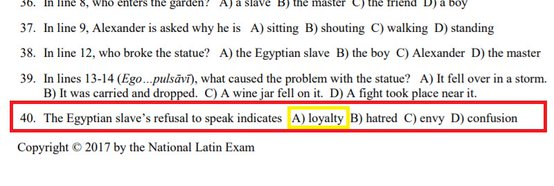
Mock slave auctions are just one example of a much larger, pervasive problem in secondary Classics that includes trivializing slavery and turning oppression, and the oppressed, into a source of humor. In 2017, Erik Robinson documented problematic portrayals of slavery in secondary text books. The National Latin Exam, which over 140,000 students take, is notorious for their regressive treatment of slavery and other forms of oppression (e.g. sexual assault). There are too many examples to list here, but one recent question echoed the racist myth of the loyal slave. Loyalty is predicated on autonomy and feelings of allegiance, which mitigates the culpability of enslavers and misrepresents the realities of slavery.
It is beyond the scope of this article to explain why slave auctions are racist and how this kind of humor, even in the context of ancient Rome, supports the messaging and strategies of white supremacy groups. Suffice it to say, these kinds of events are unethical and harmful. Recently, the New York attorney general’s office investigated a school for holding a slave auction, finding “that the teacher’s re-enactments in the two classes had a profoundly negative effect on all of the students present — especially the African American students — and the school community at large.” A student who witnessed the Illinois JCL slave auction told the Washington Post, “Since JCL is primarily white, they are so into their, like, white privilege, I guess, that they don’t know how they can affect minorities.”
The Junior Classical League has abused its monopoly and imposed a twisted value system on its members. JCL membership appeals to students looking to build their college resumes. And, many teachers are contractually required to sponsor a chapter. Our dues should not support this kind of culture. We should not cultivate students’ interest in this distortion of Classics.
The American Classical League has hired a diversity consultant, and in most of my correspondence with them, I am reminded of this fact. It is a positive step for the ACL to obtain the services of an outside expert, but a diversity consultant should be a small part of a larger strategy to eradicate racism from secondary Classics, not a standalone solution. As long as stakeholders in secondary Classics and our post-secondary colleagues protect the status quo through both action and inaction, this culture will persist and become even more toxic.
Concern for people affected by these systemic failures must trump the defense of the organization. ACL, JCL, NLE, and other affiliates exist to promote Classics. Nothing in the promotion of Classics should also include the promotion of racism and white supremacy, especially when hundreds of thousands of children are affected by the way the ACL has shaped the field.
It is time for decisive action and commitment to change.
The co-chair of the National Latin Exam accused me in a late-night Twitter direct message of wanting a spectacle. I do not want a spectacle. (Perhaps that accusation was wishful thinking.) I want the culture of secondary Latin to stop supporting racism and narratives of white dominance.
This goal will take work, not just words. If you are interested in advocating against racism in Classics and want to know how to help, feel free to email me at dani.bostick@gmail.com
Meanwhile, here are a few ways the American Classical League and its affiliates can begin to change the culture in secondary Classics. This list is far from exhaustive:
1) Apologize for your role in perpetuating white supremacy and racism. Stop treating each instance of problematic content and practices as some sort of aberration.
2) Remove leaders and volunteers who have aggressively defended and perpetuated the status quo and who prioritize the interests and image of the organization over the well-being and safety of students.
3) Provide information to teachers about how to talk about white supremacy and dangerous appropriations of Classics. Our field has supported racist ideas and is used to legitimize hate and violence. We have a responsibility to equip students to recognize and counter these appropriations, even when they come from within our own field.
4) Remove all content immediately that is incompatible with the goal of “Classics for All” and release an accompanying statement that explains why the material was harmful. Do not legitimize offensive content and practices by engaging in a ‘both sides discussion’ and hiding behind procedure and tradition. Swift action and adherence to procedures are not mutually exclusive.
Colleagues in post-secondary Classics. Here are a few calls to action and points to consider:
1) Find out if JCL held a mock slave auction on your campus. If so, apologize. Do not allow them on your campus. Fraternities have been suspended for holding slave auctions. It is even worse when they are held as entertainment in the context of an academic program for children.
2) Formally condemn the practice of slave auctions and call on the Junior Classical League and, more broadly, the American Classical League, to own its uncomfortable past and repair the damage it has done through events like these and the culture they reflect.
3) If you publish a newsletter or promote activities in secondary Latin, vet them before you provide a platform for abhorrent practices. There is no excuse for a “master/slave” activity to have been featured in a CAMWS publication (or any publication).
4) Stay informed about what is going on in secondary Classics and hold organizations accountable for failures that affect both current students and the future of the field.
“We must rebuke not only those sophists but also those who promise to teach political oratory—for these guys don’t care at all about the truth but instead think that it is an art because they get the greatest number of students thanks to the small size of their fee and the greatness of their pronouncements and then they get something from them.
They are so imperceptive and imagine everyone else to be that even though they write speeches worse than some of the untrained masses compose, they still guarantee that they will make their students the kinds of politicians who never leave out any of the possibilities in a matter.
Even worse, they don’t derive any of that power from their experiences or the talent of a student, but they say that they can train the knowledge of speaking as they would basic literacy—in reality, each of them believe that because of the insanity of their promises they will be objects of wonder and that people will think that training in their discipline is worth more than it is. In this, they have not even considered that the people who make arts great are not those who dare to boast about them, but those who have the ability to discover what the power of each art is on its own.”
“These are the reasons why I first said that the first principle to offer is one of the most frequently repeated. For I am in the habit of telling those who attend our school that the first thing they must consider is what must be accomplished by the whole speech and its parts. When we have figured this out and we judge it completely, then I say that we must think about the forms that will advance and complete the goal we have established.
Now, I offer this advice about argumentation but this also applies as a rule into all other matters and your affairs too. For nothing is able to be done in an intentional fashion if you do not first take an accounting and take council with great forethought of how you need to arrange the rest of your lives, what life work you should choose, what kind of reputation you should pursue, and what achievements you will delight in—whether they are those which come willingly from your fellow citizens or those they give up unwillingly.”
Socrates is telling a story of the invention of writing in Egypt
“When it came to the written letters, Theuth said, ‘This training, King, will make Egyptians wiser and will give them stronger memories: for it is a drug for memory and wisdom!’ But the king replied, “Most inventive Theuth, one man is able to create technology, but another judges how much harm and benefit it brings to those who use it. Just so now you, who are father of letters, declare the opposite of what they are capable because of your enthusiasm.
This craft will engender forgetfulness in the minds of those who learn it from the disuse of the memory since they will trust external writing struck by others, no longer recalling their own thoughts within them. You have discovered a drug for reminding, not one for memory; you will offer students the reputation of wisdom but not the true thing. For many who become students without instruction will seem to know a lot when they are mostly ignorant and difficult to be around, since they have become wise for appearance instead of wise in truth.’
Ph. Socrates, you can easily make up any story about Egypt that you want to…”
“But, truly, the knowledge of many disciplines is pleasurable”. Ok, then, let’s keep only what is necessary from these arts. Do you think that the person who considers superficial matters equal to useful ones and for this reason makes his home a museum of expensive products is reprehensible but not the man who is obsessed with the superfluous aspects of academia? To want to know more than is enough is a kind of excessive delusion.
Why? Well, this extreme pursuit of the liberal arts makes people annoying, wordy, bad-mannered, and overly self-satisfied, even though they have not learned the basics because they pursue the useless.
The scholar Didymus wrote four thousand books. I would pity him if had only read that many useless works. In these books he searched for Homer’s homeland, the real mother of Aeneas, whether Anacreon is more licentious or just drunk, whether Sappho was promiscuous and other various questions which, if you learned them, would have been necessarily forgotten. Go on, don’t say life is long. No, when you turn to your own people too, I will show you many things which should be pruned back with an ax.”
“At enim delectat artium notitia multarum.” Tantum itaque ex illis retineamus, quantum necessarium est. An tu existimas reprendendum, qui supervacua usibus conparat et pretiosarum rerum pompam in domo explicat, non putas eum, qui occupatus est in supervacua litterarum supellectile? Plus scire velle quam sit satis, intemperantiae genus est.
Quid? Quod ista liberalium artium consectatio molestos, verbosos, intempestivos, sibi placentes facit et ideo non discentes necessaria, quia supervacua didicerunt. Quattuor milia librorum Didymus grammaticus scripsit. Misererer, si tam multa supervacua legisset. In his libris de patria Homeri quaeritur, in his de Aeneae matre vera, in his libidinosior Anacreon an ebriosior vixerit, in his an Sappho publica fuerit, et alia, quae erant dediscenda, si scires. I nunc et longam esse vitam nega. Sed ad nostros quoque cum perveneris, ostendam multa securibus recidenda.
These are themes close to the old man’s heart, elsewhere too:
Seneca, De Brevitate Vitae 13
“This sickness used to just afflict the Greeks, to discover the number of oars Odysseus possessed, whether the Iliad was written before the Odyssey, whether the poems belong to the same author, and other matters like this which, if you keep them to yourself, cannot please your private mind; but if you publish them, you seem less learned than annoying.”
Graecorum iste morbus fuit quaerere, quem numerum Ulixes remigum habuisset, prior scripta esset Ilias an Odyssia, praeterea an eiusdem essent auctoris, alia deinceps huius notae, quae sive contineas, nihil tacitam conscientiam iuvant sive proferas, non doctior videaris sed molestior.
Seneca, Moral Epistle 108
“But some error comes thanks to our teachers who instruct us how to argue but not how to live; some error too comes from students, who bring themselves to teachers not for the nourishing of the soul, but the cultivation of our wit. Thus what was philosophy has been turned into philology.”
Sed aliquid praecipientium vitio peccatur, qui nos docent disputare, non vivere, aliquid discentium, qui propositum adferunt ad praeceptores suos non animum excolendi, sed ingenium. Itaque quae philosophia fuit, facta philologia est.
“There are many other examples which provide proof for this, but the clearest one of all is that from reading. In this case, if someone sets a person who is illiterate and unaccustomed to reading but not a fool and then place next to him a child who can read, give the child a book and order them to read what is written, it is clear that the man would not be able to believe that while reading one must first understand the image of each letter, then the value of its sound, and then the possible combinations with other letters, all things that require a great deal of time.
When he sees the child reading without pausing seven or five lines, he will not easily be able to believe that the child has not read the book before. He will straight out deny it if the reader observes the rhythm, the pauses, the rough breathings and the smooth breathings too. We should not bar for ourselves, then, anything which is useful because it appears to be difficult at first. No, we must use the force of habit, the means by which humans achieve all good things and even more so when it concerns the matters upon which our very safety depends.”
For too long, the discipline of Classics has been like Uncle Roger at Thanksgiving dinner, that relative who shows up wrapped in a confederate flag, complaining about “those people” ruining his neighborhood and destroying everything good about our country. The difference is that tolerating Uncle Roger is not just a once-a-year event for Classics. Uncle Roger has been at the American Classical League’s dinner table every day for over a century. In more recent years, the main response to him has been “That’s just the way he is” or “Don’t mind him. He’s from a different era.” Active encouragement and passive acceptance of Uncle Roger has made our Classics classrooms resemble ca. 1987 Augusta National.
The lack of diversity in Classics is not an accident. It is by design. A good example of this is the secondary Latin recruitment material that was available online until Tuesday that presents a version of Classics that portrays a select few as rightful heirs of ancient Roman culture. The problematic content is not limited to a regressive use of the term “Western Civilization.” In this material, Classics is presented as a signifier of cultural superiority. I won’t mince words: This is the language of White Supremacy.
Excerpt from Latin in the Schools
One of the most troubling examples is an excerpt from More Than Just a Language, a pamphlet that has been distributed to over 50,000 people: “Rome: a heritage shared by North and South Americans, Europeans and citizens of many third world nations helps bring students into the mainstream of western culture.” This messaging is not an anomaly. It seems to be a formal talking point. Latin in the Schools, a resource from 2015 also promotes this abhorrent appropriation of Classics: “Students of diverse ethnic backgrounds find that Latin helps bring students into the mainstream of American culture and western civilization.”
Excerpt from More Than Just a Language
Other resources promote the idea that Latin is primarily for people of European descent. Why Study Latin, presupposes that “foreign peoples” aren’t even in the Latin classroom and presents Latin as White Area Studies: “Familiar with diversity, change and longevity of his own culture, a person is more inclined to respect the views, ideologies, religions, and economic systems of foreign peoples.” What is “his own culture”? Who are the “foreign peoples” that the dominant-culture student cannot respect without taking Latin?
In 2019, Classics should never be described as a path to civilization or acceptance into American society. In the 1830s, pro-slavery senator John Calhoun reportedly said that if he “could find a Negro who knew the Greek syntax, (he) would then believe the Negro was a human being and should be treated as a man.’” In Stamped from the Beginning, Ibram X. Kendi described the Enlightenment-era assimilationists who believed in the “racist idea of unenlightened Africa” and sought out “‘barbarians to civilize into the ‘superior’ ways of Europeans.’” Recruitment material for Classics should not provide a platform for these abhorrent, dehumanizing ideas.
It is not OK when this rhetoric comes from individuals or fringe groups. It is even worse when it comes from the professional organizations. We cannot pretend these messages do not represent the field when they were disseminated so recently by the National Committee on Latin and Greek, a standing committee of the American Classical League tasked with promoting Classics through lobbying efforts, developing recruitment material, and representing Classics on the Joint National Committee for Languages (JNCL), whose role is to “shape national policy for World Languages, ASL, and international education and to raise the profile of the language enterprise.” NCLG is supported by the Classical Association for the Atlantic States (CAAS), the Classical Association of the Middle West and South (CAMWS), and many other Classical organizations. In other words, member dues helped produce, support, and disseminate this content. This is particularly troubling since many secondary teachers are required to sponsor a chapter of Junior Classical League, a requirement of which is sponsor membership in ACL. I am not alone in objecting to these representations of the field, my profession, and my students.
When confronted about their material, ACL removed it immediately and initiated a productive dialogue about creating new, appropriate materials. On Twitter, however, ACL downplayed the seriousness of the complaint, writing, “This is referring to old materials that we do not distribute any longer. NCLG is working on a revision of the brochure, and our Diversity and Inclusivity Committee will be giving input.” One Latin teacher, who is also a member of this task force, wrote on Twitter, “Personally, I think Paterno’s* name on it is a duh, this is obviously old… what some would not consider offensive 5, 10 years ago is now.” This comment belies a common fallacy: “Because it doesn’t offend me, it is not offensive.” Make no mistake, this content was as offensive and dangerous ten years ago as it was on Tuesday, the last day it was available to the public on Promote Latin, the NCLG website.
Removing the material does not solve the underlying problem. The troubling reality is these are receptions of Classics that some still actively endorse and that many others tolerate or justify. The ACL exists to “initiate, improve, and extend the study of Classical languages and civilizations in north America.” The Society for Classical Studies (SCS) and regional Classical organizations share this goal along with their members. If “Classics is for everyone” is more than an empty slogan, that message must be conveyed in action and words. Too many aspects of Classics have sent the exact opposite message and have gone unchallenged. The ACL needs to be better a better steward and ambassador of the field.
There has already been some progress. Earlier this Spring, ACL released a statement affirming its core values and emphasizing that Latin is for everyone. Recently, the National Latin Exam also released a statement on Diversity and Inclusion along with plans to remove problematic questions from their online app and compose their exam “with greater awareness moving forward.” Responding to problems is better than silence, inaction, and defensiveness, but the absence of a concrete, action-oriented strategy will leave the field playing whack-a-mole with shifting manifestations of a systemic problem.
The ACL is in a unique position to transform Classics for the better. Here are some concrete steps the organization should take to make “Latin for everyone” a reality:
1) Formally condemn systems, practices, policies, and rhetoric that limit access to Classics. Appropriations of Classics as a marker of cultural superiority are hurtful and dangerous. For starters, ACL should release a clear statement disavowing the harmful ideas in recruitment materials that were available to the public until this week.
2) Establish and disseminate anti-racist expectations for secondary Classics. Set the explicit expectation that all children should be afforded the opportunity to study Classics in schools where programs exist. Be explicit that there is no reason programs should not mirror the demographics of their schools. If only one kind of student is signing up for Latin, that is a red flag.
3) Investigate the problem. We all know that disproportionality is a problem in secondary Classics classrooms. The College Board should not be the only source of demographic information about the composition of our field. The National Latin Exam already collects demographic data from the more than 150,000 participants. Adding a question about race and ethnicity for this coming year will provide important data for NLE and ACL as they implement changes to make the field more accessible.**
4) Invest in diversity training for ACL leaders. The existence of the problematic recruitment material reveals a gap in knowledge and tools. If ACL is serious about making our classrooms more welcoming (and I believe it is), it makes sense to leverage the expertise of professionals who have been doing this type of work for decades. Ignorance is not an excuse. Equally important, members of the Diversity and Inclusion task force must recognize and understand the dangerous ways classics can be appropriated, even from within the field itself.
5) Develop clear and consistent messaging. This point is difficult since organizations like ACL are so decentralized and depend on volunteers. Still, it is important that members in positions of leadership uphold the values of ACL in their communications and always prioritize the field over organizational interests. For example, nobody with a role in ACL should have excused or justified any of the problematic materials earlier this week. The focus should have been condemnation of the material. Concern for people affected by the problem should always trump the defense of the organization.
6) Create appropriate materials for recruitment and teacher support. If “Classics is for everyone” could be achieved simply by announcing it, Classics would already be for everyone. How can teachers let school counselors know to tell everyone about Latin? What messages do we want students to hear about Classics? How do we make sure all students feel comfortable and successful in our classrooms? These are questions ACL can help answer by providing practical, concrete information. There has already been positive movement on this front.
7) Address the dearth of inclusive instructional materials for secondary teachers by advocating for better products and updates to existing resources that are in line with ACL values.
Problems within the field are impossible to solve without leadership and action that will make Classics welcoming and accessible to all students. For too long, we have normalized exclusion and failed to eradicate racist ideas about Classics from the field. We cannot afford to let another year pass without confronting these problems. Primary and secondary Latin programs represent the biggest opportunity for reforming Classics, which I discussed in greater detail in The Future of Classics From Below. As our professional organization, the American Classical League has the power to make “Classics for everyone.”
*Yes, this brochure also included Joe Paterno and listed football as a potential career for Classicists.