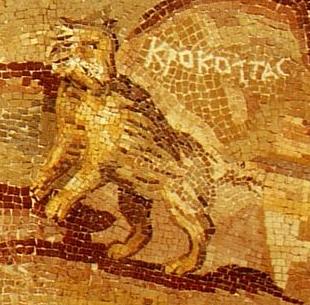
2 “Daliôn says in the first book of his Ethiopian Matters that there is an animal in Ethiopia called a krokotta. When that creature goes near backyards it hears people chattering, and especially the words/names of children. But when it goes out at night, it speaks words/names and the children who come out are devoured by it”
“[We should note the fact that] there is a creature in Ethiopia which is named krokottas which is like a combination of wolf and a dog, but it is more savage than both and is heavier in its face and at the end of its feet. It is also amazing for its boldness, and it is extremely capable compared to the rest in its teeth and its belly. For they also tear to pieces easily every type of bone and whatever they take up is consumed easily and their digestion is indescribable.
In addition, while some of them have been described as imitating human language, we don’t believe it. Nevertheless, some have added that they call out people by name at night—and that they try to use a human voice in doing this—and then they gobble up whoever comes out as they fall upon them.”
“Antisthenes, the peripatetic philosopher, also records that the consul Acilius Glabrio with the ambassadors Porcius Cato and Lucius Valerius Flaccus was stationed in war against Antiochus at Thermopylae and, after fighting well, compelled those on Antiochus’ side to throw down their weapons and the man himself to flee to Elataia with five hundred hypastists. From there, they compelled him to turn again to Thessaly. Acilius then sent Cato to Rome so he might announce the victory while he led the army himself against the Aitolians in Herakleia, which he took with ease.
In the action against Antiochus at Thermopylae, the Romans witnessed some shocking signs. After Antiochus turned and fled, on the next day the Romans turned to the gathering of those who died on the battle and a selection of weapons, war-spoils, and prisoners.
There was some man from the Syrian cavalry, named Bouplagos, who was honored by Antiochus but fell in battle even as he fought nobly. While the Romans were gathering up all the arms at midday, Bouplagos rose from the corpses even though he had twelve wounds. As he appeared to the army, he spoke the following verses in a soft voice:
Stop gathering booty from an army which has marched to Hades’ land—
For Kronos’ Son Zeus already feels anger as he watches your deeds.
He is raging at the murder of the army and your acts,
And he will send a bold-hearted race into your country
Who will end your empire and make you pay for what you’ve done.
Because they were troubled by these verses, the generals swiftly gathered the army in assembly and discussed the meaning of the omen. They thought it best to cremate and bury Bouplagos who had died right after he uttered these words. Then they performed a cleansing of the camp, made sacrifices to Zeus Apotropaios and sent a group to Delphi to ask the god what they should do.”
The following two passages are from the Mirabilia ofApollonius the Paradoxographer (usually dated to the 2nd Century BCE, making him one of the earliest extant paradoxographers).
This plant makes you bigger [=BNJ 81 F17]
“Phularkhos writes in the eighth book of his Histories that near the Arabian Gulf there is a spring of water from which if anyone ever anoints their feet what transpires miraculously is that their penis becomes enormously erect. For some it never contracts completely, while others are put back in shape with great suffering and medical attention.”
“Phularkhos in book 20 of the Histories says that there is a white root imported from India which when [people] cut it and smear it over their feet with water, those who are smeared with it experience forgetfulness of sex and become similar to eunuchs. For this reason still some apply it before they are fully adults and are not aroused for the rest of their life.”
“Phularkhos says that Sandrokottos, the king of the Indians, sent along with other gifts to Seleukos some drugs with erectile powers, the kind of which, when they are applied beneath feet of those who are going to have sex, give the urge like birds, while some people lose their ability [for sex].”
“To be able to fuck a lot: mix fifty [pine nuts] with two measures of honey and seeds of pepper and drink it. To have an erection whenever you want: mix pepper with honey and rub it on your thing.”
25 “Among the Iberians there is a tribe [and] and in a certain festival they honor women with gifts, however so many demonstrate at that time that they can weave the most numerous and beautiful cloaks.”
27 “Among the Nasamoi in Libya it is the custom that on the first day a woman is married that she has sex with everyone who is present and then take gifts from them. After that, she has sex only with the one who marries her.”
45 “The Liburnians have shared wives and they raise their children in common for five years. When they make it to the eighth year, they compare the children for their similarity to the men and they distribute to each one who is similar. And that one keeps him as a son.”
51 “The Assyrians sell their daughters in the marketplace to whoever wants to settle down with them. First the most well-born and most beautiful and then the rest in order. Whenever they get to the least attractive, they announce how much someone is willing to take to live with them and they add this consolation price from the fee charged for the desirable girls to these [last ones].”
This might be the most disturbing thing I have read all summer. When I was reading the Greek for the final sentence below, I actually uttered “what the f*ck” aloud. Go here for the second part.
Phlegon of Tralles, On Marvels 2 (Part 1)
Hieron the Alexandrian or Ephesian tells of the following wonder which occurred in Aitolia.
There was a certain citizen, Polykritos, who was voted Aitolian arkhon by the people. His fellow citizens considered him worthy for three years because of the nobility of his forebears. During the time he was in that office, he married a Lokrian woman. After he shared a bed with her for three nights, he died on the fourth.
The woman remained in their home widowed. When she gave birth, she had a child who had two sets of genitals, both male and female, which was alarmingly different from nature. The parts up top were completely rough and masculine and those near the thighs were feminine and softer.
Awestruck by this, her relatives forced the child to the agora and held an assembly to take advice about this, calling together the omen readers and interpreters. Some were claiming that this meant there would be dissent between Aitolians and Lokrians, since the mother was Lokrian and the father was Aitolian. But others believed that it was necessary to take the child and mother to the frontier and have them burned.
While the people were deliberating, suddenly the dead Polykritos appeared in the assembly dressed in black near his child. Even though the citizens were thunderstruck by this apparition and many of them were rushing to flight, he asked the citizens to be brave and not to be rattled by the sight which appeared. Then a bit of the chaos and the uproar receded, and he said these things in a slight voice:
“My fellow citizens, although I am dead in my body, I live among you in goodwill and thanks. And now I am present imploring those people who have power of this land to your collective benefit. I advise you who are citizens not to be troubled or angry at the impossible miracle which has happened. And I ask all of you, vouching for the safety of each, is to give me the child who was born from me so that no violence may come from those who make some different kind of plans and that there may be no beginning of malicious and hard affairs because of a conflict on my part.
It would not be possible for me to overlook the burning of my child thanks to the shock of these interpreters who are advising you. I do have some pity, because you are at a loss when you see this kind of unexpected sight as to how you might respond to it correctly for current events. If you assent to me without fear, you will be relieved of the present anxieties and of the evils to come. But if you fall prey to another opinion, then I have fear for you that you will come into some incurable sufferings because you did not trust me.
Therefore, because of the goodwill I experienced while I was alive and the unexpectedness of the current situation, I am predicting the suffering to you. I think it is right that you do not delay any longer but that, once you deliberate correcly and obey the things I have said, you should hand over the child to me with a blessing. It is not fitting for me to waste any more time because of the men who rule this land.”
After he said these things, he kept quiet for a bit as he awaited what kind of decision there would be once they deliberated about it. Some were thinking it was right to give him the child and consider the sight sacred and the influence of a deity; but most of them denied this, claiming that it was necessary to deliberate in a calmer atmopshere when they were not at so great a loss, because the affair was a big deal.
When he saw that they were not moving in his favor but were actually impeding the decision there, he spoke these things in turn: “Fellow Citizens. If something more terrible happens to you because of a lack of decision, do not blame me, but this fate which directs you to something worse—it sets you in opposition to me and compels me to transgress against my child.”
There was a great mist and a portent of strife as he reached for the child and and grabbed most of it up boldly before butchering and eating the child.
“Antisthenes, the peripatetic philosopher, also records that the consul Acilius Glabrio with the ambassadors Porcius Cato and Lucius Valerius Flaccus was stationed in war against Antiochus at Thermopylae and, after fighting well, compelled those on Antiochus’ side to throw down their weapons and the man himself to flee to Elataia with five hundred hypastists. From there, they compelled him to turn again to Thessaly. Acilius then sent Cato to Rome so he might announce the victory while he led the army himself against the Aitolians in Herakleia, which he took with ease.
In the action against Antiochus at Thermopylae, the Romans witnessed some shocking signs. After Antiochus turned and fled, on the next day the Romans turned to the gathering of those who died on the battle and a selection of weapons, war-spoils, and prisoners.
There was some man from the Syrian cavalry, named Bouplagos, who was honored by Antiochus but fell in battle even as he fought nobly. While the Romans were gathering up all the arms at midday, Bouplagos rose from the corpses even though he had twelve wounds. As he appeared to the army, he spoke the following verses in a soft voice:
Stop gathering booty from an army which has marched to Hades’ land—
For Kronos’ Son Zeus already feels anger as he watches your deeds.
He is raging at the murder of the army and your acts,
And he will send a bold-hearted race into your country
Who will end your empire and make you pay for what you’ve done.
Because they were troubled by these verses, the generals swiftly gathered the army in assembly and discussed the meaning of the omen. They thought it best to cremate and bury Bouplagos who had died right after he uttered these words. Then they performed a cleansing of the camp, made sacrifices to Zeus Apotropaios and sent a group to Delphi to ask the god what they should do.”
2 “Daliôn says in the first book of his Ethiopian Matters that there is an animal in Ethiopia called a krokotta. When that creature goes near backyards it hears people chattering, and especially the words/names of children. But when it goes out at night, it speaks words/names and the children who come out are devoured by it”
“[We should note the fact that] there is a creature in Ethiopia which is named krokottas which is like a combination of wolf and a dog, but it is more savage than both and is heavier in its face and at the end of its feet. It is also amazing for its boldness, and it is extremely capable compared to the rest in its teeth and its belly. For they also tear to pieces easily every type of bone and whatever they take up is consumed easily and their digestion is indescribable. In addition, while some of them have been described as imitating human language, we don’t believe it. Nevertheless, some have added that they call out people by name at night—and that they try to use a human voice in doing this—and then they gobble up whoever comes out as they fall upon them.”
The New York Times reports that the current US administration is trying to narrowly define gender in order to strip transgender people of federal protections. Here are some ancient intersex stories we posted over the summer. Human beings have known that gender is not simply binary and is not simply about how we are born for a very long time.
6 Also in Antioch near the Maiander river there was an intersex person, when Antipater who was the Athenians and Marcus Vinicius and Titus Statilus Taurus were consuls. The person was called Kourbinus. As a maiden of famous parents when she was thirteen she was suited by many because of her beauty.
After her parents chose the suitor they wanted, they appointed the day for the marriage But the girl shouted out as she was about to leave the house when the most severe amount of pain over took her.
Those near her lifted her up and were taking care of her because she had pains in her guts and twisting within them. This pain remained for three days straight and her suffering made everyone confused, since they could not give her relief from the toils at night or day.
Even though the doctors in the city applied every type of healing to her they found no cause for the suffering. On the fourth day near dawn, the pains greatly increased and, as she shouted out with a terrible groan, suddenly the masculine parts descended from her and a girl became a man.
After some time, he was taken to Rome to be presented to Claudius Caesar. And he, on account of the fame, had an altar erected for Zeus the Defender of Evils on the Capitoline.”
7 “There was also in Mêouania, an Italian city, in the home of Agrippina Augusta, an intersex person when Dionysodorus was archon in Athens and in Rome Decimus Junius Silanos Torquatos and Quintus Aterius Atonius were consuls.
The girl’s name was Philôtis and she was Smyrnaian in origin. When the time of her marriage came and she had been promised by her parents to a man, male genitals appeared on her and she became a man.”
8 “There was also another intersex person in the same time period in Epidaurus, a child of poor parents who was called Sumpherousa first but was named Sumpherôn when he became a man. He spent his life gardening.”
9 “In Laodikeia there was also a Syrian women named Aitêtê who changed her form when she was already living with her husband and then changed her name to Aitêtos once she became a man. This was when Makrinos was archon in Athens and Lucius Lamia Aelianos and Sextus Carminius Veterus were consuls. I even saw him myself.”
The story of Teiresias, Phlegon of Tralles, On Marvels 4
“Hesiod—along with Dikaiarkhos, Klearkhos, Kallimakhos and some others—relates these things about Teiresias. When Teiresias the son of Euêros in Arcadia was a young man he saw snakes copulating, he wounded one and immediately changed his form. He changed into a woman from a man and then had sex with a man.
But after Apollo prophesied to him that, if he saw snakes copulating again and wounded one in the same way, he would be as he was before, Teiresias took care to do the things which were prophesied by the god and thus regained his older form.
When Zeus was fighting with Hera and saying that in sex a wife surpassed her husband in the pleasures of intercourse—even while Hera was claiming the opposite—it seemed right to them to send for Teiresias because he had tried out both ways. When they questioned him, he responded that if there were ten portions, a man took pleasure in one and a woman took pleasure in ten.
In her rage over this, Hera took out his eyes and made him blind. But Zeus gave him the gift of prophecy and to live for seven generations.”
What is a little different about this version is the presence of Apollo and the claim that Zeus lengthened Teiresias’ life as part of his ‘reward’. This second part helps to explain Tiresias’ presence from the birth of Dionysus to the fall of Thebes with the Epigonoi.
5 “Others tell the story that in the land of the Lapiths the king Elatos had a daughter whose name was Kainis. After Poseidon had sex with her he promised to make her into whatever she wanted. She said she wanted to be changed into a man who was invulnerable. When Poseidon did this—as was right—he changed her name to Kaineus.”
This story is older than Ovid and Phlegon. It is detailed in the fragments of Akousilaus, perhaps alluded to in Homer, definitely indicated by Apollonius Rhodes, and present even in Plato. While the sex-change narrative remains an important element, the main feature of Kaineus’ tale is his hubris–because of his invulnerability he asks to be made into a god.
“Poseidon has sex with Kainê of Elatos. Then—for it was not right for him [sic] to have children with him nor anyone else—Poseidon turned him into an invulnerable man, who had the greatest strength of the men at that time. Whenever anyone tried to strike him with iron or bronze, [the attacker] was completely defeated.
Then [Kaineus] became king of the Lapiths and was warring with the Centaurs. After he set up his javelin in the agora he was asking to be included in the number of the gods. This was not pleasing to the gods. And when Zeus saw him doing this, he threatened him and raised the Centaurs against him. They struck him straight down into the earth and placed a stone above as assign. Then he died.”
In this account, Poseidon seems to be changing Kaineus because of his inability to have children. This makes it rather clear what women are good for from this cultural perspective. In addition, it is interesting that Kaineus as an intersex figure is involved in the war between the Lapiths and Centaurs, a conflict which has its origins in a rapes at a wedding and is often seen as a reflection of the civilized Lapiths struggling against the primitive and violent urges of the Centaurs.
But, as can be seen from the relief below which dates to the early Archaic period, the punishment of Kaineus is a primary motif of the story tradition. In a way, if the sex-change and rape were equally ancient, this is a tale about a women who is raped ultimately being punished for surviving and thriving and exacting retribution for her suffering.
D Scholia ad Il. 264
“Kaineus was a son of Elatos and king of the Lapiths. He was a very beautiful virgin girl before. But after Poseidon had sex with her, she asked to be changed from a young woman into a man. And he became invulnerable, and the most excellent of those alive at the time. And after he stuck his javelin into the middle of the agora, he demanded to be entered into the number of the gods for this reason.
Zeus was annoyed by this request and he arranged the following type of payback from him for impiety. For, even though he was invincible, he made him less while he was fighting the Centaurs. For they were hurling and striking him with pines and oak trees and they drove him into the ground. Apollonius recalls this in the Argonautica saying this, “For the singers used to report the fame that Kaineus was killed by Centaurs, when he alone from the rest of the best drove them, they surged back. They were not strong enough to repel him nor to kill him, but he went under the earth, unbroken, unbent, pummeled by the striking force of powerful pines.”
This story is held up as a wistful impossibility by Plato in the laws. This passage is, well, upsetting.
Plato’s Laws 944d-c
“What then would be the right punishment for someone who has thrown away this kind of a power of a defensive weapon for the opposite? For it is not possible for a person to do the opposite of what they say the god did when he changed the Thessalian Kaineus from a women into a man. For one who throws away his shield, the opposite of this transformation, changing from a man into a women, in some way would be the best of all punishments for this.”
In two earlier posts, we have the story of a victorious Roman army beset by tragic prophecies provided by a zombie opponent, the oracle at Delphi, and a suddenly mad general. Here, the general prophesies, dies, and speaks again. Oh, there’s a red wolf involved too.
Phlegon of Tralles, On Marvels 3 (Part 3)
“After he said these things, he spoke in verse again:
When the shining gold-bedecked Nêsaian horses
Trod on the shining earth, after they leave behind their seat
The horses Daidalian Êetion once made in the city
Of the very wealthy Syracusans, building up a longed-for friendship.
He put a fire on the bronze and laid golden knots
On their halters and he fit all this too on the son of
Hyperion who shines with rays and light.
On that day, Roman, harsh griefs will occur for you.
A broad army will come and it will destroy your whole land,
It will desolate your marketplaces, and it will make your cities burned ash.
It will fill the rivers with blood; it will fill Hades,
And it will cast pitiful, hateful, terrible slavery upon you.
No wife will welcome her husband come from war
But darkly-dressed Hades who lives below will hold them
among the rotting places where he has stolen children from their mothers,
as this foreign Ares will craft his day of enslavement.
He was silent and then, after he left the camp, he climbed up a certain tree. Because the crowd followed him, he addressed them again and said: “Roman men and remaining soldiers, it is fated for me to be eaten by a red wolf after I die on the same day. But you must take to heart that everything which I have said will turn out well for you. Take the coming appearance of this beast and my death as a clear sign that I have spoken truly, inspired from a god.”
After he said these things, he ordered them to hold back and that no one should stop the beast from approaching, warning that it would not help them if they turned it away. When the mob did what was ordered, a wolf arrived before too long. When Publius say it, he came down from the tree and fell to his back. The wolf tore him apart and dined on him while everyone was walking. Once it had eaten up his body except for his head, he turned to the mountain. When the mob approached and was considering collecting what was left and burying him, the head spoke as it sat upon the earth and uttered these lines.
Don’t touch my head! For it is not right
For those upon whose thoughts Athena has set a savage rage
To touch a godly head. No, stop!
Heed the true prophecy which I will tell you.
For a great a powerful Ares will approach this land—
He will send a host in arms down to Hades’ gloom.
It will break the stone fortifications and long walls
And after that, once it has taken our wealth and wives and children
Will lead it all to Asia by crossing the waves.
Phoibos Apollo has uttered these truths to you
The Pythian one who sent me as his strong servant
And has led me now to the homes of Persephone and the blessed.
Once they heard these voices, they were extremely upset. Once they built a shrine to Lykian Apollo along which an altar in the very place where the head say, they embarked on their ships and everyone sailed to their own country. Everything promised by Publius happened in time.”
“Antisthenes, the peripatetic philosopher, also records that the consul Acilius Glabrio with the ambassadors Porcius Cato and Lucius Valerius Flaccus was stationed in war against Antiochus at Thermopylae and, after fighting well, compelled those on Antiochus’ side to throw down their weapons and the man himself to flee to Elataia with five hundred hypastists. From there, they compelled him to turn again to Thessaly. Acilius then sent Cato to Rome so he might announce the victory while he led the army himself against the Aitolians in Herakleia, which he took with ease.
In the action against Antiochus at Thermopylae, the Romans witnessed some shocking signs. After Antiochus turned and fled, on the next day the Romans turned to the gathering of those who died on the battle and a selection of weapons, war-spoils, and prisoners.
There was some man from the Syrian cavalry, named Bouplagos, who was honored by Antiochus but fell in battle even as he fought nobly. While the Romans were gathering up all the arms at midday, Bouplagos rose from the corpses even though he had twelve wounds. As he appeared to the army, he spoke the following verses in a soft voice:
Stop gathering booty from an army which has marched to Hades’ land—
For Kronos’ Son Zeus already feels anger as he watches your deeds.
He is raging at the murder of the army and your acts,
And he will send a bold-hearted race into your country
Who will end your empire and make you pay for what you’ve done.
Because they were troubled by these verses, the generals swiftly gathered the army in assembly and discussed the meaning of the omen. They thought it best to cremate and bury Bouplagos who had died right after he uttered these words. Then they performed a cleansing of the camp, made sacrifices to Zeus Apotropaios and sent a group to Delphi to ask the god what they should do.”