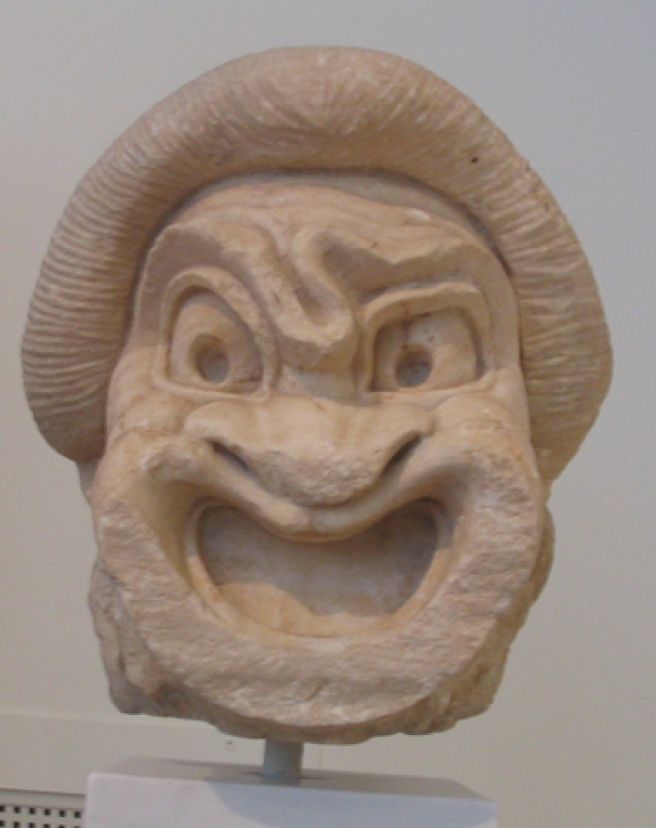
“Solon, after he was asked by Periander over drink—when the former happened to be quiet—whether he was silent because of a loss of words or foolishness, said “No fool could ever be quiet at a drinking party.”
μωρολογία: properly, “stupid-talking” or “the talk of fools”. But why not: “the science of stupidity”?
Sophocles, fr. 924
“Stupidity is a terrible opponent to wrestle”
ὡς δυσπάλαιστόν <ἐστιν> ἀμαθία κακόν
Terence, Phormio, 659-660
“Whether I claim he does this because of stupidity or
malice—whether this is a knowing plot, or incompetence, I am unsure.”
utrum stultitia facere ego hunc an malitia
dicam, scientem an imprudentem, incertu’ sum.
Sophocles, fr. 925
“Stupidity really is evil’s sibling”
ἡ δὲ μωρία
μάλιστ᾿ ἀδελφὴ τῆς πονηρίας ἔφυ
Suetonius, Divus Claudius 38
“But he did not stay quiet even about his own stupidity: but claimed that he had faked it on purpose under Gaius because he would have not escaped and advanced to his eventual position otherwise—and that this was supported by certain oracles. But he persuaded no one. And after a brief time, a book was published with the title “The Ascension of Fools” which posited that no one can pretend stupidity.”
Ac ne stultitiam quidem suam reticuit simulatamque a se ex industria sub Gaio, quod aliter evasurus perventurusque ad susceptam stationem non fuerit, quibusdam oratiunculis testatus est; nec tamen49 persuasit, cum intra breve tempus liber editus sit, cui index erat μωρῶν ἐπανάστασις, argumentum autem stultitiam neminem fingere.
Plutarch, Rational Beasts 998a
“Note that a lack of intelligence or stupidity in some animals emerges in contrast with the abilities and sharpness of others as you might compare an ass or a sheep with a fox, a wolf or a bee. It would be the same if you would compare Polyphemos or that idiot Koroibos to your grandfather Autolykos. For I do not think that there is so great a difference between beasts as there is between individual people in thinking, using reason, and in memory.”
“These men must be the dumbest of all people or they are the most inimical to the state. If they believe that it is also better for their private affairs when the state does well, then they are complete fools in pursuing something opposite to their own advantage right now. If they do not believe that they share common interests with you, then they must be enemies of the state”
“A special recognition for stupidity needs to be given to the rhetorician Corvus who said, “Since Xerxes is already sailing against us on his sea, shouldn’t we flee before the earth is taken from us””
Corvo rhetori testimonium stuporis reddendum est, qui dixit: “quidni, si iam Xerses ad nos suo mari navigat, fugiamus, ntequam nobis terra subripiatur?”
μωρολογία: properly, “stupid-talking” or “the talk of fools”. But why not: “the science of stupidity”?
Sophocles, fr. 924
“Stupidity is a terrible opponent to wrestle”
ὡς δυσπάλαιστόν <ἐστιν> ἀμαθία κακόν
Terence, Phormio, 659-660
“Whether I claim he does this because of stupidity or
malice—whether this is a knowing plot, or incompetence, I am unsure.”
utrum stultitia facere ego hunc an malitia
dicam, scientem an imprudentem, incertu’ sum.
Sophocles, fr. 925
“Stupidity really is evil’s sibling”
ἡ δὲ μωρία
μάλιστ᾿ ἀδελφὴ τῆς πονηρίας ἔφυ
Suetonius, Divus Claudius 38
“But he did not stay quiet even about his own stupidity: but claimed that he had faked it on purpose under Gaius because he would have not escaped and advanced to his eventual position otherwise—and that this was supported by certain oracles. But he persuaded no one. And after a brief time, a book was published with the title “The Ascension of Fools” which posited that no one can pretend stupidity.”
Ac ne stultitiam quidem suam reticuit simulatamque a se ex industria sub Gaio, quod aliter evasurus perventurusque ad susceptam stationem non fuerit, quibusdam oratiunculis testatus est; nec tamen49 persuasit, cum intra breve tempus liber editus sit, cui index erat μωρῶν ἐπανάστασις, argumentum autem stultitiam neminem fingere.
Plutarch, Rational Beasts 998a
“Note that a lack of intelligence or stupidity in some animals emerges in contrast with the abilities and sharpness of others as you might compare an ass or a sheep with a fox, a wolf or a bee. It would be the same if you would compare Polyphemos or that idiot Koroibos to your grandfather Autolykos. For I do not think that there is so great a difference between beasts as there is between individual people in thinking, using reason, and in memory.”
“These men must be the dumbest of all people or they are the most inimical to the state. If they believe that it is also better for their private affairs when the state does well, then they are complete fools in pursuing something opposite to their own advantage right now. If they do not believe that they share common interests with you, then they must be enemies of the state”
“A special recognition for stupidity needs to be given to the rhetorician Corvus who said, “Since Xerxes is already sailing against us on his sea, shouldn’t we flee before the earth is taken from us””
Corvo rhetori testimonium stuporis reddendum est, qui dixit: “quidni, si iam Xerses ad nos suo mari navigat, fugiamus, ntequam nobis terra subripiatur?”
Archilochus talks about the monkey in another fragment. Here, the monkey meets a fox.
Archilochus, Fr. 185
“I will tell you a fable, Cerycides,
With a mournful message [stick]:
A monkey was traveling ahead of the other animals,
Alone into the distance,
When a clever fox met him,
Possessing a well-formed mind.”
Les Fables d’Esope Phrygien, mises en Ryme Francoise. Auec la vie dudit Esope extraite de plusieurs autheurs par M. Antoine du Moulin Masconnois. A Lyon, Par Iean de Tournes, & Guillaume Gazeau. 1547. Fable 41. Du Singe & du Renard.
(confused about the “message stick” [ἀχνυμένηι σκυτάληι]? Me too. For a discussion, see
See Katerina Philippides’ “The Fox and the Wolf: Archilochus’ 81 D/185 W and Pindar’s “Olympian” 6, 87-91 (With Reference to “Pythian” 2)” Quaderni Urbinati di Cultura Classica. 9 (2009) 11-21).
The fabulous meeting of the monkey and fox may have even more to say to our times. Here are two fables from the Aesopic tradition. (For an embarrassment of riches when it comes to resources for fables, go to mythfolklore.net)
Aesop, Fable 83
“A monkey danced at a gathering of unreasoning animals and, impressing them, was elected king. But a fox, envying him for this, noticed a piece of meat lying in a trap. She led the monkey to where it was, and said that she had discovered a storehouse on her own but did not use it because she had saved the prize for his kingdom. She advised him to take it. When he stupidly approached, he was caught by the trap. When he blamed the fox for leading him to the trap, she said, “Monkey, how are you going to be king of the animals with this kind of mind?”
In this way, people who attempt deeds without any experience slip into misfortune and absurdity.”
“While traveling together a fox and a monkey started arguing about their family trees. They were arguing for a while until they came to a graveyard. After he looked there, the monkey moaned. When the fox was asking why, the monkey pointed to the monuments and said, “How can I fail to weep looking at the graves of my ancestors?” The fox responded, “Lie as much as you want. None of them will stand up to refute you!”
It is the same way with men: braggarts lie the most whenever they won’t be challenged.”
Phaedrus, Appendix: Simius et Vulpes (Monkey and Fox)
“A monkey was asking a fox for part of her tail
So he could properly cover his naked ass.
The mean fox said, “even if it should grow longer still
I would rather drag my tail through muck and spines
Than share with you the smaller part of mine!”
Vulpem rogabat partem caudae simius,
contegere honeste posset ut nudas nates;
cui sic maligna: “Longior fiat licet,
tamen illam citius per lutum et spinas traham,
partem tibi quam quamvis parvam impartiar.”
And just because I cannot leave well-enough alone:
Diogenes Laertius, Lives of the Philosophers 5.6 (Heracleides)
“Dionysius said to him: “you will also find these lines: ‘an old monkey is not caught in a trap’; ‘he is caught, he is caught after some time’. And in addition to these, he said: “Heracleides is illiterate, but not ashamed of it.”
In another passage (Apol. 21a), Plato says that Chaerophon asked the Pythia if anyone was wiser than Socrates and that she answered that no one was. In this, as well, Xenophon says something different (Apol.14): “When Chaerophon once asked about me at Delphi, Apollo answered that no one of the present men was more just or wise.”
How is it sensible or persuasive that Socrates, who agreed that he knew nothing, was declared the wisest of all men by the god who knows everything? If this is wisdom, knowing nothing, then knowing everything is foolishness. What need was there for Chaerophon to ask the god about Socrates? It is because itwas right to Believe Socrates when he said about himself that he was not wise. “For the man who would ask such things of a god is a fool”.