“His Heart Barked”: Sex, Slaves, and Transgression in the Odyssey

Earlier I posted a passage from the Odyssey where the narrator tells us that Penelope raised the slave Melanthô and gave her toys. This detail is paired with the slave woman’s sexual behavior—she is now a bad slave because she is having sex with one of the suitors.

Odyssey, 18.321–5

“Then fine-cheeked Melanthô reproached him shamefully. Dolios fathered her and Penelope raised her, she treated her like her own child and used to give her delights for her heart. But she did not have grief in her thoughts for Penelope. Instead she was having sex with and feeling affection for Eurymakhos.”

τὸν δ’ αἰσχρῶς ἐνένιπε Μελανθὼ καλλιπάρῃος,
τὴν Δολίος μὲν ἔτικτε, κόμισσε δὲ Πηνελόπεια,
παῖδα δὲ ὣς ἀτίταλλε, δίδου δ’ ἄρ’ ἀθύρματα θυμῷ·
ἀλλ’ οὐδ’ ὧς ἔχε πένθος ἐνὶ φρεσὶ Πηνελοπείης,
ἀλλ’ ἥ γ’ Εὐρυμάχῳ μισγέσκετο καὶ φιλέεσκεν.

The meaning of this behavior might not be clear to modern audiences. Ancient audiences might have needed clarification too. The epic shows Odysseus witnessing this later.

20.5–24

“Odysseus was lying there, still awake, devising evils in his heart
For the suitors. And the women went from the hall
The ones who were having sex with the suitors before
Greeting one another with a welcome and a laugh.
And Odysseus’ heart rose in his dear chest.
He debated much in his thoughts and through his heart
Whether after leaping up he should deal out death to each woman
Or he should allow them to have sex with the arrogant suitors
a last and final time. The heart inside his chest barked.
And as a mother dog who stands over her young pups
When she sees an unknown man barks and waits to fight,
So his heart growled within him as he was enraged at the evil deeds.
Then he struck his chest and reproached the heart inside him.
Endure this my heart, you endured a more harrowing thing on that day
When the savage Cyclops, insanely daring, ate
My strong companions. You were enduring this and your intelligence
Led you from that cave even though you thought you were going to die.”

ἔνθ’ ᾿Οδυσεὺς μνηστῆρσι κακὰ φρονέων ἐνὶ θυμῷ
κεῖτ’ ἐγρηγορόων· ταὶ δ’ ἐκ μεγάροιο γυναῖκες
ἤϊσαν, αἳ μνηστῆρσιν ἐμισγέσκοντο πάρος περ,
ἀλλήλῃσι γέλω τε καὶ εὐφροσύνην παρέχουσαι.
τοῦ δ’ ὠρίνετο θυμὸς ἐνὶ στήθεσσι φίλοισι·
πολλὰ δὲ μερμήριζε κατὰ φρένα καὶ κατὰ θυμόν,
ἠὲ μεταΐξας θάνατον τεύξειεν ἑκάστῃ,
ἦ ἔτ’ ἐῷ μνηστῆρσιν ὑπερφιάλοισι μιγῆναι
ὕστατα καὶ πύματα· κραδίη δέ οἱ ἔνδον ὑλάκτει.
ὡς δὲ κύων ἀμαλῇσι περὶ σκυλάκεσσι βεβῶσα
ἄνδρ’ ἀγνοιήσασ’ ὑλάει μέμονέν τε μάχεσθαι,
ὥς ῥα τοῦ ἔνδον ὑλάκτει ἀγαιομένου κακὰ ἔργα.
στῆθος δὲ πλήξας κραδίην ἠνίπαπε μύθῳ·
“τέτλαθι δή, κραδίη· καὶ κύντερον ἄλλο ποτ’ ἔτλης,
ἤματι τῷ, ὅτε μοι μένος ἄσχετος ἤσθιε Κύκλωψ
ἰφθίμους ἑτάρους· σὺ δ’ ἐτόλμας, ὄφρα σε μῆτις
ἐξάγαγ’ ἐξ ἄντροιο ὀϊόμενον θανέεσθαι.”

Beyond whether or not the liaison was a good wooing strategy for Eurymachus, these closely paired statements show that despite being integrated into the family structure, Melantho has not internalized her position and has instead exercised agency in pursuing sexuality. (Or, perhaps more accurately, exercising control over her own body to choose a different master.) When the epic returns to the issue, it takes pains to depict the women as in control and to ensure that Odysseus witnesses it. When he reveals himself to the suitors in book 22, he accuses them of forcefully sleeping with the women.

22.35-38

“Dogs, you were expecting that out of the way I would not come
home from the land of the Trojans and you ruined my home,
Took the slave women in my house to bed by force
And wooed the wife of a man who was still alive…”

“ὦ κύνες, οὔ μ’ ἔτ’ ἐφάσκεθ’ ὑπότροπον οἴκαδε νεῖσθαι
δήμου ἄπο Τρώων, ὅτι μοι κατεκείρετε οἶκον
δμῳῇσίν τε γυναιξὶ παρευνάζεσθε βιαίως
αὐτοῦ τε ζώοντος ὑπεμνάασθε γυναῖκα…

The difference in tone is in part due to the level of narrative—in the first two scenes mentioned above, the sexual acts are observed through the narrator. When Odysseus talks about it, he characterizes the acts differently because he sees the sexual acts as transgressing his control of the household. If the women—who are animate objects, not people—have sex, then they are the sexual objects of aggressors against Odysseus’ control. This transgressive behavior on their part helps to explain why Odysseus decides to slaughter them.

Who should have sex with the slave women is implied by a narrative passage from the beginning of the epic (1.428–33)

“And with him Eurykleia carried the burning torches. She knew proper things, the daughter of Ops, the son of Peisênor whom Laertes bought to be among his possessions when she was just a girl and he paid a price worth 20 oxen. And he used to honor her equal to his dear wife in his home but he never had sex with her and he was avoiding his wife’s anger.”

τῷ δ’ ἄρ’ ἅμ’ αἰθομένας δαΐδας φέρε κεδνὰ ἰδυῖα
Εὐρύκλει’, ῏Ωπος θυγάτηρ Πεισηνορίδαο,
τήν ποτε Λαέρτης πρίατο κτεάτεσσιν ἑοῖσι,
πρωθήβην ἔτ’ ἐοῦσαν, ἐεικοσάβοια δ’ ἔδωκεν,
ἶσα δέ μιν κεδνῇ ἀλόχῳ τίεν ἐν μεγάροισιν,
εὐνῇ δ’ οὔ ποτ’ ἔμικτο, χόλον δ’ ἀλέεινε γυναικός·

It is exceptional here that Laertes does not have sex with Eurykleia. This indicates an economy of sexual slavery in which the slave women are the objects to be used by those who own them. If they are used without permission or act on their own, they represent perversions.

See:

Doherty, Lillian. 2001. “The Snares of the Odyssey: A Feminist Narratological Reading.” 117-133.
Thalmann, William G. 1998. “Female Slaves in the Odyssey.” 22–34
Related image
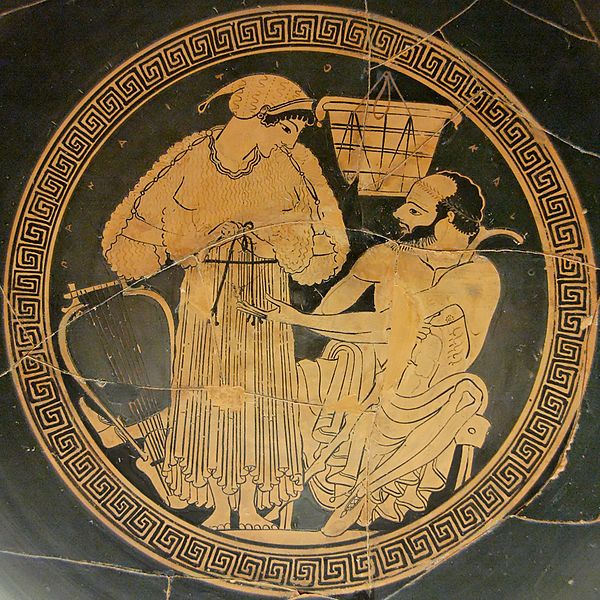
Red-figure Kylix, c. 490 BCE


Diogenes Can Get Satisfaction (And So Can You!)

Dio recounts how the philosopher proposed dealing with, um, animal urges.

Dio Chrysostom, The Sixth Oration: On Diogenes or Tyranny (16-20)

“On behalf of that very thing which men make the most effort and waste the most money—through which many cities have been overturned and for whose sake many people have perished pitiably—for [Diogenes] this was the easiest and cheapest thing. For he didn’t have to go anywhere for sexual satisfaction, since, as he used to joke, Aphrodite was near him everywhere, and for free. He used to say that the poets slandered the goddess because of their own lack of control when they called her “all golden”. Since many did not believe this, he proved it out in the open while everyone was watching. And he used to say that if people did this, then Troy would not have fallen, nor would have Priam, the Phrygian king of the line of Zeus, bled out on Zeus’ altar.

He added that the Achaeans were so witless as to imagine that even corpses needed women and so slaughtered Polyxena on the tomb of Achilles. So he used to explain that fish proved themselves to be almost more prudent than men—for whenever they needed to expel their seed, the went out and rubbed up against something with friction. Diogenes was amazed at the unwillingness of men to spend money to have their foot, hand, or any other part of the body rubbed, and how the very rich would not waste even a drachma on this. But they [all] lavished many a talent on that single member often and that some even still endangered their lives too. He used to joke that this kind of intercourse was Pan’s discovery: when he was lusting after Echo but couldn’t overtake her, he was wondering in the mountains night and day until that point when Hermes taught him how to do this, because he pitied his helplessness and he was his son. And, after he learned this, he got a break from his great suffering. Apparently, shepherds learned this from him.”

ὑπὲρ οὗ δὲ πλεῖστα μὲν πράγματα ἔχουσιν ἄνθρωποι πλεῖστα δὲ χρήματα ἀναλίσκουσι, πολλαὶ δὲ ἀνάστατοι πόλεις διὰ ταῦτα γεγόνασι, πολλὰ δὲ ἔθνη τούτων ἕνεκεν οἰκτρῶς ἀπόλωλεν, ἁπάντων ἐκείνῳ χρημάτων ἀπονώτατον ἦν καὶ ἀδαπανώτατον. οὐ γὰρ ἔδει αὐτὸν οὐδαμόσε ἐλθεῖν ἀφροδισίων ἕνεκεν, ἀλλὰ παίζων ἔλεγεν ἁπανταχοῦ παρεῖναι αὐτῷ τὴν Ἀφροδίτην προῖκα· τοὺς δὲ ποιητὰς καταψεύδεσθαι τῆς θεοῦ διὰ τὴν αὑτῶν ἀκρασίαν, πολύχρυσον καλοῦντας. ἐπεὶ δὲ πολλοὶ τοῦτο ἠπίστουν, ἐν τῷ φανερῷ ἐχρῆτο καὶ πάντων ὁρώντων· καὶ ἔλεγεν ὡς εἴπερ οἱ ἄνθρωποι οὕτως εἶχον, οὐκ ἂν ἑάλω ποτὲ ἡ Τροία, οὐδ᾿ ἂν ὁ Πρίαμος ὁ Φρυγῶν βασιλεύς, ἀπὸ Διὸς γεγονώς, ἐπὶ τῷ βωμῷ τοῦ Διὸς ἐσφάγη. τοὺς δὲ Ἀχαιοὺς οὕτως εἶναι ἄφρονας ὥστε καὶ τοὺς νεκροὺς νομίζειν προσδεῖσθαι γυναικῶν καὶ τὴν Πολυξένην σφάττειν ἐπὶ τῷ τάφῳ τοῦ Ἀχιλλέως. ἔφη δὲ τοὺς ἰχθύας σχεδόν τι φρονιμωτέρους φαίνεσθαι τῶν ἀνθρώπων· ὅταν γὰρ δέωνται τὸ σπέρμα ἀποβαλεῖν, ἰόντας ἔξω προσκνᾶσθαι πρός τι τραχύ. θαυμάζειν δὲ τῶν ἀνθρώπων τὸ τὸν μὲν πόδα μὴ θέλειν ἀργυρίου κνᾶσθαι μηδὲ τὴν χεῖρα μηδὲ ἄλλο μηδὲν τοῦ σώματος, μηδὲ τοὺς πάνυ πλουσίους ἀναλῶσαι ἂν μηδεμίαν ὑπὲρ τούτου δραχμήν· ἓν δὲ ἐκεῖνο τὸ μέρος πολλάκις πολλῶν ταλάντων, τοὺς δέ τινας ἤδη καὶ τὴν ψυχὴν παραβαλλομένους. ἔλεγε δὲ παίζων τὴν συνουσίαν ταύτην εὕρεμα εἶναι τοῦ Πανός, ὅτε τῆς Ἠχοῦς ἐρασθεὶς οὐκ ἐδύνατο λαβεῖν, ἀλλ᾿ ἐπλανᾶτο ἐν τοῖς ὄρεσι νύκτα καὶ ἡμέραν, τότε οὖν τὸν Ἑρμῆν διδάξαι αὐτόν, οἰκτείραντα τῆς ἀπορίας, ἅτε υἱὸν αὐτοῦ. καὶ τόν, ἐπεὶ ἔμαθε, παύσασθαι τῆς πολλῆς ταλαιπωρίας· ἀπ᾿ ἐκείνου δὲ τοὺς ποιμένας χρῆσθαι μαθόντας.

Image result for Ancient Greek Diogenes

Here’s another post on masturbation in Ancient Greek.

Helen’s Serving Girl Wrote the First Greek Sex Manual


I received the first passage this morning as a gift from one of my students. I am so very proud.

From the Suda

Astuanassa: A handmaid of Helen, Menelaos’ wife. She first discovered positions for intercourse and wrote On Sexual Positions. Philainis and Elephantinê rivaled her in this later—they were women who danced out these sorts of wanton acts.

Ἀστυάνασσα, Ἑλένης τῆς Μενελάου θεράπαινα: ἥτις πρώτη τὰς ἐν τῇ συνουσίᾳ κατακλίσεις εὗρε καὶ ἔγραψε περὶ σχημάτων συνουσιαστικῶν: ἣν ὕστερον παρεζήλωσαν Φιλαινὶς καὶ Ἐλεφαντίνη, αἱ τὰ τοιαῦτα ἐξορχησάμεναι ἀσελγήματα.

Photius Bibl. 190.149a 27-30

We have learned about this embroidered girdle, that Hera took it from Aphrodite and gave it to Helen. Her handmaid Astuanassa stole it but Aphrodite took it back from her again.

Περὶ τοῦ κεστοῦ ἱμάντος ὡς λάβοιμὲν αὐτὸν ῞Ηρα παρὰ ᾿Αφροδίτης, δοίη δ’ ῾Ελένῃ, κλέψοι δ’ αὐτὸν ἡ ῾Ελένης θεράπαινα ᾿Αστυάνασσα, ἀφέλοι δ’ αὐτὸν ἐξ αὐτῆς πάλιν ᾿Αφροδίτη.

Hesychius, sv. Astuanassa

Astuanassa: A handmaiden of Helen and the first to discover Aphrodite and her licentious positions.

᾿Αστυάνασσα· ῾Ελένης θεράπαινα ἥτις πρώτη ἐξεῦρεν ᾿Αφροδίτην καὶ ἀκόλαστα σχήματα

Image result for Ancient Greek Helen vase

As is largely unsurprising from the perspective of Greek misogyny, excessive interest in sexual behavior is projected a female quality. Expertise beyond interest is made the province of female ‘professionals’ (slaves) who may act as scapegoats and marginal figures for the corruption of both men and women. There is a combination of such interest with an excessive emphasis on eating (and eating really well) in Athenaeus where the pleasures of the body are combined.

Athenaeus, Deipnosophists 8.335c

“Dear men, even though I have great admiration for Chrysippus as the leader of the Stoa, I praise him even more because he ranks Arkhestratos, well-known for his Science of Cooking along with Philainis who is credited with a licentious screed about sexual matters—even though the iambic poet of Samos, Aiskhriôn, claims that Polycrates the sophist started this slander of her when she was really quite chaste. The lines go like this:

“I, Philainis, circulated among men
Lie here thanks to great old age.
Don’t laugh, foolish sailor, as your trace the cape
Nor make me a target of mockery or insult
For, by Zeus and his sons in Hell
I was never a slut with men nor a public whore.
Polykrates, Athenian by birth,
A bit clever with words and with a nasty tongue,
Wrote what he wrote. I don’t know anything about it.”

But the most amazing Chrysippus combines in the fifth book of his On Goodness and Pleasure that both “the books of Philianis and the Gastronomiai of Arkhestratos and forces of erotic and sexual nature, and in the same way slave-girls who are expert at these kinds of movements and positions and who are engaged in their practice.” He adds that they learn this type of material completely and then thoroughly possess what has been written on these topics by Philainis and Arkhestratos and those who have written on similar topics. Similarly, in his seventh book, he says ‘As you cannot wholly learn the works of Philianis and Arkhestratos’ Gastronomia because they do have something to offer for living better.’ “

Χρύσιππον δ᾿, ἄνδρες φίλοι, τὸν τῆς στοᾶς ἡγεμόνα κατὰ πολλὰ θαυμάζων ἔτι μᾶλλον ἐπαινῶ τὸν πολυθρύλητον ἐπὶ τῇ Ὀψολογίᾳ Ἀρχέστρατον αἰεί ποτε μετὰ Φιλαινίδος κατατάττοντα, εἰς ἣν ἀναφέρεται τὸ περὶ ἀφροδισίων ἀκόλαστον cσύγγραμμα, ὅπερ φησὶ | ποιῆσαι Αἰσχρίων ὁ Σάμιος ἰαμβοποιὸς Πολυκράτη τὸν σοφιστὴν ἐπὶ διαβολῇ τῆς ἀνθρώπου σωφρονεστάτης γενομένης. ἔχει δὲ οὕτως τὰ ἰαμβεῖα·

ἐγὼ Φιλαινὶς ἡ ᾿πίβωτος ἀνθρώποις
ἐνταῦθα γήρᾳ τῷ μακρῷ κεκοίμημαι.
μή μ᾿, ὦ μάταιε ναῦτα, τὴν ἄκραν κάμπτων
χλεύην τε ποιεῦ καὶ γέλωτα καὶ λάσθην.
ὐ γὰρ μὰ τὸν Ζῆν᾿, οὐ μὰ τοὺς κάτω κούρους, |
dοὐκ ἦν ἐς ἄνδρας μάχλος οὐδὲ δημώδης.
Πολυκράτης δὲ τὴν γενὴν Ἀθηναῖος,
λόγων τι παιπάλημα καὶ κακὴ γλῶσσα,
ἔγραψεν οἷ᾿ ἔγραψ᾿· ἐγὼ γὰρ οὐκ οἶδα.

ἀλλ᾿ οὖν ὅ γε θαυμασιώτατος Χρύσιππος ἐν τῷ πέμπτῳ Περὶ τοῦ Καλοῦ καὶ τῆς Ἡδονῆς φησι· καὶ βιβλία τά τε Φιλαινίδος καὶ τὴν τοῦ Ἀρχεστράτου Γαστρονομίαν καὶ δυνάμεις ἐρωτικὰς καὶ συνουσιαστικάς, ὁμοίως δὲ καὶ τὰς θεραπαίνας ἐμπείρους τοιῶνδε κινήσεών τε καὶ σχημάτων καὶ περὶ τὴν eτούτων μελέτην γινομένας. καὶ πάλιν· ἐκμανθάνειν | τ᾿ αὐτοὺς τὰ τοιαῦτα καὶ κτᾶσθαι τὰ περὶ τούτων γεγραμμένα Φιλαινίδι καὶ Ἀρχεστράτῳ καὶ τοῖς τὰ ὅμοια γράψασιν. κἀν τῷ ἑβδόμῳ δέ φησι· καθάπερ γὰρ οὐκ ἐκμανθάνειν τὰ Φιλαινίδος καὶ τὴν Ἀρχεστράτου Γαστρονομίαν ἔστιν ὡς φέροντά τι πρὸς τὸ ζῆν ἄμεινον.

Masturbating in Ancient Greek

Just in case the picture of a man’s final moment at Pompeii has inspired people this morning, Ancient Greek for (male) masturbation:

https://twitter.com/PersianRose1/status/881330662321655808

Aristophanes, Peace 290-292

“Now comes the time of for Datis’ song
The one he sang once at midday as he masturbated
“How I am pleased and I enjoy this and I am finding delight!”

ΤΡ.                Νῦν, τοῦτ’ ἐκεῖν’, ἥκει τὸ Δάτιδος μέλος.
δεφόμενός ποτ’ ᾖδε τῆς μεσημβρίας·
«῾Ως ἥδομαι καὶ χαίρομαι κεὐφραίνομαι.»

The small LSJ defines δέφω as “to soften by working by the hand, to make supple, to tan hides.” The 1902 LSJ uses Latin to explain: “sensu obscoeno, v. Lat. Masturbari.”

The Suda (delta 297) cuts to the chase on this one with “dephein: grabbing someone by the genitals. Also, “rubbing” (Dephomenos) instead of “flogging your genitals.” (Δέφειν: τὸ τοῦ αἰδοίου τινὰ ἅπτεσθαι. καὶ Δεφόμενος, ἀντὶ τοῦ ἀποδέρων τὸ αἰδοῖον). So, the active vs. middle voice is an important distinction (echoing something I have emphasized in teaching Greek: active voice is something you do to someone else, middle is what you do to yourself…).

Here’s a nice passage that shows the difference in active and passive voice:

Artemidorus, Dream Interpretation 1.78: 74-80

“I know of a certain slave who dreamed that he was masturbating his master—and he then became the teacher and nurse of his children. For he was holding his master’s genitals in his hands which was a symbol of his children. And again, I know of another who dreamed he was being jerked off by his master, and, later he was bound to a pillar and then he received many blows…”

οἶδα δέ τινα δοῦλον, ὃς ἔδοξε τὸν δεσπότην αὐτοῦ δέφειν, καὶ ἐγένετο τῶν παίδων αὐτοῦ παιδαγωγὸς καὶ τροφός· ἔσχε γὰρ ἐν ταῖς χερσὶ τὸ τοῦ δεσπότου αἰδοῖον ὂν τῶν ἐκείνου τέκνων σημαντικόν. καὶ πάλιν αὖ οἶδά <τινα> ὃς ἔδοξεν ὑπὸ τοῦ δεσπότου δέφεσθαι, καὶ προσδεθεὶς κίονι πολλὰς ἔλαβε πληγάς….

Most of the extant uses of this verb appear in comedy. And, not surprisingly, this means Aristophanes:

Aristophanes, Knights 23-24

ΟΙ. Β′                                               Πάνυ καλῶς.
῞Ωσπερ δεφόμενός νυν ἀτρέμα πρῶτον λέγε
τὸ μολωμεν, εἶτα δ’ αὐτο, κᾆτ’ ἐπάγων πυκνόν.

“Excellent.
Just as if you were masturbating, say it first now gently
“let us hurry” and then again pushing on, quickly.”

[Here’s a link to the whole play. Soon, one of the interlocutors stops “because the skin is irritated by masturbation.” (῾Οτιὴ τὸ δέρμα δεφομένων ἀπέρχεται, 29)]

The verb is not common, to say the least, so later commentators found it necessary to gloss it and explain Aristophanes’ joke. Through the explanations of the joke, it immediately becomes less funny, and the language used in the commentaries.

Scholia in Knights:

[1] “ ‘Just like dephomenos’: instead of “flogging your genitals” (apodérôn to aidoion). For, when men touch their genitals they don’t complete as they began, but they move more eagerly towards the secretion of semen. This plays on that, he means start small at first but then go continuously.

[2]dephomenos’: “having intercourse’. Flogging genitals.

[3]dephomenos’: They mean handling the penis. For, when men take hold of their penises they don’t move towards ejaculation the way they began, but more eagerly over time, as they are inflamed by the continuity of movement.”

 ὥσπερ δεφόμενος: ἀντὶ τοῦ ἀποδέρων τὸ αἰδοῖον. οἱ γὰρ ἁπτόμενοι τῶν αἰδοίων οὐχ ὡς ἤρξαντο, ἀλλὰ σπουδαιότερον κινοῦσι πρὸς τῇ τῆς γονῆς ἐκκρίσει. τοῦτο οὖν λέγει, ὅτι πρῶτον κατὰ μικρόν, εἶτα συνεχῶς λέγε. RVEΓ2M

δεφόμενος] ξυνουσιάζων, ἀποδέρων τὸ αἰδοῖον. M

δεφόμενος] ἤγουν τοῦ μορίου ἁπτόμενος. οἱ γὰρ ἁπτόμενοι τοῦ μορίου
πρὸς ἔκκρισιν τῆς γονῆς οὐχ ὡς ἤρξαντο κινοῦσιν ἀλλὰ σπουδαιότερον, ἐκπυρούμενοι τῇ συνεχείᾳ τῆς κινήσεως. VatLh

Aristophanes, Ecclesiazusae, 705–709

“It is decreed that the ugly and the wretched
Get to fuck first.
Take your pleasure on the porch in the meantime
Handling your fig-leaves in the courtyard”

τοῖς γὰρ σιμοῖς καὶ τοῖς αἰσχροῖς
ἐψήφισται προτέροις βινεῖν,
ὑμᾶς δὲ τέως θρῖα λαβόντας
διφόρου συκῆς
ἐν τοῖς προθύροισι δέφεσθαι.

The Suda interprets this passage as meaning that someone is masturbating with a fig leaf. Henderson ( The Maculate Muse. New Haven 1975) explains that the “fig-leaves” are the foreskin and the “courtyard” means outside of a vagina.

Image result for ancient Greek Masturbating vase

And just in case one might worry about moral dimensions of masturbation, ancient philosophers have already tackled the question:

From Sextus Empiricus Pyrrhonian Hypotyposes, 3.206-207

“Similarly, this seems shameful to one of the sages but not to another. For us it is wrong to marry your own mother or sister. But the Persians, especially those of them who seem to pursue wisdom, the Magi, marry their mothers just as the Egyptians marry their sisters. The poet also says: “Zeus addressed Hera, his wife and sister…”

Zeno of Citium even says that it is not strange to rub your mother’s genitals with your own, just as no one would claim it is wrong to rub any other part of her body with your hand. Chrysippus approves in his Republic of a father getting children from his daughter, a mother from her son, and a brother from his sister. Plato insisted generally that wives should be held in common. Zeno also does not disapprove of masturbation, which is shameful in our culture. We have also learned that others practice this wicked habit as if it were a good thing.”

οὕτω καὶ τῶν σοφῶν ᾧ μὲν οὐκ αἰσχρόν, ᾧ δὲ αἰσχρὸν ἐδόκει τοῦτο εἶναι. ἄθεσμον τέ ἐστι παρ’ ἡμῖν μητέρα ἢ ἀδελφὴν ἰδίαν γαμεῖν· Πέρσαι δέ, καὶ μάλιστα αὐτῶν οἱ σοφίαν ἀσκεῖν δοκοῦντες, οἱ Μάγοι, γαμοῦσι τὰς μητέρας, καὶ Αἰγύπτιοι τὰς ἀδελφὰς ἄγονται πρὸς γάμον, καὶ ὡς ὁ ποιητής φησιν,

Ζεὺς ῞Ηρην προσέειπε κασιγνήτην ἄλοχόν τε.

ἀλλὰ καὶ ὁ Κιτιεὺς Ζήνων φησὶ μὴ ἄτοπον εἶναι τὸ μόριον τῆς μητρὸς τῷ ἑαυτοῦ μορίῳ τρῖψαι, καθάπερ οὐδὲ ἄλλο τι μέρος τοῦ σώματος αὐτῆς τῇ χειρὶ τρῖψαι φαῦλον ἂν εἴποι τις εἶναι. καὶ ὁ Χρύσιππος δὲ ἐν τῇ πολιτείᾳ δογματίζει τόν τε πατέρα ἐκ τῆς θυγατρὸς παιδοποιεῖσθαι καὶ τὴν μητέρα ἐκ τοῦ παιδὸς καὶ τὸν ἀδελφὸν ἐκ τῆς ἀδελφῆς. Πλάτων δὲ καὶ καθολικώτερον κοινὰς εἶναι τὰς γυναῖκας δεῖν ἀπεφήνατο. τό τε αἰσχρουργεῖν ἐπάρατον ὂν παρ’ ἡμῖν ὁ Ζήνων οὐκ ἀποδοκιμάζει· καὶ ἄλλους δὲ ὡς ἀγαθῷ τινι τούτῳ χρῆσθαι τῷ κακῷ πυνθανόμεθα.

Teiresias the Trans-Prophet: Origins of Prophecy and A Long-life, Not Requested

Book 3 of Ovid’s Metamorphoses offers a delightful tale about Teiresias’ blindness and power of prophecy. The Theban was born as a man but changed into a woman when he saw two snakes copulating in the forest. Years later—after getting married and having at least one child—she happened to be walking in the forest and witnessed the same thing. Wham! Teiresias was a man again.

Sometime after that, Teiresias was summoned to Olympus to adjudicate a marital dispute between Zeus and Hera who had been arguing about whether sex was better for males or females. Teiresias gave an enigmatic answer (1 part enjoyment far a man to 10 for women) and Hera blinded him in rage. Zeus compensated for this by giving him the power of prophecy.

What most people don’t know is that this tale is not at all an Ovidian innovation. A few fragments attributed to Hesiod preserve the answer and Teiresias’ reaction to Zeus’ “gift”.

The first few lines present Hesiod’s answer (Fr. 275):

[Teiresias described how]

“A man delights only in one portion of ten
While a woman delights her thoughts filling out the other ten.”

οἴην μὲν μοῖραν δέκα μοιρέων τέρπεται ἀνήρ,
τὰς δὲ δέκ’ ἐμπίπλησι γυνὴ τέρπουσα νόημα.
Another fragment appears to have Teiresias addressing Zeus (fr. 276):

“Zeus father I wish that you would give me a shorter life
And grant that I might know only the things equal to the thoughts
Of mortal men. Now you have not honored me at all,
You who have made my lifetime so long,
That I will live on through seven generations of mortal men.”

Ζεῦ πάτερ, εἴθε μοι †εἴθ’ ἥσσω μ’† αἰῶνα βίοιο
ὤφελλες δοῦναι καὶ ἴσα φρεσὶ μήδεα ἴδμεν
θνητοῖς ἀνθρώποις· νῦν δ’ οὐδέ με τυτθὸν ἔτισας,
ὃς μακρόν γέ μ’ ἔθηκας ἔχειν αἰῶνα βίοιο
ἑπτά τ’ ἐπὶ ζώειν γενεὰς μερόπων ἀνθρώπων

Tiresias_striking_the_snakes

Teiresias is right to lament. As he probably knows from his recent power of prophecy, he will witness Dionysus’ return to Thebes (and subsequent bloodshed); the exposure of Oedipus and his parricidal, incestuous return; the deaths of Oedipus’ sons Eteokles and Polyneices at each other’s hands; and the sack of Thebes in the next generation. And even then his story isn’t over: Odysseus will wake up his tired ghost in the Odyssey for one more prophecy.

As for Teiresias’ answer to Zeus and Hera? When I teach this story I joke that he’s more afraid of Zeus than his wife. But his answer is part of a general Greek misogyny that justifies the cloistering of woman by characterizing them as libidinous by nature. The number 10 seems significant here: there may be an irony in the use of “enjoy”. In the Greek world, babies are born after 10 lunar months. If I had to give an answer to why “10:1” to save my life, that would be all I would have.

Fortunately, no Olympian beings will be seeking my advice…