“And then when they consume the flower of their age
As their limbs are laced together, just when the body senses delight
And that Venus is about to sow the furrows of the feminine field,
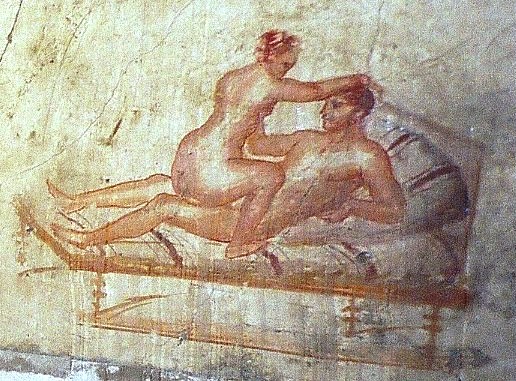
They press their bodies together greedily and join their wet mouths
Trying to breathe each other in as they press lips into teeth—
All pointlessly, since they can’t rub anything from there,
Nor can they truly enter each other or leave for a single body.
For this is what they often seem to want and try to do.
That’s how eagerly they cleave to Venus’s re-combinations of flesh
While their limbs become liquid under pleasure’s force.
Finally, once the lust which has amassed in their veins erupts,
Then, for a moment, there is a brief lull in the violent fire.
But soon the rabid hunger and the same madness returns,
And they quest to fulfill what they desire,
But they cannot discover any trick to overcome the pain,
And they remain uncertain, wasting away from a hidden wound.”
denique cum membris conlatis flore fruuntur
aetatis, iam cum praesagit gaudia corpus
atque in eost Venus ut muliebria conserat arva,
adfigunt avide corpus iunguntque salivas
oris et inspirant pressantes dentibus ora—
nequiquam, quoniam nil inde abradere possunt
nec penetrare et abire in corpus corpore toto;
nam facere interdum velle et certare videntur:
usque adeo cupide in Veneris compagibus haerent,
membra voluptatis dum vi labefacta liquescunt.
tandem ubi se erupit nervis conlecta cupido,
parva fit ardoris violenti pausa parumper.
inde redit rabies eadem et furor ille revisit,
cum sibi quod cupiunt ipsi contingere quaerunt,
nec reperire malum id possunt quae machina vincat:
usque adeo incerti tabescunt volnere caeco.
Yesterday, Erik posted that famous passage from Herodotus where Peisistratos runs afoul of the tyrant of Megara, Megacles, when “because he did not want to have children by his new wife, he was having sex with her not in the customary manner” οὐ βουλόμενός οἱ γενέσθαι ἐκ τῆς νεογάμου γυναικὸς τέκνα ἐμίσγετό οἱ οὐ κατὰ νόμον.
As you can probably imagine, there have been many discussions about what his means (e.g. should the negator go with the verb and not the prepositional phrase and mean “he did not have sex with her, as is customary” rather than “he did not have sex with her in the customary fashion?”) A passage from Diodorus Siculus which Cassie Garrison brought to my attention made me think about this again.
When Kallion, who seems to have been intersex, reaches adulthood, their sexual origins present a particular challenge (D. S. 32.11)
When she reached maturity, she was married to a certain citizen. For two years she lived with her husband, and since she could not endure feminine intercourse, she was forced to submit to unnatural embraces.
Here, we have an interesting comparison. The passage from Diodorus is clearly interpreted as referring to anal sex whereas there is debate about the Herodotean reference. One act being referred to as “against nature” (phusis) may make us rethink what it means for the other to merely be against custom (nomos), although I expect what both are really about is that intercourse with women was expected to be procreative. the assertion that something is “by nature” is rhetorical and based on cultural perspectives. What is considered natural is often so in order to affirm what is customary.
In the Herodotean passage, the marriage is an arrangement between noble families from different cities and children were an expectation of this type of arrangement. Hence, engaging in intentionally non-procreative activity would be against custom. In the second passage, Diodorus Siculus is emphasizing the fact that Kallion is not a woman, who, by nature should be able to produce children through sex (from Diodorus’ perspective).
This does not of course mean that we are positive about Peisistratos’ marital activities. We could still be talking intercrural sex vel. sim….
Plutarch, Moralia 653: Table-Talk—Book 3, Question 8: Concerning the Right Time for Sex
“Some young men who had not spent much time in classical literature were criticizing Epicurus, that it was not noble or necessary that he included a discussion about the right time for sex in his Symposium. For, they claimed that it was the worst kind of impropriety for an older man to talk about sexual matters during dinner when youths were present and to work through whether it was better after dinner or before dinner.
To this, some guests added that Xenophon used to take his dinner companions home after dinner not by foot but by horse to have sex with their wives. Zopyros the doctor—a man very familiar with Epicurus’ arguments, said that they has not read Epicurus’ Symposium very carefully. For, he did not put forth the problem as one based on a certain rule or established practice, and then provide his arguments in its favor. Instead, he roused the youths after dinner for a walk and talked for the reason of instruction, to curb them from their desires, because sex is always a matter which might bring harm and which afflicts those worst who engage after food and drink.
He said, “If, indeed, this discussion were earnestly about sex, would it seem right not to examine the better opportunity and hour for doing these kinds of things? Would it be otherwise right for him to look look for another moment more opportune except at the symposium and the dinner table?”
“Men who drink a lot of wine are rather sluggish at intercourse and they ejaculate semen not at all strong or good for fertilization; instead their attempts at sex with women are cursory and incomplete because of the weakness and frigidity of their seed.
Indeed, however much men suffer because of the cold occurs to them when they are drunk: tremors, heaviness, paleness, sudden jumps in the limbs, senseless speech, a lack of feeling in the joints and extremities. For most men, being drunk results in paralysis, whenever the wine totally expels and defeats the heat.”
5 “Others tell the story that in the land of the Lapiths the king Elatos had a daughter whose name was Kainis. After Poseidon had sex with her he promised to make her into whatever she wanted. She said she wanted to be changed into a man who was invulnerable. When Poseidon did this—as was right—he changed her name to Kaineus.”
This story is older than Ovid and Phlegon. It is detailed in the fragments of Akousilaus, perhaps alluded to in Homer, definitely indicated by Apollonius Rhodes, and present even in Plato. While the sex-change narrative remains an important element, the main feature of Kaineus’ tale is his hubris–because of his invulnerability he asks to be made into a god.
“Poseidon has sex with Kainê of Elatos. Then—for it was not right for him [sic] to have children with him nor anyone else—Poseidon turned him into an invulnerable man, who had the greatest strength of the men at that time. Whenever anyone tried to strike him with iron or bronze, [the attacker] was completely defeated.
Then [Kaineus] became king of the Lapiths and was warring with the Centaurs. After he set up his javelin in the agora he was asking to be included in the number of the gods. This was not pleasing to the gods. And when Zeus saw him doing this, he threatened him and raised the Centaurs against him. They struck him straight down into the earth and placed a stone above as assign. Then he died.”
In this account, Poseidon seems to be changing Kaineus because of his inability to have children. This makes it rather clear what women are good for from this cultural perspective. In addition, it is interesting that Kaineus as an intersex figure is involved in the war between the Lapiths and Centaurs, a conflict which has its origins in a rapes at a wedding and is often seen as a reflection of the civilized Lapiths struggling against the primitive and violent urges of the Centaurs.
But, as can be seen from the relief below which dates to the early Archaic period, the punishment of Kaineus is a primary motif of the story tradition. In a way, if the sex-change and rape were equally ancient, this is a tale about a women who is raped ultimately being punished for surviving and thriving and exacting retribution for her suffering.
D Scholia ad Il. 264
“Kaineus was a son of Elatos and king of the Lapiths. He was a very beautiful virgin girl before. But after Poseidon had sex with her, she asked to be changed from a young woman into a man. And he became invulnerable, and the most excellent of those alive at the time. And after he stuck his javelin into the middle of the agora, he demanded to be entered into the number of the gods for this reason.
Zeus was annoyed by this request and he arranged the following type of payback from him for impiety. For, even though he was invincible, he made him less while he was fighting the Centaurs. For they were hurling and striking him with pines and oak trees and they drove him into the ground. Apollonius recalls this in the Argonautica saying this, “For the singers used to report the fame that Kaineus was killed by Centaurs, when he alone from the rest of the best drove them, they surged back. They were not strong enough to repel him nor to kill him, but he went under the earth, unbroken, unbent, pummeled by the striking force of powerful pines.”
This story is held up as a wistful impossibility by Plato in the laws. This passage is, well, upsetting.
Plato’s Laws 944d-c
“What then would be the right punishment for someone who has thrown away this kind of a power of a defensive weapon for the opposite? For it is not possible for a person to do the opposite of what they say the god did when he changed the Thessalian Kaineus from a women into a man. For one who throws away his shield, the opposite of this transformation, changing from a man into a women, in some way would be the best of all punishments for this.”
“But as soon as pleasure, spent, comes to its goal
And bodies lie thoroughly exhausted with the mind
When it gets annoying and you prefer to have touched no girl
And you seem unlikely to touch one again for a while,
Then gather in your mind whatever faults are in her flesh
And hold each of her imperfections in your eyes.
Perhaps someone else will consider them small—as they are,
But what is no advantage alone aids in numbers.
A viper slays a giant bull will a small bite;
A boar is often held by a hound of no great size.
Make sure you fight with such a number: collect your judgments,
A mountain will grow from so much sand.”
At simul ad metas venit finita voluptas,
Lassaque cum tota corpora mente iacent,
Dum piget, et malis nullam tetigisse puellam,
Tacturusque tibi non videare diu,
Tunc animo signa, quaecumque in corpore menda est,
Luminaque in vitiis illius usque tene.
Forsitan haec aliquis (nam sunt quoque) parva vocabit,
Sed, quae non prosunt singula, multa iuvant.
Parva necat morsu spatiosum vipera taurum:
A cane non magno saepe tenetur aper.
Tu tantum numero pugna, praeceptaque in unum
Contrahe: de multis grandis acervus erit.
Homeric Hymn to Aphrodite, 168–176
“But when the shepherds gather back to the fold
Their cattle and strong sheep from the blooming meadows,
Then over Anchises she was pouring sweet sleep
Gently and she wrapped her shining cloths around her.
Once clothed well over her entire body, the shining goddess
Stood near the bed, and her head touched the well-made roof,
And the immortal beauty shone from her cheeks
As it does from well-crowned Kytherea.
And she woke him from sleep and spoke his name:
“Get up, Dardanian. Why do you still stretch out in deep sleep?…”
Earlier I posted a passage from the Odyssey where the narrator tells us that Penelope raised the slave Melanthô and gave her toys. This detail is paired with the slave woman’s sexual behavior—she is now a bad slave because she is having sex with one of the suitors.
Odyssey, 18.321–5
“Then fine-cheeked Melanthô reproached him shamefully. Dolios fathered her and Penelope raised her, she treated her like her own child and used to give her delights for her heart. But she did not have grief in her thoughts for Penelope. Instead she was having sex with and feeling affection for Eurymakhos.”
The meaning of this behavior might not be clear to modern audiences. Ancient audiences might have needed clarification too. The epic shows Odysseus witnessing this later.
20.5–24
“Odysseus was lying there, still awake, devising evils in his heart
For the suitors. And the women went from the hall
The ones who were having sex with the suitors before
Greeting one another with a welcome and a laugh.
And Odysseus’ heart rose in his dear chest.
He debated much in his thoughts and through his heart
Whether after leaping up he should deal out death to each woman
Or he should allow them to have sex with the arrogant suitors
a last and final time. The heart inside his chest barked.
And as a mother dog who stands over her young pups
When she sees an unknown man barks and waits to fight,
So his heart growled within him as he was enraged at the evil deeds.
Then he struck his chest and reproached the heart inside him.
Endure this my heart, you endured a more harrowing thing on that day
When the savage Cyclops, insanely daring, ate
My strong companions. You were enduring this and your intelligence
Led you from that cave even though you thought you were going to die.”
Beyond whether or not the liaison was a good wooing strategy for Eurymachus, these closely paired statements show that despite being integrated into the family structure, Melantho has not internalized her position and has instead exercised agency in pursuing sexuality. (Or, perhaps more accurately, exercising control over her own body to choose a different master.) When the epic returns to the issue, it takes pains to depict the women as in control and to ensure that Odysseus witnesses it. When he reveals himself to the suitors in book 22, he accuses them of forcefully sleeping with the women.
22.35-38
“Dogs, you were expecting that out of the way I would not come
home from the land of the Trojans and you ruined my home,
Took the slave women in my house to bed by force
And wooed the wife of a man who was still alive…”
The difference in tone is in part due to the level of narrative—in the first two scenes mentioned above, the sexual acts are observed through the narrator. When Odysseus talks about it, he characterizes the acts differently because he sees the sexual acts as transgressing his control of the household. If the women—who are animate objects, not people—have sex, then they are the sexual objects of aggressors against Odysseus’ control. This transgressive behavior on their part helps to explain why Odysseus decides to slaughter them.
Who should have sex with the slave women is implied by a narrative passage from the beginning of the epic (1.428–33)
“And with him Eurykleia carried the burning torches. She knew proper things, the daughter of Ops, the son of Peisênor whom Laertes bought to be among his possessions when she was just a girl and he paid a price worth 20 oxen. And he used to honor her equal to his dear wife in his home but he never had sex with her and he was avoiding his wife’s anger.”
It is exceptional here that Laertes does not have sex with Eurykleia. This indicates an economy of sexual slavery in which the slave women are the objects to be used by those who own them. If they are used without permission or act on their own, they represent perversions.
See:
Doherty, Lillian. 2001. “The Snares of the Odyssey: A Feminist Narratological Reading.” 117-133.
Thalmann, William G. 1998. “Female Slaves in the Odyssey.” 22–34
“Children, the Cyprian is certainly not only the Cyprian
But she is a being of many names.
She is Hades. She is immortal life.
She is mad insanity. She is desire undiluted.
She is lamentation. In her is everything
Earnest, peaceful, all that leads to violence
She seeps into the organs of everything
In which life resides. Who is ever sated by the goddess?
She enters into the fishes’ swimming race,
She is in the four-limbed tribe on the land
And guides her wing among the birds.
Among beasts, mortals, among the gods above.
Whom of the gods has she not thrown three times?
If it is right for me—if it is right to speak the truth,
She rules Zeus’ chest without a spear or iron
The Cyprian certainly cuts short
All the best plans of humans and gods.”
Plutarch, Moralia 653: Table-Talk—Book 3, Question 8: Concerning the Right Time for Sex
“Some young men who had not spent much time in classical literature were criticizing Epicurus, that it was not noble or necessary that he included a discussion about the right time for sex in his Symposium. For, they claimed that it was the worst kind of impropriety for an older man to talk about sexual matters during dinner when youths were present and to work through whether it was better after dinner or before dinner.
To this, some guests added that Xenophon used to take his dinner companions home after dinner not by foot but by horse to have sex with their wives. Zopyros the doctor—a man very familiar with Epicurus’ arguments, said that they has not read Epicurus’ Symposium very carefully. For, he did not put forth the problem as one based on a certain rule or established practice, and then provide his arguments in its favor. Instead, he roused the youths after dinner for a walk and talked for the reason of instruction, to curb them from their desires, because sex is always a matter which might bring harm and which afflicts those worst who engage after food and drink.
He said, “If, indeed, this discussion were earnestly about sex, would it seem right not to examine the better opportunity and hour for doing these kinds of things? Would it be otherwise right for him to look look for another moment more opportune except at the symposium and the dinner table?”
I have been weighing the sense and import of the pages below for a few weeks now. Typically, I don’t teach too much about sexuality and I research it even less as a Homerist. I suspect that this is partly disciplinary (Homer is happy to indicate the power and fact of sexual acts with little specification; this is largely a generic characteristic) but part is nurture: my parents were both Lutherans of mid-Western Scandinavian persuasion: sex is fine, as long as no one talks about it.
But I do mention misogyny quite a bit in classes and on the blog and I have long been worried about the ways in which an uncritical presentation of the material in Homer and myth merely recapitulates and strengthens structural biases about gender and power. When it comes to human sexuality, I get a little squeamish with posts on this site: I like to post material that surprises people with the dirtiness of the Ancient world (you know, farting, shitting, middle fingers) and which disabuses people of the notion that what we have from the Ancient Greek and Romans is largely philosophy and Galen. But in a time when people misuse the ancient world for many things–most execrably to support racists and white supremacist views erroneously--I do fear that some postings might appear exploitative or be misused in some way.
This is one reason, for example although I put up a post about masturbation in ancient Greek, I did not follow it up, as requested with one about female masturbation. For one, there is only a small amount of evidence (and the evidence is extremely problematic because it comes from men and is mostly negative). For another, I don’t think there is any way for a male author to post information about female masturbation online without seeming in some way salacious, creepy, or just, well, gross.
(Again, this is where both my nature and my nurture may be causing me problems. Oh, and this: not talking about female masturbation reinforces taboos about female sexuality and agency.)
Another area in which we have posted very little is on topics that pertain to homosexuality, same-sex acts, or non-heteronormative (in a modern sense) eroticism. People respond all too well to lists of words for feces, but descriptions of sexuality that fall under the earlier categories get some strange responses. This is not enough to stop us alone. My worry is akin to my concern in the last paragraph, but more. I fear that some readers will use such material negatively (doing harm to ancient and modern communities); I also feel we run the risk of getting cheap entertainment through the exploitative expropriation of someone else’s sexuality.
But I have been struggling with the line of thought in the passage I am about to cite. The work of the book The Maculate Muse is really groundbreaking (and it is a work to which I have referred for many years), but the comments on comparing modern and ancient ‘homosexuality’ seem skewed in a damaging way. I am posting them not with the intention of shaming the scholar, but instead with the hope that someone will tell me I have read this all wrong.
J. Henderson. The Maculate Muse, 1991 (2nd edition; first 1975): 207
The Maculate Muse, 1991: 208
I am troubled by a few things here. The bit about “perversion” and “not without reason” seems particularly problematic, especially since it is unexplained. The additional language of compulsion is also borderline for me. Although the second edition is now nearly 30 years old (and the original is closer to 50!), I would have thought that it would be more sensitive in its treatment of sexual categories and notions of sexual activity, sexual identity, gender and sex.
My suspicions about this passage and its implicit definitions of sexuality (and identities) have led me to read a lot of what Henderson says about “pathics”, effeminacy, and the insults which may or may not pertain to these categories with much greater caution.
Update: an important note of context. The comments cited above were not updated from the 1975 edition of the book. The following note precedes the discussion.
A scholar familiar with the development of this book from dissertation to publication and revision was kind enough to share some context. It was dangerous for a career to write this book in the 1970s. Classics has not always been in the social and cultural vanguard.
So, this passage can serve particularly well as a lesson for how our scholarship is shaped by cultural constrainta both in its articulation and ita reception over time.





,_small_bronze_relief,_AM_Olympia,_Olym14.jpg)

