Words, Seeds, and Fertile Minds

Seneca, Moral Epistle 38

“You rightly urge that we increase the frequency of our letters. Conversation, however, is the most helpful because it seeps into the mind bit by bit. Prepared lectures delivered while a crowd listens provide more opportunity for noise than familiarity.

Philosophy is good counsel, yet no one gives counsel by shouting. We need to use these verbal assaults, as I call them, at times, when someone who doubts needs to be pushed. But to make someone learn,–not just to want to learn, that’s when we shouldn’t lecture but turn to quieter conversation instead. Such words enter people more easily and stick with them. You don’t need a lot of words, just the right ones.

Words ought to be spread around like seeds–however small a seed might be, once it finds a fertile place, it expands its own strength and grows to its full power from the smallest size. Reason works the same way: it does not look large from the outside, but it grows in application.

There may be few words uttered, but if a mind receives them well, they grow stronger and surge to the surface. Advice and seeds, I think, have the same characteristics: they create much, though they start small. Provided, as I said, a fertile mind accepts them and welcomes them into itself. Then, the mind itself will create much in turn and return in kind more than it received. Goodbye.”

Merito exigis, ut hoc inter nos epistularum commercium frequentemus. Plurimum proficit sermo, quia minutatim inrepit animo. Disputationes praeparatae et effusae audiente populo plus habent strepitus, minus familiaritatis. Philosophia bonum consilium est; consilium nemo clare dat. Aliquando utendum est et illis, ut ita dicam, contionibus, ubi qui dubitat, impellendus est; ubi vero non hoc agendum est, ut velit discere, sed ut discat, ad haec submissiora verba veniendum est. Facilius intrant et haerent; nec enim multis opus est, sed efficacibus.

Seminis modo spargenda sunt, quod quamvis sit exiguum, cum occupavit idoneum locum, vires suas explicat et ex minimo in maximos auctus diffunditur. Idem facit ratio; non late patet, si aspicias; in opere crescit. Pauca sunt, quae dicuntur, sed si illa animus bene excepit, convalescunt et exurgunt. Eadem est, inquam, praeceptorum condicio quae seminum; multum efficiunt, et angusta sunt. Tantum, ut dixi, idonea mens capiat illa et in se trahat. Multa invicem et ipsa generabit et plus reddet quam acceperit. Vale.

John Denver, The Garden Song
Inch by inch, row by rowGonna make this garden growAll it takes is a rake and a hoeAnd a piece of fertile ground
Inch by inch, row by rowSomeone bless these seeds I sowSomeone warm them from belowTill the rain comes tumblin’ down
Pullin’ weeds and pickin’ stonesMan is made of dreams and bonesFeel the need to grow my own‘Cause the time is close at hand
Rainful rain, sun and rainFind my way in nature’s chainTune my body and my brainTo the music from the land
Plant your rows straight and longTemper them with prayer and songMother Earth will make you strong
If you give her love and care
Old crow watchin’ hungrilyFrom his perch in yonder treeIn my garden I’m as freeAs that feathered thief up there
Inch by inch, row by rowGonna make this garden growAll it takes is a rake and a hoeAnd a piece of fertile ground
An inch by inch, row by rowSomeone bless these seeds I sowSomeone warm them from belowTill the rain comes tumblin’ down

An Apple A Day

The fragment below is what survives of a hymn to Adonis by Praxilla (5th-century-BC female poet). The lines are Adonis’ response to a question put to him in Hades: what’s the most beautiful thing you left behind in the world of the living? 

Praxilla Fr.747 (PMG) 

The loveliest thing I leave behind is sunlight;
Then follows brilliant stars and the face of the moon,
And also ripe cucumbers, and apples, and pears.

κάλλιστον μὲν ἐγὼ λείπω φάος ἠελίοιο,
δεύτερον ἄστρα φαεινὰ σεληναίης τε πρόσωπον
ἠδὲ καὶ ὡραίους σικύους καὶ μῆλα καὶ ὄγχνας·

Zenobius (2nd century AD) preserved the fragment in his collection of proverbs. He explains that the inclusion of fruits and vegetables alongside the moon and stars is so foolish that it gave rise to the saying “sillier than Praxilla’s Adonis.” 

But is it silly to rank fruits with the heavenly bodies as life’s singular blessings? Looked at from the perspective of Rilke, a 20th-century poet much influenced by Greek lyric, Praxilla was prescient, not silly. 

In poem I.13 of his Sonnets to Orpheus, Rilke celebrates the eating of fruit as a transporting, ineffable experience which carries with it sensations of life as well as intimations of death. In other words, the aspirations of lyric are little other than what the humble apple and pear already accomplish for us.

Rilke: Sonnets to Orpheus I.13

Ripe apple, pear, and banana,
Gooseberry . . . These all speak
Death and life into the mouth . . .I infer . . .
Read it in a child’s expression

when she tastes them. This comes from far away.
Does this nameless thing slowly happen in your mouth?
Where words used to be, discoveries flow
From pulp surprised at being set free.

Try to say what it is you call ‘apple.’
This sweetness that’s at first tightly contained,
Then, when tasted, gently unfolds

To become clear, alive and transparent,
Double in meaning, sunny, earthy, present—:
O experience, feeling, joy—colossal!

Rilke: Sonette an Orpheus, I.13
Voller Apfel, Birne und Banane,
Stachelbeere … Alles dieses spricht
Tod und Leben in den Mund … Ich ahne …
Lest es einem Kind vom Angesicht,

wenn es sie erschmeckt. Dies kommt von weit.
Wird euch langsam namenlos im Munde?
Wo sonst Worte waren, fließen Funde,
aus dem Fruchtfleisch überrascht befreit.

Wagt zu sagen, was ihr Apfel nennt.
Diese Süße, die sich erst verdichtet,
um, im Schmecken leise aufgerichtet,

klar zu werden, wach und transparent,
doppeldeutig, sonnig, erdig, hiesig –:
O Erfahrung, Fühlung, Freude –, riesig!

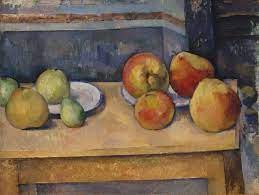
Paul Cezanne, Still Life with Apples and Pears (1892).

Larry Benn has a B.A. in English Literature from Harvard College, an M.Phil in English Literature from Oxford University, and a J.D. from Yale Law School. Making amends for a working life misspent in finance, he’s now a hobbyist in ancient languages and blogs at featsofgreek.blogspot.com.