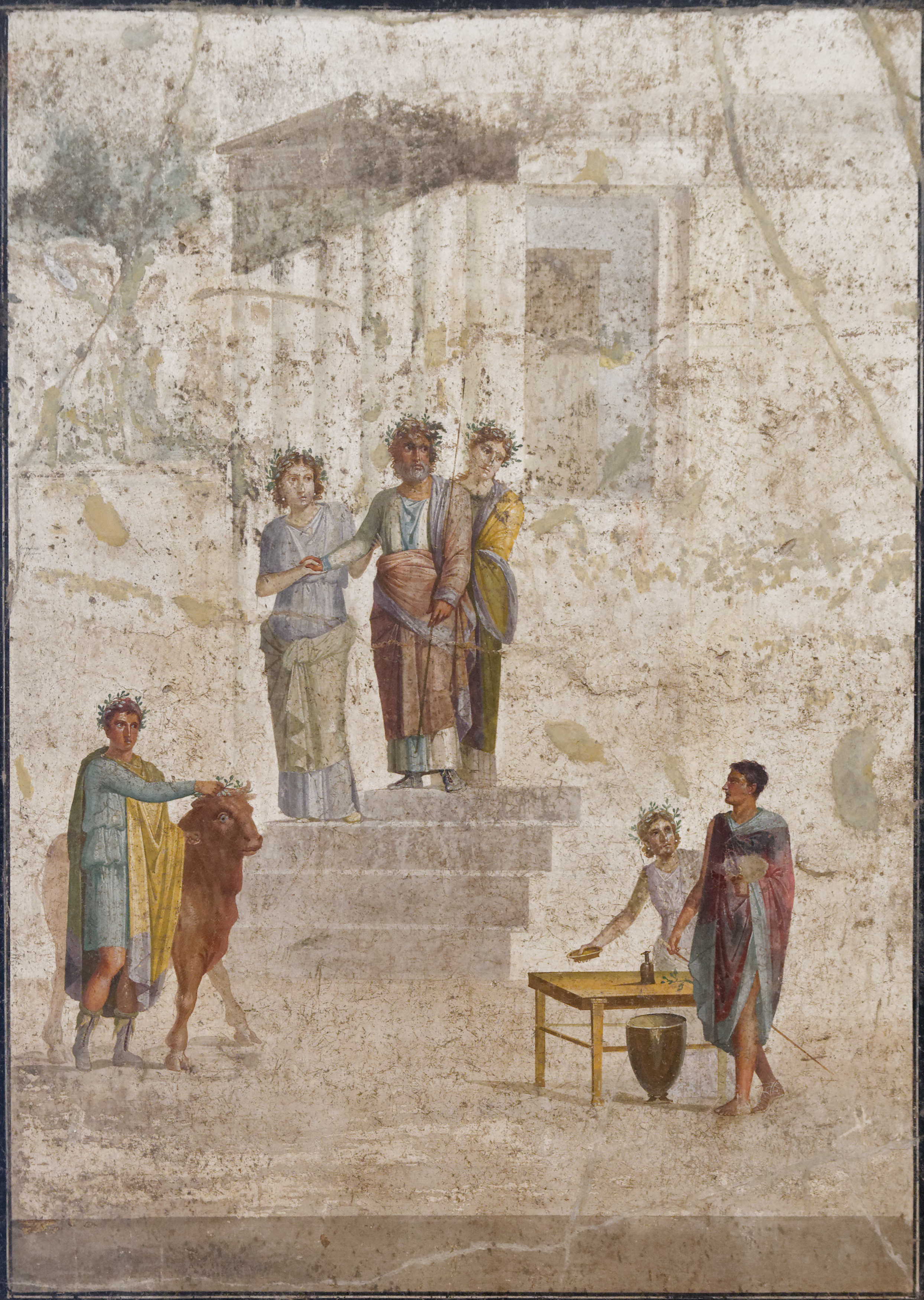
Homer, Il. 22.126-129 [Hektor talking to himself about facing Achilles]
“There’s no way from oak nor stone
To sweet-talk him, the way that a young woman and a young man
As a young man and a young woman sweet talk one another.”
”There’s no way from oak or stone to sweet-talk him” to recount a ridiculous ancient saying; it is either from the generation of humans who were in the mountains, or it is because early people said they were ash-born or from the stones of Deukalion. Or it is about providing oracles, since Dodona is an oak and Pytho was a stone. Or it means to speak uselessly, coming from the leaves around trees and the waves around stones. Or it is not possible for him to describe the beginning of the human race”
“There were twelve sons of blameless Neleus. According to the Separatists, Homer records that there were twelve children of Neleus in the Iliad but had three in the Odyssey where he provides the genealogy: “And I saw surpassingly beautiful Khloris” and soon after, “Nestor and Khromios, and proud Periklymenos”. It is likely that the children born before came to him from another woman and these three came from Khloris, for Priamos said, “I had fifty children. When the sons of the Achaeans came / 19 of them were from a single womb / the rest women bore to me in my home.”
“Just as poetry is separated by meters—such as half-lines, hexameters, and the rest—so too will sections called clauses [kôla] separate and define prose composition. They allow rests to the speaker and what is spoken and they give the composition boundaries in many places, since it would be long and endless and would just exhaust anyone reading it otherwise.
These clauses are really meant to bring an end to a thought. Sometimes they convey a complete thought on their own, as when Hekataios says at the beginning of his History, “Hekataios speaks thus”. In this a case a whole thought coincides with a single clause and both end together. At another time, a clause doesn’t effect a complete thought, but merely part of one.
For, just as the hand is a whole thing but has individual parts of the whole, such as the fingers and the wrist—each of which has its own particular shape and recognizable parts—so too will the parts of a larger thought which is complete and whole be subsumed within it even though they too are recognizable and defined.”
Once communal latrines were established in the Hellenistic period, the risk of exposure to social gaze while sitting with one’s anachronistic pants down was more acute, albeit the experience perhaps more sanitary.
However, at least in Ephesus in the fourth century AD you may have had the pleasure of the following humorous poem to read in a latrine next to the Baths of Constantine, wishing you a satisfying unburdenment in a Homeric-style which is comically at odds with the wholly-un-Homeric subject matter (Ephesos 2104 [= IEph 456.1]):
Kicking afoot and raising fists ahand
And coughing your heart out and shaking your whole body
Take full pleasure in shitting your brains out, and may your stomach
Never give you pain whenever you come to my house.
“Ligurra, you fear that I might compose
Verses against you, a brief, intense poem—
Oh how you long to seem worthy of this fear.
But you fear in vain, in vain you long.
The Libyan lions growl at bulls;
They do not pester butterflies.
I will advise you—if you are in pain to be read,
Find a drunk alley poet who writes
with broken coal or dusty chalk
the poems people read while shitting.
This face of yours can’t be known by my touch.”
Versus et breve vividumque carmen
in te ne faciam times, Ligurra,
et dignus cupis hoc metu videri.
sed frustra metuis cupisque frustra.
in tauros Libyci fremunt leones,
non sunt papilionibus molesti.
quaeras censeo, si legi laboras,
nigri fornicis ebrium poetam,
qui carbone rudi putrique creta
scribit carmina quae legunt cacantes.
frons haec stigmate non meo notanda est
Amy Coker has a PhD in Classics from the University of Manchester, UK. She taught and held research positions in University-land for the best part of a decade after her PhD, before jumping ship to school teaching (11-18 year olds) in 2018. She still manages to find time to think and write about Ancient Greek offensive words, pragmatics, and historical linguistics. She can be found on Twitter at @AECoker.
Servius Danielis, schol. ad Vergil’s Aeneid, 1.273
“There are various accounts provided by different authors on the origin and the founding of the city. Clinias reports that the daughter of Telemachus, named Rhomê, was Aeneas’ wife and that the city was named after her. [….] claims that Latinus, a child of Ulysses and Circe, called the state Rome in honor of his dead sister.”
sed de origine et conditore urbis diversa a diversis traduntur. Clinias refert Telemachi filiam Romen nomine Aeneae nuptam fuisse, ex cuius vocabulo Romam appellatam. ** dicit1 Latinum ex Ulixe et Circe editum de nomine sororis suae mortuae Romen civitatem appellasse.
Servius Danielis, schol ad. Vergil’s Aeneid, 6.14
“Menekrates claims that Daedalus went to Crete after he killed his paternal cousin and that his son Icarus, driven from Attica, died by shipwreck while looking for his father. This is why the sea got its name.”
Menecrates Daedalum occiso patruele fratre Cretam petisse dicit; Icarum filium eius ab Atticis pulsum, dum patrem petit, naufragio perisse, unde mari nomen.
Maurus Servius Honoratus is the original commentator and all-around learned man from Rome. “Danielis” is given to a set of additions that creep into his manuscript tradition around the 10th and 11th centuries.
Daedalus constructs wings for Icarus Andrea Sacchi
“I say that the over-powering son of Kronos assented
On that day when the Argives took to the fast-faring ships
Bringing murder and death to the Trojans,
Showing clear and favorable signs by flashing lightning.
So let no one be compelled to return home,
Before each one has taken a Trojan wife to bed
As payback for the struggles and moans of Helen”
[To pay back the struggles and moans of Helen]: “The separatists say that the poet of the Iliad presents Helen as enduring it badly and groaning because of the trauma of rape by Alexander while the poet of the Odyssey presents her as willing.
This is because they do not understand that the account is not from her perspective, but that we need to understand that it is from outside her perspective, that she is the object. So, there is the interpretation that it is is necessary to take vengeance in exchange for how we have groaned and suffered about Helen.”
The debate here, then, seems to be whether Helen is the actor behind the ὁρμήματά τε στοναχάς τε or the reason the ὁρμήματά τε στοναχάς τε are experienced by others. What I find more interesting in this passage is the assertion that ancient scholars split the authorship of the epics based on whether Helen seems a willing participant or not. Also not to be overlooked here: Nestor is rallying the troops by telling them they won’t go home until each of them “lies alongside” (κατακοιμηθῆναι) a wife of a Trojan.
(Most of our information about the separatists comes from scholia attributed to Aristarchus. There are eleven direct mentions of the scholiasts in Erbse’s edition.)
Fresco from Pompeii, Helen Boards the Ship to Troy
“The things that Homer says about Kirkê contain a wonderful theory about the soul. The interpretation runs as follows:
Some have the heads, voice, head and skin of swine, but the mind remains constant as it was before. This myth is similar to the riddle about the soul presented by Pythagoras and Plato, that it is indestructible in nature and unseen but that it is not safe from harm or unchangeable. In what is called its destruction or death, it undergoes a change and then a transference into different kinds of bodies pursuing an appearance and fit according to pleasure, by similarity and practice to how it lived life. In this, each person draws a great advantage from education and philosophy, since the soul has a memory of noble things, judges the shameful harshly, and is able to overcome the unnatural pleasures. This soul can pay attention to itself, and guard that it might not accidentally become a beast because it has grown attracted to an hideously shaped, unclean body regarding virtue, a body that excites and nourishes uncultured and unreasoning nature rather than increasing and nourishing thought.
“Once the soul is translated, that which is fated and nature, which Empedocles named the divine force that “wraps us in a foreign robe of flesh”, also re-fits the soul. Homer has named this circular journey and return of rebirth Kirkê, the child of the sun because the sun binds every destruction to birth and every birth in turn to destruction, always weaving them together. The Island Aiaia is also that place allotted to receive one who dies—where the souls first arrive as they wander, and suffer alienation as they mourn and they do not know which way is west nor “where the sun which brings mortals light comes upon the earth”.
As they long for their habits of pleasure—their shared life in the flesh and their way of life with the flesh—they provide the draught with its character again: it is the drink where birth is mixed and stirs together what is truly immortal and mortal, the thoughts and sufferings, the ethereal and the earthbound. The souls are enchanted and weakened by the pleasures that will lead them back to birth again. At this time, souls require great luck and great wisdom in order to avoid pursuing their worst aspects or passions and dedicate themselves to a cursed and beastly life”.
For it is right that it is called and considered a crossroad in the underworld around which the parts of the soul split: the rational, the emotional, and the desirous. Each of these produces a force or an inducement to the life appropriate to itself. This is no longer myth or poetry but truth and a story of nature. In this transformation and rebirth, when the aspect of desire overpowers and takes control, [Homer] is claiming that because of the dominance of pleasure and gluttony, they transform into the bodies of donkeys and pigs and receive unclean lives on the ground. The interpretation runs as follows.
Whenever a soul has an emotional component that has grown completely savage because of harsh rivalries or murderous savagery developing from some disagreement or vendetta, that soul finds a second birth which is full of bitterness and angry thoughts and falls into the shape of a wolf or a lion, embracing this body as if it were a tool of vengeance for his controlling passion. For this reason, one must keep clean when near death as if for a religious rite and restrain from every kind of base pleasure, put every harsh emotion to bed, and to withdraw from the body by suppressing envies, enmities, and rages down deep. This “Hermes of the golden-staff” happens to be that very reasoning which indicates clearly the good and either wholly restrains or saves it from the deadly draught should it drink—it preserves the soul in a human life and character for as long a time as is possible.”
“Nireus who was the most beautiful man who came to Troy
Of the rest of the Danaans, after Peleus’ blameless son.
But he was weak and a small army followed him.”
<Lemma> his beauty in reputation was not of a kind with his family; Achilles, however, was adorned in both ways. Because [the poet] was a philhellene, he was trying to make everyone worthy of memory and used to praise everyone as far as he might be believed and so that we might imagine the Greeks to be differentiated in their manliness, or their body, or their beauty.”
“Diplai have been applied to question these three lines because Zenodotus athetized two of them, although he did not mark the middle one, (674) because Homer always strove to have Achilles stand out far in front of the rest.”
“And because of that, Homer mentioned [Nireus] only once and in the Catalog Of Ships, as it seems to me, to make a demonstration of the uselessness of the most beautiful men, when they have none of the other things that are useful for life.”
“Aristarchus believed it best to make sense of those things that were presented more fantastically by Homer according to the poet’s authority, that we not be overwhelmed by anything outside of the things presented by Homer.”
Since often in our conversations with one another about Homeric questions, when I try to show you that Homer interprets himself for the most part, and we consider from every angle in most instances based on our training more than [simply] knowing what he says, you have considered it right that I write up the things we have said rather than allow them to fall aside and disappear because we’ve forgotten them.
“Because I think to best to make sense of Homer through Homer, I usually show by example how he may interpret himself, sometimes in juxtaposition, sometimes in other ways.
“The Lydians and Ionans [report] that letters came from Phoinix the son of Agênor who invented them. But the Cretans report differently that they were developed from writing on the leaves of palm trees [phoinikes].
Skamôn, in the second book of his Inventions, says that they were named for Aktaion’s daughter Phoinikê. The story goes that he had no male children, but that he had daughters Aglauros, Ersê, and Pandrosos. Phoinikê died still a virgin. For this reason, Aktaion named the letters “Phoenician” for her, because he wished to give some honor to his daughter.”
“Letters: Know that Phoenicians were the first to invent letters. For this reason, letters are also called Phoinikeia. People also say that Kadmos first brought them to Greece. And Apis, the Egyptian, brought medicine. Asklepios improved the art itself. Look also in the entry on Phoenician Letters.” [reference is the same as reported in Photios’ Lexicon.]