Zonaras 7.3 Part III – The Rape of the Sabine Women

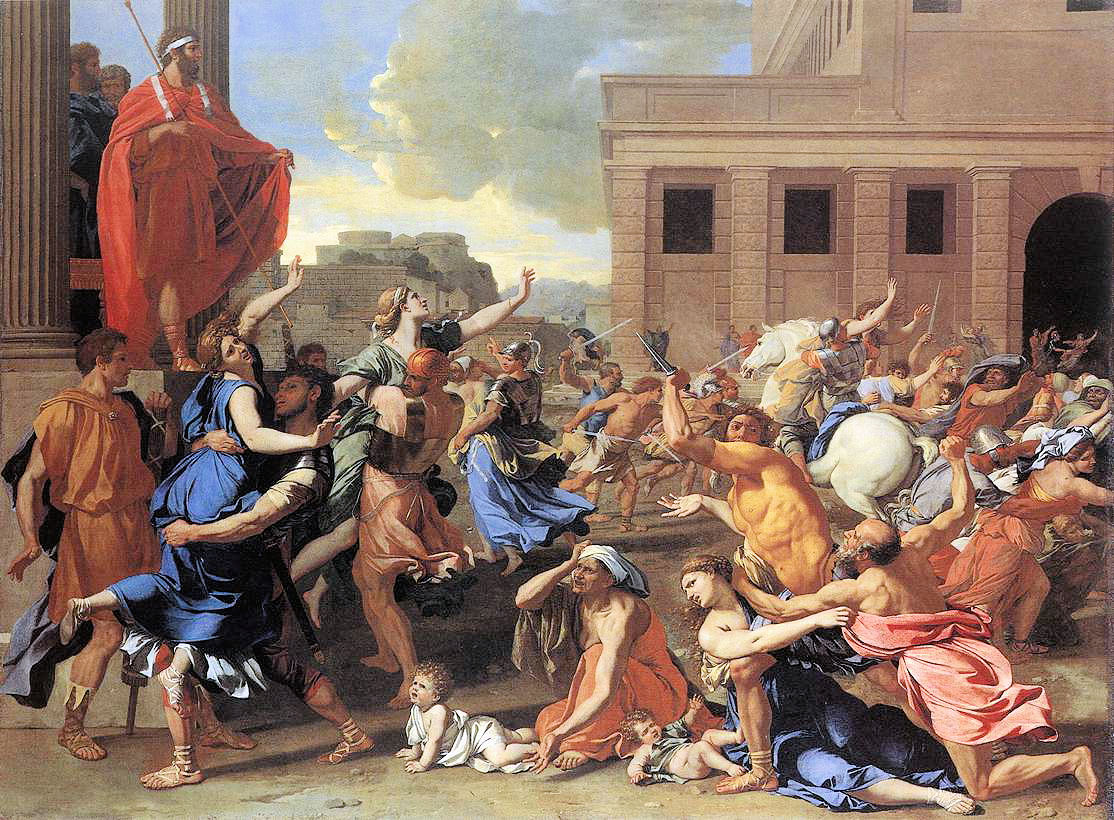
Zonaras relates the well-known story of Romulus’ plan to increase the Roman population:

There were now many men living in the city, of whom very few were wedded to wives. So, Romulus had the idea that they could unite women to themselves. For they were just a mob who had come from difficult and undistinguished circumstances, and they were despised in their marriage suits by all of the neighboring tribes. Romulus then planned for his citizens to take wives by means of forcible seizure, so he announced that there would be a sacrifice, some games, and a religious assembly on the pretext that a strange new altar of the gods had been discovered. Many people came together for this. Romulus himself, however, sat at the front among the nobles, outfitted in a purple robe. He gave as the sign that the undertaking should commence the sudden spreading and re-fastening of his robe. Once this sign was given, the men, grabbing their swords, set out and grabbed the maiden daughters of the Sabines – not, indeed, anyone’s wife.

Πολλῶν δὲ τῇ πόλει ἐνοικισθέντων, ὧν ὀλίγοι γυναιξὶ συνεζεύγνυντο, φροντὶς τῷ ῾Ρωμύλῳ ἐγένετο ἵνα κἀκεῖνοι γυναῖκας ἑαυτοῖς συνοικίσωσι. σύγκλυδες γὰρ καὶ ἐξ ἀπόρων ὄντες καὶ ἀφανῶν, ὑπερωρῶντο πρὸς κῆδος παρὰ τῶν γειτνιώντων ἐθνῶν. βουλεύεται τοίνυν ἐξ ἁρπαγῆς λαβεῖν γυναῖκας τοὺς πολίτας αὐτοῦ, καὶ κηρύσσει θυσίαν καὶ ἀγῶνα καὶ θέαν μέλλειν τελεῖν πανηγυρικήν, ὡς βωμοῦ εὑρημένου θεοῦ καινοῦ. καὶ πολλοὶ συνῆλθον. αὐτὸς δὲ προυκάθητο μετὰ τῶν ἀρίστων, ἁλουργίδι κεκοσμημένος· δέδωκε δὲ τῷ δήμῳ τῆς ἐπιχειρήσεως σύμβολον τὴν τῆς ἁλουργίδος διάπτυξιν καὶ αὖθις ταύτης περιβολήν. οὗ γενομένου σπασάμενοι τὰ ξίφη μετὰ βοῆς ὥρμησαν καὶ ἥρπαζον τὰς θυγατέρας τῶν Σαβίνων παρθένους, οὐ μέντοι γυναῖκάς τινων

Zonaras 7.3 Part II – Romulus, The ‘Crafty Tyrant’

Zonaras relates how Romulus constructs the city walls, and employs some tricks of civic nomenclature to manipulate the people:

After burying his brother, Romulus settled his city. He yoked a bull to a cow, and threw a bronze ploughshare onto the plough; he then dug a large circular furrow, and those who followed him took the clods of earth which the plough dug out and turned them all around the furrow. Once it was time for the wall to be constructed, as it was said, the furrow was dug up where they had contrived to erect the walls, and they made intervals in the furrow, by lifting the plough up above them. For, they consider every wall a sacred thing; but if they had considered the gates sacred, it would not have been possible to bring in and send out some of the necessary and even impure articles of life.

The founding of the city was completed on the eleventh day before the Kalends of May, or better perhaps, on the twentieth of April. The Romans celebrate that day with festivals, considering it the birthday of their fatherland. It was said that Romulus was eighteen years old when he founded the city, which he founded near the home of Faustulus; this region was named the Palatine.

Now that the city was founded, he rounded up as much of the mob was the right age for military service and drew them up into military contingents. Each of these contingents consisted of three thousand infantry and three hundred cavalry, and was called a legion, because the fighters were chosen from all, while all of the rest were proclaimed part of the citizen body, which they named the people (populus). For this reason in their law books the assembly of the people is called the “popular” (popularia) assembly. He then marked out as counselors a hundred of the men most prominent for their birth, prudence, and mode of life, and called them patricians. The rest of the organized government he called the senate, which is the counsel of old men (gerousia). The patricians were so called either because they were the fathers of legitimate offspring, or perhaps more likely because they were able to demonstrate that their fathers were descended from well-known families, or from their patronia. (Thus they called the relationship of patronage, for they called those who took care of and protected a person “patrons.”) One could readily guess at Romulus’ motive here: he thought that by this appellation, he thought that it would be clear that the chief and most powerful men of the state would need to employ a certain paternal care for the lowborn, and that simultaneously the common people would be led on by the name of “patricians” not to feel put-upon by the honors granted to those more powerful than them, but would rather submit to it peacefully by both calling and considering them as “fathers.”

῾Ο δὲ ῾Ρωμύλος θάψας τὸν ἀδελφὸν ᾤκιζε τὴν πόλιν καὶ βοῦν ἄρρενα συζεύξας θηλείᾳ, καὶ ἀρότρῳ ὕννιν χαλκῆν ἐμβαλών, αὐτὸς μὲν αὔλακα βαθεῖαν κυκλοτερῆ περιέγραψεν, οἱ δ’ ἑπόμενοι τὰς βώλους, ἃς ἀνίστη τὸ ἄροτρον, εἴσω πάσας τῆς αὔλακος περιέστρεφον. καὶ ὅπου μὲν ἔμελλε τὸ τεῖχος ἀνίστασθαι, καθὼς εἴρηται, ἡ αὖλαξ ἐτέτμητο, ἔνθα δὲ πύλας στῆσαι διενοοῦντο, διάλειμμα ἐποιοῦντο τῆς αὔλακος, τὸ ἄροτρον ἀνέχοντες ὕπερθεν. πᾶν μὲν γὰρ τεῖχος νομίζουσιν ἱερόν· τὰς δὲ πύλας εἴπερ ἥγηντοἱεράς, οὐκ ἦν τὰ μὲν δι’ αὐτῶν εἰσάγειν, τὰ δὲ ἀποπέμπειν τῶν ἀναγκαίων καὶ μὴ καθαρῶν.

῾Η δὲ κτίσις τῆς πόλεως ταύτης ἡμέρᾳ τετέλεστο τῇ πρὸ ἕνδεκα καλανδῶν Μαΐων, ἣ ἂν εἴη μᾶλλον εἰκοστὴ ᾿Απριλλίου· καὶ τὴν ἡμέραν ταύτην ἑορτάζουσι ῾Ρωμαῖοι, γενέθλιον τῆς πατρίδος ὀνομάζοντες. ὀκτωκαίδεκα δ’ εἶναι ῾Ρωμύλος ἐνιαυτῶν ἀναγέγραπται ὅτε τὴν ῾Ρώμην συνῴκισεν. ἔκτισε δὲ αὐτὴν περὶ τὴν τοῦ Φαυστούλου οἴκησιν· ὠνόμαστο δ’ ὁ χῶρος Παλάτιον.

Κτισθείσης μέντοι τῆς πόλεως, ὅσον μὲν ἐν ἡλικίᾳ στρατευσίμῳ πλῆθος ἐτύγχανεν, εἰς στρατιωτικὰ διεῖλε συντάγματα, ἕκαστον δὲ σύνταγμα πεζῶν τρισχιλίων ἦν καὶ τριακοσίων ἱππέων, ἐκλήθη δὲ λεγεών, ὅτι λογάδες ἦσαν ἐκ πάντων οἱ μάχιμοι, τοῖς δ’ ἄλλοις δήμῳ ἐκέχρητο. καὶ τὸν δῆμον ποπούλους ὠνόμασεν· ὅθεν καὶ παρὰ ταῖς βίβλοις ταῖς νομικαῖς ποπουλαρία κέκληται ἡ δημοτικὴ ἀγωγή. τῶν μέντοι περιφανεστέρων γένει τε καὶ συνέσει καὶ βίου αἱρέσει ἑκατὸν ἀπέδειξε βουλευτάς, πατρικίους ὀνομάσας αὐτούς· τὸ δὲ λοιπὸν σύστημα σενάτον προσηγόρευσεν, ὅ ἐστι γερουσία. πατρίκιοι μέντοι οἱ βουλευταὶ ἐπεκλήθησαν ἢ ὅτι παίδων ἦσαν γνησίων πατέρες, ἢ μᾶλλον ὅτι αὐτοὶ πατέρας ἑαυτῶν ἀποδεικνύειν ἠδύναντο ἕκαστος ἐκ γένους ὄντες γνωρίμου, ἢ ἀπὸ τῆς πατρωνίας· οὕτω δ’ ἐκάλουν τὴν προστασίαν· πάτρωνας γὰρ τοὺς κηδεμονικοὺς καὶ βοηθητικοὺς προσηγόρευον. μάλιστα δ’ ἄν τις καταστοχάσαιτο τῆς τοῦ ῾Ρωμύλου διανοίας, εἰ οἴοιτο διὰ τῆς κλήσεως ταύτης ἐμφαίνειν χρῆναι τοὺς πρώτους καὶ δυνατωτάτους τῆς πόλεως πατρικῇ κηδεμονίᾳ κήδεσθαι τῶν ταπεινοτέρων, ἅμα δὲ καὶ τὸν δῆμον ἐνάγειν διὰ τῆς τῶν πατρικίων προσηγορίας εἰς τὸ μὴ ἄχθεσθαι ταῖς τῶν κρειττόνων τιμαῖς, ἀλλ’ εὐνοϊκῶς διακεῖσθαι, νομίζοντας πατέρας αὐτοὺς καὶ προσαγορεύοντας.

Zonaras: Romulus and… Romus? (7.1 pt. III)

Zonaras relates the birth of Romulus and Remus, how they were cast out by Amulius, and how they were raised either by a wolf or a prostitute.

So much for Lavinium and the Albans. Roman affairs had as their beginning Numitor and Amulius, who were the sons of Aventinus, and the descendants of Aeneas. Once the throne in Alba Longa had fallen to them through succession, they wished to apportion it out between themselves, along with the royal possessions. When Amulius set both the property and the crown as private, and asked his brother which of the two he would like for himself, Numitor chose the crown because he was the older brother. Amulius took the property and surrounded himself with the power which naturally attends wealth, and with it seized the crown. Numitor had a daughter and Amulius, fearing that she might have children who would rebel against him, made her a priestess of Hestia which entailed that she would be an unmarried virgin through all of her life. She was seen later to be pregnant by Ares, as the myth goes, but most probably it was by some man. She was imprisoned on that account, so that she could not escape when she gave birth. She gave birth to two children who were great and noble. Amulius, now even more terrified, ordered that the children be cast out. So, he took them and placed them in a little skiff in the Tiber. The water’s flow led the skiff away to a pleasant spot, where they say that a she-wolf came upon the children and offered them her teat; they also say that there was a woodpecker there feeding them and guarding them. One of Amulius’ swineherds, named Faustulus, came upon the children there and took them. He then raised them with his wife, whose name was Larentia. One was named Romulus, and the other Romus. Some deny that a she-wolf nursed them, which would be more credible or even have more of an air of truth, but this story took hold from the beginning. The Romans call both she-wolves and prostitutes “lupas.” The fact that Larentia, who raised the boys, was a prostitute and on that account called a lupa (she-wolf), caused the region to buy into the myth.*

  • NOTE: This idea is at least as old as Livy: Sunt qui Larentiam volgato corpore lupam inter pastores vocatam putent. “There are those who would say that Larentia was called ‘the she-wolf’ among the pastors, on account of having put her body into common circulation.”

Καὶ ταῦτα μὲν περὶ Λαουινίου καὶ ᾿Αλβανῶν· τὰ δὲ τῶν ῾Ρωμαίων ἀρχὴν ἐσχήκασι τὸν Νομίτωρά τε καὶ τὸν ᾿Αμούλιον, οἳ ᾿Αουεντίνου μὲν ἐγένοντο υἱωνοί, τοῦ δ’ Αἰνείου ἀπόγονοι. τῆς γοῦν ἐν ῎Αλβῃ βασιλείας κατὰ διαδοχὴν περιελθούσης αὐτοῖς, νείμασθαι ταύτην ἠθέλησαν καὶ τὰ χρήματα. τοῦ ᾿Αμουλίου τοίνυν ἰδίᾳ μὲν τὰ χρήματα θέντος, ἰδίᾳ δέ γε τὴν βασιλείαν, καὶ ἐξ ἀμφοῖν τὸν ἀδελφὸν προτρεψαμένου ὃ πρὸς βουλῆς αὐτῷ ἐπιλέξασθαι, τὴν βασιλείαν εἵλετο ὁ Νομίτωρ, ἅτε καὶ πρεσβύτερος ἀδελφός· λαβὼν δὲ τὰ χρήματα ὁ ᾿Αμούλιος, καὶ δύναμιν ἐκ τούτων περιβαλλόμενος, καὶ τὴν βασιλείαν ἀφείλετο. θυγατρὸς δὲ τῷ Νομίτωρι οὔσης, δεδιὼς μὴ παῖδες ἐξ αὐτῆς γένοιντο καὶ κατεξανασταῖεν αὐτοῦ, ἱέρειαν τῆς ῾Εστίας ἐκείνην ἀπέδειξεν, ἄγαμον διὰ τοῦτο καὶ παρθένον διὰ βίου μέλλουσαν ἔσεσθαι. ἡ δὲ κύουσα ἐφωράθη μετέπειτα ὑπὸ ῎Αρεος, ὡς μυθεύεται, ὑπ’ ἀνθρώπων δὲ πάντως τινός. εἵρχθη οὖν διὰ τοῦτο, ἵνα μὴ λάθῃ τεκοῦσα. καὶ ἔτεκε διδύμους παῖδας μεγάλους τε καὶ καλούς. μᾶλλον οὖν φοβηθεὶς ὁ ᾿Αμούλιος ἐκέλευσε τὰ βρέφη ῥιφῆναι. καὶ ὁ ταῦτα λαβὼν σκάφῃ ἐνθέμενος ἐμβάλλει τῷ ποταμῷ τῷ Τιβέριδι. παρασῦραν δὲ τὴν σκάφην τὸ ῥεῦμα εἴς τινα χῶρον κατήνεγκε μαλθακόν· ἔνθα κειμένοις τοῖς βρέφεσι λύκαιναν ἱστοροῦσι προσιοῦσαν θηλὴν παρέχειν αὐτοῖς, καὶ ὄρνιν δρυοκολάπτην παρεῖναι ταῦτα ψωμίζοντα καὶ φυλάττοντα. ἐκεῖ δὲ κείμενα τὰ βρέφη λαθὼν ἀφείλετό τις ᾿Αμουλίου συοφορβὸς Φαυστοῦλος καλούμενος· καὶ παρὰ τῆς ἐκείνου ἐτράφησαν γυναικός, ᾗ ὄνομα Λαρεντία· καὶ ὁ μὲν ῾Ρωμύλος, ὁ δ’ ἕτερος ῾Ρῶμος ἐκλήθησαν. τινὲς δὲ μὴ λύκαιναν εἶναι τὴν τῶν παίδων φασὶ τροφόν, ὃ καὶ πιθανώτερον ἢ ἀληθέστερον μάλιστα, ἀρχὴν δὲ τὸν λόγον οὕτω λαβεῖν. λούπας καλοῦσι ῾Ρωμαῖοι τάς τε λυκαίνας καὶ τὰς ἑταίρας· πορνευομένη δ’ ἡ Λαρεντία, ἣ τοὺς παῖδας ἐθρέψατο, καὶ λοῦπα διὰ τοῦτο καλουμένη, χώραν τῷ μύθῳ παρέσχετο.

Zonaras: Lavinium and Alba Longa (7.1 Part II)

Zonaras discusses the history of Lavinium, the founding of Alba Longa, and the naming of the Tiber:

After some time had passed and the Latins had increased the population of Lavinium, most of them left the city and founded another one in a more agreeable region, which they called Alba Longa – Alba because of its whiteness, and Longa because of its magnitude. Upon the death of Ascanius, the Latins honored the son born to Aeneas from Lavinia (named Silvius) over and above the son of Ascanius, preferring Silvius because Latinus was his grandfather. An Aeneas was born to Silvius, from this Aeneas was born another Latinus, and Pastis succeeded this Latinus. A man named Tiberinus, setting out on the river named Albulus, fell in and died. This river was afterward called the Tiber after him; it flowed through Rome, provided a most excellent supply to the city, and was useful to the Romans in the highest degree. Amulius, the son of Tiberinus, who became exceedingly arrogant and attempted to deify himself, died while trying to return lightning against lightning by means of a contrivance, and even to make the light flash and hurl thunderbolts. The pond near which his palace was built suddenly began to flow and swept both Amulius and his palace into the sea. Then, Amulius’ son Aventinus was killed in battle.

7.1. (Pt. 2) Χρόνου δὲ διεληλυθότος πληθυνθέντες οἱ Λατῖνοι τὴν μὲν πόλιν τὸ Λαουίνιον οἱ πλείονες ἐκλελοίπασιν, ἑτέραν δ’ ἐν ἀμείνονι χώρᾳ ἀντῳκοδόμησαν, ἣν ῎Αλβαν ἐκ τῆς λευκότητος καὶ ἀπὸ τοῦ μήκους Λόγγαν ἐπωνόμασαν· εἴποιεν ἂν ῞Ελληνες λευκὴν καὶ μακράν. ᾿Ασκανίου δὲ τελευτήσαντος οἱ Λατῖνοι τὸν ἐκ τῆς Λαουινίας τεχθέντα τῷ Αἰνείᾳ υἱὸν εἰς τὴν βασιλείαν προετιμήσαντο τοῦ ᾿Ασκανίου παιδός, διὰ τὸν πάππον τὸν Λατῖνον τοῦτον προκρίναντες, Σιλούιον κεκλημένον. ἐκ Σιλουίου δὲ Αἰνείας ἐτέχθη, ἐξ Αἰνείου δὲ Λατῖνος ἐγένετο, Λατῖνον δὲ διεδέξατο Πάστις. Τιβερῖνος δ’ ἄρξας μετέπειτα ἐν ποταμῷ καλουμένῳ ᾿Αλβούλῳ πεσὼν διεφθάρη· ὃς δὴ ποταμὸς Τίβερις ἐξ ἐκείνου μετωνομάσθη, ῥέων διὰ τῆς ῾Ρώμης καὶ ὢν τῇ πόλει πολυαρκέστατος καὶ ῾Ρωμαίοις ἐς τὰ μάλιστα χρησιμώτατος. ἔκγονος δὲ τοῦ Τιβερίνου ᾿Αμούλιος, ὃς ὑπερφρονήσας καὶ θεοῦν ἑαυτὸν τολμήσας, ὡς βροντάς τε ταῖς βρονταῖς ἐκ μηχανῆς ἀντεπάγειν καὶ ἀνταστράπτειν ταῖς ἀστραπαῖς ἐνσκήπτειν τε κεραυνούς, διεφθάρη, τῆς λίμνης παρ’ ᾗ τὰ αὐτοῦ βασίλεια ἵδρυτο ἐπιρρυείσης αἰφνίδιον καὶ καταποντισάσης κἀκεῖνον καὶ τὰ βασίλεια. ᾿Αουεντῖνος δὲ ὁ υἱὸς αὐτοῦ ἐν πολέμῳ ἀπέθανε.

Roma Could have Been Remora

This passage from Ennius is preserved in Cicero’s De Divinatione 1.48

“They were struggling over whether the city would be called Roma or Remora.
And worry about which one of them would rule infected all men.
They were awaiting the word as when the consul wishes to give the signal
And all men eagerly look to the wall’s border to see
How soon he will send out the chariots from the painted mouths—
This is the way the people were watching and holding their tongues
For which man the victory would elevate to a great kingdom.
Meanwhile, the white sun receded into the darkness of night.
When suddenly a white light struck the sky with its rays.
At the same time there came flying straight down the most beautiful
Bird from the left and then the golden sun rose.
Three times, four sacred forms of birds descended from the sky
And settled themselves in propitious and noble positions.
In this, Romulus recognized that the first place was granted to him,
A kingdom and place made certain by the signs of birds.”

Certabant urbem Romam Remoramne vocarent.
Omnibus cura viris uter esset induperator.
Expectant vel uti, consul cum mittere signum
Volt, omnes avidi spectant ad carceris oras,
Quam mox emittat pictis e faucibus currus: 90
Sic expectabat populus atque ora tenebat
Rebus, utri magni victoria sit data regni.
Interea sol albus recessit in infera noctis.
Exin candida se radiis dedit icta foras lux.
Et simul ex alto longe pulcherruma praepes 95
Laeva volavit avis: simul aureus exoritur sol.
Cedunt de caelo ter quattor corpora sancta
Avium, praepetibus sese pulchrisque locis dant.
Conspicit inde sibi data Romulus esse priora,
Auspicio regni stabilita scamna locumque.

Romulus and Remus
Ah, the city of brotherly….

The Life of the Sophist Aelian: Writer, Coward, Homebody

We’ve quoted a lot on this site from the Varia Historia of Claudius Aelianus. Here’s the mixed praise delivered in his honor.

Philostratus, Lives of the Sophists 31

“Aelian was a Roman, but he used Attic just as well as the Athenians in the middle of the region. This man seems to me to be worthy of praise, first because he toiled to achieve a pure version of Greek even though he lived in a city that spoke a different language, and second because, although he was called sophist by those who flatter in this way, he did not believe them and he neither kept the same opinion of himself nor was inflated by the title—even though it is impressive—but once he examined himself well as unsuited for public speeches, he set himself to writing and earned wide respect from this. Simplicity is the overwhelming nature of the style, at times nearing the attractions of Nikostratos, at others he favors Dio and his tone.

Once Philostratos of Lemnos* met him when he had a book in hand and was reading it aloud with anger and a striking voice—he asked Aelian what he was pursuing and he answered “I have written a condemnation of Gynnis*, for that’s what I call the tyrant who has just been killed, since he shamed the Roman Empire with every type of disgusting behavior.” And Philostratus answered, “I would be more impressed if you had condemned him when he was alive!” For it takes a brave man to stand up to a living tyrant, while anyone can attack him when he’s dead.

Aelian used to say  that he had never traveled abroad anywhere outside of the Italian peninsula, and that he had never stepped on a ship or got to know the sea—for this reason he was praised in Rome on the grounds that he valued their lifestyle. He was a student of Pausanias but he respected Herodes the most varied of sophists. He lived until he was sixty years old and without children, for he avoided child-rearing by never marrying. Whether this is a blessing or a curse it is not the right time to consider.”

*Likely a relative of the Philostratus writing this Vita.

*”Womanly-Man”, for the Emperor Heliogabulus who was assassinated in 222 (and ascended to power at age 14!).

Elagabalus
Yo, Aelian…

λα′. Αἰλιανὸς δὲ ῾Ρωμαῖος μὲν ἦν, ἠττίκιζε δέ, ὥσπερ οἱ ἐν τῇ μεσογείᾳ ᾿Αθηναῖοι. ἐπαίνου μοι δοκεῖ ἄξιος ὁ ἀνὴρ οὗτος, πρῶτον μέν, ἐπειδὴ καθαρὰν φωνὴν ἐξεπόνησε πόλιν οἰκῶν ἑτέρᾳ φωνῇ χρωμένην, ἔπειθ’, ὅτι προσρηθεὶς σοφιστὴς ὑπὸ τῶν χαριζομένων τὰ τοιαῦτα οὐκ ἐπίστευσεν, οὐδὲ ἐκολάκευσε τὴν ἑαυτοῦ γνώμην, οὐδὲ ἐπήρθη ὑπὸ τοῦ ὀνόματος οὕτω μεγάλου ὄντος, ἀλλ’ ἑαυτὸν εὖ διασκεψάμενος ὡς μελέτῃ οὐκ ἐπιτήδειον τῷ ξυγγράφειν ἐπέθετο καὶ ἐθαυμάσθη ἐκ τούτου. ἡ μὲν ἐπίπαν ἰδέα τοῦ ἀνδρὸς ἀφέλεια προσβάλλουσά τι τῆς Νικοστράτου ὥρας, ἡ δὲ ἐνίοτε, πρὸς Δίωνα ὁρᾷ καὶ τὸν ἐκείνου τόνον.

᾿Εντυχὼν δέ ποτε αὐτῷ Φιλόστρατος ὁ Λήμνιος  βιβλίον ἔτι πρόχειρον ἔχοντι καὶ ἀναγιγνώσκοντιαὐτὸ σὺν ὀργῇ καὶ ἐπιτάσει τοῦ φθέγματος ἤρετο αὐτόν, ὅ τι σπουδάζοι, καὶ ὃς „ἐκπεπόνηταί μοι” ἔφη „κατηγορία τοῦ Γύννιδος, καλῶ γὰρ οὕτω τὸν ἄρτι καθῃρημένον τύραννον, ἐπειδὴ ἀσελγείᾳ πάσῃ τὰ ῾Ρωμαίων ᾔσχυνε.” καὶ ὁ Φιλόστρατος „ἐγώ σε” εἶπεν „ἐθαύμαζον ἄν, εἰ ζῶντος κατηγόρησας”. εἶναι γὰρ δὴ τὸ μὲν ζῶντα τύραννον ἐπικόπτειν ἀνδρός, τὸ δὲ ἐπεμβαίνειν κειμένῳ παντός.

῎Εφασκε δὲ ὁ ἀνὴρ οὗτος μηδ’ ἀποδεδημηκέναι ποι τῆς γῆς ὑπὲρ τὴν ᾿Ιταλῶν χώραν, μηδὲ ἐμβῆναι ναῦν, μηδὲ γνῶναι θάλατταν, ὅθεν καὶ λόγου πλείνος κατὰ τὴν ῾Ρώμην ἠξιοῦτο ὡς τιμῶν τὰ ἤθη. Παυσανίου μὲν οὖν ἀκροατὴς ἐγένετο, ἐθαύμαζε δὲ τὸν ῾Ηρώδην ὡς ποικιλώτατον ῥητόρων. ἐβίω δὲ ὑπὲρ τὰ ἑξήκοντα ἔτη καὶ ἐτελεύτα οὐκ ἐπὶ παισίν,  παιδοποιίαν γὰρ παρῃτήσατο τῷ μὴ γῆμαί ποτε. τοῦτο δὲ εἴτε εὔδαιμον εἴτε ἄθλιον οὐ τοῦ παρόντος καιροῦ φιλοσοφῆσαι.

Rome Was Rebuilt By Expanding Citizenship


Velleius Paterculus, History of Rome 2.16.4


“Gradually, then, by granting citizenship to those who had not carried arms or had put them down rather late, the population was rebuilt as Pompeius, Sulla and Marius restored the flagging and sputtering power of the Roman people.”

Paulatim deinde recipiendo in civitatem, qui arma aut non ceperant aut deposuerant maturius, vires refectae sunt, Pompeio Sullaque et Mano fluentem procumbentemque rem populi Romani restituentibus.

Any student of Roman history understands that Rome’s expansion and strength relied in part on its ability to absorb and assimilate hostile populations. Today we often forget that the Italian peninsula was far from a uniform culture. (And a tour through modern Italy will confirm the persistence of many differences).  The process, of course, was not without pain and hard compromises, as Vergil echoes in Aeneid 6 during Anchises’ prophecy to Aeneas (851-3):

tu regere imperio populos, Romane, memento
(hae tibi erunt artes), pacique imponere morem,
parcere subiectis et debellare superbos.


“Roman, remember that your arts are to rule
The nations with your empire, to enforce the custom of peace,
To spare the conquered and to subjugate the proud.”

I Saved the Republic! Augustus, Res Gestae, 1-2

Augustus composed (or had composed?) his public accomplishments before his death and they were published on his mausoleum and temples soon thereafter. We have Latin and Greek versions from  the Temple to Rome and Augustus in Ancyra (Modern Turkey).

(The Full text in Greek, English and Latin from the 1924 Loeb is made available by Lacus Curtius. A simpler Latin text is on The Latin Library.)

“1 When I was nineteen I raised an army on my own counsel and at my own expense, with which I restored the republic, then best by the oppression of a faction, to freedom. In recognition of this, the senate enrolled me in its order with honorific decrees during the consulship of Gaius Pansa and Aulus Hirtius, granting me as well the consular place in the declaration of opinion and they also gave me military command [imperium]. The senate ordered me, along with the consuls, to ensure that the Republic suffer no injury. When, in the same year, both consuls died in war, the People elected me consul and a triumvir, because I preserved the state.

2 I drove the men who murdered my father [Julius Caesar] into exile as a punishment for their crime according to legitimate legal judgments. And later when they waged war on the Republic, I defeated them twice.”

[1] Annos undeviginti natus exercitum privato consilio et privata impensa comparavi, per quem rem publicam a dominatione factionis oppressam in libertatem vindicavi. [Ob quae] senatus decretis honorificis in ordinem suum me adlegit, C. Pansa et A. Hirtio consulibus, consularem locum sententiae dicendae tribuens, et imperium mihi dedit. Res publica ne quid detrimenti caperet, me propraetore simul cum consulibus providere iussit. Populus autem eodem anno me consulem, cum cos. uterque bello cecidisset, et triumvirum rei publicae constituendae creavit.

Qui parentem meum trucidaverunt, eos in exilium expuli iudiciis legitimis ultus eorum facinus, et postea bellum inferentis rei publicae vici bis acie

1 Ἐτῶν δεκαεννέα ὢν τὸ στράτευμα ἐμῆι γνώμηι καὶ ἐμοῖς ἀναλώμασιν ἡτοίμασα, δι᾽ οὗ τὰ κοινὰ πράγματα ἐκ τῆς τῶν συνομοσαμένων δουλήας ἠλευθέρωσα. Ἐφ᾽ οἷς ἡ σύνκλητος ἐπαινέσασά  με ψηφίσμασι προκατέλεξε τῆι βουλῆι Γαϊωι Πάνσᾳ  Αὔλωι Ἱρτίωι ὑπάτοις, ἐν τῆι τάξει τῶν ὑπατικῶν 7 ἅμα τὸ συμβουλεύειν δοῦσα, ῥάβδους τ᾽ ἐμοὶ ἔδωκεν. Περὶ τὰ δημόσια πράγματα μή τι βλαβῆι, ἐμοὶ μετὰ τῶν ὑπάτων προνοεῖν ἐπέτρεψεν ἀντὶ στρατηγοῦ ὄντι. § Ὀδὲ δῆμος τῶι αὐτῶι ἐνιαυτῶι, ἀμφοτέρων τῶν ὑπάτων πολέωι πεπτωκότων, ἐμὲ ὕπατον ἀπέδειξεν καὶ τὴν τῶν τριῶν ἀνδρῶν ἔχοντα ἀρχὴν ἐπὶ τῆι καταστάσει τῶν δημοσίων πρα γμάτων εἵλατο.

2 Τοὺς τὸν πατέρα τὸν ἐμὸν φονεύσαντας ἐξώρισα κρίσεσιν ἐνδίκοις τειμωρησάμενος αὐτῶν τὸ 17 ἀσέβημα καὶ μετὰ ταῦτα αὐτοὺς πόλεμον ἐπιφέροντας τῆι πατρίδι δὶς ἐνείκησα παρατάξει.

Arriving in Italy, But Not at the Journey’s End: Aeneid 6.1-12

I am currently in Siena, Italy (leading a summer study-abroad program for the month). My travels took about 20 hours followed by a mad search through Florence for a lost student who had neither phone nor money. (And today I travel south to retrieve more students from Rome!). I arrived in Siena tired and worn. But once I opened the Aeneid to consider Aeneas’ arrival on the Italian peninsula, I realized my complaints were quite unbecoming:

“He spoke this crying and then gave rein to the fleet
And they finally reached the Eubaean shores of Cumae.
They turn the prows toward the sea and then fasten the ships
safe by anchor where the curved boats make a shelter
on the shore. An eager band of youths leap down
on the Italian strand; one part seeks the seeds of flame
contained in a flint’s vein; another seizes trees
used as beasts’ thick roofs; and another traces along the river’s path.
But dutiful Aeneas climbs the hills where Apollo rules
On high and seeks the hollow cave of the horrid Sibyl,
the prophet whose mind and great soul the Delian inspires
as he lays open for her the secrets yet to come.”

Sic fatur lacrimans, classique immittit habenas,
et tandem Euboïcis Cumarum adlabitur oris.
Obvertunt pelago proras; tum dente tenaci
ancora fundabat naves, et litora curvae
praetexunt puppes. Iuvenum manus emicat ardens
litus in Hesperium; quaerit pars semina flammae
abstrusa in venis silicis, pars densa ferarum
tecta rapit silvas, inventaque flumina monstrat.
At pius Aeneas arces, quibus altus Apollo
praesidet, horrendaeque procul secreta Sibyllae
antrum immane petit, magnum cui mentem animumque
Delius inspirat vates, aperitque futura.

What Should One Learn from Early Histories? (Livy, Ab Urbe Condita, Praefatio 9)

In previous weeks we have posted the beginning to Livy’s impressive Ab Urbe Condita

“But these tales and those like them—whether to ponder them or how to weigh them—I don’t emphasize greatly. Let anyone who reads these instead pay attention to what life was like, what the customs were, through which men and by which skills the empire was born and increased. And, when discipline bit by bit deteriorated, how at first customs degraded with desire, then they collapsed more and more, then they began to fall headlong until we came to our own time when we can endure neither our sins nor their remedies.”

ad haec tempora quibus nec vitia nostra nec remedia pati possumus. Sed haec et his similia utcumque animaduersa aut existimata erunt haud in magno equidem ponam discrimine: ad illa mihi pro se quisque acriter intendat animum, quae vita, qui mores fuerint, per quos viros quibusque artibus domi militiaeque et partum et auctum imperium sit; labente deinde paulatim disciplina velut desidentes primo mores sequatur animo, deinde ut magis magisque lapsi sint, tum ire coeperint praecipites, donec ad haec tempora quibus nec vitia nostra nec remedia pati possumus perventum est.