Talking Dreams in Silent Speech

Lucretius, De Rerum Natura 4.453-461

“And when sleep has bound our limbs with sweet
slumber and the whole body lies in deep repose,
we still seem to ourselves to be awake and to move
our limbs—in the obscure darkness of night.
We think that we see the sun and the light of day;
we seem to trade a closed room or the sky, sea,
rivers and mountains—-we cross fields on our feet.
We hear sounds when the heavy quiet of night
hangs over everything; we utter words while staying silent.”

Denique cum suavi devinxit membra sopore
somnus et in summa corpus iacet omne quiete,
tum vigilare tamen nobis et membra movere
nostra videmur, et in noctis caligine caeca
cernere censemus solem lumenque diurnum,
conclusoque loco caelum mare flumina montis
mutare et campos pedibus transire videmur,
et sonitus audire, severa silentia noctis
undique cum constent, et reddere dicta tacentes.


Image result for Ancient Roman Dreams

Escaping the Self is Impossible

Lucretius, De Rerum Natura 3.1053-1075

“When people seem to feel that there is a weight
On their minds, which wears them out with its pressure–
If they were able to understand where it comes from and what causes
So great a burden of misery to press upon their chests,
They would hardly live their lives as we now see most do:
Each person does not know what he wants and always seeks
To change his place as if he could possibly slough of the burden.

Often this man departs from the doors of his great home,
When he has tired of being there, only to return suddenly
When he comes to believe that he is no better off outside.
He rushes out driving his ponies heedlessly to his villa
As if he were bringing crucial help to a burning home.
Yet when he arrives and crosses the threshold of the house,
He either falls into a deep sleep or pursues oblivion,
Or he even rushes to visit the city again,
This is the way each man flees from himself, but it is his self
That it is impossible to escape, so he clings to it thanklessly and hates.

He does this because he is a sick man who is ignorant of the cause.
If he knew the cause, he would abandon all these things
And begin his first study of the nature of things,
Since the problem is not that of a single hour but of eternal time—
In what state we must understand that all time will pass
For mortal man after the death that awaits all of us.”

Image result for ancient roman art death

Si possent homines, proinde ac sentire videntur
pondus inesse animo, quod se gravitate fatiget,
e quibus id fiat causis quoque noscere et unde
tanta mali tam quam moles in pectore constet,
haut ita vitam agerent, ut nunc plerumque videmus
quid sibi quisque velit nescire et quaerere semper,
commutare locum, quasi onus deponere possit.
exit saepe foras magnis ex aedibus ille,
esse domi quem pertaesumst, subitoque [revertit>,
quippe foris nihilo melius qui sentiat esse.
currit agens mannos ad villam praecipitanter
auxilium tectis quasi ferre ardentibus instans;
oscitat extemplo, tetigit cum limina villae,
aut abit in somnum gravis atque oblivia quaerit,
aut etiam properans urbem petit atque revisit.
hoc se quisque modo fugit, at quem scilicet, ut fit,
effugere haut potis est: ingratius haeret et odit
propterea, morbi quia causam non tenet aeger;
quam bene si videat, iam rebus quisque relictis
naturam primum studeat cognoscere rerum,
temporis aeterni quoniam, non unius horae,
ambigitur status, in quo sit mortalibus omnis
aetas, post mortem quae restat cumque manendo.

Nothing is So Simple. Nothing is So Great

Lucretius, De Rerum Natura 2.1023-1039

“Listen, put your mind now on true reason.
For a new matter rises fiercely to meet your ears
and a new image of the universe strives to show itself.

Nothing is so simple that at first sight
it is not rather difficult to believe;
and in the same way nothing is so great or miraculous
that over time we don’t slowly fail to behold it with wonder.

Consider first the clear and pure color of the sky
and everything it holds, the wandering stars
the moon and the gleam of the sun with its bright light;
If suddenly mortals now saw all these things
for the first time with no prior experience of them,
could anything possibly be said to be more wondrous
or would the races of men have dared to believe they existed?
Nothing. I believe that is how striking the sight would be.
But now, since we are so used to seeing them,
no one thinks it worthwhile to gaze at heaven’s bright splendor.”

Nunc animum nobis adhibe veram ad rationem.
nam tibi vehementer nova res molitur ad auris
accedere et nova se species ostendere rerum.
sed neque tam facilis res ulla est, quin ea primum
difficilis magis ad credendum constet, itemque
nil adeo magnum neque tam mirabile quicquam,
quod non paulatim minuant mirarier omnes,
principio caeli clarum purumque colorem
quaeque in se cohibet, palantia sidera passim,
lunamque et solis praeclara luce nitorem;
omnia quae nunc si primum mortalibus essent
ex improviso si sint obiecta repente,
quid magis his rebus poterat mirabile dici,
aut minus ante quod auderent fore credere gentes?
nil, ut opinor; ita haec species miranda fuisset.
quam tibi iam nemo fessus satiate videndi,
suspicere in caeli dignatur lucida templa.


Image result for Ancient Roman Night sky
Image taken from Pinterest,

The Death of Phaethon: An Aetiology for an Eclipse

Ovid, Metamorphoses 2.381-93

“All along, Phaethon’s father, filthy and bereft
Of his own light, the way he is when the sun is eclipsed,
He hates the light and himself and the day
And he dedicates his soul to sorrow and adds rage
To his mourning as he refuses his duty to the world.

‘I’m done. From the beginning my lot has been restless.
My job without end, without honor for my work, has embittered me.
Let some other, anyone, drive the chariot carrying the light.
If there is no one and all the gods claim they cannot do it,
Let the father himself drive it so that, at some point, as he controls the reins,
And he puts down the bolts that make fathers barren,
Then he will understand, once he knows the strength of the fire-footed stallions,
That he did not earn death just because he did not rule them well.’ ”

Squalidus interea genitor Phaethontis et expers
ipse sui decoris, qualis, cum deficit orbem,
esse solet, lucemque odit seque ipse diemque
datque animum in luctus et luctibus adicit iram
officiumque negat mundo. “satis” inquit “ab aevi
sors mea principiis fuit inrequieta, pigetque
actorum sine fine mihi, sine honore laborum!
quilibet alter agat portantes lumina currus!
si nemo est omnesque dei non posse fatentur,
ipse agat ut saltem, dum nostras temptat habenas,
orbatura patres aliquando fulmina ponat!
tum sciet ignipedum vires expertus equorum
non meruisse necem, qui non bene rexerit illos.”


Image result for Death of Phaethon

Odysseus, Necromancer

A student paper on the Elpenor Pelike at the MFA in Boston drew my attention to the following passage.

Servius ad Aen. 6.107

“For this reason the place is named without joy since, as people claim, it would not have been there but for necromancy or spellcraft. For, Aeneas completed these sacred rites when Misenus was killed and Ulysses did it with the death of Elpenor. This very scene Homer himself presented falsely from the detail of its location which he specifies along with the length of time of the journey. For he claims that Ulysses sailed for one night and came to the place where he completed these sacrifices. For this reason it is abundantly clear that he doesn’t mean the ocean but Campania.”

sine gaudio autem ideo ille dicitur locus, quod necromantia vel sciomantia, ut dicunt, non nisi ibi poterat fieri: quae sine hominis occisione non fiebant; nam et Aeneas illic occiso Miseno sacra ista conplevit et Vlixes occiso Elpenore. quamquam fingatur in extrema Oceani parte Vlixes fuisse: quod et ipse Homerus falsum esse ostendit ex qualitate locorum, quae commemorat, et ex tempore navigationis; dicit enim eum a Circe unam noctem navigasse et ad locum venisse, in quo haec sacra perfecit: quod de Oceano non procedit, de Campania manifestissimum est.

The relevant passages from the Odyssey don’t give any hint that Elpenor was intentionally killed for black magic. When Odysseus actually does summon the dead, now that gets a little dark.

Odyssey, 10.552–560

“I could not even lead my companions unharmed from there.
The youngest of my companions was a certain Elpênor,
He was neither especially brave in battle or composed in his thoughts.
He separated himself from the companions in Kirkê’s holy home
Because he needed some air; then he fell asleep because he was drunk.
When he heard the noise and trouble of our companions moving out,
He got up immediately and it completely escaped his thoughts
To climb down again by the long ladder—
So he fell straight from the roof and his neck
Shattered along his spine; then his spirit flew down to Hades.”

οὐδὲ μὲν οὐδ’ ἔνθεν περ ἀπήμονας ἦγον ἑταίρους.
᾿Ελπήνωρ δέ τις ἔσκε νεώτατος, οὔτε τι λίην
ἄλκιμος ἐν πολέμῳ οὔτε φρεσὶν ᾗσιν ἀρηρώς,
ὅς μοι ἄνευθ’ ἑτάρων ἱεροῖσ’ ἐν δώμασι Κίρκης,
ψύχεος ἱμείρων, κατελέξατο οἰνοβαρείων·
κινυμένων δ’ ἑτάρων ὅμαδον καὶ δοῦπον ἀκούσας
ἐξαπίνης ἀνόρουσε καὶ ἐκλάθετο φρεσὶν ᾗσιν
ἄψορρον καταβῆναι ἰὼν ἐς κλίμακα μακρήν,
ἀλλὰ καταντικρὺ τέγεος πέσεν· ἐκ δέ οἱ αὐχὴν
ἀστραγάλων ἐάγη, ψυχὴ δ’ ῎Αϊδόσδε κατῆλθεν.

Elpênor appears twice more in the epic: 11.51–80 (Odysseus meets Elpênor’s ghost when he summons the dead); 12.9-15 (Odysseus buries Elpênor).
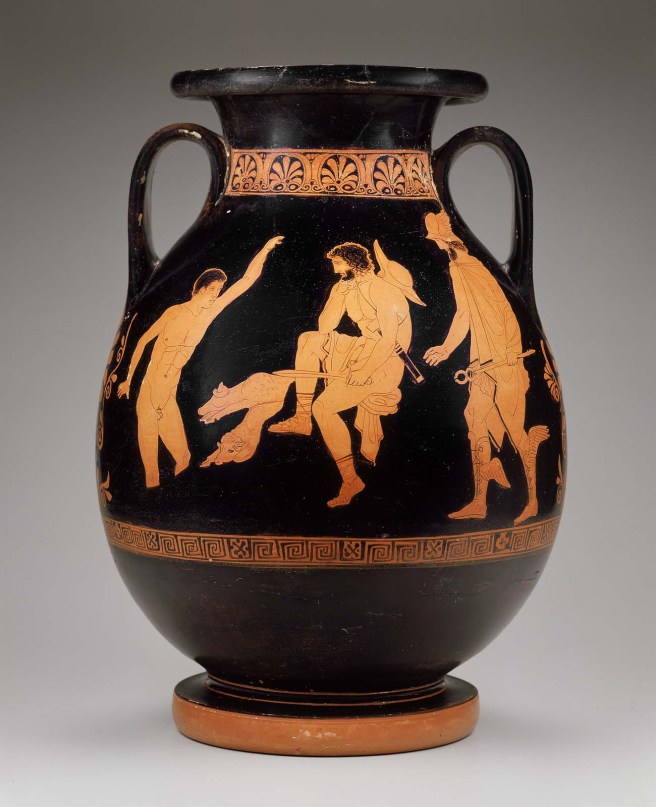
MFA Boston, Accession Number 34.79; Caskey-Beazley, Attic Vase Paintings (MFA), no. 111; Highlights: Classical Art (MFA), p. 070-071.

Nekuomanteia, glossed by Hesychius as nekromanteia (i.e. “necromancy”) is an alternate name for the Nekyuia, the parade of the dead in book 11 of the Odyssey. From the Greek Anthology: ᾿Εν τῷ Η ἡ τοῦ ᾿Οδυσσέως νεκυομαντεία· (3.8); Scholia to the Odyssey, Hypotheses: Λ. Νεκυομαντεία, ἢ, Νεκυία. Cf. Eustathius, Comm. Ad Od. 1.396.10

Two Romans Speak of Mothers

Sidonius, Letters 4.21

“The first place in explaining someone’s heritage is usually given to the father’s line, but we still owe much to our mothers. So it is not right that we give some smaller honor to the fact that we were our mothers’ burdens than that we were our father’s seeds.”

Est quidem princeps in genere monstrando partis paternae praerogativa, sed tamen multum est,quod debemus et matribus. non enim a nobis aliquid exilius fas honorari quod pondera illarum quam quod istorum semina sumus.

Image result for Ancient Roman Mothers

Vergil, Aeneid 2.796-798

“And here, I was shocked to find an overwhelming
Flood of new companions, mothers and men,
A band assembled for exile, a pitiable crowd.”

“Atque hic ingentem comitum adfluxisse novorum
invenio admirans numerum, matresque virosque,
collectam exsilio pubem, miserabile vulgus.

Escape Yourself! Study the Nature of Things

Lucretius, De Rerum Natura 3.1053-1075

“When people seem to feel that there is a weight
On their minds, which wears them out with its pressure–
If they were able to understand where it comes from and what causes
So great a burden of misery to press upon their chests,
They would hardly live their lives as we now see most do:
Each person does not know what he wants and always seeks
To change his place as if he could possibly slough of the burden.

Often this man departs from the doors of his great home,
When he has tired of being there, only to return suddenly
When he comes to believe that he is no better off outside.
He rushes out driving his ponies heedlessly to his villa
As if he were bringing crucial help to a burning home.
Yet when he arrives and crosses the threshold of the house,
He either falls into a deep sleep or pursues oblivion,
Or he even rushes to visit the city again,
This is the way each man flees from himself, but it is his self
That it is impossible to escape, so he clings to it thanklessly and hates.

He does this because he is a sick man who is ignorant of the cause.
If he knew the cause, he would abandon all these things
And begin his first study of the nature of things,
Since the problem is not that of a single hour but of eternal time—
In what state we must understand that all time will pass
For mortal man after the death that awaits all of us.”

Image result for ancient roman art death

Si possent homines, proinde ac sentire videntur
pondus inesse animo, quod se gravitate fatiget,
e quibus id fiat causis quoque noscere et unde
tanta mali tam quam moles in pectore constet,
haut ita vitam agerent, ut nunc plerumque videmus
quid sibi quisque velit nescire et quaerere semper,
commutare locum, quasi onus deponere possit.
exit saepe foras magnis ex aedibus ille,
esse domi quem pertaesumst, subitoque [revertit>,
quippe foris nihilo melius qui sentiat esse.
currit agens mannos ad villam praecipitanter
auxilium tectis quasi ferre ardentibus instans;
oscitat extemplo, tetigit cum limina villae,
aut abit in somnum gravis atque oblivia quaerit,
aut etiam properans urbem petit atque revisit.
hoc se quisque modo fugit, at quem scilicet, ut fit,
effugere haut potis est: ingratius haeret et odit
propterea, morbi quia causam non tenet aeger;
quam bene si videat, iam rebus quisque relictis
naturam primum studeat cognoscere rerum,
temporis aeterni quoniam, non unius horae,
ambigitur status, in quo sit mortalibus omnis
aetas, post mortem quae restat cumque manendo.

On the Origin of the Social Contract

Lucretius, De Rerum Natura 1.1145-1160


“The race of man, tired of living in a state of violence
was languishing in feuds and they were eager
to submit themselves to law and strict judgments.
Otherwise, each man would turn himself to vengeance
More harshly than our current laws allow,
And this is why man has avoided living in a state of violence.
From here comes the fear that alters life’s rewards
Since violence and pain entrap the man who wields them
And tend to return most to those who acted first.
It isn’t easy to lead a quiet and peaceful life
If you break the faith of a community’s written peace.
Even if you deceive the races of god and man,
There’s no way to be sure to keep a secret forever.
Often many men reveal themselves by speaking in sleep
Or confused by a lengthy illness, they finally
Disclose their deeply hidden memories and sins.”


nam genus humanum, defessum vi colere aevom,
ex inimicitiis languebat; quo magis ipsum
sponte sua cecidit sub leges artaque iura.
acrius ex ira quod enim se quisque parabat
ulcisci quam nunc concessumst legibus aequis,
hanc ob rem est homines pertaesum vi colere aevom.
inde metus maculat poenarum praemia vitae.
circumretit enim vis atque iniuria quemque
atque unde exortast, ad eum plerumque revertit,
nec facilest placidam ac pacatam degere vitam
qui violat factis communia foedera pacis.
etsi fallit enim divom genus humanumque,
perpetuo tamen id fore clam diffidere debet;
quippe ubi se multi per somnia saepe loquentes
aut morbo delirantes protraxe ferantur
et celata [mala] in medium et peccata dedisse.


locke
Not Lucretius, but John Locke

How to Discover a Person’s True Nature

Lucretius, De Rerum Natura 3.41-58

“For men often claim that disease and a life
of a bad reputation should be feared more than Tartaros.
And they claim they know that the nature of the soul is like blood
Or even air, if that fits their current desire.
And they claim that they do not need our arguments.
But what follows will make you see these things as a matter of boasting
rather than because the matter itself has been proved.
The same men, out of their homeland and in a long exile
From the sight of others, charged with some foul crime,
live as they do, even afflicted with all possible troubles.
But, still, wherever they go the outcasts minister to their ancestors
and slaughter dark cattle and make their offerings
to the departed ghosts and when things get worse
they focus more sharply on religion.
For this reason it is better to examine a man in doubt or danger:
Adverse circumstances make it easier to know who a man is,
for then true words finally rise from his deepest heart;
when the mask is removed, the thing itself remains.”

nam quod saepe homines morbos magis esse timendos
infamemque ferunt vitam quam Tartara leti
et se scire animi naturam sanguinis esse,
aut etiam venti, si fert ita forte voluntas,
nec prosum quicquam nostrae rationis egere,
hinc licet advertas animum magis omnia laudis
iactari causa quam quod res ipsa probetur.
extorres idem patria longeque fugati
conspectu ex hominum, foedati crimine turpi,
omnibus aerumnis adfecti denique vivunt,
et quo cumque tamen miseri venere parentant
et nigras mactant pecudes et manibus divis
inferias mittunt multoque in rebus acerbis
acrius advertunt animos ad religionem.
quo magis in dubiis hominem spectare periclis
convenit adversisque in rebus noscere qui sit;
nam verae voces tum demum pectore ab imo
eliciuntur [et] eripitur persona manet res.

There are always other methods too:

Carm. Conv. 6

“What kind of man each person is
I wish I could know by opening his chest and then
once I have looked at his mind and after closing it again
To recognize a dear friend by his guileless thought”

εἴθ’ ἐξῆν ὁποῖός τις ἦν ἕκαστος
τὸ στῆθος διελόντ’, ἔπειτα τὸν νοῦν
ἐσιδόντα, κλείσαντα πάλιν,
ἄνδρα φίλον νομίζειν ἀδόλωι φρενί.

rabtorture
Rabbits discover a man’s true heart

Roma Could have Been Remora

This passage from Ennius is preserved in Cicero’s De Divinatione 1.48

“They were struggling over whether the city would be called Roma or Remora.
And worry about which one of them would rule infected all men.
They were awaiting the word as when the consul wishes to give the signal
And all men eagerly look to the wall’s border to see
How soon he will send out the chariots from the painted mouths—
This is the way the people were watching and holding their tongues
For which man the victory would elevate to a great kingdom.
Meanwhile, the white sun receded into the darkness of night.
When suddenly a white light struck the sky with its rays.
At the same time there came flying straight down the most beautiful
Bird from the left and then the golden sun rose.
Three times, four sacred forms of birds descended from the sky
And settled themselves in propitious and noble positions.
In this, Romulus recognized that the first place was granted to him,
A kingdom and place made certain by the signs of birds.”

Certabant urbem Romam Remoramne vocarent.
Omnibus cura viris uter esset induperator.
Expectant vel uti, consul cum mittere signum
Volt, omnes avidi spectant ad carceris oras,
Quam mox emittat pictis e faucibus currus: 90
Sic expectabat populus atque ora tenebat
Rebus, utri magni victoria sit data regni.
Interea sol albus recessit in infera noctis.
Exin candida se radiis dedit icta foras lux.
Et simul ex alto longe pulcherruma praepes 95
Laeva volavit avis: simul aureus exoritur sol.
Cedunt de caelo ter quattor corpora sancta
Avium, praepetibus sese pulchrisque locis dant.
Conspicit inde sibi data Romulus esse priora,
Auspicio regni stabilita scamna locumque.

Romulus and Remus
Ah, the city of brotherly….