Madness and Ecstasy: Reading the Bacchae

Five years ago Reading Greek Tragedy Online presented Euripides’ Bacchae

Reading Euripides’ Bacchae 

Over the past few weeks we have presented readings of Euripides’ Helen and Sophocles’ Philoktetes, Euripides’ Herakles (in partnership with the Center for Hellenic Studies and the Kosmos Society and Out of Chaos Theatre). Our basic approach is to have actors in isolation read parts with each other online, interspersed with commentary and discussion from ‘experts’ and the actors. This week, we turn to the Bacchae (text to be used here).

Eur. Bacchae 196

“We alone are right-minded; everyone else is wrong.”

μόνοι γὰρ εὖ φρονοῦμεν, οἱ δ᾽ ἄλλοι κακῶς.

Scenes to be Read

1-64
170-329
460-518
775-1024
1167-end


Euripides, Bacchae 386–401

The fate for unbridled mouths
And lawless foolishness
Is misfortune.
The life of peace
And prudence
Is unshaken and cements together
Human homes. For even though
They live far off in the sky
The gods gaze at human affairs.
Wisdom is not wit;
Nor is thinking thoughts which belong not to mortals.

Life is brief. And because of this
Whoever seeks out great accomplishments
May not grasp the things at hand.
These are the ways of madmen
And wicked fools, I think.

ἀχαλίνων στομάτων
ἀνόμου τ’ ἀφροσύνας
τὸ τέλος δυστυχία·
ὁ δὲ τᾶς ἡσυχίας
βίοτος καὶ τὸ φρονεῖν
ἀσάλευτόν τε μένει καὶ
ξυνέχει δώματα· πόρσω
γὰρ ὅμως αἰθέρα ναίον-
τες ὁρῶσιν τὰ βροτῶν οὐρανίδαι.
τὸ σοφὸν δ’ οὐ σοφία,
τό τε μὴ θνατὰ φρονεῖν
βραχὺς αἰών· ἐπὶ τούτωι
δὲ τίς ἂν μεγάλα διώκων
τὰ παρόντ’ οὐχὶ φέροι; μαι

νομένων οἵδε τρόποι καὶ
κακοβούλων παρ’ ἔμοιγε φωτῶν.

Actors
Dionysus – Tony Jayawardena
Agaue – Janet Spencer-Turner
Pentheus – Richard Neale
Kadmos – Vince Brimble
Tiresias – Paul O’Mahony
Chorus – Nichole Bird and Sarah Finigan

Euripides Bacchae, Fourth Chorus (862-912)

“Will I ever lift my white foot
As I dance along
In the all night chorus—
Shaking my head at the dewy sky
Like the fawn who plays
In a meadow’s pale pleasures
When she has fled the frightful hunt
Beyond the well-woven nets of the guard—
With a holler, the hunter
Recalls the rush of his hounds
And she leaps
With the swift-raced lust of the winds
Across the riverbounded plain,
Taking pleasure in the places free
Of mortals and in the tender shoots
Of the shadow grove?

What’s cleverness for? Is there any nobler prize
Mortals can receive from the gods
Than to hold your hand over the heads
Of your enemies?
Whatever is noble is always dear.

Scarcely, but still surely,
The divine moves its strength
It brings mortals low
When they honor foolishness
And do not worship the gods
Because of some insane belief
They skillfully hide
The long step of time
As they hunt down the irreverent.
For it is never right
To think or practice stronger
Than the laws.
For it is a light price
To believe that these have strength—
Whatever the divine force truly is
And whatever has been customary for so long,
This will always be, by nature.

What’s cleverness for? Is there any nobler prize
Mortals can receive from the gods
Than to hold your hand over the heads
Of your enemies?
Whatever is noble is always dear.

Fortunate is the one who flees
The swell of the sea and returns to harbor.
Fortunate is the one who survives through troubles
One is greater than another in different things,
He surpasses in fortune and power—
But in numberless hearts still
Are numberless hopes: some result
In good fortune, but other mortal dreams
Just disappear.

Whoever has a happy life to-day,
I consider fortunate.

Χο. ἆρ’ ἐν παννυχίοις χοροῖς
θήσω ποτὲ λευκὸν
πόδ’ ἀναβακχεύουσα, δέραν
αἰθέρ’ ἐς δροσερὸν ῥίπτουσ’,
ὡς νεβρὸς χλοεραῖς ἐμπαί-
ζουσα λείμακος ἡδοναῖς,
ἁνίκ’ ἂν φοβερὰν φύγηι
θήραν ἔξω φυλακᾶς
εὐπλέκτων ὑπὲρ ἀρκύων,
θωύσσων δὲ κυναγέτας
συντείνηι δράμημα κυνῶν,
μόχθοις δ’ ὠκυδρόμοις ἀελ-
λὰς θρώισκηι πεδίον
παραποτάμιον, ἡδομένα
βροτῶν ἐρημίαις σκιαρο-
κόμοιό τ’ ἔρνεσιν ὕλας;
†τί τὸ σοφόν, ἢ τί τὸ κάλλιον†
παρὰ θεῶν γέρας ἐν βροτοῖς
ἢ χεῖρ’ ὑπὲρ κορυφᾶς
τῶν ἐχθρῶν κρείσσω κατέχειν;
ὅτι καλὸν φίλον αἰεί.
ὁρμᾶται μόλις, ἀλλ’ ὅμως
πιστόν <τι> τὸ θεῖον
σθένος· ἀπευθύνει δὲ βροτῶν
τούς τ’ ἀγνωμοσύναν τιμῶν-
τας καὶ μὴ τὰ θεῶν αὔξον-
τας σὺν μαινομέναι δόξαι.
κρυπτεύουσι δὲ ποικίλως
δαρὸν χρόνου πόδα καὶ
θηρῶσιν τὸν ἄσεπτον· οὐ
γὰρ κρεῖσσόν ποτε τῶν νόμων
γιγνώσκειν χρὴ καὶ μελετᾶν.
κούφα γὰρ δαπάνα νομί-
ζειν ἰσχὺν τόδ’ ἔχειν,
ὅτι ποτ’ ἄρα τὸ δαιμόνιον,
τό τ’ ἐν χρόνωι μακρῶι νόμιμον
ἀεὶ φύσει τε πεφυκός.
†τί τὸ σοφόν, ἢ τί τὸ κάλλιον†
παρὰ θεῶν γέρας ἐν βροτοῖς
ἢ χεῖρ’ ὑπὲρ κορυφᾶς
τῶν ἐχθρῶν κρείσσω κατέχειν;
ὅτι καλὸν φίλον αἰεί.
εὐδαίμων μὲν ὃς ἐκ θαλάσσας
ἔφυγε χεῖμα, λιμένα δ’ ἔκιχεν·
εὐδαίμων δ’ ὃς ὕπερθε μόχθων
ἐγένεθ’· ἕτερα δ’ ἕτερος ἕτερον
ὄλβωι καὶ δυνάμει παρῆλθεν.
μυρίαι δ’ ἔτι μυρίοις
εἰσὶν ἐλπίδες· αἱ μὲν
τελευτῶσιν ἐν ὄλβωι
βροτοῖς, αἱ δ’ ἀπέβασαν·
τὸ δὲ κατ’ ἦμαρ ὅτωι βίοτος
εὐδαίμων, μακαρίζω.

Euripides, Bacchae 1388-1392

Many are the forms of divine powers
Many are the acts the gods unexpectedly make.
The very things which seemed likely did not happen
but for the unlikely, some god found a way.
This turned out to be that kind of story.

πολλαὶ μορφαὶ τῶν δαιμονίων,
πολλὰ δ᾿ ἀέλπτως κραίνουσι θεοί·
καὶ τὰ δοκηθέντ᾿ οὐκ ἐτελέσθη,
τῶν δ᾿ ἀδοκήτων πόρον ηὗρε θεός.
τοιόνδ᾿ ἀπέβη τόδε πρᾶγμα.

Image result for agave pentheus vase

Videos of Earlier Sessions
Euripides’ Helen, March 25th
Sophocles Philoktetes, April 1st
Euripides’ Herakles, April 8th 

Reading Euripides’ “Herakles” Online

Five years ago, we live-streamed Euripides’ Herakles with Reading Greek Tragedy Online

Euripides, Herakles 1256-1257

“I will convince you of this: my life’s not worth living now or even before.”

…ἀναπτύξω δέ σοι
ἀβίωτον ἡμῖν νῦν τε καὶ πάροιθεν ὄν.


Over the past few weeks we have presented readings of Euripides’ Helen and Sophocles’ Philoktetes (in partnership with  the Center for Hellenic Studies and the Kosmos Society and Out of Chaos Theatre). This week we turn to Euripides’ Herakles, a play which contemplates just how much one person should be alone and the cruel machinations of divine will. So, uplifting reading for everyone!

Euripides, Herakles 772-780

“The [gods] heed the unjust and
Hear the pious too.
Gold and good luck
Drive mortals out of their minds,
And pull unjust power together.
No one dares to glance back at time:
They pass by law to honor lawlessness
And break the dark chariot of wealth.”

τῶν ἀδίκων μέλουσι καὶ
τῶν ὁσίων ἐπάιειν.
ὁ χρυσὸς ἅ τ’ εὐτυχία
φρενῶν βροτοὺς ἐξάγεται
δύνασιν ἄδικον ἐφέλκων.
†χρόνου γὰρ οὔτις ἔτλα τὸ πάλιν εἰσορᾶν†·
νόμον παρέμενος ἀνομίαι χάριν διδοὺς
ἔθραυσεν ὄλβου κελαινὸν ἅρμα.

The text used will be the freely available translation on the Kosmos Society Website (Euripides Herakles, trans. By R. Potter with adaptations from M. Ebbot and C. Dué). The livestream will start at 3 PM.

Scenes to be performed

80-169 – Megara, Amphitryon, Chorus, Lykos
252-347 – Megara, Amphitryon, Chorus, Lykos
514-636 – Herakles, Megara, Amphitryon, Chorus
822-873 – Iris, Lyssa
1089-1254 – Herakles, Amphitryon, Chorus, Theseus
1394-1428 – Theseus, Herakles, Amphitryon, Chorus

Today’s Actors

Tim Delap – Tim has performed several times in leading roles at the National Theatre and in the West End. He recently played Rochester in the critically-acclaimed Jane Eyre
Evelyn Miller – just finished playing Bianca in The Taming of the Shrew at Shakespeare’s Globe. Other recent credits include leading roles at the National Theatre and RSC. Evvy is an associate director of Actors From The London Stage.
Richard Neale  – associate director of Actor From The London Stage with whom he has toured the US playing leading roles in The Tempest, King Lear and Othello. A director and teacher, Richard has almost 20 years’ experience of performing in the UK.
Paul O’Mahony – artistic director of Out of Chaos with whom he created the award winning Unmythable. He recently toured the US in their production of Macbeth and is currently working on two productions inspired by ancient culture. He has twice been a visiting artist at the CHS.

Euripides, Herakles 1425-1426

“Whoever wishes to have honor or strength instead of
Good friends reckons badly.”

ὅστις δὲ πλοῦτον ἢ σθένος μᾶλλον φίλων
ἀγαθῶν πεπᾶσθαι βούλεται κακῶς φρονεῖ.

Planned Future Plays

Euripides’ Bacchae (15th April) and  Iphigenia in Aulis (22nd April)

Earlier Readings

Euripides’ Helen, March 25th

Sophocles Philoktetes, April 1st

Reading (and Performing) Tragedy Online: Episode 2, Philoktetes

5 years ago we debuted the 2nd episode of Reading Greek Tragedy Online

A reading and discussion of Sophocles’ Philoctetes. Tim Delap, Evelyn Miller, Paul O’Mahony, and Jack Whitam perform select scenes, with Joel Christensen (Brandeis) and Norman Sandridge (Howard) moderating the discussion. Reading Greek Tragedy Online is presented by the Center for Hellenic Studies, the Kosmos Society, and Out of Chaos Theatre.

Scene selections:

1-130 – Neoptolemos and Odysseus

219-390 – Neoptolemos and Philoctetes

468-507 – Philoctetes

730-825 – Neoptolemos and Philoctetes

1222-1470 – Neoptolemos, Philoctetes, Odysseus, Chorus, Heracles


Featured actors and researchers:


Tim Delap (http://www.spotlight.com/5313-5614-0380) – Tim has performed several times in leading roles at the National Theatre and in the West End. He recently played Rochester in the critically-acclaimed Jane Eyre.

Evelyn Miller (https://www.spotlight.com/6297-8974-1880) – just finished playing Bianca in The Taming of the Shrew at Shakespeare’s Globe. Other recent credits include leading roles at the National Theatre and RSC. Evvy is an associate director of Actors From The London Stage.

Paul O’Mahony (http://www.spotlight.com/2458-3492-2766) – artistic director of Out of Chaos with whom he created the award winning Unmythable. He recently toured the US in their production of Macbeth and is currently working on two productions inspired by ancient culture. He has twice been a visiting artist at the CHS.

Norman Sandridge is Associate Professor of Classics at Howard University and a co-founder of Kallion Leadership. His “Sophocles’ Philoctetes: Causes of and Remedies for Dehumanization in a Leadership Role” has appeared in the SAGE series of business case studies on “Becoming a Leader in the Ancient World.”

Jack Whitam (http://www.spotlight.com/9494-0165-4393) has numerous credits with the RSC and has recently played Macbeth for the Guildford Shakespeare Company.

Below is a short post from Paul O’Mahony of Out of Chaos Theatre (and many other projects) explaining the background and inspiration for Greek Tragedy Readings in partnership with the Center for Hellenic Studies and the Kosmos SocietyPlease join us Wednesdays at 3PM EST for additional readings.)

Life is pretty strange at the moment. To be honest, we wouldn’t have been going out that much anyway, owing to our second daughter being born just 2 months ago and our lack of sleep not being conducive to extensive exploration of the outside world.

But I like to think (and maybe I’m just kidding myself) that we would at least have ventured out for more than just our weekly supermarket trip. We were all set for celebrating new life, but now it feels even more precious and, indeed, precarious. We’re aware how fortunate we are to be able to stay inside and limit our contact while friends all over the world face significant peril.

Unable to explore the outside world, we have no option but to explore further the inner one. Life can often be solitary for an actor. Of course there are bouts of unemployment but even when acting in a play we’ll spend a significant amount of time working things out by ourselves: we learn and interpret lines, discover actions, develop a character’s playlist (and whatever exercises may form our particular technique), all (at least in part) on our own.

But we always get to share the result of that work with our fellow creative teammates. We are accustomed to working extremely closely (physically and emotionally) with others – our fellow cast members, directors, choreographers, stage managers, technical team, accent coaches, etc. For now, this traditional network of people meeting to create has been placed on hold. So how can we respond?

I suggested to Lanah at the Center for Hellenic Studies that we could start running readings of tragedy once a week to create opportunities for actors and academics to meet online and discover something together. I’ve been passionate about tragedy and its enduring impact since my time as a student, and I’ve devoted a significant portion of my career to exploring the connections between the ancient and modern worlds.

I was really delighted to hear from the CHS that Joel Christensen had been in touch with a similar proposal – and so our first international collaboration has been created. Last week we read scenes from Helen. This week it’s Sophocles’ Philoctetes (a man who knows a lot about isolation). I’ll be providing actors and directors to offer readings and their creative responses – I hope we’ll start to find new ways to use the medium to our advantage as I bring more artists into this project. Check out the CHS homepage for the livestream.

I’m especially intrigued to discover how we’ll use a computer screen as our ’empty space’. I also hope it can provide a fascinating resource for students and even a supportive testing ground for new translations of tragedy. We’ll be meeting at 3pm ET (which works well for my 2 month old), every Wednesday until we tell you otherwise. I hope you’re all staying safe and well.

Paul

Editor’s Note: The Second Reading went pretty well, check it out here:


Actors included: Tim Delap, Evelyn Miller,  and Jack Whitam with commentary by Norman Sandridge from Howard University.

A List of Women Authors from Ancient Greece and Rome for #InternationalWomensDay

In our  annual tradition, we are re-posting this list with more names and updated links. Most of the evidence for these authors has been collected only in Wikipedia. I have added new translations and new names over the past few years (especially among the philosophers). Always happy to have new names and links suggested.

I originally received a link to the core list in an email from my undergraduate poetry teacher, the amazing poet and translator Olga Broumas. The post is on tumblr on a page by DiasporaChic, bit the original author is Terpsikeraunos.

** denotes names I have added

Sappho and Erinna in a Garden at Mytilene by Simeon Solomon
Women in ancient Greece and Rome with surviving works or fragments


PHILOSOPHY

Here is a list of Women philosophers with testimonia and fragments (with French translations and commentary).

Aesara of Lucania: “Only a fragment survives of Aesara of Lucania’s Book on Human Nature, but it provides a key to understanding the philosophies of Phintys, Perictione, and Theano II as well. Aesara presents a familiar and intuitive natural law theory. She says that through the activity of introspection into our own nature – specifically the nature of a human soul – we can discover not only the natural philosophic foundation for all of human law, but we can also discern the technical structure of morality, positive law, and, it may be inferred, the laws of moral psychology and of physical medicine. Aesara’s natural law theory concerns laws governing three applications of moral law: individual or private morality, laws governing the moral basis of the institution of the family, and, laws governing the moral foundations of social institutions. By analyzing the nature of the soul, Aesara says, we will understand the nature of law and of justice at the individual, familial, and social levels.” – A History of Women Philosophers: Volume I: Ancient Women Philosophers, 600 B.C.-500 A.D., by M.E. Waith

*Wikipedia on Aesara

A translation of her work

**Aspasia of Miletus: wikipedia entry

**Axiothea of Phlius: wikipedia entry

**Bistala

**Damo: daughter of Pythagoras and Theano. wikipedia entry

**Deino of Croton: A student of Pythagoras.

A translation of Diogenes Laertius’ account.

**Diotima: wikipedia entry

**Eurydice: cf. Plutarch Conj. praec. 145a and e

**Hipparchia of Maronea: wikipedia entry

A translation of Diogenes Laertius’ account

**Klea: Cf.  Plut. Mul. virt. 242 ef

**Lasthenia of Mantinea: wikipedia entry

**Leontion: an Epicurean philosopher

Melissa: “Melissa (3rd century BC)[1][2] was a Pythagorean philosopher…Nothing is known about her life. She is known only from a letter written to another woman named Cleareta (or Clearete). The letter is written in a Doric Greek dialect dated to around the 3rd century BC.[2] The letter discusses the need for a wife to be modest and virtuous, and stresses that she should obey her husband.[2] The content has led to the suggestion that it was written pseudonymously by a man.[2] On the other hand, the author of the letter does not suggest that a woman is naturally inferior or weak, or that she needs a man’s rule to be virtuous.[1]” –Wikipedia

**Myia of Samos: wikipedia article

Perictione (I and II): “Two works attributed to Perictione have survived in fragments: On the Harmony of Women and On Wisdom. Differences in language suggest that they were written by two different people. Allen and Waithe identify them as Perictione I and Perictione II. Plato’s mother was named Perictione, and Waithe argues that she should be identified as the earlier Perictione, suggesting that similarities between Plato’s Republic and On the Harmony of Women may not be the result of Perictione reading Plato, but the opposite–the son learning philosophy from his mother. On the Harmony of Women, however, is written in Ionic prose with occasional Doric forms. This mixed dialect dates the work to the late fourth or third centuries BC. The reference in On the Harmony of Women to women ruling suggests the Hellenistic monarchies of the third century BC or later. On Wisdom is written in Doric and is partly identical with a work by Archytas of the same name. This work should be dated later, to the third or second centuries BC. Both the dates of the works and their dialects mean Perictione as the mother of Plato could not have written them. We then have two Pythagorean texts, attributed to otherwise unknown women named Perictione who should be dated perhaps one hundred years apart.” –Women Writers of Ancient Greece and Rome: An Anthology, by I.M. Plant

*N.B. This account leaves out the the basic narrative from Diogenes Laertius, that Plato’s father Ariston raped his mother Perictione.

A translation of a fragment attributed to Perictione here.

Phintys: “Phintys (or Phyntis, Greek: Φίντυς; 4th or 3rd century BC) was a Pythagorean philosopher. Nothing is known about her life, nor where she came from. She wrote a work on the correct behavior of women, two extracts of which are preserved by Stobaeus.” –Wikipedia

*Note, Stobaeus (4.32.61a) calls her the daughter of Kallikrates the Pythagorean (Φιντύος τᾶς Καλλικράτεος θυγατρὸς Πυθαγορείας). Here are some of her fragments on the prudence befitting women: part 1 and part 2.

Ptolemais of Cyrene: “Ptolemais is known to us through reference to her work by Porphyry in his Commentary on the Harmonics of Ptolemy. He tells us that she came from Cyrene and gives the title of her work, The Pythagorean Principles of Music, which he quotes. She is the only known female musical theorist from antiquity. Her dates cannot be known for sure. She clearly preceded Porphyry, who was born about AD 232; Didymus, who is also quoted by Porphyry, knew Ptolemais’ work and may even have been Porphyry’s source for it. This Didymus is probably the one who lived in the time of Nero, giving us a date for Ptolemais of the first century AD or earlier…One of the problems in dealing with this text is that it is in quotation. Porphyry does not clearly distinguish between the text he quotes from Ptolemais and his own discussion of the issues raised…A second issue is the problem of the accuracy of the quotation. Porphyry says in the introduction to fragment 4 that he has altered a few things in the quotation for the sake of brevity. We should not assume that this is the only quotation to have suffered from editing. On the other hand, where he quotes the same passage twice (fragment 3 is repeated almost verbatim in fragment 4) his consistency is encouraging. Ptolemais’ extant work is a catechism, written as a series of questions and answers. She discusses different schools of thought on harmonic theory, distinguishing between the degree to which they gave importance to theory and perception. Her text prefers the approach of Aristoxenus to that of the Pythagoreans, thus she should not be thought a Pythagorean, despite the title of her work.” –Women Writers of Ancient Greece and Rome: An Anthology, by I.M. Plant

A new translation of her fragment

**Theano the Pythagorean (I have collected her words here)

“When Theano the Pythagorean philosopher was asked what eros is, she said ‘the passion of a soul with spare time.’ ”

Θεανὼ ἡ πυθαγορικὴ φιλόσοφος ἐρωτηθεῖσα τί ἐστιν ἔρως ἔφη· ” πάθος ψυχῆς σχολαζούσης.”

“While Theano was walking she showed her forearm and some youth when he saw it said “Nice skin”. She responded, “it’s not communal”.

Θεανὼ πορευομένη ἔξω εἶχε τὸν βραχίονα· νεανίσκος δέ τις ἰδὼν εἶπε· ” καλὸν τὸ δέμας·” ἡ δὲ ἀπεκρίνατο· ” ἀλλ’ οὐ κοινόν.”

**Timycha of Sparta: wikipedia entry

Continue reading “A List of Women Authors from Ancient Greece and Rome for #InternationalWomensDay”

A List of Women Authors from Ancient Greece and Rome for #InternationalWomensDay

In our  annual tradition, we are re-posting this list with more names and updated links. Most of the evidence for these authors has been collected only in Wikipedia. I have added new translations and new names over the past few years (especially among the philosophers). Always happy to have new names and links suggested.

I originally received a link to the core list in an email from my undergraduate poetry teacher, the amazing poet and translator Olga Broumas. The post is on tumblr on a page by DiasporaChic, bit the original author is Terpsikeraunos.

** denotes names I have added

Sappho and Erinna in a Garden at Mytilene by Simeon Solomon
Women in ancient Greece and Rome with surviving works or fragments


PHILOSOPHY

Here is a list of Women philosophers with testimonia and fragments (with French translations and commentary).

Aesara of Lucania: “Only a fragment survives of Aesara of Lucania’s Book on Human Nature, but it provides a key to understanding the philosophies of Phintys, Perictione, and Theano II as well. Aesara presents a familiar and intuitive natural law theory. She says that through the activity of introspection into our own nature – specifically the nature of a human soul – we can discover not only the natural philosophic foundation for all of human law, but we can also discern the technical structure of morality, positive law, and, it may be inferred, the laws of moral psychology and of physical medicine. Aesara’s natural law theory concerns laws governing three applications of moral law: individual or private morality, laws governing the moral basis of the institution of the family, and, laws governing the moral foundations of social institutions. By analyzing the nature of the soul, Aesara says, we will understand the nature of law and of justice at the individual, familial, and social levels.” – A History of Women Philosophers: Volume I: Ancient Women Philosophers, 600 B.C.-500 A.D., by M.E. Waith

*Wikipedia on Aesara

A translation of her work

**Aspasia of Miletus: wikipedia entry

**Axiothea of Phlius: wikipedia entry

**Bistala

**Damo: daughter of Pythagoras and Theano. wikipedia entry

**Deino of Croton: A student of Pythagoras.

A translation of Diogenes Laertius’ account.

**Diotima: wikipedia entry

**Eurydice: cf. Plutarch Conj. praec. 145a and e

**Hipparchia of Maronea: wikipedia entry

A translation of Diogenes Laertius’ account

**Klea: Cf.  Plut. Mul. virt. 242 ef

**Lasthenia of Mantinea: wikipedia entry

**Leontion: an Epicurean philosopher

Melissa: “Melissa (3rd century BC)[1][2] was a Pythagorean philosopher…Nothing is known about her life. She is known only from a letter written to another woman named Cleareta (or Clearete). The letter is written in a Doric Greek dialect dated to around the 3rd century BC.[2] The letter discusses the need for a wife to be modest and virtuous, and stresses that she should obey her husband.[2] The content has led to the suggestion that it was written pseudonymously by a man.[2] On the other hand, the author of the letter does not suggest that a woman is naturally inferior or weak, or that she needs a man’s rule to be virtuous.[1]” –Wikipedia

**Myia of Samos: wikipedia article

Perictione (I and II): “Two works attributed to Perictione have survived in fragments: On the Harmony of Women and On Wisdom. Differences in language suggest that they were written by two different people. Allen and Waithe identify them as Perictione I and Perictione II. Plato’s mother was named Perictione, and Waithe argues that she should be identified as the earlier Perictione, suggesting that similarities between Plato’s Republic and On the Harmony of Women may not be the result of Perictione reading Plato, but the opposite–the son learning philosophy from his mother. On the Harmony of Women, however, is written in Ionic prose with occasional Doric forms. This mixed dialect dates the work to the late fourth or third centuries BC. The reference in On the Harmony of Women to women ruling suggests the Hellenistic monarchies of the third century BC or later. On Wisdom is written in Doric and is partly identical with a work by Archytas of the same name. This work should be dated later, to the third or second centuries BC. Both the dates of the works and their dialects mean Perictione as the mother of Plato could not have written them. We then have two Pythagorean texts, attributed to otherwise unknown women named Perictione who should be dated perhaps one hundred years apart.” –Women Writers of Ancient Greece and Rome: An Anthology, by I.M. Plant

*N.B. This account leaves out the the basic narrative from Diogenes Laertius, that Plato’s father Ariston raped his mother Perictione.

A translation of a fragment attributed to Perictione here.

Phintys: “Phintys (or Phyntis, Greek: Φίντυς; 4th or 3rd century BC) was a Pythagorean philosopher. Nothing is known about her life, nor where she came from. She wrote a work on the correct behavior of women, two extracts of which are preserved by Stobaeus.” –Wikipedia

*Note, Stobaeus (4.32.61a) calls her the daughter of Kallikrates the Pythagorean (Φιντύος τᾶς Καλλικράτεος θυγατρὸς Πυθαγορείας). Here are some of her fragments on the prudence befitting women: part 1 and part 2.

Ptolemais of Cyrene: “Ptolemais is known to us through reference to her work by Porphyry in his Commentary on the Harmonics of Ptolemy. He tells us that she came from Cyrene and gives the title of her work, The Pythagorean Principles of Music, which he quotes. She is the only known female musical theorist from antiquity. Her dates cannot be known for sure. She clearly preceded Porphyry, who was born about AD 232; Didymus, who is also quoted by Porphyry, knew Ptolemais’ work and may even have been Porphyry’s source for it. This Didymus is probably the one who lived in the time of Nero, giving us a date for Ptolemais of the first century AD or earlier…One of the problems in dealing with this text is that it is in quotation. Porphyry does not clearly distinguish between the text he quotes from Ptolemais and his own discussion of the issues raised…A second issue is the problem of the accuracy of the quotation. Porphyry says in the introduction to fragment 4 that he has altered a few things in the quotation for the sake of brevity. We should not assume that this is the only quotation to have suffered from editing. On the other hand, where he quotes the same passage twice (fragment 3 is repeated almost verbatim in fragment 4) his consistency is encouraging. Ptolemais’ extant work is a catechism, written as a series of questions and answers. She discusses different schools of thought on harmonic theory, distinguishing between the degree to which they gave importance to theory and perception. Her text prefers the approach of Aristoxenus to that of the Pythagoreans, thus she should not be thought a Pythagorean, despite the title of her work.” –Women Writers of Ancient Greece and Rome: An Anthology, by I.M. Plant

A new translation of her fragment

**Theano the Pythagorean (I have collected her words here)

“When Theano the Pythagorean philosopher was asked what eros is, she said ‘the passion of a soul with spare time.’ ”

Θεανὼ ἡ πυθαγορικὴ φιλόσοφος ἐρωτηθεῖσα τί ἐστιν ἔρως ἔφη· ” πάθος ψυχῆς σχολαζούσης.”

“While Theano was walking she showed her forearm and some youth when he saw it said “Nice skin”. She responded, “it’s not communal”.

Θεανὼ πορευομένη ἔξω εἶχε τὸν βραχίονα· νεανίσκος δέ τις ἰδὼν εἶπε· ” καλὸν τὸ δέμας·” ἡ δὲ ἀπεκρίνατο· ” ἀλλ’ οὐ κοινόν.”

**Timycha of Sparta: wikipedia entry

Continue reading “A List of Women Authors from Ancient Greece and Rome for #InternationalWomensDay”

His Sufferings Teach Us: Returning to Aeschylus’ “Prometheus Bound” Online

Aeschylus, Prometheus Bound 609-612 (Full text on Scaife Viewer)

“I will tell you everything clearly that you need to learn,
Without interweaving riddles, in a direct speech,
The right way to open one’s mouth to friends.
You see Prometheus, the one who gave mortals fire.”

λέξω τορῶς σοι πᾶν ὅπερ χρήζεις μαθεῖν,
οὐκ ἐμπλέκων αἰνίγματ᾿, ἀλλ᾿ ἁπλῷ λόγῳ,
ὥσπερ δίκαιον πρὸς φίλους οἴγειν στόμα.
πυρὸς βροτοῖς δοτῆρ᾿ ὁρᾷς Προμηθέα.

our poster from 2 years agoRGTO.Prometheus.poster-01-1

Aeschylus, Prometheus Bound 144-151

“I see you, Prometheus. Fear falls like a mist
Over my eyes full of tears
As I witness you bound to this rock
By these unbreakable offensive chains.
There are new leaders ruling Olympos,
Zeus rules without sense over new-cut laws.
He renders unknown what stood out before.”

λεύσσω, Προμηθεῦ· φοβερὰ δ᾿ ἐμοῖσιν ὄσσοις
ὀμίχλα προσῇξε πλήρης
δακρύων σὸν δέμας εἰσιδούσᾳ
πέτρᾳ προσαυαινόμενον
ταῖσδ᾿ ἀδαμαντοδέτοισι λύμαις.
νέοι γὰρ οἰακονόμοι κρατοῦσ᾿ Ὀλύμπου,
νεοχμοῖς δὲ δὴ νόμοις Ζεὺς ἀθέτως κρατύνει·
τὰ πρὶν δὲ πελώρια νῦν ἀϊστοῖ.

The Center for Hellenic Studies , the Kosmos Society and Out of Chaos Theatre has been presenting scenes from Greek tragedy on the ‘small screen’ with discussion and interpretation during our time of isolation and social distancing. As Paul O’Mahony, whose idea this whole thing was said in an earlier blog post, Since we are “unable to explore the outside world, we have no option but to explore further the inner one.

Each week we select scenes from a play, actors and experts from around the world, and put them all together for 90 minutes or so to see what will happen. This process is therapeutic for us; and it helps us think about how tragedy may have had similar functions in the ancient world as well.

Aeschylus, Prometheus Bound 178-187

“…you are bold and bowing
To nothing despite these terrible pains—
And you are too free with your mouth!
A sharp fear pricks at my thoughts
And I worry over your fate,
Where will you ever go to find and end to these toils?
For Kronos’ son has unchangeable ways
And a heart never to be persuaded.”

σὺ μὲν θρασύς τε καὶ πικραῖς
δύαισιν οὐδὲν ἐπιχαλᾷς,
ἄγαν δ᾿ ἐλευθεροστομεῖς.
ἐμᾶς δὲ φρένας ἠρέθισε διάτορος φόβος,
δέδια δ᾿ ἀμφὶ σαῖς τύχαις,
ποῖ ποτε τῶνδε πόνων χρή σε τέρμα κέλσαντ᾿
ἐσιδεῖν· ἀκίχητα γὰρ ἤθεα καὶ κέαρ
ἀπαράμυθον ἔχει Κρόνου παῖς.

This week we return to Aeschylus Prometheus Bound, a play said to have been part of a trilogy which included the now lost Prometheus Unbound and Prometheus Fire-Bearer. The play as been long attributed to Aeschylus as either late or early in his life based on its style, while for the past two centuries there have been questions based on the content (is this play too hard on Zeus?) and the form (based on uses of meter and language). The play has been attributed to Aeschylus’ son Euphorion and has been dated as early as the 480s and as late as 430.

The play’s use of myth and its exploration of justice and rather problematic Zeus makes it difficult to contextualize in Athens whether it is by Aeschylus or another. The Zeus of Prometheus is a tyrant and its eponymous character his apostate: the play’s tension comes from the interplay between his knowledge and the audience’s and the way his motivations are revealed through his conversations with characters like Okeanos, Io, and Hermes. Indeed, there is so much unclear about this play, that any given performance can radically change what we think about it. And this play hinges on our changing responses to Prometheus and his cherished knowledge.

Aeschylus, Prometheus Bound 263-267

“It is simple when someone is out of trouble’s way
To advise and criticize someone who is doing badly.
I knew all of these things. All of them.
I willingly, willfully, made my mistake—I will not deny it.
By helping people I created troubles for myself.”

λαφρόν, ὅστις πημάτων ἔξω πόδα
ἔχει, παραινεῖν νουθετεῖν τε τὸν κακῶς
πράσσοντ᾿. ἐγὼ δὲ ταῦθ᾿ ἅπαντ᾿ ἠπιστάμην.
ἑκὼν ἑκὼν ἥμαρτον, οὐκ ἀρνήσομαι·
θνητοῖς ἀρήγων αὐτὸς ηὑρόμην πόνους.


Aeschylus, Prometheus Bound 447-450

“At first, though they looked, they saw nothing,
While they listened, they did not hear, but they lived
Mixing everything up, like people in dreams…”

οἳ πρῶτα μὲν βλέποντες ἔβλεπον μάτην,
κλύοντες οὐκ ἤκουον, ἀλλ᾿ ὀνειράτων
ἀλίγκιοι μορφαῖσι τὸν μακρὸν βίον
ἔφυρον εἰκῇ πάντα…

Actors

Hannah Barrie
Carlos Bellato
Paul O’Mahony
David Rubin

Direction: Paul O’Mahony

Posters: John Koelle

Technical, Moral, Administrative Support: Lanah Koelle, Allie Mabry, Janet Ozsolak, Helene Emeriaud, Sarah Scott, Keith DeStone

472-475

“Because you have suffered incurable pain, you’re
Going out of your mind, like a poor doctor fallen ill
you are depressed and you have no way to uncover
Any kind of medicine to use as a cure.”

ᾀκὲς πεπονθὼς πῆμ᾿ ἀποσφαλεὶς φρενῶν
πλανᾷ· κακὸς δ᾿ ἰατρὸς ὥς τις εἰς νόσον
πεσὼν ἀθυμεῖς καὶ σεαυτὸν οὐκ ἔχεις
εὑρεῖν ὁποίοις φαρμάκοις ἰάσιμος.


391

“Prometheus, your sufferings are my teacher”

ἡ σή, Προμηθεῦ, ξυμφορὰ διδάσκαλος.

A List of Women Authors from Ancient Greece and Rome for #InternationalWomensDay

In our now annual tradition, we are re-posting this list with more names and updated links. Most of the evidence for these authors has been collected only in Wikipedia. I have added new translations and new names over the past few years (especially among the philosophers). Always happy to have new names and links suggested.

I originally received a link to the core list in an email from my undergraduate poetry teacher, the amazing poet and translator Olga Broumas. The post is on tumblr on a page by DiasporaChic, bit the original author is Terpsikeraunos.

** denotes names I have added

Sappho and Erinna in a Garden at Mytilene by Simeon Solomon
Women in ancient Greece and Rome with surviving works or fragments


PHILOSOPHY

Here is a list of Women philosophers with testimonia and fragments (with French translations and commentary).

Aesara of Lucania: “Only a fragment survives of Aesara of Lucania’s Book on Human Nature, but it provides a key to understanding the philosophies of Phintys, Perictione, and Theano II as well. Aesara presents a familiar and intuitive natural law theory. She says that through the activity of introspection into our own nature – specifically the nature of a human soul – we can discover not only the natural philosophic foundation for all of human law, but we can also discern the technical structure of morality, positive law, and, it may be inferred, the laws of moral psychology and of physical medicine. Aesara’s natural law theory concerns laws governing three applications of moral law: individual or private morality, laws governing the moral basis of the institution of the family, and, laws governing the moral foundations of social institutions. By analyzing the nature of the soul, Aesara says, we will understand the nature of law and of justice at the individual, familial, and social levels.” – A History of Women Philosophers: Volume I: Ancient Women Philosophers, 600 B.C.-500 A.D., by M.E. Waith

*Wikipedia on Aesara

A translation of her work

**Aspasia of Miletus: wikipedia entry

**Axiothea of Phlius: wikipedia entry

**Bistala

**Damo: daughter of Pythagoras and Theano. wikipedia entry

**Deino of Croton: A student of Pythagoras.

A translation of Diogenes Laertius’ account.

**Diotima: wikipedia entry

**Eurydice: cf. Plutarch Conj. praec. 145a and e

**Hipparchia of Maronea: wikipedia entry

A translation of Diogenes Laertius’ account

**Klea: Cf.  Plut. Mul. virt. 242 ef

**Lasthenia of Mantinea: wikipedia entry

**Leontion: an Epicurean philosopher

Melissa: “Melissa (3rd century BC)[1][2] was a Pythagorean philosopher…Nothing is known about her life. She is known only from a letter written to another woman named Cleareta (or Clearete). The letter is written in a Doric Greek dialect dated to around the 3rd century BC.[2] The letter discusses the need for a wife to be modest and virtuous, and stresses that she should obey her husband.[2] The content has led to the suggestion that it was written pseudonymously by a man.[2] On the other hand, the author of the letter does not suggest that a woman is naturally inferior or weak, or that she needs a man’s rule to be virtuous.[1]” –Wikipedia

**Myia of Samos: wikipedia article

Perictione (I and II): “Two works attributed to Perictione have survived in fragments: On the Harmony of Women and On Wisdom. Differences in language suggest that they were written by two different people. Allen and Waithe identify them as Perictione I and Perictione II. Plato’s mother was named Perictione, and Waithe argues that she should be identified as the earlier Perictione, suggesting that similarities between Plato’s Republic and On the Harmony of Women may not be the result of Perictione reading Plato, but the opposite–the son learning philosophy from his mother. On the Harmony of Women, however, is written in Ionic prose with occasional Doric forms. This mixed dialect dates the work to the late fourth or third centuries BC. The reference in On the Harmony of Women to women ruling suggests the Hellenistic monarchies of the third century BC or later. On Wisdom is written in Doric and is partly identical with a work by Archytas of the same name. This work should be dated later, to the third or second centuries BC. Both the dates of the works and their dialects mean Perictione as the mother of Plato could not have written them. We then have two Pythagorean texts, attributed to otherwise unknown women named Perictione who should be dated perhaps one hundred years apart.” –Women Writers of Ancient Greece and Rome: An Anthology, by I.M. Plant

*N.B. This account leaves out the the basic narrative from Diogenes Laertius, that Plato’s father Ariston raped his mother Perictione.

A translation of a fragment attributed to Perictione here.

Phintys: “Phintys (or Phyntis, Greek: Φίντυς; 4th or 3rd century BC) was a Pythagorean philosopher. Nothing is known about her life, nor where she came from. She wrote a work on the correct behavior of women, two extracts of which are preserved by Stobaeus.” –Wikipedia

*Note, Stobaeus (4.32.61a) calls her the daughter of Kallikrates the Pythagorean (Φιντύος τᾶς Καλλικράτεος θυγατρὸς Πυθαγορείας). Here are some of her fragments on the prudence befitting women: part 1 and part 2.

Ptolemais of Cyrene: “Ptolemais is known to us through reference to her work by Porphyry in his Commentary on the Harmonics of Ptolemy. He tells us that she came from Cyrene and gives the title of her work, The Pythagorean Principles of Music, which he quotes. She is the only known female musical theorist from antiquity. Her dates cannot be known for sure. She clearly preceded Porphyry, who was born about AD 232; Didymus, who is also quoted by Porphyry, knew Ptolemais’ work and may even have been Porphyry’s source for it. This Didymus is probably the one who lived in the time of Nero, giving us a date for Ptolemais of the first century AD or earlier…One of the problems in dealing with this text is that it is in quotation. Porphyry does not clearly distinguish between the text he quotes from Ptolemais and his own discussion of the issues raised…A second issue is the problem of the accuracy of the quotation. Porphyry says in the introduction to fragment 4 that he has altered a few things in the quotation for the sake of brevity. We should not assume that this is the only quotation to have suffered from editing. On the other hand, where he quotes the same passage twice (fragment 3 is repeated almost verbatim in fragment 4) his consistency is encouraging. Ptolemais’ extant work is a catechism, written as a series of questions and answers. She discusses different schools of thought on harmonic theory, distinguishing between the degree to which they gave importance to theory and perception. Her text prefers the approach of Aristoxenus to that of the Pythagoreans, thus she should not be thought a Pythagorean, despite the title of her work.” –Women Writers of Ancient Greece and Rome: An Anthology, by I.M. Plant

A new translation of her fragment

**Theano the Pythagorean (I have collected her words here)

“When Theano the Pythagorean philosopher was asked what eros is, she said ‘the passion of a soul with spare time.’ ”

Θεανὼ ἡ πυθαγορικὴ φιλόσοφος ἐρωτηθεῖσα τί ἐστιν ἔρως ἔφη· ” πάθος ψυχῆς σχολαζούσης.”

“While Theano was walking she showed her forearm and some youth when he saw it said “Nice skin”. She responded, “it’s not communal”.

Θεανὼ πορευομένη ἔξω εἶχε τὸν βραχίονα· νεανίσκος δέ τις ἰδὼν εἶπε· ” καλὸν τὸ δέμας·” ἡ δὲ ἀπεκρίνατο· ” ἀλλ’ οὐ κοινόν.”

**Timycha of Sparta: wikipedia entry

Continue reading “A List of Women Authors from Ancient Greece and Rome for #InternationalWomensDay”

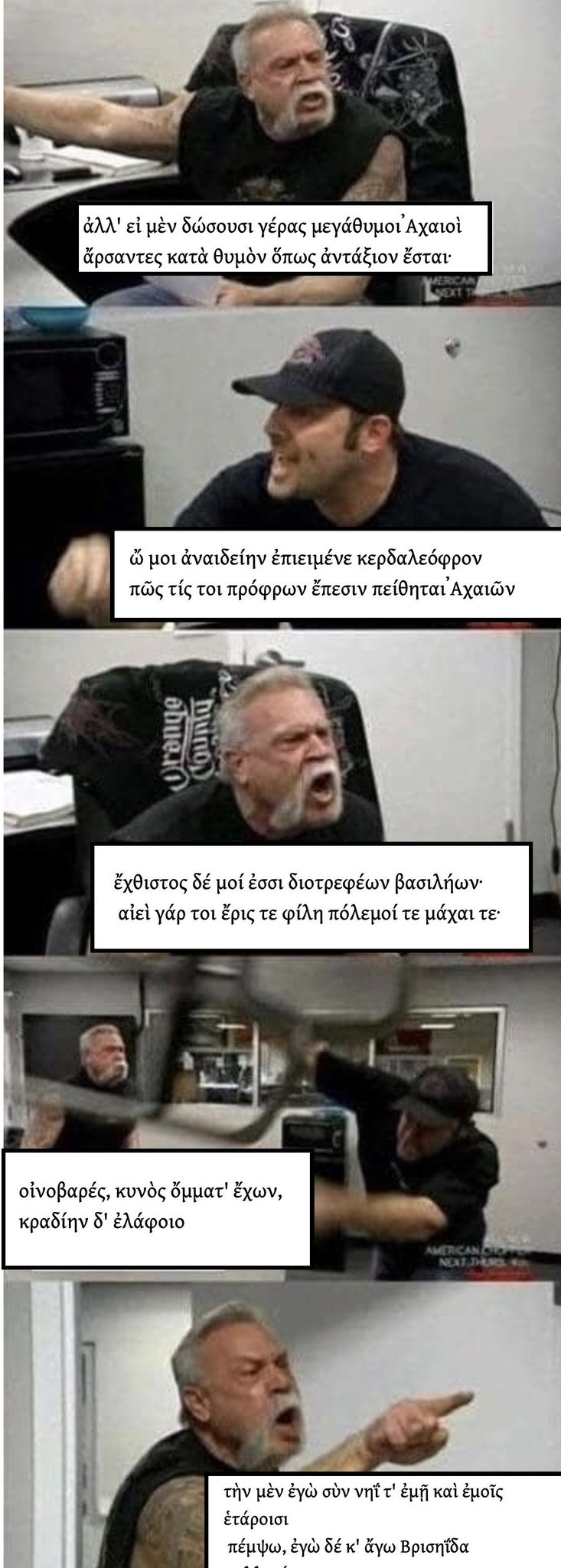
Sing the Rage! Returning to the Iliad with Reading Greek Tragedy Online

Tomorrow we return to the Iliad with Reading Greek Tragedy Online, a series produced in partnership with Out of Chaos Theatre, the Center for Hellenic Studies, and the Kosmos Society. This project started at the onset of COVID19 lockdowns in the US and UK and brings together actors and researches to stage scenes from the ancient stage and talk about how they impact us to this day. We have over 45 episodes posted already and will add 5 more before the end of the year.

We return to book 1 of the Iliad, the scene of the crime.

4 PM EST, Live and Archived

Homer, Iliad 1.1-9

Μῆνιν ἄειδε θεὰ Πηληϊάδεω ᾿Αχιλῆος
οὐλομένην, ἣ μυρί’ ᾿Αχαιοῖς ἄλγε’ ἔθηκε,
πολλὰς δ’ ἰφθίμους ψυχὰς ῎Αϊδι προΐαψεν
ἡρώων, αὐτοὺς δὲ ἑλώρια τεῦχε κύνεσσιν
οἰωνοῖσί τε πᾶσι, Διὸς δ’ ἐτελείετο βουλή,
ἐξ οὗ δὴ τὰ πρῶτα διαστήτην ἐρίσαντε
᾿Ατρεΐδης τε ἄναξ ἀνδρῶν καὶ δῖος ᾿Αχιλλεύς.

“Goddess, sing the rage of Pelias’ son Achilles,
Destructive, how it gave the Achaeans endless pain
And sent many brave souls of heroes to Hades—
And it made them food for the dogs
And all the birds as Zeus plan was being fulfilled.
Start from when those two first diverged in strife,
The lord of men Atreus’ son and godly Achilles.”

Youtube Link:

Homer, Iliad 1.158–168 [Achilles addressing Agamemnon]

“But, you great shamepot, we follow you so that you feel joy,
As we collect honor for Menelaos and you, dog-face,
From the Trojans—you don’t shudder at this, you don’t care.”

ἀλλὰ σοὶ ὦ μέγ’ ἀναιδὲς ἅμ’ ἑσπόμεθ’ ὄφρα σὺ χαίρῃς,
τιμὴν ἀρνύμενοι Μενελάῳ σοί τε κυνῶπα
πρὸς Τρώων· τῶν οὔ τι μετατρέπῃ οὐδ’ ἀλεγίζεις·

Performers and Artists
Musical guest and performer: Bettina Joy de Guzman
Paul Hurley
Paul O’Mahony
Rene Thornton Jr.
Damian Jermaine Thompson
Sara Valentine
Special Guests: Jared Simrad and Maria Xanthou

Iliad 1.224–228 [Achilles Addressing Agamemnon]

“Wine-sod! Dog-eyes! You have the heart of a deer!
You never suffer to arm yourself to enter battle with the army
Nor to set an ambush with the best of the Achaeans.
That seems like death itself to you!”

οἰνοβαρές, κυνὸς ὄμματ’ ἔχων, κραδίην δ’ ἐλάφοιο,
οὔτέ ποτ’ ἐς πόλεμον ἅμα λαῷ θωρηχθῆναι
οὔτε λόχον δ’ ἰέναι σὺν ἀριστήεσσιν ᾿Αχαιῶν
τέτληκας θυμῷ· τὸ δέ τοι κὴρ εἴδεται εἶναι.

Crew and Amazing People
Artistic Director: Paul O’Mahony (Out of Chaos Theatre)
Host and Faculty Consultant: Joel Christensen (Brandeis University)
Executive Producer: Lanah Koelle (Center for Hellenic Studies)
Producers: Keith DeStone (Center for Hellenic Studies), Hélène Emeriaud, Janet Ozsolak, and Sarah Scott (Kosmos Society)
Director of Outreach: Amy Pistone (Gonzaga University)
Poster Designer: Allie Marbry (Center for Hellenic Studies)
Poster Illustration Artist: John Koelle

Eustathius, Commentary to Homer’s Iliad, 1.14

“That Homer was an Achilles-lover will appear in thousands of ways. Homer would have readily named the Iliad the Achillea, just as he named the Odysseia (Odyssey) after Odysseus, if it were not for the fact that he would thus slight and insult the rest of the Greek nobility by naming the poem after one person.”

῞Οτι δὲ φιλοαχιλλεὺς ὁ ποιητής, μυριαχοῦ φανήσεται, ὃς τάχα, ὥσπερ ἐξ ᾿Οδυσσέως τὴν ᾿Οδύσσειαν, οὕτω καὶ τὴν ᾿Ιλιάδα ἐξ ᾿Αχιλλέως ᾿Αχίλλειαν ἐπέγραψεν ἄν, εἰ μὴ τὸ πρεσβεῖον τῆς ῾Ελλάδος οὕτως ἤμελλε καταβαλεῖν  καὶ ταπεινῶσαι τῇ ἐξ ἑνός τινος ἐπιγραφῇ.

Future episodes

All start times are 3pm ET unless otherwise noted. Live stream available at chs.harvard.edu and on YouTube.

November 17 Goddess and The Women of Gods, conceived and directed by LeeAnet Noble, with Suzanne Lye (University of North Carolina, Chapel Hill) and Jackie Murray (University of Kentucky)

December 1 The Laodamiad by Chas LiBretto

December 15 An Ancient Cabaret

Media preview

Mayhem, Murder, AND Music: Returning to Euripides’ Bacchae!

Today we return to Reading Greek Tragedy Online, a series produced in partnership with Out of Chaos Theatre, the Center for Hellenic Studies, and the Kosmos Society. This project started at the onset of COVID19 lockdowns in the US and UK and brings together actors and researches to stage scenes from the ancient stage and talk about how they impact us to this day. We have over 40 episodes posted already and will add 5 more before the end of the year.

We return to that most mysterious and maddening tragedy, Euripides’ Bacchae. Today’s performance is a The Bacchae, a musical adaptation by J. Landon Marcus and Johanna Warren, with special guest Emma Cole (University of Bristol).

Here’s a sneak peak

Eur. Bacchae 196

“We alone are right-minded; everyone else is wrong.”

μόνοι γὰρ εὖ φρονοῦμεν, οἱ δ᾽ ἄλλοι κακῶς.

Amazing artwork by John Koelle and design by Allie Marby

Youtube Link:

Euripides, Bacchae 386–401

The fate for unbridled mouths
And lawless foolishness
Is misfortune.
The life of peace
And prudence
Is unshaken and cements together
Human homes. For even though
They live far off in the sky
The gods gaze at human affairs.
Wisdom is not wit;
Nor is thinking thoughts which belong not to mortals.

Life is brief. And because of this
Whoever seeks out great accomplishments
May not grasp the things at hand.
These are the ways of madmen
And wicked fools, I think.

ἀχαλίνων στομάτων
ἀνόμου τ’ ἀφροσύνας
τὸ τέλος δυστυχία·
ὁ δὲ τᾶς ἡσυχίας
βίοτος καὶ τὸ φρονεῖν
ἀσάλευτόν τε μένει καὶ
ξυνέχει δώματα· πόρσω
γὰρ ὅμως αἰθέρα ναίον-
τες ὁρῶσιν τὰ βροτῶν οὐρανίδαι.
τὸ σοφὸν δ’ οὐ σοφία,
τό τε μὴ θνατὰ φρονεῖν
βραχὺς αἰών· ἐπὶ τούτωι
δὲ τίς ἂν μεγάλα διώκων
τὰ παρόντ’ οὐχὶ φέροι; μαι

νομένων οἵδε τρόποι καὶ
κακοβούλων παρ’ ἔμοιγε φωτῶν.

Performers and Artists
Dionysus – J Landon Marcus
Agave – Johanna Warren
Pentheus – Johanna Warren / Sung by J Landon Marcus
Maenads – Aimée Cornwell, Gracel Delos Santos, Imogen Alice Grace, Jane Lu, Avery Rabbitt, Claire Rhiannon
Bacchae – Helen Campbell, Sophie Ferrier, Hannah Padgett
Guards – Owen Harris, Dan Lee
Lyrics by J. Landon Marcus
Music by Johanna Warren and J. Landon
Director of Photography – Ren Faulkner
Director – Johanna Warren
Dionysus Director – Madeleine Hamer
Dionysus filmed on location at Epiphany Sanctuary
Music recorded by J Landon Marcus and Johanna Warren
Mixed by Eric Crespo
Props and masks handmade by: Kate Cornish
Costumes by Kate Cornish, Hannah Padgett, Johanna Warren and the Maenads
Makeup by Johanna Warren
Cadmus’ hands – Richey Beckett
Production Assistant – Ryan James
Title Screen Art by Scarlett Cussel (scarlettcussell.com)
“Enemy of Obscenity” Projections – Mohammad Fakhori
Scenes
The Primal Drum: Maenad gathering and ritual invoking Dionysus
I Am: Dionysus appears and delivers his opening monologue.
The Enemy of Obscenity: Pentheus’ manifesto against Dionysus
Justice: Maenads and Bacchae on the mountain, Pentheus discovers them and is dismembered
Exceptional Kill: Agave with the chorus, returning to Thebes with the head of Pentheus
Funeral Hymn: The lacuna of The Bacchae, Agave comes out of the spell and grapples with saying a funeral prayer for Pentheus
Crew and Amazing People
Artistic Director: Paul O’Mahony (Out of Chaos Theatre)
Host and Faculty Consultant: Joel Christensen (Brandeis University)
Executive Producer: Lanah Koelle (Center for Hellenic Studies)
Producers: Keith DeStone (Center for Hellenic Studies), Hélène Emeriaud, Janet Ozsolak, and Sarah Scott (Kosmos Society)
Director of Outreach: Amy Pistone (Gonzaga University)
Poster Designer: Allie Marbry (Center for Hellenic Studies)
Poster Illustration Artist: John Koelle

Euripides Bacchae, Fourth Chorus (862-912)

“Will I ever lift my white foot
As I dance along
In the all night chorus—
Shaking my head at the dewy sky
Like the fawn who plays
In a meadow’s pale pleasures
When she has fled the frightful hunt
Beyond the well-woven nets of the guard—
With a holler, the hunter
Recalls the rush of his hounds
And she leaps
With the swift-raced lust of the winds
Across the riverbounded plain,
Taking pleasure in the places free
Of mortals and in the tender shoots
Of the shadow grove?

What’s cleverness for? Is there any nobler prize
Mortals can receive from the gods
Than to hold your hand over the heads
Of your enemies?
Whatever is noble is always dear.

Scarcely, but still surely,
The divine moves its strength
It brings mortals low
When they honor foolishness
And do not worship the gods
Because of some insane belief
They skillfully hide
The long step of time
As they hunt down the irreverent.
For it is never right
To think or practice stronger
Than the laws.
For it is a light price
To believe that these have strength—
Whatever the divine force truly is
And whatever has been customary for so long,
This will always be, by nature.

What’s cleverness for? Is there any nobler prize
Mortals can receive from the gods
Than to hold your hand over the heads
Of your enemies?
Whatever is noble is always dear.

Fortunate is the one who flees
The swell of the sea and returns to harbor.
Fortunate is the one who survives through troubles
One is greater than another in different things,
He surpasses in fortune and power—
But in numberless hearts still
Are numberless hopes: some result
In good fortune, but other mortal dreams
Just disappear.

Whoever has a happy life to-day,
I consider fortunate.

Χο. ἆρ’ ἐν παννυχίοις χοροῖς
θήσω ποτὲ λευκὸν
πόδ’ ἀναβακχεύουσα, δέραν
αἰθέρ’ ἐς δροσερὸν ῥίπτουσ’,
ὡς νεβρὸς χλοεραῖς ἐμπαί-
ζουσα λείμακος ἡδοναῖς,
ἁνίκ’ ἂν φοβερὰν φύγηι
θήραν ἔξω φυλακᾶς
εὐπλέκτων ὑπὲρ ἀρκύων,
θωύσσων δὲ κυναγέτας
συντείνηι δράμημα κυνῶν,
μόχθοις δ’ ὠκυδρόμοις ἀελ-
λὰς θρώισκηι πεδίον
παραποτάμιον, ἡδομένα
βροτῶν ἐρημίαις σκιαρο-
κόμοιό τ’ ἔρνεσιν ὕλας;
†τί τὸ σοφόν, ἢ τί τὸ κάλλιον†
παρὰ θεῶν γέρας ἐν βροτοῖς
ἢ χεῖρ’ ὑπὲρ κορυφᾶς
τῶν ἐχθρῶν κρείσσω κατέχειν;
ὅτι καλὸν φίλον αἰεί.
ὁρμᾶται μόλις, ἀλλ’ ὅμως
πιστόν <τι> τὸ θεῖον
σθένος· ἀπευθύνει δὲ βροτῶν
τούς τ’ ἀγνωμοσύναν τιμῶν-
τας καὶ μὴ τὰ θεῶν αὔξον-
τας σὺν μαινομέναι δόξαι.
κρυπτεύουσι δὲ ποικίλως
δαρὸν χρόνου πόδα καὶ
θηρῶσιν τὸν ἄσεπτον· οὐ
γὰρ κρεῖσσόν ποτε τῶν νόμων
γιγνώσκειν χρὴ καὶ μελετᾶν.
κούφα γὰρ δαπάνα νομί-
ζειν ἰσχὺν τόδ’ ἔχειν,
ὅτι ποτ’ ἄρα τὸ δαιμόνιον,
τό τ’ ἐν χρόνωι μακρῶι νόμιμον
ἀεὶ φύσει τε πεφυκός.
†τί τὸ σοφόν, ἢ τί τὸ κάλλιον†
παρὰ θεῶν γέρας ἐν βροτοῖς
ἢ χεῖρ’ ὑπὲρ κορυφᾶς
τῶν ἐχθρῶν κρείσσω κατέχειν;
ὅτι καλὸν φίλον αἰεί.
εὐδαίμων μὲν ὃς ἐκ θαλάσσας
ἔφυγε χεῖμα, λιμένα δ’ ἔκιχεν·
εὐδαίμων δ’ ὃς ὕπερθε μόχθων
ἐγένεθ’· ἕτερα δ’ ἕτερος ἕτερον
ὄλβωι καὶ δυνάμει παρῆλθεν.
μυρίαι δ’ ἔτι μυρίοις
εἰσὶν ἐλπίδες· αἱ μὲν
τελευτῶσιν ἐν ὄλβωι
βροτοῖς, αἱ δ’ ἀπέβασαν·
τὸ δὲ κατ’ ἦμαρ ὅτωι βίοτος
εὐδαίμων, μακαρίζω.

Euripides, Bacchae 1388-1392

Many are the forms of divine powers
Many are the acts the gods unexpectedly make.
The very things which seemed likely did not happen
but for the unlikely, some god found a way.
This turned out to be that kind of story.

πολλαὶ μορφαὶ τῶν δαιμονίων,
πολλὰ δ᾿ ἀέλπτως κραίνουσι θεοί·
καὶ τὰ δοκηθέντ᾿ οὐκ ἐτελέσθη,
τῶν δ᾿ ἀδοκήτων πόρον ηὗρε θεός.
τοιόνδ᾿ ἀπέβη τόδε πρᾶγμα.
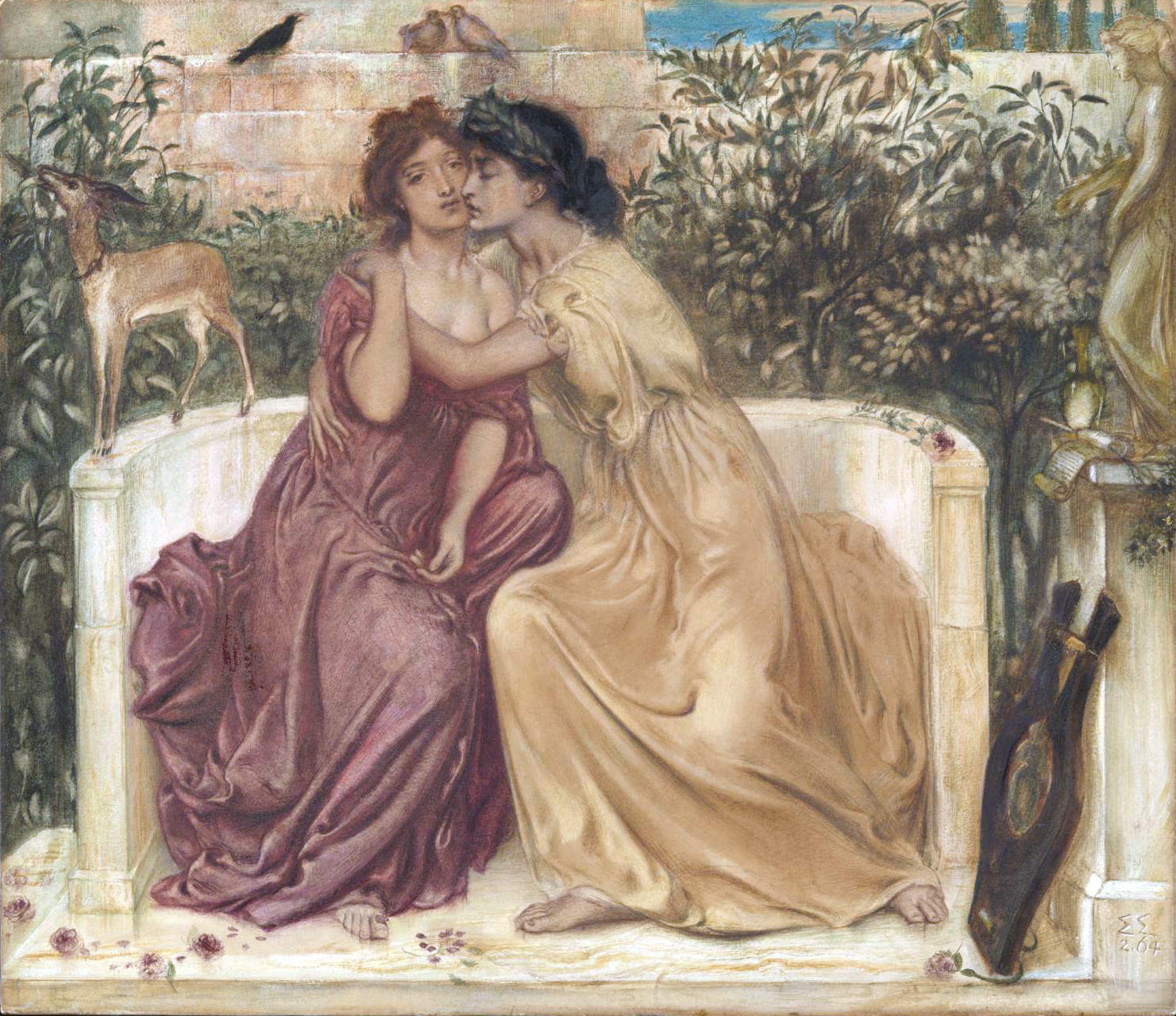
Image result for agave pentheus vase

Future episodes

All start times are 3pm ET unless otherwise noted. Live stream available at chs.harvard.edu and on YouTube.

October 13 The Bacchae, a musical adaptation by J. Landon Marcus and Johanna Warren, with Emma Cole (University of Bristol)

November 3 The Iliad, Scroll 1, with Jared Simard (New York University) and Maria Xanthou (University of Leeds)

November 17 Goddess and The Women of Gods, conceived and directed by LeeAnet Noble, with Suzanne Lye (University of North Carolina, Chapel Hill) and Jackie Murray (University of Kentucky)

December 1 The Laodamiad by Chas LiBretto

December 15 An Ancient Cabaret

Last Year’s version of the Bacchae

Countless Mixtures Incomplete: Introducing Pasts Imperfect

“When virtue is cast off into leisure without action it is a shapeless and imperfect good.”
sic imperfectum ac languidum bonum est in otium sine actu proiecta virtus
Seneca, De Otio 6.3
Today is the release of the first column in a series called Pasts Imperfecta partnership with the LA Review of Books, edited by Sarah E. Bond, Nandini Pandey, and Joel Christensen (and more to come, but see this thread). It is part of a network of publications  that hat explore the literature, material culture, reception, art, and pop culture within a global antiquity. Sign up here for the newsletter and more information. Sarah, Nandini, and Joel collaborated on this post.

Appion in Ps.-Clement, Homilies, 6.3.4

Elena, ekkolapsis (ἐκκόλαψις) la schiusa dell’uovo, Museo archeologico nazionale di Metaponto. In calcare, V sec. a.C.

“…the egg that Orpheus claims was created, projected from the boundless matter, was born like this: the quadruple matter is alive and all of the endless deep flows eternally but it moves in an unclear war, pouring forth here and there endless incomplete mixtures from one time to another. For this reason, it pulls them back too and then opens wide as if for the birth of a creature that cannot be bound.”

ὅπερ Ὀρφεὺς ᾠὸν λέγει γενητόν, ἐξ ἀπείρου τῆς ὕλης προβεβλημένον, γεγονὸς δὲ οὕτω· τῆς τετραγενοῦς ὕλης ἐμψύχου οὔσης, καὶ ὅλου ἀπείρου τινὸς βυθοῦ ἀεὶ ῥέοντος, καὶ ἀκρίτως φερομένου, καὶ μυρίας ἀτελεῖς κράσεις ἄλλοτε ἄλλως ἐπαναχέοντος, καὶ διὰ τοῦτο αὐτὰς ἀναλύοντος τῇ ἀταξίᾳ, καὶ κεχηνότος ὡς εἰς γένεσιν ζῴου δεθῆναι μὴ δυναμένου…

The poet and classicist Anne Carson has an essay that sticks like maple syrup to your subconscious, called “Essay on What I Think About Most.” She begins the poem by addressing the idea of the error and what we can learn from it by dissecting a bit of poetry from Alcman of Sparta, a Greek lyric poet from the 7th century BCE.

ὥρας δ᾿ ἔσηκε τρεῖς, θέρος
καὶ χεῖμα κὠπώραν τρίταν
καὶ τέτρατον τὸ ϝῆρ, ὅκα
σάλλει μέν, ἐσθίην δ᾿ ἄδαν
οὐκ ἔστι. Athenaeus 416d

[made?] three seasons, summer
and winter and autumn third
and fourth spring when
there is blooming but to eat enough
is not (trans. Carson)

Carson notes that the verb in Alcman’s laconic rumination on hunger seems to have no subject. She addresses whether this was a grammatical mistake caused by transmission and fragmentation; a way modern philologists can scrub away “errors” of the past. “But as you know, the chief aim of philology,” she says, “is to reduce all textual delight / to an accident of history. And I am uneasy with any claim to know exactly / what a poet means to say. So let’s leave the question mark there “

The lack of any punctuation is the kicker there. The absence does more work than any ellipsis or period ever could. Carson demonstrates how, for her, Alcman “sidesteps fear, anxiety, shame, remorse” connected to mistakes in order to engage with a truth:

“The fact of the matter for humans is imperfection.”

And that is in part what the first column of Pasts Imperfect argues for in addressing the construction, impact, and harm of Joseph Campbell’s Monomyth: the need to embrace the mess and variants of the past. To do this, we must also situate the “classical” Mediterranean within a global antiquity.

What is Pasts Imperfect? It is a column and a space for commentary, reviews, essays, reflections, statements, and any other words needed to help us negotiate between the past and our present world. We talk about pasts because antiquity isn’t just one land, timeline, or narrative; it is multiple and multiplied by the perspectives we bring to bear on it. Our Pasts are not just Greek, Roman, and Mediterranean; they are not just elite, white, and male. The past includes these people and perspectives, but also those who were silenced or left behind: the people, the languages, and the histories in or beyond the margins.

Imperfect is about value and aspect. We acknowledge that the past is far from perfect and we study antiquity to help us understand ourselves and the causes of things, not to render fictive, to emulate, or to praise simply because something has been praised before. To be human is to be imperfect; to love as a human is to love imperfectly. Our studies of the past and ourselves must honor and inhabit such complexities.

Imperfect is also about incompletion. We see the study of the past as a process that is ongoing and never truly done: each generation, each embodied person, each new perspective contributes to challenging what we think we know about what has come before.

Pasts Imperfect seeks to bring critical and transparently progressive reflections and scholarship on antiquity to a wider audience. It is a column, a space, and a developing network for those who want to engage in challenging discussions about antiquity, its construction and reception in scholarship, and its impact on the modern world. As our editorial college and paid writer-network begins to expand and to take pitches, we hope to venture into a more global understanding of the past while also making space for imperfection.

Plutarch, On the Affection Offspring (Moralia 496b)

“There is nothing so imperfect, helpless, naked, formless, and unclean as a human being glimpsed at the moment of birth, someone to whom nature has not even given a clear path to the light.”

οὐδὲν γάρ ἐστιν οὕτως ἀτελὲς οὐδ᾿ ἄπορον οὐδὲ γυμνὸν οὐδ᾿ ἄμορφον οὐδὲ μιαρὸν ὡς ἄνθρωπος ἐν γοναῖς ὁρώμενος· ᾧ μόνῳ σχεδὸν οὐδὲ καθαρὰν ἔδωκεν εἰς φῶς ὁδὸν ἡ φύσις…

Please reach out to anyone of the editors if you want to collaborate or pitch a story idea. We are working to help place essays in several different venues. See also the Public Books Antiquities Section, edited by Stephanie Wong and Sarah E. Bond and sign up for the newsletter to learn more.

File:Fragment de mosaique Ino (Dotô), découverte dans une villa romaine de Saint-Rustice en 1833, IVè ou Vè siècle, MSR, Musée Saint-Raymond (7221368224).jpg
Fragment de mosaique : Ino (Dotô), découverte dans une villa romaine de Saint-Rustice en 1833, IVè ou Vè siècle, MSR, Musée Saint-Raymond