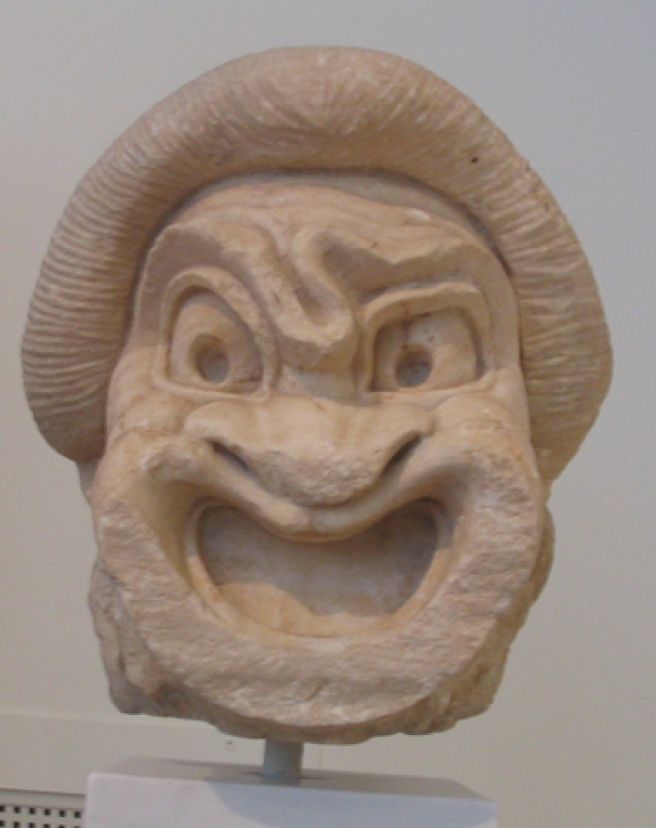
Why are those who are actually drunk, less messed up than those we call tipsy?
“Since we have hassled Aristotle,” my father said, “Shouldn’t we also try to say something particular about those who are called “tipsy”. For even though he was the sharpest in these kinds of explorations, he seems to me to have insufficiently examined the cause of this. For he says, I think, that it is possible for a sober man to make a judgment well and in line with reality while one who is pretty drunk is too wrecked to have control over his perception even as one who is only tipsy remains strong in imagination but has compromised logic. For this reason, he makes judgments and does it badly because he following imaginary things. What do you think about these things?” He said.
“When I was reading this,” I said, “the argument was fine regarding the cause. But if you want me to work up some contribution of my own, look first at whether we should credit the difference you have mentioned to the body. For, the tipsy mind alone is messed up, the body is still capable of serving impulses because it is not yet completely permeated. But when the body is overcome and soaked, it betrays its movements and ignores them and it does not move on to actual deeds. Those who have a body that still responds to them are reproved not by their lack of logical thought but by their greater strength.”
Then I said, “And, if we were to consider it from another principle, nothing stops the strength of wine from being variable and from changing alongside its amount. In the same way, fire, if it is measured, gives strength and hardness to pottery; but if it strikes it too much, it melts it and makes it liquid. In another way, spring revives and increases fevers as it begins while the heat of summer settles them and makes them desist.
Therefore, what prevents the mind, once it is moved by wine naturally, when it has been disturbed and excited, from calming and settling down as drinking increases? Hellebore has at its onset of purging pain for the body. But if less then the right amount is given, it disturbs but does not cleanse. And some people are made a little manic when they have a smaller dose of sleeping medicine, but sleep once they take more.”
The Lamia (or, just Lamia to her friends) is one of the figures from Greek myth who seems like a frightening monster but really is a particular distillation of misogyny. She is often called a Greek ‘vampire’ along with Empousa. Unlike the latter, however, Lamia is specifically associated with killing children.
Diodorus Siculus, 20.40
“At the rock’s root there was a very large cave which was roofed with ivy and bryony in which the myths say the queen Lamia, exceptional for her beauty, was born. But, because of the beastliness of her soul, they say that her appearance has become more monstrous in the time since then.
For, when all her children who were born died, she was overwhelmed by her suffering and envied all the women who were luckier with their children. So she ordered that the infants be snatched from their arms and killed immediately. For this reason, even in our lifetime, the story of that women has lingered among children and the mention of her name is most horrifying to them.
But, whenever she was getting drunk, she would allow people to do whatever pleased them without observation. Because she was not closely watching everything at that time, the people in that land imagined that she could not see. This is why the myth developed that she put her eyes into a bottle, using this story a metaphor for the carelessness she enacted in wine, since that deprived her of sight.”
The story of why Lamia killed children gets a little more depressing in the Fragments of the Greek Historians
Duris, BNJ 76 F17 [= Photios s.v. Lamia]
“In the second book of his Libyan History, Duris reports that Lamia was a fine looking woman but after Zeus had sex with her, Hera killed the children she bore because she was envious. As a result she was disfigured by grief and would seize and kill the children of others.”
Elsewhere, the evidence of narratives about Lamia are rather limited. She becomes just another negative, female monster.
Suda, Lambda 85
“Lamia: a monster. The name comes from having a gaping throat, laimia and lamia. Aristophanes: “It has the smell of a seal, the unwashed balls of a Lamia.” For testicles are active—and he is making a fantasy image of Lamia’s balls, since she is female.
“There is a crag rising up over the ground on which the Delphians claim that a woman stood singing oracles, named Hêrophilê but known as Sibyl. There is the earlier Sibyl, the one I have found to be equally as old as the others, whom the Greeks claim is the daughter of Zeus and Lamia, the daughter of Poseidon. She was the first woman to sing oracles and they say that she was named Sibyl by the Libyans. Hêrophilê was younger than here, but she was obviously born before the Trojan War since she predicted Helen in her oracles, that was raised up in Sparta as the destruction for Asia and Europe and that Troy would be taken by the Greeks because of her.”
“Foremost he differed from previous authors in this, by which I mean how he took on a subject that was not a single thread nor one divided in many different and also disconnected parts. And then, because did not include mythical material in his work and he did not use his writing for the deception and bewitchment of many, as every author before him did when they told the stories of certain Lamiai rising up from the earth in groves and glens and of amphibious Naiads rushing out of Tartaros, half-beasts swimming through the seas and then joining together in groups among humans, and producing offspring of mortals and gods, demigods—and other stories which seem extremely unbelievable and untrustworthy to us now.”
Mormô, in the genitive Mormous, declined like Sappho. There is also the form Mormôn, genitive Mormonos. Aristophanes says “I ask you, take this Mormo away from me”. This meant to dispel frightening things. For Mormo is frightening. And again in Aristophanes: “A Mormo for courage”. There is also a mormalukeion which they also call a Lamia. They also frightening things this.
Plutarch, De Curiositate [On Being a Busybody] 516a
“Now, just as in the myth they say that Lamia sleeps at home, putting her eyes set aside in some jar, but when she goes out she puts them back in and peers around, in the same way each of us puts his curiosity, as if fitting in an eye, into meanness towards others. But we often stumble over our own mistakes and faults because of ignorance, since we fail to secure sight or light for them.
For this reason, a busybody is rather useful to his enemies, since he rebukes and emphasizes their faults and shows them what they should guard and correct, even as he overlooks most of his own issues thanks to his obsession with everyone else. This is why Odysseus did not stop to speak with his mother before he inquired from the seer about those things for which he had come to Hades. Once he had made his inquiry, he turned to his own mother and also the other women, asking who Tyro was, who beautiful Khloris was, and why Epikaste had died.”
“Public leadership comes from persuading people through argument. But manipulating a mob in this way differs little from the capture and herding of stupid animals.”
The passage above made me think of Peisistratus and how he subverted a democratic state.
Aristophanes gets in on this game with his presentation of the advantages of the Unjust Argument over the just, see a friend’s post on this topic.
Herodotus, 1.59
Peisistratos becomes a tyrant through histrionic lies
“After that, [Hippokrates] had a son named Peisistratos. Then the Athenians on the coasts were in strife with those who lived inland and Megakles, the son of Almeôn, was the leader of the first group, and Lykourgos the son of Aristolaidos was the leader of the inlanders. Peisistratos, because he had designs on a tyranny, led a third faction; after he gathered his partisans and claimed to be a defender of the heartland-Greeks, he enacted the following plans. He wounded himself and his mules and then drove his wagon into the marketplace as if he had fled enemies who wished to kill him as he was traveling to the country. Because of this, he asked the people for a bodyguard under his power, since he had previously earned good repute as a general against the Megarians when he took Nisaia and displayed many other great accomplishments. The Athenian people, utterly deceived, permitted him to choose from the citizens men three hundred men who were not spear-bearers under Peisistratus but club-carriers: for they followed behind him, carrying clubs. Once these men rebelled with Peisistratos, they occupied the acropolis.”
Peisistratos is exiled after ruling for a short time. But, with the help of a foreign tyrant, regains the tyranny through more deceit and stupidity
Herodotus, 1.60
“Once Peisistratos accepted this argument and agreed to these proposals, they devised the dumbest plan for his return that I can find, by far, if, even then, those in Athens, said to be among the first of the Greeks in wisdom, devised these things. (From antiquity, the Greek people have been set apart from barbarians by being more clever and freer from silly stupidity). In the country there was a Paianiean woman—her name was Phuê—and she was three inches short of six feet and altogether fine looking. After they dressed her up in a panoply, they put her in a chariot, and adorned her with the kind of scene which would make her a completely conspicuous sight to be seen. Then they drove her into the city, sending heralds out in front of her, who were announcing after they entered the city the words they had been assigned, saying something like “O Athenians, receive Peisistratos with a good thought, a man Athena herself honored beyond all men as she leads him to her own acropolis.” They went everywhere saying these things. And as soon as the rumor circulated among the people, they believed that the woman was Athena herself: then they were praying to the woman and were welcoming Peisistratos!
After he regained the tyranny in the way I have narrated, Peisistratos married the daughter of Megakles in accordance with the agreement they made. But because he already had young sons and since the family of the Alkmeaonids were said to be cursed, he did not wish to have children with his newly wedded wife, and he was not having sex with her according to custom…”
μωρολογία: properly, “stupid-talking” or “the talk of fools”. But why not: “the science of stupidity”?
Sophocles, fr. 924
“Stupidity is a terrible opponent to wrestle”
ὡς δυσπάλαιστόν <ἐστιν> ἀμαθία κακόν
Terence, Phormio, 659-660
“Whether I claim he does this because of stupidity or
malice—whether this is a knowing plot, or incompetence, I am unsure.”
utrum stultitia facere ego hunc an malitia
dicam, scientem an imprudentem, incertu’ sum.
Sophocles, fr. 925
“Stupidity really is evil’s sibling”
ἡ δὲ μωρία
μάλιστ᾿ ἀδελφὴ τῆς πονηρίας ἔφυ
Suetonius, Divus Claudius 38
“But he did not stay quiet even about his own stupidity: but claimed that he had faked it on purpose under Gaius because he would have not escaped and advanced to his eventual position otherwise—and that this was supported by certain oracles. But he persuaded no one. And after a brief time, a book was published with the title “The Ascension of Fools” which posited that no one can pretend stupidity.”
Ac ne stultitiam quidem suam reticuit simulatamque a se ex industria sub Gaio, quod aliter evasurus perventurusque ad susceptam stationem non fuerit, quibusdam oratiunculis testatus est; nec tamen49 persuasit, cum intra breve tempus liber editus sit, cui index erat μωρῶν ἐπανάστασις, argumentum autem stultitiam neminem fingere.
Plutarch, Rational Beasts 998a
“Note that a lack of intelligence or stupidity in some animals emerges in contrast with the abilities and sharpness of others as you might compare an ass or a sheep with a fox, a wolf or a bee. It would be the same if you would compare Polyphemos or that idiot Koroibos to your grandfather Autolykos. For I do not think that there is so great a difference between beasts as there is between individual people in thinking, using reason, and in memory.”
“These men must be the dumbest of all people or they are the most inimical to the state. If they believe that it is also better for their private affairs when the state does well, then they are complete fools in pursuing something opposite to their own advantage right now. If they do not believe that they share common interests with you, then they must be enemies of the state”
“A special recognition for stupidity needs to be given to the rhetorician Corvus who said, “Since Xerxes is already sailing against us on his sea, shouldn’t we flee before the earth is taken from us””
Corvo rhetori testimonium stuporis reddendum est, qui dixit: “quidni, si iam Xerses ad nos suo mari navigat, fugiamus, ntequam nobis terra subripiatur?”
“Among the weak, base and private citizens, ignorance when combined with a lack of power yields little wrongdoing, as in nightmares some trouble upsets the mind, making it incapable of responding to its desires. But when power has been combined with wickedness it adds energy to latent passions. And so that saying of Dionysus is true—for he used to say that he loved his power most when he could do what he wanted quickly. It is truly a great danger when one who wants what is wrong has the power to do what he wants to do.
As Homer puts it “When the plan was made, then the deed was done.” When wickedness has an open course because of its power, it compels every passion to emerge, producing rage, murder, lust, adultery, and greedy acquisition of public wealth.”
“His accuser claimed that he selected the most wretched lines from the most famous poets and used them as proofs to teach his followers to be evildoers and tyrants. He is said to have used the line from Hesiod “there is nothing reproachable about work, but laziness is reproachable” (WD 311) to claim that the poet exhorted not to refrain from any work, unjust or shameful, but to do everything for profit.
Socrates, although he might agree that it is good and useful for a man to be a worker and harmful and bad for him to be lazy—that work is good and laziness is bad—he used to say that being a worker required people to do something good. Gambling or any other immortal occupation which takes from others he used to call laziness. Within these parameters, Hesiod’s claim that “there is nothing reproachable about work, but laziness is reproachable” holds true.
“Critoboulos, Some say that whenever the great king gives gifts, he calls in first those who proved their excellence at war because there is no advantage to plowing many fields unless they defend them. After them, he rewards those who prepare and work the land best, because brave men cannot survive unless someone works the land.”
“Let no one find fault with this line because wealth is made to be much praised ahead of virtue. Know that wealth here is the product workers get from their labors—it is a just portion gathered from their personal toil.”
“No mortal could rival me in work:
No one could best me at building a fire or heaping dry wood,
At serving at the table, cooking meat or serving wine–
All those tasks lesser men complete for their betters.”
“Eurymachus: I wish the two of us could have a labor-contest
In the height of spring when the days are drawing longer,
In the thickening grass. I would grip the curved scythe
And you could hold the same thing, so we could test each other
At work, fasting right up to dusk where the grass was thick.
And then the next day we could drive the oxen, the strongest ones,
Bright and large, both stuffed full with their food,
A pair of the same age, equally burdened, their strength unwavering.
I’d wish for a four-acre parcel to put under the plow.
Then you’d see me, how I would cut a furrow straight from end to end.
Or if, instead, Kronos’ son would send me a war today,
And I would have a shield and two spears
Matched with a bronze helmet well-fit to my temples.
Then you’d see me mixing it up in the front lines
And you wouldn’t bawl about, belittling my hungry stomach.”
“We have frequently noted more than a few words or expressions which we cannot say in a few words, as in Greek, and which, even if we use as many words as possible to say them, cannot be articulated as clearly or pointedly in Latin as the Greeks can convey in a few words. For recently, when a book of Plutarch came my way and I was reading the title, which was “Peri polypragmosunes”, a man who didn’t know Greek asked me whose book it was and what it was written about. I spoke the name of the writer immediately, but the subject of the book was something I hesitated on.
At first, since I did not believe that it would be an elegant translation if I said that the book was De Negotiositate (about busyness), I began to search my mind for some other description which, as the saying goes, would express it “word for word”. But there was nothing which I could remember that I read nor anything I could invent that would not in some way be harsh or silly—if I made a new word out of multitude and negotium, in the same way we say “multifaceted” or “multicolored” or “multiform”. But it would be said no less awkwardly than if one were to translate into a single world polyphilia (having many friends), polytropia (of many ways) or polysarkia (with much flesh). Therefore, after I spent a while thinking silently, I responded that it did not seem possible to me to communicate the subject in a single word and that, as a result, I was considering how to convey the meaning of that Greek word with a phrase.”
“Therefore, beginning many affairs and working on all of them is called in Greek polypragmosunê” I said, “and the label communicates that this book is written about this matter.” Then, that unrefined man, misled by my incomplete and unclear words and thinking that polypragmonê is a virtue, said “Certainly, then, this man Plutarch, whoever he is, exhorts us to engage in business, and that very many endeavors should be pursued with dedication and speed, and he has written the name of this virtue, about which he plans to speak, on the book itself, just as you say, with propriety.” I answered “Not at all, in truth. For that is in no way a virtue, that subject which is anticipated by the Greek name on the book. And Plutarch does not do what you believe—and I did not mean to say that. Indeed, he dissuades us in this book as much as he is able from too varied and frequent and unnecessary planning or seeking of too many types of obligations. But” I added, “I do see that the root of your mistake is in my lack of eloquence, the way that I could not express in many words and with clarity what a single Greek word indicates completely and plainly.”
Adiecimus saepe animum ad vocabula rerum non paucissima, quae neque singulis verbis, ut a Graecis, neque, si maxime pluribus eas res verbis dicamus, tam dilucide tamque apte demonstrari Latina oratione possunt, quam Graeci ea dicunt privis vocibus. 2 Nuper etiam cum adlatus esset ad nos Plutarchi liber et eius libri indicem legissemus, qui erat peri polypragmosynes, percontanti cuipiam, qui et litterarum et vocum Graecarum expers fuit, cuiusnam liber et qua de re scriptus esset, nomen quidem scriptoris statim diximus, rem, de qua scriptum fuit, dicturi haesimus. 3 Ac tum quidem primo, quia non satis commode opinabar interpretaturum me esse, si dicerem librum scriptum “de negotiositate”, aliud institui aput me exquirere, quod, ut dicitur, verbum de verbo expressum esset. 4 Nihil erat prorsus, quod aut meminissem legere me aut, si etiam vellem fingere, quod non insigniter asperum absurdumque esset, si ex multitudine et negotio verbum unum compingerem, sicuti “multiiuga” dicimus et “multicolora” et “multiformia”. 5 Sed non minus inlepide ita diceretur, quam si interpretari voce una velis polyphilian aut polytropian aut polysarkian. Quamobrem, cum diutule tacitus in cogitando fuissem, respondi tandem non videri mihi significari eam rem posse uno nomine et idcirco iuncta oratione, quid ucliet Graecum id verbum, pararam dicere.
“Ad multas igitur res adgressio earumque omnium rerum actio polypragmosyne” inquam “Graece dicitur, de qua hunc librum conpositum esse inscriptio ista indicat”. VII. Tum ille opicus verbis meis inchoatis et inconditis adductus virtutemque esse polypragmosynen ratus: “hortatur” inquit “nos profecto nescio quis hic Plutarchus ad negotia capessenda et ad res obeundas plurimas cum industria et celeritate nomenque ipsius virtutis, de qua locuturus esset, libro ipsi, sicuti dicis, non incommode praescripsit”. VIII. “Minime” inquam “vero; neque enim ista omnino virtus est, cuius Graeco nomine argumentum hoc libri demonstratur, neque id, quod tu opinare, aut ego me dicere sentio aut Plutarchus facit. Deterret enim nos hoc quidem in libro, quam potest maxime, a varia promiscaque et non necessaria rerum cuiuscemodi plurimarum et cogitatione et petitione. Sed huius” inquam “tui erroris culpam esse intellego in mea scilicet infacundia, qui ne pluribus quidem verbis potuerim non obscurissime dicere, quod a Graecis perfectissime verbo uno et planissime dicitur”.
This and the following passage are from Plutarch’s On Whether Sickness of the Body or Mind Are Worse (Moralia 500 ff). The following (especially the last line of the first paragraph) appears to perpetuate the stigmatizing of mental illness. And it does: many behaviors we today would see as parafunctional and requiring therapy, ancient authors viewed as issues of will. But it also seems to attest well to the madness of certain manufactured protests….
“Just as, therefore, the storm which keeps you from docking is more dangerous than the one that won’t let you sail, the storms of the soul are worse when they do not allow a person to control or put down his troubled thoughts—this person goes without a helmsman, without ballast in confusion and wandering, taking off in steep and opposite courses until suffering a harrowing shipwreck and crushing his life. This is why it is worse to suffer sickness of mind than the body: For those who are sick, merely suffer; the sick of mind suffer and harm others.
But why is it necessary to repeat the great number of afflictions? Current events remind me of them. Do you see this immense, mixed up crowd which clings together and mixes around the seat of government and the market?”
“Beyond the theater is the shrine of Aphrodite. In front of the foundation is a stele on which Telesilla, a poet of lyric, is depicted. Her books are tossed near her feet while she looks at the helmet she holds in her hand as she is about to put it on her head. Telesilla was famous among women and especially honored for her poetry.
But a greater story about her comes from when the Argives were bested by Kleomenes the son of Alexandrides and the Lakedaimonians. Some Argives died during the battle itself and however many fled to the grove of Ares died there too—at first they left the grove under an armistice but they realized they were deceived and were burned with the rest in the grove. As a result, Kleomenes led the Spartans to an Argos bereft of men.
But Telesilla stationed on the wall of the city all the slaves who were unable to bear arms because of youth or old age and, after collecting however many weapons had been left in homes or in the shrines, she armed all the women at the strongest age and once she had armed herself they took up posts were the army was going to attack.
When the Spartans came near and the women were not awestruck by their battle-cry but waited and were fighting bravely, then the Spartans, because they reasoned that if they killed the women the victory would be ill-rumored even as their own defeat would come with great insult, yielded to the women.
The Pythian priestess had predicted this contest earlier in the prophecy relayed by Herodotus who may or may not have understood it (6.77):
But when the female conquers the male
And drives him away and wins glory for the Argives,
It will make many Argive women tear their cheeks.
These are the words of the oracle on the women’s accomplishment.”
Plutarch, On the Virtues of Women 245d-f6 reports a version of this tale; the Suda (s.v. Telesilla) likely takes its account from Pausanias.
“Telesilla, a poetess. On a stele her books are tossed around and she has placed a helmet on her head. And When the Lakedaimonians slaughtered the Argives who had fled to a shrine and were heading to the city to sack it, then Telesilla armed the women of the right age and set them against where they were marching. When the Lakedaimonians saw this, they turned back because they believed it shameful to fight against women whom it would be inglorious to conquer but a great reproached to be defeated by….” [the oracle is listed next”
“Klea, I do not have the same opinion as Thucydides concerning the virtue of women. For he claims that the best woman is the one who has the slimmest reputation among those outside her home, critical or positive—since he believes that the name of a good woman ought to be locked up and kept indoors just like her body. Gorgias, in fact, is more appealing to me, since he insists that the fame rather than the form of a woman should be known to many. Indeed, the Roman practice seems best: granting praise to women in public after their death just as for men.
So, when Leontis, one of the best women died, you and I had a rather long conversation which did not lack philosophical solace; and now, just as you have asked, I have written down for you the rest of the things one can say supporting the assertion that the virtue of a man and woman are the same thing. This [composition] is historical and is not arranged for pleasurable hearing. But if some pleasure is possible in a persuasive piece thanks to the nature of its example, then the argument itself does not avoid some charm—that aid to explanation—nor is it reluctant to “mix the Graces in with the Muses, a most noble pairing”, in the words of Euripides, basing its credibility on the love of beauty which is a special province of the soul.”