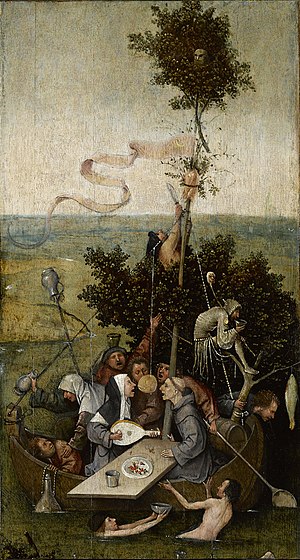
“What is the beginning of the change from guardian to tyrant? Isn’t clear when the guardian begins to do that very thing which myth says happened at the shrine of Lykaion Zeus in Arcadia?
Which is? He said.
That once someone tastes a bit of human innards mixed up with the other sacrifices he becomes a wolf by necessity? Haven’t you heard this tale?
I have.
Is it not something the same with a protector of the people? Once he controls a mob that obeys him, he cannot restrain himself from tribal blood, but he prosecutes unjustly, the sorts of things men love to do, and brings a man into court for murder, eliminating the life of a man—and with tongue and unholy mouth that have tasted the murder of his kind, he exiles, kills, and promises the cutting of debts and the redistribution of land. Is it not by necessity that such a man is fated either to be killed by his enemies or to become a tyrant, to turn into a wolf from a man?”
In ancient Greek myth, Lykaon (Lycaon, related to lúkos, “wolf”) was a king of Arcadia. According to Pausanias (8.31-5) , Lykaon sacrificed a newborn child to Zeus. In other sources he offers the infant mixed up with other food to test Zeus’ divinity (although some attribute the deed to his sons, see Apollodorus, 3.8.1). Zeus killed the sons with lightning; Lykaon was transformed into a wolf. Stay tuned for more of this in coming days.
Consider this how this could turn out on many ships or even just one: there is a captain of some size and strength beyond the rest of the men in the ship, but he is deaf and similarly limited at seeing, and he knows as much about sailing as these qualities might imply. So, the sailors are struggling with one another about steering the ship, because each one believes that he should be in charge, even though he has learned nothing of the craft nor can indicate who his teacher was nor when he had the time to learn. Some of them are even saying that it is not teachable, and that they are ready to cut down the man who says it can be taught.
They are always hanging all over the captain asking him and making a big deal of the fact that he should entrust the rudder to them. There are times when some of them do not persuade him, and some of them kill others or kick them off the ship, and once they have overcome the noble captain through a mandrake, or drugs, or something else and run the ship, using up its contents drinking, and partying, and sailing just as such sort of men might. In addition to this, they praise as a fit sailor, and call a captain and knowledgeable at shipcraft the man who is cunning at convincing or forcing the captain that they should be in charge. And they rebuke as useless anyone who is not like this.
Such men are unaware what a true helmsman is like, that he must be concerned about the time of year, the seasons, the sky, the stars, the wind and everything that is appropriate to the art, if he is going to be a leader of a ship in reality, how he might steer the ship even if some desire it or not, when they believe that it is not possible to obtain art or practice about how to do this, something like an art of ship-steering. When these types of conflicts are occurring on a ship, don’t you think the one who is a true helmsman would be called a star-gazer, a blabber, or useless to them by the sailors in the ships organized in this way?
“Plato, the son of Ariston, at first pursued poetry and used to write heroic verse. But he soon burned it all because he despised it, since he reckoned that his poetry was far inferior when compared to Homer’s. He then tried tragedy and even completed a tetralogy, and he was about to enter the competition, even to the point of giving the verses to actors. But right before the Dionysia, he went and heard Socrates; and once he was seized by that Siren, he not only withdrew from the competition, but he also gave up the writing of tragedy for good to immerse himself in philosophy.”
Although he did not master poetry, Plato could still deal out a sick burn:
Aelian 4.9
“Plato used to call Aristotle Pôlos [the Foal]. What did he wish with that name? Everyone knows that a foal, when it has had its fill of baby’s milk, kicks its mother. Thus Plato was signaling a certain ingratitude on Aristotle’ part. Indeed, Aristotle received the greatest seeds of Philosophy from Plato and then, though he was filled to the brim with the best ideas, he broke with Plato rebelliously. He founded his own house, took his friends on Plato’s walk, and set himself up to be Plato’s rival.”
“What is life? What enjoyment is there without golden Aphrodite?
May I die when these things no longer interest me:
Secret sex and its moving gifts in bed,
Those blossoms of youth that tug
At men and women alike.
…But then painful old age
Presses down and makes a man ugly and embarrassing.
Cruel thoughts are always wearing down his mind
And he takes no pleasure seeing the sunrise.
No, he’s disgusting to boys and a joke to women too.
That the hard old age god makes for us.”
“I was once with Sophocles when someone asked him, ‘O Sophocles, how do things stand with you in the old love-making line? Can you still lie with a woman?’ Sophocles responded, ‘Ah man, you should sing a song of triumph for me – for indeed, I have most gladly fled from love as though I had gotten away from a cruel and raving master.’
It seemed to me at the time that he had spoken well on the subject, and I think so no less even today. Indeed, we are granted a certain peace and freedom from such concerns in old age. When our desires relent and finally cease to draw us out, then indeed does Sophocles’ saying come true, and we are entirely freed from many a raving master.
But respecting these things, and our relationships with our friends, my dear Socrates, there is one cause to consider – not old age, but rather the person’s character. If they have their lives well-ordered and are easily contented, then old age is a moderate burden. But to a man of the opposite character, both old age and youth happen to be burdensome affairs.
“But I am saying nothing new. And I have never stopped saying these things at different times and in previous arguments. And I am really going to try to demonstrate to you the kind of cause which I have been on about. I am going back to those things everyone knows and I am starting from them.
Once I have proposed that that there is a thing called the beautiful on its own and also the good and the big and all the rest of the things, if you grant these to me and concede that they exist, I hope to show the cause from these things and to prove that the soul is immortal.
Look at the things that follow from these assumptions if it occurs to you as it does to me. For it seems to me that if any other thing is beautiful apart from beauty itself it is not because some other single type of beauty exists more than because it has a share of that initial beauty?”
“We should speak next about the teaching and communication of these subjects: how to do so, who should do it, and when it is right to apply each of them. In the same way that a shipwright anticipates the outline of his creation at the beginning in laying out the keel, I seem to be outlining the whole, trying to imagine the shape of lives based on the habits of their minds and in actuality then laying out their keels, by seeking out precisely through what method and with what habits we might best navigate through this journey of life.”
How does it balance with innate skills and character? It’s complicated.
Quintilian, 2.19
“In sum, nature is education’s raw material: the latter shapes, the former is shaped. There is no art without substance; material has a worth apart from art; and yet, the highest art is superior to the best material.”
Denique natura materia doctrinae est: haec fingit, illa fingitur. Nihil ars sine materia, materiae etiam sine arte pretium est; ars summa materia optima melior.
How important is education?
Plutarch, Can Virtue Be Taught 439f
“ ‘If people are not made better through education, their teacher’s pay is wasted’ The teachers are the first to guide children after they leave their mother and, just as nurses help shape the body with hands, teachers shape their character: with their habits they put children on the first step toward excellence. This is why the Spartan, when asked what he accomplished through teaching, said ‘I make noble things appealing to children.’ ”
“Marcus Verrius flaccus, a freedman, became especially famous through his manner of teaching. For he was in the habit of matching students with their equals in order to encourage learning. He would not merely specify the subjects they would write about, but he would offer a prize which the winner would earn. This prize was some pretty or rare old book. For this reason, Augustus chose him as tutor to his grandsons….”
Verrius Flaccus libertinus docendi genere maxime claruit. Namque ad exercitanda discentium ingenia aequales inter se committere solebat, proposita non solum materia quam scriberent, sed et praemio quod victor auferret. Id erat liber aliquis antiquus pulcher aut rarior. Quare ab Augusto quoque nepotibus eius praeceptor electus
No course of learning is without some regrets….
Letters of Cicero, Fragments. (Suet. Gram. 26)
On Lucius Plotius Gallus,
“I still have a memory from my childhood when a certain Plotius began to teach in Latin for the first time. When crowds circled him and everyone was eager to study with him, I was upset because it was forbidden to me. I was restricted by the advice of the most educated men who used to believe that minds were better fed by training in Greek.”
Plotius Gallus. de hoc Cicero in epistula ad M. Titinium sic refert: equidem memoria teneo pueris nobis primum Latine docere coepisse Plotium quendam. ad quem cum fieret concursus et studiosissimus quisque apud eum exerceretur, dolebam mihi idem non licere; continebar autem doctissimorum hominum auctoritate, qui existimabant Graecis exercitationibus ali melius ingenia posse. (Suet.Gram. 26)
P: This argument has made me completely speechless right now
S: Let’s not give up yet! Let’s take up and examine the life of the mind too.
P: What sort of life are you talking about?
S: If someone would accept living while possessing intelligence, thought, knowledge and perfect memory, but without having any small or great part of pleasure or pain but instead be completely untouched by these kinds of things.
P: Socrates, neither life seems attractive to me, nor to anyone else, I believe.”
“But you wouldn’t mix things up like those debate-me guys who talk about a principle and its results at the same time if you really want to discover something real. These guys probably have not one single understanding or concern for the truth.
They’re just good enough to please themselves with their ‘wisdom’, even though they’re mixing everything up.”
“Bigness seems to me not only never willing to be big and small at the same time, but the bigness in us is never eager to accept smallness nor to be surpassed, but it does two things: it flees or shrinks whenever the opposite—smallness—is present or, once it has approached, it perishes.”
“These facts are as accurate details about Plato as we are able to gather in our laborious research of the things said about him. Speusippus, an an Athenian son of Eurymedon, took over for him. He was from the deme of Myrrhinos and was the son of Plato’s sister, Pôtônê.
Speusippos was the leader of the school for eight years, and he began after the 108th Olympiad. He had statues of the Graces dedicated in the Museion which Plato built in the Academy. Although he remained an adherent to Plato’s theories, he was not like him at all in his character. For he was quick to anger and easily induced by pleasures. People say that he threw a little dog into a well in a rage and he went to Macedonia to the marriage of Kassander thanks to pleasure.
Two women, Lastheneia of Mantinea and Aksiothea of Phlios, were students of Plato who are said to have heard Speusippus speak. Writing at the time, Dionysus says mockingly: “It is possible to evaluate your wisdom from your Arcadian girl of a student.” And, while Plato made everyone who came to him exempt from tuition, you “send everyone a bill and take money from the willing and unwilling alike!”
“Come, listen to my stories: for learning will certainly improve your thoughts.
As I said before when I declared the outline of my speeches,
I will speak a two-fold tale. Once, first, the one alone grew
Out of many and then in turn it grew apart into many from one.
Fire, and Water, and Earth and the invincible peak of Air,
Ruinous strife as well, separate from these, equal to every one,
And Love was among them, equal as well in length and breadth.
Keep Love central in your mind, don’t sit with eyes in a stupor.
She is known to be innate to mortal bodies,
She causes them to think of love and complete acts of peace,
Whether we call her Happiness or Aphrodite as a nickname….”
“But mortals truly have a different kind of love,
One of a just, prudent, and good soul.
It would be better if it were the custom among mortals,
of reverent men and all those with reason,
To love this way, and to leave Zeus’ daughter Cypris alone.”
“As I was walking from the Peiraios beset
By troubles and despair, philosophy came over me.
And all the painters now seem to me to be ignorant
About love, and, to put it simply, so is everyone else
Who fashions images of him as a god.
For he is neither female nor male, and again,
He is not a god or mortal; nor is he foolish
Or wise, but he is drawn together from everywhere
And carries many shapes in one form.
For he has a man’s boldness with a woman’s restraint;
he has the senselessness of madness
But the reason of a thinker; he has a beast’s ferocity,
The toil of the unbreakable, and the avarice of a god.
Indeed, by Athena and the gods, I do not understand
What love is, but still it is the type of thing
I have said only without this name.”
“I will begin to praise first what people see first—the way everyone recognizes you, your beauty, the complexion by which your limbs and your whole body shines. When I search for something to compare it to, I see nothing. But it remains my right to ask those who read this speech to look at you and witness this so that I may be forgiven for providing no comparison.
What similarity could someone offer when something mortal fills its witnesses with immortal desire, whose seeing never tires, and when absent stays remembered? How, when this has a nature in human form yet worthy of the gods, so like a flower in its good form, beyond even a whiff of fault? Truly, it is not possible to seek out even those things in your appearance which have marred many others who had their share of beauty. For either they have disturbed their natural form through some tremor of character or because of some bad luck they have undermined their natural beauty to the same end.
No, we couldn’t find your beauty touched by anything like this. Whoever of the gods planned out your appearance guarded so earnestly against every type of chance that you have no feature worthy of critique—he made you entirely exceptional. Moreover, since the face is the most conspicuous of all the parts that are seen, and on that face, the eyes stand out in turn, here the divine showed it had even more good will toward you.
For not only did he provide you with eyes sufficient for seeing—and even though it is not possible to recognize virtue when some men act–he showed the noblest character by signaling through your eyes, making your glance soft and kind to those who see it, dignified and solemn to those you spend time which, and brave and wise to all.
Someone might wonder at this next thing especially. Although other men are taken as harsh because of their docility, or brash because of their solemnity, or arrogant because of their bravery, or they seem rather dull because they are quiet, chance has gathered these opposite qualities together and granted them all in agreement in you, just as if answering a prayer or deciding to make an example for others, but not crafting just a mortal, as she usually does.
If, then, it were possible to approach your beauty in speech or if these were the only of your traits worthy of praise, we would think it right to pass over no part of your advantages. But I fear that we might not trust our audience to hear the rest and that we may wear ourselves out about this in vain. How could one exaggerate your appearance when not even works made by the best artists could match them? And it is not wondrous—for artworks have an immovable appearance, so that it is unclear how would they appear if they had a soul. But your character increases the great beauty of your body with everything you do. I can praise your beauty this much, passing over many things.”