“For this reason we must examine whether or not it is possible for the study of the philosophers to bring us [happiness].”
Quare hoc videndum est, possitne nobis hoc ratio philosophorum dare.
Aristotle, Eudemian Ethics, 2.1 (1219a25)
“Let the work of the mind be the performance of life—and what this means is using life and being awake (for sleep is some kind of a rest and cessation of life). As a result, since the work of the mind and its virtue are identical, then the work of virtue is an earnest life.
This, then, is the complete good, which is itself happiness. For it is clear from what we have argued—as we said that happiness was the best thing; the goals and the greatest of the goods are in the mind, but aspects of the mind are either a state of being or an action—it is clear that, since an action is better than a state and the best action is better than the best state, that the performance of virtue is the greatest good of the mind. Happiness, then, is the action of a good mind.”
ψυχή: can be translated into English as “spirit” or “soul” instead of “mind”. I avoided the former to sidestep the implication that Aristotle is making some kind of a mystical argument; I avoided the latter because it has such strong religious associations in English.
Seneca De Beneficiis 22
“A just reason for happiness is seeing that a friend is happy—even better, is to make a friend happy.”
iusta enim causa laetitiae est laetum amicum videre, iustior fecisse
“Pythagoras the son of Mnêsarkhos was present among these men, and first he was toiling over learning and arithmetic and later he did not condemn the omen reading of Pherecydes.
For also in Metapontios when a ship was approaching carrying a cargo and there were people nearby praying for it to arrive safe because of its cargo, he stood and said this, “this ship will appear to you, like a corpse carrying a body”
And again in Kaulônia, as Aristotle says when he is writing about this, he says many other things, and in Turrênia, he says he bit the deadly snake who was biting him and killed him. He also foretold the strife that occurred among the Pythagoreans. For this reason he went to Metapontios and was seen by no one.
And after crossing the river near Kosa with others he heard a great voice beyond human ability: “Hello, Pythagoras.” And those present became very frightened. He also once appeared both in Kroton and Metapontios in the same day and hour.
While he was seated once in the theater, he stretched out and showed to those who were seated that his own thigh was gold. There are other impossible stories about him too. But we should stop the account about him because we don’t want to write only about him.”
Diogenes Laertius, Lives of the Eminent Philosophers 7.2
“Hêrillos the Karthaginian said that our purpose was knowledge: we should live by adducing the life of knowledge to everything and surrendering nothing to ignorance. He believed that knowledge was a practice of the imagination, imperturbable by argument. He used to say that there was no single end, but that it changed depending on events and situations, just as a bronze figure could be made into either Alexander or Socrates.”
“The highest good according to Herillus is knowledge; according to Zeno, to live congruously with nature, and according to some Stoics, to pursue virtue.”
Herilli summum bonum est scientia, Zenonis cum natura congruenter vivere, quorundam Stoicorum virtutem sequi.
Cicero, De Finibus 2.14
“Erillus, moreover, since he refers everything back to knowledge, imagines one certain good, but it is not the greatest good by which you could steer a life. For this reason, Erillus has been dismissed for a long time. No one has directly disputed him since Chrysippus.”
Erillus autem ad scientiam omnia revocans unum quoddam bonum vidit, sed nec optimum nec quo vita gubernari possit. Itaque hic ipse iam pridem est reiectus; post enim Chrysippum non sane est disputatum.
Cicero, Academica 2.42
“I am not including the philosophies which now seem abandoned, for example Erillus who positioned the highest good in thinking and knowledge. Although he was a pupil of Zeno, you can see how much he disagreed with him and how little with Plato.”
Omitto illa quae relicta iam videntur—ut Erillum, qui in cognitione et scientia summum bonum ponit; qui cum Zenonis auditor esset, vides quantum ab eo dissenserit et quam non multum a Platone.
Empedocles, R88 : (Ps.-?) Hipp. Haer. 7.29.1–3 et 31.2–4
“Markiôn of Pontos was much crazier than these people: after dismissing many of the notions of the majority of people and moving into even more shame, he proposed that there were two principles of everything, claiming there was one good deity and one bad one. Because he thought that he had invented something new, he created his own school filled with madness and a cynic life, since he was something of a bellicose person.
This guy, somehow believing that he would evade most people in failing to be a follower of Christ but really of Empedocles who happened to come from a much earlier period and laid out the belief that there were two causes of the universe, Strife and Attraction…”
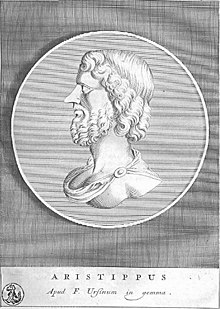
Diogenes Laertius, Lives of the Philosophers 2.8 Aristippos 71
“Once, when [Aristippos] was sailing to Corinth and there was a storm, he got pretty upset. When someone said to him, “We simple people are not afraid, but you philosophers are cowards now?”, he responded, “We are not each worrying about souls of equal worth.”
When someone else thought highly of himself for his great learning, Aristippos said, “Just as those who eat the most and exercise the most are not healthier than those who take what they need, so too the serious people are not those who read many books but useful ones.”
“It is also necessary for a woman to take to heart that she will find no kind of purifying remedy for this mistake [adultery], something that would allow her to approach the temples and altars of the gods as a chaste and god-loved woman. This is because in this crime especially the divine spirit is most unforgiving. The most beautiful achievement of a free woman and the foremost glory is to provide as testimony to her prudence toward her husband her children, if they do in fact bear the imprint of similarity to the father who sowed them. That seems to me to be enough regarding marriage.
The following seems to be right to me when it comes to the management of the body. A woman should wear white, but be dressed simply and without decoration. This style of dressing is achieved without transparent or decorated robes or robes which are made from silk; instead a woman should wear modest and white clothing. She preferably also avoids luxury and ostentation and will not cause vile jealousy in other women. She should also not put on gold or emeralds at all—this behavior would make her seem wealthy and haughty to common women.
It is necessary that the well-governed city which is ordered completely with a view to its whole should be one of common experiences and likemindedness. And it should keep out the craftspeople who create these sorts of baubles from its territory. A prudent woman should not embellish her appearance with foreign decoration and makeup but should use the native beauty of the body—she should decorate her body by washing it in water rather than bringing it shame. For this brings honor to herself and the man she lives with.
Women need to make processions from their homes to make sacrifices to the leading-god of the city for themselves, their husbands, and their households. They must make their expedition to the theater or to the market for household goods, however, not when the evening star is rising nor when it is dark but whenever it is still light, accompanied by a single servant or, at most, two as is proper.
In addition, a prudent woman must also perform sacrificial rites for the gods as is permitted to her, but must abstain from the occult rites and rituals of the Great Mother at home. For the common law prohibits women from performing these rituals, since, in addition to other things, these practices make them drunk and insane. The woman of the home needs to be temperate and uncontaminated by everything, even when she is governing the home.”
“Ptolemais of Cyrene wrote about these things briefly in her investigation and Didymos the musician addressed it as well among many other this in his work On the Difference Between Aristoksenians and Pythagoreians… Ptolemais wrote this:
What is the difference in those who are exceptional at music? Some put reason forward as the matter, but others offer sensation, while there are those who posit both. The Pythagoreans offer reason as the issue, those of them who challenge musiciians to abandon perception and instead to accept reason itself as a sufficient criterion. Musicians are refuted when they start by taking up perception in the beginning only to forget it. Instrumentalists tend to emphasize perception because the contemplation of theory is useless to them or in some way weak.
What is the difference of those who believe that both reason and perception are important criteria? Some propose that both perception and reason have similar power, while others position one in front of the other. Aristoxenos of Tarantum thinks that they matter equally. He believes that perception cannot sustain itself apart from reason and that reason is not powerful enough alone to persist without the basic foundations of perception and that it eventually returns the product of introspection back to perception.”
Why does he want to set perception before reasons? It is because of order not power. For, he says, whenever what is sensed in any way takes root then we need to privilege reason in any theory about it. Who else values both principles similarly? Pythagoras and his followers. For they want perception, as a kind of guide, to start by taking the inspirations which they pass on to reason and for reason then to move on from receiving these sensations and to adapt them on its own in moving away from perception. For this reason, if a system of thought founded upon reason seems no longer perfectly fit to perception, they do not undermine it, but instead reproach the sensation for departing from its meaning since reason discovers what is correct through itself and refutes perception.
Who is in opposition to them? Some of the musicians from the school of Aristoxenos, especially those who have assumed a theoretical mindset but have also adding to it from instrumental practice. These people believe that perception is the greater power and that reason is second only because it is useful.”
The work of Aisara of Sparta the Pythagorean about the nature of human kind
“Human nature seems to me to be a model for law and justice for home and the city alike. For one who searches the tracks inside themselves might discover and interpret this within: for law and justice, which is the guiding principle of the soul, are inside us. Because our nature is threefold, it supports three types of operations: our intelligence [noos] guides judgment and wisdom; our passion [thumôsis] directs bravery and impulse; and our desire shapes our attractions and affection. These forces are situated in relation to each other in such a way that the most powerful controls them, and the weakest is controlled. The intermediate power has a middle position, to exercise control and to be controlled in turn.
God shaped these traits in such a way and distributed them too along the model of the human body because he believes that the human alone—and none of the other mortal animals—is amenable to law and justice. For the state of any community could not even develop from one thing only, much less many, and those similar to each other—since it is necessary, when materials are different, for the parts of our souls to be different too, just as in the parts of the body when it comes to the instruments of touch, sight, taste, smell, they do not have the same harmony in respect to all things—nor could a common state come from multiple things which are unrelated but just happen to come into contact, but instead [it comes] from parts which have obtained some completeness in their whole arrangement, their composition, and their harmony together. Not only do multiple unrelated things happen to find a whole and complete form but these elements also may brought together in a random way however they happened to come together, and yet are still governed by some law and a kind of wisdom.
If each of the elements takes the same part of power and honor, even though they are unlike and one is worse and one is better and one is in the middle, they are not able of bringing the parts of the soul into harmony. If they are unequal, and the best does not control the greater portion of the soul, but the worse does, then there is great imprudence and disorder in the mind. If the better takes the greater portion and the worse takes the less, but they are not each distributed according to a logical balance, then harmony and love and justice are not able to exist in the mind, since when each one of them is distributed according to a proportional order, that’s the structure I think is most just.
A certain kind of unanimity and similarity of outlook accompanies this kind of composition. This would be rightly said to be a good government of the soul which brings the strength of virtue from the better ruling and the worse being ruled. Friendship and attraction and affection for one’s own kind and family also grow from these parts. For the mind persuades, since it can see consequences; desire longs for things; and passion, when full of energy, seethes with hate and becomes dear to desire. The mind, because it can harmonize pleasure and pain, also balances out the tense and eager portion of the soul with the light and dissolute part.
Each part is apportioned according to the family and state of each trait. The mind sees consequences and keeps track of affairs while the passion provides impulse and courage for what has been anticipated and desire, which is related to tender affection, harmonizes with the mind, taking what is pleasurable and providing a reflection on it to the reflective portion of the mind. Human life seems to me to be best with a mixture of these things, when the pleasurable is mixed with the serious and pleasure is mixed with virtue. The mind is able to harmonize these things, once it has come to love learning and virtue.”
Αἰσάρας Πυθαγορείου Λευκανᾶς ἐκ τοῦ Περὶ ἀνθρώπω φύσιος (Fr. phil. Gr. II p. 51 Mull.) :
“It is necessary that a woman be completely good and well-ordered. Someone could never be like this without virtue. For the virtue which is proper to each thing causes the object which welcomes it to be more serious. The excellence of the eyes improves the eyes; that of hearing improves the ears; the horse’s virtue betters the horse and a man’s virtue improves the man. In the same way, a woman’s virtue ennobles a woman.
The virtue most appropriate to a woman is prudence. For through prudence a woman will be able to honor and take delight in her own husband. Many may in fact think that it is not fitting for a woman to practice philosophy, just as she should not ride a horse or speak in public. But I believe that while some things are particular to a man and others to a woman, there are some that are shared by both man and woman, even though some are more appropriate to a man than a woman and those better for a woman than a man.
For example, serving in an army or working in politics and speaking in public are proper for a man. For a woman, it is running the household, staying at home, and welcoming and serving her husband. In common I place bravery, an understanding of justice, and wisdom. For It is right that virtues of the body are proper for both a man and woman along with the virtues of the soul. And, just as having a healthy body is useful for both, so too is the health of the soul.
The virtues of the body are health, strength, good perception, and beauty. Some of these are better for a man to nourish and keep; and others are more appropriate for a woman. Courage and wisdom are certainly more proper for a man both die to the nature of his body and the power of his mind. But prudence is proper for a woman.
For this reason it is important to recognize what a woman trained in prudence is like, in particular from what number and kinds of traits this possession graces a woman. I propose that this comes from five things. The first is from respecting the sanctity and reverence of her marriage bed; the second is a sense of propriety for her body; the third is concerning the actions of those from her own household; the fourth is from not practicing the occult rites and the celebrations of the Great Mother; the fifth is in proper and moderate sacrifices to the divine.
Of these traits, the most important and vital for prudence in terms of her marriage bed is staying uncontaminated and fully separate from some other man. For, to start with, a woman who breaks this law does wrong against her ancestral gods, because she provides for her home and her family not true born allies but bastards.
The one who does this transgresses against the natural gods whose oath she took, following the practice of her forebears and relatives, “to participate in the common life and to produce offspring according to the law.” She also commits injustice against her country, because she does not stay with those who were assigned to her. Then she acts even beyond those for whom the greatest of penalties is assigned because of the excess of this injustice: this is because to commit an error or an outrage for the sake of pleasure is unlawful and the most unforgivable. Ruin is the outcome of all outrage.”
“Hipparkhia, Metrokles’s sister, was also attracted to their theories. They were both from Marôneia. She fell in love with Kratês’s words and his life and paid no attention to any of her suitors, ignoring their wealth, nobility, and beauty. No, Kratês was everything to her. She even used to threatened her parents, in fact, that she would kill herself if she were not married to him.
So, when Kratês was summoned her her parents to discourage the girl, he was trying everything and when he finally could not persuade her, he stood up and stripped off his clothes and said, “Look, this is the bridegroom; this is his wealth; you are choosing these things. You will not be my partner unless you share these practices.”
The girl made the choice and once she took up the same dress she used to travel with her husband and appeared in public and went to meals with him. Once when she went to Lysimakhos’ home for a symposium, she insulted Theodoros, nicknamed the Atheist, by applying the following witticism: “If whatever Theodoros does is not called unjust then it would not be unjust if Hipparkhia did it. But if Theodoros hit himself, it would not be called wrong, nor would it be wrong if Hipparkhia hit him.”
He had nothing to say in response to this, but he started to take away Hipparkhia’s cloak. But Hipparkhia was neither surprised nor troubled in the way a woman typically is. Instead, when he said, ““Who is this who is abandoning the shuttle at the loom?” She replied, “It’s me, Theodorus—do I seem to have made a mess of my life if, instead of wasting the time to come at the loom, I have used it for education?” There are tons of other tales like this about the lady-philosopher.







_-_cropped.jpg)
.jpg)
