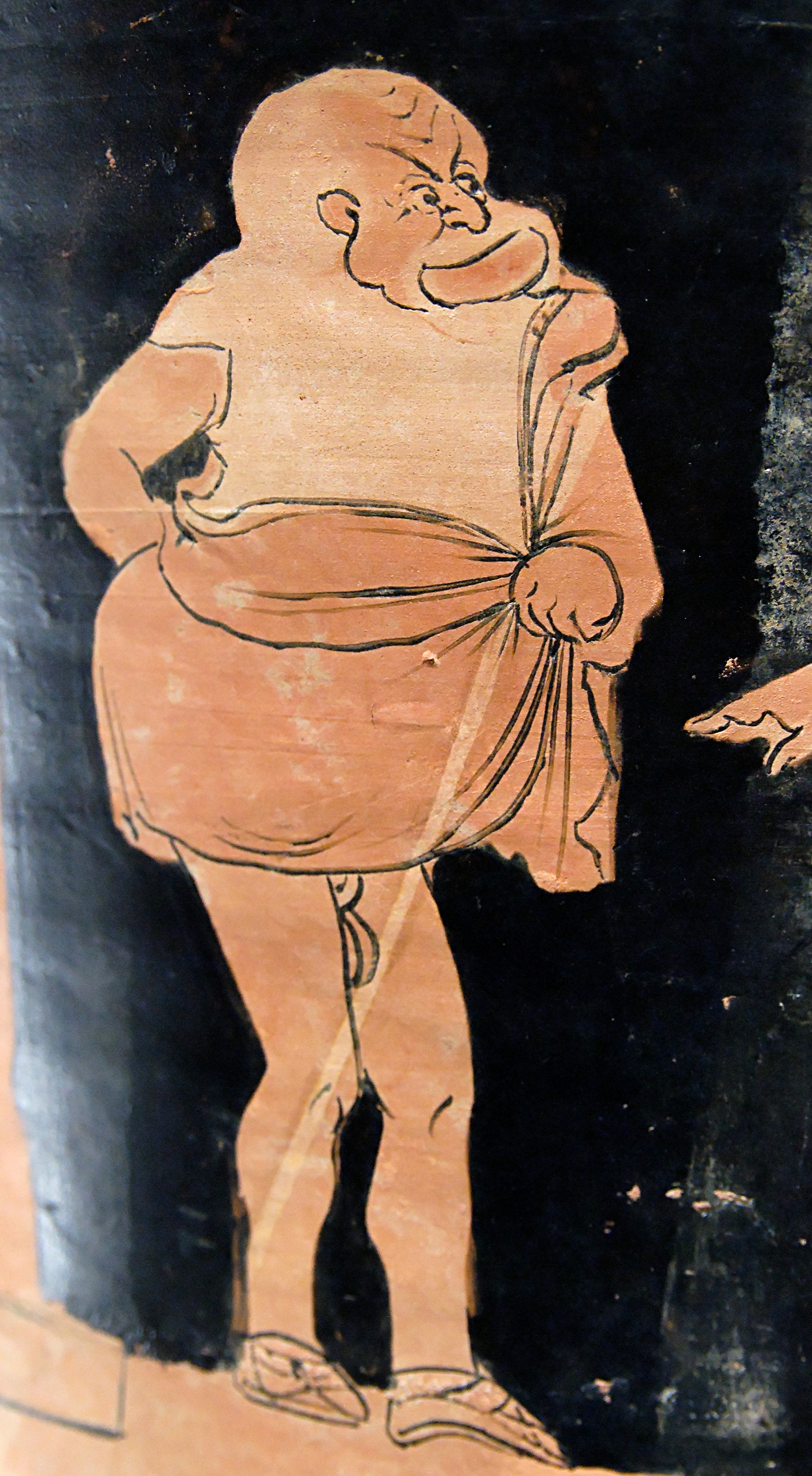
Odysseus, Ancient Athlete Enraged

Homer, Odyssey 8.165–185

Euryalus (a Phaeacian youth) has just claimed that Odysseus looks more like a pirate than an athlete.

Very-clever Odysseus glared at him and then answered in response

“Friend, you don’t speak well. You’re like a reckless man.
The gods don’t give good things to people at once in this way–
Not in form or brains or in ability to speak.
For one man is not exceptional in looks
But a god crowns his form with words. People delight
As they see him, and he speaks without hesitation in public,
With sweet reverence, and is conspicuous among those assembled,
And they gaze upon him like a god when he goes through the city.

Another is equal to the immortals in his appearance
But no charm sits well upon his words—
Just so, your shape is excellent, not even a god
Could make it differently. But your mind is limited [apophôlios].
You have raised the spirit in my dear chest
By speaking against what is right. I am no novice in sports,
As you at least claim, but I think I was among the best
When I could trust my youth and my hands.
But now I am overcome by evil and pains. I have endured much
Surviving the wars of men and the harrowing waves.
But, even so, after suffering much, I will play your games.
Your speech gnaws at my heart: you have pissed me off by speaking.”

τὸν δ’ ἄρ’ ὑπόδρα ἰδὼν προσέφη πολύμητις ᾿Οδυσσεύς·
“ξεῖν’, οὐ καλὸν ἔειπες· ἀτασθάλῳ ἀνδρὶ ἔοικας.
οὕτως οὐ πάντεσσι θεοὶ χαρίεντα διδοῦσιν
ἀνδράσιν, οὔτε φυὴν οὔτ’ ἂρ φρένας οὔτ’ ἀγορητύν.
ἄλλος μὲν γὰρ εἶδος ἀκιδνότερος πέλει ἀνήρ,
ἀλλὰ θεὸς μορφὴν ἔπεσι στέφει· οἱ δέ τ’ ἐς αὐτὸν
τερπόμενοι λεύσσουσιν, ὁ δ’ ἀσφαλέως ἀγορεύει,
αἰδοῖ μειλιχίῃ, μετὰ δὲ πρέπει ἀγρομένοισιν,
ἐρχόμενον δ’ ἀνὰ ἄστυ θεὸν ὣς εἰσορόωσιν.
ἄλλος δ’ αὖ εἶδος μὲν ἀλίγκιος ἀθανάτοισιν,
ἀλλ’ οὔ οἱ χάρις ἀμφὶ περιστέφεται ἐπέεσσιν,
ὡς καὶ σοὶ εἶδος μὲν ἀριπρεπές, οὐδέ κεν ἄλλως
οὐδὲ θεὸς τεύξειε, νόον δ’ ἀποφώλιός ἐσσι.
ὤρινάς μοι θυμὸν ἐνὶ στήθεσσι φίλοισιν
εἰπὼν οὐ κατὰ κόσμον· ἐγὼ δ’ οὐ νῆϊς ἀέθλων,
ὡς σύ γε μυθεῖαι, ἀλλ’ ἐν πρώτοισιν ὀΐω
ἔμμεναι, ὄφρ’ ἥβῃ τε πεποίθεα χερσί τ’ ἐμῇσι.
νῦν δ’ ἔχομαι κακότητι καὶ ἄλγεσι· πολλὰ γὰρ ἔτλην,
ἀνδρῶν τε πτολέμους ἀλεγεινά τε κύματα πείρων.
ἀλλὰ καὶ ὧς, κακὰ πολλὰ παθών, πειρήσομ’ ἀέθλων·
θυμοδακὴς γὰρ μῦθος· ἐπώτρυνας δέ με εἰπών.”


Schol. QT ad Od. 8.166 ex

 “it is the Homeric custom to get a sense of the manner and character of someone you meet from their words. [This occurs elsewhere] for Telemachus: “you are of good blood, dear child, based on the way you think.” This is because he believe that being well-born and educated necessarily go together and he says everything appropriately. But Odysseus, for he did not maintain strongly that he is reckless, but says that he is like someone who is, because of his response and what he said.”

ξεῖν’, οὐ καλὸν ἔειπες] ἔθος ἐστὶν ῾Ομηρικὸν ἐκ τῶν λόγων χαρακτηρίζεσθαι καὶ τὸν τρόπον τοῦ ἐντυγχάνοντος. καὶ ἐν ἄλλοις περὶ τοῦ Τηλεμάχου “αἵματος εἶς ἀγαθοῖο, φίλον τέκος, οἷ’ ἀγορεύεις” (δ, 611.)· οἰόμενος τὸν εὐγενῆ καὶ πεπαιδευμένον ἀναγκαίως ὁμιλεῖν, πρεπόντως δὲ πάντα λέγειν. ᾿Οδυσσεὺς δὲ, οὐ γὰρ διεβεβαιώσατο τὸ ἀτάσθαλον αὐτὸν εἶναι, ἀλλ’ ἐοικέναι φησὶ τούτῳ διὰ τὸ
ἀντειπεῖν καὶ εἰρηκέναι. Q.T.

Schol. E ad Od. 8.177 ex 11-14

“Apophôlios properly means one who is not worthy of being included in the number of men, for they lack words and deeds at the right time. They call the primary schools phôleus. The one who has not frequented schools is called un-schooled.”

καὶ ἔστι κυρίως ἀποφώλιος ὁ μὴ ἄξιος συναριθμεῖσθαι ἀνδρῶν ὁλότητι ἐν φωτὶ, ἤγουν ἐν καιρῷ ἔργων ἢ λόγων δεομένῳ. φωλεοὺς λέγουσι τὰ παιδευτήρια. ὁ γοῦν μὴ φοιτῶν εἰς τὰ παιδευτήρια λέγεται ἀποφώλιος. E.

Image result for Ancient Greek vase Odysseus

What Games Are the Phaeacians Good At?

Homer Odyssey 8.97-103

“Hear me, leaders and chiefs of the Phaeacians.
We have already sated our desire for the righteous feast
And the lyre which is the companion to a bountiful meal.
Now, let us go out and test ourselves at every kind of competition
So that this stranger may tell his friends once he gets home
How much we are better than the rest at boxing
And wrestling, and jumping and running.”

“κέκλυτε, Φαιήκων ἡγήτορες ἠδὲ μέδοντες·
ἤδη μὲν δαιτὸς κεκορήμεθα θυμὸν ἐΐσης
φόρμιγγός θ’, ἣ δαιτὶ συνήορός ἐστι θαλείῃ·
νῦν δ’ ἐξέλθωμεν καὶ ἀέθλων πειρηθῶμεν
πάντων, ὥς χ’ ὁ ξεῖνος ἐνίσπῃ οἷσι φίλοισιν
οἴκαδε νοστήσας, ὅσσον περιγινόμεθ’ ἄλλων
πύξ τε παλαιμοσύνῃ τε καὶ ἅλμασιν ἠδὲ πόδεσσιν.”

Schol. EQ ad 8.100 ex 6 asks

[now, let us go out..]“Why were the Phaeacians after dinner competing in the field competition, the race and the double race, and not any other sport? For these are wholly the activities of leisurely people. Perhaps because it was necessary to make this suitable to their character, since the poetry is imitation [mimesis], [the poet] composed it thus. For they say “the feast and the cithara and dances are always dear to us”

νῦν δ’ ἐξέλθωμεν] διὰ τί οἱ Φαίακες εὐωχηθέντες ἠγωνίζοντο γυμνικὸν ἀγῶνα, δρόμον καὶ δίαυλον καὶ οὐ τὴν ἄλλην ἄθλησιν; παντελῶς γὰρ ἀπόνων ἀνθρώπων ταῦτα. ἴσως δὲ, ἁρμόττον τοῖς ἤθεσι δέον ποιεῖν, ἐπειδὴ μίμησις ἡ ποίησις, οὕτω πεποίηκεν. ὅτι δὲ τοιοῦ-τοι δῆλον. ἔφασαν γὰρ “ἀεὶ δ’ ἡμῖν δαίς τε φίλη κίθαρίς τε χοροί τε” (248.).

Schol. HQ ad Od. 8.102 ex

And how does he say later “For we are not preeminent at boxing or wrestling”? Certainly, in however much they are inexperienced with Odysseus, they believe they all surpass him  in these games when in the actual performance once he speaks of himself himself, Odysseus boasted about the rest of the competitions, begging out only in the race and responding to the praise of Alkinoos when he said “but we run swiftly with our feet and are best at ships…” (247)

καὶ πῶς φησιν “οὐ γὰρ πυγμάχοι εἰμὲν ἀμύμονες οὐδὲ παλαισταί” (246.); ἐν ὅσῳ τοίνυν ἄπειροί εἰσιν ᾿Οδυσσέως οἴονται νικᾶν ἅπαντας ἐν τούτοις, ὅτε δὲ τῇ πείρᾳ δείξας ἑαυτὸν ᾿Οδυσσεὺς ἐκαυχήσατο περὶ τῶν ἄλλων ἄθλων μόνον παραιτησάμενος τὸν δρόμον, ἀντιμεταλαβὼν τὰ ἐγκώμια ᾿Αλκίνους φησὶν “ἀλλὰ ποσὶ κραιπνῶς θέομεν καὶ νηυσὶν ἄριστοι, ἀεὶ δ’ ἡμῖν δαίς τε φίλη, εἵματά τ’ ἐξημοιβά” (247—249.).


Image result for Ancient Greek running vase
A vase from the Getty Museum

The ‘Wives’ of Telemachus

Tell me of Telemachus, Muse, and the tawdry tales
of his trio of tender-ankled temptresses

Hesiod, Fr. 221 (Eustathius in Hom. (π 117—20) p. 1796. 38)

“Well-belted Polycaste, the youngest daughter of Nestor Neleus’ son, gave birth to Persepolis after having sex with Telemachus Thanks to golden Aphrodite.”

Τηλεμάχωι δ’ ἄρ’ ἔτικτεν ἐύζωνος Πολυκάστη
Νέστορος ὁπλοτάτη κούρη Νηληϊάδαο
Περσέπολιν μιχθεῖσα διὰ χρυσῆν ᾿Αφροδίτην

This resonates with one moment in the Odyssey (3.464-5):

“Then pretty Polycaste, the youngest daughter of Nestor
the son of Neleus, bathed Telemachus”

τόφρα δὲ Τηλέμαχον λοῦσεν καλὴ Πολυκάστη
Νέστορος ὁπλοτάτη θυγάτηρ Νηληϊάδαο.

Dictys, BNJ 49 F10

“And Telemachus took the daughter of Alkinoos as bride, her name was Nausikaa.”

λαμβάνει δὲ Τηλέμαχος γαμετὴν θυγατέρα Ἀλκινόου Ναυσικάαν ὀνόματι.

Proclus (?), Chrestomathia 324-330

“And then Telegonos went sailing in search of his father; once he stopped in Ithaca he was trashing the island. Odysseus shouted out and was killed by his child because of ignorance.

Once Telegonos understood his mistake he returned the body of his father along with Penelope and Telemachus to his own mother. She made them immortal. Then he lived with Penelope and Telemachus lived with Kirke.

κἀν τούτῳ Τηλέγονος ἐπὶ ζήτησιν τοῦ πατρὸς πλέων ἀποβὰς εἰς τὴν ᾿Ιθάκην τέμνει τὴν νῆσον· ἐκβοηθήσας δ’ ᾿Οδυσσεὺς ὑπὸ τοῦ παιδὸς ἀναιρεῖται κατ’ ἄγνοιαν.
Τηλέγονος δ’ ἐπιγνοὺς τὴν ἁμαρτίαν τό τε τοῦ πατρὸς σῶμα

Image result for Ancient Greek vase Circe

Avenging Vengeance: Murder, Exile, and ‘Justice’

When Telemachus slips their ambush, the suitors hold an assembly and reflect on the political consequences.

Homer, Odyssey 16.372–382

“…For I do not think
that our acts will come to good while [Telemachus] is alive.
For he is smart in plans and thought on his own,
and the people are no longer completely showing us favor.
Come, before he gathers the Achaians in assembly.
For I do not think that he will delay at all,
but he will be angry and he will rise and speak among everyone
because we were weaving sheer murder for him and we did not catch him.
They will not praise it when they hear these evil deeds,
but they will accomplish something terrible
and drive us from our land, and we will go to another’s country.

“…οὐ γὰρ ὀΐω
τούτου γε ζώοντος ἀνύσσεσθαι τάδε ἔργα.
αὐτὸς μὲν γὰρ ἐπιστήμων βουλῇ τε νόῳ τε,
λαοὶ δ’ οὐκέτι πάμπαν ἐφ’ ἡμῖν ἦρα φέρουσιν.
ἀλλ’ ἄγετε, πρὶν κεῖνον ὁμηγυρίσασθαι ᾿Αχαιοὺς
εἰς ἀγορήν· —οὐ γάρ τι μεθησέμεναί μιν ὀΐω,
ἀλλ’ ἀπομηνίσει, ἐρέει δ’ ἐν πᾶσιν ἀναστάς,
οὕνεκά οἱ φόνον αἰπὺν ἐράπτομεν οὐδ’ ἐκίχημεν·
οἱ δ’ οὐκ αἰνήσουσιν ἀκούοντες κακὰ ἔργα·
μή τι κακὸν ῥέξωσι καὶ ἥμεας ἐξελάσωσι
γαίης ἡμετέρης, ἄλλων δ’ ἀφικώμεθα δῆμον.”

After slaughtering the suitors, Odysseus tells Telemachus to think about what happens when someone murders someone else.

Odyssey 23.118–122:

“For whoever has killed only one man in his country,
one who does not leave many behind to avenge him,
flees, leaving his relatives and his paternal land.
And we have killed the bulwark of the city, the best by far
of the young men in Ithaca. I order you to think about these things.”

καὶ γάρ τίς θ’ ἕνα φῶτα κατακτείνας ἐνὶ δήμῳ,
ᾧ μὴ πολλοὶ ἔωσιν ἀοσσητῆρες ὀπίσσω,
φεύγει πηούς τε προλιπὼν καὶ πατρίδα γαῖαν·
ἡμεῖς δ’ ἕρμα πόληος ἀπέκταμεν, οἳ μέγ’ ἄριστοι
κούρων εἰν ᾿Ιθάκῃ· τὰ δέ σε φράζεσθαι ἄνωγα.”

Peter Ahrensdorf emphasizes that in times of civil war “human hopes, especially for immortality, tend to overwhelm human fears, even of violent death”  (2000, 579). It changes the threshold of expectation the way that epic tales of vengeance set a horizon of expectation for proper behavior and outcomes in narratives (587). In contemplating the Thucydidean claim that men “preferred to suffer injustice and then take revenge than not suffer injustice at all. They believed it was better to be wronged and to avenge that wrong than never to wrong at all”, he explains that “ the passion for vengeance is, from the viewpoint of one who seeks vengeance, a passion for justice, since it necessarily entails seeking to punish what is thought to be previous injustice.”

Peter. J. Ahrensdorf. “The Fear of Death and the Longing for Immortality: Hobbes and Thucydides on Human Nature and the Problem of Anarchy.” The American Political Science Review 94 (2000) 579-593.

Image result for Ancient greek vase odysseus suitors

Odyssey 22.11-14

“Murder wasn’t on his mind at all.
Who would think that one man alone among many dinner guests
Even a really strong one, could contrive a wicked death
And dark fate?”

… φόνος δέ οἱ οὐκ ἐνὶ θυμῷ
μέμβλετο. τίς κ’ οἴοιτο μετ’ ἀνδράσι δαιτυμόνεσσι
μοῦνον ἐνὶ πλεόνεσσι, καὶ εἰ μάλα καρτερὸς εἴη,
οἷ τεύξειν θάνατόν τε κακὸν καὶ κῆρα μέλαιναν;

An Eclipse in the Odyssey? [Updated]

When he arrives in Odysseus’ household, the seer Theoklymenos gets a little judgy:

Homer, Odyssey 20.351-57

“Wretches! What evil is this you are suffering? Now your heads
Are covered with night along with your faces and legs below.
A wailing burns and your cheeks streak with tears
As the walls and fine rafters are sprayed with blood.
The entryway is filled with ghosts, the courtyard is filled with ghosts
Heading to Erebos under the darkness. The sun has perished
From the sky and a wicked mist rushes over us.”

“ἆ δειλοί, τί κακὸν τόδε πάσχετε; νυκτὶ μὲν ὑμέων
εἰλύαται κεφαλαί τε πρόσωπά τε νέρθε τε γοῦνα,
οἰμωγὴ δὲ δέδηε, δεδάκρυνται δὲ παρειαί,
αἵματι δ’ ἐρράδαται τοῖχοι καλαί τε μεσόδμαι·
εἰδώλων δὲ πλέον πρόθυρον, πλείη δὲ καὶ αὐλή,
ἱεμένων ῎Ερεβόσδε ὑπὸ ζόφον· ἠέλιος δὲ
οὐρανοῦ ἐξαπόλωλε, κακὴ δ’ ἐπιδέδρομεν ἀχλύς.”

A suitor’s response is appropriately dismissive: 20.360-362

“A crazy stranger has just arrived from somewhere else.
Come, quick, young men, send him out of the house
To to to the assembly since he thinks this is like the night!”

“ἀφραίνει ξεῖνος νέον ἄλλοθεν εἰληλουθώς.
ἀλλά μιν αἶψα, νέοι, δόμου ἐκπέμψασθε θύραζε
εἰς ἀγορὴν ἔρχεσθαι, ἐπεὶ τάδε νυκτὶ ἐΐσκει.”

People have, of course, figured out which eclipse this might have been. Despite, you know, that this is poetry.  A scholion is having nothing to do with that:

Schol. B ad Od. 20.356

“A solar eclipse did not happen but Theoklymenos sees it this way as he tells a prophecy under divine influence since the sun will eclipse for these guys.”

ἠέλιος δὲ οὐρανοῦ ἐξαπόλωλε] οὐ γὰρ ἡλίου ἔκλειψις ἐγένετο,
ἀλλὰ Θεοκλύμενος οὕτως ὁρᾷ ὑπό τινος ἐνθουσιασμοῦ μαντευόμενος
ὅτι ἐκλείψει αὐτοῖς ὁ ἥλιος.

People cite Plutarch (On the Face in the Moon 19), suggesting that he presents this scene as being an eclipse: but he is, in my opinion, satirizing a man who marshals an excess of questionable poetic ‘proofs’ to display his own erudition about eclipses. You can read a free version of this at Lacus Curtius.

Image result for Ancient Greek Odyssey eclipse
“I’ll put your lights out….”

Peter Gainsford has a great piece about this from 2012 (TAPA 142 1-22). Over twitter, he pointed out that he did not include P. Oxy. 53, 3710 (M.W. Haslam, 1986) which contains a lot of information about eclipses in conjunction with the passage from the Odyssey.

I have read a good deal of scholia and I am not convinced that the passage changes anything about whether or not this part of Odyssey refers to an eclipse. Some ancient scholars may have thought so—and the scholion implies that—but scholiasts also tend to fill commentary with displays of erudition and minutiae. But, here’s my [hasty] translation of a section of the fragment. You can view the whole fragment here. Also, I welcome any suggestions for cleaning up this translation.

“Aristonikos says that it was the new moon then, from which [we get?] Apollo, since he is the sun himself. Aristarkhos of Samos writes that this is because eclipses happen on the new moon. Thales says that the sun goes into eclipse when the moon is in front of it and when the day [….] marks it, on which it makes the eclipse which some call the thirtieth day and others call the new moon.

Heraclitus says as follows: when the months come together [the eclipse?] appears then before the second new moon and then they grow sometimes less and at other times more. Diodorus explains the same thing. For, after the moon is hidden it moves towards the sun during the final [days] of the month until it impedes the rays of the sun and…..makes it disappear and then in turn….”

Ἀριστόνικός11 φησι̣ν ὅτι νουμη̣νία ἦν̣ τότε,
35 ὅθεν Ἀ[πόλ]λ̣ωνος, ἐπεὶ ὁ α̣ὐτὸς ἡλίωι·
36 ὅτι ἐν νο̣υ̣μη̣ν̣ίαι αἱ ἐκλείψεις12 δηλο̣[ῖ]
37 Ἀρίσταρχ̣ο̣ς̣ ὁ Σάμ[ι]ος γράφων· ἔφη τε
38 ὁ μὲν Θαλῆς ὅτι ἐκλείπει̣ν τὸν ἥλ[ι]‐
39 ον σ̣ελήνης ἐπίπροσθεν̣ αὐτῶι γεν̣ο̣‐
40 μένης, σημ̣ειουμέ̣[νης ] ̣ ̣ ̣ τῆς
41 ἡμέρα̣ς̣, ἐν ἧ̣ι ποιεῖτα̣ι̣ τ̣ὴν ἔκλει̣ψιν13,
42 ἣ[ν] ο̣ἱ̣ μ̣ὲν τ̣ριακάδα καλοῦσιν ο[ἱ] δὲ νου‐
43 μηνί̣α̣ν. Ἡράκλειτος· συνϊόντ̣ων 〉
44 τῶν μηνῶν ἡμέρας ἐξ [ὅ]τ̣ου̣14 φαί‐ 〉
45 ν̣ε̣ται15 προτέρην νουμην[ί]ην̣ δ̣ευ‐16
46 τέρ̣ην ἄλλοτ’ ἐλάσσονας μ̣εταβάλ̣λ̣ε‐
47 τ̣α̣ι̣ ἄλλοτε πλεῦνας. Διόδωρος οὕτω̣ς̣
48 α̣ὐ̣τ̣ὸ εξαγει̣το17· ἐπεὶ γὰρ ἀπ[ο]κρύπτετ̣αι
49 μ̣ὲν ἡ18 σ̣ελήνη προσάγουσ̣α τῶι ἡλίωι
50 κ̣α̣τ̣ὰ̣ τὰς τῶν μην̣ῶν τελ̣ευτάς, ὅτ̣αν
51 ε̣ἰς τὰς̣ α̣ὐγὰς19 ἐμπέσηι τὰ̣ς̣ τοῦ ἡλίου, 〉
52 ̣ ̣] ̣χρον̣[ ] ̣α̣φανι̣σ̣[θε]ῖ̣σα20, πάλιν
53 ] ̣ ̣ ̣να[ ̣] ̣ωνεκφα ̣[ ] ̣ ̣τ̣ι̣
54 ]μεισοταντηνεκτων 〉
55 ] ̣πρωτωσπ[ ̣ ̣ ̣]ηταιν[ ]υ

Notes from the site: 34 n. 11 Ἀριστόνικός res ed.pr. : αριΝι P
36 n. 12 αἱ ἐκλείψεις add m2 : εκλειψεις m1
41 n. 13 ἔκλει̣ψιν corr ed.pr. : εγλει̣ψιν P
44 n. 14 ἐξ [ὅ]τ̣ου̣ ed.pr. : ἑξ[ῆς] γ̣̅ οὐ̣ Mouraviev
45 n. 15 ν̣ε̣ται ed.pr : / ν̣ε̣ται Mouraviev
45 n. 16 προτέρην νουμην[ί]ην̣ δ̣ευ‐ del m1 : προτέρην νουμην[ί]α̣νην̣ δ̣ευ P : προτέρη νουμηνίη vel νεομηνίη ἐς δευ‐ corr West
48 n. 17 εξαγει̣το ed.pr. : ἐξηγεῖτο corr Mouraviev
49 n. 18 μ̣ὲν ἡ ed.pr. : μὴν ἢ corr Mouraviev
51 n. 19 α̣ὐγὰς corr ed.pr. : α̣υτας P
52 n. 20 α̣φανι̣σ̣[θε]ῖ̣σα ed.pr. : ἀ̣φανι̣σ̣[θε]ὶ̣ς del Mouraviev
05 n. 21 ̣εωσμεσο̣ del m1 : ̣εωσμεσαι̣ο̣ P

Lies Like the Truth: Correspondence and Coherence?

Theogony 26-28

“Rustic shepherds, wretched reproaches, nothing but bellies,
We know how to say many lies similar to the truth
And we know how to speak the truth when we want to.”

“ποιμένες ἄγραυλοι, κάκ’ ἐλέγχεα, γαστέρες οἶον,
ἴδμεν ψεύδεα πολλὰ λέγειν ἐτύμοισιν ὁμοῖα,
ἴδμεν δ’ εὖτ’ ἐθέλωμεν ἀληθέα γηρύσασθαι.”

Odyssey 19.203

“He was like someone speaking many lies similar to the truth.”

ἴσκε ψεύδεα πολλὰ λέγων ἐτύμοισιν ὁμοῖα·

In studying memory systems, Martin Conway suggests that there are two forces in human memory: correspondence, which is about equivalence between details of ‘reality’ (or experience) and details of a story and coherence, which means that details make sense together in a narrative. When it comes to the way these systems operate in the human mind, not only does he argue that the memory systems have different neuro-anatomy, but he suggests that the episodic memory system (which prizes correspondence) developed earlier and is more basic to day-to-day survival than the autobiographical memory system which focuses more on coherence and is essential for the development of a goal or ‘identity’ driven self. The two systems are not exclusive—autobiographical memory selects from episodic memory in the creation of a coherent self.

Perhaps rather than considering these moments from the Theogony and the Odyssey as reflections of a tension between “fact and fiction”, we might find the relationship of correspondence and coherence more illuminating. Just as the Theogonic narrative selects from the range of mythical episodes to create a coherent narrative that is goal-driven, so too does Odysseus select and reintegrate details throughout books 13–19 in order to reintegrate into his community and complete a narrative of vengeance.

Image result for Ancient Greek Memory

Some things to read

Martin A. Conway. “Memory and the Self,” Journal of Memory and Language 53 (2005) 594-628.

Charles Fernyhough. Pieces of Light: How the New Science of Memory Illuminates the Stories We Tell About Our Past. London: Profile, 2012.

David C. Rubin. “The Basic-systems Model of Episodic Memory,” Perspectives on Psychological Science 1 (2006) 277-311.

Edmund Wilson. “On Free Will and How the Brain is Like a Colony of Ants.” Harper’s September 2014, 49-52.

Can You Stomach This? Gaster-Compounds in Ancient Greek

A proverb

“A fat stomach does not bear a subtle mind”

Γαστὴρ παχεῖα λεπτὸν οὐ τίκτει νόον.  (Arsenius, 5.22a1)

Od. 18.54-56

“Friends, it is in no way good for an old man
In the clutches of sorrow to fight a younger man.
But my no-good stomach compels me, that I might fall beneath his blows.”

“ὦ φίλοι, οὔ πως ἔστι νεωτέρῳ ἀνδρὶ μάχεσθαι
ἄνδρα γέροντα δύῃ ἀρημένον· ἀλλά με γαστὴρ
ὀτρύνει κακοεργός, ἵνα πληγῇσι δαμείω.

γαστήρ, ἡ: “stomach”

γαστραία: A type of turnip

γαστρίδουλος: “slave to one’s stomach”

γαστρίον: “sausage”

γαστρίζω: “to punch someone in the belly”

γραστριμαργία: “gluttony”

γαστροβαρής: “stomach-heavy”, i.e. “heavy with child”

γαστροκνημία: lit. “shin-stomach”, so “calf”

γαστρολογία: An almanac for gourmands, so “foodie-book”

γαστρομαντεύομαι: “to divine by the stomach”

γαστροπίων: “a fat-bellied fellow”

γαστρορραφία: “sewing a stomach wound”

γαστρόρροια: “diarrhea”

γαστροτόμος: “stomach cutting”

Image result for ancient greek comic vase

γαστροχάρυβδις: “having a gaping maw of a belly”

γαστρόχειρ: lit. “stomach-hand”, so “living by hand” or “hand to mouth”

γαστρώδης: “pot pellied”

Proteus, Tithonus and Aiolos: More Odyssean Allegories

Schol. EM ad Od. 4.384

“The winds and every sort of breeze”: Some allegorize Proteus as matter itself. For without matter, they claim that the creator [could not] have made everything distinct. For, although matter is never clear to us, men, trees, water and all things come from it. Eidothea, you see, is thought. Matter produces thought once it is condensed. Others allegorize Proteus as the right part of the spring when the earth first begins to make the shapes of grapes and offspring. Menelaos, since it was not the right time for sailing and he missed the spring, sailed in the wrong direction. The name Proteus is suitable for allegory.”

ἀνέμων καὶ παντελοῦς ἀπνοίας. τινὲς δὲ καὶ ἀλληγορικῶς Πρωτέα τὴν ὕλην. ἄνευ γὰρ ὕλης φασὶ τὸν δημιουργὸν πάντα τὰ ὁρώμενα **** ὕλης δὲ τῆς μὴ φαινομένης ἡμῖν, ἐξ ἧς ἄνθρωποι, δένδρα, ὕδατα καὶ πάντα τἄλλα. Εἰδοθέη γὰρ τὸ εἶδος. ὕλη γὰρ ἀποτελεῖ εἶδος κατεργασθεῖσα. ἄλλοι δὲ Πρωτέα φασὶν ἀλληγορικῶς τὸν πρὸ τοῦ ἔαρος καιρὸν, μεθ’ ὃν ἄρχεται ἡ γῆ εἴδη ποιεῖν βοτανῶν καὶ γενῶν. ὁ δὲ Μενέλαος μὴ ὄντος καιροῦ ἐπιτηδείου πρὸς τὸ πλεῖν φθάσαντος τοῦ ἔαρος ἀπέπλευσε. τὸ δὲ Πρωτέως ὄνομα εἰς τὴν ἀλληγορίαν ἐπιτήδειον. E.M.


Schol V ad Od. 5.1

“Tithonos is the son of Laomedon, Priam’s brother. He is a husband of Dawn [Eos]. Endumiôn is said to have married Selenê and Tithonos, the Day. The allegory works like this. Endumiôn is concerned with hunting man, and he goes to bed at night, but not so much at day because he is occupying his time with hunting affairs. Tithonos is appropriate for those interested in the stars and who take to bed at day but stay awake at night because they are occupying themselves with the stars.”

Τιθωνοῖο] Τιθωνὸς Λαομέδοντος παῖς, Πριάμου ἀδελφὸς, ᾿Ηοῦς ἀνήρ. ὁ ᾿Ενδυμίων λέγεται συνευνᾶσθαι τῇ Σελήνῃ καὶ ὁ Τιθωνὸς τῇ ῾Ημέρᾳ. ἀλληγορεῖται δὲ οὕτως. ὁ ᾿Ενδυμίων εἰς ἄνδρα κυνηγέτην, καὶ τῇ μὲν νυκτὶ κοιμώμενον, τῇ δὲ ἡμέρᾳ οὐδὲ ποσῶς, διὰ τὸ ἠσχολῆσθαι περὶ τὰ κυνηγέσια· ὁ δὲ Τιθωνὸς εἰς ἀστρονόμον καὶ τῇ μὲν ἡμέρᾳ κοιμώμενον, τῇ δὲ νυκτὶ ἐπαγρυπνοῦντα, διὰ τὸ ἠσχολῆσθαι περὶ τὰ ἄστρα. V.

Schol. HQV ad Od. 10.6

There are other interpretations. Some allegorize Aiolos as the year and his children as the twelve months. Some say that he that he paid special attention, because he was knowledgeable of astrology, of when the sun was blowing in the west in the bull position. Some winds blow sometimes and then move against themselves, as many do….

῎Αλλως. τινὲς ἀλληγοροῦντες Αἴολον μὲν λέγουσι τὸν ἐνιαυτὸν, δώδεκα δὲ παῖδας τοὺς μῆνας. τινὲς δὲ ὅτι παρετήρησεν, ἀστρολογίας ἔμπειρος ὢν, ἡλίου ὄντος ἐν ταύρῳ ζέφυρον πνεῦσαι. οἱ δὲ ἄνεμοι πνέουσιν ἐνίοτε καὶ καθ’ ἑαυτοὺς, ὡς καὶ πολλοί· καὶ γὰρ ἡμεῖς δίχα βασιλικοῦ προστασσόμενοι προστάγματος. H.Q.V.


vImage result for Ancient Greek Proteus medieval manuscript

Odysseus’ Wanderings As Allegory

Heraclitus, Homeric Problems 70

“Generally, then, if one wants to examine it carefully, you will find Odysseus’ wandering to be an allegory. Homer has positioned Odysseus as some kind of an instrument of every kind of virtue and he has used him to philosophize, since he hated the wickedness which governs human life.

The land of the Lotus-eaters, a farm of exotic temptation, represents the temptation of pleasure through which Odysseus sailed in perfect control. He snuffs out the savage anger of each of us with the advice from his words as if cauterizing it. This anger is named the Cyclops, the one who steals away [hypoklôpôn] our faculties of reason.

What of this—does it not seem that Odysseus who ‘overcame the winds’ was the first to anticipate fair sailing through his knowledge of the stars? And he was superior to Kirkê’s drugs because he discovered a cure for addictive delicacies thanks to his deep wisdom.

And his intelligence extends even to Hades so that nothing in the underworld might go unexplored. Who listens to the Sirens and learns a diverse history of all time? Charybdis is an obvious name for luxury and endless drinking. Homer has allegorized manifold shamelessness in Skylla, which is why she would logically have a belt of dogs, guardians for her rapacity, daring, and pugnacity. The cattle of the sun are about controlling your eating—for he would not even allow starvation to be a compulsion to do injustice.

These stories were told mythically for their audiences, if someone delves into the allegorized wisdom, it will be the most useful to those who apprehend it.”

Καθόλου δὲ τὴν ᾿Οδυσσέως πλάνην, εἴ τις ἀκριβῶς ἐθέλει σκοπεῖν, ἠλληγορημένην εὑρήσει·

 πάσης γὰρ ἀρετῆς καθάπερ ὄργανόν τι τὸν ᾿Οδυσσέα παραστησάμενος ἑαυτῷ διὰ τοῦτο πεφιλοσόφηκεν, ἐπειδὴ τὰς ἐκνεμομένας τὸν ἀνθρώπινον βίον ἤχθηρε κακίας.

 ῾Ηδονὴν μέν γε, τὸ Λωτοφάγον χωρίον, ξένης γεωργὸν ἀπολαύσεως, ἣν ᾿Οδυσσεὺς ἐγκρατῶς παρέπλευσεν·  τὸν δ’ ἄγριον ἑκάστου θυμὸν ὡσπερεὶ καυτηρίῳ τῇ παραινέσει τῶν λόγων ἐπήρωσε.  Κύκλωψ δὲ οὗτος ὠνόμασται, ὁ τοὺς λογισμοὺς ὑποκλωπῶν.

     Τί δ’; οὐχὶ πρῶτος εὔδιον πλοῦν δι’ ἐπιστήμης ἀστρονόμου τεκμηράμενος ἔδοξεν ἀνέμους δεδωκέναι; Φαρμάκων τε τῶν παρὰ Κίρκης γέγονε κρείττων, ὑπὸ πολλῆς σοφίας πεμμάτων ἐπεισάκτων κακῶν λύσιν εὑρόμενος.

     ῾Η δὲ φρόνησις ἕως ῞Αιδου καταβέβηκεν, ἵνα μηδὲ τῶν νέρθεν ἀδιερεύνητον ᾖ.  Τίς δὲ Σειρήνων ἀκούει, τὰς πολυπείρους ἱστορίας παντὸς αἰῶνος ἐκμαθών;  Καὶ Χάρυβδις μὲν ἡ δάπανος ἀσωτία καὶ περὶ πότους ἄπληστος  εὐλόγως ὠνόμασται·  Σκύλλαν δὲ τὴν πολύμορφον ἀναίδειαν ἠλληγόρησε, διὸ δὴ κύνας οὐκ ἀλόγως ὑπέζωσται προτομαῖς ἁρπαγῇ, τόλμῃ καὶ πλεονεξίᾳ πεφραγμέναις·

 αἱ δ’ ἡλίου βόες ἐγκράτεια γαστρός εἰσιν, εἰ μηδὲ λιμὸν ἔσχεν ἀδικίας ἀνάγκην.

     ῝Α δὴ μυθικῶς μέν ἐστιν εἰρημένα περὶ τοὺς ἀκούοντας, εἰ δ’ ἐπὶ τὴν ἠλληγορημένην σοφίαν καταβέβηκεν, ὠφελιμώτατα τοῖς μιμουμένοις γενήσεται.


Image result for Ancient Greek Odysseus wandering

“A Safe Harbor for the Soul”: On Poetry and Reason

Philo, On Dreams 1.233

“Perhaps this is not sung truly, but it is wholly profitable and advantageous”

καὶ τάχα μὲν οὺκ ἀληθῶς, πάντως δὲ λυσιτελῶς καὶ συμφερόντως ᾄδεται


Proclus, Commentary on Plato’s Parmenides 1025.29-37

“Our soul experiences many wanderings and turns—one comes from the imagination, another emerges in the beliefs before these, and other occurs in understanding. But the life governed by the mind is free from vagrancy and this is the mystical harbor of the soul into which the poem leads Odysseus after the great wandering of his life and where we too, if we want to be saved, may find our mooring.”

Πολλαὶ οὖν αἱ πλάναι καὶ αἱ δινεύσεις τῆς ψυχῆς· ἄλλη γὰρ ἡ ἐν ταῖς φαντασίαις, ἄλλη πρὸ τούτων ἡ ἐν δόξαις, ἄλλη ἡ ἐν αὐτῇ τῇ διανοίᾳ· μόνη δὲ ἡ κατὰ νοῦν ζωὴ τὸ ἀπλανὲς ἔχει, καὶ οὗτος ὁ μυστικὸς ὅρμος τῆς ψυχῆς, εἰς ὃν καὶ ἡ ποίησις ἄγει τὸν ᾿Οδυσσέα μετὰ τὴν πολλὴν πλάνην τῆς ζωῆς, καὶ ἡμεῖς, ἐὰν ἄρα σώζεσθαι θέλωμεν, μᾶλλον ἑαυτοὺς ἀνάξομεν.


Image result for Ancient Greek Odysseus mind song
National Archaeological Museum, Athens 1130