

Herodotus, Histories, VII, 7.219.1-7.220.4
The seer Megistias, examining the sacrifices, first told the Hellenes at Thermopylae that death was coming to them with the dawn. Then deserters came who announced the circuit made by the Persians. These gave their signals while it was still night; a third report came from the watchers running down from the heights of down. The Hellenes then took counsel, but their opinions were divided. Some advised not to leave their post, but others spoke against them. They eventually parted, some departing and dispersing each to other own cities, others preparing to remain there with Leonidas. It is said that Leonidas himself sent them away because he was concerned that they would be killed, but felt it not fitting for himself and the Spartans to desert that post which they had come to defend at the beginning. I, however, tend to believe that when Leonidas perceived that the allies were dispirited and unwilling to run all risks with him, he told them to depart. For himself, however, it was not good to leave; if he remained, he would leave a name of great fame, and the prosperity of Sparta would not be blotted out. When the Spartans asked the oracle about this war when it broke out, the Pythia had foretold that either Lacedaemon would be destroyed by the barbarians or their king would be killed. She gave them this answer in hexameter verses running as follows:
“For you, inhabitants of wide-wayed Sparta,
Either your great and glorious city must be wasted by Persian men,
Or if not that, then the bound of Lacedaemon must mourn a dead king, from Heracles’ line.
The might of bulls and lions will not restrain him opposing strength; for he has the might of Zeus. I declare that he will not be restrained until he utterly tears apart one of these.”
Considering this and wishing the win distinction for the Spartans alone, he sent away the allies rather than have them leave in disorder because of a difference of opinion.
τοῖσι δὲ ἐν Θερμοπύλῃσι Ἑλλήνων πρῶτον μὲν ὁ μάντις Μεγιστίης ἐσιδὼν ἐς τὰ ἱρὰ ἔφρασε τὸν μέλλοντα ἔσεσθαι ἅμα ἠοῖ σφι θάνατον, ἐπὶ δὲ καὶ αὐτόμολοι ἦσαν οἱ ἐξαγγείλαντες τῶν Περσέων τὴν περίοδον. οὗτοι μὲν ἔτι νυκτὸς ἐσήμηναν, τρίτοι δὲ οἱ ἡμεροσκόποι καταδραμόντες ἀπὸ τῶν ἄκρων ἤδη διαφαινούσης ἡμέρης. ἐνθαῦτα ἐβουλεύοντο οἱ Ἕλληνες, καί σφεων ἐσχίζοντο αἱ γνῶμαι: οἳ μὲν γὰρ οὐκ ἔων τὴν τάξιν ἐκλιπεῖν, οἳ δὲ ἀντέτεινον. μετὰ δὲ τοῦτο διακριθέντες οἳ μὲν ἀπαλλάσσοντο καὶ διασκεδασθέντες κατὰ πόλις ἕκαστοι ἐτράποντο, οἳ δὲ αὐτῶν ἅμα Λεωνίδῃ μένειν αὐτοῦ παρεσκευάδατο. λέγεται δὲ καὶ ὡς αὐτός σφεας ἀπέπεμψε Λεωνίδης, μὴ ἀπόλωνται κηδόμενος: αὐτῷ δὲ καὶ Σπαρτιητέων τοῖσι παρεοῦσι οὐκ ἔχειν εὐπρεπέως ἐκλιπεῖν τὴν τάξιν ἐς τὴν ἦλθον φυλάξοντες ἀρχήν. ἐκέχρηστο γὰρ ὑπὸ τῆς Πυθίης τοῖσι Σπαρτιήτῃσι χρεωμένοισι περὶ τοῦ πολέμου τούτου αὐτίκα κατ᾽ ἀρχὰς ἐγειρομένου, ἢ Λακεδαίμονα ἀνάστατον γενέσθαι ὑπὸ τῶν βαρβάρων ἢ τὴν βασιλέα σφέων ἀπολέσθαι. ταῦτα δέ σφι ἐν ἔπεσι ἑξαμέτροισι χρᾷ λέγοντα ὧδε.
“ὑμῖν δ᾽, ὦ Σπάρτης οἰκήτορες εὐρυχόροιο,
ἢ μέγα ἄστυ ἐρικυδὲς ὑπ᾽ ἀνδράσι Περσεΐδῃσι
πέρθεται, ἢ τὸ μὲν οὐχί, ἀφ᾽ Ἡρακλέους δὲ γενέθλης
πενθήσει βασιλῆ φθίμενον Λακεδαίμονος οὖρος.
οὐ γὰρ τὸν ταύρων σχήσει μένος οὐδὲ λεόντων
ἀντιβίην: Ζηνὸς γὰρ ἔχει μένος: οὐδέ ἑ φημί
σχήσεσθαι, πρὶν τῶνδ᾽ ἕτερον διὰ πάντα δάσηται.”
ταῦτά τε δὴ ἐπιλεγόμενον Λεωνίδην, καὶ βουλόμενον κλέος καταθέσθαι μούνων Σπαρτιητέων, ἀποπέμψαι τοὺς συμμάχους μᾶλλον ἢ γνώμῃ διενειχθέντας οὕτω ἀκόσμως οἴχεσθαι τοὺς οἰχομένους.

During the Byzantine era, Greek fishermen and mariners made up the entirety of the population on these three islands, Prinkipo, Halki and Antigone. On the latter, there was a watchtower that gave the island its Turkish name, (Burgaz, a corruption of the ancient Greek πύργος), mentioned by Evliya Çelebi and other Westerner travelers, seen in an engraving by Cosimo Comidas, from 1794. The island of course looks very different today, with its wooden palaces built in earlier centuries, now a present memory of an earlier Istanbul that disappeared during the fires – both real and metaphorical, and punctuated by the vast inequalities of Turkey; the humble boats of the now Turkish fishermen docked alongside jet skies and sailboats. The Greek population has largely vanished, but many Jews from the city still have their summer residences there.
If you’ve been to Antigone on a summer day, you would recognize the scene, portrayed in Nektaria Anastasiadou’s debut novel “A Recipe for Daphne” (2020), when a group of Istanbul Greeks (known as “Rums”, I’ll return to this later) traveled by ferry to the island for a lunch at Aliki’s house:
“Do you see that old lady up there?” she said, nodding toward a woman with an arm dangling over her oriel sill. “Probably Rum,” said Kosmas. “She’d have to be Rum -or Jewish- to have an old house like that. That’s what I love about Antigone in the summer. You can ever hear Greek and Ladino coming from open windows. It’s like smelling the rich aroma of tsoureki bread wafting out of bakeries at Easter time.”
It’s impossible to miss the purple-dyed lilacs hanging from the windows, the pungent smell of pines, the mild saltiness of the Marmara Sea, and the loud chatter coming out of fish restaurants on the seashores. At lunch, in Anastasiadou’s novel, everything is made to seem extraordinary; the trays of freshly prepared food under mosquito tents, the smell of coffee, clinking glasses of cherry liquor, heated conversations with fists on the table and dances to the tune of music. Perhaps the music of Roza Eskenazi, the Jewish-Greek rebetiko singer from Constantinople, is playing in the background?
And yet, anyone who lived on the islands has been to such day-long gatherings, where always an elderly person will tell you that parties were so much better in the earlier years, without being able to say specifically why. Is this scene then a telegram from a lost world?
It’s a pity that the Greeks left, it’s the common explanation, after which a long silence settles in. During a phaeton ride (they have been banned since 2019), Daphne, our main character, wonders about the history of this place: They slowed for a turn. A derelict cottage of dry boards caught up Daphne’s eye. Through its glassless windows and tattered lace curtains, she glimpsed dusty, abandoned wicker furniture and a paper icon tacked to the wall. She wondered why the cottage’s owners had left without even collecting the furniture and curtains. Had they been deported in 1964? Had they been unable to endure the nationalistic pressures of the seventies?

In a different part of the novel, Kosmas’ mother Rea (he is courting Daphne) recounts the events of the pogroms against the Greeks in 1955, on the Princes Islands:
“–we were at our cottage on the island. It’s always on a Tuesday that these things happen, just like in 1453.”
“Mama, please. What do your shoes have to do with black Tuesday and pogroms and the fall of Constantinople?”
“When the mob arrived by ferry, my mother and I hid in the shed behind the house. My father and brothers took refuge in the fig trees. The thugs threw the bell of Saint Nicholas into the sea and killed the monk who used to make these crucifixes. They tried to burn our house, too, but the fire extinguished itself. My mother said it was because of the crucifix. She’d fixed it to the inside of the door before we hid in the shed.”
Yet, the central theme of “A Recipe for Daphne” is not the tragic modern history of the Greeks of Istanbul, although the events of 1955 lurk powerfully in the background: Fanis’ wife committed suicide after a rape on the night of the events, and Daphne’s parents, Ilyas and Sultana, an “Ottoman” (a polite nod to “Turk” and Muslim, often used in Greek media) and a Greek woman, migrated to the United States afterwards. Daphne is a Greek-American teacher from Miami, who travels to Istanbul for the summer (set in 2011), to discover this distant ancestral home, and try to make sense of her Greekness, which in a place like Istanbul, is far from a linear, well-organized narrative.
The actual theme of the novel is food. Yes, food. Lots of food. An incredibly fertile and vivacious metaphor for the pluriverse of the Mediterranean; richly extravagant descriptions of interminable plates, appetizers, confections, and pastries, make Istanbul feel alive!
The descriptions are mesmerizing: “A waiter brought a tray of cold appetizers in rectangular white dishes. Everything was fresh, impeccable, and tastefully decorated with red pepper slices, lemon wedges, olives, and minced parsley. Kosmas wondered what Daphne would like best. He ordered mussels stuffed with cinnamon-flavored rice, smoked eggplant salad, cod roe spread, and salt bonito in oil.” At times, I struggled to identify the English names, since I have known these dishes for nearly a decade only in Turkish.
Or think of this spectacular idea for a wedding cake: “For you I’d do five round tiers delicately accented with green cardamom from the Egyptian Bazaar. Butter-cream icing, without coloring, because the natural cream is understated and elegant, like you.” He paused. Car lights flashed from the rim of the bay, lighting up her face. She was smiling and looking directly at him now, as if no one else existed. He shook off the dizziness caused by her gaze and continued: “The decoration will be of the same cream color. Piped like embroidery, not stenciled. You’d never fit into a mold. The motifs will be Ottoman: foliage, tulips, carnations, hyacinths. From top to bottom, in an elegant curve, will stretch one stern of white orchids.”

It is a pastry recipe which holds the center of the narrative together and presents Anastasiadou’s complex but tender world. Kosmas is a trained patissier, proud Rum, and deeply knowledgeable about the history of the city:
“All the time. Ancient, Byzantine, Ottoman. Everything I find about the City. My favorite is Edmondo de Amici’s 1877 travelogue Constantinople. After raving about the beauty of the city from afar, de Amici begins his second chapter by describing Constantinople -in which he had, by that time, spent five hours -as a monstrous confusion of civilization and barbarism. Which is exactly what Istanbul remains to this day.”
Kosmas is searching for a lost recipe from the Ottoman world, a pastry called the Balkanik, and after many attempts, the original recipe was found in an old Ottoman language book from Uncle Mustafa:
He now understood the general construction: the Balkanik was a long hollow pastry with a consistency that fell somewhere between that of an éclair and a sponge cake. It was filled with lightly flavored creams: chocolate, vanilla, cardamom, rose, pistachio, saffron, mastic gum, orchid root.
[…]
Fanis looked down at the plate. If the Balkanik pastry could be resurrected, then perhaps there was hope for their community. “Bravo,” he said.
“I’m proud of you, son,” said Rea. She took the knife from Emine, symbolically crossed the pastry thrice, and cut it into slices. The inside was exactly as it always had been: Filled with different colored and flavored creams.
“Each cream represents one of the Ottoman Balkan peoples,” Kosmas explained. “Bulgarians, Romanians, Albanian, Greeks, Serbs, Croats, Jews and Turks.”

But who are the Rums and Greeks that Anastasiadou uses almost interchangeably? Here things begin to get complicated for Daphne and for us. The identity of Hellenic peoples in the ancient world was never a coherent whole, and this ambiguity significantly expanded during the Byzantine period, with the transition of power from West to East, and the inheritance of complex ideas about Roman citizenship. But fundamentally, “Rum” is merely the Ottoman term for Roman, or Ῥωμαῖος that the foundation of Constantinople in the year 324 came to problematize in its own particular manner, between contradictory ethnic, religious and cultural identities.
The question of who Byzantines were, has historically preoccupied scholars, especially given that the term Byzantine was never used by Romans themselves. Anthony Kaldellis, one prominent Byzantine scholar in this debate, for example, argues, that the terms of engagement were not homogeneous between elite identity and ethnicity, city and countryside, and that although for the most part, Roman, referred from that point in time onwards, to Greek-speaking Christians from the empire, this usage was not consistent. Rum is also used today in all Arabic-speaking countries to refer to all their native Christian Orthodox population and was at some point used in India in reference to all the peoples of the Middle East, both Christian and Muslim.
A number of conversations emerge in “A Recipe for Daphne” that touch on these unfinished debates and what they mean today for the tiny, dwindling, Greek Orthodox community in Turkey, now numbering in the few thousands. When Daphne criticized the idea of the Orthodox Homogeneia in describing Greeks only as a race, Kosmas’ mother slapped her hand onto the table and said “You’re not from here, Daphne,” […] “You don’t know what you’re talking about.” It’s a difficult conversation to have in a volatile and often violent environment, where public trust is absent, and a traumatized community is clinging to a last stand, wondering if there’s a future for the community.
In the novel, a sermon takes place at the local church (perhaps the Panagia Isodion church, in the district of Beyoğlu, around the corner from the Hazzopoulos restaurant?), that puts this last stand to the test with a folk tale based on Herodotus:
At the close of the service, the bishop delivered a short sermon about the survival of the Rum community: “When Leonidas, King of the Spartans, went forth to battle with the Persians at Thermopylae with a force of only three hundred men, someone asked how he planned to defeat an enemy so numerous with so few. Leonidas replied, ‘if you think I am going to get by numbers, then the whole of Greece would be insufficient to match the Persians, but if I am going to get by courage, then even this number is sufficient.’”
“You see?” said Daphne to her aunt. “Even this number is sufficient.”
We know now, nevertheless, that courage is not sufficient, for as Herodotus tells us (Hdt. 7.238.1) Xerxes gave orders to cut off the head of Leonidas and impale it, the source of great humiliation. Today in Istanbul it’s not necessary to be Greek in order to see clearly that more than courage is needed for a last stand that doesn’t involve dying as it was for Leonidas: Constant unrest, student protests, impoverishment, arbitrary arrests, sham trials, infinite nepotism, embezzlement, conspiracy theories and wars. One might harbor good intentions and faith, but the surface of reality cannot be trusted.

The order of history is so fragile and convoluted that a scene taking place in the green scenery in the Gezi Park, in central Istanbul, though set in 2011, now seems part of an archaic, nearly forgotten era. Since the Gezi Park protests that rocked the country in 2013, the park has been largely closed to the public and heavily policed, as a traditional site of political contestation between the authorities and the public. We can already sense here the permanent uncertainty:
“You can easily make your life there, but there’s little history and no decay, no domes and minarets, no craziness, no secrets. In Istanbul you never know what’s around the next corner.”
“It could be a policeman in riot gear, or a teargas canister, or a bombed synagogue or bank,” said Selin.
[…]
“Girls!” Gavriela made a zipper motion over her mouth. “Enough of the B-word. Half the people in this park are plainclothes cops. They might think you’re terrorists.”
In a way, we are constantly witnessing decay and deterioration as a marker of time, but it also seems to me as if the city has been always been decaying, since the very beginning of time, and that decay is one of its structural features, always trapped between its mythologies and its utopian dreams (to paraphrase here the sociologist Ekrem Işın). The idea, constantly appearing in conversations in Istanbul, that the past had been better, is always fraught with hesitation.
I can’t help but think of the Lebanese-French writer Amin Maalouf and his recent book “Adrift: How Our Word Lost Its Way” (2020), where he mourns the vanishing world of Levantine Christians from Alexandria, to Adana, to Beirut, Cairo and Constantinople, he also hastens to add that the collapse of this multicultural world, though beautiful as it might have been, was unavoidable precisely because its foundations were not solid, anchored in the divide and rule policies of the Ottomans, followed by European colonialist adventures in the region, and the watching eye of American imperialism.
Fanis hated nothing more than solitude at the close of the day, yet there was nothing more certain than solitude for the last of the Levantine Christians and Rums.

Nevertheless there’s something especially relevant in “A Recipe for Daphne” far beyond the delicate metaphors around the Balkanik, and that is, a conversation about the complexities of the ancient world that resonate strongly now at a moment when there’s a fierce debate in the Classics around the meaning of antiquity and the classical tradition today, against a background of the role classicism has played in shaping Western political institutions.
On the one hand, the novel resorts to the traditional strategy of contextualizing Istanbul “Rums” as the descendants of “natives” from the Eastern Roman Empire, which of course we know to be historically flawed: The Greek community of Constantinople was destroyed during the Ottoman conquest and a careful look at Greek family names present in the 20th century Rum community, would inform us that the origin of many of these names is in fact in mainland Greece and that many Greeks relocated to Istanbul through the centuries primarily seeking the advantages of the imperial Ottoman capital.
On the other hand, one the characters in the novel, Jewish violinist Selin, explains to the audience that the various peoples of Turkey are not so different genetically, the result of countless intermarriages, conversions and migrations.
“Look at the key,” said Selin, pointing. “The light green represents the Minoan Greek gene. The Greeks have the same amount of that as the Turks. The black is Caucasian and Greco-Anatolian. The dark green is Arab and Jewish, the yellow Mycenaean Greek. The orange is also Mediterranean, and the red represents Hittite and Armenian.”
Fanis set the iPad on the table. “Do you mean to say… that the Turks are almost as indigenous as we are?”
“Yes,” said Selin.
“Nonsense,” said Gavriela. “I don’t believe a word.”
For an example from history, the key moment in the transition from Byzantine to Modern Greek, one of the cornerstones of Greek identity, as we know from a study by Henri Tonnet, took place in Istanbul but not even among the Rums; it was the translation of the Constantinople Torah by Greek-speaking Jews in 1547.

What we can learn today from this complex world depicted in a contemporary novel, is the liquidity of time: There are infinite permutations and narrative fluctuations between temporal horizons that are neither closed nor stable. The idea of Greekness presented here, departs from the indifference of the classical tradition to Byzantine and Modern Greek but also from the Greek state’s national narrative that presents a perfect continuity line between the rather brief classical period and the modern republic. This divergence is articulated in one simple sentence, in a conversation between Daphne and Kosmas that would seem puzzling to a Western audience:
“You’re an easterner, Daphne, one of ours. Frankish men aren’t for you.”
But the city remains, as it is… I can’t remember a single occasion when a Rum in Istanbul didn’t tell me that he or she was moving somewhere: Moving out of the Old City in the imperial era, and then now moving between Khalkedon and Prinkipo, Tatavla and Therapia, Pera and Fener, leaving the country, moving to Athens, moving to America, returning from Athens, leaving again. Always going somewhere as if in a peripatetic circle. But the city, both cruel and gentle, witness to the depth of time, has chosen to remain seated in its place.
“Do you know where you are?”
“Of course I do. I’m in the City.” “Which city?”
“There’s only one. Istanbul.”
Lastly, a word about minor literatures: Why was a novel like “A Recipe for Daphne” not written in Turkish or Greek, both languages native to the author? In many ways, English creates a hermetic narrative, and thus, a distance impossible to bridge.
It’s the ornate palatial rooms, the saturation of light and life, the over-jewelled Istanbul women, and the trays overflowing with food. Or the precariousness of the cosmopolitan minorities with their lips tightly sealed, serving the local elites in exchange for protection, or the sad aura of rebetiko playing in a meyhane, now shuttered due to the pandemic. Or the cruel humor about sex and marriage, in both Turkish and Greek, characteristic of traditional societies. I assure you there’s not an inch of fiction in these descriptions, methodically excavated from life. In this sense, the novel is a form of minor literature (rather than minority) in the way envisioned by Deleuze and Guattari: “Minor literature is not a literature written in a minor language; it is rather that which a minority constructs within a major language. Rather than a literature of a small nation, minor literature is a form of expression, a subversion of a language by a minority use.”
And here minor is also a form of multidirectional memory: Minor in reference not only to the status of the Rums in Turkey and the Turkish language itself, but also minor in reference to mainland Greece and the Greek republican monopolization of a Greek identity that existed (perhaps it is appropriate to use here the past tense, with the exception of Istanbul) across Western Asia. It is the distance from both Greek and Turkish what I believe, creates this additional geography, around a central question: What does it mean to be the Other?
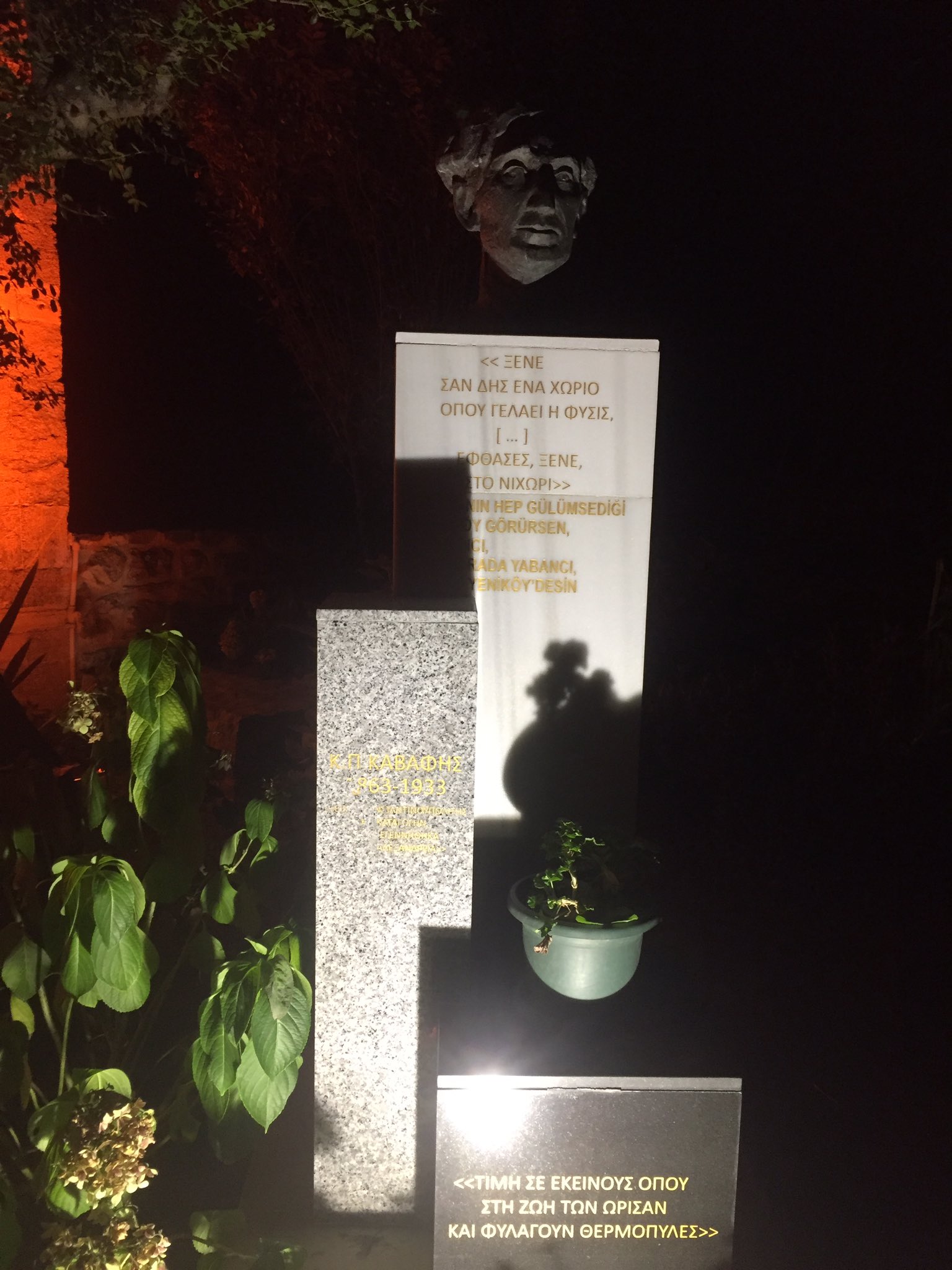
Last year, on the 6th of September, the memorial day of the pogroms against the Greeks in 1955, Nektaria launched “A Recipe for Daphne” in the courtyard of the Panagia Kumariotisa church, in the elegant neighborhood of Nihori (Yeniköy in Turkish). There, in the garden, there’s a bust of Alexandrian poet C.P. Cavafy, who lived in the area for three years in his youth and the house where he lived is now the stuff of legends. Gregory Jusdanis was the last Greek to attempt a search, which yielded nothing but an empty plot in the middle of a road intersection. It is Cavafy, a favorite of Nektaria Anastasiadou, who in a letter, once mentioned that he saw himself as “Hellenic” rather than “Greek”, a broader community defined by language and culture, more than an ethnic or national belonging to a place. I think Daphne would be comfortable with this reading.
That evening, without having yet read Daphne, walking along the shores of the Bosporus, amidst the prominent yalis of Yeniköy, returning from the church, I thought about whether it might not be a good time to leave the city, while the sky’s still blue and the lilacs in full summer bloom. Being unaware then of the days and the hours, both beautiful and terrible, that would soon engulf me and my new friend Daphne, after a certain day, weeks later, the most miraculous of all, on the Golden Horn.
I still haven’t left Istanbul, but that day, Cavafy’s poem for his beloved Alexandria came to mind.
C.P. Cavafy, The City, 1905-1915, trans. Evangelos Sachperoglou
Any new lands you will not find; you’ll find no other seas.
The city will be following you. In the same streets
You’ll wander. And in the same neighborhood you’ll age,
And in these same houses you’ll grow grey.
Always in this same city you’ll arrive. For elsewhere -do not
Hope-
There’s no ship for you, there’s no road.
Just as you’ve wasted your life here,
In this tiny niche, in the entire world you’ve ruined it.
Καινούριους τόπους δεν θα βρεις, δεν θά βρεις άλλες θάλασσες.
Η πόλις θα σε ακολουθεί. Στους δρόμους θα γυρνάς
τους ίδιους. Και στες γειτονιές τες ίδιες θα γερνάς·
και μες στα ίδια σπίτια αυτά θ’ ασπρίζεις.
Πάντα στην πόλι αυτή θα φθάνεις. Για τα αλλού — μη ελπίζεις —
δεν έχει πλοίο για σε, δεν έχει οδό.
Έτσι που τη ζωή σου ρήμαξες εδώ
στην κόχη τούτη την μικρή, σ’ όλην την γη την χάλασες.
“A Recipe for Daphne”, by Nektaria Anastasiadou, was published by Hoopoe Fiction/AUCPress, and is available here. All quotes in italics are from the book.

Arie Amaya-Akkermans is a writer and art critic based in Istanbul. He’s also tweeting about Classics, continental philosophy, contemporary art and Turkey/Greece.

