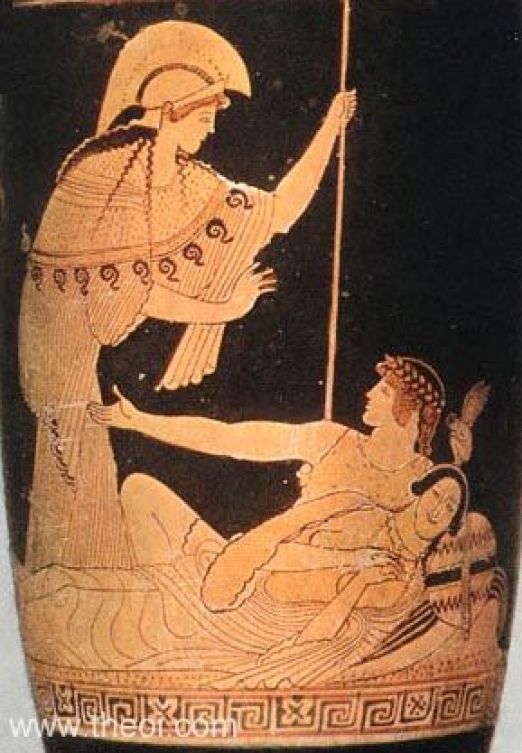
In that country, no one finds vice amusing; nor is seducing or being seduced celebrated as a sign of the times. Even better are those communities where only virgins marry and a promise is made with the hope and vow of a wife. And so, they have only one husband just as each has one body and one life so that there may be no additional thought of it, no lingering desire, that they may not love the man so much as they love the marriage. It is considered a sin to limit the number of children or to eliminate the later born. There good customs are stronger than good laws.
There are children there naked and dirty in every house growing into the size of limbs and body at which we wonder. Each mother nourishes each child with her own breasts; they are not passed around to maids and nurses.”
nemo enim illic vitia ridet, nec corrumpere et corrumpi saeculum vocatur. melius quidem adhuc eae civitates, in quibus tantum virgines nubunt et cum spe votoque uxoris semel transigitur. sic unum accipiunt maritum quo modo unum corpus unamque vitam, ne ulla cogitatio ultra, ne longior cupiditas, ne tamquam maritum, sed tamquam matrimonium ament. numerum liberorum finire aut quemquam ex agnatis necare flagitium habetur, plusque ibi boni mores valent quam alibi bonae leges.In omni domo nudi ac sordidi in hos artus, in haec corpora, quae miramur, excrescunt. sua quemque mater uberibus alit, nec ancillis aut nutricibus delegantur.
25 “Among the Iberians there is a tribe [and] and in a certain festival they honor women with gifts, however so many demonstrate at that time that they can weave the most numerous and beautiful cloaks.”
27 “Among the Nasamoi in Libya it is the custom that on the first day a woman is married that she has sex with everyone who is present and then take gifts from them. After that, she has sex only with the one who marries her.”
45 “The Liburnians have shared wives and they raise their children in common for five years. When they make it to the eighth year, they compare the children for their similarity to the men and they distribute to each one who is similar. And that one keeps him as a son.”
51 “The Assyrians sell their daughters in the marketplace to whoever wants to settle down with them. First the most well-born and most beautiful and then the rest in order. Whenever they get to the least attractive, they announce how much someone is willing to take to live with them and they add this consolation price from the fee charged for the desirable girls to these [last ones].”
The Lamia (or, just Lamia to her friends) is one of the figures from Greek myth who seems like a frightening monster but really is a particular distillation of misogyny. She is often called a Greek ‘vampire’ along with Empousa. Unlike the latter, however, Lamia is specifically associated with killing children.
Diodorus Siculus, 20.40
“At the rock’s root there was a very large cave which was roofed with ivy and bryony in which the myths say the queen Lamia, exceptional for her beauty, was born. But, because of the beastliness of her soul, they say that her appearance has become more monstrous in the time since then.
For, when all her children who were born died, she was overwhelmed by her suffering and envied all the women who were luckier with their children. So she ordered that the infants be snatched from their arms and killed immediately. For this reason, even in our lifetime, the story of that women has lingered among children and the mention of her name is most horrifying to them.
But, whenever she was getting drunk, she would allow people to do whatever pleased them without observation. Because she was not closely watching everything at that time, the people in that land imagined that she could not see. This is why the myth developed that she put her eyes into a bottle, using this story a metaphor for the carelessness she enacted in wine, since that deprived her of sight.”
The story of why Lamia killed children gets a little more depressing in the Fragments of the Greek Historians
Duris, BNJ 76 F17 [= Photios s.v. Lamia]
“In the second book of his Libyan History, Duris reports that Lamia was a fine looking woman but after Zeus had sex with her, Hera killed the children she bore because she was envious. As a result she was disfigured by grief and would seize and kill the children of others.”
Elsewhere, the evidence of narratives about Lamia are rather limited. She becomes just another negative, female monster.
Suda, Lambda 85
“Lamia: a monster. The name comes from having a gaping throat, laimia and lamia. Aristophanes: “It has the smell of a seal, the unwashed balls of a Lamia.” For testicles are active—and he is making a fantasy image of Lamia’s balls, since she is female.”
“There is a crag rising up over the ground on which the Delphians claim that a woman stood singing oracles, named Hêrophilê but known as Sibyl. There is the earlier Sibyl, the one I have found to be equally as old as the others, whom the Greeks claim is the daughter of Zeus and Lamia, the daughter of Poseidon. She was the first woman to sing oracles and they say that she was named Sibyl by the Libyans. Hêrophilê was younger than here, but she was obviously born before the Trojan War since she predicted Helen in her oracles, that was raised up in Sparta as the destruction for Asia and Europe and that Troy would be taken by the Greeks because of her.”
“Foremost he differed from previous authors in this, by which I mean how he took on a subject that was not a single thread nor one divided in many different and also disconnected parts. And then, because did not include mythical material in his work and he did not use his writing for the deception and bewitchment of many, as every author before him did when they told the stories of certain Lamiai rising up from the earth in groves and glens and of amphibious Naiads rushing out of Tartaros, half-beasts swimming through the seas and then joining together in groups among humans, and producing offspring of mortals and gods, demigods—and other stories which seem extremely unbelievable and untrustworthy to us now.”
Mormô, in the genitive Mormous, declined like Sappho. There is also the form Mormôn, genitive Mormonos. Aristophanes says “I ask you, take this Mormo away from me”. This meant to dispel frightening things. For Mormo is frightening. And again in Aristophanes: “A Mormo for courage”. There is also a mormalukeion which they also call a Lamia. They were also saying frightening things like this.”
Plutarch, De Curiositate [On Being a Busybody] 516a
“Now, just as in the myth they say that Lamia sleeps at home, putting her eyes set aside in some jar, but when she goes out she puts them back in and peers around, in the same way each of us puts his curiosity, as if fitting in an eye, into meanness towards others. But we often stumble over our own mistakes and faults because of ignorance, since we fail to secure sight or light for them.
For this reason, a busybody is rather useful to his enemies, since he rebukes and emphasizes their faults and shows them what they should guard and correct, even as he overlooks most of his own issues thanks to his obsession with everyone else. This is why Odysseus did not stop to speak with his mother before he inquired from the seer about those things for which he had come to Hades. Once he had made his inquiry, he turned to his own mother and also the other women, asking who Tyro was, who beautiful Khloris was, and why Epikaste had died.”
“I suggest you safeguard my words by writing them on tablet in your minds”
αἰνῶ φυλάξαι τἄμ᾿ ἔπη δελτουμένας
Aeschylus, Suppliants, 200-204
“Don’t be too aggressive or broken in speech: These people are really ready to be angry. Remember to be accommodating: you are a foreign refugee in need. To speak boldly is not a fitting move for the weak.”
“You are the city, truly. You are the people. An unjudged chief of state rules The altar, the city’s hearth, With only your votes and nods, With only your scepter on the throne You judge every need. Be on guard against contamination!”
original DELACROIX Eugène française Fonds des dessins et miniatures Album Delacroix Eugène -31-
Aeschylus, Suppliants 991-997
“Write this down with the many other notes In your mind of the wisdoms from your father: An unfamiliar mob is evaluated by time, But everyone has an evil tongue prepared to lash out over immigrants and speaking foully is somehow easy. I advise you not to bring me shame Now that you are in the age which turns mortal gazes.”
“I suggest you safeguard my words by writing them on tablet in your minds” αἰνῶ φυλάξαι τἄμ᾿ ἔπη δελτουμένας
Aeschylus, Suppliants, 200-204
“Don’t be too aggressive or broken in speech: These people are especially ready to be angry. Remember to be accommodating: you are a foreign refugee in need. To speak boldly is not a fitting move for the weak.”
“You are the city, really. You are the people. An unjudged chief of state rules The altar, the city’s hearth, With only your votes and nods, With only your scepter on the throne You judge every need. Be on guard against contamination!”
“Write this down with the many other notes In your mind of the wisdoms from your father: An unfamiliar mob is evaluated by time, But everyone has an evil tongue prepared to lash out over immigrants and speaking foully is somehow easy. I advise you not to bring me shame Now that you are in the age which turns mortal gazes.”
“The time to bring a wife to your home
is when you are not too many years under thirty,
or just a few years older. This is the season for marriage.
Your wife should be four years in puberty and married in the fifth.
Marry a virgin so you may teach her proper habits,
And marry a woman who lives nearby, making sure you check
every detail so that you won’t be wed to a joke for your neighbors.
For nothing is better for a man than a wife,
a good one, and nothing is more horrible than a bad one,
one who lies down to eat, and who can cook her husband without a fire,
even though he is a strong man, she makes him age when he’s young.”
“But I am considered well-married, because I am called Hercules’ wife
And because my father-in-law is the one who sounds deeply with swift steeds.
Yet, this is how the unequal colts arrive unhappily at the plow,
The way that a lesser bride matches to a great husband.
This isn’t an honor but merely the appearance of it which pains who carries it more;
If you want to be married happily, marry your equal.
My husband is always absent—he’s more famous as my guest than husband
As he pursues is terrible monsters and beasts.”
At bene nupta feror, quia nominer Herculis uxor,
sitque socer, rapidis qui tonat altus equis.
quam male inaequales veniunt ad aratra iuvenci,
tam premitur magno coniuge nupta minor.
non honor est sed onus species laesura ferentes:
siqua voles apte nubere, nube pari.
vir mihi semper abest, et coniuge notior hospes
monstraque terribiles persequiturque feras.
Hipponax, Fr. 68
“A woman has two days which are the sweetest:
When someone marries her and when someone carries her out dead.”
δύ᾿ ἡμέραι γυναικός εἰσιν ἥδισται,
ὅταν γαμῇ τις κἀκφέρῃ τεθνηκυῖαν.
Red-figure skyphoid pyxis by the Adrano Group, ca 330-320 BC, today at the Pushkin Museum in Moscow. Image shown under Creative Common License: shakko, Pyxis01 pushkin, CC BY-SA 3.0 (Thanks to Commenter Marcus Cyron for reminding me to post this credit)
The following account is interesting for the variations in the story of Ariadne and Theseus but also for the strange detail of the ritual where young men imitate a woman in childbirth.
Other tales about Ariadne, According to Plutarch (Theseus 20)
“There are many other versions circulated about these matters still and also about Ariadne, none of which agree. For some say that she hanged herself after she was abandoned by Theseus. Others claim that after she was taken to Naxos by sailors she lived with Oinaros a priest of Dionysus and that she was abandoned by Theseus because he loved another.
“A terrible lust for Aiglê the daughter of Panopeus ate at him” [fr. 105]—this is a line Hereas the Megarean claims Peisistratus deleted from the poems of Hesiod, just as again he says that he inserted into the Homeric catalogue of dead “Theseus and Perithoos, famous children of the gods” [Od. 11.631] to please the Athenans. There are some who say that Ariadne gave birth to Oinipiôn and Staphulos with Theseus. One of these is Ion of Khios who has sung about his own city “Oinopiôn, Theseus’ son, founded this city once.” [fr. 4D]
The most reputable of the myths told are those which, as the saying goes, all people have in their mouths. But Paiôn the Amathousian has handed down a particular tale about these events. For he says that Theseus was driven by a storm, to Cyprus and that he had Ariadne with him, who was pregnant and doing quite badly because of the sea and the rough sailing. So he set her out alone and he was carried back into the sea from the land while he was tending to the ship. The native women, then, received Ariadne and they tried to ease her depression because of her loneliness by offering her a counterfeit letter written to her by Theseus and helping her and supporting her during childbirth. They buried her when she died before giving birth.
Paiôn claims that when Theseus returned he was overcome with grief and he left money to the island’s inhabitants, charging them to sacrifice to Ariadne and to have two small statues made for her—one of silver and one of bronze. During the second day of the month of Gorpiaon at the sacrifice, one of the young men lies down and mouns and acts as women do during childbirth. They call the grove in which they claim her tomb is that of Ariadne Aphrodite.
Some of the Naxians claim peculiarly that there were two Minoses and two Ariadnes. They claim one was married to Dionysus on Naxos and bore the child Staphulos, and the young one was taken by Theseus and left when he came to Naxos with a nurse named Korkunê—whose tomb they put on display. They claim that Ariadne died there and has honors unequal to those of the earlier one. The first has a festival of singing and play; the second has one where sacrifices are performed with grief and mourning.”
“Phylarkhos claims that Thetis went to Hephaistos on Olympos so that he might create weapons for Achilles and that he did it. But, because Hephaistos was lusting after Thetis, he said he would not give them to her unless she had sex with him. She promised him that she would, but that she only wanted to try on the weapons first, so she could see if the gear he had made was fit for Achilles. She was actually the same size as him.
Once Hephaistos agreed on this, Thetis armed herself and fled. Because he was incapable of grabbing her, he took a hammer and hit Thetis in the ankle. Injured in this way, she went to Thessaly and healed in the city that is called Thetideion after her.”
“And there is also a notion older than this which seemed right to Lykourgos for Sparta. Because he meant to provide warrior-athletes for Sparta, he said, “Let the girls exercise and permit them to run in public. Certainly this strengthening of their bodies was for the sake of good childbearing and that they would have better offspring.
For one who comes from this training to her husband’s home will not hesitate to carry water or to mill grain because she has prepared from her youth. And if she is joined together with a youth who has joined her in rigorous exercise, she will provide better offspring—for they will be tall, strong and rarely sick. Sparta became so preeminent in war once her marriages were prepared in this way.”
“Let’s talk first concerning the disease which is called sacred and paralyzed people and the many anxieties which frighten people seriously enough that they lose their minds and believe that they see evil spirits by night or even at times by die or sometimes on all hours. Many have hanged themselves before because of this kind of vision, more often women than men.
For a woman’s nature is more depressed and sorrowful. And young women, when they are at the age of marriage and without a husband, suffer terribly at the time of their menstruation, which they did not suffer earlier in life. For blood collects later in their uterus so that it may flow out. When, then, the mouth of the exit does not create an opening, the blood pools up more because of food and the body’s growth. When the blood has nowhere to flow, it rises up toward the heart and the diaphragm. When these organs are filled, the heart is desensitized and from this transformation it becomes numb. Madness overtakes women because of this numbness.”