“Women know everything, even how Zeus married Hera.”
Homer has, “They traveled together to bed, avoiding their parents’ notice”. Aristokles in his work “On the Cults of Hermione”, provides something of an odd tale about the marriage of Zeus and Hera. For, as the story goes, Zeus was planning on having sex with Hera when he noticed that she was separated from the other gods. Because he did not want to be obvious and did not want to be seen by her, he changed his appearance into a cuckoo and was waiting on a mountain which was first called Thornax but is now just called Cuckoo.
Zeus made a terrible storm on that day and when Hera was going toward the mountain alone, she stopped at the very place where there is currently a temple to Hera Teleia. The cuckoo, flew down and sat on her lap when he saw her, shivering and freezing because of the weather. Hera saw the bird and pitied him and covered him with her cloak. Then Zeus suddenly transformed his appearance and grabbed a hold of Hera. Because she was refusing him due to their mother, he promised that he would marry her.
Among the Argives, who honor the goddess the most of all the Greeks, the cult image of Hera sits in the temple on a throne holding a scepter in one hand on which a cuckoo is seated.”
Pausanias (2.17.4) describes a statue in a temple to Hera outside of Corinth:
“The statue of Hera—extraordinarily huge—sits on a throne made of gold and ivory, a work of Polykleitos. She has a crown embossed with Graces and the Seasons and carries in one hand a pomegranate fruit and in the other a scepter. I must pass over the reason for the pomegranate, since the tale is protected by sacred rite. But people say that the cuckoo bird sitting on the scepter is Zeus: because he was in love with Hera when she was a maiden and turned himself into this bird which she hunted to have as a pet. I record this story as much as the others of the gods which I offer incredulously—but I record them still.”
Plutarch, Advice to Bride and Groom (Moralia138a-146a : Conjugalia Praecepta)
“These kinds of studies, foremost, distract women from inappropriate matters. For, a wife will be ashamed to dance when she is learning geometry. And she will not receive spells of medicine if she is charmed by Platonic dialogues and the works of Xenophon. And if anyone claims she can pull down the moon, she will laugh at the ignorance and simplicity of the women who believe these things because she herself is not ignorant of astronomy and she has read about Aglaonikê. She was the daughter of Hêgêtor of Thessaly because she knew all about the periods of the moon and eclipses knew before everyone about the time when the moon would be taken by the shadow of the earth. She tricked the other women and persuaded them that she herself was causing the lunar eclipse.”
“Septicia as well, the mother of Ariminum’s Trachali, because she was angry with her sons, married Publicius who was already old, even though she could no longer have children, as an insult against them. Then she took both of them out of her will. When they appealed to him, the divine Augustus criticized both the woman’s marriage and her final allotments. He ordered that the sons have their mother’s inheritance and the dowry since she had not begun the marriage for the purpose of having children.
If Fairness herself were to judge this affair, could she have come up with a more just or more substantial opinion? You spurn the children you bore, make a sterile marriage, make a mess of a final will because of your malicious spirit, and you don’t blush to hand all your wealth over to a man whose body you climb under even when it has already been laid out like a corpse? So, since you acted like this, you are struck by divine lightning even among the damned!”
Septicia quoque, mater Trachalorum Ariminensium, irata filiis, in contumeliam eorum, cum iam parere non posset, Publicio seni admodum nupsit, testamento etiam utrumque praeteriit. a quibus aditus divus Augustus et nuptias mulieris et suprema iudicia improbavit: nam hereditatem maternam filios habere iussit, dotem, quia non creandorum liberorum causa coniugium intercesserat, virum retinere vetuit. si ipsa Aequitas hac de re cognosceret, potuitne iustius aut gravius pronuntiare? spernis quos genuisti, nubis effeta, testamenti ordinem malevolo animo confundis, neque erubescis ei totum patrimonium addicere cuius pollincto iam corpori marcidam senectutem tuam substravisti. ergo dum sic te geris, ad inferos usque caelesti fulmine adflata es.
Perictione, On a Woman’s “Harmony”[=Stob. 4.28.19 p. 688]
“A woman must recognize that harmony is full of thought and wisdom. For a mind must be thoroughly trained for virtue in order to be just, brave, thoughtful, improved by self-sufficiency, and hateful to empty opinion. From these qualities, a woman gains noble deeds for herself and her husband. Her children and home benefit too. Often there is also benefit for the state if a woman like this governs cities or peoples as we observe in kingdoms.
For the one who rules her own desires and passion becomes divine and harmonious. Lawless lusts do not pursue her and she will be able to maintain her husband, children, and whole household in friendship. Indeed, all the women who become seduced by foreign beds also become hostile to all those in their home who are free and dedicated to the family. A woman like this works up tricks against her husband and manufactures lies about him so that she alone might seem to stand apart for her good mind and her conduct of the household when she really loves laziness. Truly, this is the ruin of all the things that are common for her and her husband.
But I have said enough about these things. It is necessary to arrange the body to the measure of nature for food, clothes, bathing, anointing, hair-dos, and everything that comes from gold and stone for jewelry. For all the women who eat, drink, dress, and carry these expensive things are prepared to fall into the folly of complete wickedness in their beds and criminal behavior in other things too. It is right only to sate hunger and thirst with things which are simple and to keep off the cold with wool or some cloak of hair.
No small a vice is forsworn by staying far away from food either sold for a a lot or of great renown. And it is great foolishness to don excessively thin clothing or garments decorated with due from seashells or any other expensive color. For the body wants only not to be cold or naked for the sake of propriety, but it asks for nothing else. Human opinion longs for empty and useless things because of ignorance. Also, a woman should not wrap gold around her, or Indian stone or anything coming from another place; she will not braid her hair with excessive artifice, nor will she anoint herself with scents smelling of Arabia, nor color the face by making it whiter or making it blush or darkening her eyebrows and eyes, making her hair light with dyes nor take lots of baths. The one who pursues these strategies is looking for someone who admires feminine lack of control.
“Beauty comes from intelligence and not from those things—and it commends women who do well. Necessity should not compel nobility and wealth and coming from great city and the repute and friendship of famous and royal men. If she misses these things, she does not grieve; if she does not miss them, she does not press to seek them. For a thoughtful woman is not hindered from living apart from these things. If she allows those things which she has been allotted, her mind must never doubt at the great and wondrous things, but instead let her depart far from them. For when they fall into misfortune it harms more than it helps. Conspiracy, envy, and betrayal are proper to these things so that a woman of this sort would never be at peace. Instead one needs to revere the gods to gain the good hope of happiness and to obey her country’s laws and customs.
After these precepts, I advise a woman to honor and revere her parents. For they are equal to the gods in all ways and act on behalf of their relatives. In respect to her husband it is right that she live lawfully and rightly, keeping nothing private in her thoughts but watching and guarding their bed. Everything is common in this. She must endure everything from her husband—if he is unlucky and if he makes any mistakes because of ignorance, or sickness or drunkenness or has relationships with other women. For this fault is at home with men, but never women, and vengeance is set for it.
“She must preserve custom and not be jealous. She needs to endure anger, and cheapness, and faultfinding, and envy, and evil speech and anything else he has his nature and will put everything in a way that will be dear to him in her prudence. For a woman who is dear to her husband and works for him well is harmonious and loves her whole household and makes those outside of it well-intentioned toward it. When she does not love the home, she is not willing to see her household, or her own children, or her servants or the possessions she has safe, but in stead she curses them and prays for every kind of ruin, as if she were an enemy, and she prays for her husband to die, as if he is hateful to her so that she is a neighbor to others and hates all those who tend to him.
“I think that a woman like this is harmonious, if she is full of intelligence and prudence. For she will not only help her husband, but also her children and relatives and slaves and the whole household in which her possessions and friends, citizens and guests, reside. Her body supports things things by not being excessive, by pursuing and heeding noble actions, by following her husband in the practice of shared opinion in their common life, by following along with those he admits to their family and friendships and by believing the same things are sweet and bitter as her husband, she is not disharmonious in any way.”
[Khairestratos]:
“Daos, boy, I am not well
I am depressed because of these events. By the gods
I am not under my own control. I am almost completely crazy.
That fine brother of mine is forcing me
To such insanity with his vile behavior.
He is about to get married!”
“In this way strength is drawn from natural philosophy against death; so too is determination against the fears of religion and a calmness of mind once the ignorance of all natural mysteries has been removed. So too comes moderation, once the nature and number of desires have been explained. And, finally, as I was just arguing, we can learn how to divine a lie from the truth, since this philosophy provides the Rule or Judgment of knowledge.”
Sic e physicis et fortitudo sumitur contra mortis timorem et constantia contra metum religionis et sedatio animi, omnium rerum occultarum ignoratione sublata, et moderatio, natura cupiditatum generibusque earum explicatis, et, ut modo docui, cognitionis regula et iudicio ab eodem illo constituto veri a falso distinctio traditur.
[Khairestratos]:
“Daos, boy, I am not well
I am depressed because of these events. By the gods
I am not under my own control. I am almost completely crazy.
That fine brother of mine is forcing me
To such insanity with his vile behavior.
He is about to get married!”
“In this way strength is drawn from natural philosophy against death; so too is determination against the fears of religion and a calmness of mind once the ignorance of all natural mysteries has been removed. So too comes moderation, once the nature and number of desires have been explained. And, finally, as I was just arguing, we can learn how to divine a lie from the truth, since this philosophy provides the Rule or Judgment of knowledge.”
Sic e physicis et fortitudo sumitur contra mortis timorem et constantia contra metum religionis et sedatio animi, omnium rerum occultarum ignoratione sublata, et moderatio, natura cupiditatum generibusque earum explicatis, et, ut modo docui, cognitionis regula et iudicio ab eodem illo constituto veri a falso distinctio traditur.
Socrates is famous in ancient anecdotes for his struggles with his wife Xanthippe. In this Roman anecdote, he dispenses some wonderful advice about marriage.
Valerius Maximus, Memorable Sayings and Deeds 7.6 ext 1b-c
“[Socrates] used to say that those who act as so that they become as they would wish to seem finish short and well-known roads to glory. With this saying he was clearly warning that humans should drink virtue itself rather than follow its shadow.
Socrates also, when asked by a certain young man whether he should take a wife or abstain from matrimony altogether, said that whichever he did he would regret it. “From second option, you will experience loneliness, childlessness, the end of your family, and a foreign heir; from the other option, you will have perpetual annoyance, a weaving of complaints, questions about the dowry, the down-turned brows of inlaws, a talkative mother-in-law, a hunter for other people’s marriages, and the uncertain bearing of children.’ He would not endure that the youth believe he was making a choice of happy material in the context of harsh matters.”
Idem expedita et compendiaria via eos ad gloriam pervenire dicebat qui id agerent ut quales videri vellent, tales etiam essent. qua quidem praedicatione aperte monebat ut homines ipsam potius virtutem haurirent quam umbram eius consectarentur.
Idem, ab adulescentulo quodam consultus utrum uxorem duceret an se omni matrimonio abstineret, respondit utrum eorum fecisset, acturum paenitentiam. ‘hinc te’ inquit ‘solitudo, hinc orbitas, hinc generis interitus, hinc heres alienus excipiet, illinc perpetua sollicitudo, contextus querellarum, dotis exprobratio, adfinium grave supercilium, garrula socrus lingua, subsessor alieni matrimonii, incertus liberorum eventus.’ non passus est iuvenem in contextu rerum asperarum quasi laetae materiae facere dilectum.
“The greatest contest in our life is this: getting a good husband
Or a bad one. For divorces do not bring women
A good reputation and it is impossible to refuse a husband.
When she enters the new ways and laws of his house
She needs to be a prophet, since she has not learned at home
How best to live with this partner. ”
“But the same story does not apply to both me and you.
You have your city and your father’s home,
A life’s benefit and the presence of friends.
I am alone, stateless, taken violently by this
Husband, kidnapped as spoil from a foreign land,
I have no mother, no brother, no cousin
To provide me safe harbor from this storm.”
“I am not like a tyrant in the least:
I have suffered much because of my sense of shame.
Now, even though I see you making a mistake, woman,
You will still get what you ask. But I am warning you:
If the sun rises tomorrow to see you here
And your children within the borders of this land,
You die. This speech is not uttered as a lie.
But, now, if you need to stay, remain for a day.
You won’t do any evil I fear in this time.”
“Plato was the son of Aristôn, an Athenian, and Periktionê, or Pôtônê, who alleged her heritage went back to Solon. For he had a brother named Drôpides who was the father of Kritias, the father of Kallaiskhros, the father of Kritias, who was one of the Thirty. He was also the father of Glaukôn, the father of Kharmides and Perictionê. Plato, then, as the son of Aristôn and that Perictionê, was the sixth generation after Solon. And Solon claimed his family descended from Neleus and Poseidon. They also claim that his father descends from Kodros the son of Melanthos and, they are said to descend from Poseidon, according to Thrasylos.
In his work named “The Feast for Plato” Speusippus writes, as Klearkhos claims in his Praise to Plato and Anaxlaides records in his second book of On Philosophers, that there was a story in Athens that Aristôn raped Perictionê when she was an adolescent girl and failed to get her [as a wife?]. When he stopped assaulting her, Apollo came to him in a dream. For this reason, he left her untouched of marriage until she gave birth.”
Hadrian, fr. II [A minor Latin Poet and a Major Roman Emperor]
“You were wanton in verse, but pure of thought”
Lascivus versu, mente pudicus eras.
Martial, 12.97
“Even though your wife is a girl of a kind
A man would scarcely seek with inappropriate prayers
(rich, noble, erudite, chase, what a find!)
You bust your nut, Bassus, but on the hair
Of the the men you buy with your wife’s money.
And when to its mistress your dick is returned
Though it was for so many thousands bought
It is so limp that its full size cannot be earned
Even if by sweet whispers or soft strokings sought.
For once, have some shame or let’s go to court.
Bassus, you sold it—your dick ain’t yours.”
Uxor cum tibi sit puella qualem
votis vix petat improbis maritus,
dives, nobilis, erudita, casta,
rumpis, Basse, latus, sed in comatis,
uxoris tibi dote quos parasti.
et sic ad dominam reversa languet
multis mentula milibus redempta
ut nec vocibus excitata blandis
molli pollice nec rogata surgat.
sit tandem pudor aut eamus in ius.
non est haec tua, Basse: vendidisti.
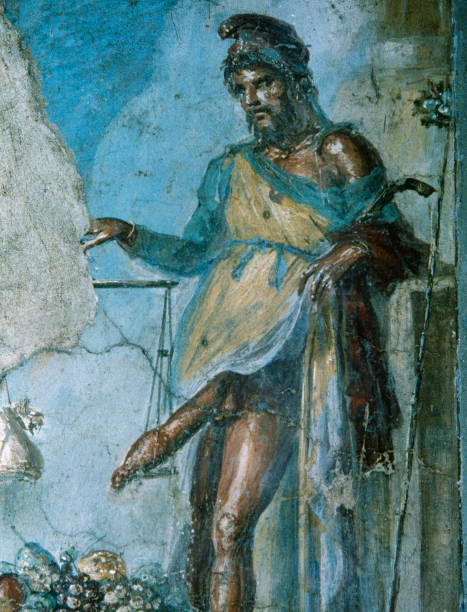
Wall-painting: Priapus weighing his phallus (Pompeii)