Death, A Pre-existing Condition

Lucretius, De Rerum Natura 3.1076-1094

“Finally, what great and vile desire for life compels us
To quake so much amidst doubts and dangers?
Mortals have an absolute end to our lives:
Death cannot be evaded—we must leave.
Nevertheless, we move again and still persist—
No new pleasure is procured by living;
But while what we desire is absent, that seems to overcome
All other things; but later, when we have gained it, we want something else—
An endless thirst for life grips us as we gasp for it.
It remains unclear what fortune life will offer,
What chance may bring us and what end awaits.
But by extending life we do not subtract a moment
Of time from death nor can we shorten it
So that we may somehow have less time after our ends.

Therefore, you may continue as living as many generations as you want,
But that everlasting death will wait for you still,
And he will be there for no less a long time, the man who
Has found the end of life with today’s light, than the man who died
Many months and many years before.”

Denique tanto opere in dubiis trepidare periclis
quae mala nos subigit vitai tanta cupido?
certe equidem finis vitae mortalibus adstat
nec devitari letum pote, quin obeamus.
praeterea versamur ibidem atque insumus usque
nec nova vivendo procuditur ulla voluptas;
sed dum abest quod avemus, id exsuperare videtur
cetera; post aliud, cum contigit illud, avemus
et sitis aequa tenet vitai semper hiantis.
posteraque in dubiost fortunam quam vehat aetas,
quidve ferat nobis casus quive exitus instet.
nec prorsum vitam ducendo demimus hilum
tempore de mortis nec delibare valemus,
quo minus esse diu possimus forte perempti.
proinde licet quod vis vivendo condere saecla,
mors aeterna tamen nihilo minus illa manebit,
nec minus ille diu iam non erit, ex hodierno
lumine qui finem vitai fecit, et ille,
mensibus atque annis qui multis occidit ante.

Seneca, Letters to Lucilius, 1.1:

“Act thus, my Lucilius: justify yourself, collect and save all of the time which to this point has been taken off, or stolen, or simply slipped away. Persuade yourself that the matter stands as I write: some time is stolen from us, some is drawn off, and some just flows away. The most shameful loss, though, is the one which occurs through negligence. If you wish to take note, you will see that a large part of life slips away from those who act badly, the greatest portion slips away from those who do nothing, and all of life slips away from those who are busy doing something else. What person can you cite who places a price upon his time, who takes an account of the day, who understands that he is dying every day? We are deceived in this, that we look forward to death: a large part of it has already gone by, and whatever part of our lives is in the past is death’s property now. Therefore, act as you claim to do, and embrace every hour; thus it will happen that you weigh out less of tomorrow, if you throw your hand upon today.

Life runs away when it is delayed. All things, my Lucilius, are foreign to us: time alone is ours. Nature has granted us the possession of this one fleeting, slippery thing, from which she expels whoever wishes it. The stupidity of humans is so great that they allow the smallest, most worthless things (certainly, those which can be retrieved) to be added to their account when they have accomplished them, but no one thinks that he owes any debt when he receives time, though this is the one thing which no one is able to pay back readily.

You will perhaps ask how I act, I who deliver these precepts to you. I will confess honestly: as happens among the diligent partaker of luxury, I keep an account of the cost. I can not say that I have wasted nothing, but I can give an account of why and how I wasted it. I will explain the causes of my poverty. But it happens to me as to many who have been reduced to poverty through no fault of their own: all ignore him, no one helps him.

What then? I do not consider a man poor if whatever is left to him seems enough to him. I advise you, though to hold on to what is yours, and do it in good time. For, as the ancients say, ‘Parsimony is too late on the ground,’ for not only is the remaining portion at the bottom the smallest, but it is also the worst. Goodbye.”

Ita fac, mi Lucili: vindica te tibi, et tempus quod adhuc aut auferebatur aut subripiebatur aut excidebat collige et serva. Persuade tibi hoc sic esse ut scribo: quaedam tempora eripiuntur nobis, quaedam subducuntur, quaedam effluunt. Turpissima tamen est iactura quae per neglegentiam fit. Et si volueris attendere, magna pars vitae elabitur male agentibus, maxima nihil agentibus, tota vita aliud agentibus. [2] Quem mihi dabis qui aliquod pretium tempori ponat, qui diem aestimet, qui intellegat se cotidie mori? In hoc enim fallimur, quod mortem prospicimus: magna pars eius iam praeterit; quidquid aetatis retro est mors tenet. Fac ergo, mi Lucili, quod facere te scribis, omnes horas complectere; sic fiet ut minus ex crastino pendeas, si hodierno manum inieceris. [3] Dum differtur vita transcurrit. Omnia, Lucili, aliena sunt, tempus tantum nostrum est; in huius rei unius fugacis ac lubricae possessionem natura nos misit, ex qua expellit quicumque vult. Et tanta stultitia mortalium est ut quae minima et vilissima sunt, certe reparabilia, imputari sibi cum impetravere patiantur, nemo se iudicet quicquam debere qui tempus accepit, cum interim hoc unum est quod ne gratus quidem potest reddere.

[4] Interrogabis fortasse quid ego faciam qui tibi ista praecipio. Fatebor ingenue: quod apud luxuriosum sed diligentem evenit, ratio mihi constat impensae. Non possum dicere nihil perdere, sed quid perdam et quare et quemadmodum dicam; causas paupertatis meae reddam. Sed evenit mihi quod plerisque non suo vitio ad inopiam redactis: omnes ignoscunt, nemo succurrit. [5] Quid ergo est? non puto pauperem cui quantulumcumque superest sat est; tu tamen malo serves tua, et bono tempore incipies. Nam ut visum est maioribus nostris, ‘sera parsimonia in fundo est’; non enim tantum minimum in imo sed pessimum remanet. Vale.

Hieronymous Bosch, “Death and the Miser” 1494

and it keeps going……

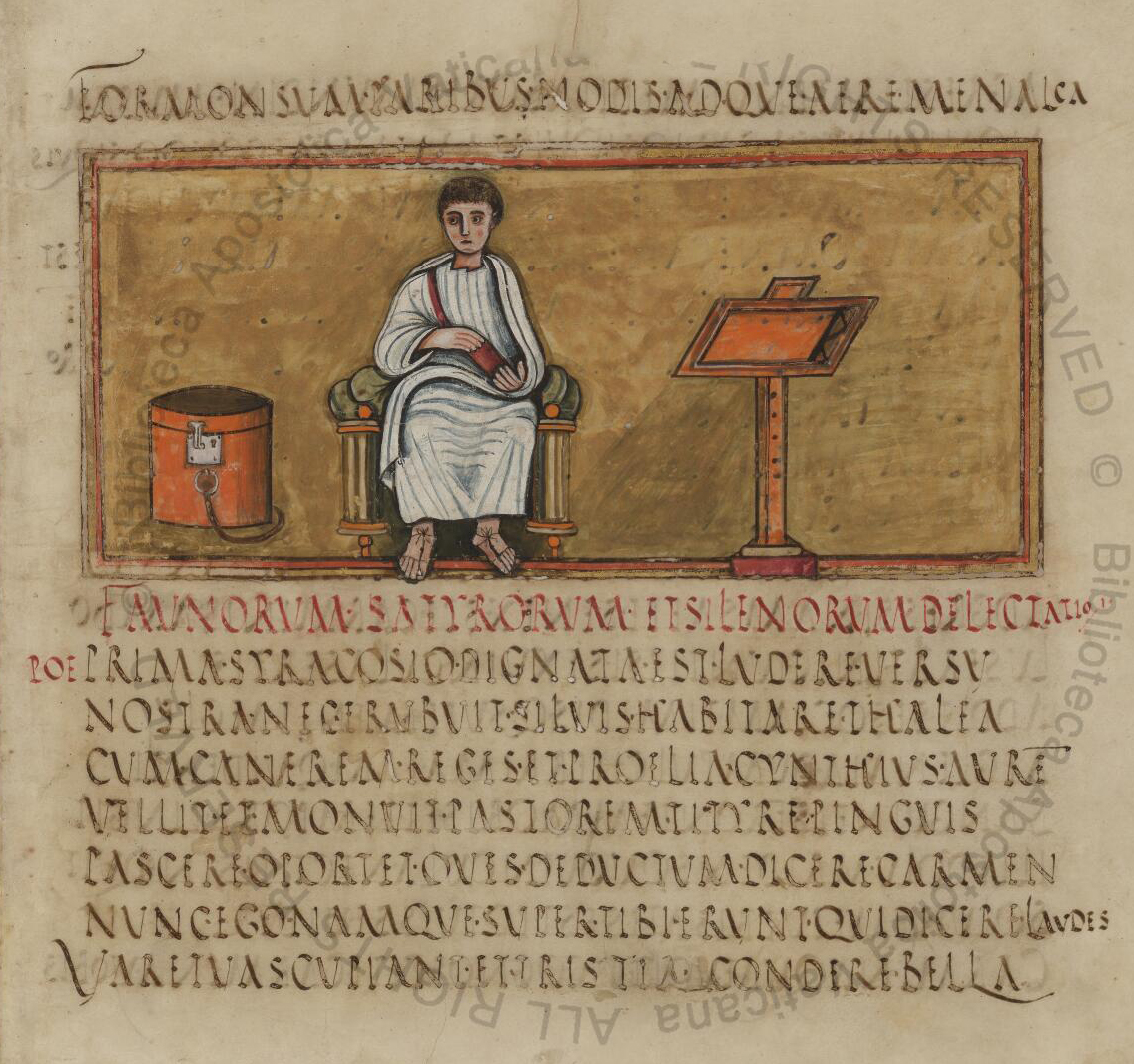
What It Takes to Understand Vergil

Macrobius, Saturnalia 5.14-15

“Has it been proved to you that Vergil cannot be understood by someone who is ignorant of the sound of Latin and is equally distant to one who has not drunk Greek learning deep with the fullest thirst?

If I did not fear making you antsy, I could fill huge volumes with the material he translated from the most obscure Greek teachings. But these assertions are enough to support the thesis I have proposed.”

probatumne vobis est Vergilium, ut ab eo intellegi non potest qui sonum Latinae vocis ignorat, ita nec ab eo posse qui Graecam non hauserit extrema satietate doctrinam?

nam si fastidium facere non timerem, ingentia poteram volumina de his quae a penitissima Graecorum doctrina transtulisset implere: sed ad fidem rei propositae relata sufficient.’

Macrobius presenting his work to his son Eustachius.

Happy Halloween: Werewolves in Greek and Roman Culture

full speed down a lykanthropic rabbit-hole in the annual tradition.

Did the Wolf Win or Lose this FIght?
Did the Wolf Win or Lose this Fight?

Here are the sources I’ve gathered in rough chronological order. Most of the material is mentioned in the Oxford Classical Dictionary, although the entry says nothing about the medical texts.

  1. Herodotus’ Histories: A Description of the Neuri, a tribe near the Skythians who could turn into wolves and back.
  2. Plato’s Republic: Lycanthropy is used as a metaphor for the compulsive behavior of tyrants.
  3. Pliny the Elder’s Natural History: Pliny describes the origins of ideas about lycanthropy and blames the traditions on the credulity of the Greeks!
  4. Petronius’ Satyricon: A character tells the story of a companion transforming into a wolf at night and back at day.
  5. Pausanias’ Geography of Greece: Like Pliny, Pausanias tells the story of the human sacrifice performed by Lykaon as an origin of lycanthropic narratives.
  6. Greek Medical Treatises on the Treatment of Lycanthropy: Medical authors from the time of Marcus Aurelius to the fall of Byzantium treat lycanthropy as a mental illness.
  7. Augustine of Hippo, City of God:  St. Augustine (5th Century CE) gives an account similar to Pliny’s, but attributes it to Varro.
  8. Michael Psellus, Poemata 9.841:An 11th century CE monk wrote a book of didactic poems about medicine. His description of lycanthropy is clearly influenced by the Greek medical treatises.

What I have learned from these texts:

  1. The early Greek tradition is harmonious with some structural aspects of Greek myth.  Lycanthropy is related to sacrilegious eating–in a system where what you eat communicates who you are, human flesh is taboo (monsters eat it).  In the Greek lycanthropic tradition, this is non mono-directional. Werewolves who abstain from human flesh can turn back again.
  2. The later ‘folkloric’ tradition (e.g. Petronius) is separate from this structural logic. in the earlier tradition, men transform for 9-10 years (in something of a purificatory period). The other tradition has shorter periods (nightly) that don’t correlate with sacrilege: Petronius’ werewolf doesn’t eat human flesh (that we know of).
  3. The moon-association may be a later accretion on the tradition. All of the medical texts associate werewolves with the night; the Roman texts agree. The lunar cycle may be implied in the Petronius tale (where the transformation happens when the light is almost as bright as day) or in the later medical texts vis a vis the connection with menstrual cycles.
  4. There is one hint of a dog-bite being associated with lycanthropy, but no foundational notion that you contract lycanthropy from a werewolf.  In addition, there are no specific suggestions or methods for how to kill a werewolf.

Continue reading “Happy Halloween: Werewolves in Greek and Roman Culture”

Disagreements and Words

Cicero, de Amicitia 23-24

“The fact is that if you remove the ties of goodwill from our world, no house or city can stand tall nor can even agriculture persist! If this is less intelligible, one can perceive how powerful friendship and harmony are from the impact of disagreements and disharmony. What house is so stable or what state is so strong that it cannot be upended by hatred and division?”

Quod si exemeris ex rerum natura benevolentiae coniunctionem, nec domus ulla nec urbs stare poterit, ne agri quidem cultus permanebit. Id si minus intellegitur, quanta vis amicitiae concordiaeque sit, ex dissensionibus atque discordiis percipi potest. Quae enim domus tam stabilis, quae tam firma civitas est, quae non odiis et discidiis funditus possit everti?


Plato, Euthyphro 7c

“So if we were disagreeing about whether something was bigger or smaller, we’d turn to actual measurement to resolve our disagreement?”

 Οὐκοῦν καὶ περὶ τοῦ μείζονος καὶ ἐλάττονος εἰ διαφεροίμεθα, ἐπὶ τὸ μετρεῖν ἐλθόντες ταχὺ παυσαίμεθ’ ἂν τῆς | διαφορᾶς;

Cicero, de Finibus 4. 22

“If we dispute about a fact, Cato, you and I can have no disagreement! There’s no difference between what you believe and I do when we compare the facts themselves once the words have been changed.”

Si de re disceptari oportet, nulla mihi tecum, Cato, potest esse dissensio; nihil est enim de quo aliter tu sentias atque ego, modo commutatis verbis ipsas res conferamus

Pheasants with a disagreement

Ariadne: A Woman Wronged

Catullus 64. 52-70.

Looking out from Dia’s wave-thudding shores
she sees Theseus and his fleet ships drawing away,
Ariadne does, her heart full of savage rage.

She still cannot believe what she’s been seeing
since shaking off hoodwinking sleep and finding
her luckless self deserted on a lonely shore:

the thoughtless youth putting oar to water, fleeing,
and letting slip to squally winds his empty vows.

It’s him the far-off sad-eyed daughter of Minos
gazes upon, Bacchant-like, from sea-tangled rocks,
gazes upon and swells with upsurges of grief.

She did not clasp to her fair head the fine headpiece,
keep her bossom veiled in her delicate robes
or her milky breasts encircled with the smooth band–

All these things, from all her person, fell haphazard
at her feet, and with them the salty waves sported.
But not for headpiece or flowing robes did she care.

Theseus, it was on you, with all her heart,
all her soul, and all her mind, that she hung, hopeless.

Racine. Phedre. 87-89.

So many others; their names escape even him,
Those too credulous spirits whom his flame deceived:
Ariadne on the rocks reciting wrongs done her . . .

Catullus

namque fluentisono prospectans litore Diae,
Thesea cedentem celeri cum classe tuetur
indomitos in corde gerens Ariadna furores,
necdum etiam sese quae visit visere credit,
utpote fallaci quae tum primum excita somno
desertam in sola miseram se cernat harena.
immemor at iuvenis fugiens pellit vada remis,
irrita ventosae linquens promissa procellae.
quem procul ex alga maestis Minois ocellis,
saxea ut effigies bacchantis, prospicit, eheu,
prospicit et magnis curarum fluctuat undis,
non flavo retinens subtilem vertice mitram,
non contecta levi uelatum pectus amictu,
non tereti strophio lactentis vincta papillas,
omnia quae toto delapsa e corpore passim
ipsius ante pedes fluctus salis alludebant.
sed neque tum mitrae neque tum fluitantis amictus
illa vicem curans toto ex te pectore, Theseu,
toto animo, tota pendebat perdita mente.

Racine

Tant d’autres, dont les noms lui sont même échappés,
Trop crédules esprits que sa flamme a trompés ;
Ariane aux rochers contant ses injustices . . .


photograph of an oil painting of a woman looking surprised
Ariadne. Joshua Reynolds (1723-1792). Private Collection.

Larry Benn has a B.A. in English Literature from Harvard College, an M.Phil in English Literature from Oxford University, and a J.D. from Yale Law School. Making amends for a working life misspent in finance, he’s now a hobbyist in ancient languages and blogs at featsofgreek.blogspot.com.

Think You’re Done with that Pee? Wait, There’s More!

Marcus Cato, On Agriculture 157.10-11

“Wait, there’s more: save the urine of someone who eats cabbage all the time, warm it, bathe your patient in it, you will heal them! This has been tested. As a bonus, if you wash a babies in this urine, they will never be unhealthy. If someone’s eyes are a little weak, work that potion into them and they will see more! Head pain or neck pain will also lessen when treated with re-heated urine.

If a woman heats her private parts with this urine, they will suffer no disease. Here’s what you do: warm the urine in a pain and place it on a chair with a cut-out cushion. Have the woman sit on it; cover her; and put clothes over her.”

Et hoc amplius lotium conservato eius qui brassicam essitarit, id calfacito, eo hominem demittito, cito sanum facies hac cura; expertum hoc est. Item pueros pusillos si laves eo lotio, numquam debiles fient. Et quibus oculi parum clari sunt, eo lotio inunguito, plus videbunt.

Si caput aut cervices dolent, eo lotio caldo lavito, desinent dolere. Et si mulier eo lotio locos fovebit, numquam miseri fient, et fovere sic oportet: ubi in scutra fervefeceris, sub sellam supponito pertusam. Eo mulier adsidat, operito, circum vestimenta eam dato.

What It Takes to Understand Vergil

Macrobius, Saturnalia 5.14-15

“Has it been proved to you that Vergil cannot be understood by someone who is ignorant of the sound of Latin and is equally distant to one who has not drunk Greek learning deep with the fullest thirst?

If I did not fear making you antsy, I could fill huge volumes with the material he translated from the most obscure Greek teachings. But these assertions are enough to support the thesis I have proposed.”

probatumne vobis est Vergilium, ut ab eo intellegi non potest qui sonum Latinae vocis ignorat, ita nec ab eo posse qui Graecam non hauserit extrema satietate doctrinam?

nam si fastidium facere non timerem, ingentia poteram volumina de his quae a penitissima Graecorum doctrina transtulisset implere: sed ad fidem rei propositae relata sufficient.’


Image result for Medieval manuscript Vergil

One Perpetual Sleep for A Week of Love

Catullus, Carm. 5

“My Lesbia, let’s live and let’s love,
Let all the rumors of harsh old men
count for only a penny.
Suns can set and rise again:
but when our brief light sets
we must sleep a lonely endless night.
Give me a thousand kisses and then a hundred,
then another thousand and a second hundred,
And even then another thousand, a hundred more.
When we’ve had so many thousands,
we will mix them together so we don’t know,
so that no wicked man can feel envy
when he knows what a number of kisses there’ve been.”

Vivamus mea Lesbia, atque amemus,
rumoresque senum severiorum
omnes unius aestimemus assis!
soles occidere et redire possunt:
nobis cum semel occidit brevis lux,
nox est perpetua una dormienda.
da mi basia mille, deinde centum,
dein mille altera, dein secunda centum,
deinde usque altera mille, deinde centum.
dein, cum milia multa fecerimus,
conturbabimus illa, ne sciamus,
aut ne quis malus invidere possit,
cum tantum sciat esse basiorum.

Image result for medieval manuscript love
From here

Continue reading “One Perpetual Sleep for A Week of Love”

Someone Moved My Chair! Seneca Wants You to Focus

Seneca, Moral Epistle 2.1-3

“Based on what you are writing to me and from what I hear, I am developing a positive opinion about you. You don’t run around in every direction or disrupt yourself by moving all the time–that kind of distraction is the mark of a sickly spirit. I guess I think that the first indication of a well-put together mind is the ability to stand still and spend time with one’s self.

But beware! Don’t let that reading of a wide number of authors and every kind of text make you absent-minded and flighty. It is best to tarry among a set number of generational talents and soak up their work, if you want to get ideas that will take firm root in your mind.

What is everywhere is nowhere. When someone spends their life travelling all over the place, it turns out that they know many people but have no friends. It works the same way for people who try to get deeply familiar with no individual author but rush around them all in a hurry.

Food is useless if the body can’t absorb it and it exits the stomach as soon as as it is consumed; nothing undermines health as much as changing medicine constantly; no wound heals if different salves are applied one after another. A plant moved too frequently never grows strong.

There is nothing so useful that it is helpful in motion. Too many books are a distraction.”

Ex iis quae mihi scribis, et ex iis quae audio, bonam spem de te concipio; non discurris nec locorum mutationibus inquietaris. Aegri animi ista iactatio est. Primum argumentum conpositae mentis existimo posse consistere et secum morari.

Illud autem vide, ne ista lectio auctorum multorum et omnis generis voluminum habeat aliquid vagum et instabile. Certis ingeniis inmorari et innutriri oportet, si velis aliquid trahere, quod in animo fideliter sedeat.

Nusquam est, qui ubique est. Vitam in peregrinatione exigentibus hoc evenit, ut multa hospitia habeant, nullas amicitias. Idem accidat necesse est iis, qui nullius se ingenio familiariter applicant, sed omnia cursim et properantes transmittunt.

Non prodest cibus nec corpori accedit, qui statim sumptus emittitur; nihil aeque sanitatem impedit quam remediorum crebra mutatio; non venit vulnus ad cicatricem, in quo medicamenta temptantur; non convalescit planta, quae saepe transfertur. Nihil tam utile est, ut in transitu prosit. Distringit librorum multitudo.

istoric works in a Bookshelf in the Prunksaal (State Hall) of the Imperial Library of the Austrian National Library in Vienna.

A Prayer for Caesar

Martial, Epigrams 7.60.

Reverend sovereign of the Tarpeian palace
Whom we recognize as the Thunderer
By our leader’s safekeeping:
Everyone importunes you with prayers for himself,
And asks that you do what you gods can do.
But don’t be vexed with me, Jupiter,
As if I too were impertinent:
I ask nothing for myself.
It’s for Caesar I must petition you.
Then for myself, it’s Caesar I must petition.

Tarpeiae venerande rector aulae,
Quem salvo duce credimus Tonantem,
Cum votis sibi quisque te fatiget
Et poscat dare, quae dei potestis:
Nil pro me mihi, Iuppiter, petenti
Ne suscensueris velut superbo.
Te pro Caesare debeo rogare:
Pro me debeo Caesarem rogare.

color photography of a small bronze statue of Jupiter. He is raising his left hand as if holding a thunderbolt. He is nude with a cloak draped over his upraised arm
Bronze statuette of Jupiter
with a thunderbolt in the left hand.
Late 1st century CE.
Metropolitan Museum of Art.

Larry Benn has a B.A. in English Literature from Harvard College, an M.Phil in English Literature from Oxford University, and a J.D. from Yale Law School. Making amends for a working life misspent in finance, he’s now a hobbyist in ancient languages and blogs at featsofgreek.blogspot.com.