It Was Winter, It Was Snowing

Homer, Il. 3.222-3

“Yet, then a great voice came from his chest And [Odysseus’] words were like snowy storms”

ἀλλ’ ὅτε δὴ ὄπα τε μεγάλην ἐκ στήθεος εἵη καὶ ἔπεα νιφάδεσσιν ἐοικότα χειμερίῃσιν,

Quintilian, 12.10.64-65

“Homer said that speech pours forth from Nestor’s lips sweeter than honey—no greater pleasure can be formed than this. But when he is about to demonstrate the greatest ability and power in Ulysses, he grants him a voice, the strength of speech “like a winter blizzard” in its force and abundance of words.

Because of this, no mortal will compete with him and men gaze at him as a god. This is the force and speed Eupolis admioes in Pericles, this force Aristophanes compares to thunderbotls. This is truly the power of speaking.”

et ex ore Nestoris dixit dulciorem melle profluere sermonem, qua certe delectatione nihil fingi maius potest: sed summam expressurus in Ulixe facundiam et magnitudinem illi vocis et vim orationis nivibus 〈hibernis〉 copia [verborum] atque impetu parem tribuit. Cum hoc igitur nemo mortalium contendet, hunc ut deum homines intuebuntur. Hanc vim et celeritatem in Pericle miratur Eupolis, hanc fulminibus Aristophanes comparat, haec est vere dicendi facultas.

Thucydides 4.103

“It was winter and it was snowing”

χειμὼν δὲ ἦν καὶ ὑπένειφεν…

Hermippus 37 (Athenaeus 650e)

“Have you ever seen a pomegranate seed in drifts of snow?”

ἤδη τεθέασαι κόκκον ἐν χιόνι ῥόας;

Pindar, Pythian 1. 20

“Snowy Aetna, perennial nurse of bitter snow”

νιφόεσσ᾿ Αἴτνα, πάνετες χιόνος ὀξείας τιθήνα

Plutarch, Moralia 340e

“Nations covered in depths of snow”

καὶ βάθεσι χιόνων κατακεχωσμένα ἔθνη

Herodotus, Histories 4.31

“Above this land, snow always falls…

τὰ κατύπερθε ταύτης τῆς χώρης αἰεὶ νίφεται

Diodorus Siculus, 14.28

“Because of the mass of snow that was constantly falling, all their weapons were covered and their bodies froze in the chill in the air. Thanks to the extremity of their troubles, they were sleepless through the whole night”

διὰ γὰρ τὸ πλῆθος τῆς κατὰ τὸ συνεχὲς ἐκχεομένης χιόνος τά τε ὅπλα πάντα συνεκαλύφθη καὶ τὰ σώματα διὰ τὸν ἀπὸ τῆς αἰθρίας πάγον περιεψύχετο. διὰ δὲ τὴν ὑπερβολὴν τῶν κακῶν ὅλην τὴν νύκτα διηγρύπνουν·

Ammianus Marcellinus, History V. V. Gratianus 27.9

“He will tolerate sun and snow, frost and thirst, and long watches.”

solem nivesque et pruinas et sitim perferet et vigilias

Basil, Letter 48

“We have been snowed in by such a volume of snow that we have been buried in our own homes and taking shelter in our holes for two months already”

καὶ γὰρ τοσούτῳ πλήθει χιόνων κατενίφημεν, ὡς αὐτοῖς οἴκοις καταχωσθέντας δύο μῆνας ἤδη ταῖς καταδύσεσιν ἐμφωλεύειν.

Livy, 10.46

“The snow now covered everything and it was no longer possible to stay outside…”

Nives iam omnia oppleverant nec durari extra tecta poterat

Plautus, Stichus 648

“The day is melting like snow…”

quasi nix tabescit dies.

Seneca, De Beneficiis 4

“I will go to dinner just as I promised, even if it is cold. But I certainly will not if it begins to snow.”

Ad cenam, quia promisi, ibo, etiam si frigus erit; non quidem, si nives cadent.

Snowy Mountain

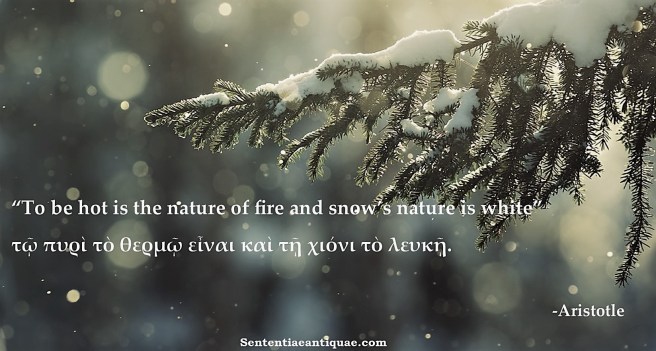
Snow istotle

Our Own Worst Enemy

Sayings from the Gnomologium Vaticanum

7 “When Antisthenes was asked by someone what he should teach his child, he said “If you want him to live with the gods, philosophy; but if you wish him to live among men, then rhetoric.”

῾Ο αὐτὸς ἐρωτηθεὶς ὑπό τινος, τί· τὸν υἱὸν διδάξει, εἶπεν· „εἰ μὲν θεοῖς αὐτὸν συμβιοῦν ἐθέλοις, φιλόσοφον· εἰ δὲ ἀνθρώποις, ῥήτορα”.

12“Antisthenes used to say that virtue had a short justification while the argument for wickedness was endless.”

῾Ο αὐτὸς ἔφη τὴν ἀρετὴν βραχύλογον εἶναι, τὴν δὲ κακίαν ἀπέραντον.

13 “When Plato was chattering on at length about something, Antisthenes said “the one who speaks is not the measure of his audience—it is the audience who makes a limit for the speaker!”

῾Ο αὐτὸς Πλάτωνός ποτε ἐν τῇ σχολῇ μακρολογήσαντος εἶπεν·„οὐχ ὁ λέγων μέτρον ἐστὶ τοῦ ἀκούοντος, ἀλλ’ ὁ ἀκούων τοῦ λέγοντος.”

14 “Anacharsis used to say that the Greeks really messed things up because their craftsmen compete and the ignorant judge them.”

᾿Ανάχαρσις ἔφη τοὺς ῞Ελληνας ἁμαρτάνειν, ὅτι παρ’ αὐτοῖς οἱ μὲν τεχνῖται ἀγωνίζονται, οἱ δ’ ἀμαθεῖς κρίνουσιν.

18 “When Anacharsis was asked by someone what was humanity’s enemy, he said “themselves”.

῾Ο αὐτὸς ἐρωτηθεὶς ὑπό τινος, τί ἐστι πολέμιον ἀνθρώποις, εἶπεν· „αὐτοὶ ἑαυτοῖς”.

19 “When Anacharsis was asked by someone why jealous people are always aggrieved he said “because their own troubles are not the only thing biting them: other people’s good fortune bothers them too.”

῾Ο αὐτὸς ἐρωτηθεὶς ὑπό τινος, διὰ τί οἱ φθονεροὶ ἄνθρωποι ἀεὶ λυποῦνται, ἔφη· „ὅτι οὐ μόνον τὰ ἑαυτῶν αὐτοὺς κακὰ δάκνει, ἀλλὰ καὶ τὰ τῶν πέλας ἀγαθὰ λυπεῖ”.

Carl Fredrik Hill: De sista människorna.
NM 6380

Responses to Monstrosity

Sophocles. Oedipus Tyrannus. 1297-1306. Chorus:

O Calamity, awful for people to see!
By far the most awful I’ve come upon yet!
Hapless man, what madness visited you?
What god has leapt farther than the farthest bound
Onto your jinxed life?
Alas, alas, disaster of a man!
I haven’t the strength to look at you,
Though there’s much I want to ask and hear.
I gawk instead–you make me shudder so.

Freud. The ‘Uncanny.’

The uncanny: “It undoubtedly belongs to all that is terrible–to all that arouses dread and creeping horror.”

“Everything is uncanny that ought to have remained hidden and secret, and yet comes to light.”

ὦ δεινὸν ἰδεῖν πάθος ἀνθρώποις,
ὦ δεινότατον πάντων ὅσ᾽ ἐγὼ
προσέκυρσ᾽ ἤδη. τίς σ᾽, ὦ τλῆμον,
προσέβη μανία; τίς ὁ πηδήσας
μείζονα δαίμων τῶν μακίστων
πρὸς σῇ δυσδαίμονι μοίρᾳ;
φεῦ φεῦ, δύσταν᾽:
ἀλλ᾽ οὐδ᾽ ἐσιδεῖν δύναμαί σε, θέλων
πόλλ᾽ ἀνερέσθαι, πολλὰ πυθέσθαι,
πολλὰ δ᾽ ἀθρῆσαι:
τοίαν φρίκην παρέχεις μοι.

white theater mask crying tears of blood

Larry Benn has a B.A. in English Literature from Harvard College, an M.Phil in English Literature from Oxford University, and a J.D. from Yale Law School. Making amends for a working life misspent in finance, he’s now a hobbyist in ancient languages and blogs at featsofgreek.blogspot.com.

A Tunic of Flesh and Kirke [#Circe] as an Allegory

Plutarch’s Moralia Fr. 200

“Our fated nature is identified by Empedocles as the force behind this remaking, “wrapping [us] in a tunic of strange flesh” and transferring souls to a new place. Homer has called this circular revolution and the return of rebirth by the name Kirke, a child of Helios, the one who unites every destruction with birth and destruction again, binding it endlessly.

The Island Aiaia is that place which revives the person who dies, a place where the souls first step when they are wandering and feel like strangers to themselves as they mourn and cannot figure out which direction is west nor where the “sun which brings life to people over the land / descends again into the earth.”

These souls long for their habits of pleasure and their life in the flesh and the way they lived with their flesh and they fall again into that mixture where birth swirls together and truly stirs into one the immortal and moral, the material of thought and experience, elements of heaven and earth. The souls are enchanted but also weakened by the pleasures that pull them to birth again. At that time, souls require a great amount of good luck and much wisdom to find some way to resist and depart from their worst characters and become bound to their most base parts or passions and take up a terrible and beastly life.”

Αὐτῆς γὰρ τῆς μετακοσμήσεως εἱμαρμένη καὶ φύσις ὑπὸ Ἐμπεδοκλέους δαίμων ἀνηγόρευται σαρκῶν ἀλλογνῶτι περιστέλλουσα χιτῶνι καὶ μεταμπίσχουσα τὰς ψυχάς, Ὅμηρος δὲ τὴν ἐν κύκλῳ περίοδον καὶ περιφορὰν παλιγγενεσίας Κίρκην προσηγόρευκεν, Ἡλίου παῖδα τοῦ πᾶσαν φθορὰν γενέσει καὶ γένεσιν αὖ πάλιν φθορᾷ συνάπτοντος ἀεὶ καὶ συνείροντος. Αἰαίη δὲ νῆσος ἡ δεχομένη τὸν ἀποθνήσκοντα μοῖρα καὶ χώρα τοῦ περιέχοντος, εἰς ἣν ἐμπεσοῦσαι πρῶτον αἱ ψυχαὶ πλανῶνται καὶ ξενοπαθοῦσι καὶ ὀλοφύρονται καὶ οὐκ ἴσασιν ὅπῃ ζόφος οὐδ᾿ ὅπῃ ἠέλιος φαεσίμβροτος εἶσ᾿ ὑπὸ γαῖαν,ποθοῦσαι δὲ καθ᾿ ἡδονὰς τὴν συνήθη καὶ σύντροφον ἐν σαρκὶ καὶ μετὰ σαρκὸς δίαιταν ἐμπίπτουσιν αὖθις εἰς τὸν κυκεῶνα, τῆς γενέσεως μιγνύσης εἰς ταὐτὸ καὶ κυκώσης ὡς ἀληθῶς ἀίδια καὶ θνητὰ καὶ φρόνιμα καὶ παθητὰ καὶ ὀλύμπια καὶ γηγενῆ, θελγόμεναι καὶ μαλασσόμεναι ταῖς ἀγούσαις αὖθις ἐπὶ τὴν γένεσιν ἡδοναῖς, ἐν ᾧ δὴ μάλιστα πολλῆς μὲν εὐτυχίας αἱ ψυχαὶ δέονται πολλῆς δὲ σωφροσύνης, ὅπως μὴ τοῖς κακίστοις ἐπισπόμεναι καὶ συνενδοῦσαι μέρεσιν ἢ πάθεσιν αὑτῶν κακοδαίμονα καὶ θηριώδη βίον ἀμείψωσιν.

Aristotle, Physiognomics 808b

“[in this case] the soul and the body would experience things together, but they would not have the same reactions as one another. But, now, it is entirely clear that one follows another. This is especially obvious from the following. For madness seems to be a matter of the mind; doctors, however, respond to it by cleansing the body with medicines and also by telling them to pursue certain habits in life which may relieve the mind of madness.

So, the form of the body is relieved by treatments to the body at the very same time that the soul is freed from madness. Since they are both relieved together, it is clear that their reactions are in synchrony. It is also clear from this that the forms special to the body are similar to the capabilities of the mind, with the result that all similarities in living things are clear signs of some kind of sameness.”

ἡ ψυχή τε καὶ τὸ σῶμα συμπαθῆ, οὐ μέντοι συνδιατελοῦντα ἀλλήλοις. νῦν δὲ καταφανὲς ὅτι ἑκάτερον ἑκατέρῳ ἕπεται. μάλιστα μέντοι ἐκ τοῦδε δῆλον γένοιτο. μανία γὰρ δοκεῖ εἶναι περὶ ψυχήν, καὶ οἱ ἰατροὶ φαρμάκοις καθαίροντες τὸ σῶμα καὶ διαίταις τισὶ πρὸς αὐτοῖς χρησάμενοι ἀπαλλάττουσι τὴν ψυχὴν τῆς μανίας. ταῖς δὴ τοῦ σώματος θεραπείαις καὶ ἅμα ἥ τε τοῦ σώματος μορφὴ λέλυται καὶ ἡ ψυχὴ μανίας ἀπήλλακται. ἐπειδὴ οὖν ἅμα ἀμφότερα λύονται, δῆλον ὅτι συνδιατελοῦσιν ἀλλήλοις. συμφανὲς δὲ καὶ ὅτι ταῖς δυνάμεσι τῆς ψυχῆς ὅμοιαι αἱ μορφαὶ τοῖς σώμασιν ἐπιγίνονται, ὥστ᾿ ἐστὶν ἅπαντα ὅμοια ἐν τοῖς ζῴοις τοῦ αὐτοῦ τινὸς δηλωτικά.

Here is another allegorical interpretation of the Odyssey attributed to Porphyry.

from Stobaeus, i. 44. 60 

Τοῦ αὐτοῦ (sc. Πορφυρίου)·

“The things that Homer says about Kirkê contain a wonderful theory about the soul. The interpretation runs as follows:

Some have the heads, voice, head and skin of swine, but the mind remains constant as it was before. This myth is similar to the riddle about the soul presented by Pythagoras and Plato, that it is indestructible in nature and unseen but that it is not safe from harm or unchangeable. In what is called its destruction or death, it undergoes a change and then a transference into different kinds of bodies pursuing an appearance and fit according to pleasure, by similarity and practice to how it lived life. In this, each person draws a great advantage from education and philosophy, since the soul has a memory of noble things, judges the shameful harshly, and is able to overcome the unnatural pleasures. This soul can pay attention to itself, and guard that it might not accidentally become a beast because it has grown attracted to an hideously shaped, unclean body regarding virtue, a body that excites and nourishes uncultured and unreasoning nature rather than increasing and nourishing thought.

Τὰ δὲ παρ᾿ Ὁμήρῳ περὶ τῆς Κίρκης λεγόμενα θαυμαστὴν ἔχει τὴν περὶ ψυχὴν θεωρίαν. λέγεται γὰρ οὕτως,

οἱ δὲ συῶν μὲν ἔχον κεφαλὰς φωνήν τε τρίχας τε καὶ δέμας· αὐτὰρ νοῦς ἦν ἔμπεδος ὡς τὸ πάρος περ. ἔστι τοίνυν ὁ μῦθος αἴνιγμα τῶν περὶ ψυχῆς ὑπό τε Πυθαγόρου λεγομένων καὶ Πλάτωνος, ὡς ἄφθαρτος οὖσα τὴν φύσιν καὶ ἀίδιος, οὔ τι μὴν ἀπαθὴς οὐδ᾿ ἀμετάβλητος, ἐν ταῖς λεγομέναις φθοραῖς καὶ τελευταῖς μεταβολὴν ἴσχει καὶ μετακόσμησιν εἰς ἕτερα σωμάτων εἴδη, καθ᾿ ἡδονὴν διώκουσα τὸ πρόσφορον καὶ οἰκεῖον ὁμοιότητι καὶ συνηθείᾳ βίου διαίτης· ἔνθα δὴ τὸ μέγα παιδείας ἑκάστῳ καὶ φιλοσοφίας ὄφελος, ἂν μνημονεύουσα τῶν καλῶν ἡ ψυχὴ καὶ δυσχεραίνουσα τὰς αἰσχρὰς καὶ παρανόμους ἡδονὰς δύνηται κρατεῖν καὶ προσέχειν αὑτῇ καὶ φυλάττειν μὴ λάθῃ θηρίον γενομένη καὶ στέρξασα σώματος οὐκ εὐφυοῦς οὐδὲ καθαροῦ πρὸς ἀρετὴν φύσιν ἄμουσον καὶ ἄλογον καὶ τὸ ἐπιθυμοῦν καὶ θυμούμενον μᾶλλον ἢ τὸ φρόνιμον αὐξάνοντος καὶ τρέφοντος.

“Once the soul is translated, that which is fated and nature, which Empedocles named the divine force that “wraps us in a foreign robe of flesh”, also re-fits the soul.  Homer has named this circular journey and return of rebirth Kirkê, the child of the sun because the sun binds every destruction to birth and every birth in turn to destruction, always weaving them together. The Island Aiaia is also that place allotted to receive one who dies—where the souls first arrive as they wander, and suffer alienation as they mourn and they do not know which way is west nor “where the sun which brings mortals light comes upon the earth”.

As they long for their habits of pleasure—their shared life in the flesh and their way of life with the flesh—they provide the draught with its character again: it is the drink where birth is mixed and stirs together what is truly immortal and mortal, the thoughts and sufferings, the ethereal and the earthbound. The souls are enchanted and weakened by the pleasures that will lead them back to birth again. At this time, souls require great luck and great wisdom in order to avoid pursuing their worst aspects or passions and dedicate themselves to a cursed and beastly life”.

Αὐτῆς γὰρ τῆς μετακοσμήσεως εἱμαρμένη καὶ φύσις ὑπὸ Ἐμπεδοκλέους δαίμων ἀνηγόρευται “σαρκῶν ἀλλογνῶτι περιστέλλουσα χιτῶνι”καὶ μεταμπίσχουσα τὰς ψυχάς, Ὅμηρος δὲ τὴν ἐν κύκλῳ περίοδον καὶ περιφορὰν παλιγγενεσίας Κίρκην προσηγόρευκεν, Ἡλίου παῖδα τοῦ πᾶσαν φθορὰν γενέσει καὶ γένεσιν αὖ πάλιν φθορᾷ συνάπτοντος ἀεὶ καὶ συνείροντος. Αἰαίη δὲ νῆσος ἡ δεχομένη τὸν ἀποθνήσκοντα μοῖρα καὶ χώρα τοῦ περιέχοντος, εἰς ἣν ἐμπεσοῦσαι πρῶτον αἱ ψυχαὶ πλανῶνται καὶ ξενοπαθοῦσι καὶ ὀλοφύρονται καὶ οὐκ ἴσασιν ὅπῃ ζόφος “οὐδ᾿ ὅπῃ ἠέλιος φαεσίμβροτος εἶσ᾿ ὑπὸ γαῖαν” ποθοῦσαι δὲ καθ᾿ ἡδονὰς τὴν συνήθη καὶ σύντροφον ἐν σαρκὶ καὶ μετὰ σαρκὸς δίαιταν ἐμπίπτουσιν αὖθις εἰς τὸν κυκεῶνα, τῆς γενέσεως μιγνύσης εἰς ταὐτὸ καὶ κυκώσης ὡς ἀληθῶς ἀίδια καὶ θνητὰ καὶ φρόνιμα καὶ παθητὰ καὶ ὀλύμπια καὶ γηγενῆ, θελγόμεναι καὶ μαλασσόμεναι ταῖς ἀγούσαις αὖθις ἐπὶ τὴν γένεσιν ἡδοναῖς, ἐν ᾧ δὴ μάλιστα πολλῆς μὲν εὐτυχίας αἱ ψυχαὶ δέονται πολλῆς δὲ σωφροσύνης, ὅπως μὴ τοῖς κακίστοις ἐπισπόμεναι καὶ συνενδοῦσαι μέρεσιν ἢ πάθεσιν αὑτῶν κακοδαίμονα καὶ θηριώδη βίον ἀμείψωσιν.

For it is right that it is called and considered a crossroad in the underworld around which the parts of the soul split: the rational, the emotional, and the desirous. Each of these produces a force or an inducement to the life appropriate to itself. This is no longer myth or poetry but truth and a story of nature. In this transformation and rebirth, when the aspect of desire overpowers and takes control, [Homer] is claiming that because of the dominance of pleasure and gluttony, they transform into the bodies of donkeys and pigs and receive unclean lives on the ground. The interpretation runs as follows.

Whenever a soul has an emotional component that has grown completely savage because of harsh rivalries or murderous savagery developing from some disagreement or vendetta, that soul finds a second birth which is full of bitterness and angry thoughts and falls into the shape of a wolf or a lion, embracing this body as if it were a tool of vengeance for his controlling passion. For this reason, one must keep clean when near death as if for a religious rite and restrain from every kind of base pleasure, put every harsh emotion to bed, and to withdraw from the body by suppressing envies, enmities, and rages down deep. This “Hermes of the golden-staff” happens to be that very reasoning which indicates clearly the good and either wholly restrains or saves it from the deadly draught should it drink—it preserves the soul in a human life and character for as long a time as is possible.”

ἡ γὰρ λεγομένη καὶ νομιζομένη τῶν ἐν Ἅιδου τρίοδος ἐνταῦθά που τέτακται περὶ τὰ τῆς ψυχῆς σχιζομένη μέρη, τὸ λογιστικὸν καὶ θυμοειδὲς καὶ ἐπιθυμητικόν, ὧν ἕκαστον ἀρχὴν ἐξ αὑτοῦ καὶ ῥοπὴν ἐπὶ τὸν οἰκεῖον βίον ἐνδίδωσι. καὶ οὐκέτι ταῦτα μῦθος οὐδὲ ποίησις ἀλλ᾿ ἀλήθεια καὶ φυσικὸς λόγος. ὧν μὲν γὰρ ἐν τῇ μεταβολῇ καὶ γενέσει τὸ ἐπιθυμητικὸν ἐξανθοῦν ἐπικρατεῖ καὶ δυναστεύει, τούτοις εἰς ὀνώδη καὶ ὑώδη σώματα καὶ βίους θολεροὺς καὶ ἀκαθάρτους ὑπὸ φιληδονίας καὶ γαστριμαργίας φησὶ γίνεσθαι τὴν μεταβολήν. ὅταν δὲ φιλονεικίαις σκληραῖς καὶ φονικαῖς ὠμότησιν ἔκ τινος διαφορᾶς ἢ δυσμενείας ἐξηγριωμένον ἔχουσα παντάπασιν ἡ ψυχὴ τὸ θυμοειδὲς εἰς δευτέραν γένεσιν ἀφίκηται, πλήρης οὖσα προσφάτου πικρίας καὶ βαρυφροσύνης ἔρριψεν ἑαυτὴν εἰς λύκου φύσιν ἢ λέοντος, ὥσπερ ὄργανον ἀμυντικὸν τὸ σῶμα τῷ κρατοῦντι προσιεμένη πάθει καὶ περιαρμόσασα. διὸ δεῖ μάλιστα περὶ τὸν θάνατον ὥσπερ ἐν τελετῇ καθαρεύοντα παντὸς ἀπέχειν πάθους φαύλου τὴν ψυχὴν καὶ πᾶσαν ἐπιθυμίαν χαλεπὴν κοιμήσαντα καὶ φθόνους καὶ δυσμενείας καὶ ὀργὰς ἀπωτάτω τιθέμενον τοῦ φρονοῦντος ἐκβαίνειν τοῦ σώματος. οὗτος ὁ χρυσόρραπις Ἑρμῆς ἀληθῶς ὁ λόγος ἐντυγχάνων καὶ δεικνύων ἐναργῶς τὸ καλὸν ἢ παντάπασιν εἴργει καὶ ἀπέχει τοῦ κυκεῶνος, ἢ πιοῦσαν2 ἐν ἀνθρωπίνῳ βίῳ καὶ ἤθει διαφυλάσσει πλεῖστον χρόνον, ὡς ἀνυστόν ἐστι.

Epictetus, Fr. 26

“Epictetus used to say, ‘you’re a tiny soul lugging around a corpse’.”

Ψυχάριον εἶ βαστάζον νεκρόν, ὡς Ἐπίκτητος ἔλεγεν.

Wright Barker (British, 1863-1941) – “Circe” c.1889Color photograph of an oil painting. A woman, nude to the waste, gestures towards the viewer from the top of marble steps. Lions and wolves gather around her

Who Was Deucalion’s Mother? Some Say Pandora…

Schol. Ad Hom. Od. 2.2 hypothesis

“Deukaliôn, in whose time the deluge happened, was the son of Prometheus and his mother—according to most authors—was Klymenê. But Hesiod says that his mother was Pronoê and Akousilaos claims that it was Hesione, the daughter of Okeanos and Prometheus. He married Pyrra who was the daughter of Epimêtheus and Pandôra the one who was given by Epimetheus in exchange for fire. Deukalion had two daughters, Prôtogeneia and Melantheia, and two sons, Ampiktuôn and Hellen, whom others say was actually an offspring of Zeus, but in truth he was Deucalion’s”.

Δευκαλίων, ἐφ’ οὗ ὁ κατακλυσμὸς γέγονε, Προμηθέως μὲν ἦν υἱὸς, μητρὸς δὲ, ὡς οἱ πλεῖστοι λέγουσι, Κλυμένης, ὡς δὲ ῾Ησίοδος Προνοής, ὡς δὲ ᾿Ακουσίλαος ῾Ησιόνης τῆς ᾿Ωκεανοῦ καὶ Προμηθέως. ἔγημε δὲ Πύρραν τὴν ᾿Επιμηθέως καὶ Πανδώρας τῆς ἀντὶ τοῦ πυρὸς δοθείσης τῷ ᾿Επιμηθεῖ εἰς γυναῖκα. γίνονται δὲ τῷ Δευκαλίωνι θυγατέρες μὲν δύο Πρωτογένεια καὶ Μελάνθεια, υἱοὶ δὲ ᾿Αμφικτύων καὶ ῞Ελλην. οἱ δὲ λέγουσιν ὅτι ῞Ελλην γόνῳ μὲν ἦν Διὸς, λόγῳ δὲ Δευκαλίωνος. ἐξ οὗ ῞Ελληνος Αἴολος πατὴρ Κρηθέως.

This story is a bit strange but repeats the typical connection between man and Prometheus. Here, however, mortal man is descended from Prometheus via Deucalion. He married his cousin, which was not all that uncommon, and the rest of the story proceeds somewhat as is typical (leading to the birth of Hellen, the origin of the ethnonym Hellenes).

Color photograph of a chalk on paper portrait of Pandora, a woman holding a box with the lid slightly open. The color scheme is primarily red
Dante Gabriel Rosetti, “Pandora”, 1869
Faringdon Collection Trust

The Schol. In Ap. Rhod. 3.1086 tells this part of the story, except, he gives us another mother:

“Deucalion was the son of Prometheus and Pandora, which is what Hesiod says in the Catalogue [Of Women] and that Hellen was the son of Deucalion and Pyrra, from whom the Hellenes and Hellas were named. He also said that Deukalion was king of Thessaly…”

ὅτι Προμηθέως καὶ Πανδώρας υἱὸς Δευκαλίων, ῾Ησίοδος ἐν α′ Καταλόγων (fg 2 Rz.2) φησί, καὶ ὅτι Δευκαλίωνος καὶ Πύρρας ῞Ελλην, ἀφ’ οὗ ῞Ελληνες καὶ ῾Ελλάς. ὅτι δὲ Δευκαλίων ἐβασίλευσε Θεσσαλίας, ῾Ελλάνικος ἐν α′ τῆς Δευκαλιωνείας (4 fg

This passage is, of course, more than a little messed up, since it makes Pandôra into Deukalion’s mother. West in the edition with Merkelbach (1967, 4) comments “locum funditus corruptum varie sanare conati sunt viri docti” (“learned men have tried to correct this deeply corrupt passage in different ways”)

The names given for Deucalion’s mothers are interesting. Hêsione is the same name as the Trojan princess rescued by Herakles but not the same figure. She appears in connection with Prometheus in Aeschylus’ Prometheus Bound. Klymene—whose name may have something to do with weeping or flowing—may be associated with Deucalion because of his relationship with the flood (κατακλυσμὸς). And the other alternative, Pronoê, is merely a parallel formation for Prometheus (both mean forethought).

The problem of Deukalion’s mother goes on: Herodotus (4.45) makes her Asia. Thought the scholiast says that “most authors” make Klymenê Deukalion’s mother, this is a bit of a problem if we look to Hesiod’s Theogony (507-511):

“Iapetos took as wife the fine-ankled Okeanid
Klumenê and put her in his own bed.
She bore to him the strong-minded child Atlas.
She also bore overawing Menoitios and Prometheus
Fine and clever minded, and then messy-minded Epimetheus.”

κούρην δ’ ᾿Ιαπετὸς καλλίσφυρον ᾿Ωκεανίνην
ἠγάγετο Κλυμένην καὶ ὁμὸν λέχος εἰσανέβαινεν.
ἡ δέ οἱ ῎Ατλαντα κρατερόφρονα γείνατο παῖδα,
τίκτε δ’ ὑπερκύδαντα Μενοίτιον ἠδὲ Προμηθέα,
ποικίλον αἰολόμητιν, ἁμαρτίνοόν τ’ ᾿Επιμηθέα·

So, it is clear that Klumenê is not likely to have been Prometheus’ mother and his wife. This also explains why Hesiod listed a different mother for Deukalion—Hesiodic poetrymade the Okeanid Prometheus’ mother. To generate a wife, it seems to have created one based on the idea of her husband’s name. It is thoroughly possible for different genealogical traditions in Greece to attribute offspring to different parents. Deukalion, as the survivor of a flood, makes sense as a son of an Okeanid.

Of course, this means we have no universal choice for his mother. Personally, I kind of like the choice of Pandôra…even if it it comes from a locum funditus corruptum. But the sensible choice, seems a compromise. If Klumene is Prometheus’ mother, then the Okeanid Hesione can be Deukalion’s mother, giving him all that association with the ocean.

Of course, this is not the end of it: in the Works and Days 159a, Epimetheus is made the father of Deucalion and Pyrra..

Works Consulted For This Mess:

R. L. Fowler. Early Greek Mythography. Volume 2: Commentary. Oxford, 2013.
R. Merkelbach and M.L. West. Fragmenta Hesiodea. Oxford, 1967.

Passages on the Origin of a Minotaur

A few years back, Erik made a post about Moonface’s Album of Songs about the Minotaur. It  made me think a lot about the story from the Minotaur’s (Asterion’s) perspective.  In general, the narratives that include him are about Theseus. Here are some passages about Pasiphae and the Minotaur.

Hesiod, Fr. 145.13–17

“When he looked in her eyes he longed for her
[and she gave herself over to the bull]
After she was impregnated, she gave birth to a powerful son to Minos,
A wonder to see: for he had the appearance of man
Down to his feet, but a bull’s head grew on top.”

τῆς δ’ ἄρ’ [ἐν ὀ]φθαλμοῖσιν̣ ἰ̣δὼν ἠράσ̣[σατο
†ταύρωι̣.[…]ρ̣ι̣μενησ̣κ̣α̣μ̣ε̣ρ̣μ̣ιδαο̣τα̣[†
ἣ δ’ ὑποκ̣[υσα]μένη Μίνωι τέκε κα[ρτερὸν υἱόν,
θαῦμα ἰ[δεῖν·] σ̣α μὲν γὰρ ἐπ̣έ̣κ̣λ̣ι̣ν̣[εν δέμας ἀνδρὶ
ἐς πόδα̣[ς], α̣ὐ̣τ̣ὰρ ὕ̣π̣ε̣ρθε κάρ̣η τ̣α̣[ύροιο πεφύκει

Suda, Epsilon 1421

“In every myth there is also Daidalos’ corruption”: People say that because Pasiphae lusted after a bull, she begged Daidalos to make her a wooden cow and, once he had set it up, to put her in it. When the bull mounted her as a cow he made her pregnant. The Minotaur was born from this. For certain reasons Minos was angry at the Athenians and he took from them seven maidens and the same number of youths. They were thrown to the beast. Since origin and responsibility for these evils were attributed to Daidalos and he was hated for them, this was translated into the proverb.”

᾿Εν παντὶ μύθῳ καὶ τὸ Δαιδάλου μύσος· Πασιφάην φασὶν ἐρασθεῖσαν ταύρου Δαίδαλον ἱκετεῦσαι ποιῆσαι ξυλίνην βοῦν καὶ κατασκευάσαντα αὐτὴν ἐνθεῖναι· ἣν ἐπιβαίνων ὡς βοῦν ὁ ταῦρος ἐγκύμονα ἐποίησεν. ἐξ ἧς ἐγεννήθη ὁ Μινώταυρος. Μίνως δὲ διά τινας αἰτίας ὀργιζόμενος τοῖς ᾿Αθηναίοις ἑπτὰ παρθένους καὶ ἴσους νέους ἐξ αὐτῶν ἐδασμολογεῖτο· οἳ παρεβάλλοντο τῷ θηρίῳ. εἰς Δαίδαλον οὖν ἀρχηγὸν τούτων τῶν κακῶν καὶ αἴτιον γενόμενον καὶ μυσαχθέντα ἐξηνέχθη εἰς παροιμίαν.

Heraclitus the Paradoxographer, 7 Concerning Pasiphae

“People claim that [Pasiphae] lusted after the Bull, not, as many believe, for an animal in a herd—for it would be ridiculous for a queen to desire such uncommon intercourse—instead she lusted for a certain local man whose name was Tauro [the bull]. She used as an accomplice for her desire Daidalos and she was impregnated. Then she gave birth to a son whom many used to call “Minos” but they would compare him to Tauro because of his similarity to him. So, he was nicknamed Mino-tauros from the combination.”

Περὶ Πασιφάης.
Ταύτην φασὶν ἐρασθῆναι Ταύρου, οὐχ, ὡς πολλοὶ
νομίζουσι, τοῦ κατὰ τὴν ἀγέλην ζῴου (γελοῖον γὰρ
ἀκοινωνήτου συνουσίας ὠρέχθαι τὴν βασίλισσαν), ἑνὸς
δέ τινος τῶν ἐντοπίων, ᾧ Ταῦρος ἦν ὄνομα. συνεργῷ
δὲ χρησαμένη πρὸς τὴν ἐπιθυμίαν Δαιδάλῳ καὶ γεγο-
νυῖα ἔγγυος, ἐγέννησε καθ’ ὁμοιότητα τοῦ Ταύρου
<υἱόν>, ὃν οἱ πολλοὶ Μίνω μὲν ἐκάλουν, Ταύρῳ δὲ
εἴκαζον· κατὰ δὲ σύνθεσιν Μινώταυρος ἐκλήθη.

Bacchylides, Dith. 26 (P.Oxy. 2364 fr. 1)

“[in] Pasiphae
The Kyprian goddess [sewed]
Longing [….]
To the son Eupalamos
The wisest of the craftsmen
She told Daidalos [about]
Her sickness. Credible oaths
She ordered him to make [so that]
So that she might have sex with the bull
But keep it secret from her husband
Minos, the oppressive-archer,
The general of the Knossians.
But when he learned of the tale,
He was overtaken by worry and
[about his] wife….

[ ]θεα̣ καὶ γ[.].[ ]
φρα.[ ]
Πασι[φ]ά̣[α]
εν Κύπ[ρις]
πόθον [ ]
Εὐπαλά[μοι’] υἱε[ῖ]
τεκτόν[ω]ν σοφω̣[τάτῳ]
φράσε Δαιδάλῳ ά.[ ]
νόσον· ὅρκια πισ[τ]
[ τ]ε τεύχειν κέλευ[σε]
μ̣είξειε ταυρείῳ σ[ ]
κρύπτουσα σύννο̣[μον]
Μίνωα [τ]οξοδάμαν[τα]
Κνωσσίων στρατα[γέταν·]
ὁ δ’ ἐπεὶ μάθε μῦθο[ν]
σχέτο φροντίδι· δε[ ]
[ ]ἀλόχου[ ]

Screenshot of a red figure vase with Pasiphae holding a baby Minotaur
the looks on their faces

Beauty and Love, A Wedding Song

Theognis, fr. 1-18

“Lord, son of Leto, child of Zeus, I will never
Forget you when beginning or ending my song.
But I sing you first and last and in the middle too
Hear me now and grant me good things.

Lord Phoebus, when the goddess Leto first gave birth to you,
The finest of the gods, she was holding close to the palm tree
with her slight arms, next to the curve of the lake—
and all of Delos was overwhelmed with a divine scent
as the expansive earth laughed beneath,
and the see delighted in its salty depths.

Artemis, slayer of beasts, daughter of Zeus, the one
Agamemnon honored with a temple as he sailed to Troy in swift ships
Hear me as I pray to you—ward off the evil spirts of death.
It is a minor thing for you, goddess; but a big deal for me.”

Muses and Graces, daughters of Zeus, who once
Went to the marriage of Kadmos and sang this beautiful line:
“Whatever is beautiful is loved; and what isn’t beautiful isn’t loved’
That’s the line that rang from your immortal mouths.”

῏Ω ἄνα, Λητοῦς υἱέ, Διὸς τέκος, οὔποτε σεῖο
λήσομαι ἀρχόμενος οὐδ’ ἀποπαυόμενος,
ἀλλ’ αἰεὶ πρῶτόν τε καὶ ὕστατον ἔν τε μέσοισιν
ἀείσω· σὺ δέ μοι κλῦθι καὶ ἐσθλὰ δίδου.

Φοῖβε ἄναξ, ὅτε μέν σε θεὰ τέκε πότνια Λητώ
φοίνικος ῥαδινῆις χερσὶν ἐφαψαμένη
ἀθανάτων κάλλιστον ἐπὶ τροχοειδέι λίμνηι,
πᾶσα μὲν ἐπλήσθη Δῆλος ἀπειρεσίη
ὀδμῆς ἀμβροσίης, ἐγέλασσε δὲ Γαῖα πελώρη,
γήθησεν δὲ βαθὺς πόντος ἁλὸς πολιῆς.

῎Αρτεμι θηροφόνη, θύγατερ Διός, ἣν ᾿Αγαμέμνων
εἵσαθ’, ὅτ’ ἐς Τροίην ἔπλεε νηυσὶ θοῆις,
εὐχομένωι μοι κλῦθι, κακὰς δ’ ἀπὸ κῆρας ἄλαλκε·
σοὶ μὲν τοῦτο, θεά, σμικρόν, ἐμοὶ δὲ μέγα.

Μοῦσαι καὶ Χάριτες, κοῦραι Διός, αἵ ποτε Κάδμου
ἐς γάμον ἐλθοῦσαι καλὸν ἀείσατ’ ἔπος,
‘ὅττι καλόν, φίλον ἐστί· τὸ δ’ οὐ καλὸν οὐ φίλον ἐστί,’
τοῦτ’ ἔπος ἀθανάτων ἦλθε διὰ στομάτων.

Small clay figure of larger divine woman holding human male in arms.
Artemis Kourotrophos. Small terracotta . 430-400 BC. Archaeological Museum of Brauron.

Paris, Primal Destroyer of Troy

Pindar, Paean, fr. 8a [=52i(A) P. Oxy. 841 (5, 1908)]

[She felt him] hurrying and her divine heart
Wailed with horrible groans
And she explained the reason
With words like this: So wholly…
Wide-browed son of Kronos–
You are bringing about the fated
Pain from when Hekabe [informed]
The Dardanian women when she
Was carrying this man in her body,
She believed that she would give birth
To a fire-breathing hundred-hander
One who would drag all Ilion
To the ground with his wicked [ways]
And she spoke [of him] [confessing]
The sign that came into her dreams
[shuddering in fear] at her foreknowledge.”

σπεύδοντ᾿, ἔκλαγξέ <θ᾿> ἱερ̣[
δαιμόνιον κέαρ ὀλοαῖ-
σι στοναχαῖς ἄφαρ,
καὶ τοιᾷδε κορυφᾷ σά-
μαινεν λόγων· ὦ παναπ.[εὐ-
ρ[ύ]οπα Κρονίων τελεῖς σ̣[
π[ε]πρωμέναν πάθαν α[
νικα Δαρδανίδαις Ἑκάβ[
. . ] ποτ᾿ εἶδεν ὑπὸ σπλάγχ[νοις
φέροισα τόνδ᾿ ἀνέρ᾿· ἔδοξ̣[ε γάρ
τεκεῖν πυρφόρον ἐρι[
Ἑκατόγχειρα, σκληρᾷ [
Ἴλιον πᾶσάν νιν ἐπὶ π[έδον
κατερεῖψαι· ἔειπε δὲ μ̣[
. . .] . ´[.]ᾳ τέρας ὑπνα̣[λέον
. . . . .]λ̣ε προμάθεια

Red figure vase. Paris holding a lance and wearing a Phrygian cap. Pillar to right

Wine Makes You King of the World

Bacchylides, fr. 20B [=P. Oxy. 1361 frr. 1 al]

To Alexander, son of Amyntas*

“Lyre, don’t hang on your peg any longer,
Keeping your seven-toned voice still–
Here are my hands! I want to send
Alexander something, a golden wing of the Muses,
A centerpiece for the parties to end the month,
When the sweet pressure of fast cups
Warms the sensitive hearts of young men,
And expectation of Aphrodite mixed up
with Dionysian gifts shakes up their thoughts.

Wine makes the thoughts of men blast off!
Suddenly one is tearing down a city’s walls,
And another thinks he is king of the world!”

[ΑΛΕΞΑ]Ν[ΔΡΩΙ ΑΜΥΝΤ]Α
ὦ βάρβιτε, μηκέτι πάσσαλον φυ[σων
ἑπτάτονον λ[ι]γυρὰν κάππαυε γᾶρυν·
δεῦρ᾿ ἐς ἐμὰς χέρας· ὁρμαίνω τι πέμπ[ειν
χρύεον Μουσᾶν Ἀλεξάνδρωι πτερό
καὶ συμπο[ίαι]σιν ἄγαλμ᾿ [ἐν] εἰκάδε[σιν,
εὖτε νέων ἁ[παλὸν γλυκεῖ᾿ ἀ]νάγκα
σευομενᾶν κ[υλίκων θάλπη]σι θυμ[όν,
Κύπριδος τ᾿ ἐλπ[ὶς <δι>αιθύσσηι φρέ]νας,
ἀμμειγνυμέν[α Διονυσίοισι] δώροις·
ἀνδράσι δ᾿ ὑψο[τάτω πέμπει] μερίμν[ας·
αὐτίκ[α] μὲν π[ολίων κράδε]μνα λ[ύει,
πᾶσ[ι δ᾿ ἀνθρώποις μοναρ]χήσ[ειν δοκεῖ·

*This Alexander was King of Macedon from 498-456

inside of a shallow drinking vessel. Black background. One red figure stands over a nude man who is drunk and confused/sick
Getty Villa Museum, Los Angeles, California: Roman, Greek, and Etruscan Antiquities. Kylix, red figure

No Time For the Weekend: On the Spartan Way of Drinking

Critias, fr. 6 [=Ath. 10.432d–33b]

“Drinking toasts that stretch beyond reason bring
Pleasure for the moment but pain for all time.

The Spartan style is one of moderation:
To eat and drink with limits so people can still
Work and think. They don’t set apart a day
To soak the body with excessive drinking.”

αἱ γὰρ ὑπὲρ τὸ μέτρον κυλίκων προπόσεις παραχρῆμα
τέρψασαι λυποῦσ᾿ εἰς τὸν ἅπαντα χρόνον·
ἡ Λακεδαιμονίων δὲ δίαιθ᾿ ὁμαλῶς διάκειται,
ἔσθειν καὶ πίνειν σύμμετρα πρὸς τὸ φρονεῖν
καὶ τὸ πονεῖν εἶναι δυνάτους· οὐκ ἔστ᾿ ἀπότακτος
ἡμέρα οἰνῶσαι σῶμ᾿ ἀμέτροισι πότοις.

Red figure vase with two figures. Black background. A servant girl unhappily carries a full wineskin and jug, while an older woman drinks from a large vessel; the reverse of the cup establishes a (rare) interior scene of a storeroom.
Skyphos with a Woman Drinking in a Storeroom (Greek, Athens, 470-460 BC).
Also, image of me sneaking drinks if I lived in Sparta