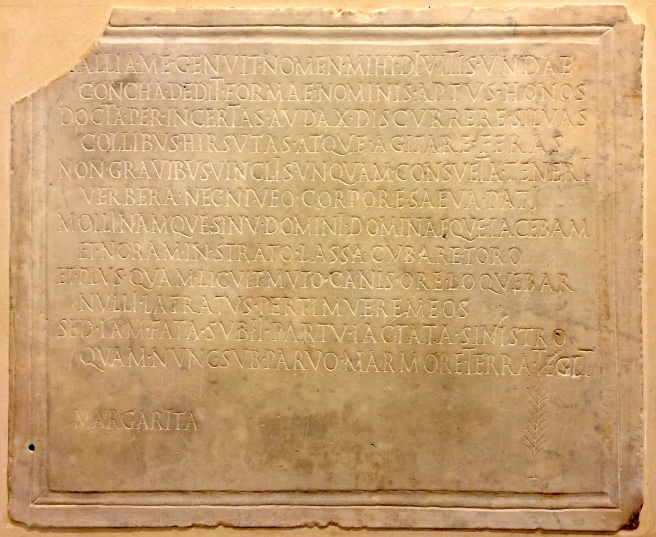
Some Archaic Latin Inscriptions from the Loeb Classical Library (the LCL numbers are first, translations are mine). There are earlier poetic epitaphs on this site as well, even legendary ones
Epitaphs 14 [CIL 1861]
“Here lies the sweet clown and slave of Clulius
Protogenes, who created many moments of happiness for people with his joking”
Protogenes Cloul[i] | suavis heicei situst | mimus
plouruma que | fecit populo soueis | gaudia nuges.
15 [CIL 1202]
“This monument was erected for Marcus Caecilius
We give you thanks, Friend, since you stopped by this home.
May you have good fortune and be well. Sleep without worry.”
Hoc est factum monumentum | Maarco Caicilio. |
Hospes, gratum est quom apud | meas restitistei seedes. |
Bene rem geras et valeas, | dormias sine qura.
18 [CIL 1211]
“Friend, what is written here is brief—stop and read it all.
This is the unattractive tomb of an attractive woman.
Her parents named her Claudia
She loved her own husband with her whole heart.
She had two sons and leaves one of them
On the earth, but placed the other beneath it.
[She was] charming in conversation; but proper in behavior.
She safeguarded her house. She made wool. I have said it all. Go.”
Hospes, quod deico paullum est; asta ac pellege.
Heic est sepulcrum hau pulcrum pulcrai feminae.
Nomen parentes nominarunt Claudiam.
Suom mareitom corde deilexit souo.
Gnatos duos creavit, horunc alterum
in terra linquit, alium sub terra locat.
Sermone lepido, tum autem incessu commodo.
Domum servavit, lanam fecit. Dixi. Abei.
39 [CIL 1219]
“Here are the bones of Pompeia the first daughter
Fortune promises a lot to many but makes a guarantee for no one.
Live for all days and all hours. For nothing is yours wholly.
Salvius and Heros donated this.”
Primae | Pompeiae | ossua heic.|
Fortuna spondet | multis, praestat nemini;
vive in dies | et horas, nam proprium est nihil. |
Salvius et Heros dant.
In desperation and joy, I scoured book seven of the Greek Anthology looking for more. I did not find any the equal of Simonides’ genius above, but here are some others.
Julian 33
“You died from drinking too much, Anacreon.”
“Yes, it was fun! You’ll die too, even though you didn’t drink”
“Even though he lies in the ground, pour out pitch
In the filthy mouth of Parthenius
Because he puked meaningless myriad floods on the muses
And his refuse of his repugnant poems.
”He was so absolutely crazy that he called
The Odyssey mud and the Iliad a mess.
That’s why he is chained by the dusky Furies
In the middle of hell with a dog collar on his neck”
“In Orkhomenos there is a [sanctuary] for Dionysus, but the most ancient shrine if for the graces. They honor the stones most especially and they say that they fell for Eteokles from the sky. In my time there were cult images dedicated, which are also made of stone. Near them, there is a fountain worthy of visiting. People go down to eat to bring back water.
And you will also find the treasure-house of Minyas, which is a wonder beneath no others in Greece. It has been fashioned in the following way. It was built up from stone; it has a circular shape but it directs upward to a peak that is not very sharp. They claim that the stone at the very top is the keystone for the entire construction.
And there are the tombs of Minyas and Hesiod. People say that the bones of Hesiod were regained in this way. When a wasting plague was afflicting men and animals they sent messengers to the gods. They reported that the Pythia answered to them that they must bring the bones of Hesiod back from Naupactus to Orknomenos, and that there was no other cure for them. When they asked in turn where they might find these bones in Naupactus, then again the Pythia told them that a crow would inform them. So, they say that as the representatives were disembarking in Naupactus a stone close to the road and a bird on the stone appeared to them. There they discovered Hesiod’s bones in a fold in the rock. And these elegiac lines were written on the marker:
Although wheat-wealthy Ascra was his home, when he died
The land of the horse-whipping Minyans holds Hesiod’s bones.
His glory will rise to be the greatest in Greece
When men are judged by the standard of wisdom.
“Hesiodic old age”: A proverb for people who are really old. Pindar’s epigram also conveys something like this: “Goodbye, Hesiod, you were twice young and twice you found a grave—you who provided for mankind a measure for wisdom”
Aristotle, fragments of the Constitution of the Orkhomenians
“Hesiodic Old Age: Aristotle says in his Constitution of the Athenians that Hesiod was buried twice and received the following epigram: “Goodbye, Hesiod, you were twice young and twice you found a grave—you who provided for mankind a measure for wisdom”
Aristotle the philosopher, I think rather than the one who gathered together the Robes, says in his Constitution of the Athenians that Stesichorus the lyric poet was the son of Hesiod who was born from Klymenê, the daughter of Amphiphanes and the sister of Ganuktôr, a daughter of Phêgeus (Cf. Schol in Hes. Op. 268: Philokhoros says that Stesichorus was a son of Klumenê and Hesiod). Pindar also has this inscription….
Io. Tzetzes (cf. A. P. p. 505 sqq.) prolegg. comm. in
“Plutarch says that this happened at that time when the Thespiens were driving out the inhabitants and the Orkhomenians had asked that they be saved. This is why the god tasked the Orkomenians with returning Hesiod’s remains and interring them among them. Aristotle says the same thing when he writes about the Constitution of the Orkhomenians.”
“Orpheus, you will no longer lead away oaks or stones
Bewitched by your song, or the leaderless herds of beasts.
You will no longer sing the howl of the wind or the hail to sleep
Or calm blizzards of snow or the roaring of the sea.
For you have died. The daughters of memory mourn you
Much, and especially your mother Kalliope.
Why do we weep over our dead sons when not even the gods
Can ward Hades from their children?”
“Stranger passing by the humble grave of Anakreon,
If my books were of any use to you,
Pour some wine on my ashes, pour it out in drops
So that my bones can smile, refreshed a bit by wine,
so I, who loved the shouting raves of Dionysus,
so I, who was a partner of music matched to drink,
may not lie dead apart from Bacchus in this place below,
the land which all the race of mortals one day must know.”
“I don’t love the man who while drinking next to a full cup
Talks about conflicts and lamentable war.
But whoever mixes the shining gifts of Aphrodite and the Muses
Let him keep in mind loving, good cheer.”
According to Aulus Gellius, here is the epitaph of Pacuvius (Gellius I.24.4)
“Young man, even though you hurry by, this stone
asks you to look on it and then to read what is written.
Here is where you find interred the bones of the poet
Marcus Pacuvius. I desire that you know this. Farewell.”
Adulescens, tam etsi properas te hoc saxum rogat
Ut sese aspicias, deinde quod scriptum est legas.
Hic sunt poetae Pacuvi Marci sita
Ossa. Hoc volebam nescius ne esses. Vale.
Literary–both fictionalized and not–epigraphs were part of the Greek literary tradition at least to the 6th century BCE. From the 5th century, we have Simonides’ epitaph at Thermopylae:
“Stranger, go tell the Spartans that we lie here
obedient to their commands.”
This epigram seems ‘real’ enough, but during the Hellenistic period, poets like Callimachus seem to have made a game of composing funerary epigrams. Here’s one he wrote about himself (or not):
Callimachus, epigram 21.
“Whoever you are lifting your foot near my grave
Know that I am the child and father both of Cyrenian Callimachus.
You would know both men. One led the soldiers of his country,
And the other sang songs beyond envy.
Don’t be surprised: whoever the Muses behold at birth
Are not abandoned friends as they grow grey.”
Gellius also adds to Pacuvius’, an epitaph of a more commonly known comedian, Plautus:
“Now that Plautus has found death, Comedy weeps,
Abandoned on the stage. And then, Laughter, Play and Jest
mourn together with all the uncountable Measures.”
postquam est mortem aptus Plautus, Comoedia luget,
scaena est deserta, dein Risus, Ludus Iocusque
et Numeri innumeri simul omnes conlacrimarunt
And we do have collections of Roman epitaphs that seem both real and literary:
“You are human: pause a moment and contemplate my grave.
As a young man, I stretched myself that I might have what I could use.
I did injustice to no one, my duty to many;
Live well, and do it soon – this must come to you too.”
Homo es: resiste et tumulum contempla meum.
iuenis tetendi ut haberem quod uterer.
iniuriam feci nulli, officia feci pluribus.
bene vive, propera, hoc est veniundum tibi.
(Roman Epitaphs B 83)
But despite all this weight and seriousness, I think that Naevius’ epitaph (also reported by Gellius) is the best:
“If it were right for gods to mourn for mortals
Then the Muses would mourn the poet Naevius.
And when he was brought down to death’s warehouse
Rome would forget how to speak the Latin tongue.”
Immortales mortales si foret fas fiere
Fierent divae Camenae Naevium poetam
Itaque postquamst Orchi traditus thesauro
Obliti sunt Romae loquier lingua latina.
“Young man, even though you hurry by, this stone
asks you to look on it and then to read what is written.
Here is where you find interred the bones of the poet
Marcus Pacuvius. I desire that you know this. Farewell.”
Adulescens, tam etsi properas te hoc saxum rogat
Ut sese aspicias, deinde quod scriptum est legas.
Hic sunt poetae Pacuvi Marci sita
Ossa. Hoc volebam nescius ne esses. Vale.
The Romans, of course, were not the only ones in on this game. Famous as well is Callimachus, epigram 21.
“Whoever you are lifting your foot near my grave
Know that I am the child and father both of Cyrenian Callimachus.
You would know both men. One led the soldiers of his country,
And the other sang songs beyond envy.
Don’t be surprised: whomever the Muses behold at birth
Are not abandoned friends as they grow grey.”
Gellius also adds to Pacuvius’, an epitaph of a more commonly known comedian, Plautus:
“Now that Plautus has found death, Comedy weeps,
Abandoned on the stage. And then, Laughter, Play and Jest
mourn together with all the uncountable Measures.”
postquam est mortem aptus Plautus, Comoedia luget,
scaena est deserta, dein Risus, Ludus Iocusque
et Numeri innumeri simul omnes conlacrimarunt,
Ennius, Varia 17-18
“Let no one honor me with tears nor celebrate my funeral
with weeping. Why? Alive I fly on the mouths of men.”
Nemo me lacrimis decoret nec funera fletu
faxit. cur? volito vivos per ora virum.
According to Aulus Gellius, here is the epitaph of Pacuvius (Gellius I.24.4)
“Young man, even though you hurry by, this stone
asks you to look on it and then to read what is written.
Here is where you find interred the bones of the poet
Marcus Pacuvius. I desire that you know this. Farewell.”
Adulescens, tam etsi properas te hoc saxum rogat
Ut sese aspicias, deinde quod scriptum est legas.
Hic sunt poetae Pacuvi Marci sita
Ossa. Hoc volebam nescius ne esses. Vale.
Literary–both fictionalized and not–epigraphs were part of the Greek literary tradition at least to the 6th century BCE. From the 5th century, we have Simonides’ epitaph at Thermopylae:
“Stranger, go tell the Spartans that we lie here
obedient to their commands.”
This epigram seems ‘real’ enough, but during the Hellenistic period, poets like Callimachus seem to have made a game of composing funerary epigrams. Here’s one he wrote about himself (or not):
Callimachus, epigram 21.
“Whoever you are lifting your foot near my grave
Know that I am the child and father both of Cyrenian Callimachus.
You would know both men. One led the soldiers of his country,
And the other sang songs beyond envy.
Don’t be surprised: whomever the Muses behold at birth
Are not abandoned friends as they grow grey.”
Gellius also adds to Pacuvius’, an epitaph of a more commonly known comedian, Plautus:
“Now that Plautus has found death, Comedy weeps,
Abandoned on the stage. And then, Laughter, Play and Jest
mourn together with all the uncountable Measures.”
postquam est mortem aptus Plautus, Comoedia luget,
scaena est deserta, dein Risus, Ludus Iocusque
et Numeri innumeri simul omnes conlacrimarunt,
But despite all this weight and seriousness, I think that Naevius’ epitaph (also reported by Gellius) is the best:
“If it were right for gods to mourn for mortals
Then the Muses would mourn the poet Naevius.
And when he was brought down to death’s warehouse
Rome would forget how to speak the Latin tongue.”
Immortales mortales si foret fas fiere
Fierent divae Camenae Naevium poetam
Itaque postquamst Orchi traditus thesauro
Obliti sunt Romae loquier lingua latina.
“If it were right for gods to mourn for mortals
Then the Muses would mourn the poet Naevius.
And when he was brought down to death’s warehouse
Rome would forget how to speak the Latin tongue.”
Immortales mortales si foret fas fiere
Fierent divae Camenae Naevium poetam
Itaque postquamst Orchi traditus thesauro
Obliti sunt Romae loquier lingua latina.