“To begin with, they wrongly reject prior meditation on future affairs. For there is nothing which works so well to calm or relieve anxiety as much as the thought throughout your life that there is nothing that is can’t happen; there’s no contemplation better for our human condition as the law of of life and learning obedience to it—this doesn’t make us sad all the time but keeps us from ever being so. For the person who reflects on the nature of things, on the variety of life, and the precarity of human existence is not sad in considering these things but is carrying out the duty of wisdom in the fullest way.
For they pursue both in enjoying the particular harvest of philosophy by considering what happens in human life and in suffering adverse outcomes by cleansning with a three-part solace. First, by previously accepting the possibility of misfortune—which is the most way of weakening and managing any annoyance and second, by learning that human events must be endured humanely; and third, by recognizing that there is nothing evil except for blame and there is no blame when the event is something against which no human can endure.”
Principio male reprehendunt praemeditationem rerum futurarum. Nihil est enim quod tam obtundat elevetque aegritudinem quam perpetua in omni vita cogitatio nihil esse, quod non accidere possit, quam meditatio condicionis humanae, quam vitae lex commentatioque parendi, quae non hoc adfert, ut semper maereamus, sed ut numquam. Neque enim qui rerum naturam, qui vitae varietatem, qui imbecillitatem generis humani cogitat, maeret, cum haec cogitat, sed tum vel maxime sapientiae fungitur munere. Utrumque enim consequitur, ut et considerandis rebus humanis proprio philosophiae fruatur officio et adversis casibus triplici consolatione sanetur: primum quod posse accidere diu cogitavit, quae cogitatio una maxime molestias omnes extenuat et diluit; deinde quod humana humane ferenda intelligit; postremo quod videt malum nullum esse nisi culpam, culpam autem nullam esse, cum id, quod ab homine non potuerit praestari, evenerit.
Lucretius, De Rerum Natura .540-147
“Unless matter itself had been eternal before our time
Everything would have already reverted to nothing
And whatever we see would also have come from nothing.
But since I have demonstrated that nothing can be made from nothing
And what has been made cannot be returned to nothing
There ought to be a primal creation for the immortal body
Where everything diffuses again at the final moment
to supply matter itself for the rebirth of things.”
raeterea nisi materies aeterna fuisset,
antehac ad nilum penitus res quaeque redissent,
de niloque renata forent quaecumque videmus.
at quoniam supra docui nil posse creari
de nilo neque quod genitum est ad nil revocari,
esse inmortali primordia corpore debent,
dissolui quo quaeque supremo tempore possint,
materies ut suppeditet rebus reparandis.
“So he spoke, and a dark cloud of grief covered Achilles.”
῝Ως φάτο, τὸν δ’ ἄχεος νεφέλη ἐκάλυψε μέλαινα·
I don’t know why I’m surprised that I find it hard to write about the Iliad. Or rather, why I find it so much harder to write about the Iliad than I do to write about the Odyssey.
Everything around the Iliad has always been harder and heavier for me as a classicist and a modern bard. And as a human being.
From the first time I read it as an undergrad studying Classics at UW-Madison, I’ve felt that the Iliad punishes the reader in a way that the Odyssey (which to be sure, itself has plenty of punishment) doesn’t.
To be sure, the context in which I’m writing about performing my Homer-inspired musical works has changed. “A Penis on the Screen” was written at the beginning of the first full escalation of the pandemic, more than nine months and three hundred thousand US deaths ago.
It was also written after only a single virtual performance of my one-man musical Odyssey, and before any virtual performances of my one-man musical Iliad, “The Blues of Achilles. Since that initial phallus-inscribed voyage I have completed fourteen virtual Odysseys and eleven virtual Blues of Achilles shows.
In a way these two blogs mirror how the creation of my two epic works unfolded. I wrote “Joe’s Odyssey” in the naive afterglow of my undergraduate studies when I didn’t know any better, when I was too young to understand how audacious it was to create a thirty-five minute non-narrative modern folk opera telling of the Odyssey, let alone to ask folks to sit still for it. That actually worked in my favor, as youthful ignorance sometimes does. I wrote a prompt in my songwriting book that read “create a one-man 24 song folk opera retelling of Homer’s Odyssey” and three months later I premiered it in my parents’ living room, with a full performance for a group of students less than two months after that.
Heracles and Geryon on an Attic black-figured amphora with a thick layer of transparent gloss, c. 540 BC, now in the Munich State Collection of Antiquities.
By contrast, sixteen years later when I decided to take on the Iliad, I spent almost a full year reading, researching, even interviewing veterans, before I wrote a single song. Once I composed the songs that comprise “The Blues of Achilles,” I played small samplings of them in modest workshop scenarios for another year before I finally debuted the full cycle in San Francisco in early March just as the pandemic took hold (a selection of songs from that performance can be viewed here on YouTube).
All of this is to say that these two pieces came from and were in two wildly different places in March as I started to consider how I would continue to perform them in a streaming environment: on the one hand, I had 300 plus Odyssey shows under my belt, on the other I had the Blues of Achilles with… one single show (and one in which I performed with an ensemble).
In reading my initial impressions of performing virtually as detailed in the Penis on the Screen blog, I have to give myself a little credit: almost all of what I wrote there about the Zoom performance environment bore itself out as correct over the course of repeated performances of my Odyssey.
(NB: I am so infrequently right about things I have to make a big deal of times when I am. For instance, as she will vouch for, I saw where the pandemic was going early on and told my wife to stock up on canned goods and alcohol for quarantine in early-February. I also correctly predicted that Dwyane Wade would be an NBA Hall-of-Famer after watching the 2003 NCAA tournament. Take that, Calchas).
But while my routines around my virtual Odyssey shows were immediately informed by the hundreds of previous live shows and discussions, The Blues of Achilles was a blank slate. Would I perform all the songs without stopping? Would I work in spoken narrative passages as I did in the public debut in San Francisco? Would I talk about all the works that informed my songs ahead of the performance, or let the audience lead me to such considerations in a discussion?
My Odyssey performance had years and years to develop organically along with my abilities, going from a living room to high school classrooms to university settings over the course of more than a decade. In contrast, The Blues of Achilles had immediate opportunities with very high level college audiences.
Luckily, I had the songs I wrote for the characters we know most intimately from Homer’s Iliad: a number of songs for Achilles of course, but also songs sung by Chryseis, Bryseis, Agamemnon, Hector, Hecuba, Priam, Helen, Andromache, Patroklus, and Thetis. Songs sung by the bard (me in this case) telling the story as well as other more impartial observers to the human suffering portrayed in the poem.
I had these songs that I loved very deeply and I felt said something interesting, deep and most importantly true about the characters and story, something that modern audiences might have a harder time accessing when considering them in millenia old translated texts.
And these songs I wrote about warriors and war were mostly love songs, a fact with which I was uncomfortable until, after I’d written them, I read Simone Weil’s influential 1940 essay The Iliad or The Poem of Force in which she writes “there is hardly any form of pure love known to humanity of which the Iliad does not treat…”
(There should be a word for when you read a sentiment similar to one which you’ve arrived at entirely independently, especially when it is confirmed by a lauded source. Joel suggested “serendipity” which is true and good but doesn’t quite capture the validation and confidence boost such an occurrence can confer upon an artist or intellectual.)
If excavating love from the grief of the Iliad was good enough for Simone Weil, it was certainly good enough for me. I thought perhaps this relationship between love and grief was the heaviness that had created such apprehension in me about considering the Iliad.
It was actually several months into these pandemic performances of The Blues of Achilles that I fully realized why adapting the Iliad scared me more and was so much harder for me than adapting the Odyssey.
In April, the songwriter John Prine died of Covid complications. In a beautiful New York Times tribute to this amazing artist, Jason Isbell (a brilliant songwriter in his own right) wrote about the genius of Prine’s writing in general but in particular the song “Angel From Montgomery,” which opens with Prine singing “I am an old woman/named after my mother.” Isbell has this epiphany: “songwriting allows you to be anybody you want to be, so long as you get the details right.”
When it came to the Iliad, my anxiety was (and is) rooted in the fear that I couldn’t get the details right. And I knew that for these characters deep inside the machine of war and their legacies, the details were a matter of life and death. This was why I spent a year reading any war literature I could get my hands on from All Quiet on the Western Front to Catch-22 to Slaughterhouse Five. I read Achilles in Vietnam and The Things They Carried and Letters Home from Vietnam and Dispatches. I interviewed veterans who served in the Korean War, the Vietnam War, Operation Enduring Freedom. I interviewed a Gold Star father who lost his son in Operation Iraqi Freedom. I found myself by chance in a hazy whiskey-fueled late night conversation with a veteran military journalist who turned me on to the album Soldier’s Heart, a set of songs by Jacob George, a veteran of OEF who wrote and recorded this album of the truest war stories I’ve ever heard before he died by suicide in 2014.
And with these details and a new vocabulary, I went back to the text and as is the case over and over with Homeric epic I found truths hovering in the spaces around the words, waiting for me. I thought about some of the other Iliad adaptations I read: Memorial by Alice Oswald, The Silence of the Girls by Pat Barker, The Song of Achilles by Madeline Miller, the play An Iliad by Denis O’Hare and Lisa Peterson. Casey Dué’s Achilles Unbound helped me recognize the multiplicity inherent in oral tradition and gave me even more confidence to find my own Achilles.
And out of me in less than 30 days in early 2019 came tumbling my 17 love songs. If Homer’s Iliad tells of the Anger of Achilles, my Blues of Achilles makes its focus the Grief that is prominent in the first syllable of Achilles’ name and the Love that is so inextricably connected to Grief (for more “serendipity,” see Emily Austin’s work in particular the forthcoming Grief and the Hero.)
Frank Zappa purportedly said “writing about music is like dancing about architecture,” and whether or not he actually did, the sentiment is correct. I write songs to capture something that other types of writing cannot convey so I won’t try to describe what my online Blues of Achilles shows are like in detail other than to say they are heavy, connected, and beautiful. I break the songs up to allow for audiences to ask questions and contribute to the meaning as we go rather than waiting until the end for them to participate and engage. Pandemic audiences seem particularly attuned to the less central characters to whom I try to give voice, to the characters who have been pulled into the grievous orbit of the principle tragic figures of the story.
I’ll be doing these shows (both Odyssey and Blues of Achilles) online for at least the first half of 2021: while I’m hoping that later in the year conditions might allow for safe travel and gatherings, it might be even into 2022 before that’s possible. But I know that eventually I’ll be able to bring The Blues of Achilles (and my Odyssey) to audiences in-person.
Whereas my online Odyssey shows were informed by live in-person performances, my live in-person Blues of Achilles shows (when they happen) will be informed by my online performances and I’m interested to see how this inversion impacts the futures of both pieces.
I return to one of my first impressions of performing online which is that these stories are so durable and rich and full of possibility that they can thrive in any sort of performance environment. Maybe better put: making the change from in-person to virtual is no big deal when a story has survived the transition from oral performance to written text and the thousands of years since.
Warning: Any resemblance to current events is not accidental.
Hesiod, Works & Days, 202-212
now I will tell a fable to rulers;
they can think it through for themselves:
this is how Hawk addressed mottled-throat Nightingale,
carrying her high up into the clouds
gored on his talons,
as she, in the grips of two hooked claws,
plaintively wept.
he spoke to her like one who holds all the cards:
“dearie, why the hollering?
one much stronger
has you now.
you’ll go here, there . . .
wherever I take you,
even with your talent for song.
if it pleases me, I’ll make a meal of you.
or, I’ll let you go.
silly, she who thinks to say no to her superior in strength.
she won’t win.
and along with disgrace,
there’s the pain she’ll suffer.”
thus spoke Hawk,
fast flyer–
a bird stretching its wings.
Schol. ad. Od. 8.17 (On why Odysseus is only responsible for the companions in his particular ship)
“According to the proverb “Common ship, common safety”
κατὰ τὴν παροιμίαν “κοινὴ ναῦς κοινὴ σωτηρία,”
Sophocles, Antigone 175–190 (Creon speaking)
“It is impossible to really learn a man’s
mind, thought and opinion before he’s been initiated
into the offices and laws of the state.
Indeed—whoever attempts to direct the country
but does not make use of the best advice
as he keeps his tongue frozen out of fear
Seems to me to be the worst kind of person now and long ago.
Anyone who thinks his friend is more important than the country,
I say that they live nowhere.
May Zeus who always sees everything witness this:
I could never be silent when I saw ruin
Overtaking my citizens instead of safety.
And I could never make my country’s enemy a friend
For myself, because I know this crucial thing: The state is the ship which saves us And we may make friends only if it remains afloat.”
Heraclitus the Commentator, in defending the application of allegorical readings to Homer, argues that allegory is of considerable antiquity—used clearly by Archilochus when he compares the troubles of a war (fr. 54) and by Alcaeus when he compares the troubles of a tyranny to a storm at sea. He writes that Alcaeus “compares the troubles of a tyranny to the turmoil of a stormy sea.” (τὰς γὰρ τυραννικὰς ταραχὰς ἐξ ἴσου χειμερίῳ προσεικάζει καταστήματι θαλάττης, Homeric Problems 5.8)
Alcaeus fr. 326
“I cannot make sense of the clash of the winds
One wave whirls from this side,
Another wave comes from the other, and we in the middle
Are borne in our dark ship
Toiling ever on in this great storm.
The swell has taken he mast
And the sail is completely transparent—
There are great tears through it
And the anchors have broken free…”
Alcaeus, fr. 6a [P. Oxy. 1789 1 i 15–19, ii 1–17, 3 i, 12 + 2166(e)4]
“Now this higher wave comes harder than the one before
And will bring us much toil to face
When it overcomes the ship
Let us strengthen the ship’s sides
As fast as we can and hurry into a safe harbor.
Let no weak hesitation take anyone.
For a great contest is clearly before us.
Recall your previous toil.
Today, let every man be dedicated.
And may we never cause shame
To our noble parents who lie beneath the earth”
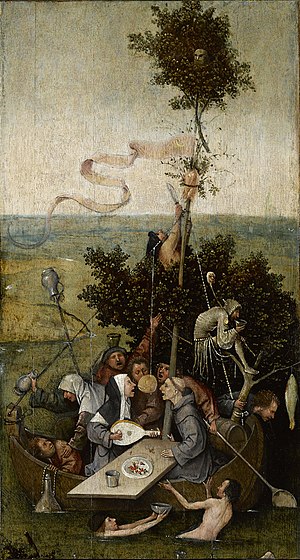
Consider this how this could turn out on many ships or even just one: there is a captain of some size and strength beyond the rest of the men in the ship, but he is deaf and similarly limited at seeing, and he knows as much about sailing as these qualities might imply. So, the sailors are struggling with one another about steering the ship, because each one believes that he should be in charge, even though he has learned nothing of the craft nor can indicate who his teacher was nor when he had the time to learn. Some of them are even saying that it is not teachable, and that they are ready to cut down the man who says it can be taught.
They are always hanging all over the captain asking him and making a big deal of the fact that he should entrust the rudder to them. There are times when some of them do not persuade him, and some of them kill others or kick them off the ship, and once they have overcome the noble captain through a mandrake, or drugs, or something else and run the ship, using up its contents drinking, and partying, and sailing just as such sort of men might. In addition to this, they praise as a fit sailor, and call a captain and knowledgeable at shipcraft the man who is cunning at convincing or forcing the captain that they should be in charge. And they rebuke as useless anyone who is not like this.
Such men are unaware what a true helmsman is like, that he must be concerned about the time of year, the seasons, the sky, the stars, the wind and everything that is appropriate to the art, if he is going to be a leader of a ship in reality, how he might steer the ship even if some desire it or not, when they believe that it is not possible to obtain art or practice about how to do this, something like an art of ship-steering. When these types of conflicts are occurring on a ship, don’t you think the one who is a true helmsman would be called a star-gazer, a blabber, or useless to them by the sailors in the ships organized in this way?
“He put a large meat block on a burning fire
And placed on top of it the back of a sheep and a fat goat
And a slab of succulent hog, rich with fat.
As Automedon held them, Achilles cut.
Then he sliced them well into pieces and put them on spits
While the son of Menoitios, a godlike man, built up the fire.
But when the fire had burned up and the flame was receding,
He spread out the coal and stretched the spits over it.
Once he put the meat on the fire he seasoned it with holy salt.
When he cooked the meat and distributed it on platters,
Patroclus retrieved bread and placed it on a table
In beautiful baskets. Then Achilles gave out the meat.”
“Blessed child of Laertes, much-devising Odysseus, You really secured a wife with magnificent virtue! That’s how good the brains are for blameless Penelope, Ikarios’ daughter, how well she remembered Odysseus, Her wedded husband. The fame of her virtue will never perish, And the gods will craft a pleasing song Of mindful Penelope for mortals over the earth. This is not the way for Tyndareos’ daughter. She devised wicked deeds and since she killed Her wedded husband, a hateful song Will be hers among men, she will attract harsh rumor To the race of women, even for those who are good.”
“Then Eurynomê the bed-maid led them As they went to bed, holding a torch in her hands. She left again once she led them into the bed chamber; Then they happily entered the rite of the ancient bed.”
Comments from the Scholia:
ἀσπάσιοι λέκτροιο] “They happily and enthusiastically remembered the ancient practice of intercourse”
Aristophanes and Aristarchus believed that this was the end (peras) of the Odyssey
Aristophanes and Aristarchus claim this as the end (telos) of the Odyssey
In the last hour of our Odyssey ‘Round the World, we bring you a dramatic reading of the epic’s final book. Since the Hellenistic period there have been debates about the 24th book of the Odyssey, since it contains more than a few perplexing moments: a second trip to the underworld, a cruel testing of the elderly Laertes, and the split assembly of the suitors’ families as they contemplate the deaths of their loved ones. To top it all off, the epic ends when Athena declares an eklesis, a forgetting of troubles and the reinstatement of Odysseus as king.
If this sudden dea ex machina is not enough, we know from Teiresias’ prophecy that Odysseus’ story is far from over: he is destined to travel again after the end of this poem. Far from being a good reason to dismiss this book, however, these are challenges to the audience to reconsider the tale they have received and any preconceptions about what it was meant to teach them.
Eustathius, Commentary on the Odyssey, II.308
“We should note that according to the very old accounts, Aristarchus and Aristophanes, the best of the ancient commentators, made this line (23.296) the end of the Odyssey, because they were suspicious of what remained to the end of the book. But these scholars are cutting off many critical things, which they claim to oppose, for example the immediately following rhetorical recapitulation of that has happened and then, in a way, a summary of the whole Odyssey and then, in the next book, the recognition scene between Odysseus and Laertes, and the many marvelous things that happen there.”
“So she spoke, and his longing for mourning swelled within him— He wept holding the wife fit to his heart, a woman who knew careful thoughts.
As when the land appears welcome to men as the swim Whose well-made ship Poseidon has dashed apart on the sea, As it is driven by the wind and a striking wave. Then few men flee from the grey sea to the shore As they swim and the bodies are covered with brine on their skin, They happily climb on the shore, escaping evil.
So welcome a sight was her husband to her as she looked upon him And she would not pull her white arms away from his neck.”
Carlos Bellato Danai Epithymiadi Tabatha Gayle Bettina Joy de Guzman Evelyn Miller Rhys Rusbatch Nektarios Theodorou Sara Valentine Argyris Xafis
Special Guests: Leonard Muellner, Gregory Nagy, Sheila Murnaghan, Suzanne Lye
Homer, Odyssey 21.407-409
“Just as a man who knows both lyre and song easily stretches a string on a new peg as he attaches the twisted sheep-gut to both sides just so, without haste, Odysseus strung the great bow”
Artistic Director: Paul O’Mahony (Out of Chaos Theatre) Director of Outreach: Amy Pistone (Gonzaga University) Dramaturg: Emma Pauly Executive Producer: Lanah Koelle (Center for Hellenic Studies); help from Madeleine Cahn
Producers: Keith DeStone (Center for Hellenic Studies), Hélène Emeriaud, Janet Ozsolak, and Sarah Scott (Kosmos Society) Poster Artist: John Koelle Poster Designer: Allie Marbry (Center for Hellenic Studies)
Odyssey 24.478–486
“Do whatever you want—but I will say what is fitting.
Since Odysseus has paid back the suitors,
let him be king again for good and take sacred others.
Let us force a forgetting of that slaughter of children and relatives.
Let all the people be friendly towards each other
as before. Let there be abundant wealth and peace.”
I will speak to you an obvious sign [sêma] and it will not escape you. Whenever some other traveler meets you and asks Why you have a winnowing fan on your fine shoulder, At that very point drive the well-shaped oar into the ground
We have posted before about Odysseus’ sister Ktimene. She is mentioned by the swineherd Eumaios but never by Odysseus. The scholia connect her to one of Odysseus’ companions. The evidence for this seems to be the fact that Ktimene was sent to Same for marriage (where Eurylochus is from) and a kinship term used for him by Odysseus. Also of interest, according to the scholion, Odysseus may have had more sisters.
Homer, Odyssey 15.364-41
Strong Ktimenê, the youngest of the children she bore.
I was raised with her, and she honored me little less.
But when we both made it to much-praised youth,
They gave her to Samê and received much in return
But she gave me a cloak, tunic and clothing
Dressing me finely and give me sandals for my feet
And sent me to the field. But she loved me more in her heart.
“She bore the youngest of the children”: [this means] of the female children. For his father only had Odysseus [for a son]. There were more sisters of Odysseus.”
“So he spoke, and I was turning over in my thoughts
As I began to draw the sharp-edged sword next to my thick thigh,
Whether I should cut off his head and drive him to the ground
Even though he really was my relative. But our companions
Were restraining me with gentle words from all sides.”
“Pêos: A relative by marriage. In-law. Also, “in-lawness” [Pêosunê], relation-by-marriage. There is also Pêôn [genitive plural], for “of relatives-by-marriage. Homer has: “relatives and friends” [Il. 3.163]
“…There is a difference between in-law and friend. People who have no connection to you by birth are friends. In-laws are related to you through marriage.”
In book 15, Eumaios tells the story of his abduction as a child. Two scholia take issue with how he knows such detail and retained it long enough to tell Odysseus.
Schol. BHQ ad Od. 15.417 ex
“Perhaps the Phoenicians told these things to Laertes because they wanted to argue that [Eumaios] was worth a lot. For it is not possible that an infant would know the truth of how he was abducted.”
Although Odysseus has recently–and frequently–told similarly long and detailed stories, the scholia do not suspect them because they think Odysseus is lying. But Eumaios, who speaks mimetically, vividly and effectively, is doubted for his power of memory.
Homer, Odyssey 15.389–484
Then the swineherd, marshal of men, responded:
“Friend, since you have asked me and inquired truly of these things,
Listen now in silence and take some pleasure and drink your wine
While you sit there. These nights are endless. There is time for sleep And there is time to take pleasure in listening. It is not at all necessary For you to sleep before it is time. Even a lot of sleep can be a burden.
Let whoever of the rest the heart and spirit moves
Go out and sleep. For as soon as the down shows itself
Let him eat and follow the master’s swine.
As we two drink and dine in this shelter Let us take pleasure as we recall one another’s terrible pains. For a man finds pleasure even in pains later on After he has suffered so very many and survived many too.
I will tell you this because you asked me and inquired.
There is an island called Suriê, if you have heard of it,
Above Ortygia, where the rays of the sun rise.
It is not too filled, but it is a good place
Well stocked with cows, sheep, with much wine and grain too.
Poverty never curses the people there, nor does any other
Hateful sickness fall upon the wretched mortals,
But when the race of humans grow old in the city
Apollo silverbow comes with Artemis
And kills them with his gentle arrows.
There are two cities there and everything is divided between them.
My father used to rule both of them as king
Ktêsios the son of Ormenos, a man equal to the immortal gods.
The ship-famous Phaeacians used to to frequent there
Pirates, bringing countless treasures in their black ships.
There was a Phoenician woman in my father’s house
Beautiful and broad and skilled in wondrous works.
The devious Phoenicians were corrupting her.
First, one of them joined her for sex while she was washing clothes
Near the swift ship—these things mix up the thoughts
For the female sex even when one of them is work-focused.
He then asked her who she was and where she was from
And she immediately told him about the high-roofed home of my father.
“I claim to be from Sidon of much-bronze,
And I am the daughter of Arubas, a wealthy man.
Taphian pirates kidnapped me one day
As I was returned from the country, and they forced me to come here
To the house of this man. And he paid a great price.”
The man who had sex with her in secret responded,
“Would you want to go back home again now with us
So that you might see the high-roofed home of you father and mother
And them too? For they are still there and are reputedly wealthy.”
And the woman then answered him in turn,
“I wish that this would happen, if you would be willing, sailors,
To swear an oath to take me home unharmed.”
So she said, and all of them swore an oath as she requested.
And once they swore and completed the oath,
The woman spoke among them again and answered with a plan.
“Be quiet now. Don’t let anyone address me with words
Should any one of your companions happen to meet me
In the street or near the stream so that no one might go to the house
And speak to the old man who might suspect something and bind me
In strong bonds. But plan for this destruction yourselves.
Keep this plan in your thoughts and earn the pay for your travels.
But whenever the ship is indeed full of its material,
Let a message come to me swiftly in the house.
And I will bring gold, as much as is ready-to-hand,
And I will add another passage-fee which I may wish to give.
For I care for the child of this nobleman in his home.
This child is clever indeed, and he is always following me outside.
I would bring him to the ship because he will earn for you
A great price when you take him to some foreign people.”
So she spoke and then left to the beautiful home.
They remained there among us for the rest of the year
As they sold the martial in their cavernous ship.
But when the hollow ship was packed up to leave,
They sent a messenger who informed the woman.
A very clever man came to the house of my father
Bringing a golden necklace worked out with amber bits.
The slave-women in the hall and my mistress mother went
To touch the necklace with their hands and see it with their eyes
As they discussed the price. He nodded to her in silence.
And once he nodded he returned to the hollow ship.
And she took my hand and led me from the house outside.
In the front part of the house she found cups and platters
From the men who dine there and attend my father.
They went to the council place and the opinion of the people,
So she quickly hind three tankards under her bosom
And left. And I followed without a care in my mind.
The sun set and all the roads were in shadows.
We went to the famous harbor in a hurry,
And there was the salt-swift ship of the Phoenician men.
They disembarked then and went sailing over the watery ways,
After they put the two of us on board. And Zeus sent a favorable wind.
We were sailing for six nights and days.
But when Kronos’ son Zeus brought the seventh day
Artemis the archer killed that woman
And she thudded into the cargo hold like a diving sea gull.
And they threw her out to be food for the seals and fish.
But I remained still, filled with pain in my heart.
The wind and the water carried them to Ithaca
Where Laertes purchased me among his possessions.
Thus I saw this land here with my own eyes.”
“Let us take pleasure in one another’s pains”—for a person among afflictions delights in terrible narratives and in hearing another person tell his own troubles.”
Erik has a beautiful post about the Cyclops Polyphemos. The scholia present some debates about what exactly a Cyclops looks like.
Schol. ad Od. 9.106
“Aristotle examines how the Cyclops Polyphemos came to be a cyclops when neither his father nor his mother was a cyclops. He resolved the issue with a different myth. For, he asserted, horses came from Boreas but Pegasos was born from Poseidon and Medousa. Why, then, would it be strange that this wild beast be born from Poseidon? Similarly, other wild beasts were born from him in the sea, as well as marvels and unusual things.
Hesiod laughably etymologizes [the Kyklopes], saying “They were given the nickname Kyklopes / because they have one single circle eye in the middle of their forehead.” But Homer clearly describes their nature.
For, if it was of that sort, just as he described the other particular features of the Cyclops, like his size, his cruelty, he would have also described his eye! Philoxenos says that he diverged from Hesiod in that the fact he could not see because he was blinded in one eye. For Homer does not say this about all the other Cyclopes. It is likely that Polyphemos lost his other eye for some other reason before Odysseus’ arrival.
Others oppose this, claiming that if he had two eyes and Odysseus blinded one, how would he say what is attributed to him, “Cyclops, if any mortal man asks you who is the blinder of your eye…” He does not say eyes. And in return the Cyclops says “My father is able to heal my eye.” For if he had another eye, properly, and Odysseus were speaking to him in this way, how would he not have taken care of the other eye? But he said “the earth-shaker will not heal [my] eye.” For this very reason people argue about his eye being completely pierced, because of what is said here, if he did not take care of the eye when it was first compromised, he would never be able to heal it.”
From the MFA in Boston, taken artfully on my phone.
These are, of course, the types of investigations for which Seneca would have the most disdain:
Seneca, De Brevitate Vitae 13
“It would be annoying to list all the people who spent their lives pursuing board games, ball games, or sunbathing. Men whose pleasures are so busy are not at leisure. For example, no one will be surprised that those occupied by useless literary studies work strenuously—and there is great band of these in Rome now too. This sickness used to just afflict the Greeks, to discover the number of oars Odysseus possessed, whether the Iliad was written before the Odyssey, whether the poems belong to the same author, and other matters like this which, if you keep them to yourself, cannot please your private mind; but if you publish them, you seem less learned than annoying.”
Persequi singulos longum est, quorum aut latrunculi aut pila aut excoquendi in sole corporis cura consumpsere vitam. Non sunt otiosi, quorum voluptates multum negotii habent. Nam de illis nemo dubitabit, quin operose nihil agant, qui litterarum inutilium studiis detinentur, quae iam apud Romanos quoque magna manus est. Graecorum iste morbus fuit quaerere, quem numerum Ulixes remigum habuisset, prior scripta esset Ilias an Odyssia, praeterea an eiusdem essent auctoris, alia deinceps huius notae, quae sive contineas, nihil tacitam conscientiam iuvant sive proferas, non doctior videaris sed molestior.
Mocking the quibbles of scholars is where the pejorative use of the term ‘academic’ comes. This is an ancient tradition!
Athenaeus, Deipnosophistae 1.22
“You know that somewhere Timo the Philasian calls the Museum a birdcage as he mocks the scholars who are supported there because they were fed like the priciest birds in a big cage:
Many are fed in many-peopled Egypt,
The paper-pushers closed up waging endless war
in the bird-cage of the Muses.
In a post, Palaiophron talks about seeing me lecture and kindly does not make it clear that when a student first asked me for the etymology of Nausikaa, I was flabbergasted and admitted it. The context was a discussion of the names Nausithoos (“swift-in-ships”) and Nausinoos (“ship-minded”) in the Homeric and Hesiodic traditions. Why wouldn’t I think that the offering of two etymologies might prompt an audience member to wonder about a third, when I mentioned the name as a parallel?
The embarrassing truth is that for some unknown reason I had never really thought about the meaning of the name Nausikaa. So, on the spot, I suggested Ναυσι+ καίω for something like “ship-burner”. Palaiophron rightly reacted that this would be preposterous for the narrative of the Odyssey and eventually dug up the records of the ancients who tied the name to either a form of καίνυμι (to excel, or surpass) or from κοσμέω (to arrange, adorn).
So, he cites Pseudo-Zonaras, in his Lexicon, writes: “Nausikaa. Excelling in ships.” (Ναυσικάα. ταῖς ναυσὶ κεκασμένη) confirmed by Etymologicum Magnum which adds Nausikaa: “Excelling (that is, honored [or, an ornament to?]). Ναυσικάα: Κεκασμένη (ὅ ἐστι κεκοσμημένη). Kallierges repeats this (598.28): Ναυσικάα: Κεκασμένη (ὅ ἐστι κεκοσμημένη) ταῖς ναυσί.